When in Doubt Add Twenty More Colours! Kaffe Fassett at The American Museum in Bath


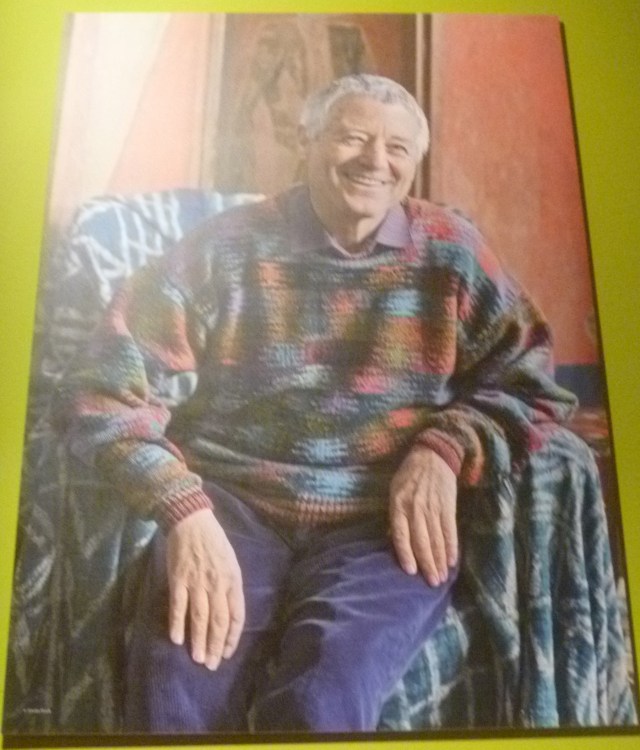
Kaffe himself

Last year I read ‘Dreaming in Colour : an autobiography’ by Kaffe Fassett. I’d always been aware of his knitting books and collaboration with Rowan Yarns of Holmfirth and vaguely knew that he had created some veggie designs for cushions for Ehrman but had been unaware of the person behind these enterprises and the prolific output and inspiration of the man. The Amazon Book Description sums it all up :

Kaffe Fassett has led an extraordinary life and is a captivating storyteller with a vivid memory. Born in 1937 in San Francisco, he spent much of his youth in Big Sur, where his parents bought a log cabin from Orson Welles and transformed it into the world-famous Nepenthe restaurant, a gathering place of artists of all sorts. After attending a boarding school run by the disciples of Krishunamurti, an Indian guru, he studied painting on scholarship at the School of the Museum of Fine Arts in Boston, but left after less than one year and travelled to England, where he ultimately made his home. After struggling to make a living as a fine artist for several years, Fassett met the fashion designer Bill Gibb and began designing knitwear for his collection. He went on to design knitwear for Missoni and for private clients and to revolutionise the hand knitting world with his explosive use of color. Further explorations led him to needlepoint, mosaics, rug-making, yarn and fabric design, set design and quilting. Now in his 70s, Fassett continues to produce new work in his studio in London and to travel worldwide to teach and lecture. This intimate autobiography is lavishly filled with Fassett’s amazing stories about his bohemian childhood, his hard-earned rise to fame, and all of his creative pursuits. It includes photos of him throughout his life, his home (which is an artwork in itself), his work (everything from childhood drawings to pencil sketches, to oil paintings, to massive tapestries and set designs, to hand knits and quilts) as well as the people and places around the world that have inspired him.”
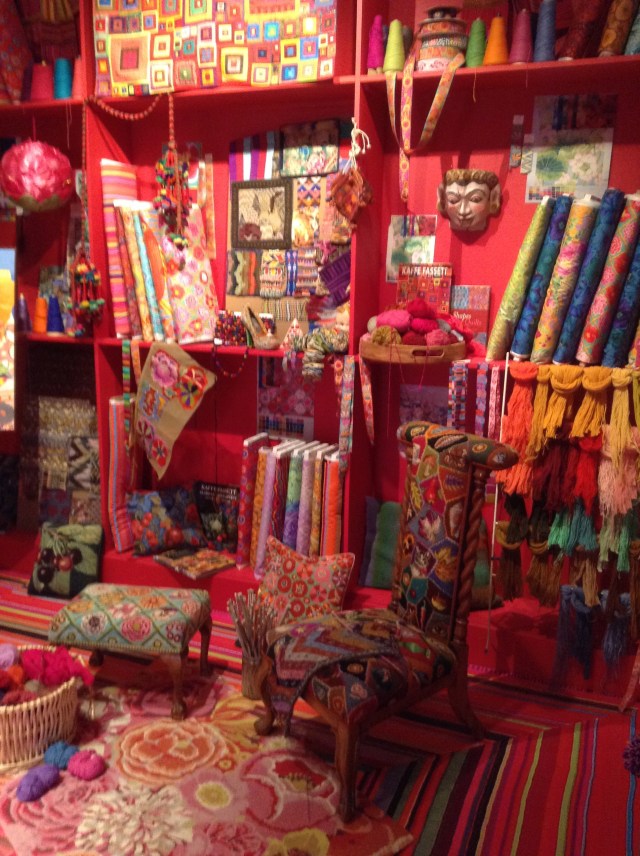
Opening display

The Display that hits you as you enter the show!

So, inspired by this book and the riot of colour in Kaffe’s designs when I decided to drive down to Cornwall I thought it would be a good opportunity to see his work for myself. It’s currently on display at The American Museum in Bath until 2nd November 2014.
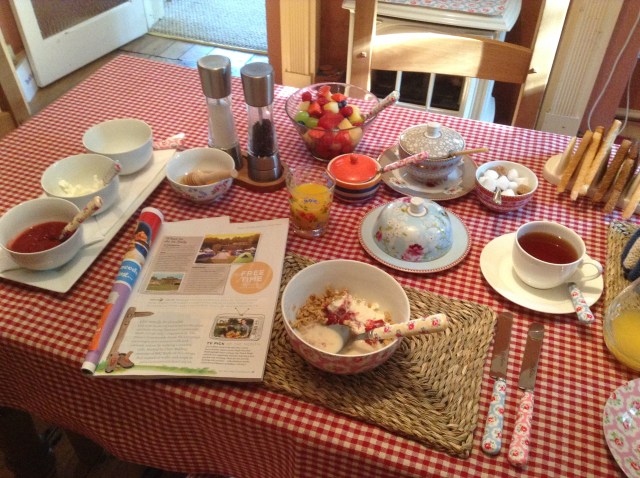
Colourful breakfast

My Colourful Breakfast Table (I’m reading about Port Eliot in Waitrose Kitchen magazine)

It was a day of colour, really, which began with a lovely breakfast : a combination of fruits and Cath Kidston tableware, moved on to meeting a friend at the Galleries Cafe at Freshford with its colourful herb garden and culminated with the exhibition and gardens at The American Museum.
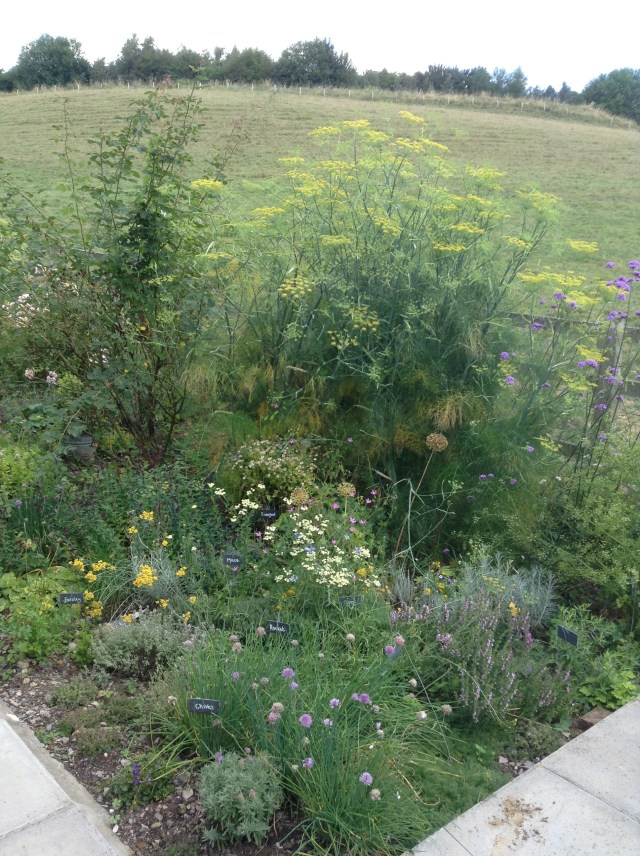
Herbs

Herbs at The Galleries – A Magnet for Butterflies
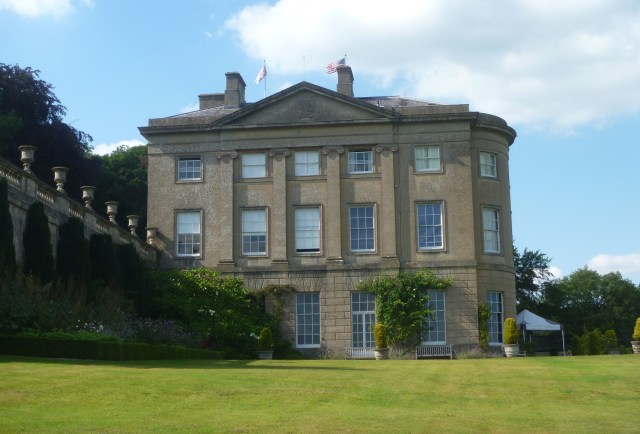
Museum, Bath

The American Museum at Bath

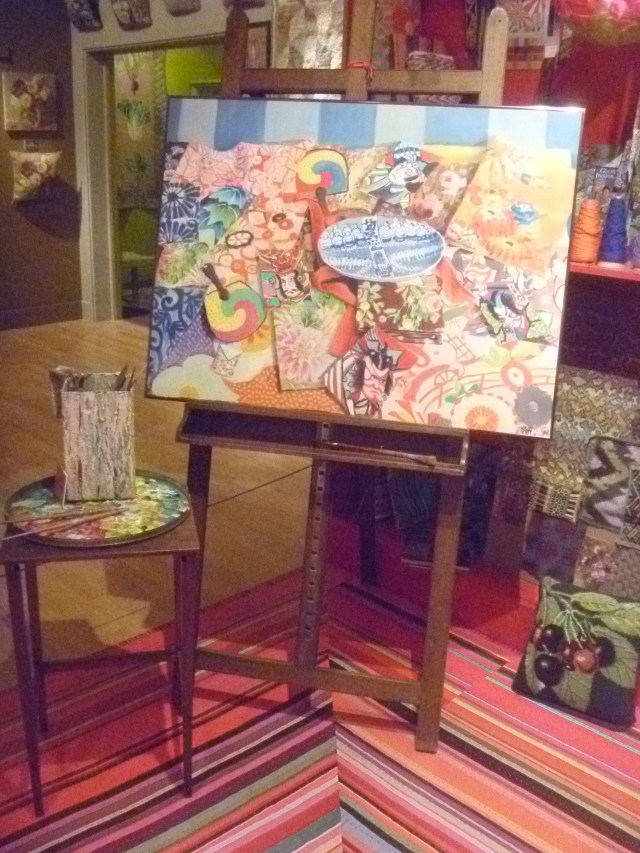
artist reminder

A Reminder that Kaffe was initially an artist
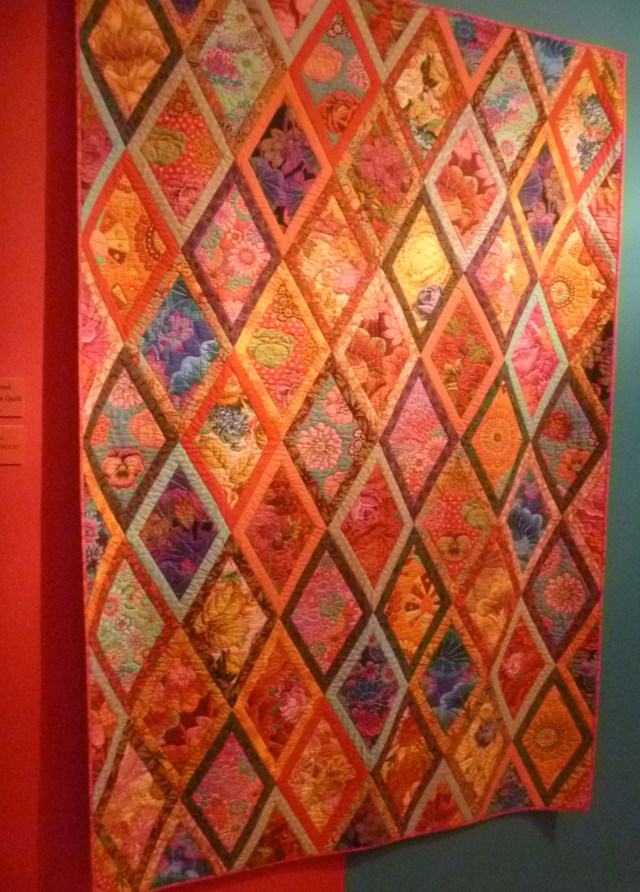
Red quilt

Red Quilt

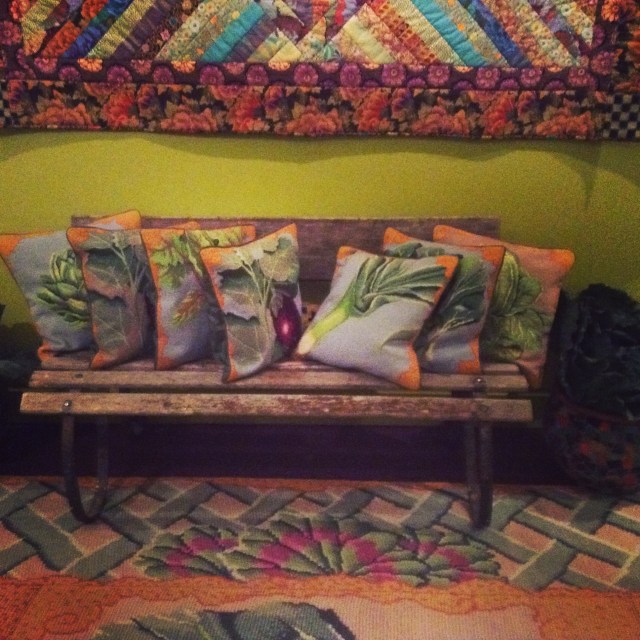
VEGGIE THAME

Veggie Theme Garden Bench

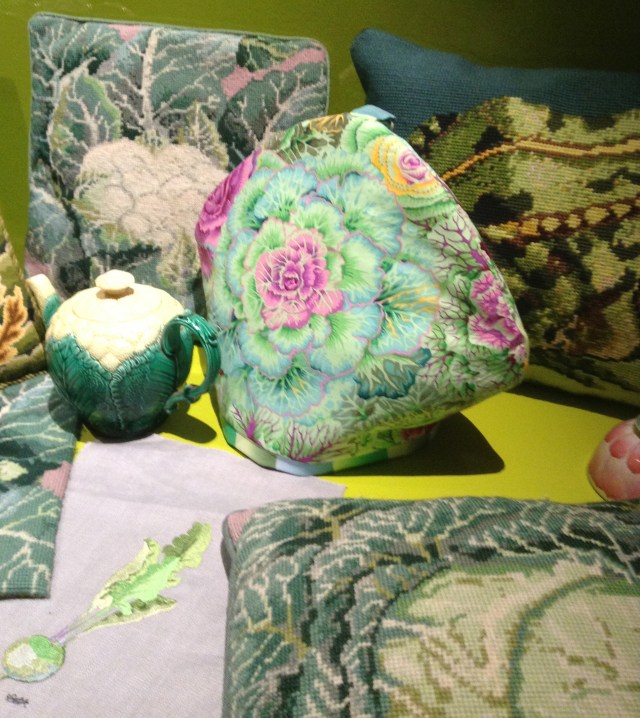
Teapot and cosy

Teapot and Cosy

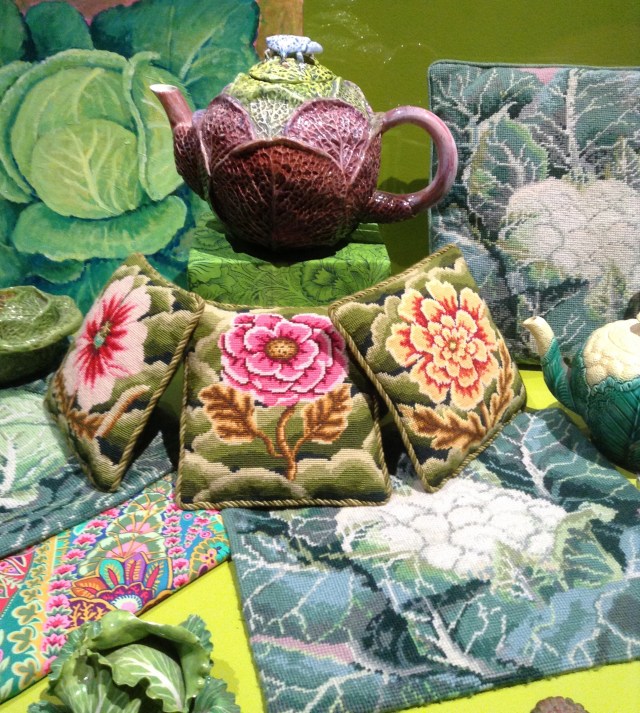
On a garden theme

Tea and Gardens Theme

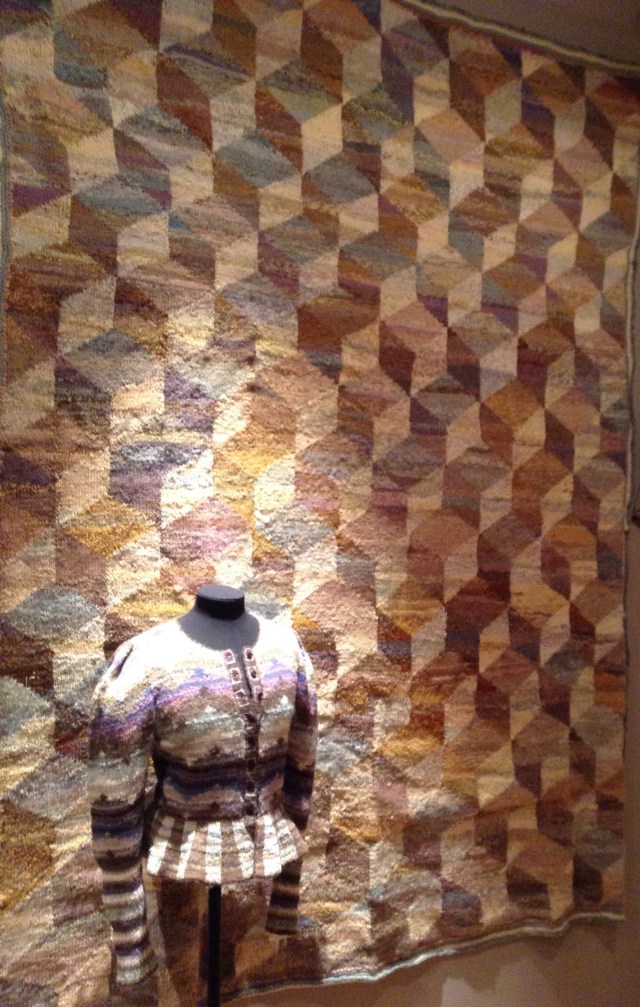
Knitted blocks

Muted Knitted Blocks Hanging and Cardy
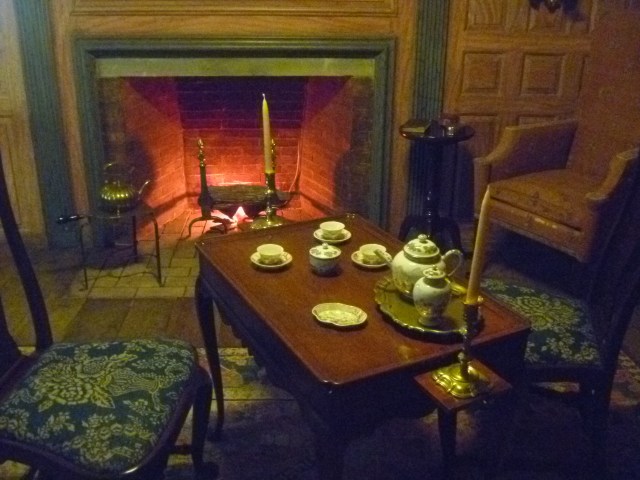
Tea at American Mus

Period Room Setting with 1750s Tea Table – Connecticut or Massachusetts
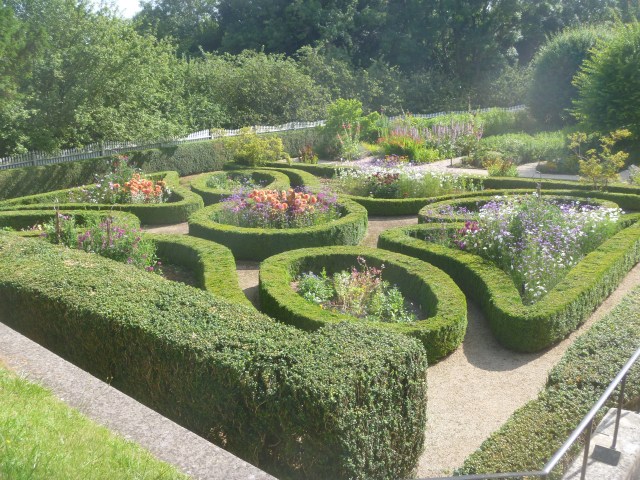
G Washington garden

George Washington Mount Vernon Garden

K Fassett hare

Remember the Kaffe Fassett Hare from Yesterday?
 

Mad March Hares in Cirencester in July

After moving at what seemed like snails pace on the M1 this morning I was glad to slip onto the Fosse Way and make my way to Cirencester a lovely mellow stone Cotswold town with Roman (and even pre-Roman) origins. My goal was to visit the Corinium Museum to see the  mosaics and other treasures of the town. With my Art Pass I gained free admission.

Corinium sign

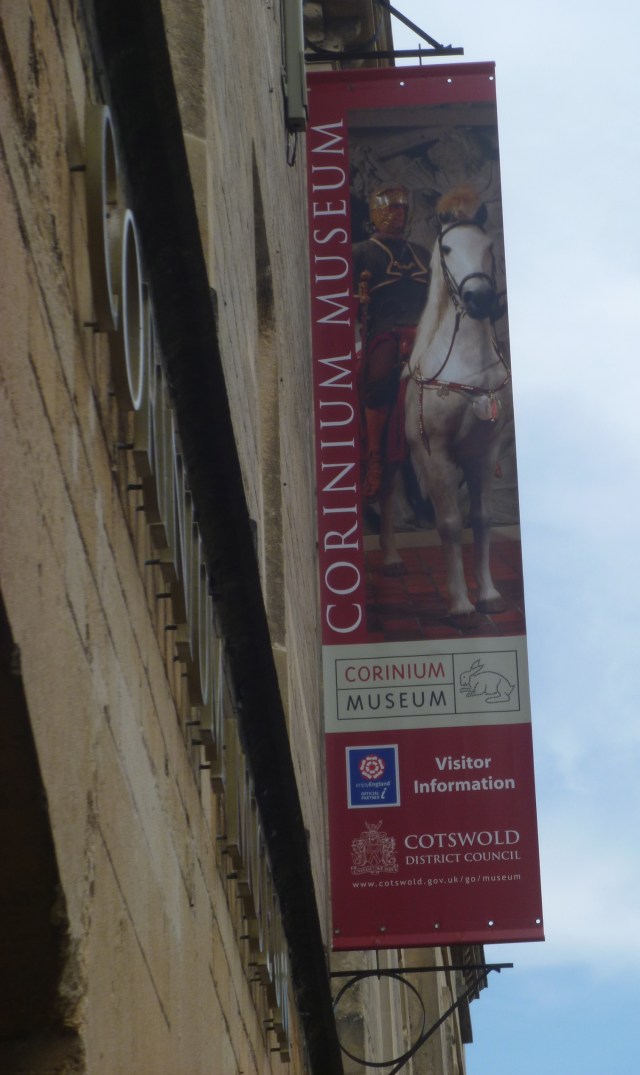
The Corinium Museum

Museum entrance

Museum Entrance

Abberley House and Corinium Museum was built by John Cripps as a town house in c.1765. It was purchased in 1936 by the local Bathurst and Cripps families and given to Cirencester Urban District Council to house the Museum.

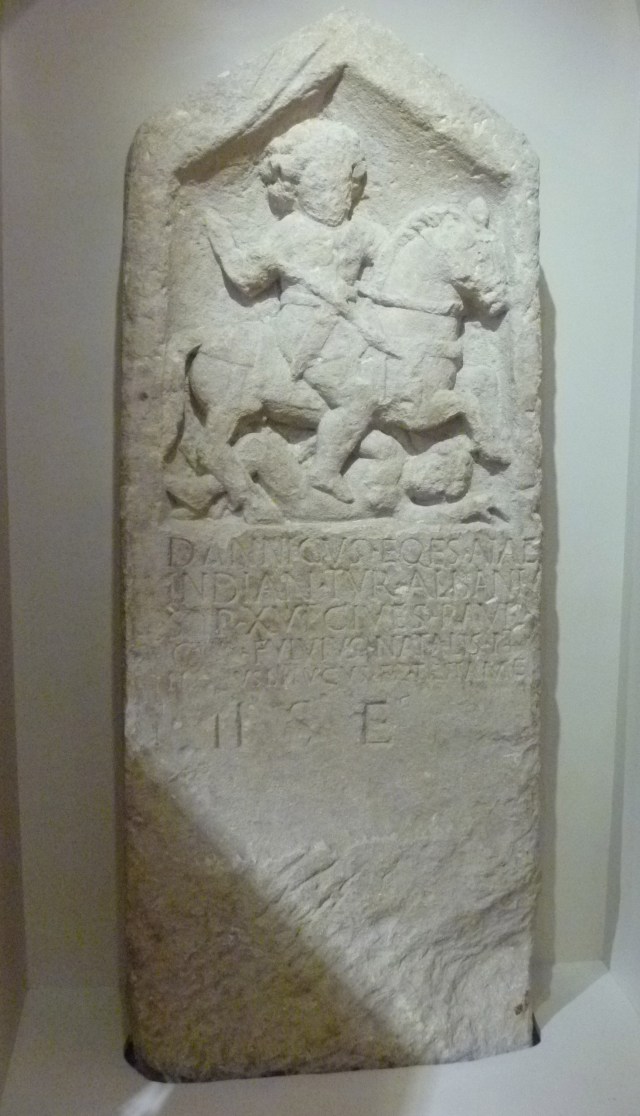
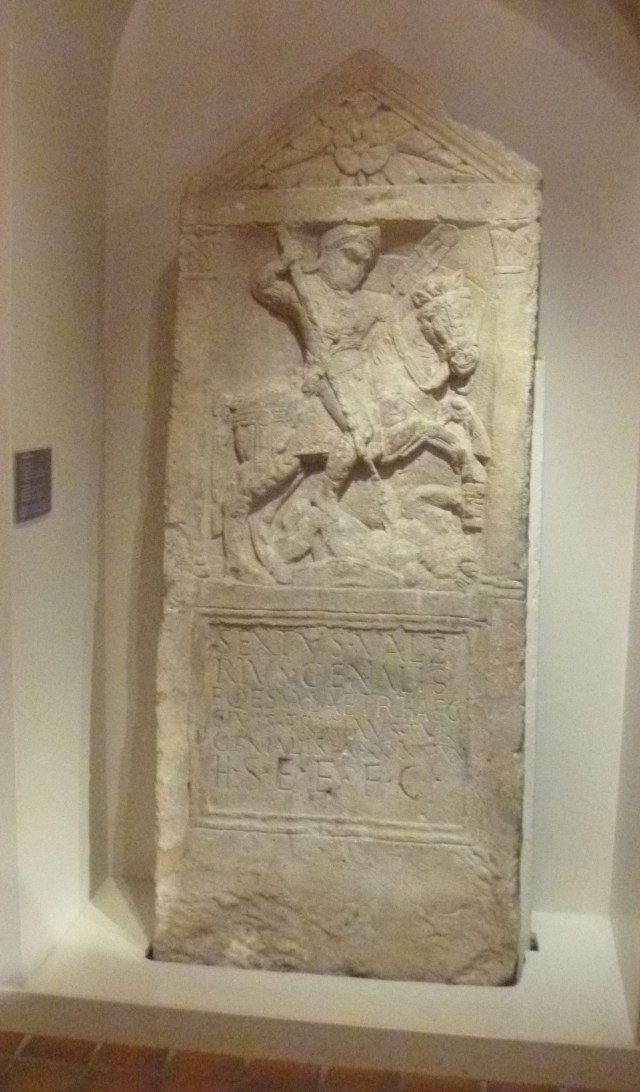
Including the mosaics Corinium Museum lists Ten Treasures as you go round the displays. Two Roman Tombstones were discovered. Soldiers of the Roman Army who died in service were awarded full military honours but they had had to pay a small sum out of the pay packet towards this. Families who wished to have a more elaborate memorial to their sons could pay the extra. The tombstones found near Cirencester were two such memorials.

Tombstone of Dannicus

Tombstone of Dannicus found in Watermoor, Cirencester in 1835

Tombstone of Genialis

Tombstone of Genialis dates to 60AD and also found at Watermoor

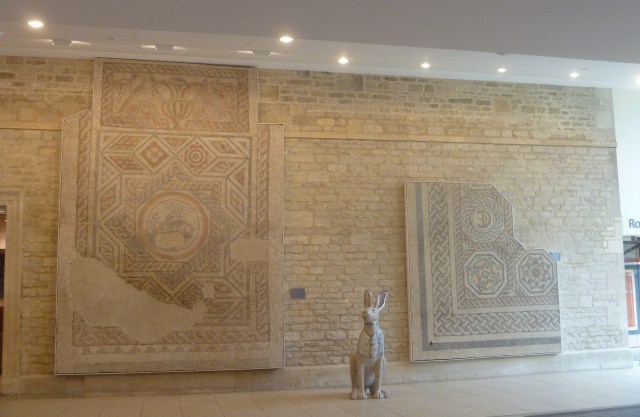
The Museum is famed for its mosaics. Chief among these are four fine (though damaged) mosaic floors, each with striking picture panels set within patterned borders.” 

Mosaics 1

Mosaics (and Hare) in the Museum Foyer – a taste of what’s to come!

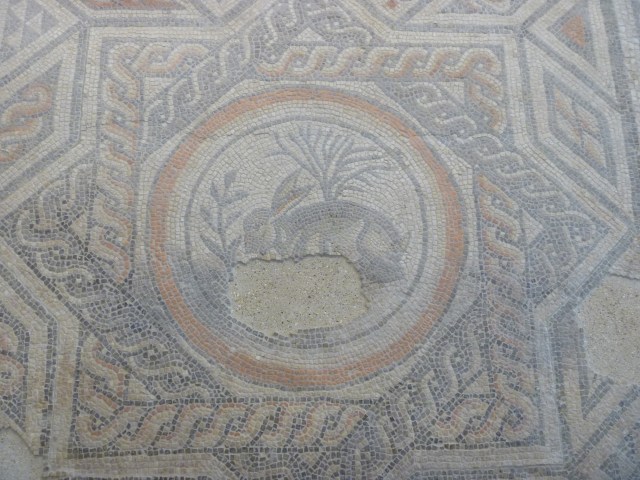
Hare mosaic

Hare Mosaic

This virtually complete mosaic was found in a Roman town house at The Beeches, Cirencester. It dates to the 4th century AD. The hare motif is unique as a centrepiece in Britain.

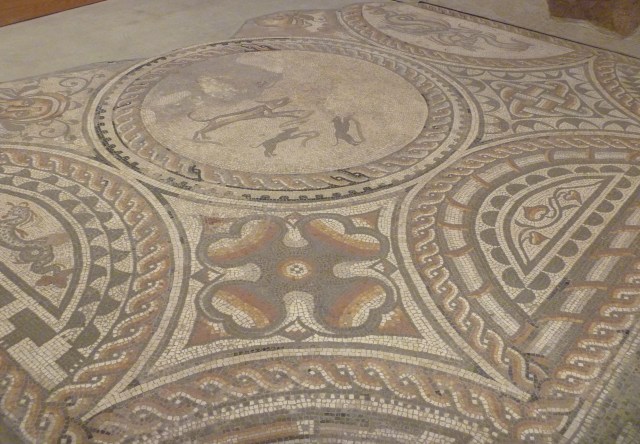
Hunting dogs mosaic

Hunting Dogs Mosaic Pavement found in Dyer Street in 1849

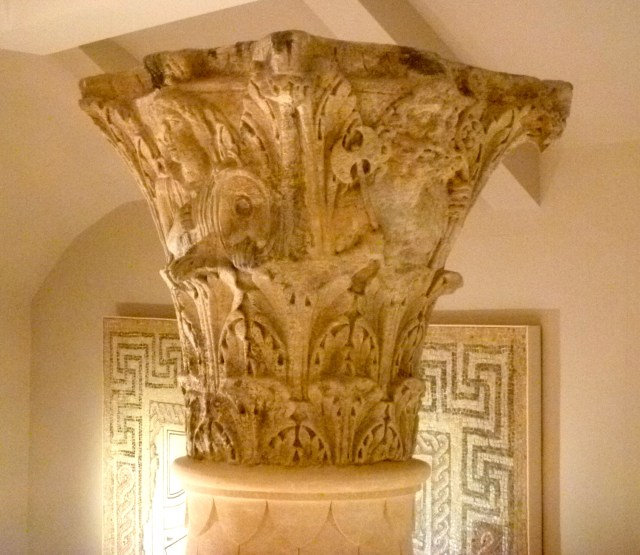
column

The Jupiter Column

The Jupiter Column has an original carving of the Greek god Bacchus and his drunken companions. The rest of the column has been reconstructed, and gives a hint of the size and grandeur of Roman public building even in this distant part of the Empire.

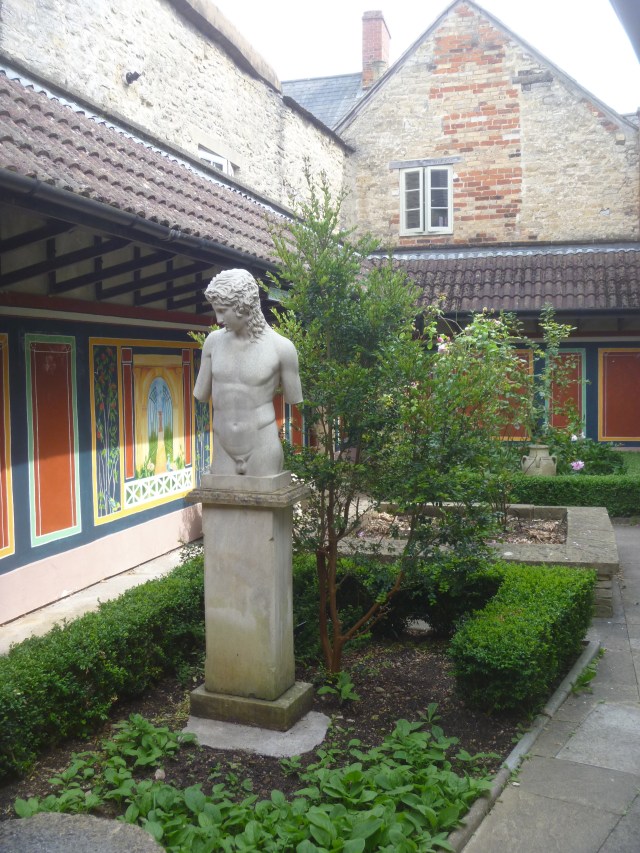
Roman garden

The Roman Garden

This small patch of garden has been planted out as might have been by Romans. The Museum is currently advertising for a volunteer to help keep the garden in shape.

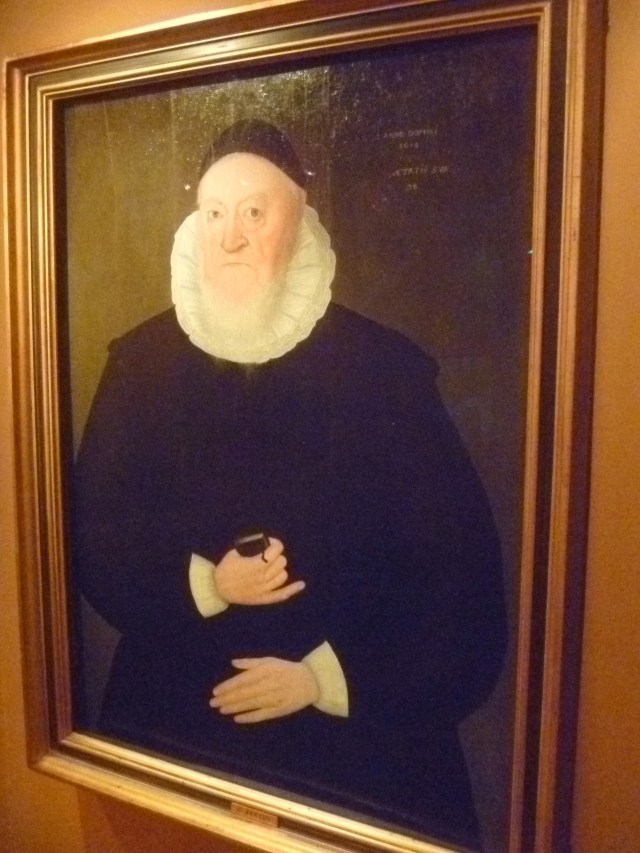
John Coxwell

John Coxwell (1516 – 1618)

Finally, in the Museum, as we moved away from the Romans we arrived at the last room where the displays are concerning the growth of Cirencester as a very significant wool town. John Coxwell played a big part in the history of wool on the town.

The Museum describes his painting :

An old man looks directly at us. Now aged nearly 100, he is dressed in costly black and carries what appears to be a prayer book. During his life, wool had made him rich; and the wool trade had brought the wealth to build churches and grand houses throughout the Cotswolds.”

When I left the Museum I realised that I still had enough time to visit the Parish Church of St John the Baptist to see The Boleyn Cup.

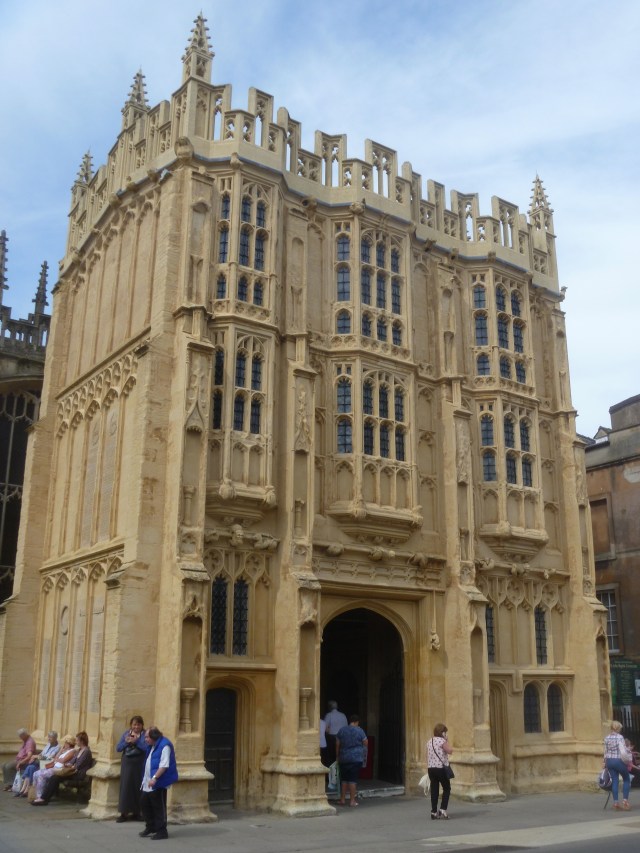
Parish church

The Parish Church Tower

Cirencester parish church is one of the biggest parish churches in the country. It is an historic Wool Church and is sometimes confused with the former Cirencester Abbey which was situated nearby. The tower was erected in 1400 with funds taken from the rebellious Earls of Kent and Salisbury arrested by the townspeople and executed in the market place. Built on the site of an old Roman ditch it needed the support of flying buttresses. [From the church leaflet]

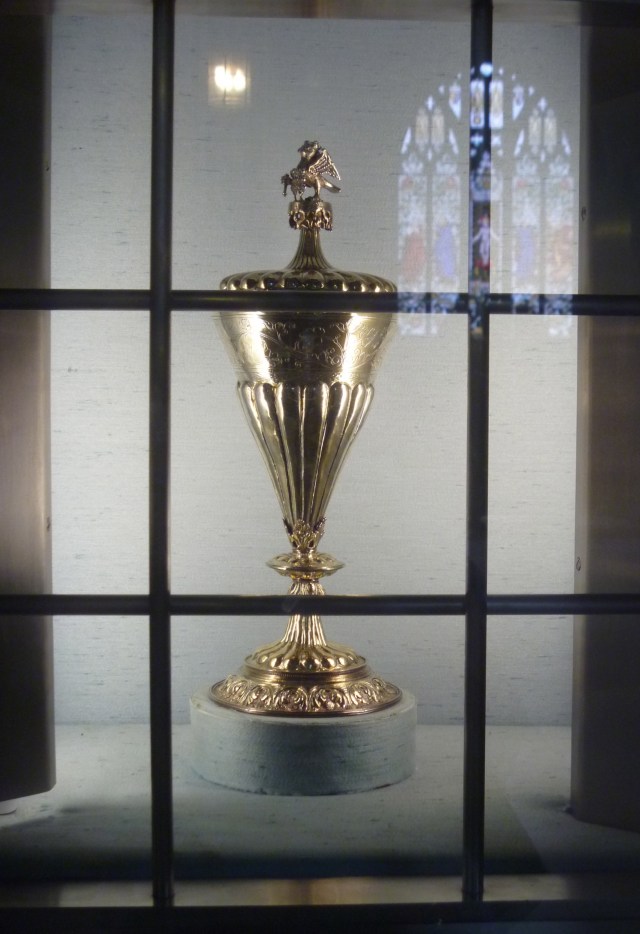
Boleyn cup

The Boleyn Cup

The Boleyn Cup was made in 1535 for Anne Boleyn and given first to her daughter Elizabeth, then by the Queen to her physician, Richard Master, who lived nearby,  and finally, by him to the church.

Church gate

The Fan-Vaulted South Porch has rooms above. It was built in 1500 for the Abbey but after the Reformation it served as the Town Hall.

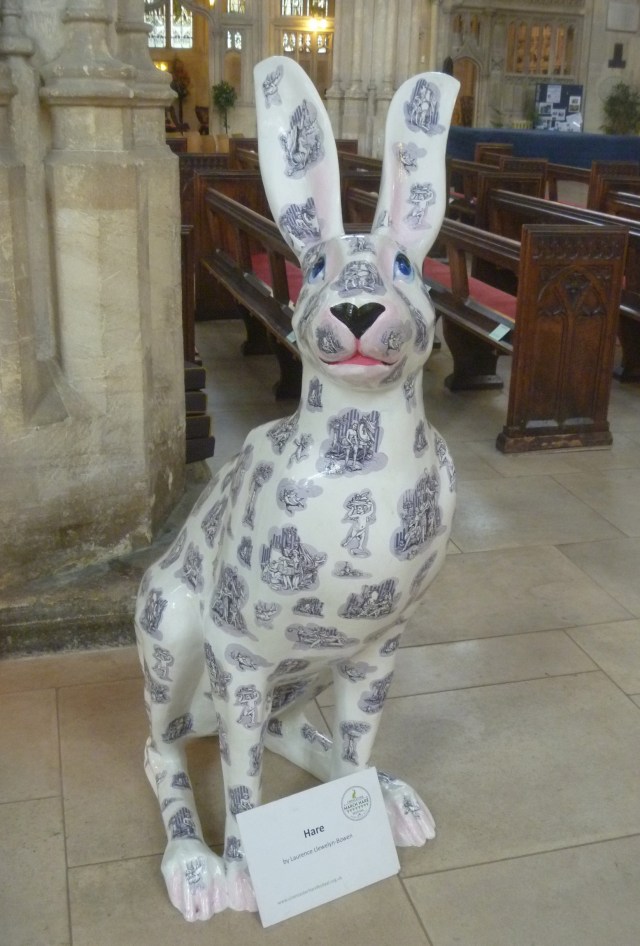
The significance of the March Hare Festival only dawned on me when I looked closely at the Hare in the church and noticed that it had been designed by Lawrence Llewelyn Bowen (of TV fame).

LLB hare

The LLB Hare

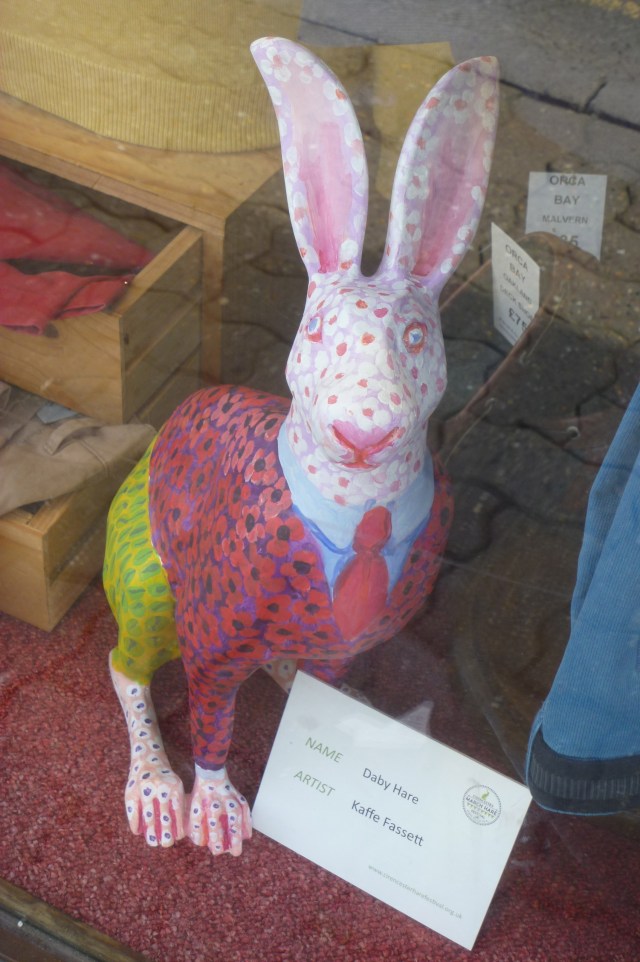
I then saw this hare by Kaffe Fassett in the window of a men’s outfitters shop.

K Fassett hare

The KF Hare

Sweet Pea Week at Easton Walled Garden, Lincolnshire

‘A Dream of Nirvana – Almost too good to be true’ – President Roosevelt on a visit to Easton, summer 1902

Easton Garden 1

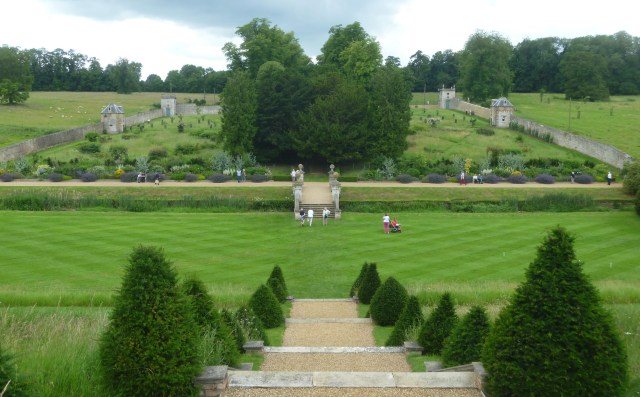
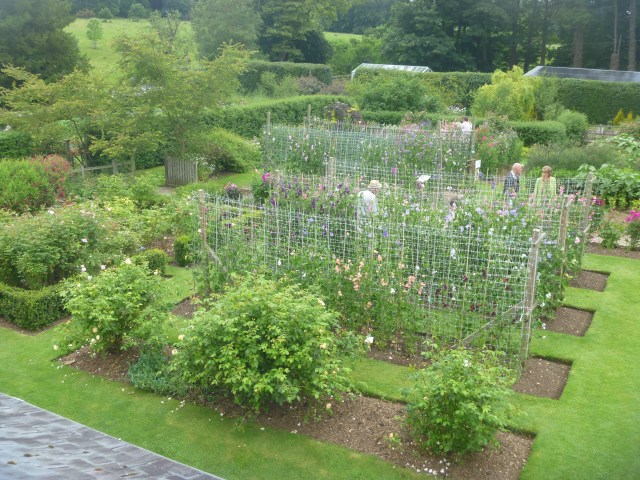
Easton Walled Garden

It’s a long old drive from Felixstowe in Suffolk up to Leeds. I was in no hurry to leave the comfortable and welcoming rectory in Alderton and join the busy A14 west and then the A1 north. The weather had taken a distinct turn for the better so I checked my list of possible stops en route and decided on Easton Walled Garden in Lincolnshire just a minute or two from the A1. By then I’d have more than half of the journey behind me. According to the website the gardens are open Wednesdays to Fridays and Sundays throughout the season. Dash it! I was travelling on a Monday. But wait. What’s this? The gardens had some additional opening days – daily for a week in February for the snowdrops and daily for a week 30 June to 6 July (this year) for Sweet Peas! My luck was in.
The gardens are at least 400 years old. They cover 12 acres of a beautiful valley just off the A1. Home to the Cholmeley family for 14 generations, the gardens were abandoned in 1951 when Easton Hall was pulled down. The revival of these gardens has been ongoing since late 2001.

Easton Hall 19C

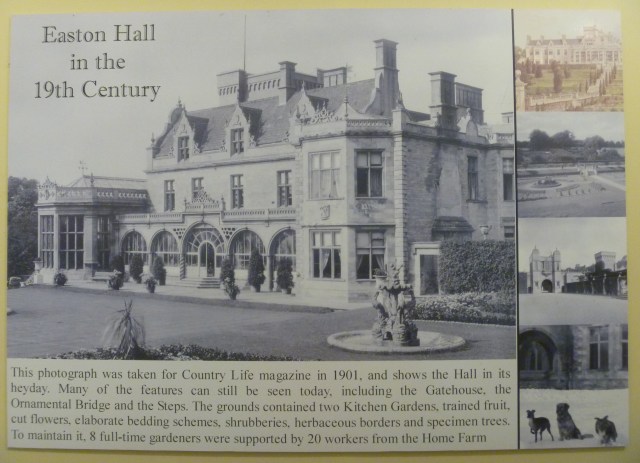
Easton Hall in the 19th century

There had been a house on this site since at least 1592 when Sir Henry Cholmeley (1562-1620) came to live in Lincolnshire on the death of his Uncle, Robert Cholmeley, in 1590 … Sir Henry built his house on a site overlooking the River Witham and this is believed to have survived until the beginning of the 19th Century …In 1805 the house was altered and enlarged by Sir Montague Cholmeley, first baronet (1772-1831). … In 1872 [the hall was described] as ‘large and handsome, with large and elegantly furnished apartments, containing many valuable paintings and other works of art’. … [The Hall] was requisitioned at the start of the Second World War. It became home to units of the Royal Artillery and and of the 2nd Battalion, The Parachute Regiment (of Arnhem fame) for four years, in which time it suffered considerable damage both to the fabric of the building and to the remaining contents. In 1951 the Hall was demolished. … The family still own the estate and have been the driving force behind the gardens revival.” [From the website]

gatehouse

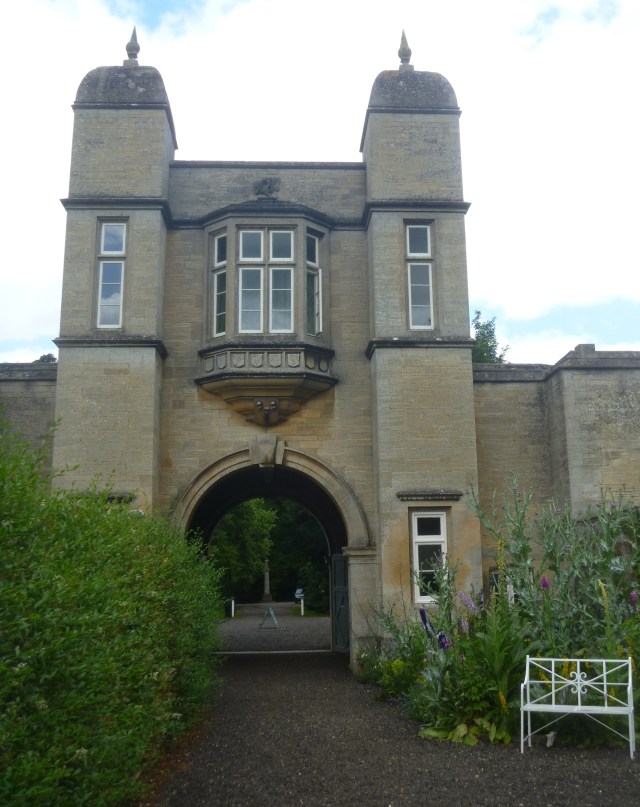
The Gatehouse

remaining buildings

The remaining buildings from the orchard site now a wildflower meadow


Canalised R Witham

River Witham canalised by the Elizabethans …

ornamental bridge

… shored up and bridged by the Victorians

Easton Garden

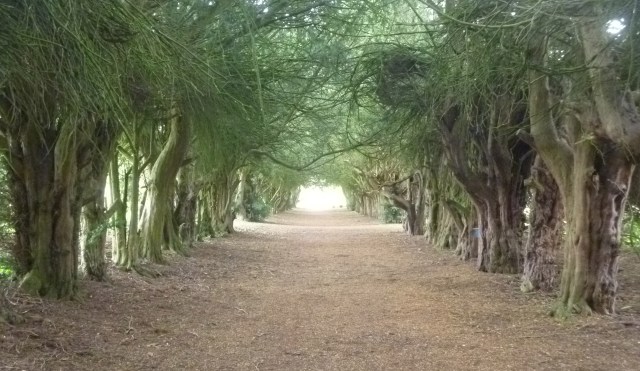
Easton Garden. In the middle is the Yew Tunnel.

Yew Tunnel

The Yew Tunnel

Birds from hide

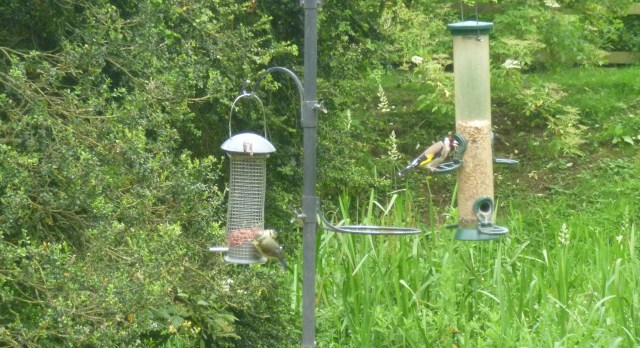
Bird Feeders from the Viewing Area

Having stretched my legs and inspected the extensive gardens I returned to the cottage garden, the pickery and the history and information rooms to look at the sweet peas and learn more about them and Easton Hall and Gardens.

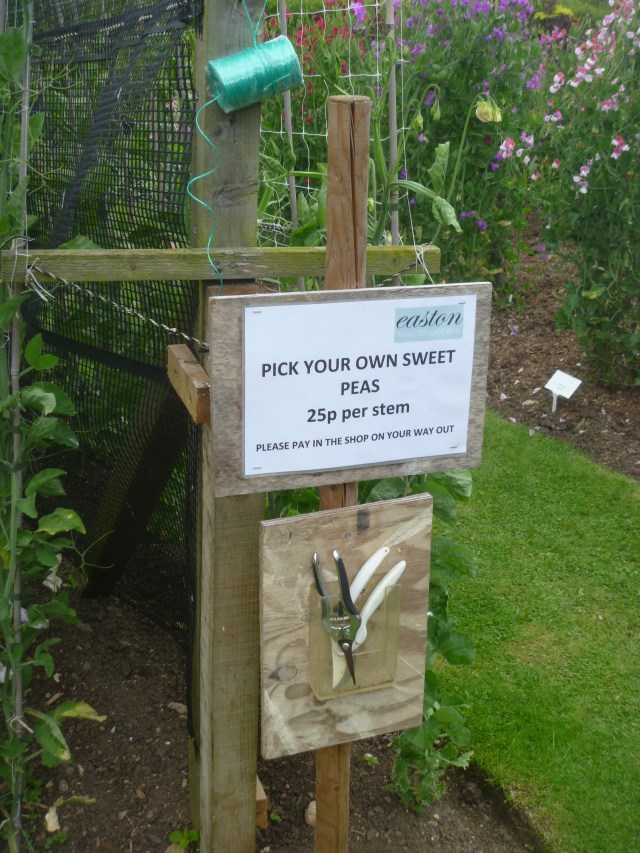
Pick your own

Pick Your Own

Sweet pea inspections

Sweet Peas in the Cottage Garden

SP display 2

Sweet Pea Specimens

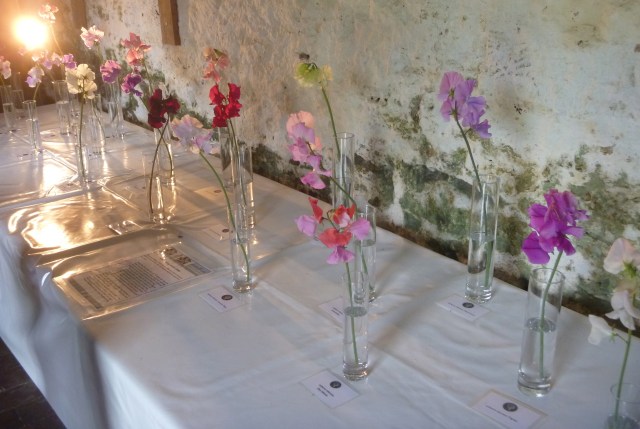
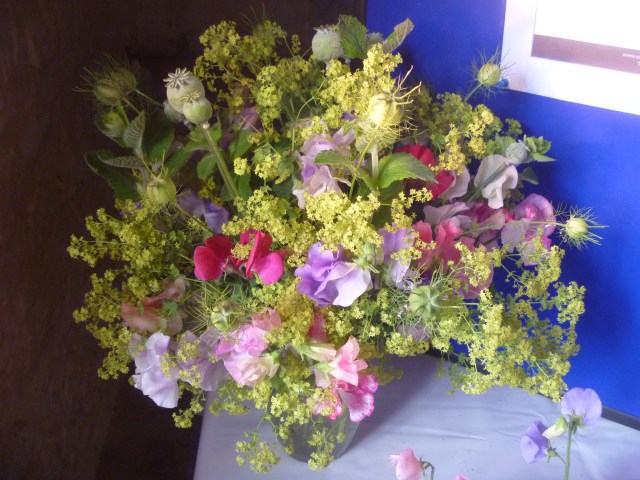
Even the worst flower arranger cannot fail to make a decent fist of arranging sweet peas. To start they usually look best on their own, they will look good in a wide-necked or a narrow container and whatever you do, the scent will make up for any artistic shortcomings. The only rule to be aware of is to make sure your container is in proportion to the size of the stems. Short grandiflora peas look good in little vintage medicine bottles. Large flowers for exhibition can be placed in traditional vases up to about 10 inches high.” [Information Board]

Display

Beautiful! – And smell even better.


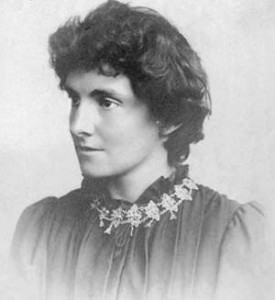
More Ghosts at Christmas : Edith in the Dark

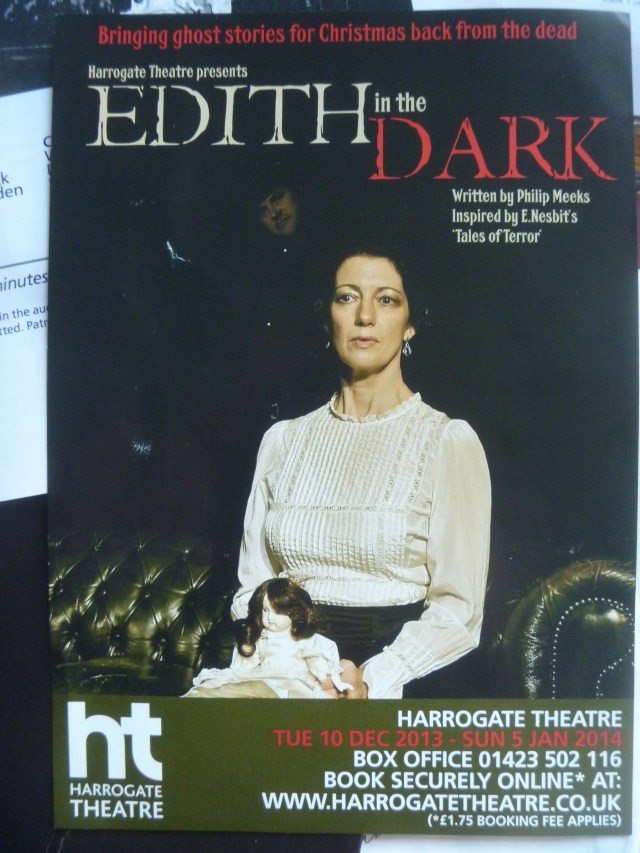
Edith in the Dark

Celebrated children’s author Edith Nesbit escapes her annual Christmas Eve soiree and finds herself in her attic writing room with a young male guest and Biddy Thricefold, her loyal housekeeper.

The trio decide to observe the festive tradition of reading scary stories to help ward off wicked spirits, choosing the stories penned by Nesbit herself. Yet as they breathe life into these terrifying creations, all is not as it seems…

One of the people in the attic is hiding a deadly secret.

Millions have grown up with the fabled work of E Nesbit,which includes classic novels Five Children and It and The Railway Children, but she began her writing career as a mistress of horror. For the first time ever, these flesh-creeping yarns have been freely adapted for the stage.” [Source Harrogate Theatre website]

Way up on the second floor of the Harrogate Theatre (just a 20 minute train journey from home) is the intimate 50 seat Harrogate Studio Theatre. Yesterday afternoon I very much enjoyed a couple of hours in the company of the three characters playing out some of Nesbit’s ghost stories.

I had read a review in the local free paper earlier in December and was intrigued to know that Edith Nesbit, author of such children’s (and adults’) favourites as ‘The Railway Children’, ‘Five Children and It’ and ‘The Story of the Treasure Seekers’, wrote much more besides including ‘Tales of Terror’.

Edith in the dark

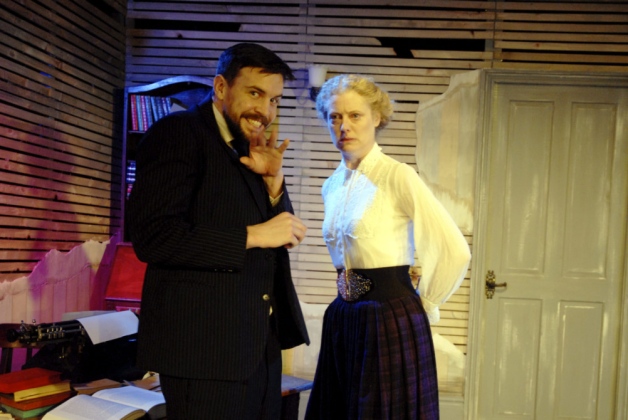
Here are Scott Ellis (as Mr Guasto) and Blue Merrick (as Edith) in Edith in the Dark [source]

Blue Merrick the actress who played Edith could have been EN herself. I had never heard of her but my friend recognised her as having played the registrar presiding over marriages in eleven separate episodes of Coronation Street on ITV.

From this new play I learned more about E. Nesbit’s life and the past that haunted her. She was an original member of the Fabian Society and named her son Fabian after it. Sadly he died at the age of 15 during a tonsil operation. She dedicated several of her books to this son including Five Children and It. She also seemed to feel very strongly that she did not want to be famous just through her children’s books. She was a keen socialist and defender of women’s rights.

I don’t know whether the play will transfer to other theatres but I was very glad to have spent the afternoon away from the shopping hordes again and in the company of Edith Nesbit.

Edith-nesbit-275x300

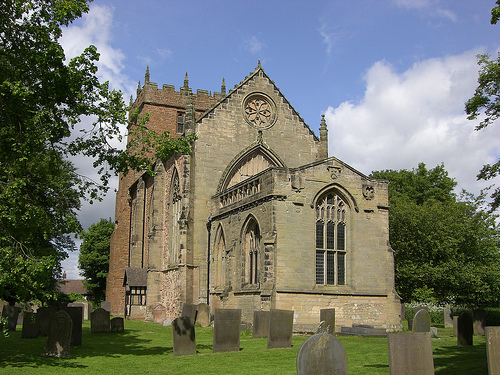
“A wonderful little church with a chequered pavement … with coats of arms in clusters on the lofty roof” : St Mary’s, Astley

 Astley Church

The above quotation is from ‘Scenes of Clerical Life : Mr Gilfil’s Love Story’ by George Eliot who based her fictional village of Knebley on the real life village of Astley. I wrote about my first visit to Astley here and this what I wrote there about the George Eliot connection :

I first visited Astley in the mid-1990s when studying for a Masters degree in Victorian Studies. A ‘field trip’ to the places associated with George Eliot was planned  and we spent the day visiting Coventry, Nuneaton, Arbury Hall and other places mentioned in her life and works including Astley church where we took in a view of the ruined castle. Astley Castle appeared in George Eliot’s story ‘Mr Gilfil’s Love Story’ as Knebley Abbey. The whole site is also part of the Arbury Estate, where George Eliot’s father, Robert Evans, was a farmer, surveyor and land agent and where the young Mary Ann Evans (GE’s real name) grew up.”

George Eliot’s parents were married in St Mary the Virgin, Astley parish church. “Robert Evans and Christina Pearson, were married in Astley Church in February 1813.” [Parish website]

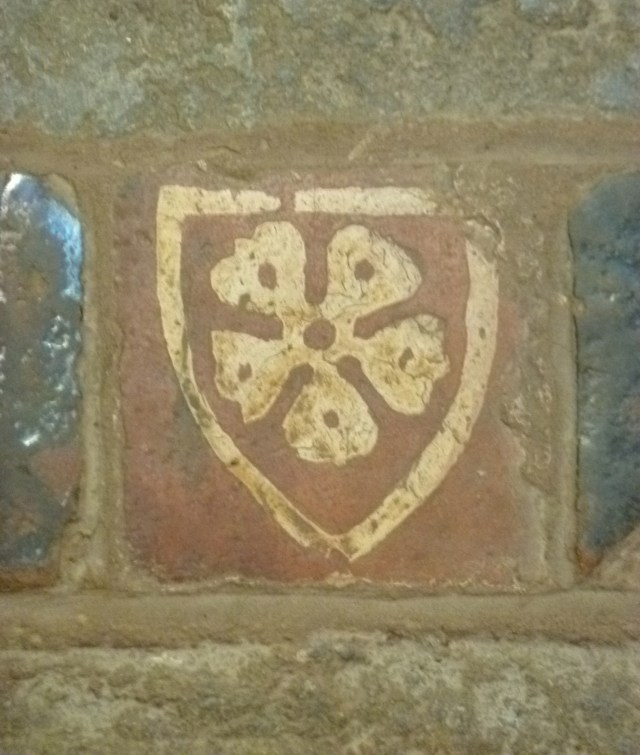
tiled floor

Tile from the floor or “chequered pavement”

The church is open regularly to visitors on the first Saturday of the month from 10.30am until 2pm and also from 11am until 2pm on every Bank Holiday. (Always check the website if you do intend to visit though)

Staying at the Castle you are invited to call one of the churchwardens (numbers are given in the Information File) in order to arrange a personal tour. I decided to do this and at 10.30 the other Thursday met Judith who was able to show me changes that had taken place since my last visit and to explain lots of the features of the church. Here is how  the Welcome Leaflet briefly describes the church and its ‘treasures’.

We know that a church existed at Astley as early as 1285 because a priest was appointed in that year. However, what remains today contains part of the church that was built in 1343 together with some additions that were built in 1607/8. 

The 1343 church was built in the form of a cross, with a central tower which had a lead covered spire. After dark a light was always shown from the spire which was known as “The Lantern of Arden”. The light was to guide travellers through the thick forest which surrounded the area in those days.

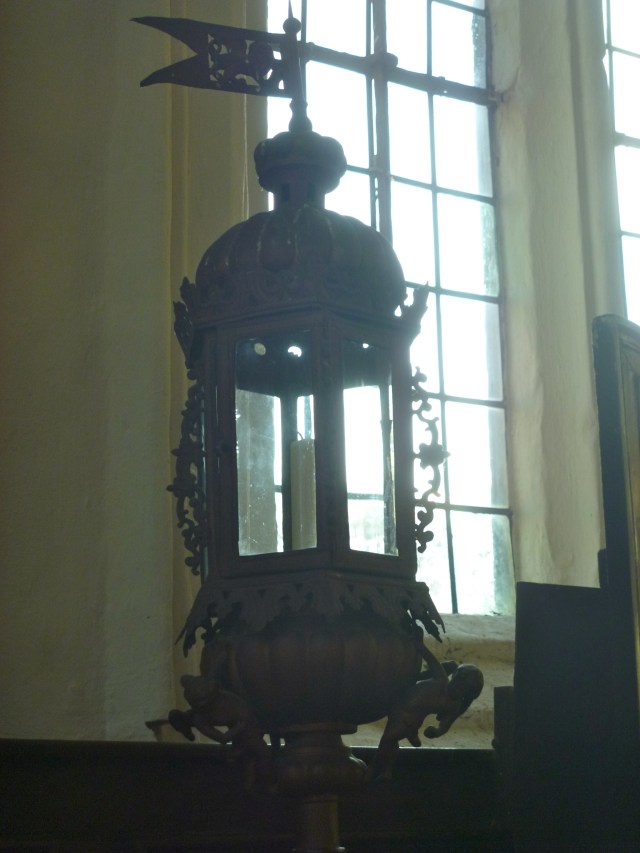
Church lantern

A Lantern in the Church

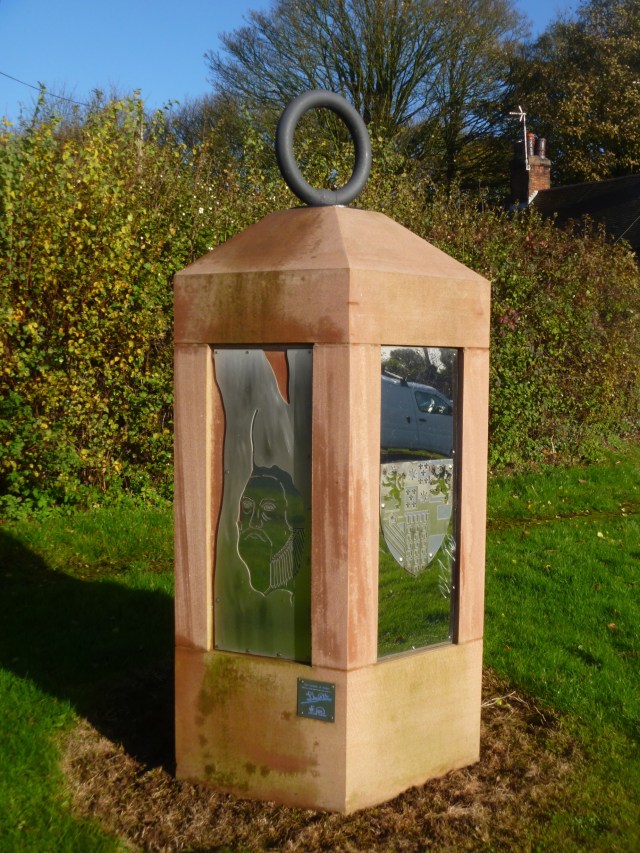
Lantern of Arden

The Modern Lantern of Arden

“When artist Johnny White created Astley’s heritage feature, the new Lantern of Arden, he took his inspiration from the church. It is made of similar red sandstone. In the lantern’s windows, stainless steel panels mirror the ancient themes and history of the parish. Three queens and the castle are represented. Sir Henry Grey hiding in an oak tree and the Victorian author, George Eliot, can all be found on the lantern, made from the same red sandstone as the church.”[Source]

The church’s purpose was a chantry for Thomas Astley. here priests sang mass daily for both him and his family to aid their souls in purgatory. Over the years the church has passed ownership through Sir Richard Chamberlayne to the Newdegate family.

The main body of the church was about 30 m. long but by 1600 the tower had fallen down and the church was in a state of disrepair.

In 1607/8 the present tower and chancel were built, using some of the materials from the old church, at each end of the chancel of the earlier building.”

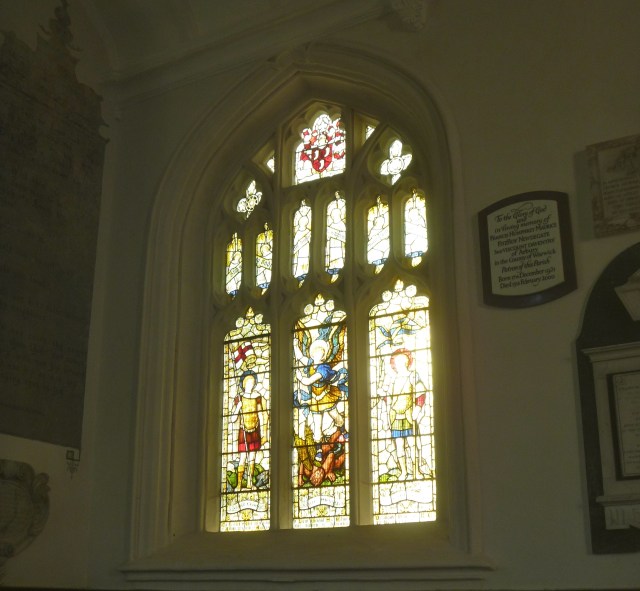
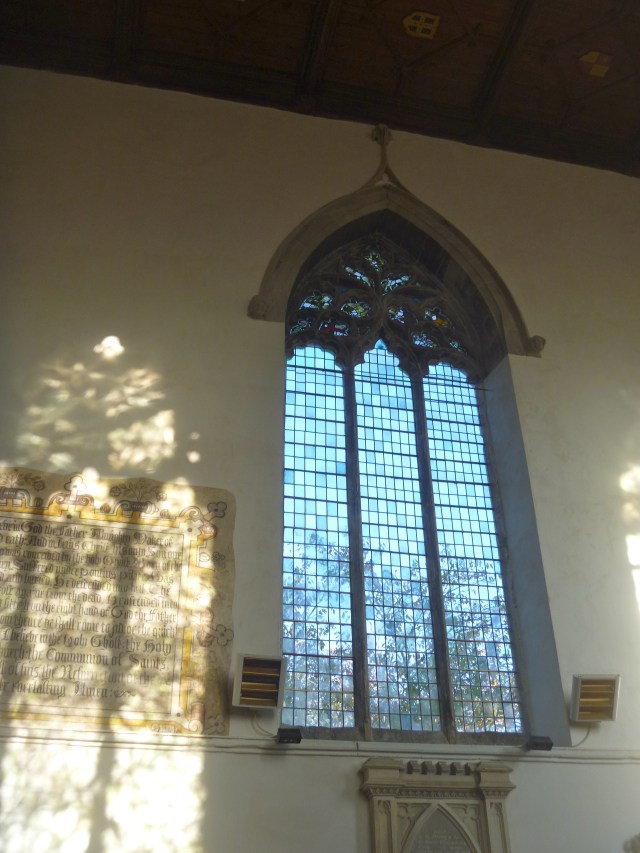
Stained Glass Windows

Stained glass window 1

Stained glass window 2

The east and north windows contain some 14th century stained glass whereas the south window is modern.

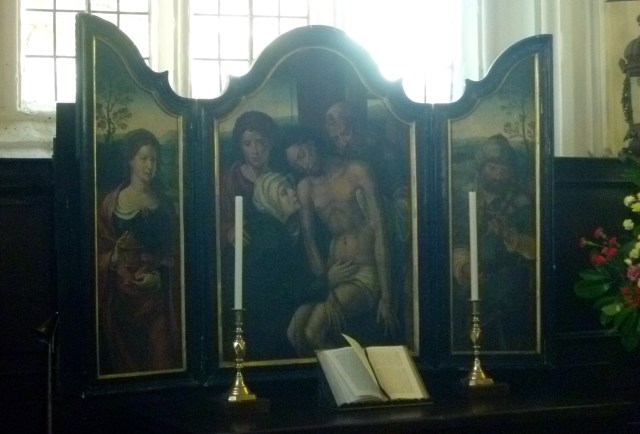
Altar Picture

Altar picture

This dates from the 17th century and depicts the taking down of Our Lord from the cross. It was given to the church in 1905 by Sir Francis Newdegate.

Tower

A stone circular staircase leads up to the bells of which there are five. Four of these have an inscription showing that they were made in Leicester in 1607.

Nave Ceiling

Roof

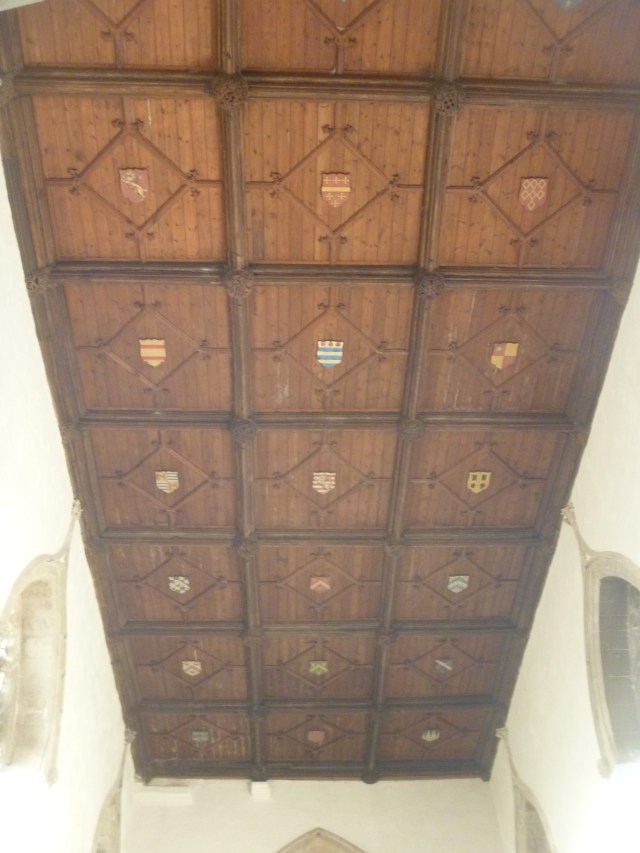
“With Coats of Arms in clusters on the painted roof” [‘Scenes of Clerical Life : Mr Gilfil’s Love Story’ by George Eliot]

This is made of oak and has twenty one shields connected with the church. It was extensively restored in 1876.

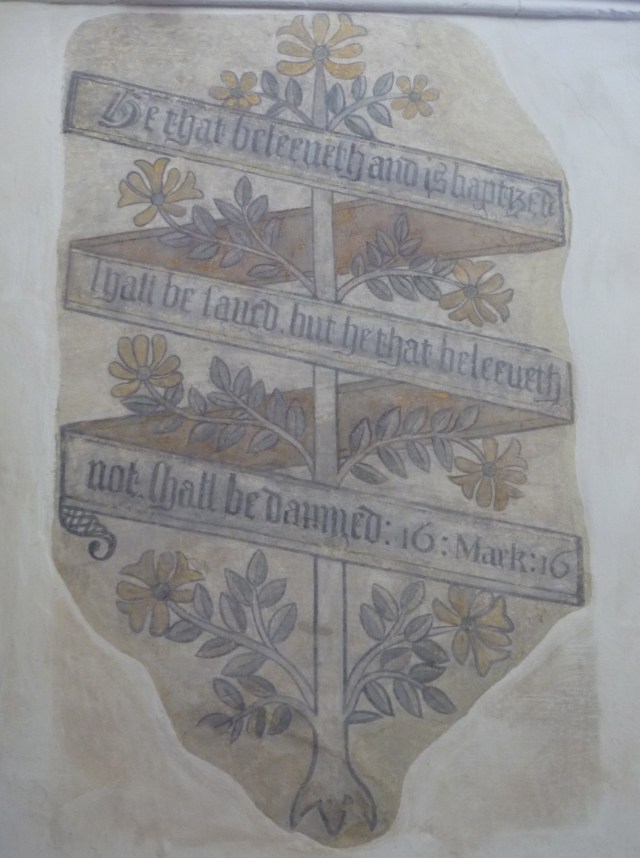
17th Century Wall Paintings

Wall painting

[“He that believeth and is baptized shall be saved; and he that believeth not shall be damned.” Mark Ch. 16 v. 16]

There are six on the south wall showing seven Bible passages, the Lord’s Prayer and the Creed.

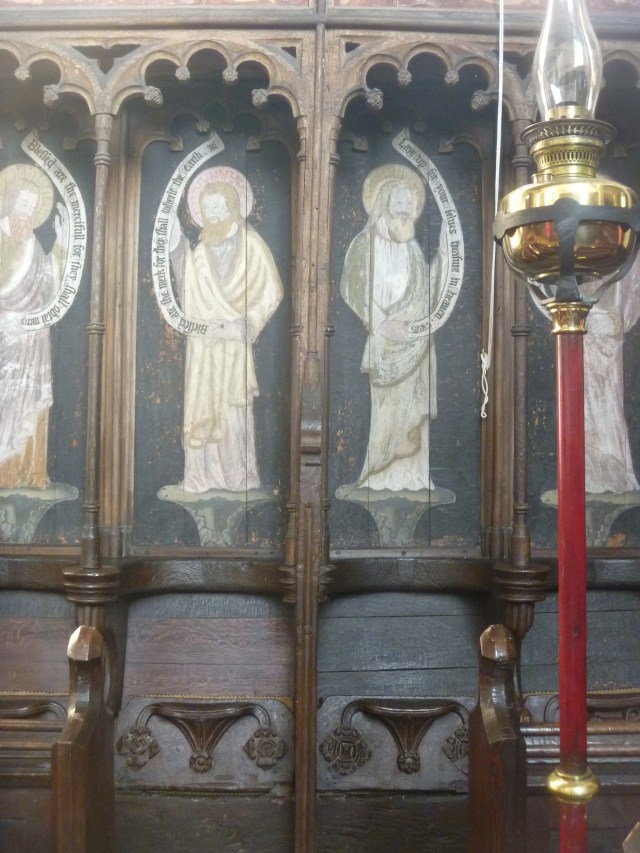
14th Century Choir Stalls

Choir stalls and apostles

There are two sets of nine and behind each stall is a painted panel. There are nine apostles on the north side and nine prophets on the south side.

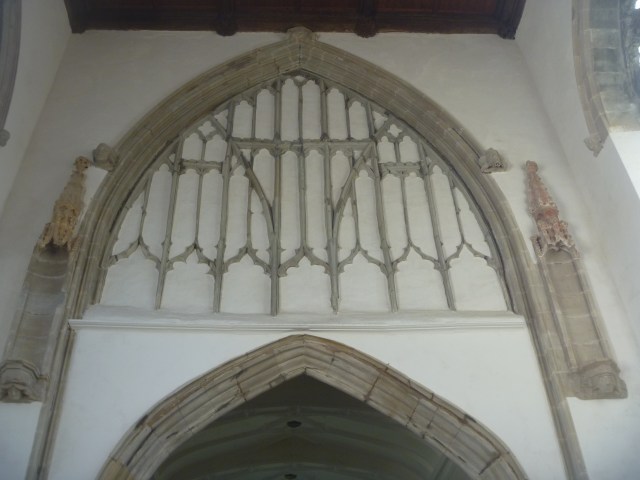
The Original East Window

Blocked window

Now blocked, this window would have been at the end of the original church. It sits above the 17th century chancel arch. Some of the stained glass from this once magnificent window was moved and placed in the windows of the north side of the chancel and also in the tracery in some windows in the nave.

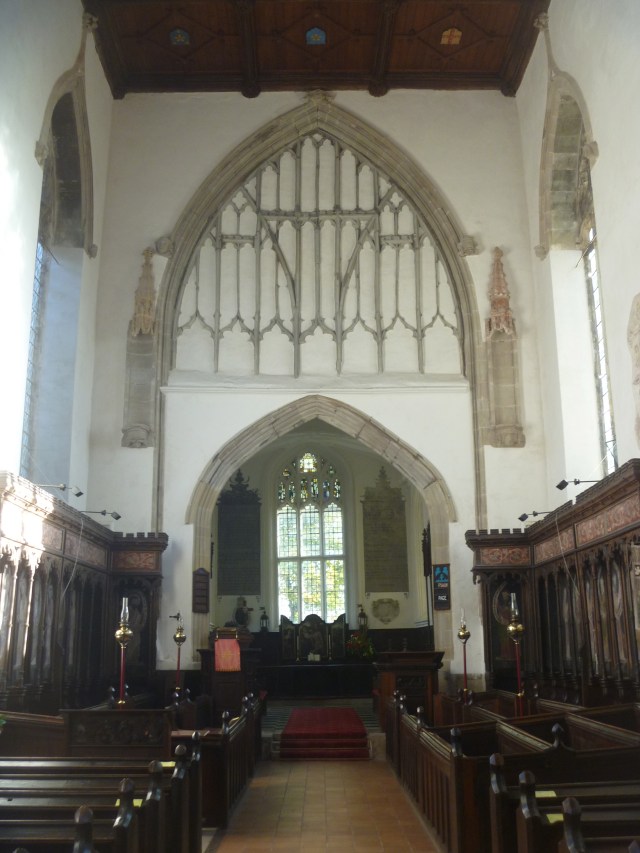
Interior view chance

Interior view towards the Chancel

Interior rear

Interior view towards the rear and access to the church tower and bells

Mary Taylor : Strong Minded Woman & Friend of Charlotte Brontë

Discover the pioneering 19th century life of early feminist Mary Taylor of Red House, friend and inspiration to Charlotte Brontë. Mary’s exceptional life included emigrating to New Zealand; starting a business; leading expeditions of women mountain climbing in Europe and writing radical feminist articles and books.” (It’s Happening …)

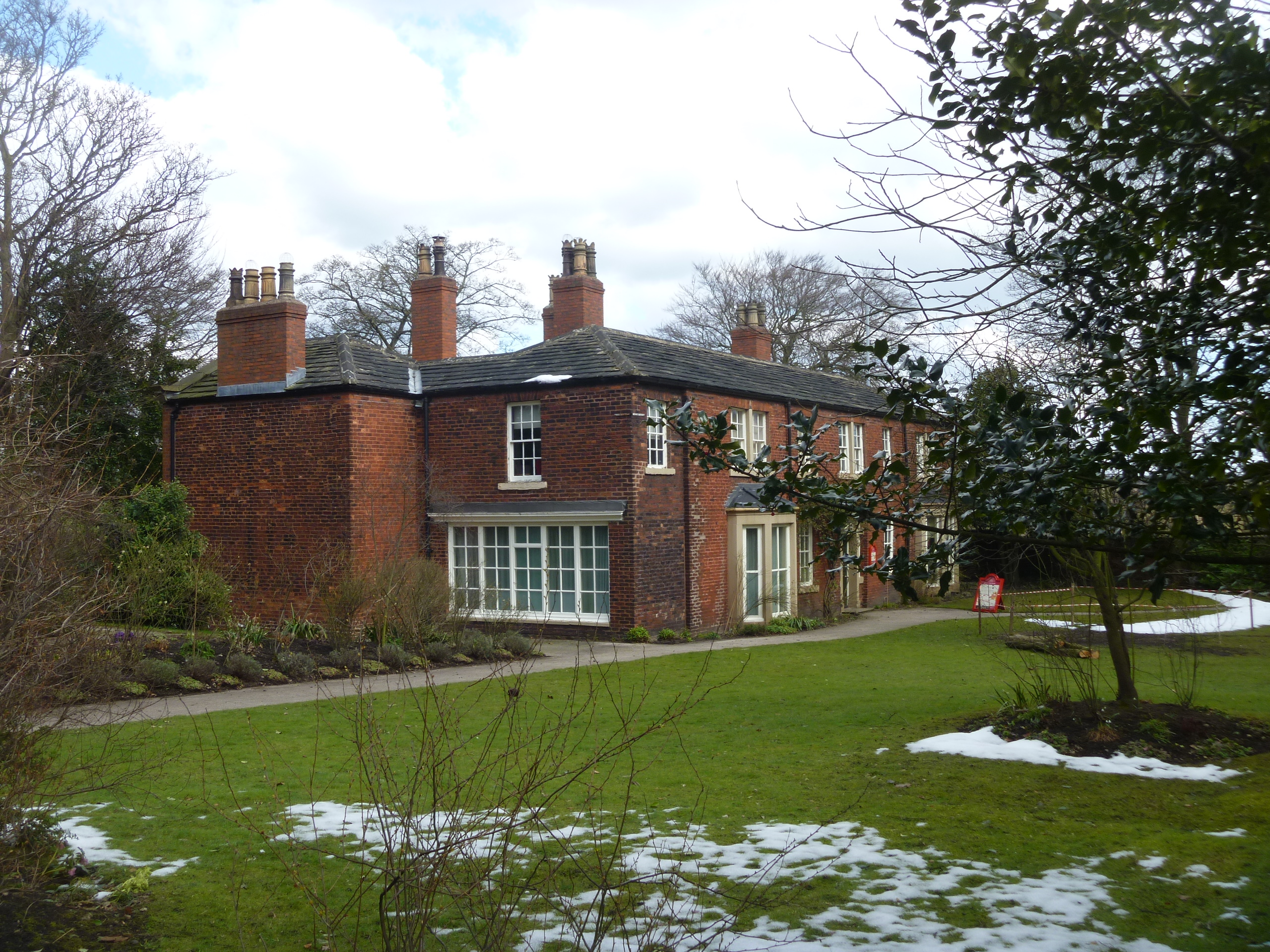
Red House

Back in December I visited Oakwell Hall in Birstall to look at the Christmas decorations and promised myself that I would follow up with a visit to the nearby Red House; which also has Brontë connections. In the ‘It’s Happening …’ leaflet which I picked up that day I noted a future exhibition to be mounted at Red House on the topic of its one-time inhabitant Mary Taylor. The exhibition runs from 2 March until 2 June.

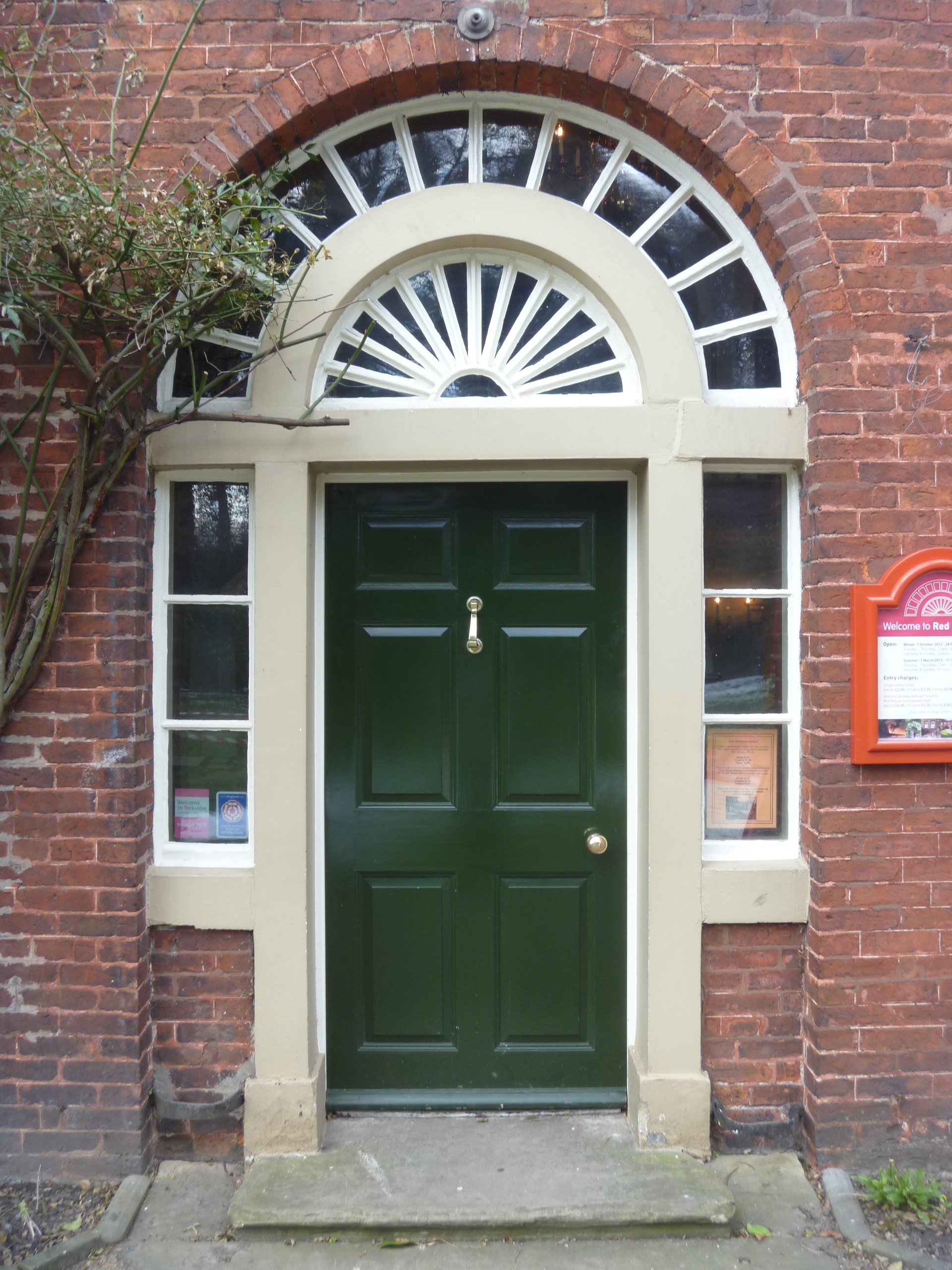
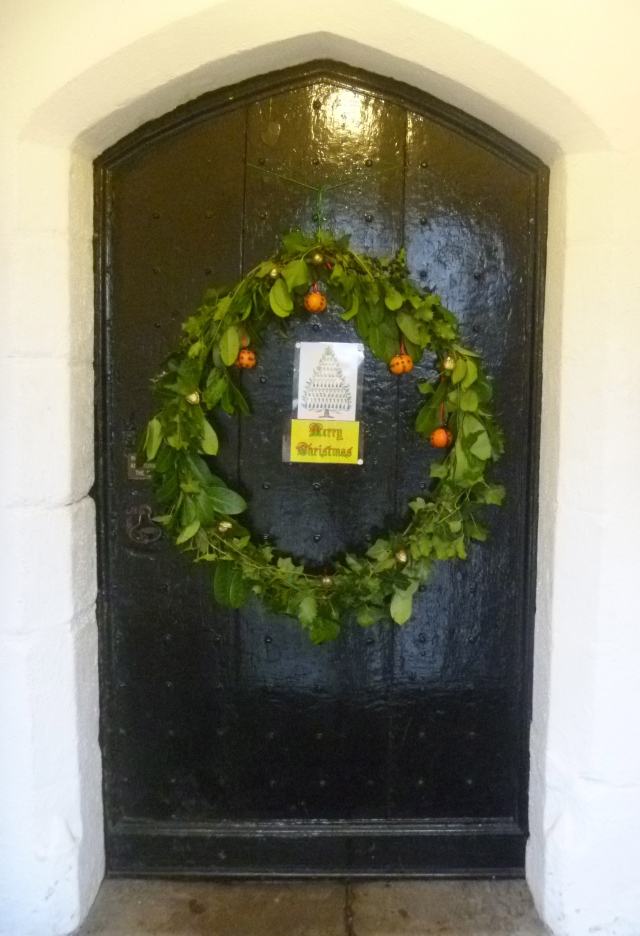
Front door Red House

No photography is allowed inside the house; but never mind it’s a bit disappointing anyway. Several times in the 1980s I brought my sons here as they laid on some good children’s craft workshops (and still do). For quite a few years it was closed for renovations and yesterday was my first visit since then.

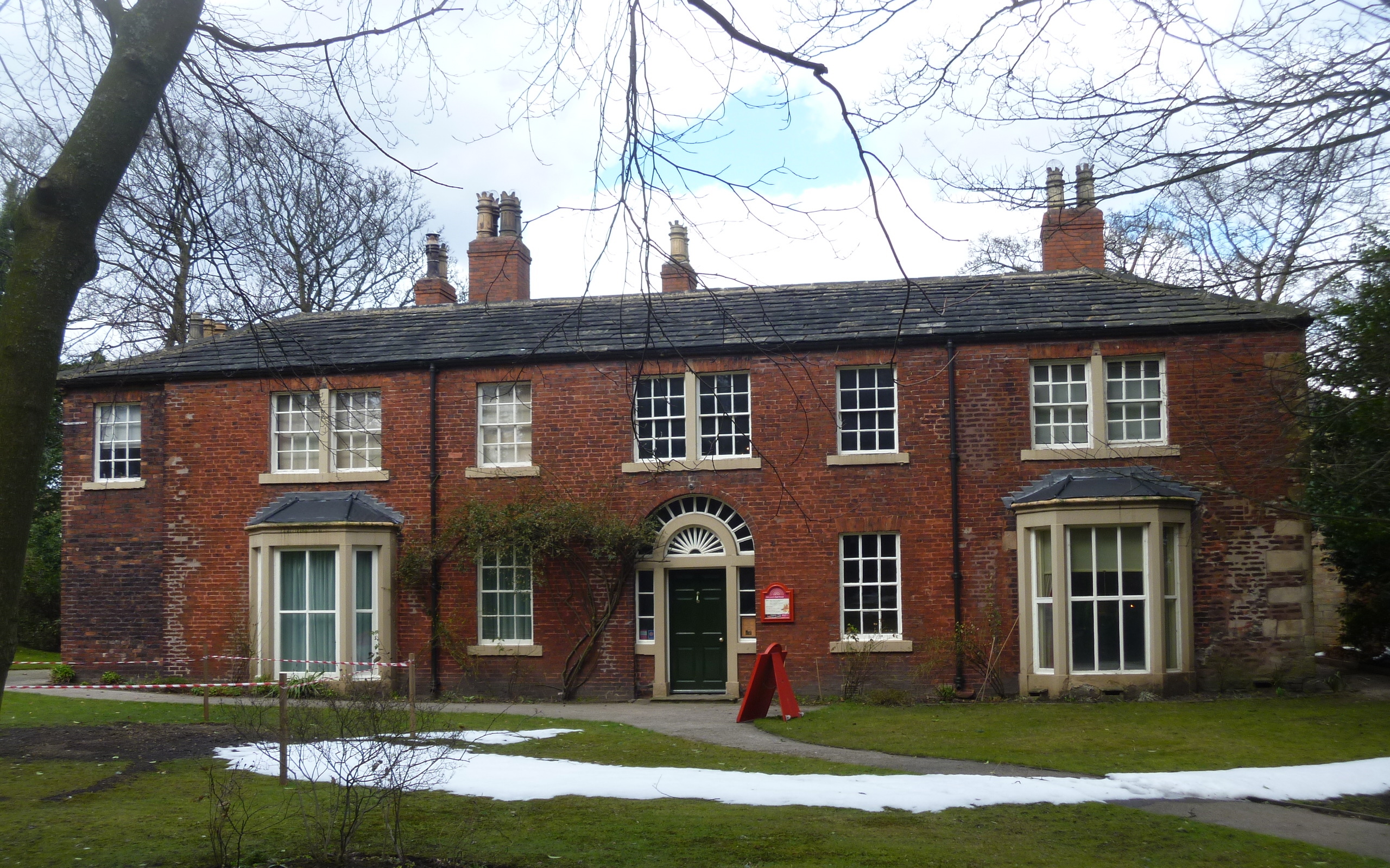
Red House - front

I was told that the house has been returned as nearly as possible to how it would have looked in the 1830s; the time when Charlotte Brontë visited. Some furniture, pictures and fittings are original, or of the period, and the rest have been carefully copied; for example the ‘Brussels’ weave, looped pile carpet in the Parlour, window curtains and bed hangings in the Main Bedroom and wallpapers.

There are very few rooms to visit – The Parlour (left in photo) with waxworks of Mary Taylor (playing the piano) and her mother (stitching tapestry); the adjoining scullery and kitchen; across the hall (which serves as reception and shop) there is the dining room and a study (right in photo). Upstairs you can visit the Main Bedchamber (above the parlour), the Governess’ room and the Girl’s room.

The Taylors were  a prosperous, middle class family and Joshua (a woollen cloth manufacturer and merchant) lived here with his wife Anne and their six children. Their daughter Mary (1817-1893) was a great friend of Charlotte Bronte, who often visited Red House and featured the house as ‘Briarmains’ and the Taylor family as ‘The Yorkes’ in her novel ‘Shirley’.

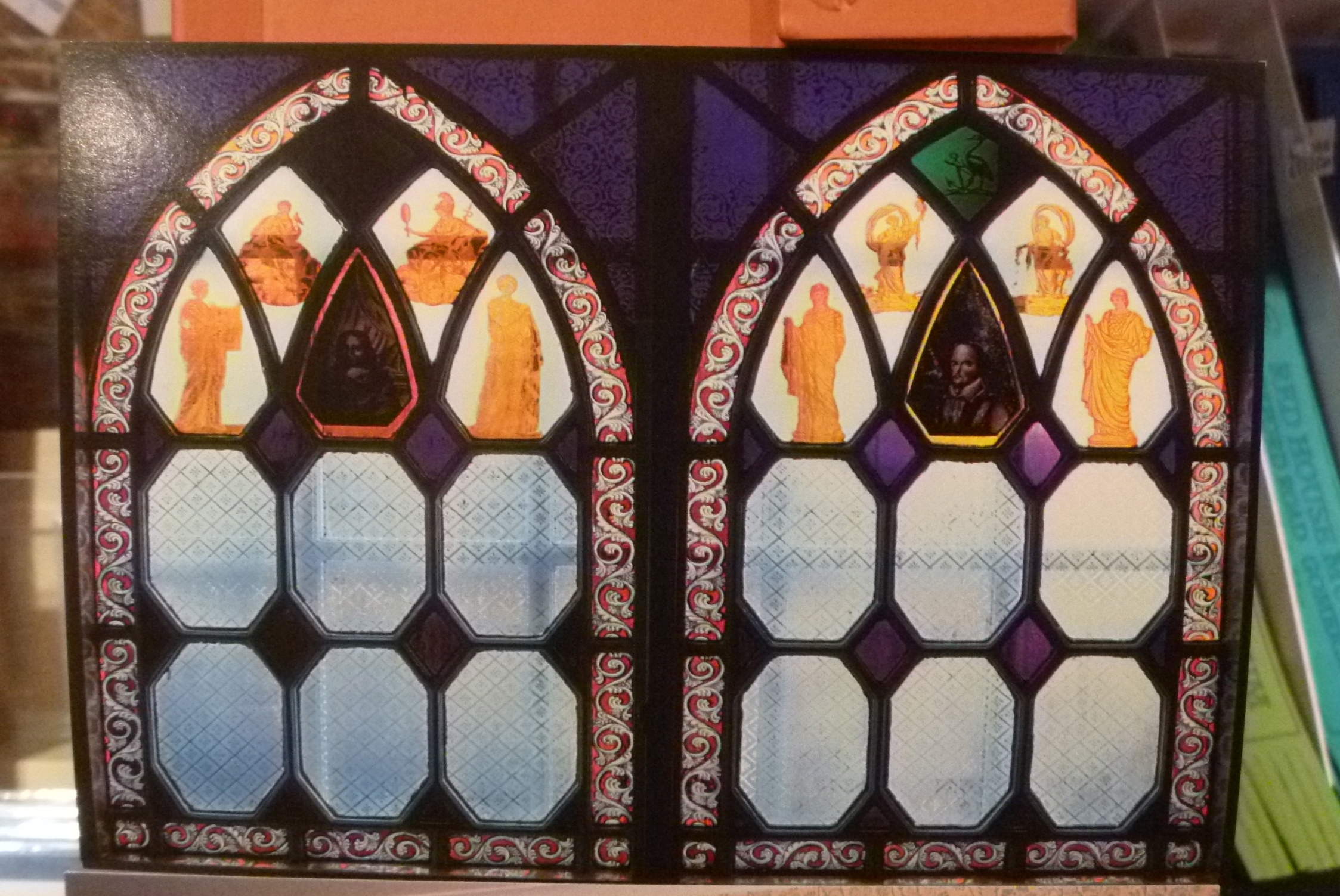
postcard

Perhaps the most interesting feature, to me, were the stained glass windows in the Dining Room with painted heads of William Shakespeare and John Milton. Charlotte Brontë describes in ‘Shirley‘.

Those windows would be seen by daylight to be of brilliantly-stained glass – purple and amber the predominant hues, glittering round a gravely-tinted medallion in the centre of each representing the suave head of William Shakspeare, and the serene one of John Milton.” (Shirley Ch.9)

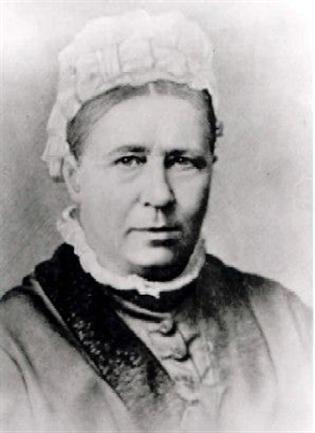
MARYTAYLOR2

Mary Taylor (Photo source)

So, having almost galloped through the main house I spent quite some time in the Exhibition Gallery studying the fascinating life of this woman Mary Taylor. One hundred years after her death she is now gaining recognition through Charlotte Brontë’s descriptions, through her letters and through her own published works. Examples of her books were displayed (including modern reprints). She wrote “The First Duty of Women” and a novel “Miss Miles, or a tale of Yorkshire life 60 years ago”. She was a strong-minded woman intent on pursuing her own way of life and living by her own ideals. She was an early feminist and strongly believed in women having their own independence.

She attended Roe Head School near Mirfield (where she met CB) and later The Chateau de Koekelberg in Brussels. She taught in Germany and I was surprised to read that in 1845 she emigrated to New Zealand and was one of its earliest settlers. There she owned a successful shop. She returned to Britain in 1860 and spent the rest of her life in nearby Gomersal. That is, when she wasn’t being a woman after my own heart and leading women’s mountaineering holidays in Switzerland! “Swiss Notes by Five Ladies : an Account of  Climbing and Touring in 1874″ was reprinted with a supplement by Peter A. Marshall and Jean K. Brown.

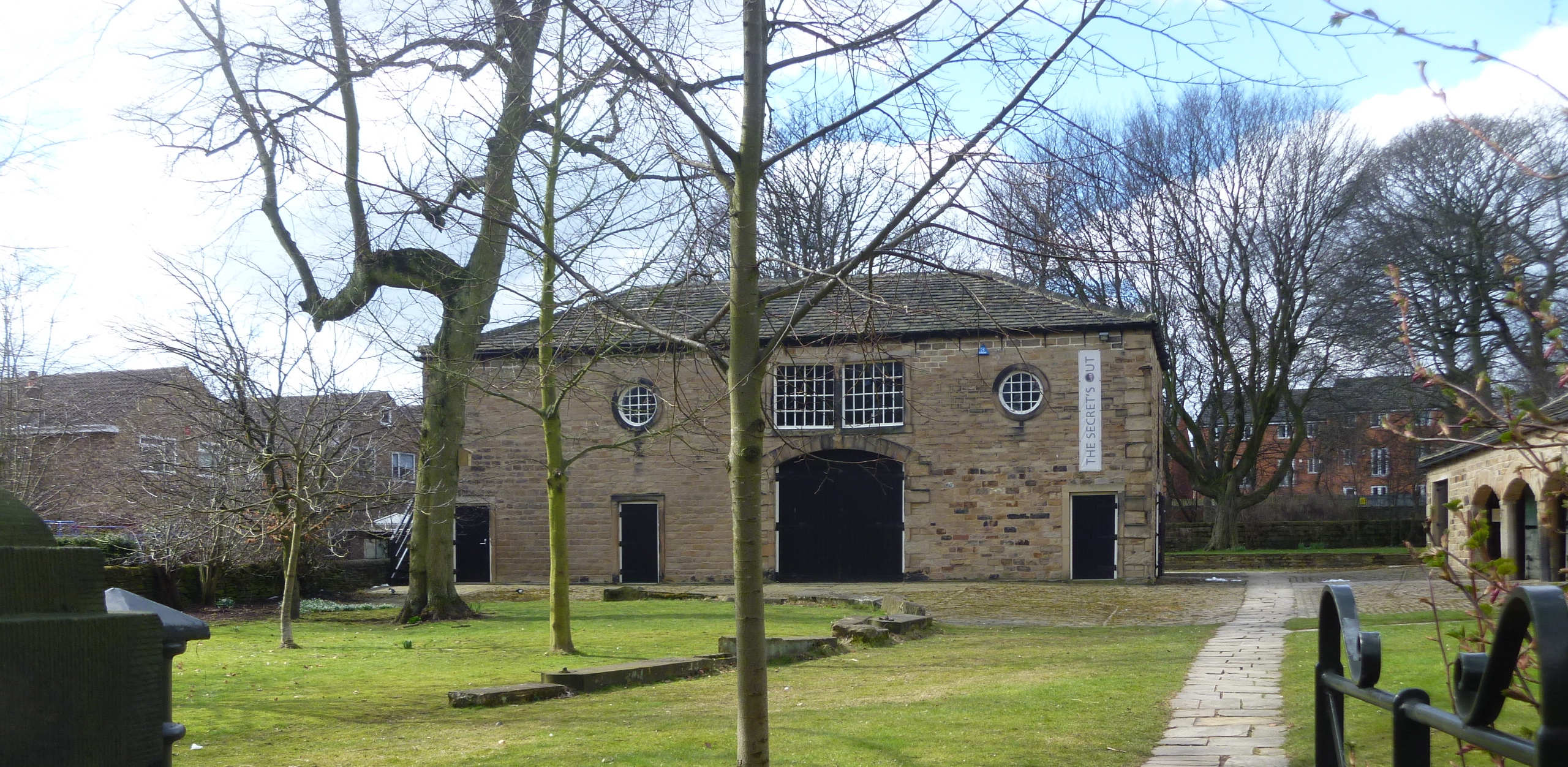
Secret's Out and Spen Valley Stories

The Secret’s Out with Spen Valley Stories (right)

So that was the house … but there is more. In the converted stables and outbuildings are two more displays. The Secret’s Out all about the Brontë connection with Red House and its local area and Spen Valley Stories : “Everyday community life through a century of change is illustrated through personal stories – displays include Schooldays; Working Lives; At Home; Freetime and Shopping.”

I didn’t have time to investigate these but I will be definitely go back, so watch this space!

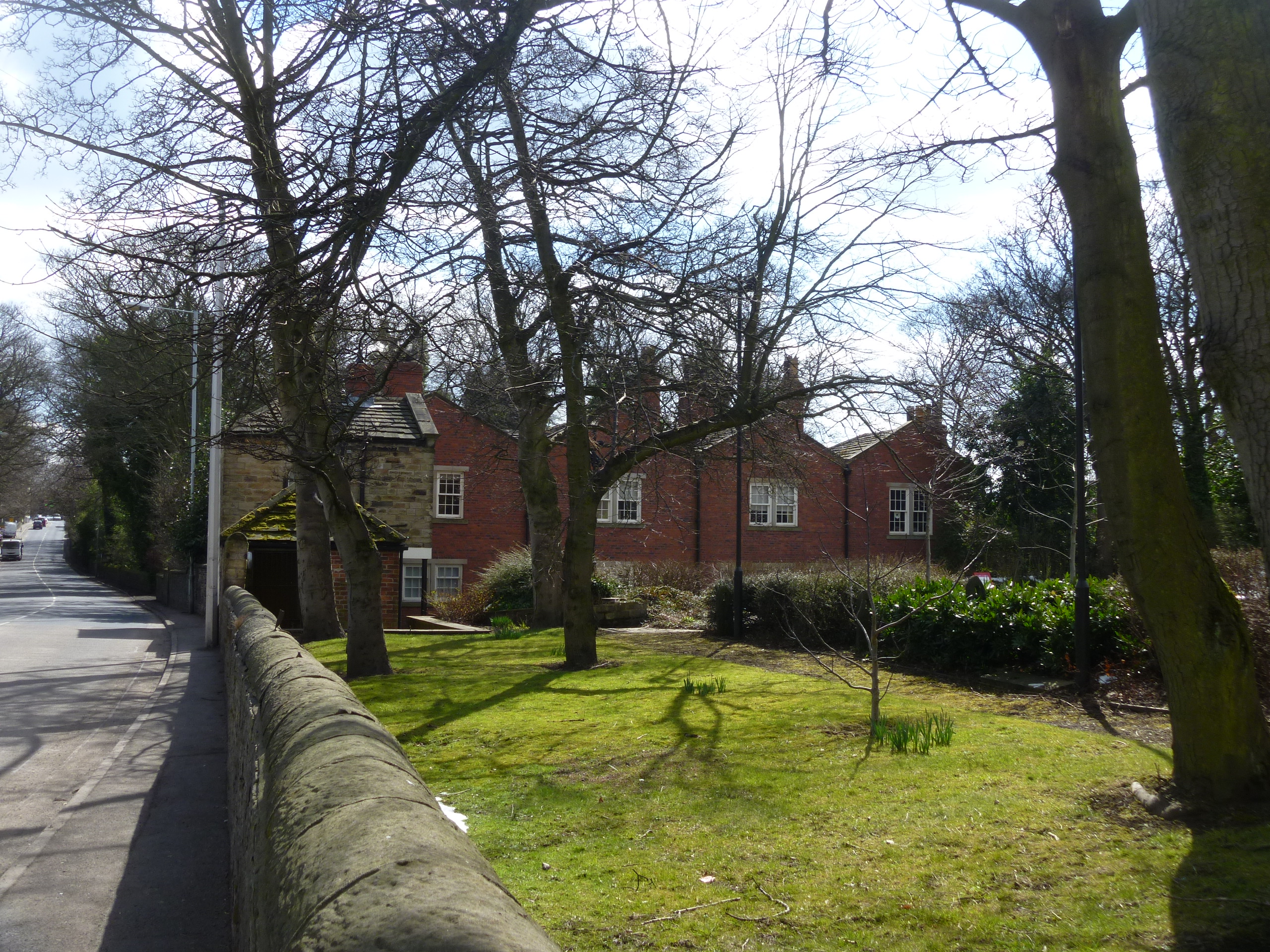
Back of Red House

Back of The Red House from the main road

‘Deck the halls’ at Oakwell

Oakwell Hall

Step back in time and enjoy Oakwell Hall’s period rooms decorated with greenery from the park with the theme of traditional Christmas carols. Enjoy the rich and historic splendour of Oakwell Hall, decorated for a 1690 Christmas.”

Oakwell Hall

“It was neither a grand nor a comfortable house; within
as without it was antique, rambling and incommodious.”

Charlotte Brontë’s description of ‘Fieldhead’ (Oakwell Hall) from ‘Shirley’.”

We have had days and days of constant rain. The dark misty clouds mean that the days seem even shorter than the time of year supposes that they should be, so I decided to ‘step back in time’ to a nearby house with Bronte connections – Oakwell Hall in Gomersall. It is now owned by Kirklees Council but has had an interesting history and the lovely house dates back to the 16th century. Read about the fascinating study of the timbers, panelling, layout and construction of Oakwell Hall here. It is such a shame that photography is no longer allowed inside Oakwell Hall as the greenery and decorations brighten up the rooms at this time of year.

Oakwell - rear

Rear view of Oakwell Hall

Thought to be built by one John Batt, whose initials appear above the door, Oakwell was occupied by him and his family for way over a century. Between 1789 and 1927 when the hall was bought by the local council it had several owners and was at times a private residence, at times occupied by short term tenants (families and schools) and at one point was threatened to be “taken down, brick by brick, and shipped to America”. A local appeal was then launched and with the help of two particular wealthy benefactors (Sir Henry Norman Rae and John Earl Sharman) the house was saved and passed to Batley Corporation (now Kirklees Council). Since 1927 the house has been a museum and more recently the surrounding parkland has come into Council ownership and the whole is now Oakwell Hall Country Park.

As you tour the house, after being greeted in the Great Hall, at one point on the ground floor you pass into the Buttery. This bare room with stone floor is now a small information space and here I read more about the Bronte connection with Oakwell Hall.

Whilst a pupil at Roehead School in Mirfield Charlotte Bronte made friends with Ellen Nussey and Mary Taylor. Ellen later attended a school at Oakwell Hall and CB frequently visited her here. She was inspired to base her descriptions of the house Fieldhead on Oakwell Hall and she also based The Yorke family in the same book on her friends The Taylors.

Accurate descriptions of the house interior and exterior can be lifted straight from Chapter 11 “Fieldhead” in Shirley.

“If Fieldhead had few other merits as a building, it might at least be
termed picturesque. Its regular architecture, and the gray and mossy
colouring communicated by time, gave it a just claim to this epithet.
The old latticed windows, the stone porch, the walls, the roof, the
chimney-stacks, were rich in crayon touches and sepia lights and shades.
The trees behind were fine, bold, and spreading; the cedar on the lawn
in front was grand; and the granite urns on the garden wall, the fretted
arch of the gateway, were, for an artist, as the very desire of the eye.”

“Mr. and Miss Helstone were ushered into a parlour. Of course, as was to
be expected in such a Gothic old barrack, this parlour was lined with
oak: fine, dark, glossy panels compassed the walls gloomily and grandly.
Very handsome, reader, these shining brown panels are, very mellow in
colouring and tasteful in effect …”

Talking with one of the Museum staff I also discovered that several filmings had taken place at Oakwell over the years. Notably in 1921 a silent film version of Shirley. 

A 2009 TV version of Wuthering Heights used Oakwell for its interior scenes. Fast forward to around 48 minutes in if you are only interested in seeing some interior shots of Oakwell. The exterior shots look to me as if they were filmed using East Riddlesden Hall near Keighley.

The interior scenes of  The Secret Diaries of Miss Anne Listeralso made for TV was filmed here at Oakwell. The true home of Miss Lister was nearby Shibden Hall at Halifax but I was told that the rooms at Oakwell were much larger to allow for all the cameramen’s paraphernalia.

Oakwell Gardens

On leaving the cosiness of the hall you enter the lovely, beautifully ordered, Elizabethan gardens. I made a mental note to revisit these on a less wet and grey day. I hurried home to light my own Christmas tree lights and relax with a mince pie.

My own Christmas tree

A MERRY CHRISTMAS EVERYONE!

A Literary Pilgrimage in Yorkshire

Yesterday I revisited Haworth with a friend. Looking back at my Flickr photos I see that my last visit to this Literary Shrine was in 2005. On that day, it was a Sunday, the queue to get into the Parsonage stretched down through the garden. I planned to return on a quieter day. So, a mere 7 years later, I was back again and indeed found the village and Parsonage very much quieter. [Mental note to self – visit Haworth Parsonage on a Monday in November] My only previous visit inside the house itself was in the early 1990s.

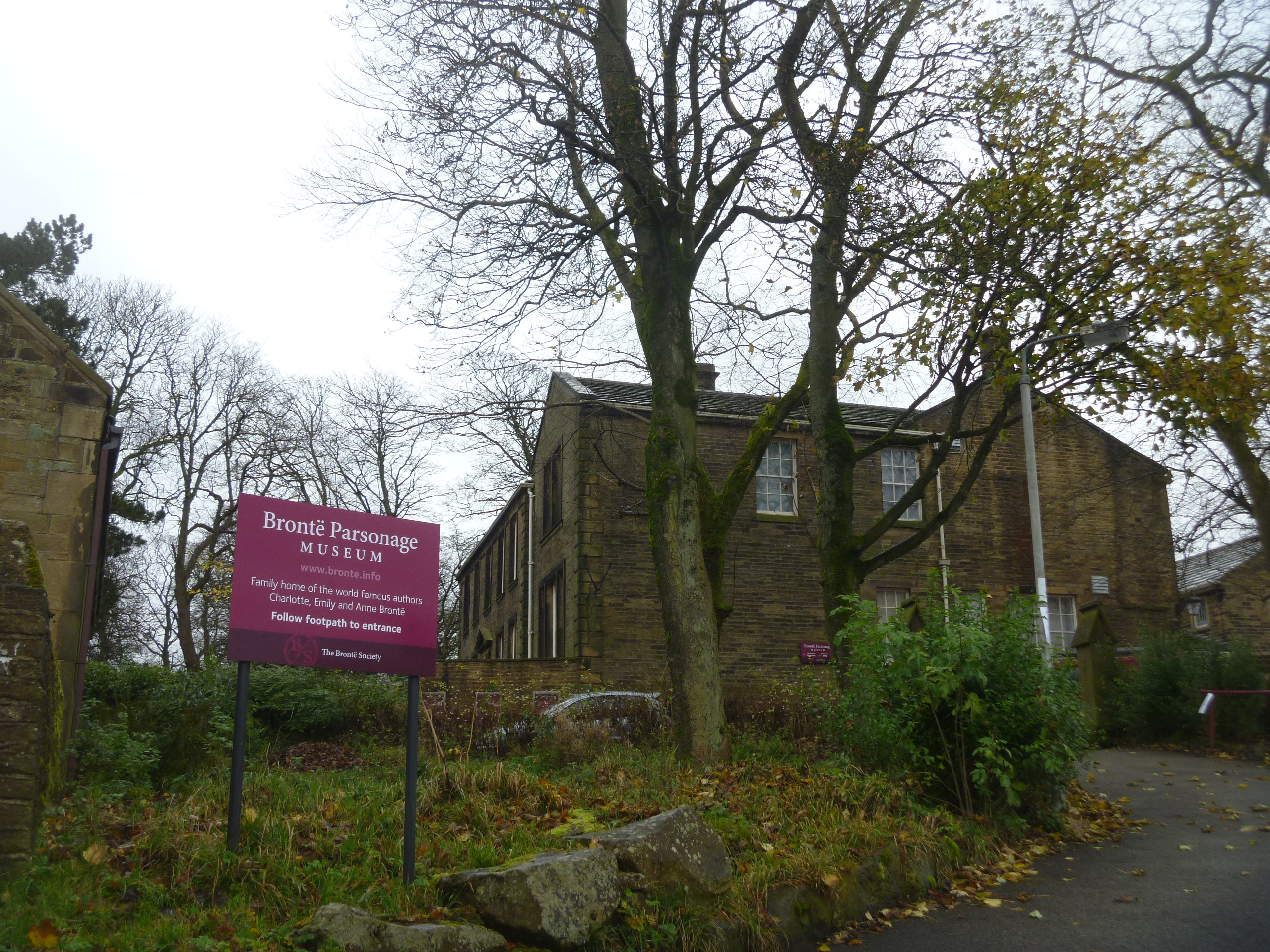
Approaching the Museum from the Car Park

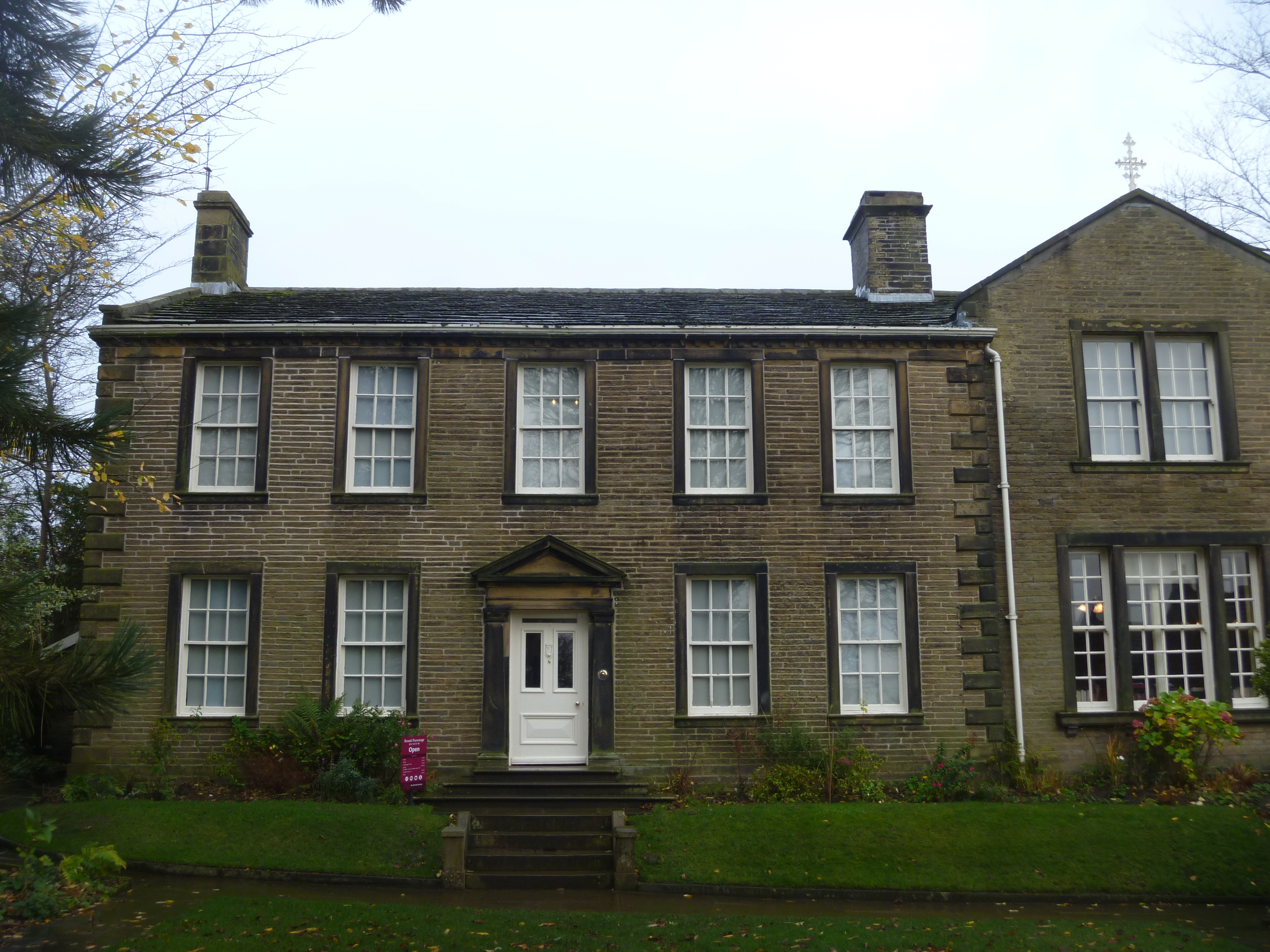
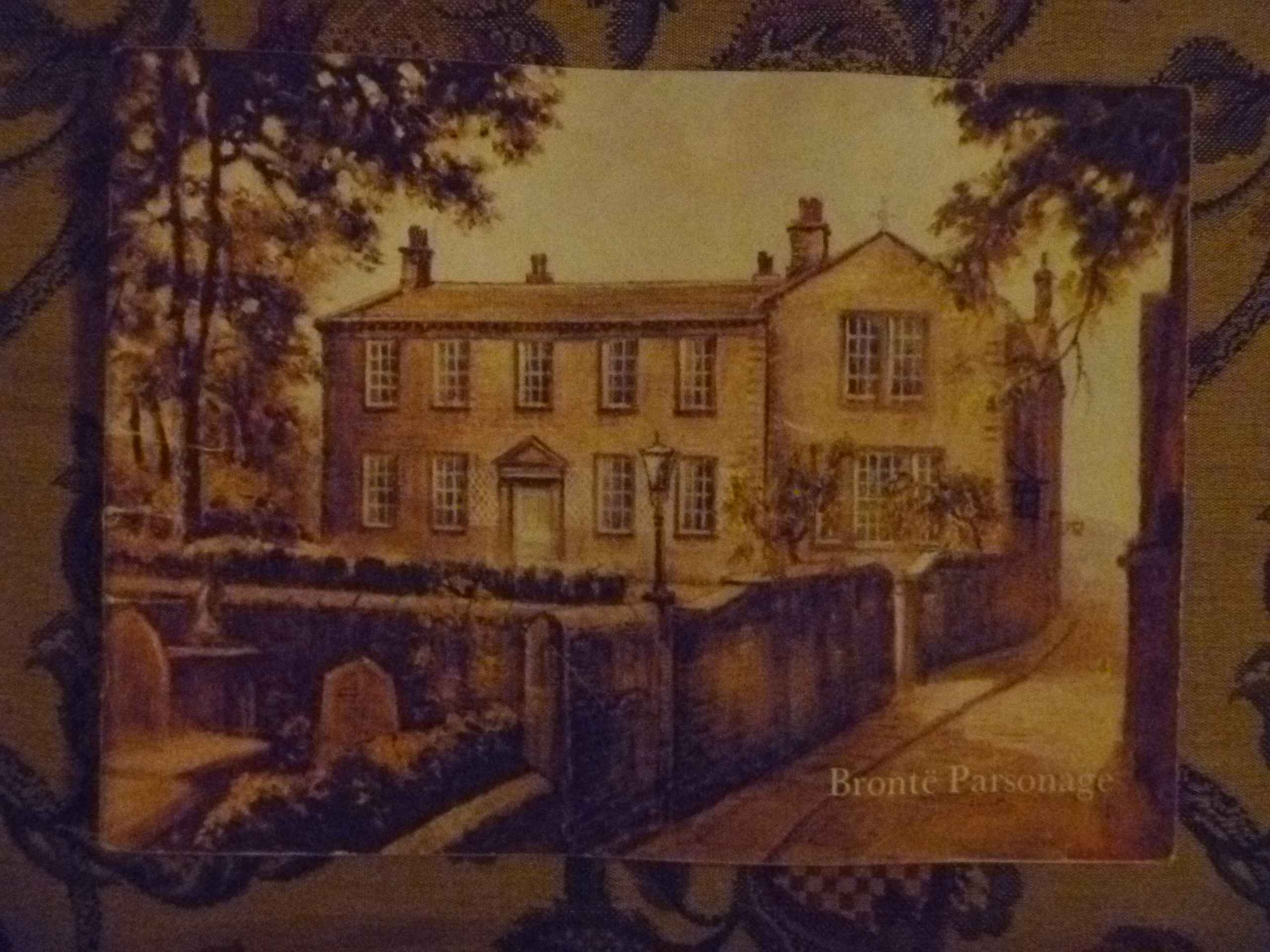
I’m sure I don’t need to explain here that the Parsonage at Haworth, near Keighley in West Yorkshire was home to the Bronte family (probably the world’s most famous literary family) from 1820 to 1861.

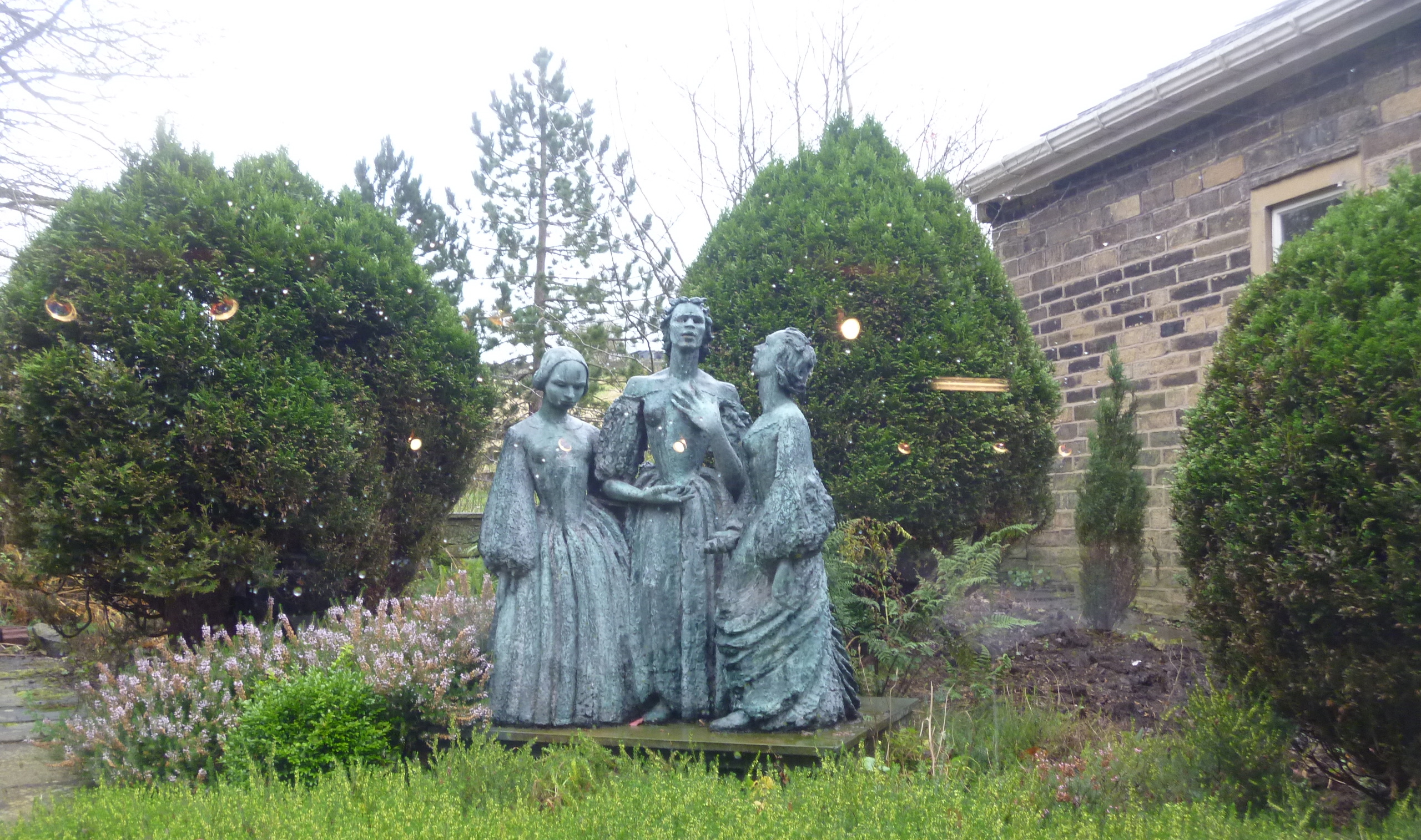
Bronze Sculpture (by Jocelyn Horner) of The Bronte Sisters in the Heather Garden

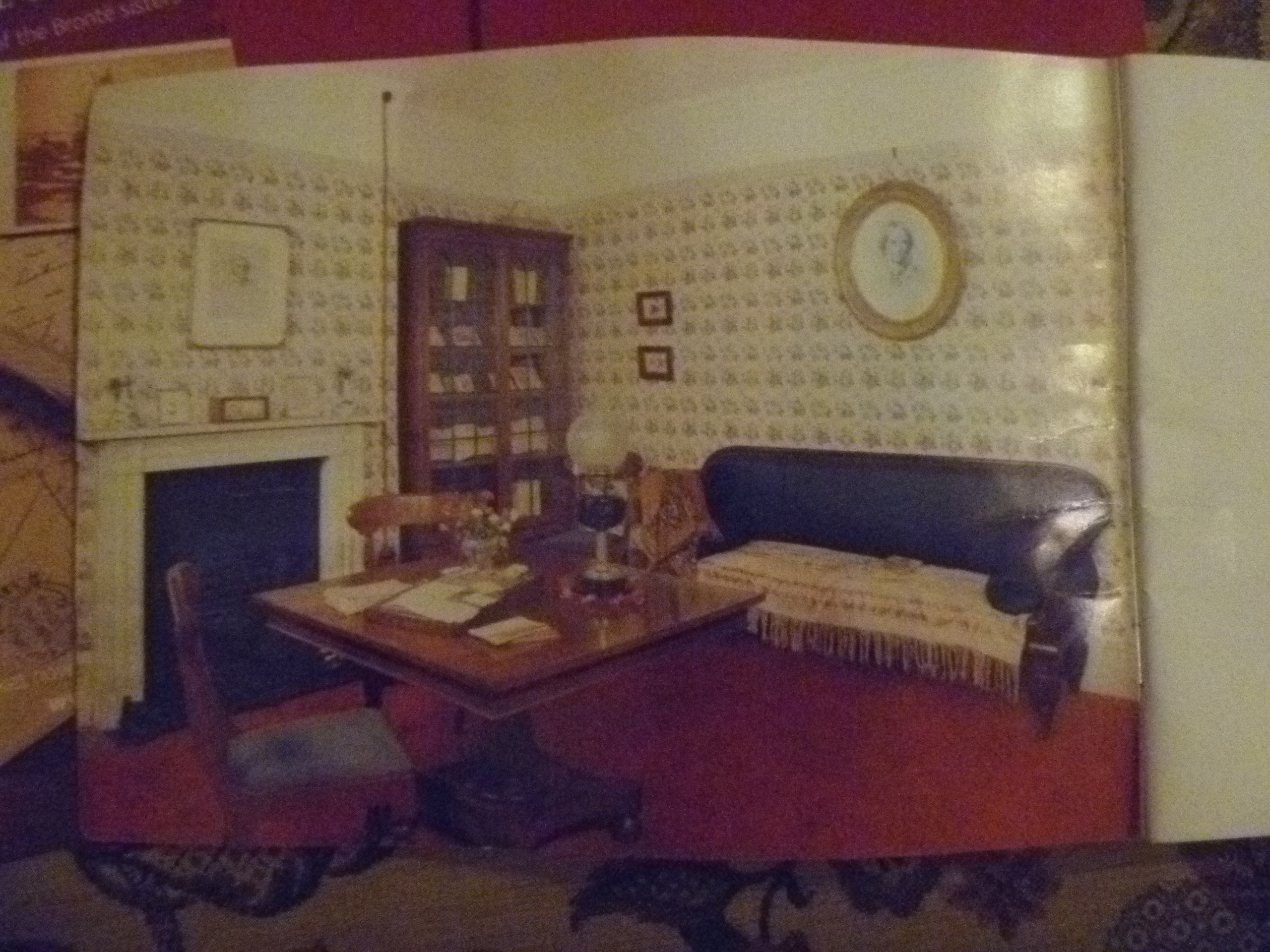
Little had changed in the house itself – my friend and I and one other couple were the only visitors at 1pm today. Some of the pictures had been moved about and there’s a much improved permanent exhibition called Genius: The Bronte Story. My friend had brought along her guidebook from a previous trip [in 1983] so we were able to compare and as photography inside the house is prohibited. Here are some pictures from that book:

The Dining Room

Mr Bronte’s Study

Bronte Parsonage Guide, 1983

There’s a further exhibition called Bronte Relics : A Collection History.

New exhibition looking at the fascinating history of the Bronte Parsonage Museum collection, a story almost as extraordinary as the Bronte story itself.” [website]

“The provenance of a variety of objects is traced back through previous owners and collectors to the major sources of Bronteana; amongst them Charlotte’s husband, Arthur Bell Nicholls; Ellen Nussey, Charlotte’s lifelong friend; the family of Martha Brown, the Brontes’ servant, and the American collector, Henry Houston Bonnell.” [2012 flyer]

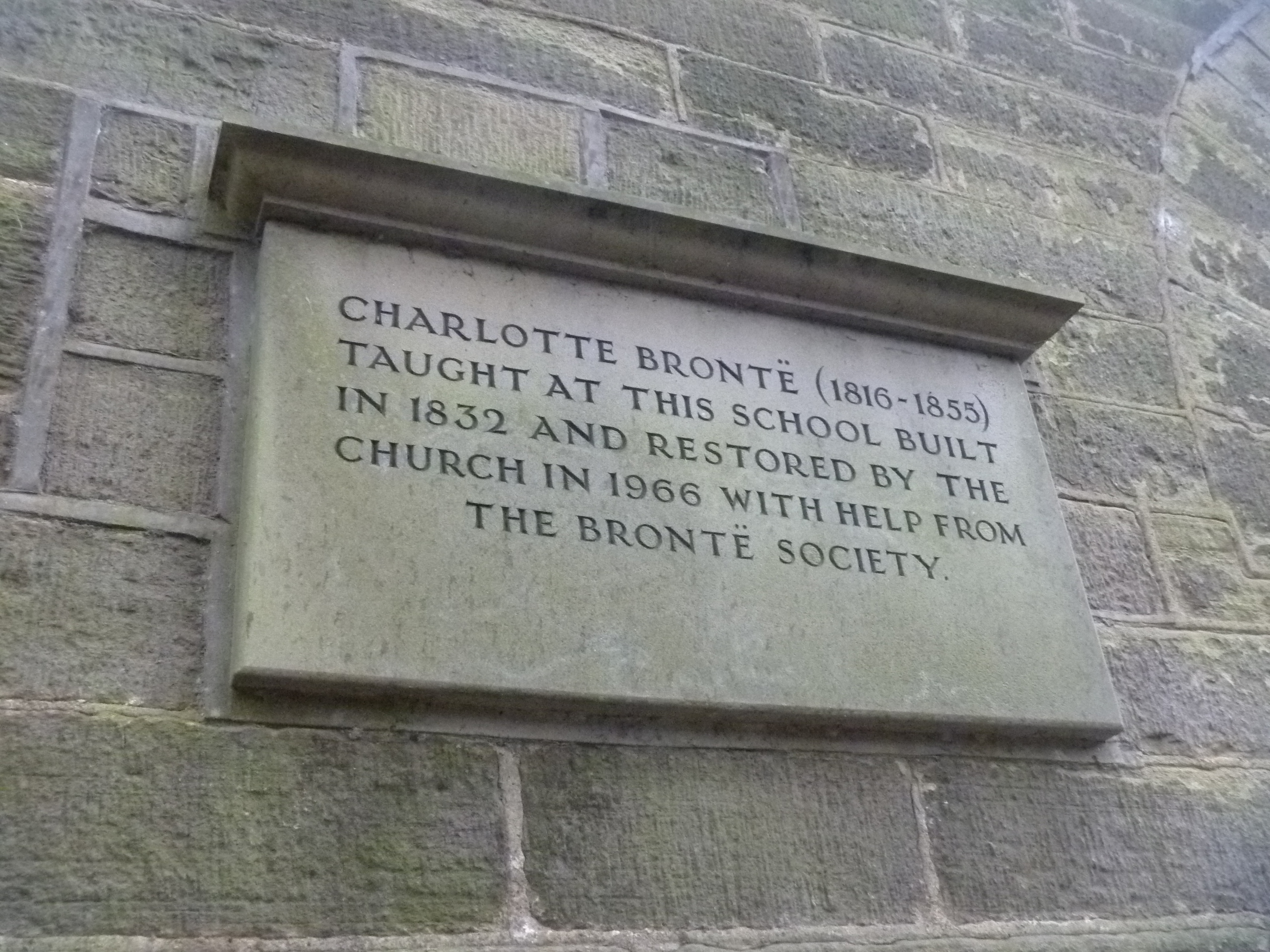
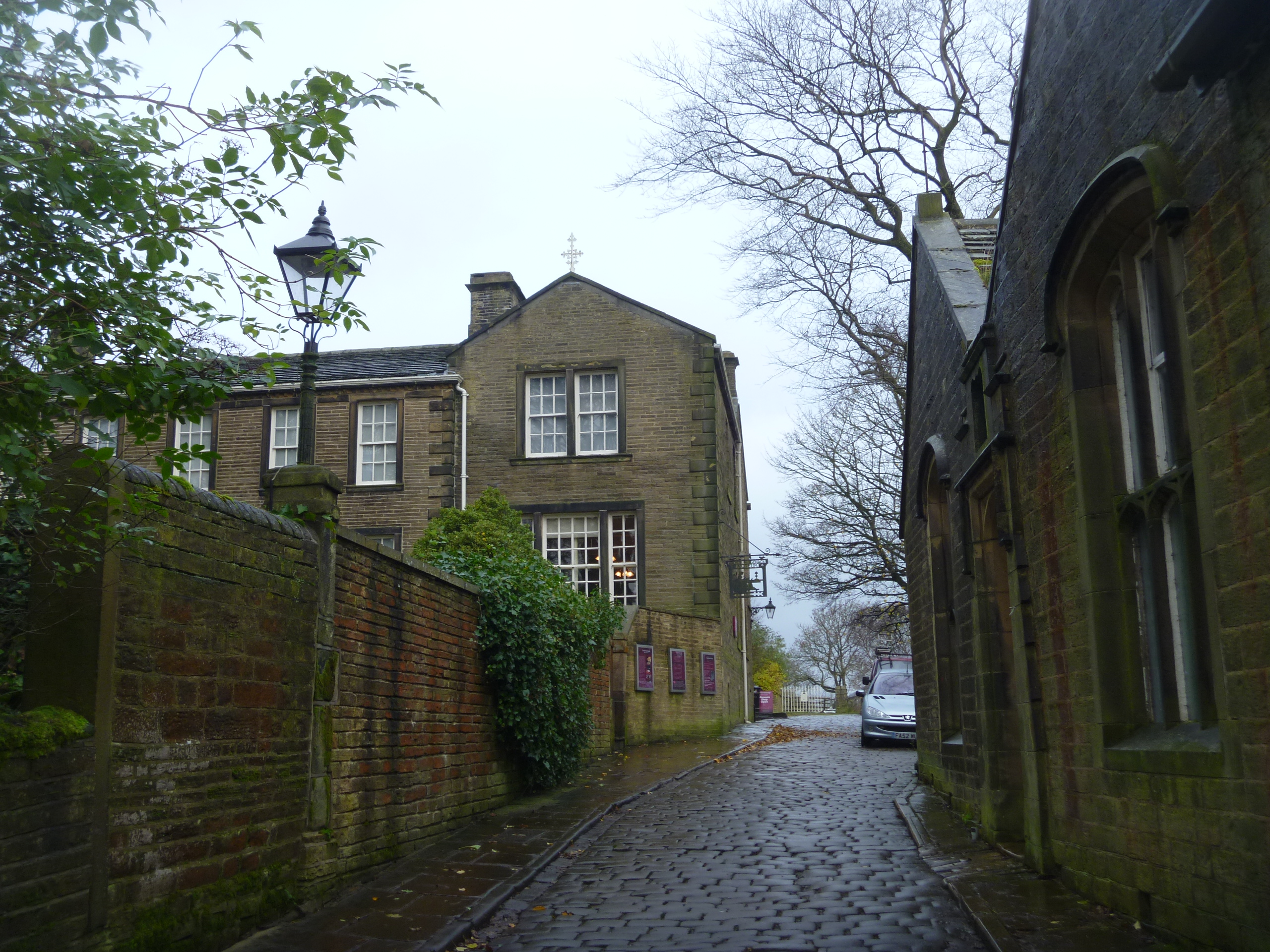
Opposite The Parsonage is the School in which Charlotte Bronte taught at one time.

The Parsonage is on the left and the School on the right

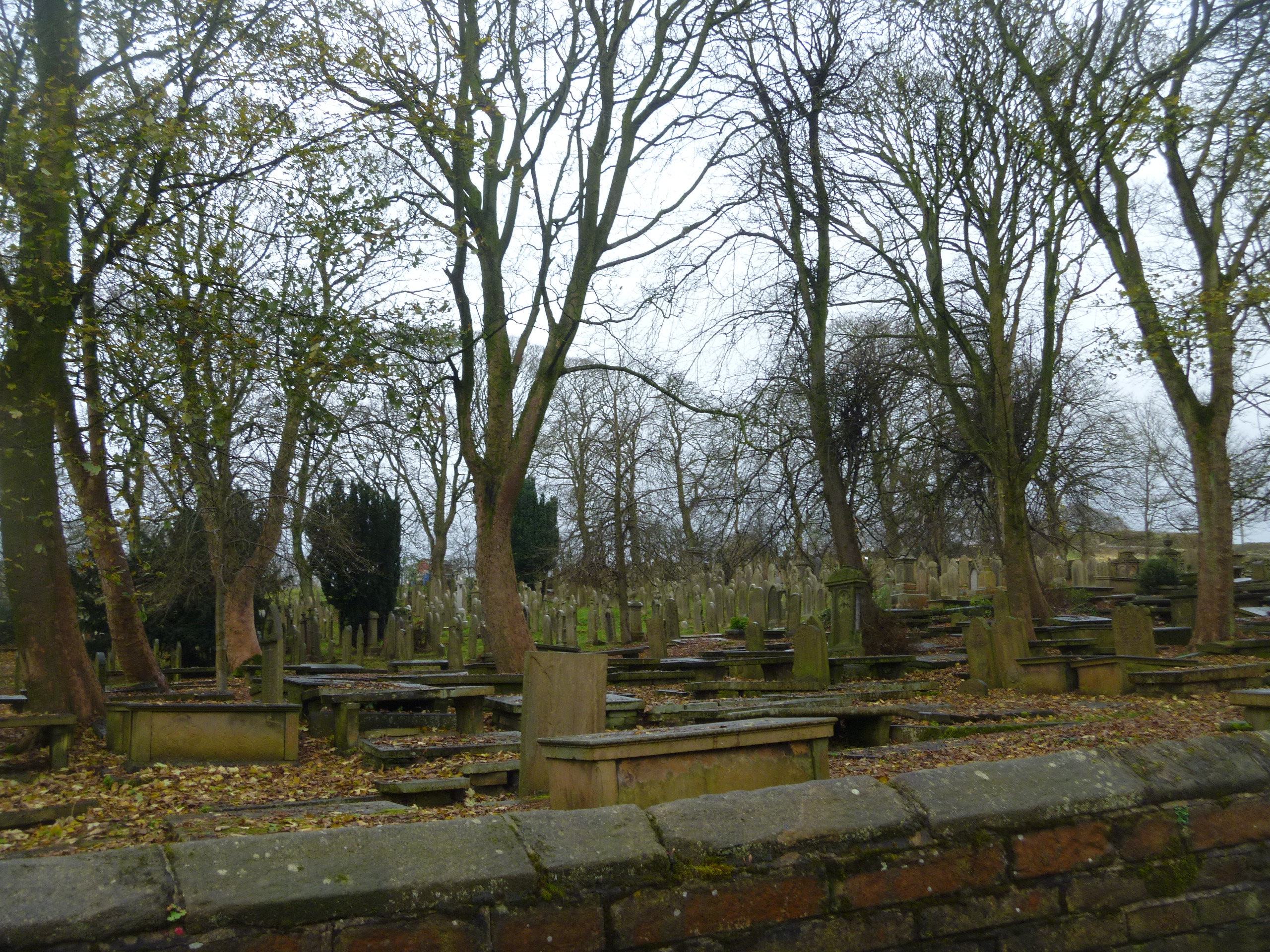
The Churchyard, Haworth

No visit to Haworth can be described without a mention of the weather. Maybe on occasion the sun shines up on Haworth Moor but I do believe that I have yet to experience this phenomenon! Today was cloudy and wet and typically atmospheric. But read here about a summertime visit.

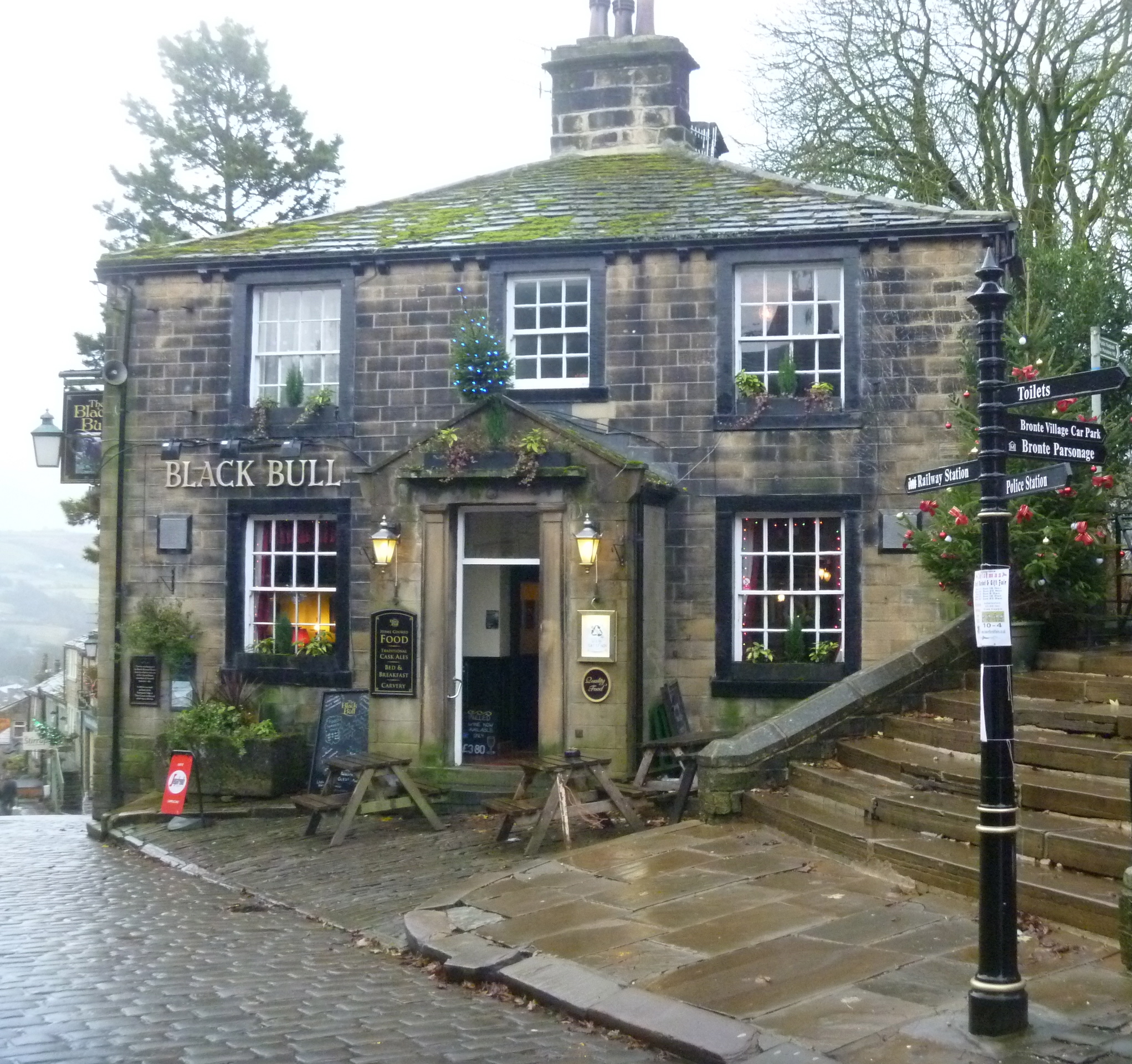
The Black Bull – Branwell was a ‘regular’

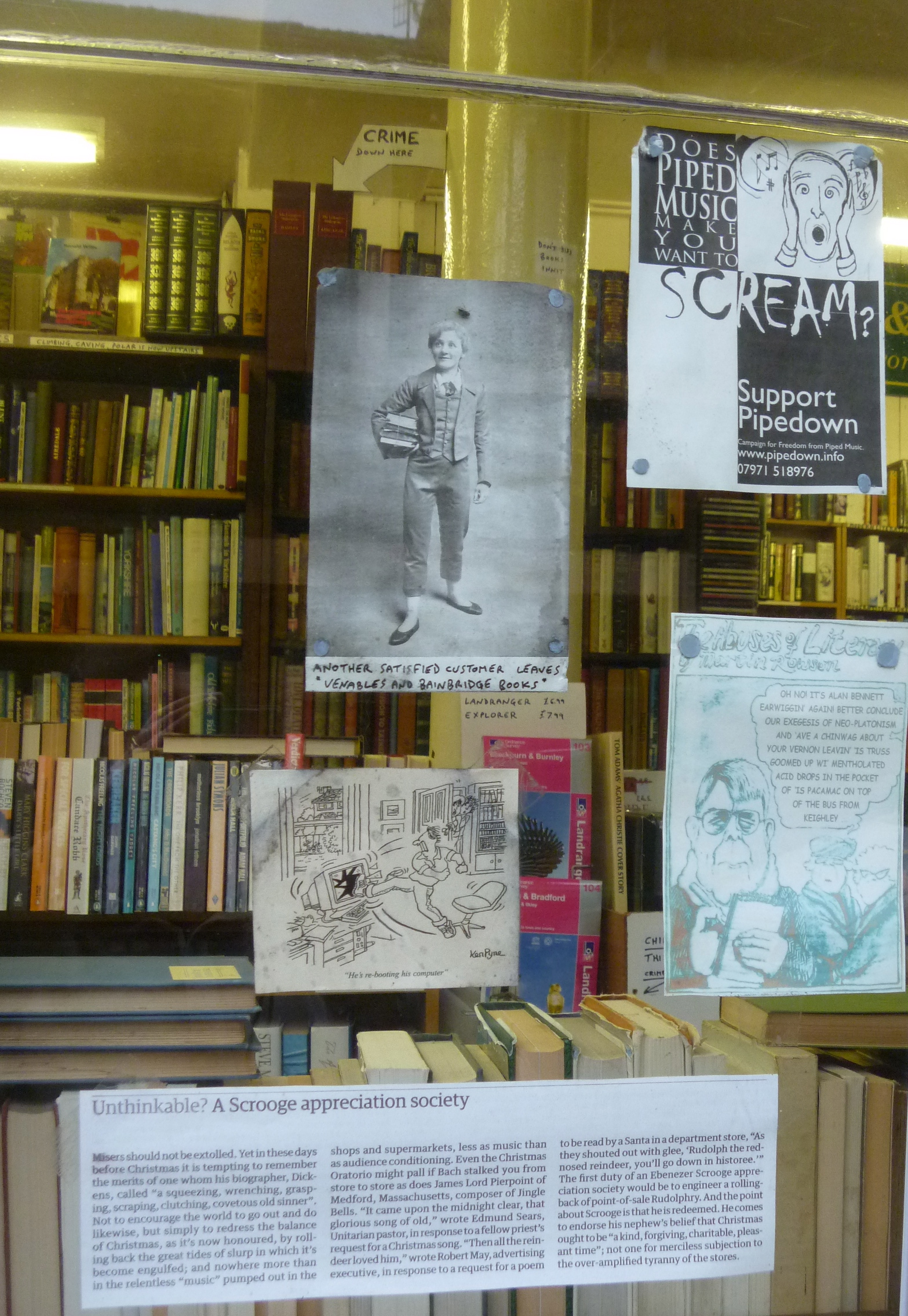
Through The Book Shop Window

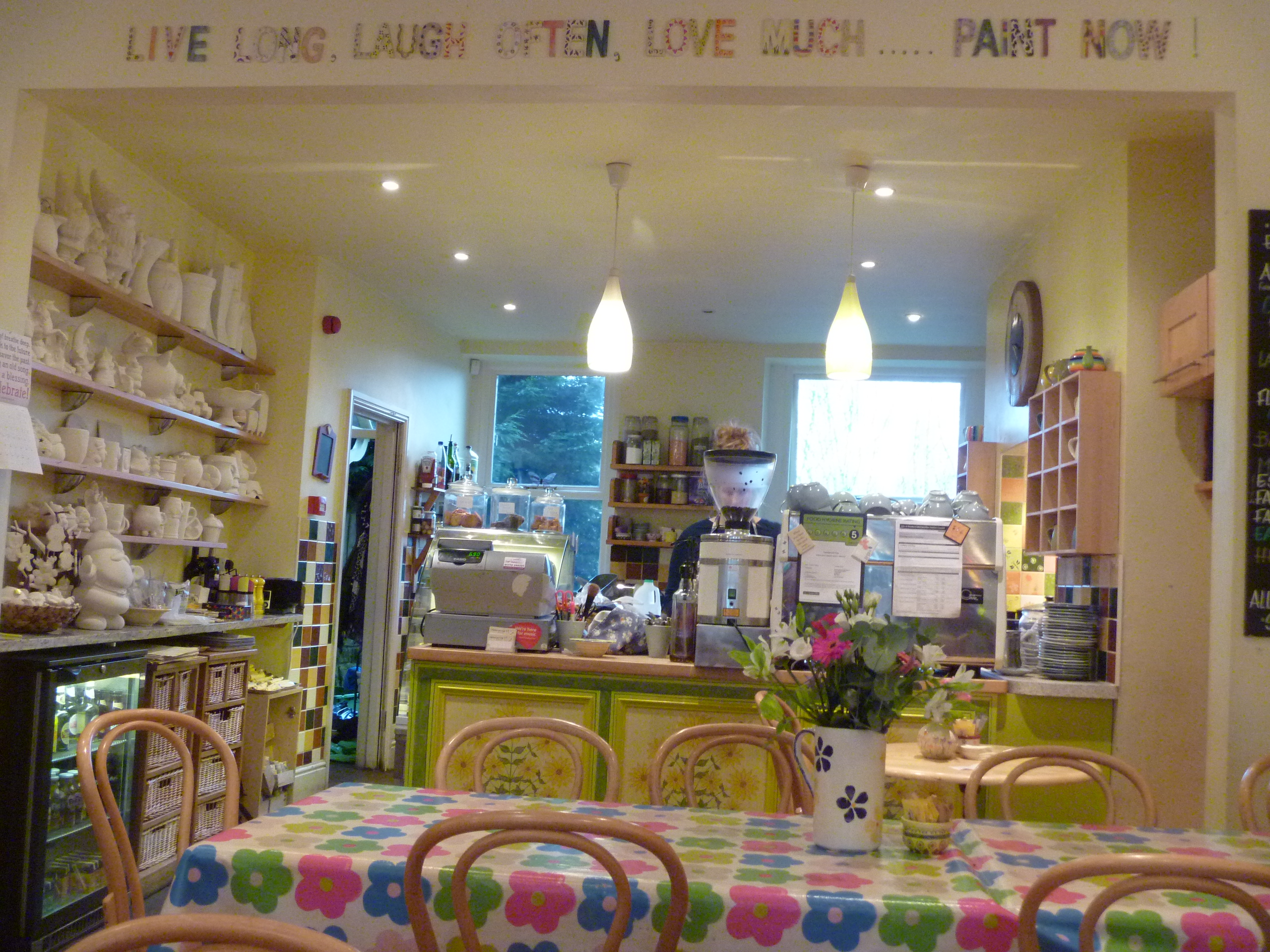
Cobbles and Clay Art Cafe, 60 Main Street, Haworth

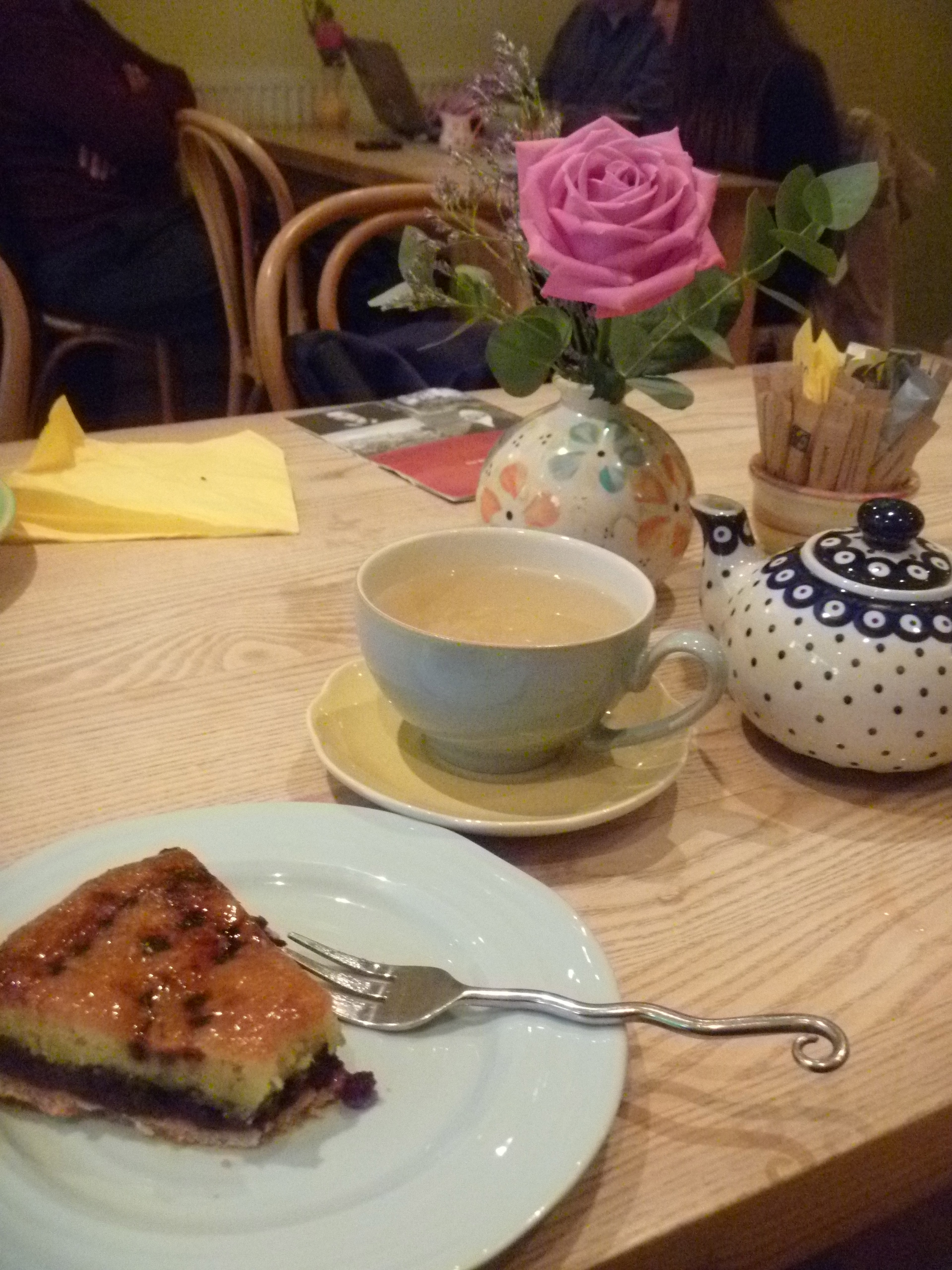
Tea and Tart at Cobbles and Clay

After just over an hour in the Museum we headed for a bright and jolly Haworth tea shop, stopping briefly to enquire whether the bookshop [Venables and Bainbridge] had any copies of Wuthering Heights in Polish for my friend to buy for her daughter-in-law. It didn’t. We were surprised that there were no foreign language versions of the great novels in the Bronte Museum Shop. We know they had sold French and German versions in the past.

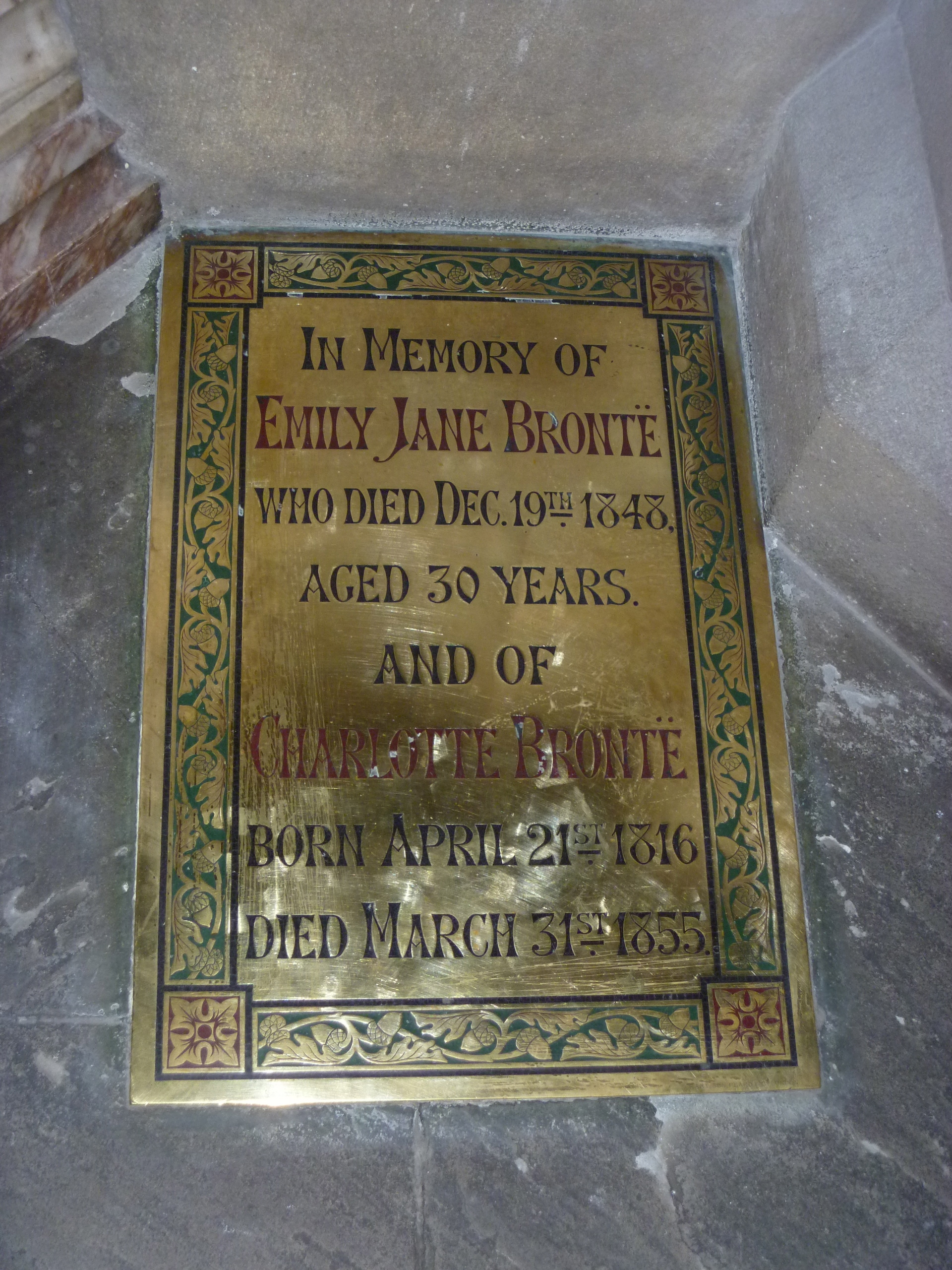
As we returned up the hill, back to the car park, we noticed that the church was open and popped quickly inside to look at the Bronte memorials before leaving the village.

Lord Byron’s Lover’s Books in Leeds

An interesting article caught my eye in The Independent on Sunday on 21st October: Byron Treasure Found in Gift to Used Bookshop.

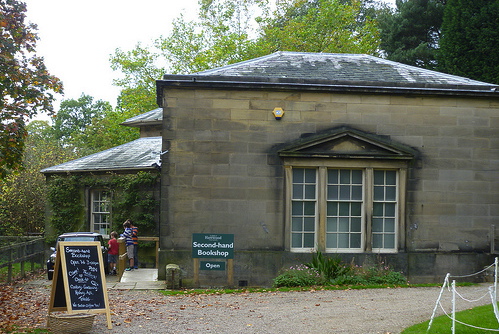
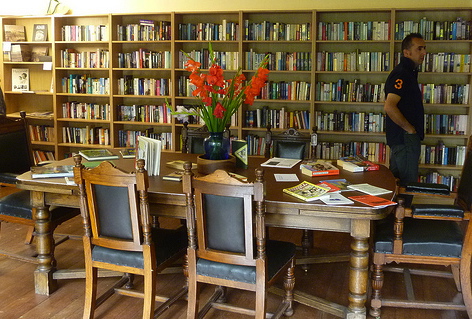
The secondhand bookshop in question is a relatively new one set up last year in a redundant building in the grounds of Harewood House. I’ve been a frequent visitor at the house and love to walk around the terrace gardens, woodland and the walled garden and, if it’s open, browse the book shelves.

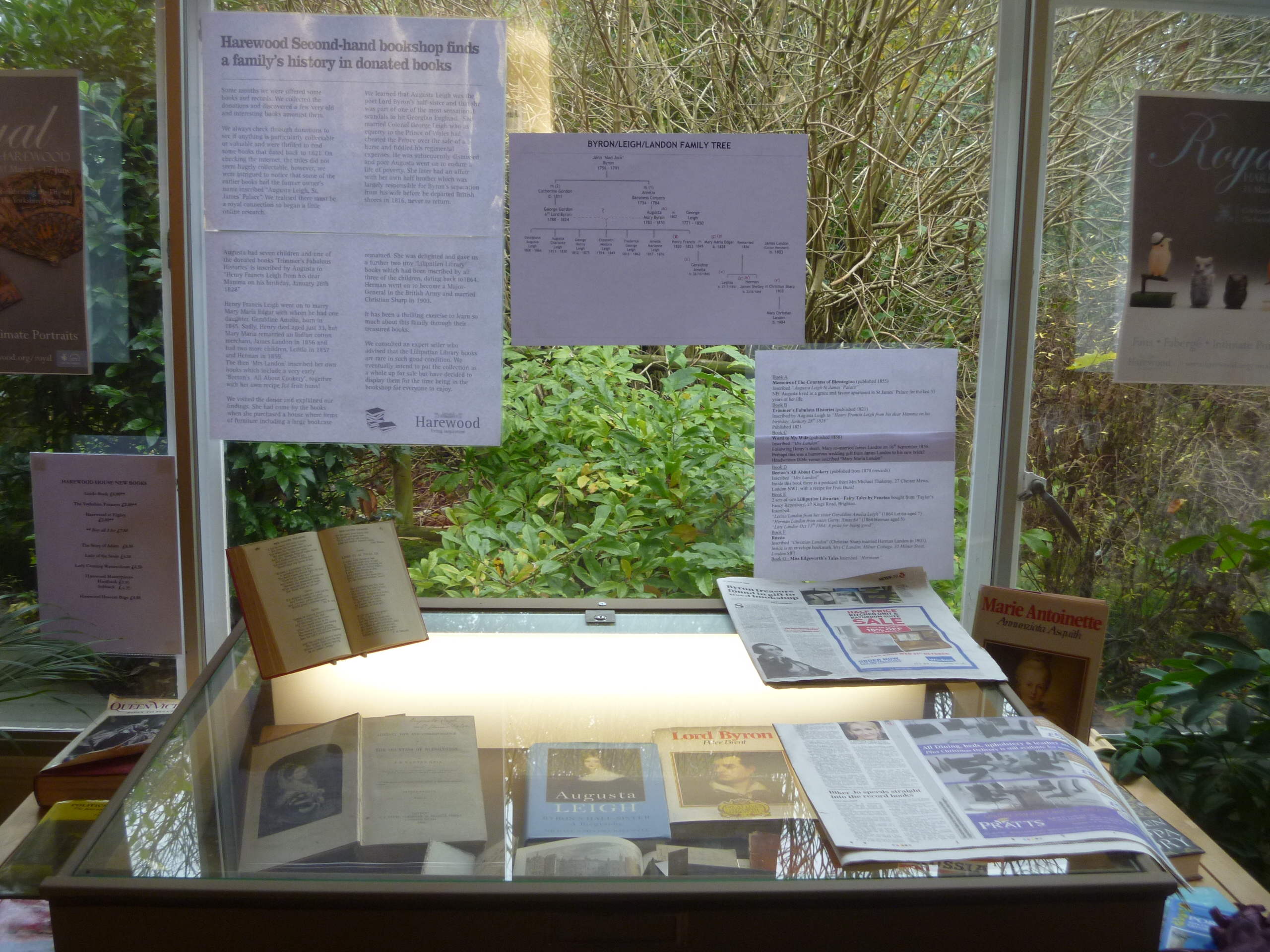
The Augusta Leigh Display at Harewood

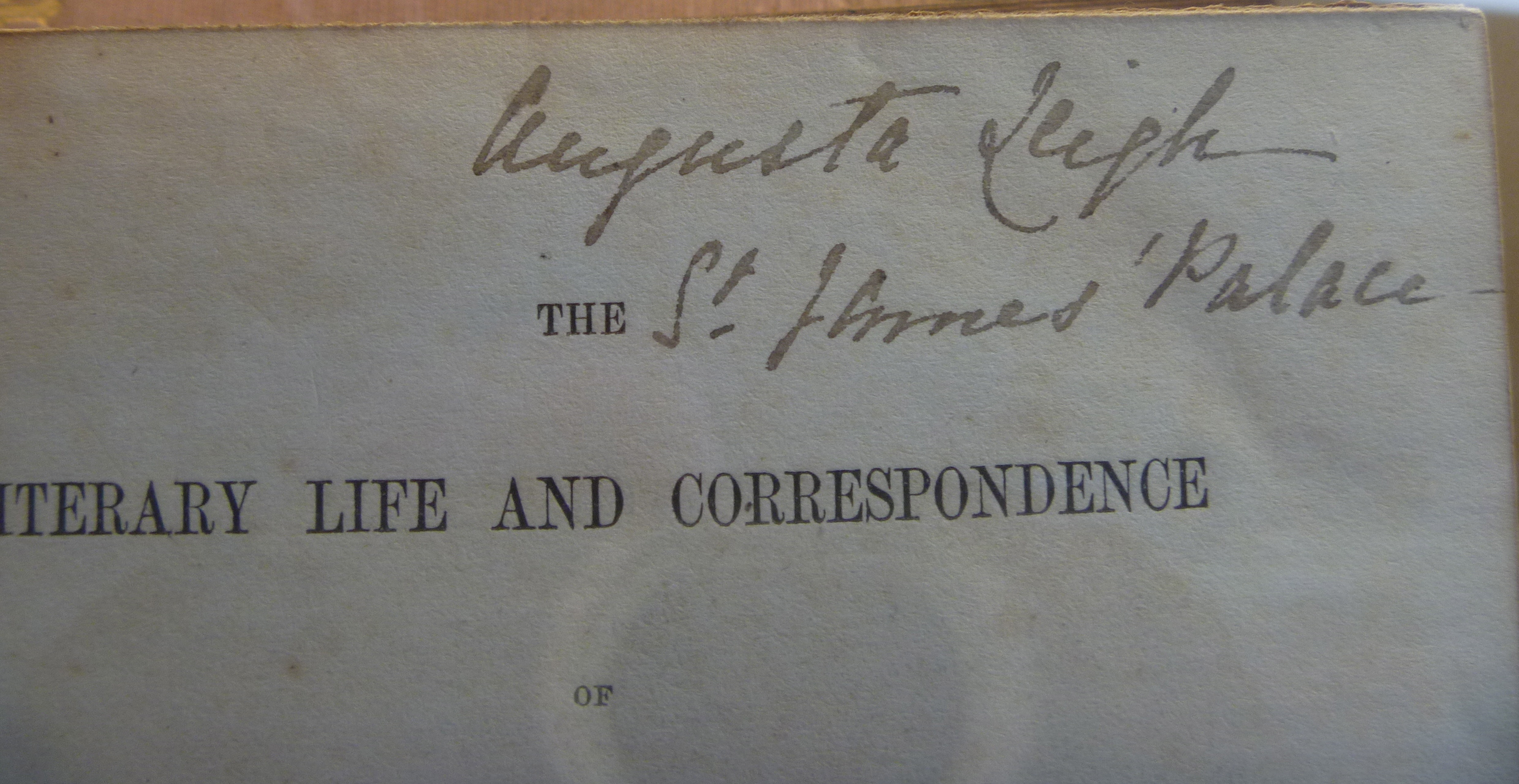
The article in question tells the story of a member of the volunteer staff at the shop discovering amongst donated books some inscribed “Augusta Leigh, St James’ Palace”.

With no idea who the Augusta was Audrey Kingsnorth began an investigation  that lead her to the Byron connection. Not only was Augusta Lord Byron’s (mad, bad and dangerous to know) lover, she was also his half sister, the result of the liaison between John (Mad Jack) Byron and Amelia Osborne. The books had been acquired by the donor (now in her 80s) following the purchase of a London House; the bookshelves of which were to large to move.

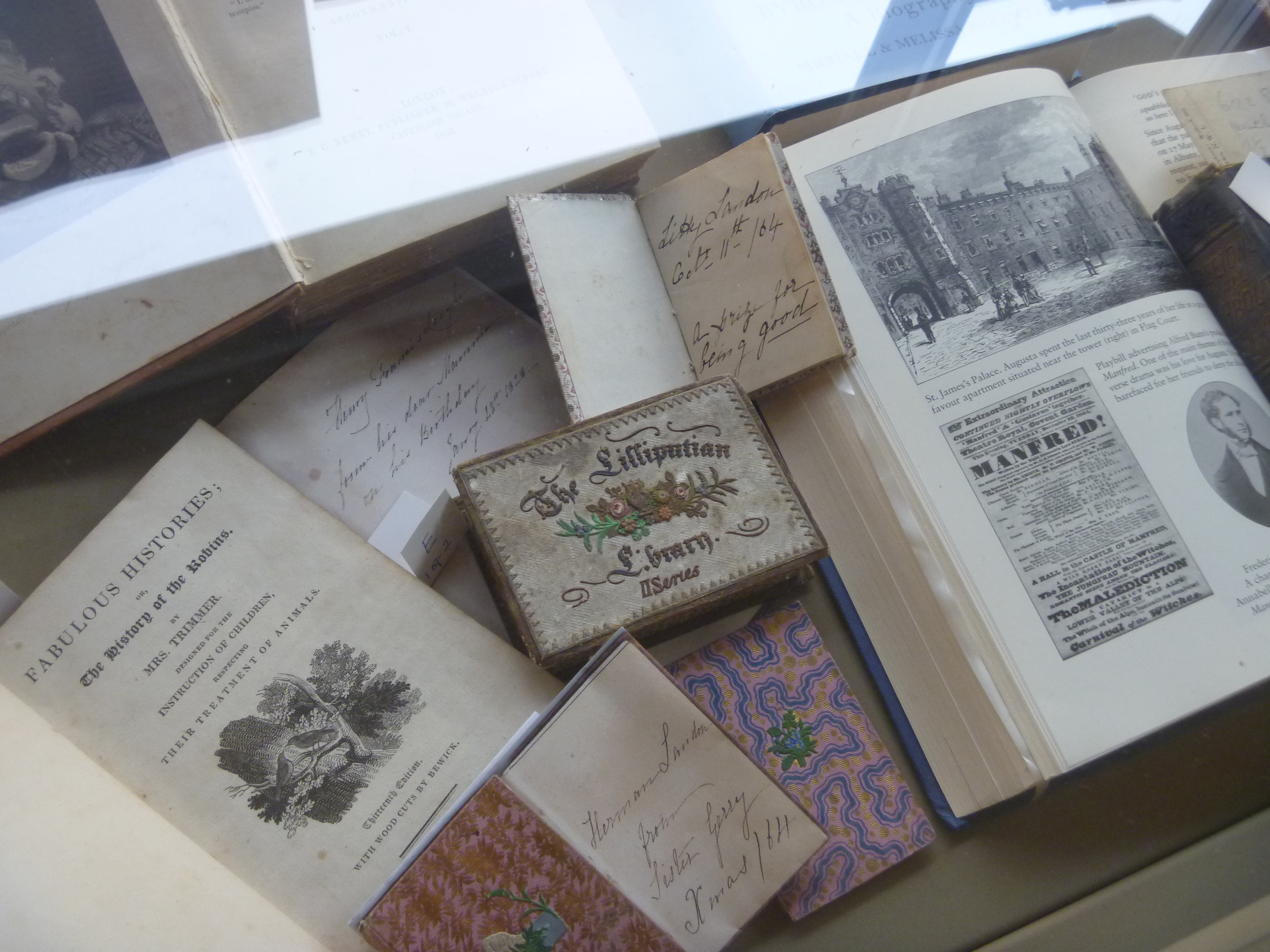
Close-up of the Display

“[One] of the donated books, Trimmer’s Fabulous Histories, is inscribed by Augusta to one of her children: “Henry Francis Leigh from his dear Mamma on his birthday, January 28th 1828″. Henry Francis died at 33, leaving a widow, Mary, and a daughter; Mary remarried and had another daughter and a son. Augusta had seven children, one of whom, Elizabeth Medora, is thought by many to be Byron’s lovechild.” 

Valued recently at around £2500 the books will put up for auction at a later date. As the books are currently still on display in the shop I thought I’d pop along and have a look at this valuable donation to the Harewood Bookshop.

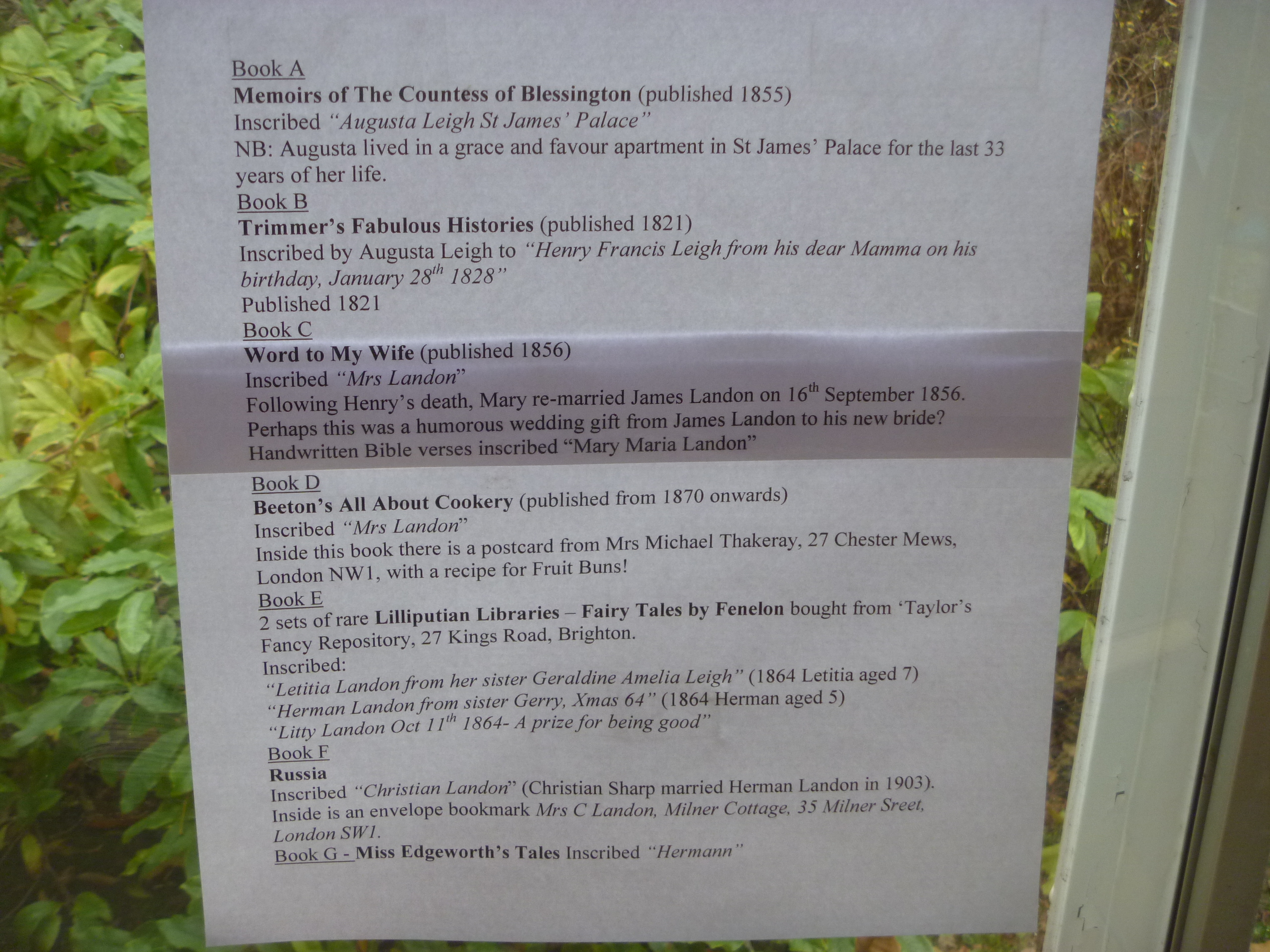
The List of Donations

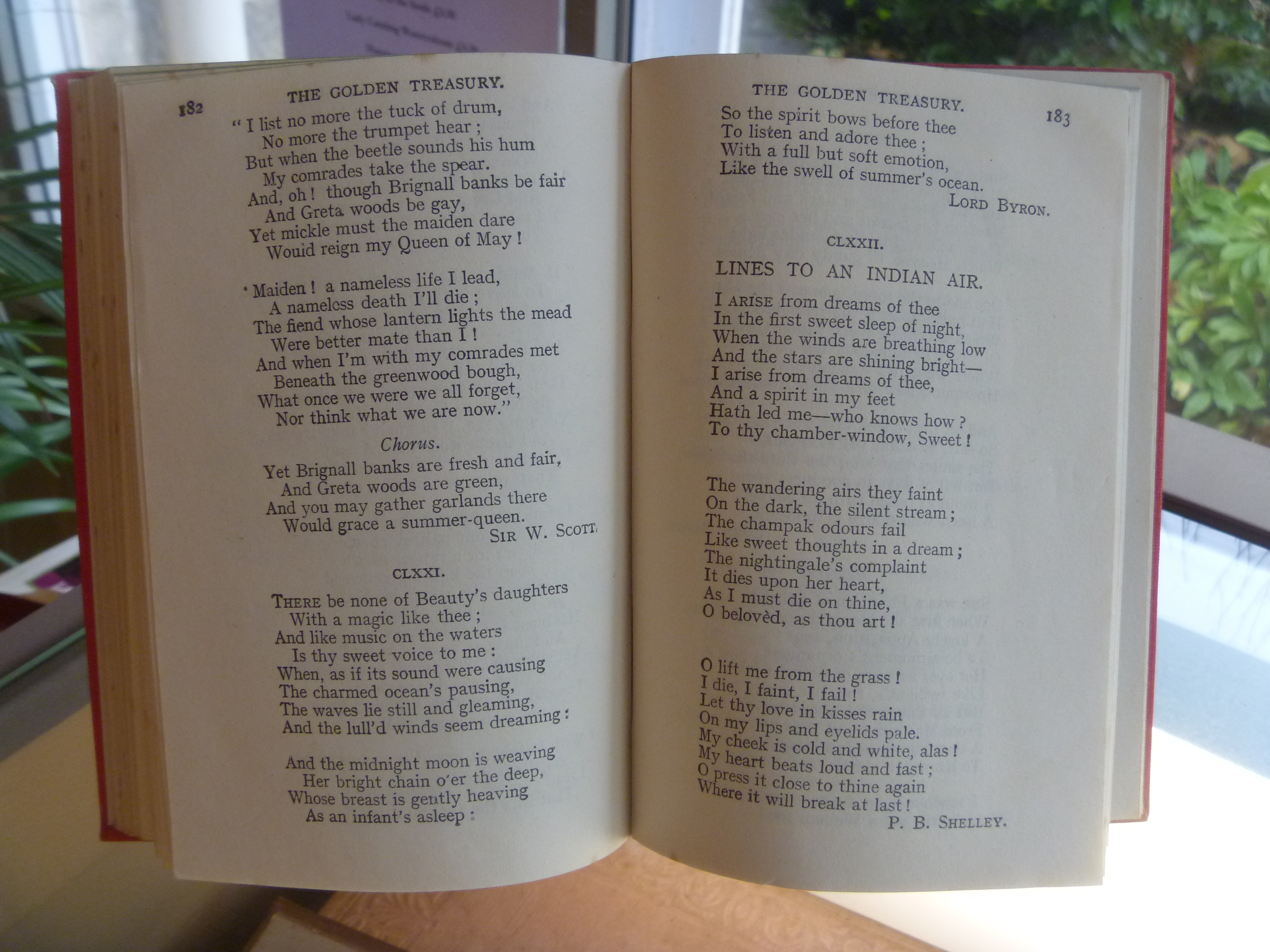
A Copy of The Golden Treasury Open at a Poem of Byron’s

Buckfast Abbey Window

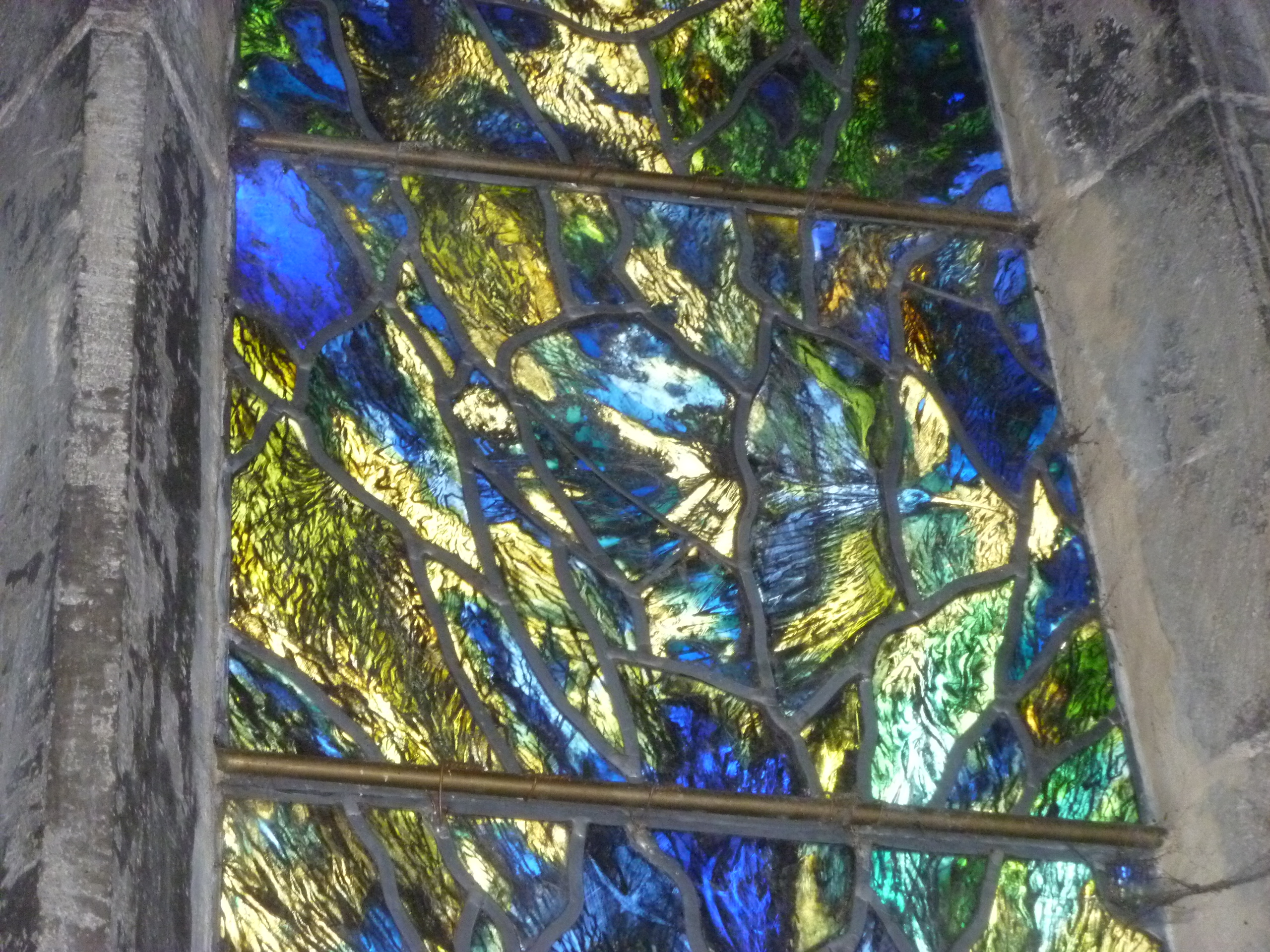
Earlier this month Lynne commented here that she loved the blues of the Millennium Window by Tom Denny at Bolton Percy church she compared it with the newer window at Buckfast Abbey.

Tom Denny Millenium Window, Bolton Percy

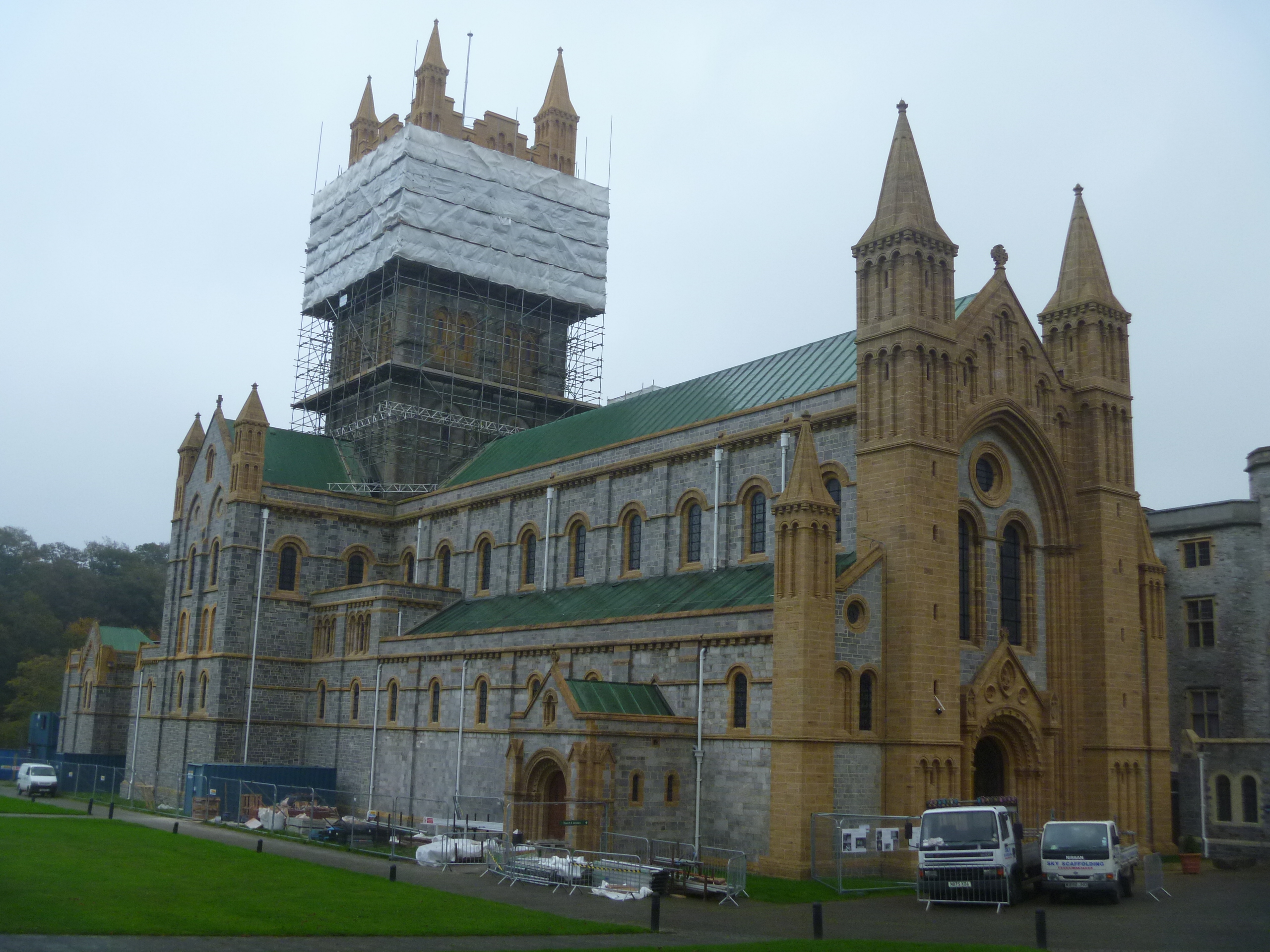
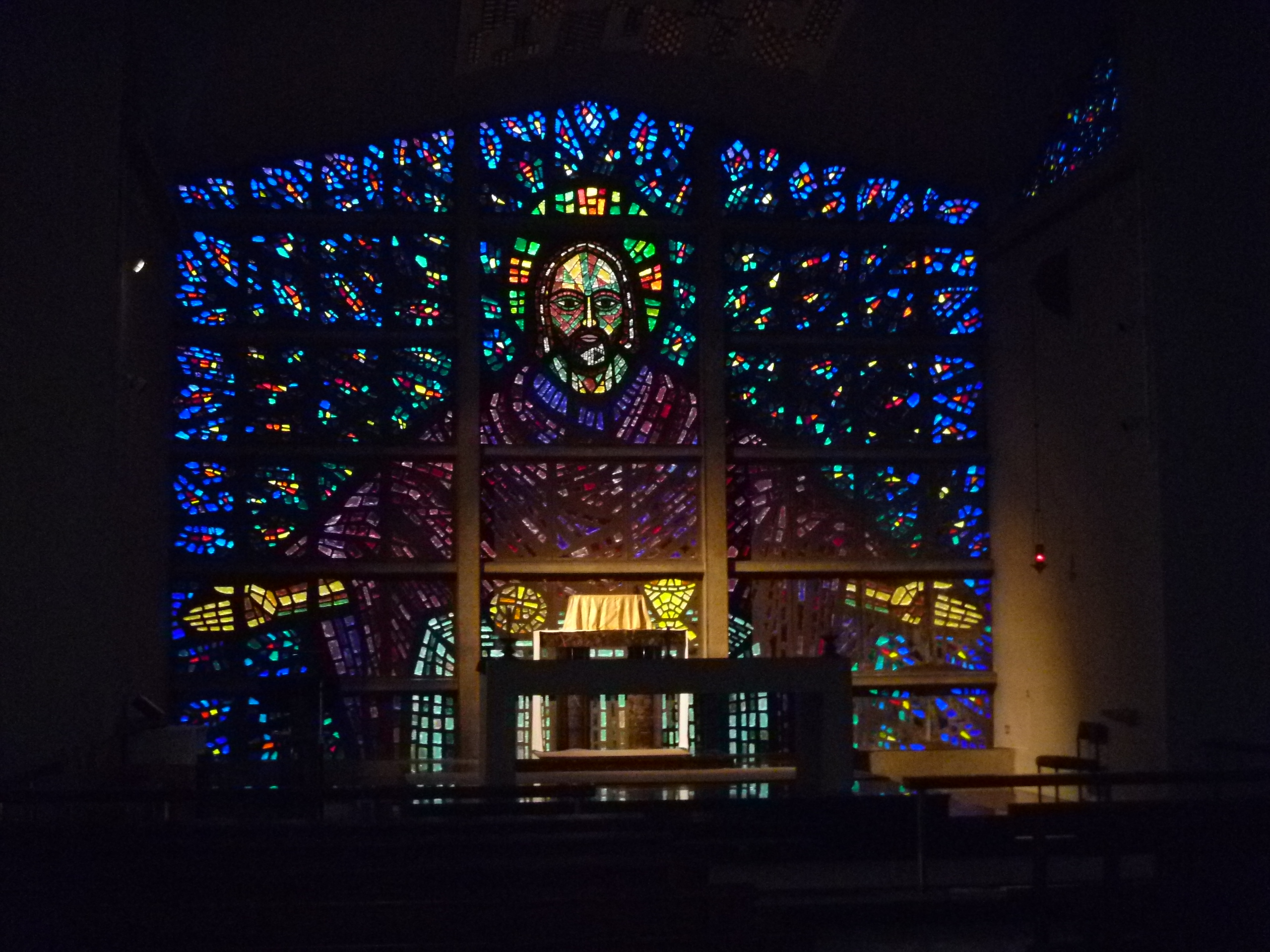
So, after we left Dartington late last Thursday afternoon we drove a few miles to Buckfast Abbey. Lynne specially wanted to show me the stained glass window in the Blessed Sacrament Chapel. But before heading into the Abbey tea and cake called. The Grange Restaurant can be highly recommended for its homemade cakes and cheesecakes!

The Abbey interior and exterior are currently undergoing major renovation works. The nave is full of scaffolding but we made our way to the only dust-free, quiet area The Blessed Sacrament Chapel.

“In contrast to the rest of the Abbey, the Blessed Sacrament Chapel brings a touch of modern. After the main church was completed, the chapel was added to provide a place for quiet prayer, especially during the summer months when thousands of people visit the church daily. The splendid stained glass windows depicting Christ at the Last Supper, were designed and made in the Abbey’s workshops by the monks.”

[http://www.buckfast.org.uk/site.php?use=stills]

The window is breathtaking and to think that it was made by the monks themselves and we could actually touch the chunky roughly-hewn glass.