A Further Selection of Colchester Landmarks

There is, of course, more to Colchester than just recycled Roman bricks. Peake’s House is in the Dutch Quarter which was named after the Flemish weavers who settled here during the 16th century.
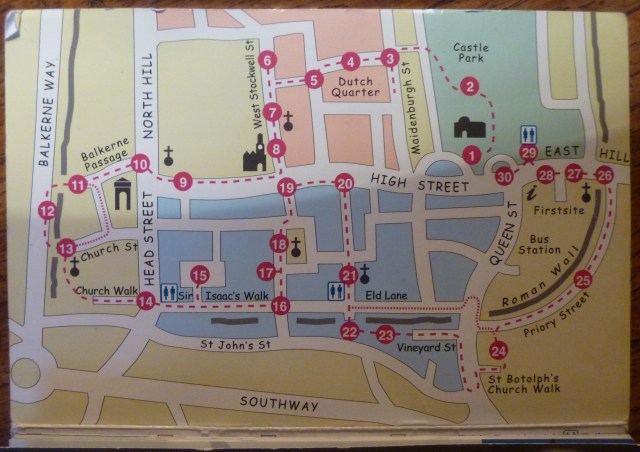
Heritage route

 Heritage Trail Route

St Helen’s (just a few steps from East Stockwell Street) was first recorded in 1097 but its history goes back to the 3rd century AD. It was founded by Empress Helena (St Helena is Colchester’s patron saint). She was the daughter of King Coel (of Old King Cole nursery rhyme fame) and mother of Emperor Constantine the Great who was born in Colchester.
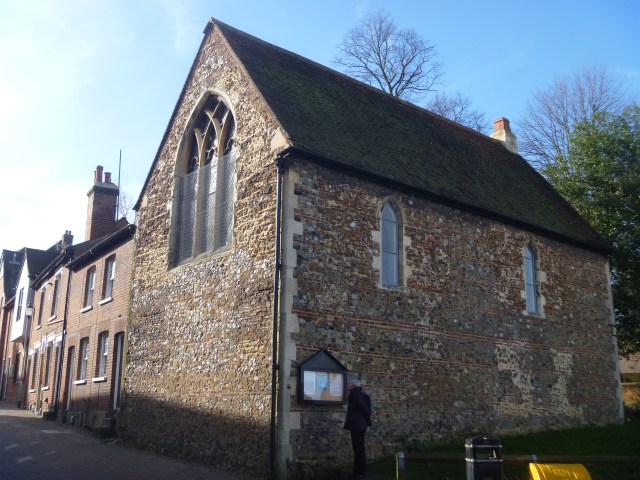
St helen's Chapel

Since 2000 AD the chapel has been a Greek Orthodox parish church of the Patriarchate of Antioch. Inside the tiny church the walls are hung with icons to the various saints including Saint Helena and Saint Barbara.
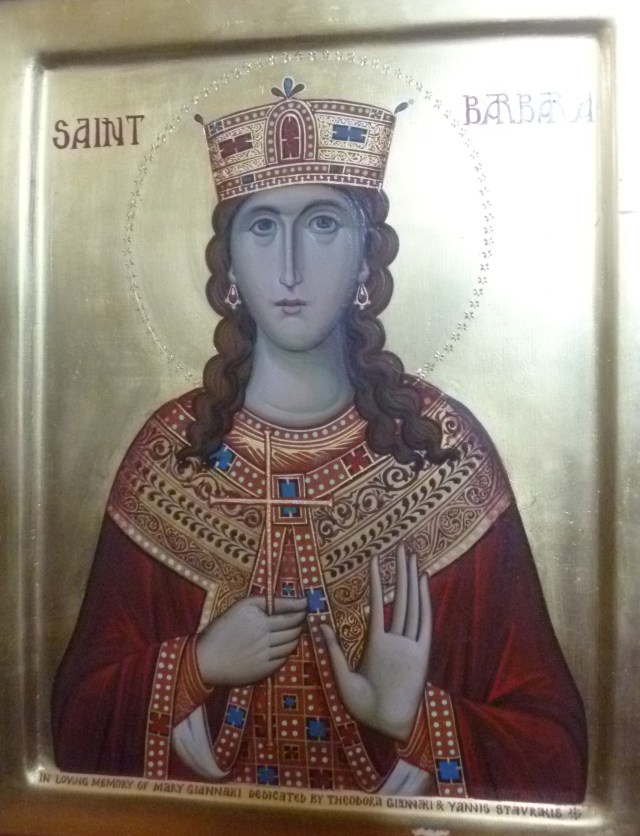
Saint Barbara

Next to the chapel on one side is a former Quaker burial ground and on the other a line of black bricks leads slightly uphill to a window through which you can see some of the remains of a vast Roman theatre that had been capable of seating 3,500 people. A mural on the wall shows an artist’s impression of the theatre when it was in use.
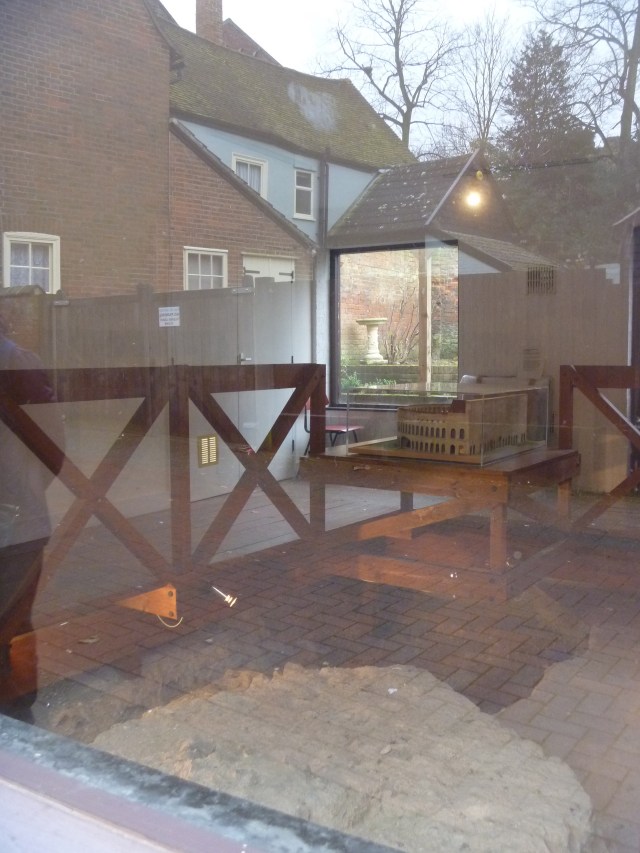
Theatre and reflection

The Roman Theatre Foundations – a Reflections of the Street
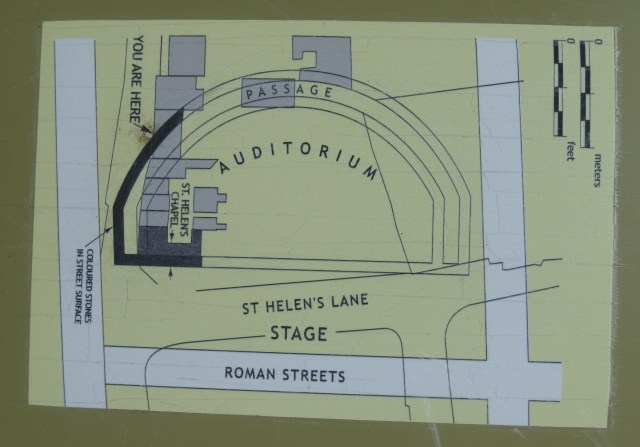
Roman theatre

Plan of the Roman Theatre superimposed onto a modern street map

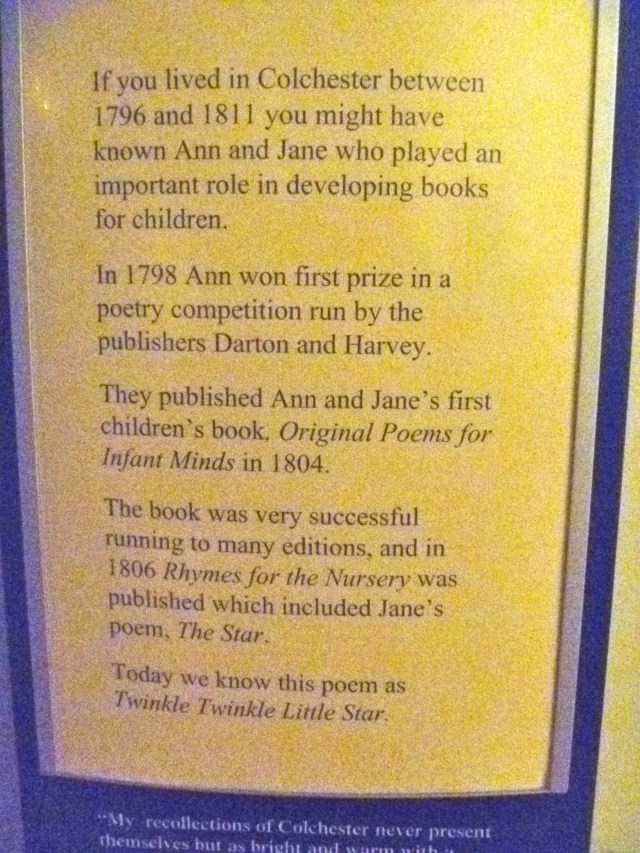
Nearby, on West Stockwell Street, is the former home of Jane and Ann Taylor who were famous for writing verse. Jane Taylor wrote the nursery rhyme ‘Twinkle, twinkle little star’ in 1806.
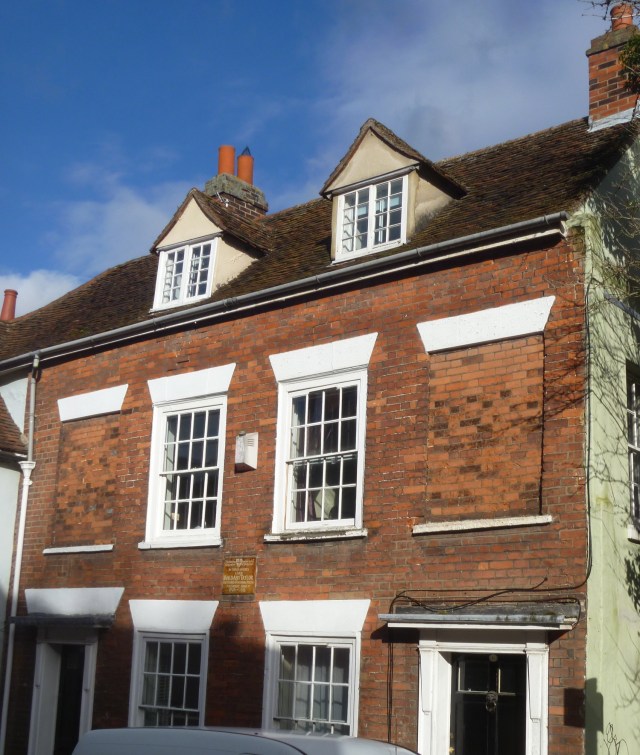
Twinkle house

Home of Jane and Ann Taylor

about taylors

We read about the Taylors in Colchester Museum
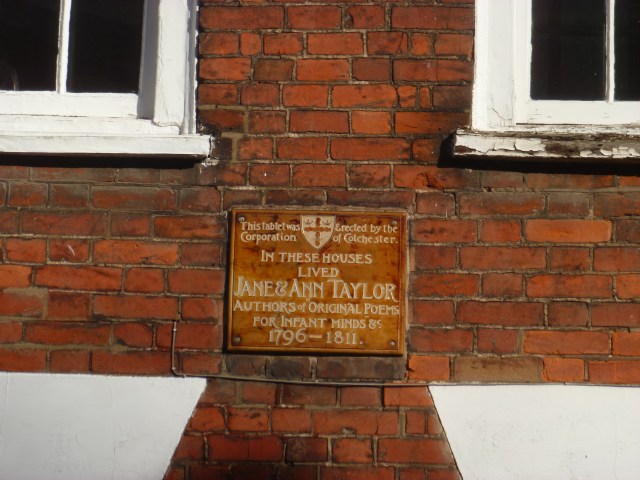
Twinkle twinkle

Colchester Town Hall on the High Street has an impressive tower designed by John Belcher and opened in 1902. It rises 50m above the street and is surmounted by a statue of St Helena and other historical figures connected with Colchester including Queen Boudicea of the Iceni. She led a rebellion against the Romans in 60 AD.

Town Hall

Colchester Town Hall

We sought out Tymperleys the former home of Dr William Gilberd a scientist and physician to Queen Elizabeth I. It’s now a tea room and until very recently had housed a large collection of Colchester-made clocks. Bernard Mason who had collected the clocks and lived at Tymperleys left the entire collection and the house to the borough. Now only a very small selection may be seen in the Colchester Museum.
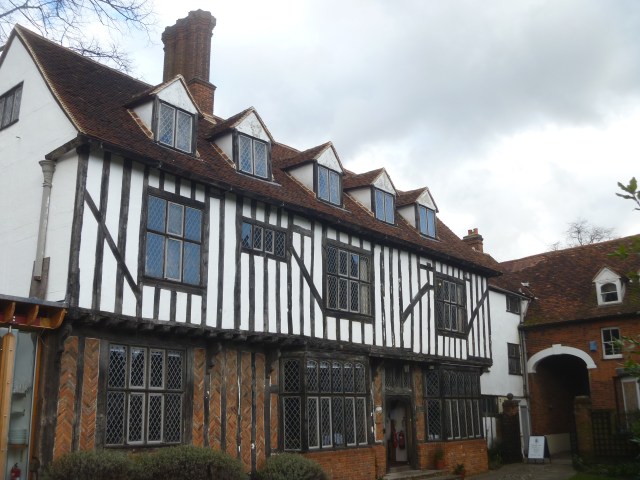
Tymperleys

Tymperleys

You can’t miss Jumbo! It’s a huge brick water tower built in 1882 and named for a famous elephant at London Zoo. The Rev John Irvine who lived in his rectory on the site of the present Mercury Theatre was not happy about the giant structure erected at the bottom of his garden and described the monstrosity as a Jumbo. The name stuck and the builders added a brass elephant to the weathervane as a reminder to the unhappy clergyman.
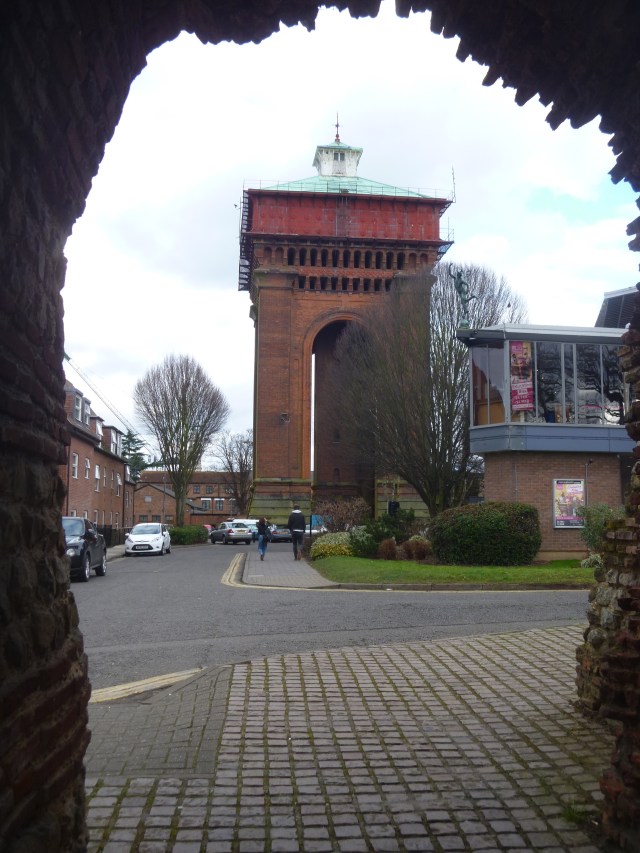
Jumbo and theatre Balkerne

Jumbo and the Mercury Theatre seen through Balkerne Gate

In addition to the Heritage Trail we also followed the Town to Sea Trail : Colchester and its historic port, the Hythe. “A unique art trail, designed for walkers and cyclists, follows the tidal River Colne through some lesser known areas of Colchester”.  We followed the whole of the 2 mile trail from its start at firstsite, an arts centre near the castle, to the end at the Hythe, a mixture of deserted or renovated quayside warehouses and modern out of town flats and shopping centre. We had a coffee in B&Q at Colne Causeway.
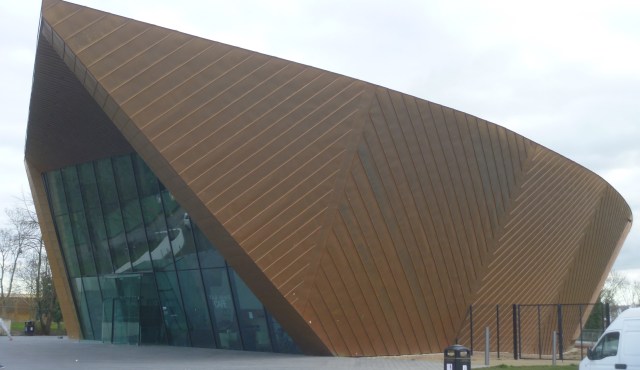
Firstsight

firstsite

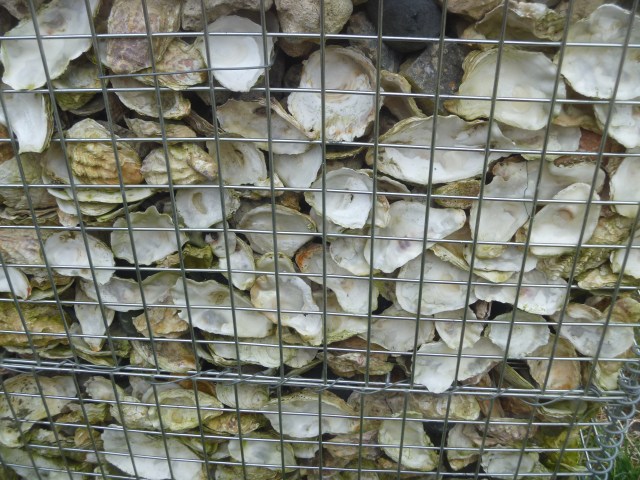
oyster shells

oysters

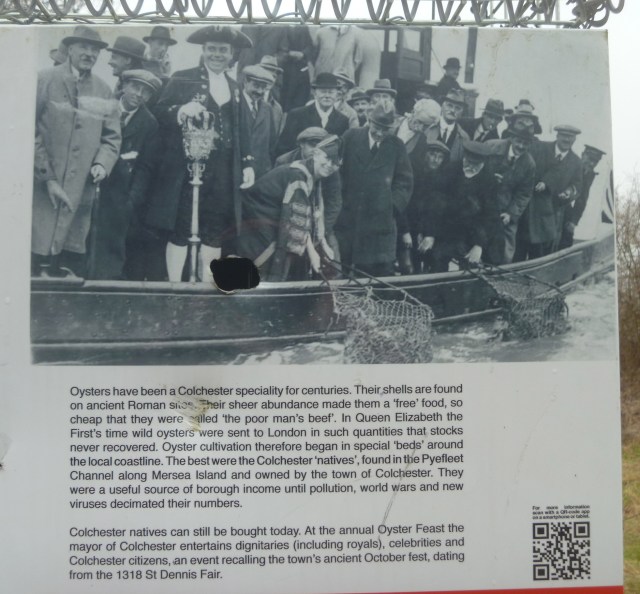
Information Board : Colchester Oysters are the best!
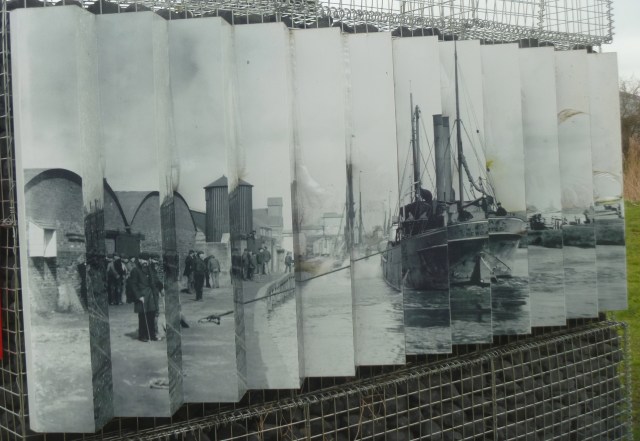
R Colne in its heyday

The River Colne in its Heyday

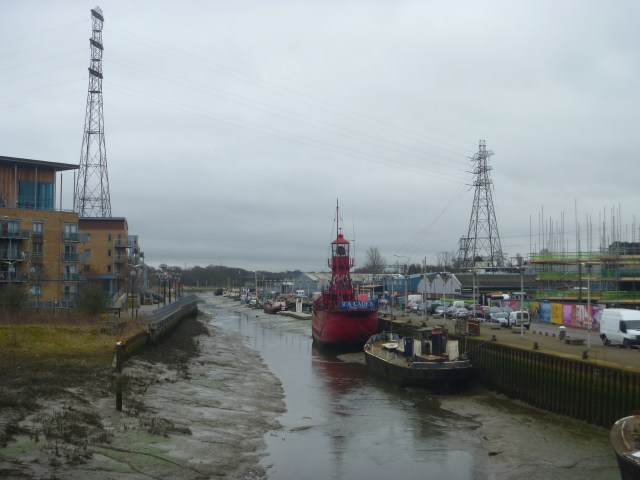
The Hythe

The Hythe today

Tidal river colne today

The Tidal River Colne Today

The highlight of the walk, but on a slight detour, was the Church of St Leonard at the Hythe; preserved by the Churches Conservation Trust its opening hours are limited but we were lucky again.
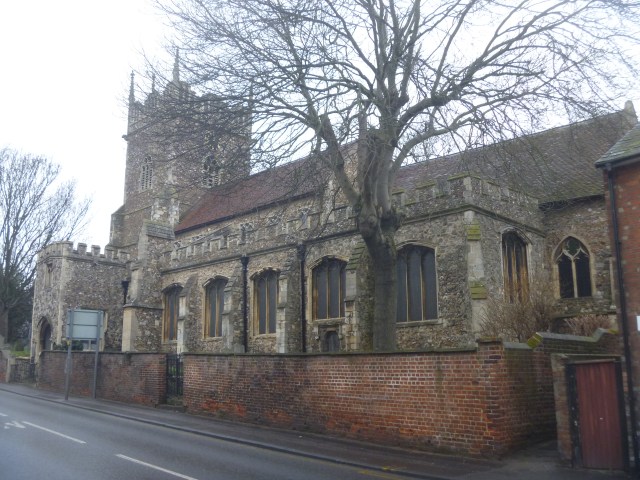
St leonard

St Leonard-at-the-Hythe

Interior

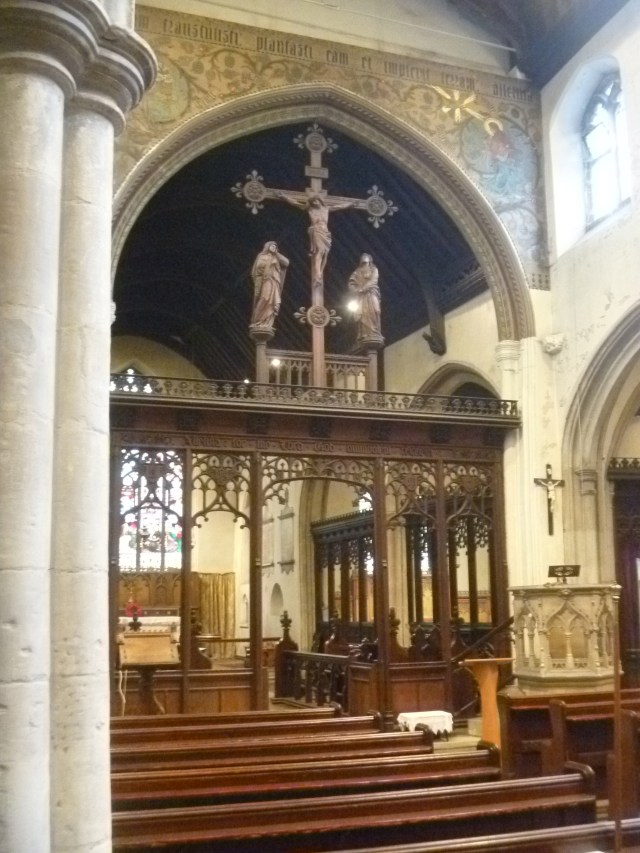
Interior : Early 20th Century Wall Paintings above the Arch once covered the whole Church
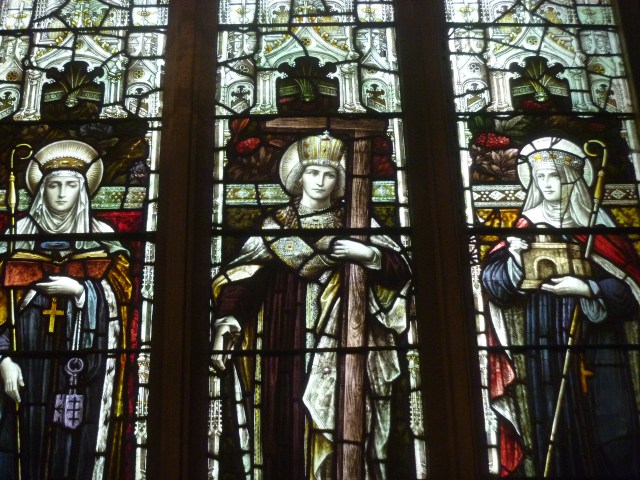
Windows St leon.

Early 20th Century Stained Glass : Sts Osyth, Helena and Ethelburga
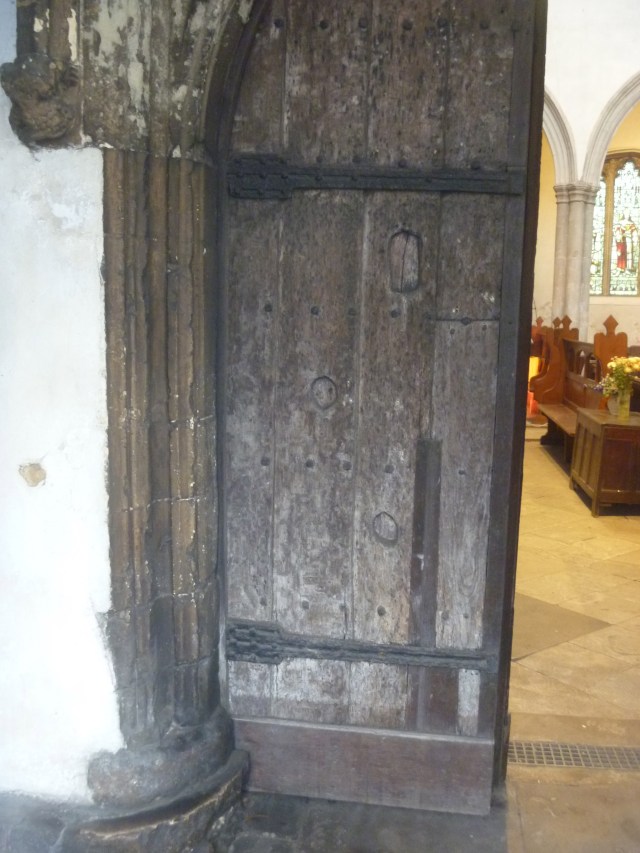
Door musket holes

The Medieval door of this old port church still bears the holes made by troops to put muskets through during the English Civil War.

“Perhaps it is little known that Twinkle, Twinkle Little Star actually consists of 5 verses, with the fifth verse rarely sung. Here’s the complete 5 verses, taken from the Oxford Dictionary of Nursery Rhymes (2nd edition, 1997), with the repetition of the first two lines added to fit the melody.” [source]

Twinkle, twinkle, little star,
How I wonder what you are!
Up above the world so high,
Like a diamond in the sky.
Twinkle, twinkle, little star,
How I wonder what you are!
****
When the blazing sun is gone,
When he nothing shines upon,
Then you show your little light,
Twinkle, twinkle, all the night.
Twinkle, twinkle, little star,
How I wonder what you are!
****
Then the traveller in the dark,
Thanks you for your tiny spark,
He could not see which way to go,
If you did not twinkle so.
Twinkle, twinkle, little star,
How I wonder what you are!
****
In the dark blue sky you keep,
And often through my curtains peep,
For you never shut your eye,
Till the sun is in the sky.
Twinkle, twinkle, little star,
How I wonder what you are!
****
As your bright and tiny spark,
Lights the traveller in the dark,—
Though I know not what you are,
Twinkle, twinkle, little star.
Twinkle, twinkle, little star,
How I wonder what you are!
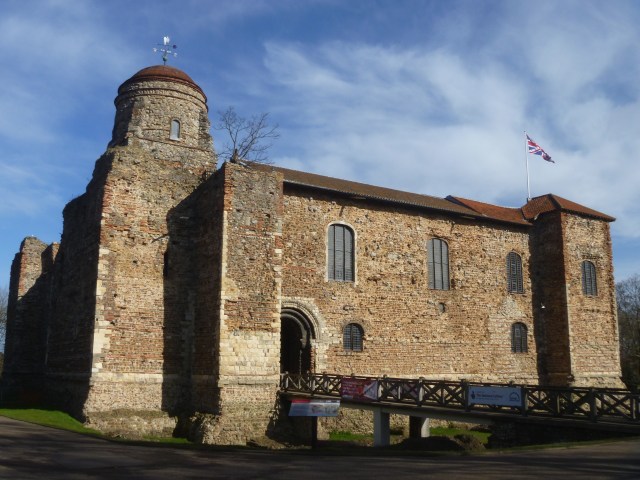
Colchester Castle Now Open!

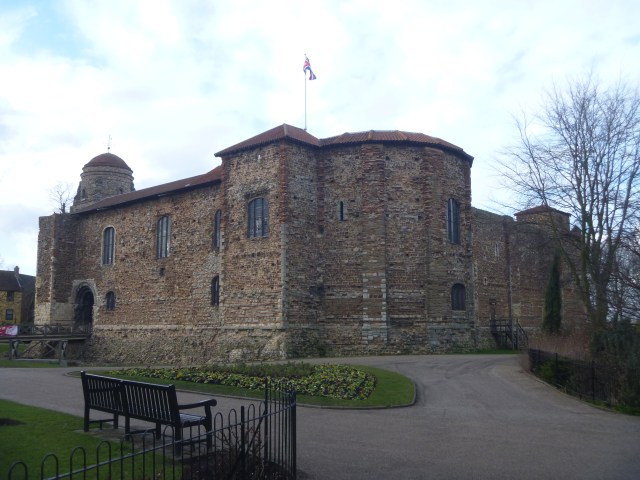
Colchester Castle

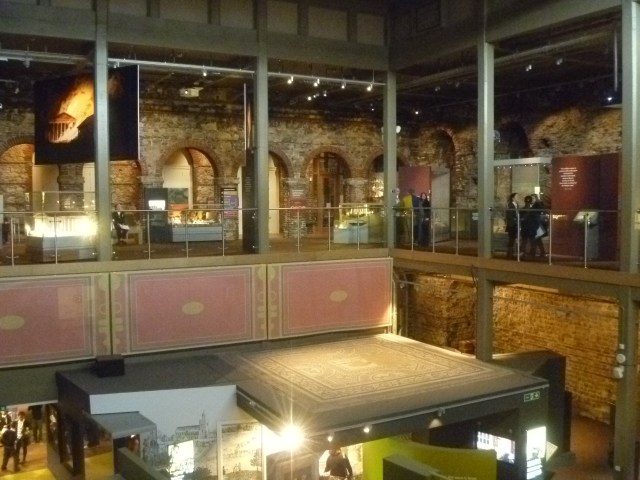
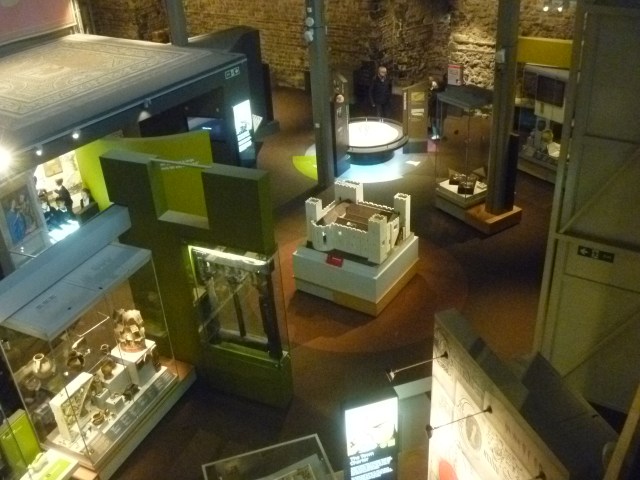
After a 16 month closure and a budget of £4.2 million Colchester Castle Museum reopened last summer (2014). With Art Fund membership cards we gained free admission and spent over two hours inspecting and admiring the amazing contents – here are quality and quantity – a magnificent collection of Roman and other antiquities.

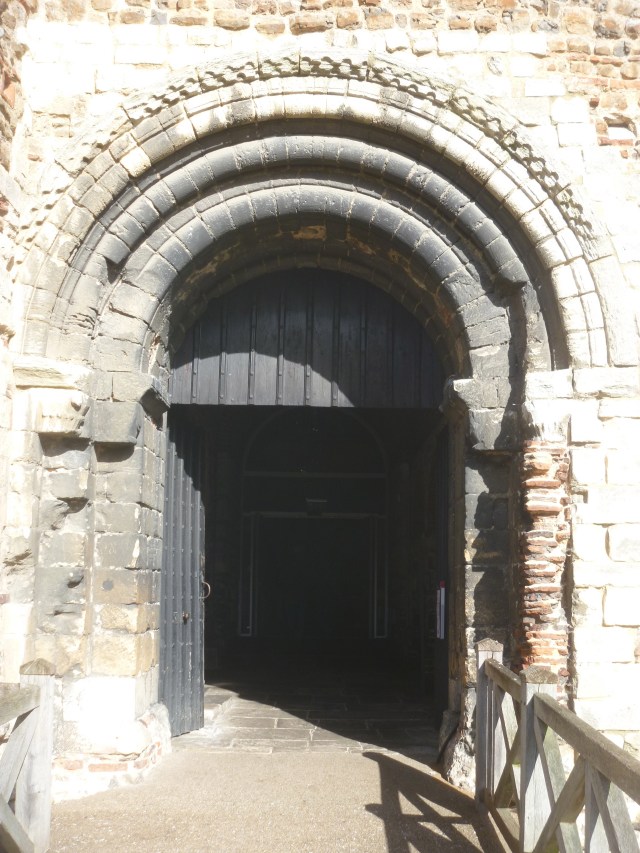
Castle keep door

Welcome to Colchester Castle – come on in!

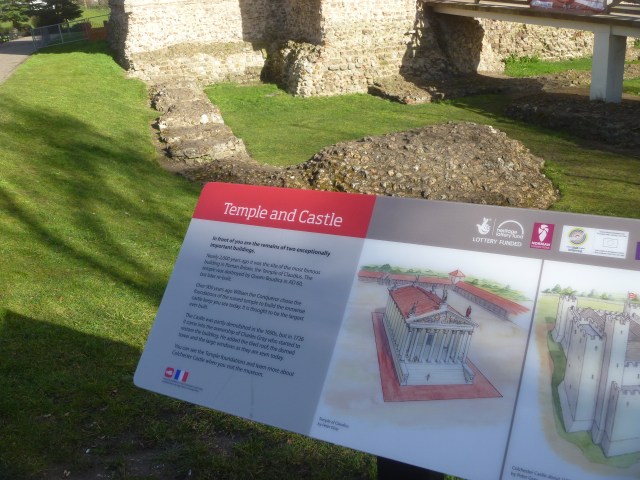
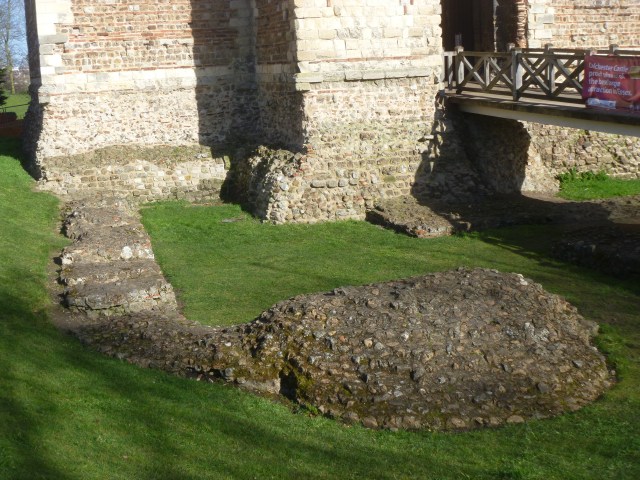
Built on top of the foundations of the Roman Temple of Claudius you can read about the castle (the largest Norman castle keep in Europe) and its contents elsewhere so here I’ve just selected a few of the contents that particularly impressed me.

Castle built on temple

The Castle was Built on the Temple Foundations

Temple remains

You follow the preferred route proposed on a plan : Castle hub then upstairs to Iron Age, through the Roman invasion, and its heyday and decline to Saxon/Norman, medieval, the Civil War siege and finally a bit of modern thrown in (and a sit-down too) to watch video extracts of interviews with present day serving and ex soldiers from the Colchester Garrison and hearing plans for the future for the garrison and the organisation of British armed forces in general.

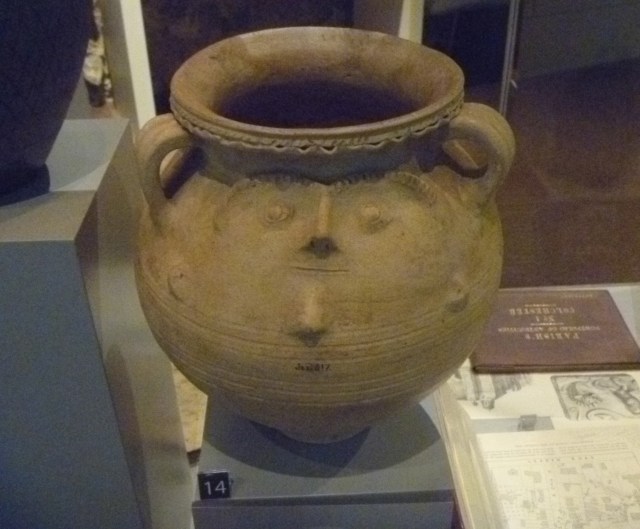
Roman Jar

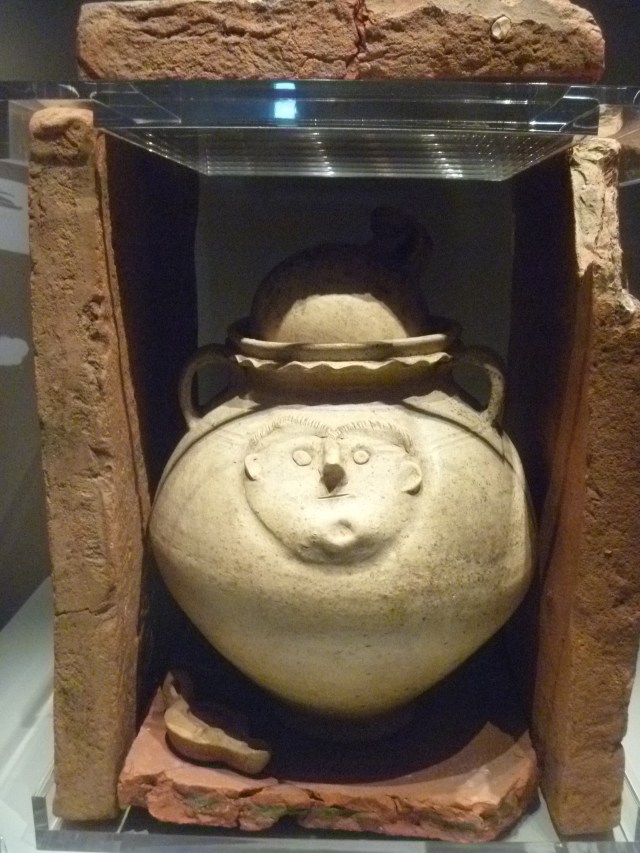
Roman Face Pot : Type of pot associated with military burials

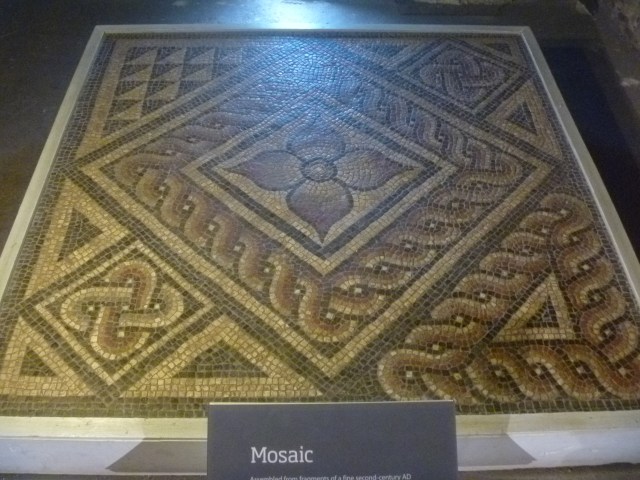
Mosaic Floor

Mosaic Floor : Assembled from fragments of a fine 2nd century  AD Roman mosaic floor found in a garden in North Hill in 1865. Research indicates that the components of the mosaic have been re-arranged.

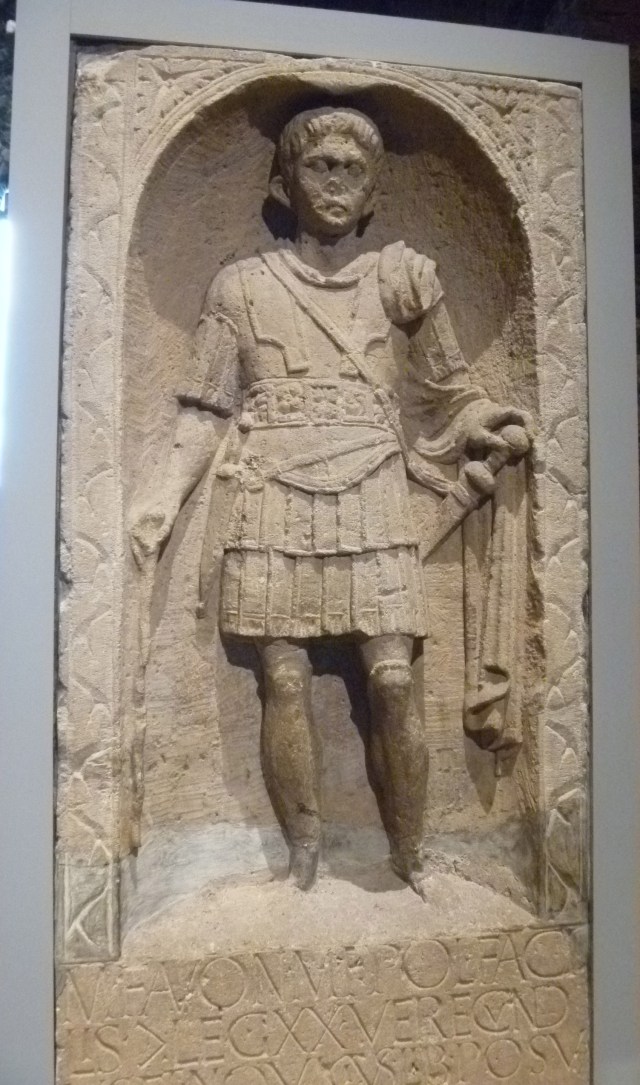
Tombstone 2

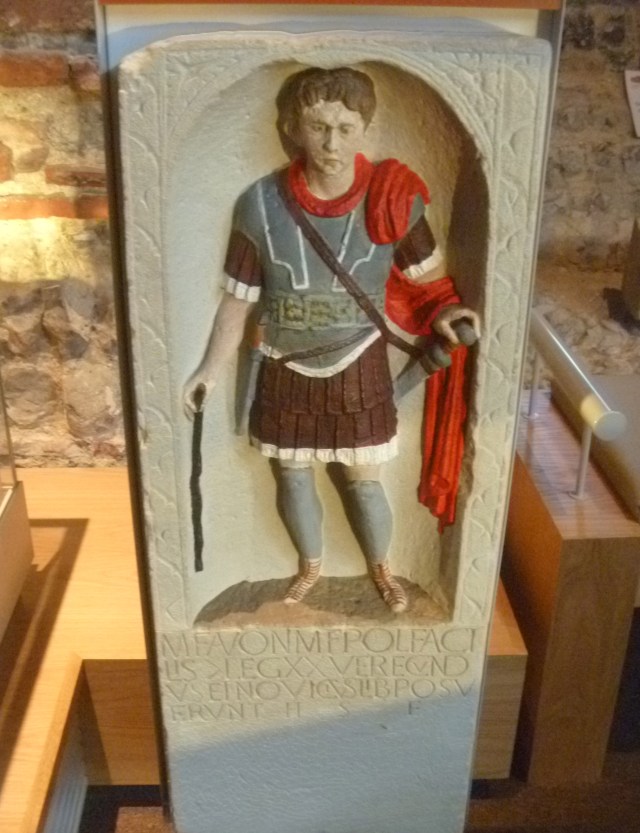
Tombstone of Marcus Favonius Facilis : the earliest Roman sculpture in Britain, and the finest. Facilis was a Centurion officer in the twentieth legion one of the regiments based at Colchester. He died a few years after the 43AD invasion of Britain and was buried in a cemetery along the main road to London. The style of sculpture represented by the tombstone developed in what is now the Rhineland area of Germany where the 20th legion had been based.

Tombstone 2.2

How the tombstone would have looked originally

Colchester vase

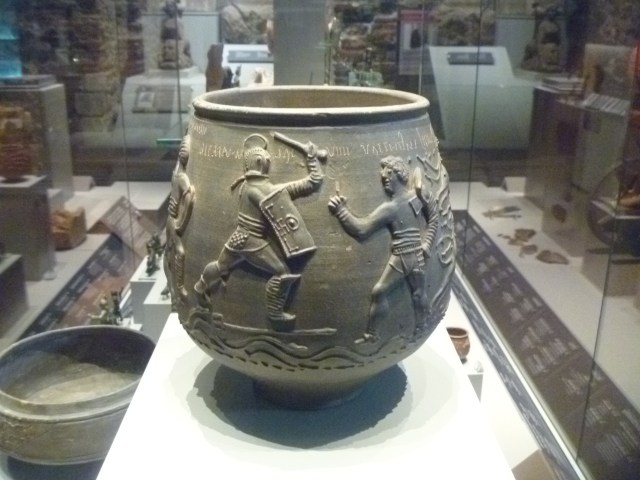
The Colchester Vase is the most famous pot from Roman Britain. It was found in a grave dated between AD 175 and  AD 200 at West Lodge in Colchester. The pot is decorated with detailed scenes showing a fight between two gladiators, a man beating a bear with a whip and a hunting dog in hot pursuit of two stags and a hare. The inscription scratched around the rim of the pot tells us the names of the people represented in the scenes and gives some details of their lives.

Sphinx

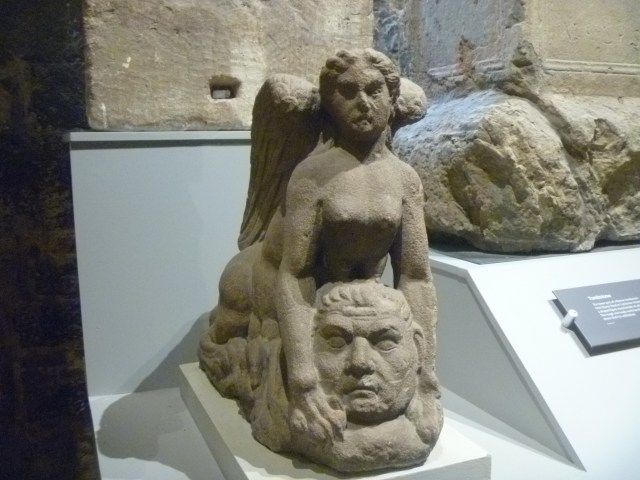
The Colchester Sphinx is a sculpture from an elaborate Roman tomb. It was found where the Essex County Hospital on Lexden Road stands today. This mythological creature is associated with death: she has the body of a winged lion and the face, arms and breasts of a woman. She was carved in the early Roman period AD 43-75. Here she represents the triumph of death over life. She is shown crouched over a pile of bones, clutching the head of the deceased in her claws.

Another face pot

Another Face Pot (contains cremated bones)

Mercury

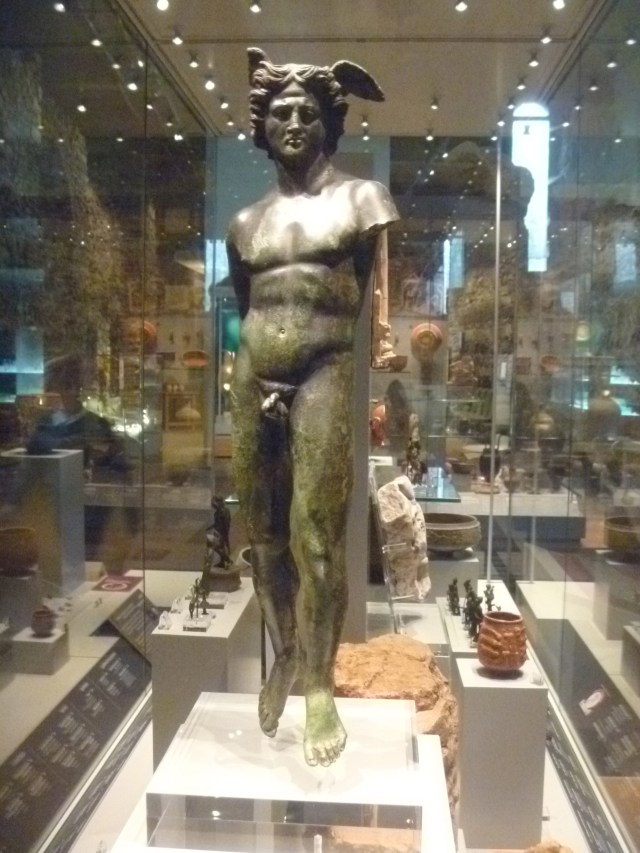
The Colchester Mercury is one of the finest statues from Roman Britain. It was found at Gosbecks, an area of countryside outside Colchester where there was a theatre and temple. This bronze statue was made in the northern part of the Roman Empire in the second century AD. Mercury was the messanger of the gods and can be recognised by the wings on his head. He was also the god of movement which made him popular with travellers, traders and even thieves.

Inside the keep 1

Inside the keep 2

Inside Views of the Keep

We already realised that Colchester is not just the first recorded town in Britain it has a wealth of history and superlatives – first, largest, best, oldest, finest.

Castle Keep

Germany : Memories of Vacations

Reading Germany: Memories of a Nation lately has made me think about the trips I’ve made to that country.

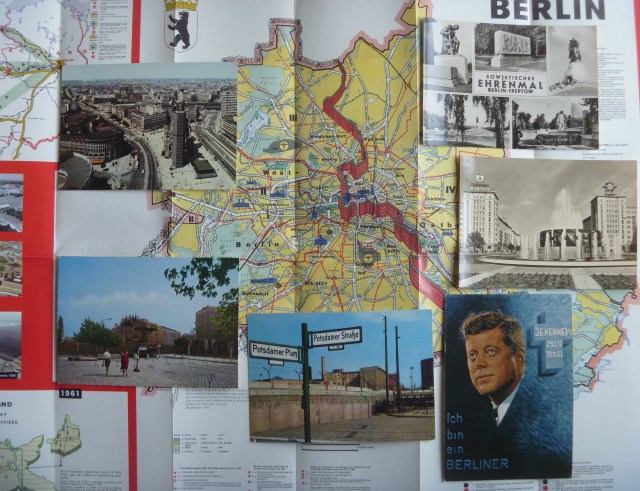
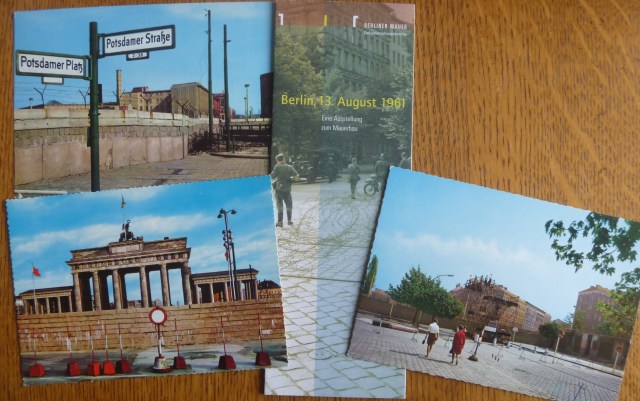
Berlin map and cards

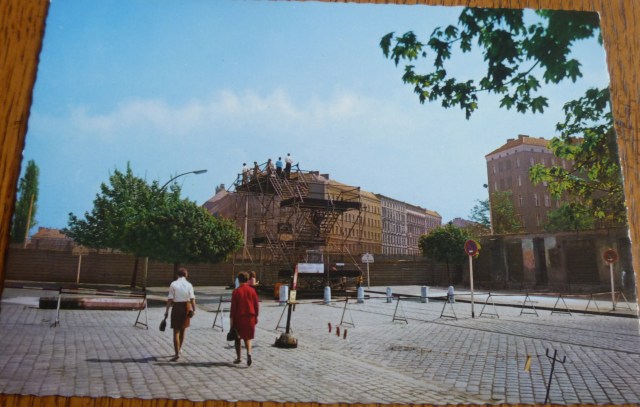
My first visit was brief but made a huge impression on me. It involved two days in Berlin and one in Cologne. It was part of a school trip to Moscow and Leningrad in 1968. We travelled to Leningrad by ship from Tilbury via stops for full days in Copenhagen and in Helsinki. We then travelled by train from Leningrad to Moscow and, again by train, from Moscow to Ostend via the two nights in Berlin and day in Cologne. What an adventure!
bernauer st

Bernauer Street 1960s

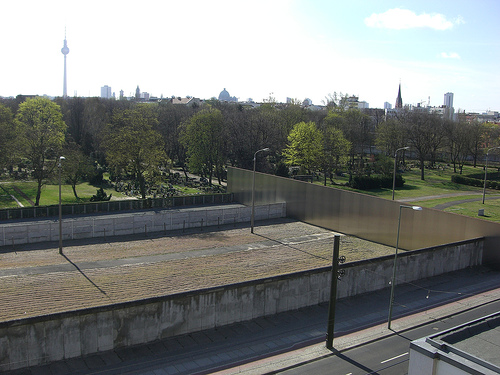
Bernauerstrasse

Bernauer Street in 2007 – part of the Wall and ‘Death Strip’ preserved today

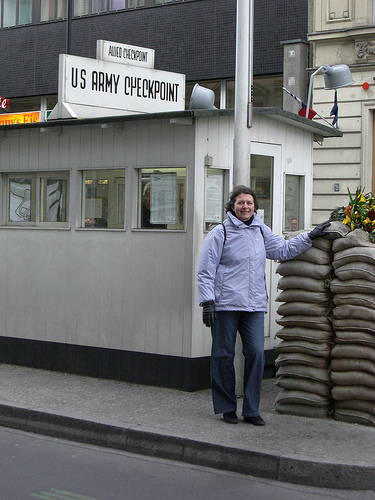
This being during Cold War days we had to cross the Wall into East Berlin via Checkpoint Charlie. Quite exciting! We stayed at a small hotel just off the Kurfurstendam in the western sector where we noticed the stark contrast between the bright lights there and the dark and grey atmosphere in the East.

The wall

Berlin Wall postcards from 1968

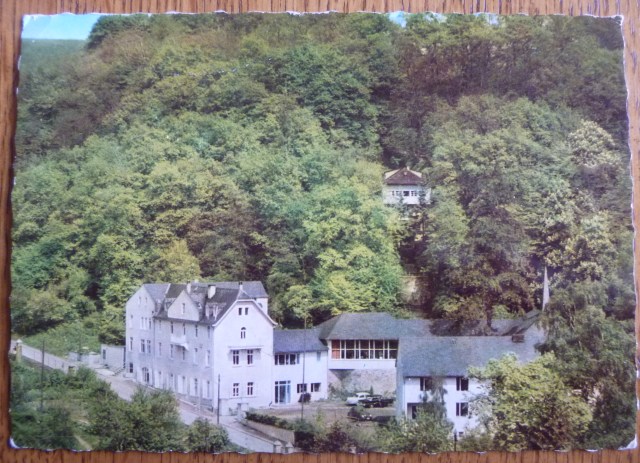
My next trip was the following year with a local Norwich church youth group lead by Ron Ingamells the Bishop’s Chaplain for Youth. We travelled by coach from Norwich and stayed about two weeks at Hedwig-Dransfeld-Haus at Bendorf-am-Rhein. I have managed to dredge up a picture postcard sent home to my family on the 9th August 1969 assuring them that we had arrived safely after a smooth crossing!

 H Dransfeld Haus

Hedwig-Dransfeld Haus, Bendorf am Rhein

I remember we made excursions by coach to Bonn and Cologne, to the city of Koblenz (twinned with Norwich) and did two Rhine boat trips – one past the Lorelei Rock and the vineyards to Oberwesel where we were welcomed by the mayor and given local wine and hors d’oeuvres and the other on a Saturday evening to watch the local fireworks – Rhein in Flammen. 

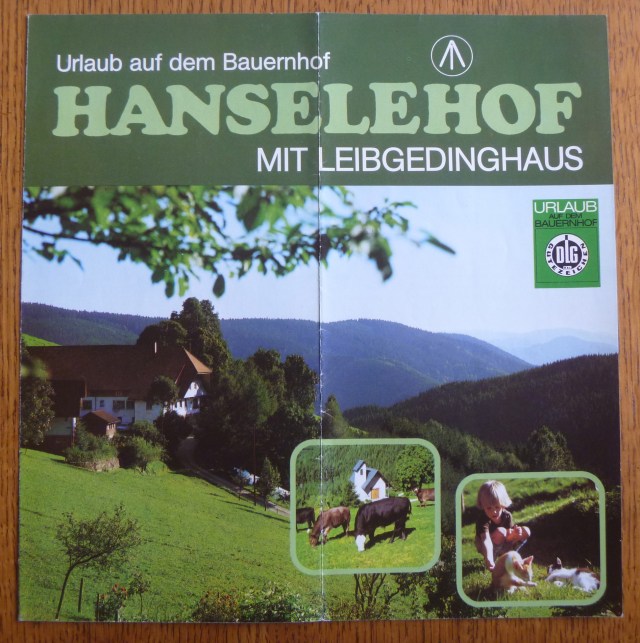
Hanselehof

In the late 1980s we enjoyed two family holidays staying at the same farmhouse in the Black Forest. We have always meant to go back. We had a modern pine wood furnished apartment within a huge old farmhouse – The Hanselehof. Despite having a full kitchen in the flat we enjoyed the half-board arrangement and practising our German on other guests. We made excursions to the nearby towns of Freudenstadt and Freiburg plus visits to a lido, museums and abbeys and made local forest walks. My photos from those trips are now rather faded and very poor quality.

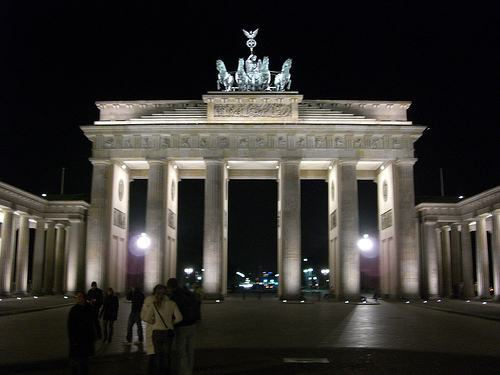
Brandenburg gate

The Brandenburg Gate in 2006 [Chapter 1 of Germany : Memories of a Nation ‘The View from the Gate’]

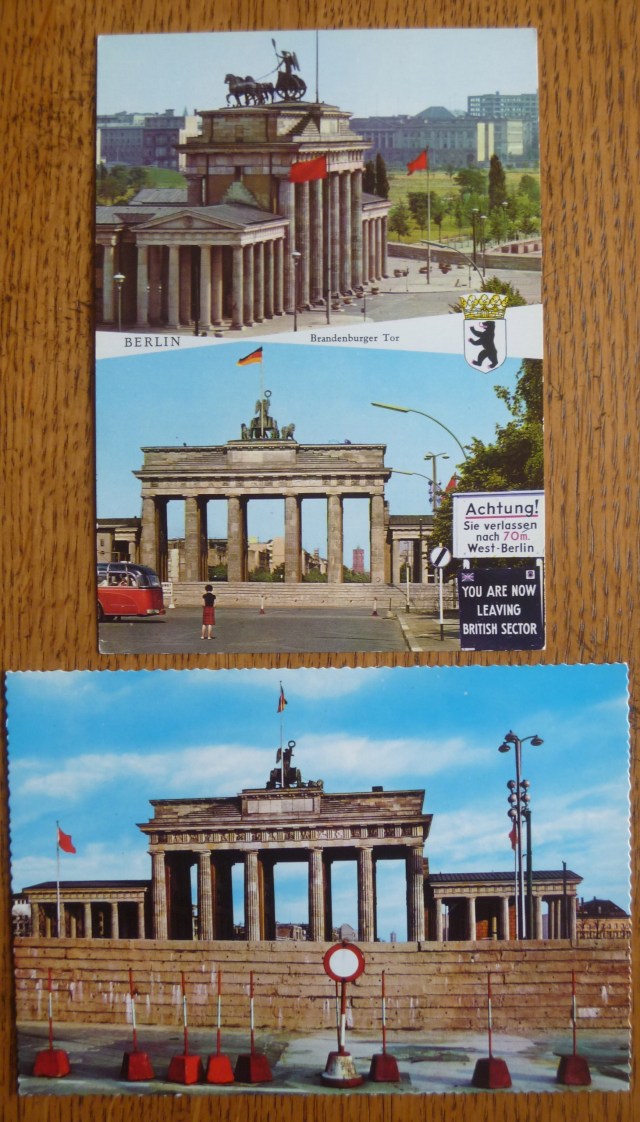
BG Cards

1960s Picture Postcard Views of the Brandenburg Gate ‘just’ in East Berlin

A long time passed before I spent any time in Germany again. By this time the Cold War was over, the Berlin Wall had come down and East and West Germany had achieved reunification. In 2006, 2007 and 2009 I made 3 five day visits to Berlin staying in Mitte in former East Berlin. It was interesting to witness the changes and yet remember my previous visit about 40 years before.

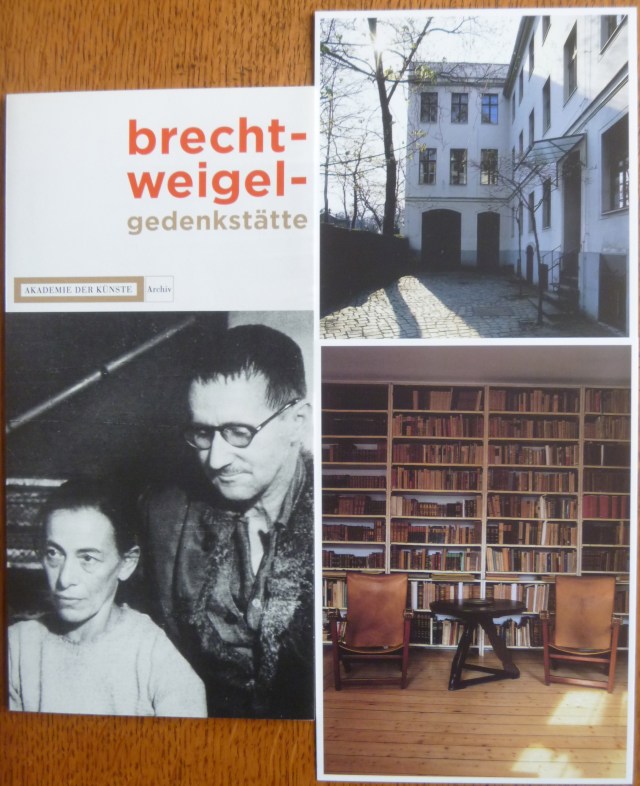
Brecht Weigel house

Bertolt Brecht’s play “Mother Courage and her Children” is discussed in the Memories book in Chapter 26 ‘Germans displaced’

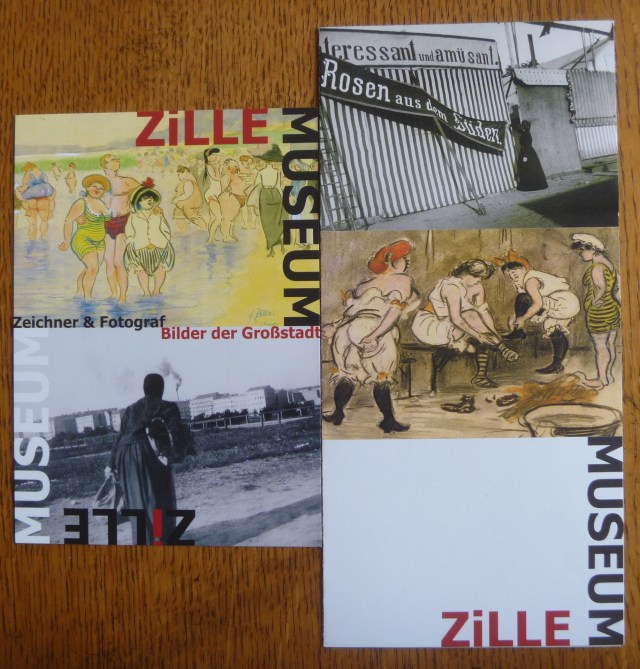
zille museum

We visited Checkpoint Charlie now a tourist trap; the Brandenburg Gate and Unter den Linden now open to all comers; various museums from the Pergamon to the Jewish Museum and the former home of playwright Bertolt Brecht and his actress wife Helene Weigel; the Museum dedicated to artist Heinrich Zille (1858-1929) in the pretty Nikolaiviertel and many many other museums and landmarks, cafes and restaurants plus I made two trips to Potsdam to the palace of Frederick the Great – Sans-Souci.

checkpoint charlie

At Check Point Charlie in 2007

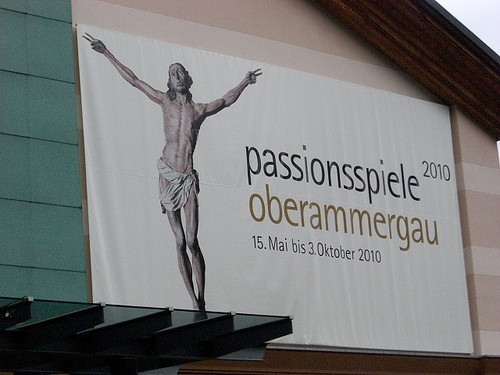
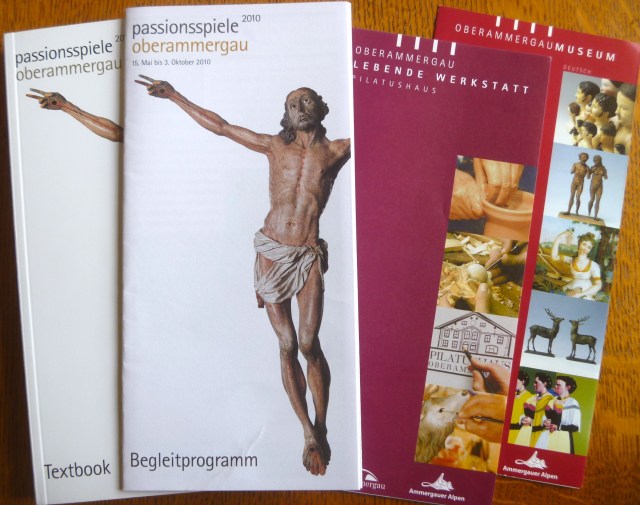
My most recent stay in Germany was only for one night but was very special. I took my mum to see the 2010 Passion Play at Oberammergau. We travelled with Saga Holidays to the pretty village of Mutters near Innsbruck and a trip to Oberammergau was included in the package. I was surprised how, despite the hundreds of visitors during the play season, very uncommercialised Oberammergau seemed. It is a pretty wood-carving village with a fascinating history and I would love visit again.

Oberammergau


passion play

PPProgrammes

The play

Postcard Scene from the 2010 Passion Play

In future I’m hoping one day to have a walking holiday on the island of Rugen on the German Baltic coast and also to visit the origins of the Bauhaus movement and former of home of playwrights Goethe and Schiller – Weimar.


Birmingham Architectural, Historical and Modern Gems, 2

As I said already, the jewels and gems of Birmingham don’t stop in the Jewellery Quarter …

There is also the Birmingham Museum and Art Gallery which houses one of the best collections of fine and decorative art, historical artefacts and archaeological treasures in Britain today; all displayed in an elegant Grade II* listed building. The collection is particularly strong in Pre-Raphaelite art. There is also a permanent display of items from the Staffordshire Hoard. [Adapted from Art Fund Guide]

Egg-travelling

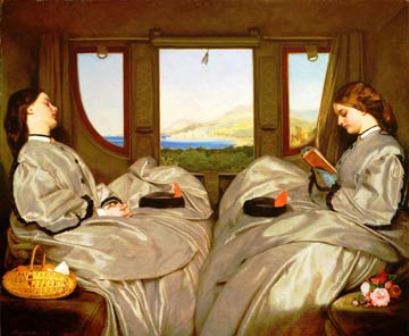
Travelling Companions by Augustus Egg (1862) one of my favourite Victorian paintings is in the care of BMAG

On Sunday afternoon we were on the trail of the gold and gems of the Staffordshire Hoard. No photography allowed.

Discovered in 2009 and acquired jointly with the Potteries Museum and Art Gallery in Stoke-on-Trent with assistance from the Art Fund, this treasure trove of 7th century Anglo-Saxon art features 4,000 pieces of gold and silver displaying intricate filigree and cloisonné work. Since October 2014 a new permanent gallery interprets the story of the hoard and its context within Anglo-Saxon history. Beyond the richness of the materials and the exquisite decoration, the hoard is significant because of its strictly masculine nature. These are exclusively military items created for Mercia’s best  fighters.” [Art Quarterly, winter 2014, p.31]

St Chad's and roads

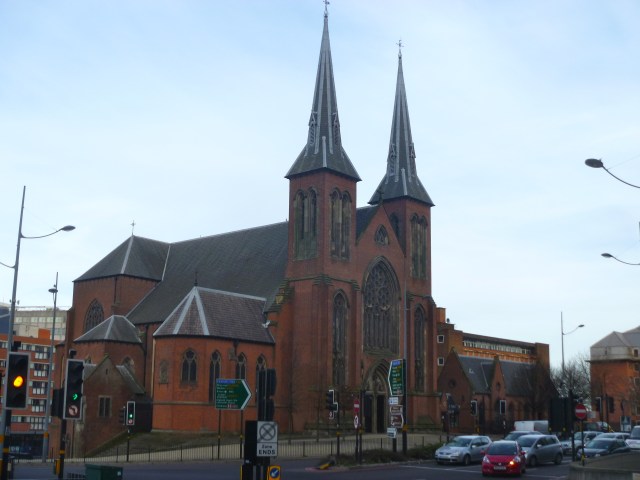
St Chad’s Cathedral or Traffic Circle

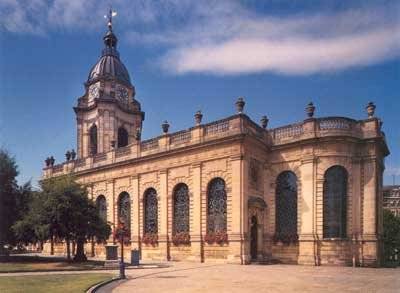
Birmingham has two cathedrals both gems of their type. The Roman Catholic Metropolitan Cathedral and Basilica of St Chad is a little out of the immediate city centre but we could easily walk there. How many times did we remark to each – “Car is King in Birmingham”? Pedestrians must wait at lights, use underpasses and walkways and over-road links. The RC Cathedral appeared to be sited in the middle of the road. Access is not easy. However, we made it safely through its doors on Monday morning and into another world. A world of peace and calm and of glorious art. No photography was allowed but I had already taken this one before I saw the sign.

St Chad's

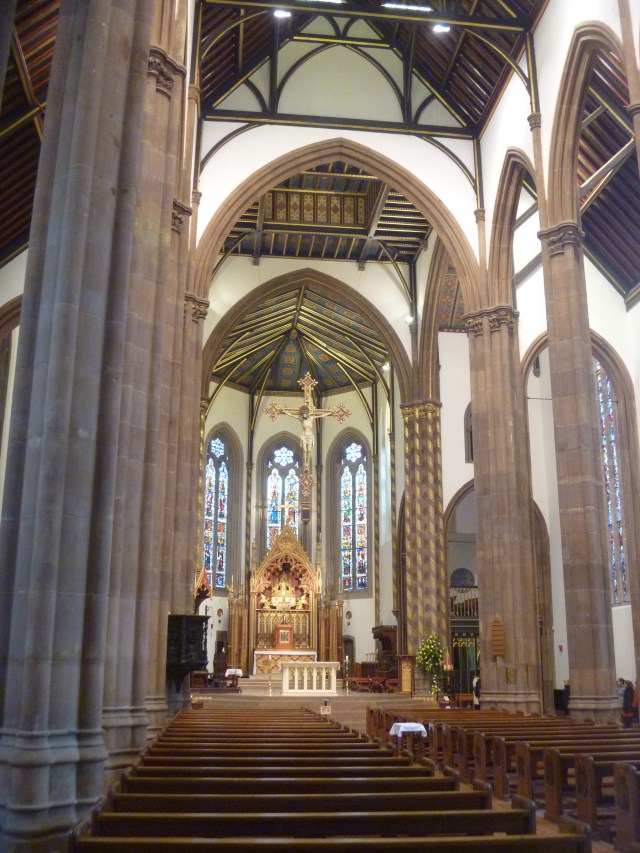
The Nave, St Chad’s Cathedral

A significant stopping-off point on Birmingham’s Pugin Trail the Cathedral was the first Roman Catholic Cathedral to built in the UK since the Reformation. The superb original internal decorations and fittings were made by skilled craftsmen re-introducing skills of the Medieval era.  John Hardman plate and windows; Herbert Minton tiles; William Warrington chancel window. Augustus Welby Northmore Pugin also supplied original Medieval furnishings from his own collection including the stalls and pulpit. His rood screen was removed in 1967.

Only after dropping in to St Philip’s Cathedral on Sunday afternoon and deciding to stay for Evensong – more members of the choir than members of the congregation and followed by a brief organ recital – did I read this suggestion in my LV City Guide 2012 Birmingham, London, Dublin :

Birmingham Cathedral

St Philip’s Cathedral [source]

Sunday in Birmingham : Attend a service in 18th century Birmingham Cathedral which has a number of stained glass windows designed by Edward Burne-Jones. Colmore Row.”

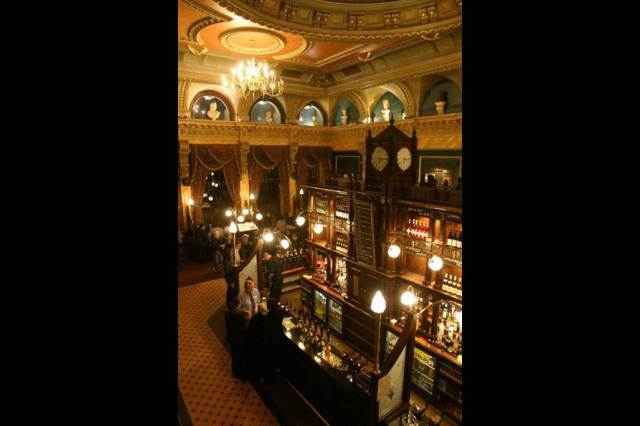
Looking_down_on_bar_3536

Old Joint Stock Bar [source]

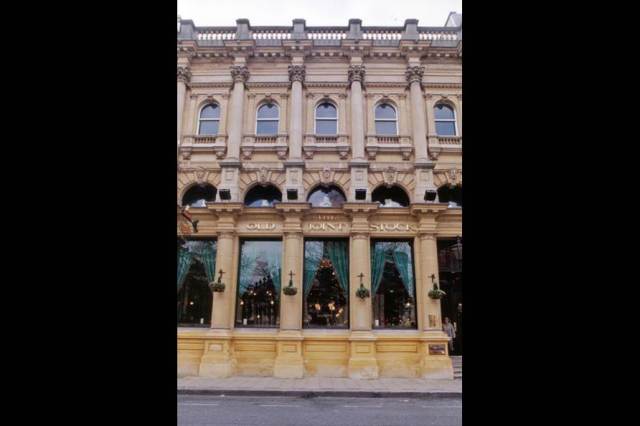
Opposite the Cathedral is the famous Birmingham pub The Old Joint Stock Pub and Theatre. Just a few paces from the Cathedral we decided to pay a visit. Unfortunately the theatre wasn’t open that evening but the island bar was impressive. Also from my LV Guide :

Old_Joint_Stock_External2_3539

Julius Alfred Chatwin was primarily a designer of Birmingham churches … But there were exceptions to his church work and the opulent interiors of the Old Joint Stock, opposite St Philip’s Cathedral (in which he had a hand), showed that he could be moved to great things in the temporal sphere as well. Completed in 1864, the building first belonged to the Birmingham Joint Stock Bank. It was converted into a pub in 1997. Under a glass domed ceiling, beside an island bar and with sumptuous interiors, this is one of the grandest pubs in the city. Upstairs is an 80-seat theatre, minimalist in decor, but the sort of facility few pubs can shout about.

ET ad

ET Mural

Tea Room Mural

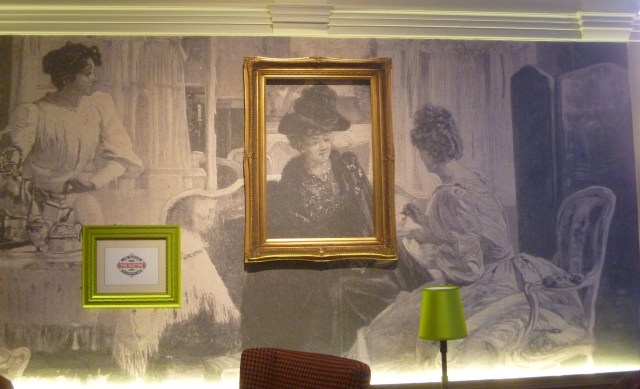
On Monday we returned to The Art Gallery to the highly recommended Edwardian Tea Room for a light lunch before heading to our raison de visite The Library of Birmingham.

Few other tea rooms in the world can boast a stellar gathering as was here under the ornate ceiling and glass canopy in May 1998. The G8 Summit was being held in the city and for a short time a group that included Bill Clinton, Boris Yeltsin, Jacques Chirac and Tony Blair (and their interpreters) sat around a table commissioned from David Linley for the occasion, surrounded by a pick of the museum’s Pre-Raphaelite paintings hung here especially for the event. Even without the table and the paintings, The Edwardian Tea Room is still a grand setting for tea, coffee, snacks and lunches.” [LV Guide]

Wedding Cake

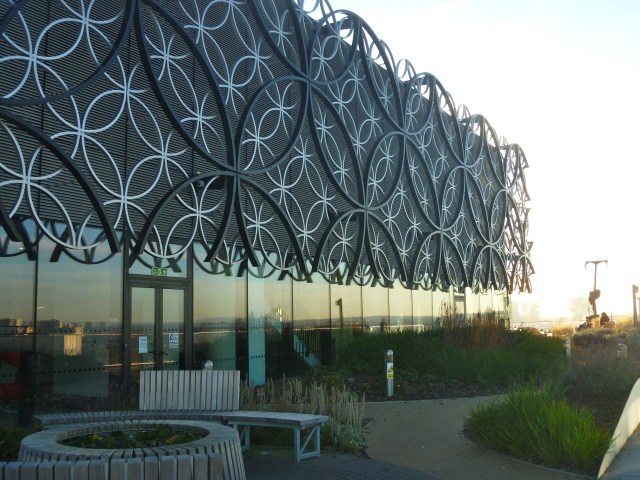
The Library Building Decorated on the Exterior to Represent Rings and Birmingham’s Jewellery Heritage

The Giant Wedding Cake, as the library is affectionately known, offers pre-bookable guided  tours to the building and its contents on Mondays at 2.15.  The building was officially opened by Malala Yousafzai in September 2013.

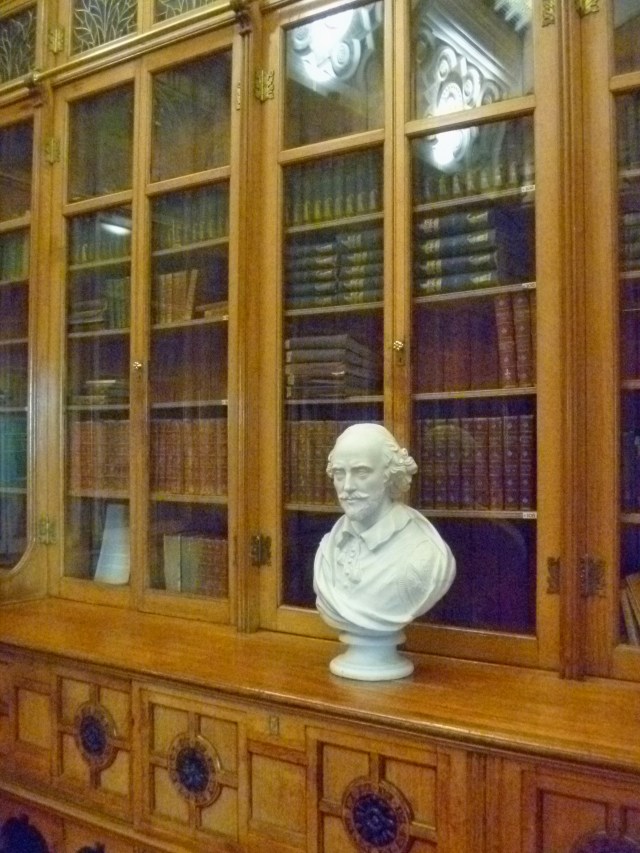
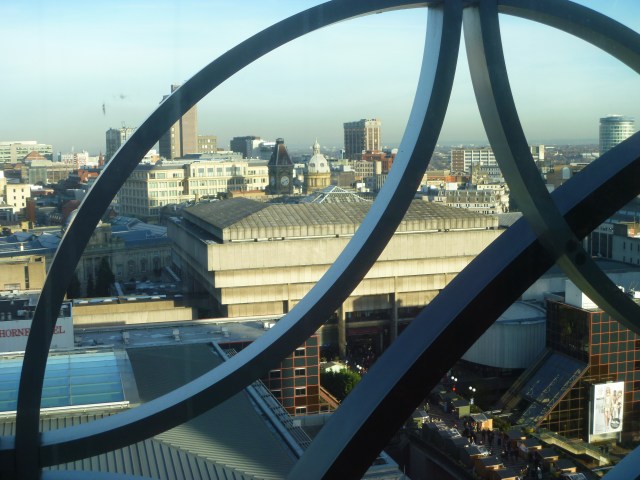
We took the glass lift up to the 9th floor from where we had long-reaching views of the city  and beyond from the Skyline Viewpoint. Also on the ninth floor is the Shakespeare Memorial Room.

Shakespeare

Shakespeare in his Memorial Room

“This original feature from the city’s Victorian library was designed by John Henry Chamberlain in 1882. Since then
it has changed home twice, moving to Central Library when it was built in the early 1970s, and to the Library of Birmingham almost forty years later. It originally housed the Birmingham Shakespeare Library, which is still available at the Library of Birmingham. The Room is wood panelled with glass printed shelves inspired by the Elizabethan age with carvings, marquetry and metalwork representing birds, flowers and foliage. The woodwork is by noted woodcarver Mr Barfield, and the brass and metal work is most likely crafted by Hardmans. The Shakespeare Memorial Room has been painstakingly reconstructed by local craftsmen A. Edmonds & Co. Ltd and the Victorian Cornice Company whorestored the elaborate ceiling. The books and memorabilia you see on the shelves are interesting items from the Library’s general collections (the Shakespeare collection outgrew the room as early as 1906).” [source]

70s library

The old Central Library seen through the rings

We then descended floor by floor visiting two gardens on our way down including the Secret Garden and The Discovery Terrace.

secret garden

The Secret Garden on the Seventh Floor

Lift and escalators

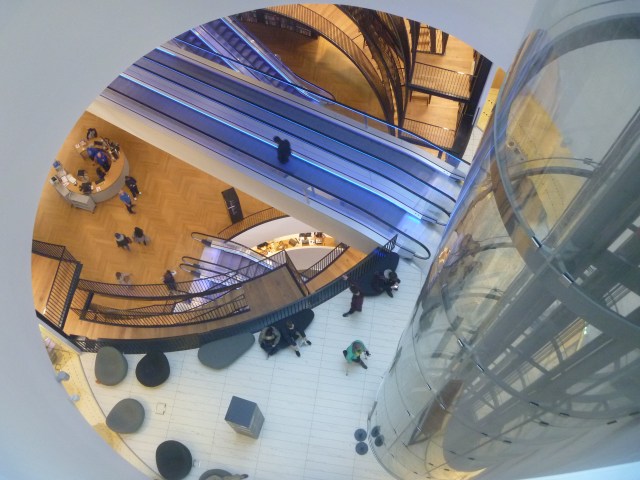
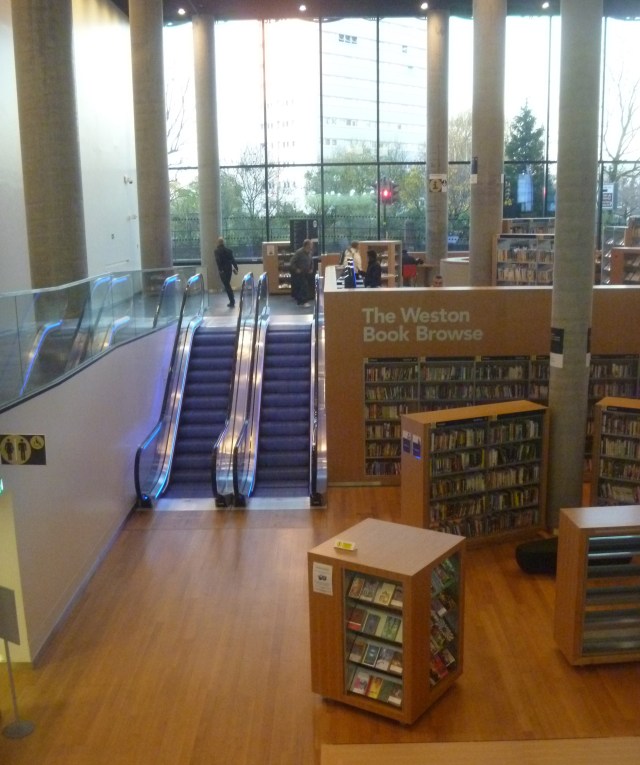
Looking down into the Library and the Book Rotunda

Book Rotunda

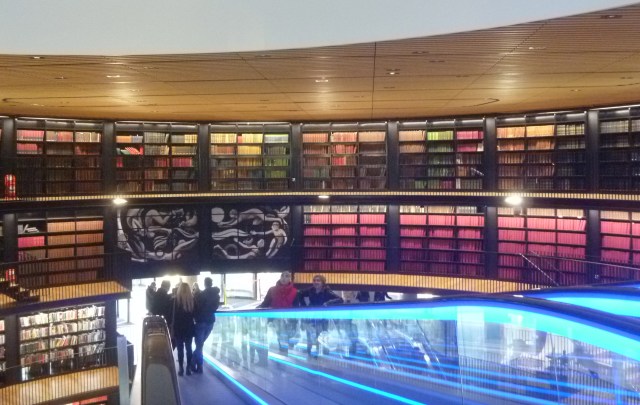
The Book Rotunda – Shades of The British Museum and Waterstones Book Shops

Children's Library

The Book Browse Fiction Library

Here is a Library buzzing with enthusiasm and offering its readers so much more than books (although I’d be happy with just the books). The What’s On programme that I picked up lists Exhibitions (we visited The Voices of War during our tour), Films, Music, Activities, Performances, Dance, Poetry and Workshops. Lucky Birmingham to have this facility in the heart of the city I hope the citizens make good use of it and what it offers.

Despite a packed two days and two half days we  are sure that there are many more Birmingham gems still to be visited!

Birmingham Architectural, Historical and Modern Gems, 1

Birmingham’s rapid expansion from the mid-18th century into a major centre for the metalworking industry earned it the title of ‘the workshop of the world’. Just outside the heart of the city, the Jewellery Quarter became a close-knit neighbourhood, where a great variety of specialist trades concentrated on the production of jewellery, silverware and small metalware.

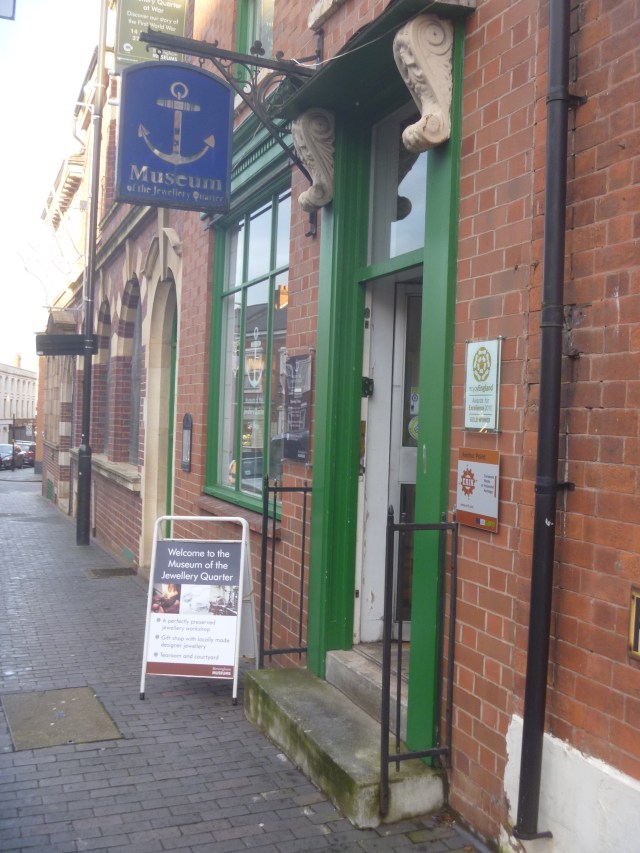
Jewellery Mus

The Anchor is the Birmingham Assay Office Mark

In the Jewellery Quarter Museum I learned some interesting facts about the work carried out in the area. There’s a small exhibition and display to whet one’s appetite before the ‘jewel in the crown’ tour of the Museum.

– Birmingham is one of only four cities in the UK which has an Assay Office and on its first working day, August 31st, 1773 the office hallmarked about 200 articles. On its busiest day ever recorded (they don’t say which day that was) the office achieved the hallmarking of 100,000 articles!

– Most gold articles are not made from pure gold. It is too soft and expensive and is mixed (alloyed) with other metals to increase its strength.

– A single gram of gold can be beaten into a sheet of one square metre.

– Coins, clocks, trophies, tableware were shipped all over the globe. By 1914 Birmingham was supplying the world with 28 million pen nibs PER WEEK! And during both World Wars manufacture was given over to medals and munitions.

– Birmingham’s increasing prosperity was largely built on its emergence as the very centre of the British button trade. From the earliest 18th century gilt buttons to the Victorian mother-of-pearls, buttons remain as popular as ever and as fastenings and as decoration.

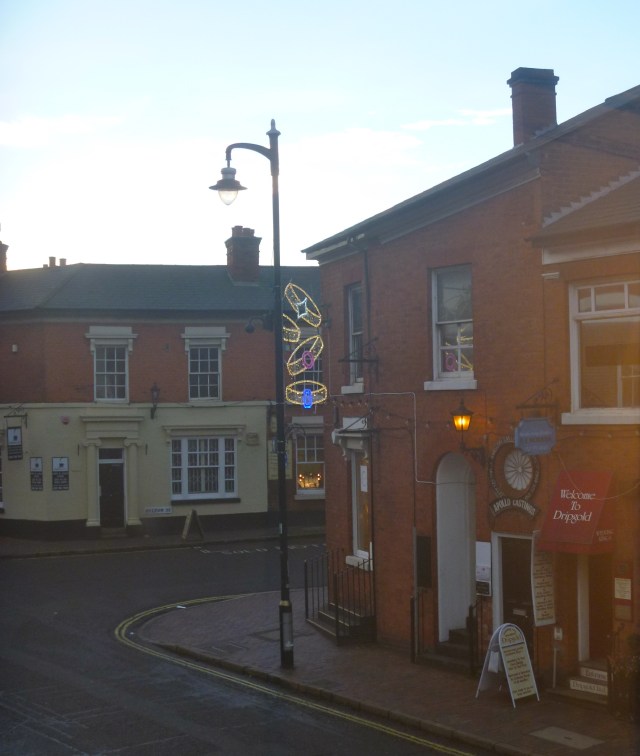
Christmas decs

Jewellery Christmas Decorations

All very interesting but the highlight was yet to come. A group of us assembled for the tour. I hadn’t studied the website or literature so was not aware quite what was to come! I’d expected examples of valuable jewels and other products of historical significance. But what we got was amazing :
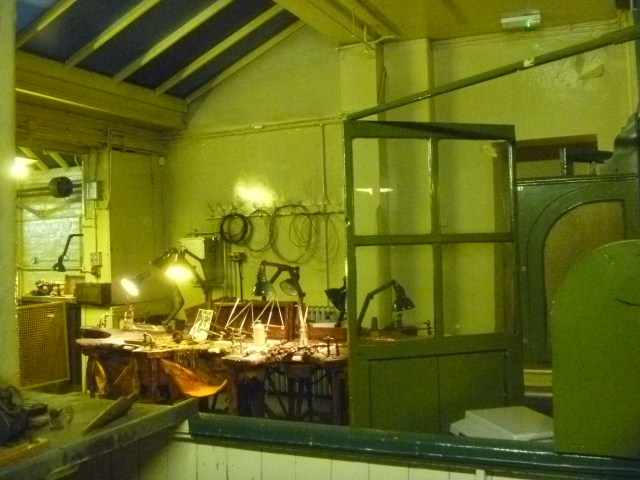
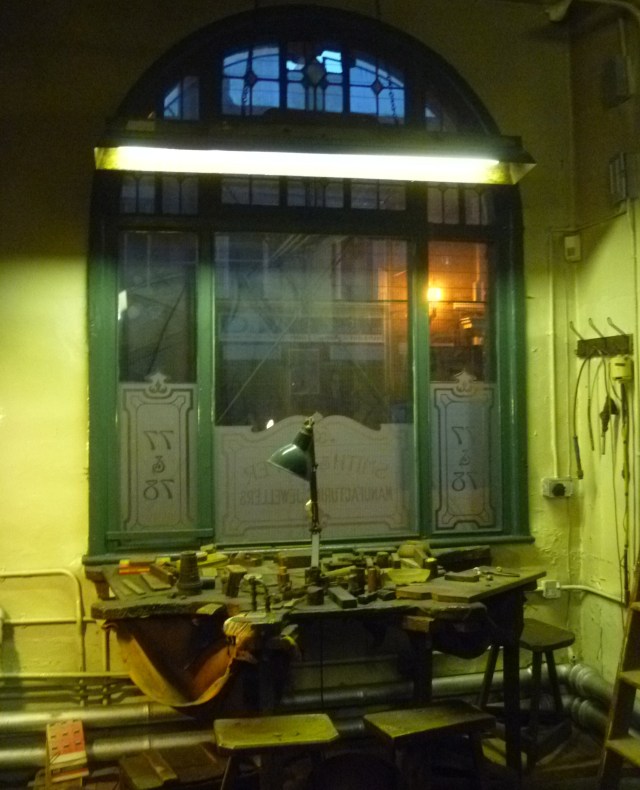
When the proprietors of the Smith & Pepper jewellery manufacturing firm decided to retire in 1981 they ceased trading and locked the door, unaware they would be leaving a time capsule for future generations. Tools were left strewn on benches; grubby overalls were hung on the coat hooks; and dirty teacups were abandoned. Today the factory is a remarkable museum which tells the story of the Jewellery Quarter.” [Art Fund Guide]

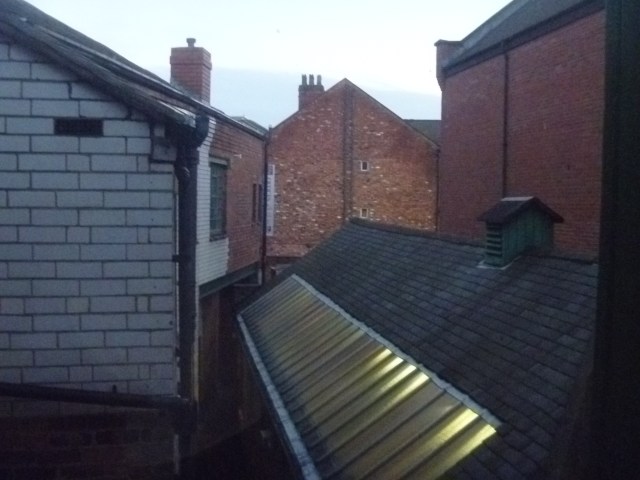
Factory skylight

The factory skylight, white walls of the neighbouring building reflect the light and the whole squeezed into a rear yard

We saw the offices, the workshop and work benches, the kitchen shared with the potassium cyanide store (looks just like sugar!!). Every single fleck of gold dust was to be saved and reused – this was a Brylcreme-free zone and no turn-ups were allowed. All dust was saved and checked. Overalls and shoes had to be changed. And the noise must have been horrendous. We had each noise source demonstrated separately but what the combination was like is unimaginable. Dangerous and unguarded sharp and heavy tools were a threat to life and limb. The whole was a Health and Safety Officer’s nightmare. I heartily recommend a visit.

work area

The Factory

work bench

A Work Bench

Notice

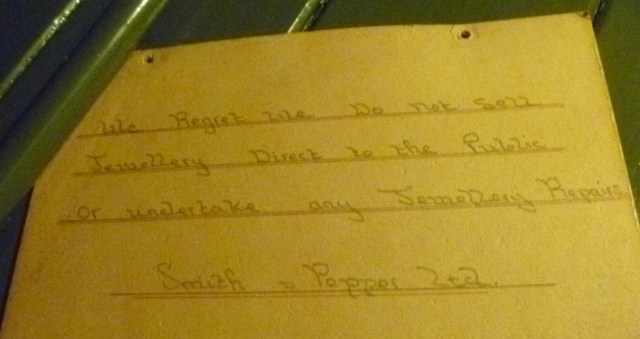
Notice on the Office Door

Order book

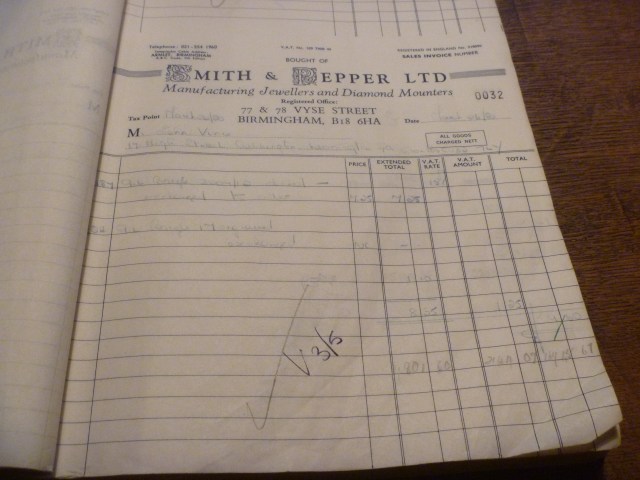
Page from the Order Book

tea tray

Tea and Cyanide, anyone?

But the jewels and gems of Birmingham don’t stop in the Jewellery Quarter …

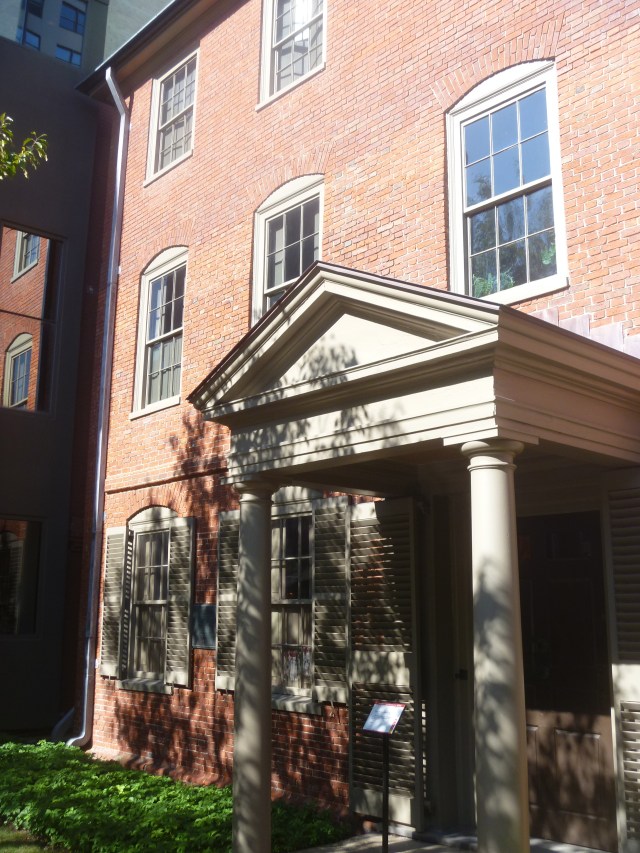
The Wadsworth-Longfellow House, Portland, Maine

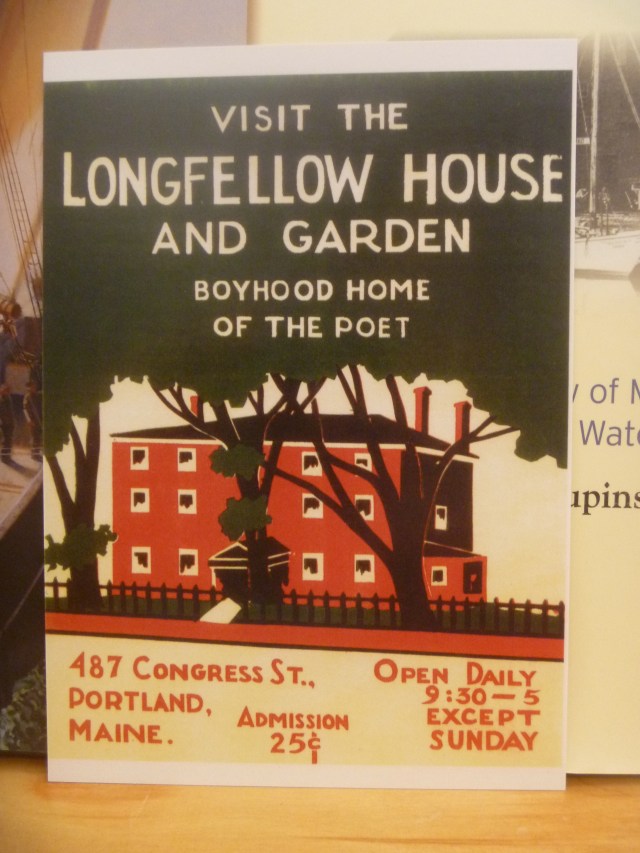
Visit the HWL House

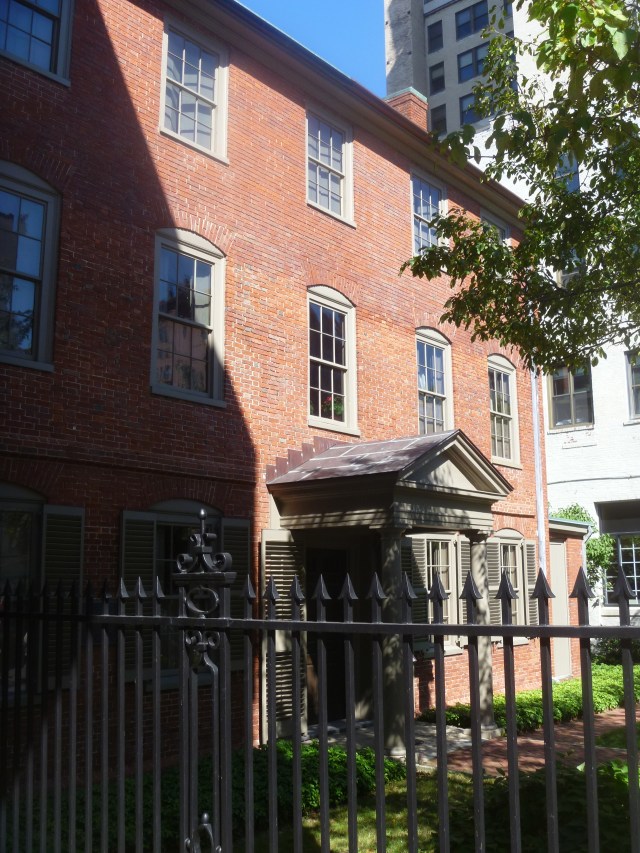
On our last full day in New England, before heading off to LLBean, I joined a morning tour of the Wadsworth-Longfellow House, located right in the middle of Portland on Congress Street. The house is not his birthplace. Although he was born in Portland that house has now been demolished.

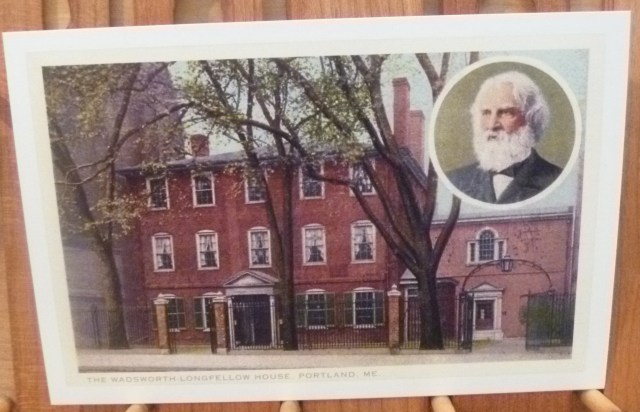
HLW House postcard


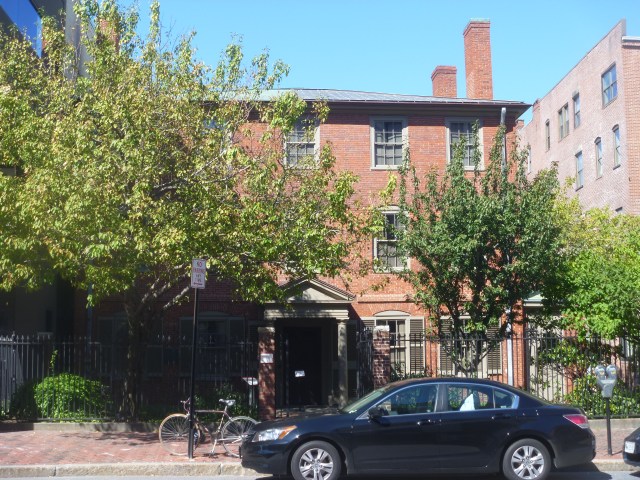
No Parking but always a car

Faithfully restored to the 1850s, the Wadsworth-Longfellow House was the childhood home of Henry Wadsworth Longfellow. Built in 1785-86 by the poet’s grandfather, the house is decorated with original furnishings and family memorabilia. Tours offer a unique glance into the poet’s family, as well as into the cultural and social history of mid-19th century Portland.” [Information Board outside the house]

WLF House door

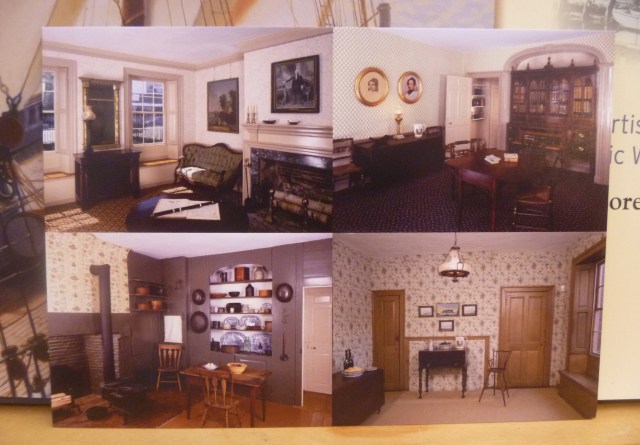
Yet again I enjoyed an entertaining and informative tour. No photography was allowed but there are pictures and descriptions of the rooms on the website and postcards of a selection were available in the excellent bookshop attached to the house.

Inside HWL House


Postcard shows the interior of Wadsworth-Longfellow House

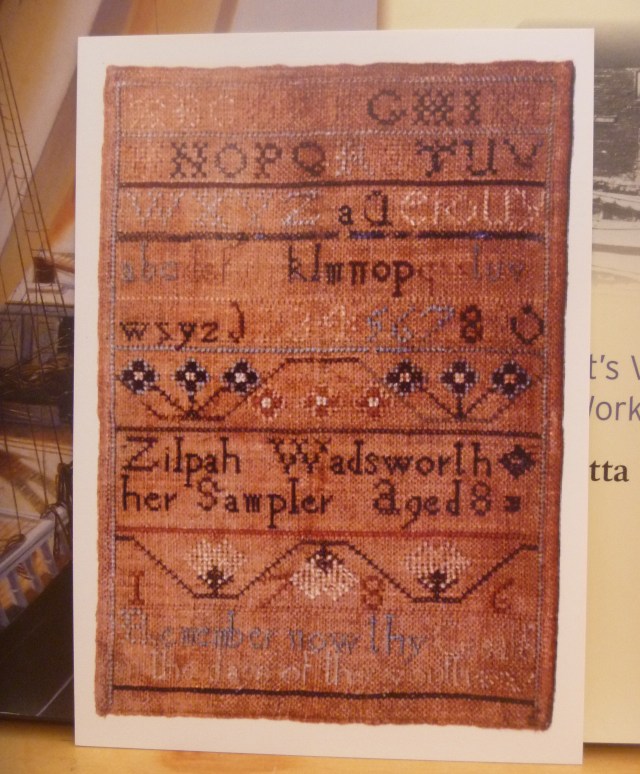
Zilpa sampler

Zilpa’s Sampler (still on display in the house)

Peleg (love that name!) and Elizabeth Wadsworth, Henry’s grandparents, built the house in 1785-86 and Henry, born in February 1807, lived there from just a few months later throughout his childhood. With 9 siblings his father Stephen (and mother Zilpa) extended the house by adding another floor. Henry entered Bowdoin College in Brunswick, ME in 1822. After graduation in 1825 he moved to Cambridge, Massachusetts where his home there is also a national historical monument and open to the public : Longfellow National Historic Site, 105, Brattle Street, Cambridge, MA. He made regular return visits to his family home although, except for once, he and his wife never actually stayed there overnight.

Henry’s sister Anne lived here for almost all her long life; and when she died in 1901 left the house to the Maine Historical Society (MHS) requesting that the rooms “be kept with appropriate articles for a memorial of the Home of Longfellow” insisting that certain items be left where they had been during Henry’s residence.

There were interesting displays in the museum next door concerning the Emergence and History of Portland and about the Wadsworth-Longfellow Family.

Longfellow House

I also learned that :

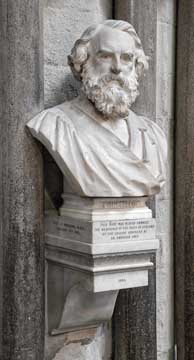
In 1884, Longfellow became the first non-British writer for whom a commemorative sculpted bust was placed in Poet’s Corner of Westminster Abbey in London; he remains the only American poet represented with a bust. [Wikipedia]

The over life-size white marble bust of the poet Henry Wadsworth Longfellow was unveiled in Poets’ Corner Westminster Abbey in 1884, on a pillar near to the tomb of Geoffrey Chaucer. It is by the sculptor Sir Thomas Brock and the main inscription reads:

Longfellow bust, Westminster Abbey

LONGFELLOW. This bust was placed amongst the memorials of the poets of England by the English admirers of an American poet.1884″

On the left and right sides of the plinth is inscribed:

“Born at Portland, U.S.A. February 27th 1807. Died at Cambridge, U.S.A. March 24th 1882”.

Longfellow’s ancestor, William Longfellow, had emigrated to New England in 1676 from Yorkshire. His parents were Stephen, a lawyer, and Zilpah. Henry taught at Harvard University and his prose romance Hyperion was published in 1839 after the death of his first wife. Ballads and other Poems includes ‘The Village Blacksmith’ and ‘The Wreck of the Hesperus’. The Song of Hiawatha is one of his best known works and he was second only to Lord Tennyson in popularity. His grave is in Cambridge, Massachusetts.

A photograph of his bust can be purchased from Westminster Abbey Library.

Further reading:

“England’s homage to Longfellow” by E.C.Lathem, 2007

[source of text and photo]

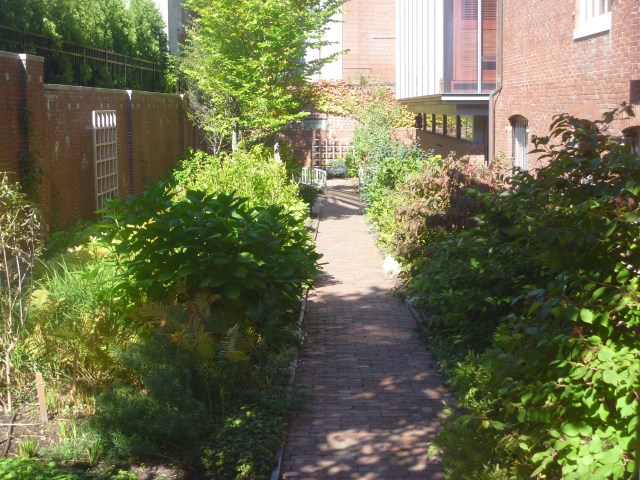
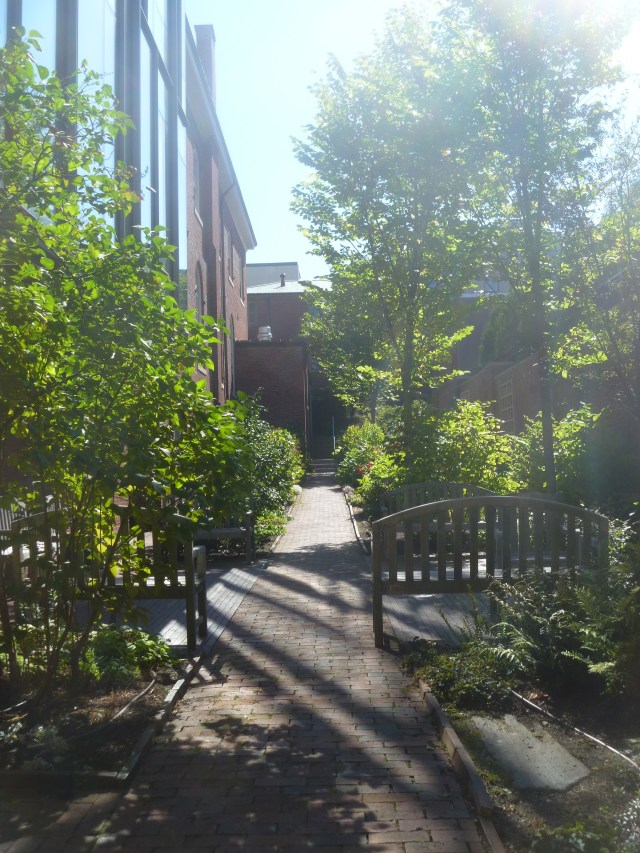
Before the tour, after the  tour or at any time during opening hours anyone may visit the Longfellow Garden behind the house.

HWL better garden

The secluded Longfellow Garden located behind the House is an oasis of green and quiet in the heart of downtown Portland. Beautifully landscaped, the public is welcome.” [Information Board]

Looking back up garden

Looking back up the garden towards the house

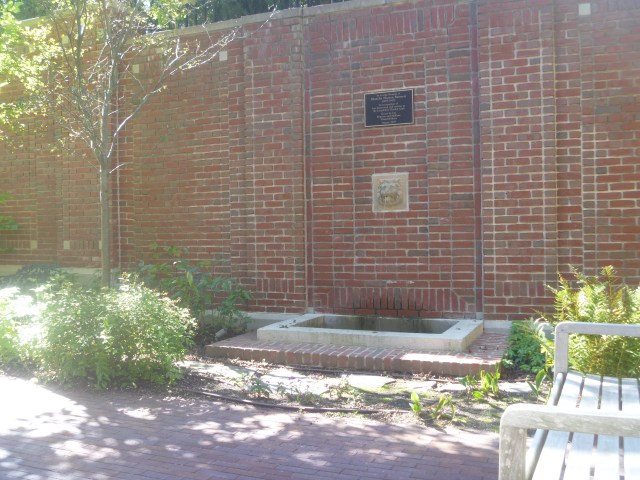
The members of the Longfellow Garden Club have tended this oasis of peace and calm in the centre of the bustling city of Portland for 90 years. These volunteers weed the beds, prune the overgrowth, plant annuals, maintain the soil and much much more.  In 1924 Mrs Pearl Wing set about restoring the garden. She encouraged the local community to help her and to donate plants and create a fountain in the garden. She also established the bye-laws and operating principles of the Club.

Presnt day fountain

Present day fountain

Naturally, there have been changes in the area and garden surroundings since then. Until 1980 the garden was only visited by those touring the house but the Club convinced the MHS to allow public access during house opening hours. It is a popular quiet retreat and “hidden treasure”.

Read more about the life and works of the author of The Song of Hiawatha (possibly his best-known work here in the UK) here and see whether you can recognise his many quotations here.

“The love of learning, the sequestered nooks, and all the sweet serenity of books”

Cape Cod : Woods Hole and Martha’s Vineyard and More

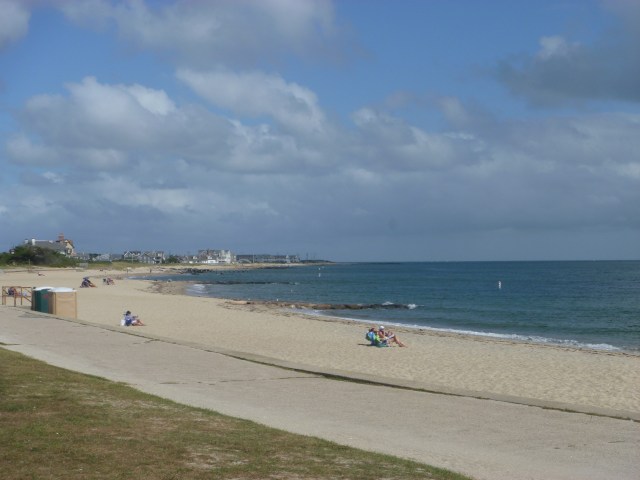
Beach at Falmouth

The Beach at Falmouth

It’s time to re-visit my summer holiday and go right back to the first week and a half that we spent on Cape Cod. We had marvellous weather and it’s strange to us but after Labor Day (the first Monday in September) many places close down and the locals more or less have the place to themselves again. It’s the way we like it. The weather is still good but you can find a table at a restaurant without queuing, the roads and beaches are almost empty but most of the local shops are still open.

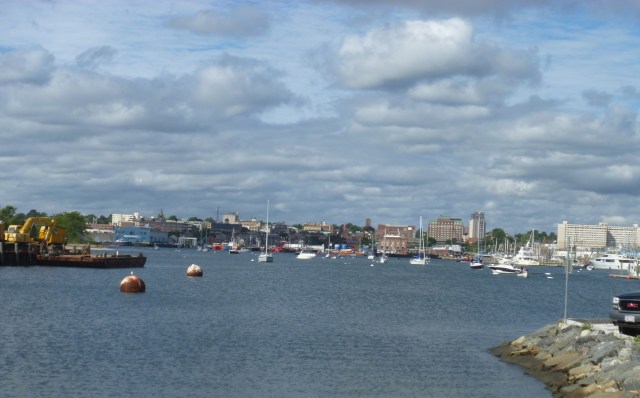
Estuary Fairhaven

The Estuary at Fairhaven

We don’t usually travel far from our digs but we always make one excursion out of our Cape Cod Comfort Zone and that is to visit my online book group friend sherry who lives in Marion, Massachusetts on the other side of Buzzards Bay. This time our excursion included a new activity as my husband has taken up sailing and as it was impossible for us to find a sailing school open on the Cape he signed up for 16 hours tuition over two days (and including a one hour written exam at the end) at Sail Buzzards Bay  (Fair Winds and We’ll See You on the Water!) based in Fairhaven, Mass. just a few miles from Marion.

101 Main St Fairhaven

Sail Buzzards Bay HQ, Main Street, Fairhaven

Preparation for sailing

Preparation for Sailing School

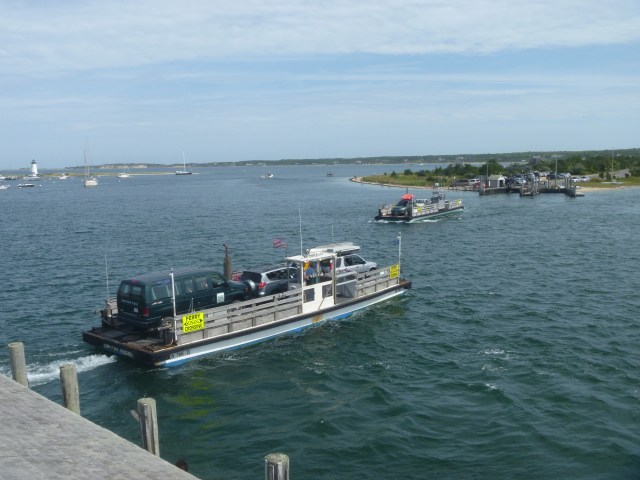
Needless to say the watery theme continued throughout the trip. One day we took the ferry to nearby Martha’s Vineyard. The ferry from Falmouth to Oak Bluffs on the Vineyard takes just 35 minutes and during the autumn season there are just two sailings in each direction each day (Monday to Thursday – more sailings at the weekend). We understood that it was worth taking the bus to Edgartown where we had lunch, watched the three vehicle five minute journey Chappaquidick Ferry and had a wander around the compact centre of town.

Main St Edgartown

The Main Street, Edgartown, MV

Here’s how the tourist leaflet describes Edgartown :

“One of New England’s most elegant communities, Edgartown was the Island’s first colonial settlement and it has been the county seat since 1642. The stately white Greek Revival houses built by the whaling captains have been carefully maintained. They make the town a museum-piece community, a seaport village preserved from the early 19th century.”

Chappaquidick Ferry

The Tiny Chappaquidick Ferry

Daniel Fisher House

The Grand Daniel Fisher House (1840)

I’d hoped to visit the Whaling Church but it was included on an organised tour from the museum (which also included a visit to Daniel Fisher House) and we just didn’t have time before taking the bus back to Oak Bluffs for our return to the mainland.

MV Museum

The Very Old Vincent House Museum

Whaling Church Edgartown

The Impressive Whaling Church

On several days we would drive down to Woods Hole the village attached to the extensive Woods Hole Oceanographic Institute that dominates the area. There are some good seafood restaurants with docks onto the marina – all very nautical.

Woods Hole Marina


Dining at Woods Hole Marina

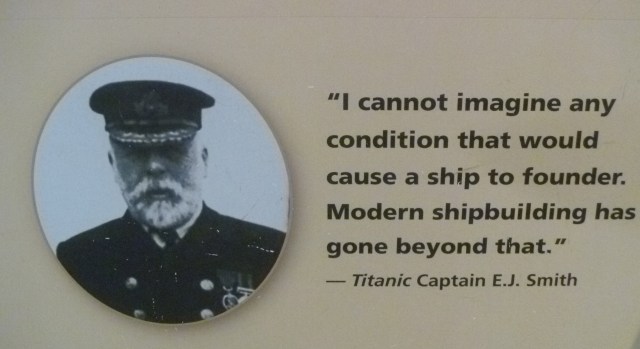
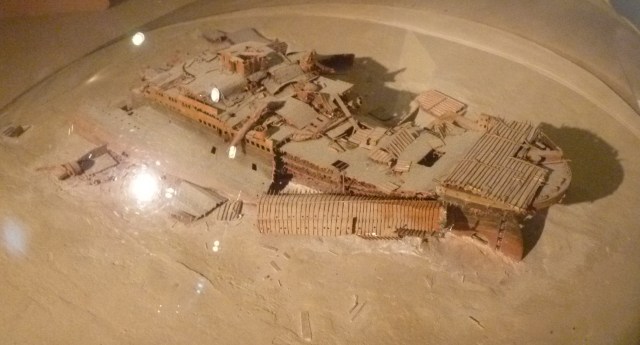
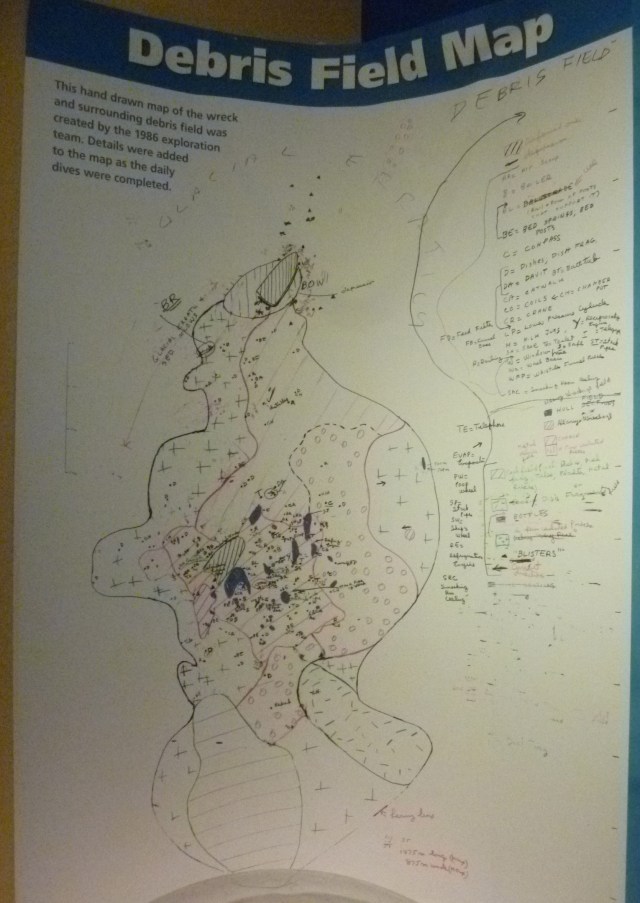
We also called in to see the displays at the WHOI Visitor Centre. The main exhibition highlight is the 1985-1986 discovery and exploration of the wreck of the Titanic.

Titanic 1


Titanic 2


Titanic 3

“This 1/570 scale model of the Titanic stern is on loan to WHOI from Roy Mengot of Plano, TX. Roy’s model is based on WHOI data and imagery and is among the best representations of the Titanic wreck as it was found during the 1985 and 1986 WHOI expeditions. The completed bow and stern models took 3,000 hours to build.”

Titanic 4

In addition to the Oceanographic Institute Woods Hole is also home to The Marine Biological Laboratory (MBL), The National Marine Fisheries Service, the Sea Education Association, The United States Geological Survey and the Woods Hole Research Center. Wow! That’s home to a lot of eggheads.

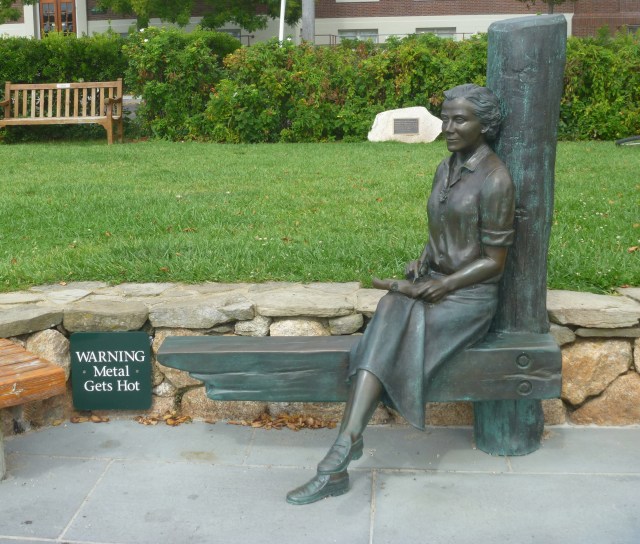
There’s a memorial statue to Rachel Carson author the far-reaching text “The Silent Spring”.

“I had my first prolonged contact with the sea at Woods Hole. I never tired of watching the tidal currents pouring through the Hole – that wonderful place of whirlpools, and eddies and swiftly racing water” Rachel Carson, author of  The Sea Around Us; The Edge of the Sea; Under the Sea Wind; Silent Spring. Scientist, writer and colleague at MBL, NOAA and WHOI 1907-1964

Rachel Carson on the hot seat

Rachel Carson on the hot seat!

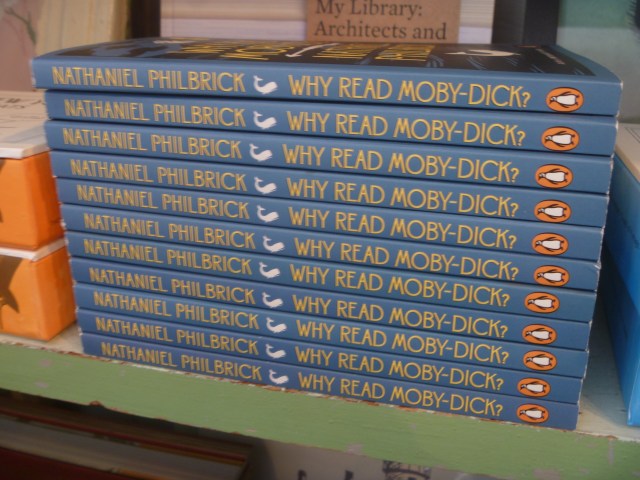
Finally, I still haven’t got round to reading it but maybe I should read this first :

Moby Dick Book


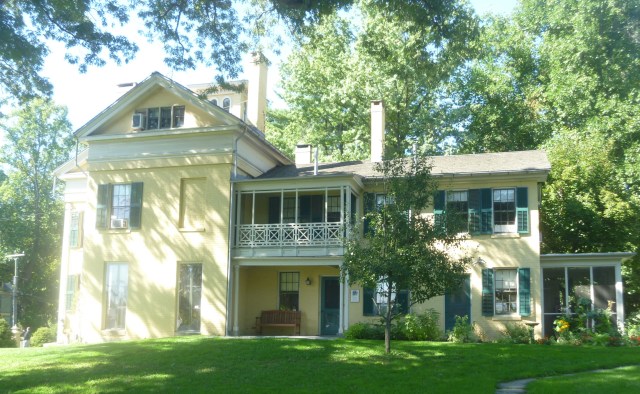
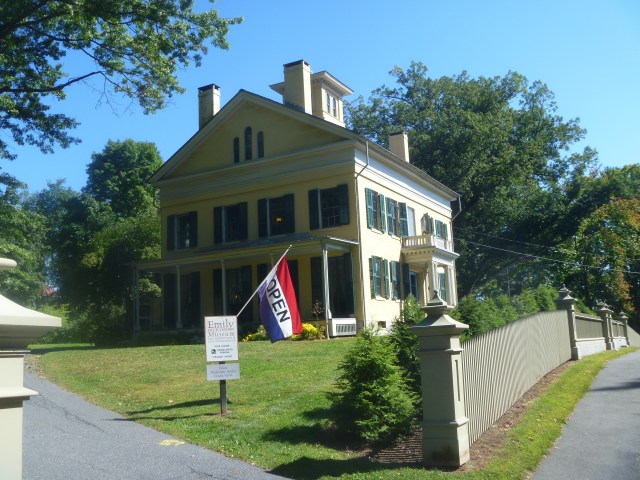
Emily Dickinson Museum : The Homestead and The Evergreens

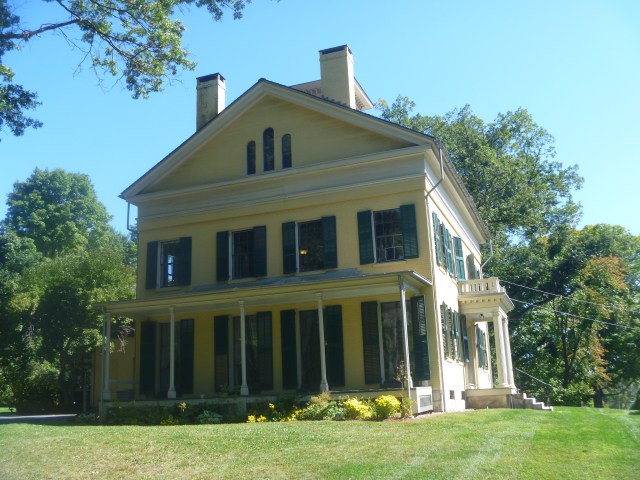
The Emily Dickinson Home

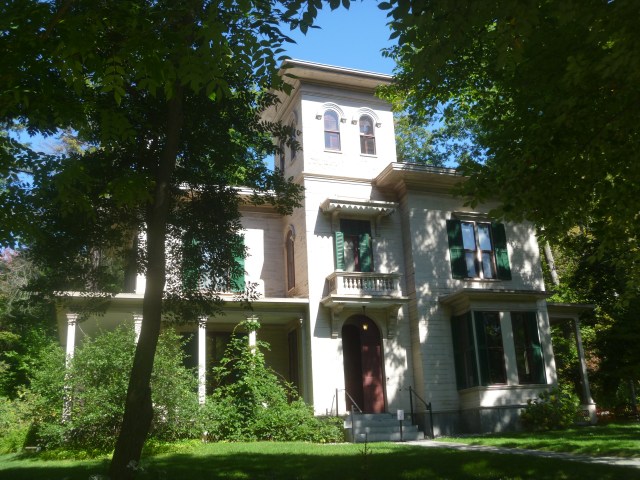
This year we made our third visit to Brattleboro, Vermont and on each visit I have wanted to make the trip an hour south to Amherst where the former home of the poet Emily Dickinson is open to the public as a museum. Amherst is an attractive College town – five in all in the area – with some interesting shops and plenty of eateries.

Emily Dickinson Homestead

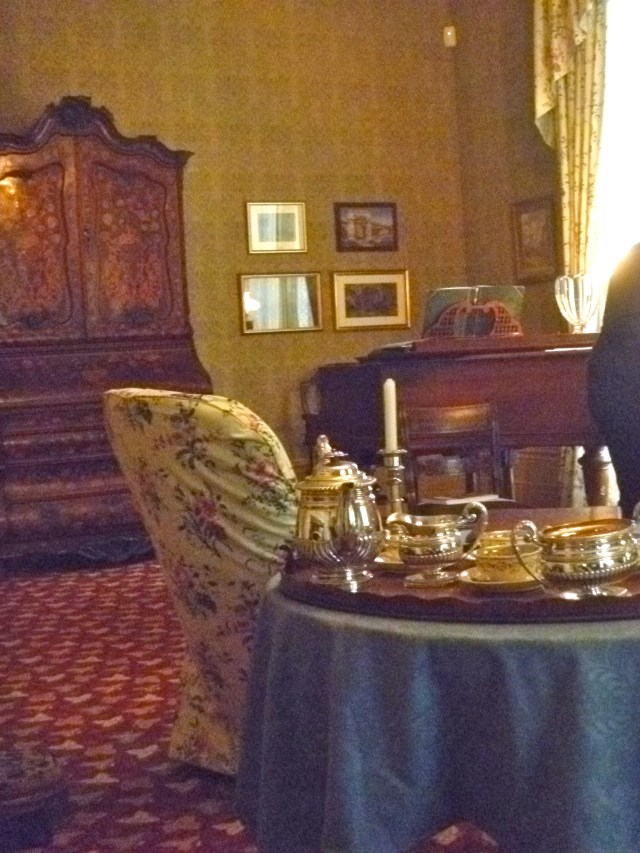
On the Friday of our stay I drove myself back down into Massachusetts. The museum was easy to find and I was able to book onto the second tour of the day : Emily Dickinson’s World a 90-minute guided tour of both the Homestead (Emily Dickinson’s house) and The Evergreens (Austin and Susan Dickinson’s home). This constitutes an in-depth focus on Emily Dickinson’s life and family and the major influences on her writing. Includes the parlors, library, and the poet’s bedroom at the Homestead; the library, parlor, dining room, kitchen, maid’s room, water closet, nursery, and “Emily Room” at The Evergreens.

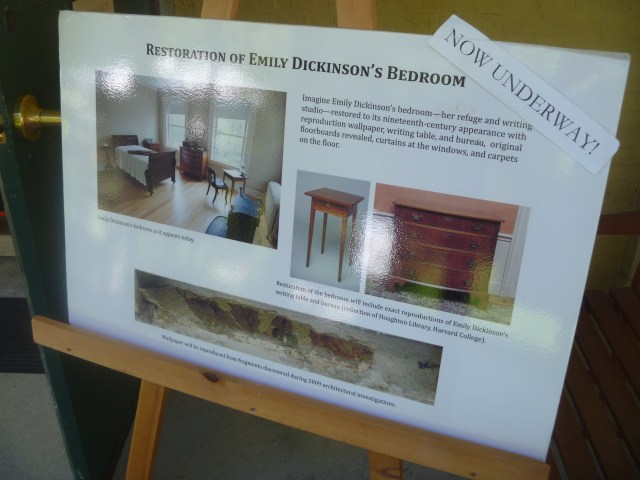
Emily Dickinson room

The Poet’s Bedroom is currently under renovation

As I had just missed the first tour by a few minutes I decided to buy the tour of the grounds which is an audio and self-guided.

“Grounds of Memory: a guide to the Dickinson landscape” The audio tour of the outdoor Dickinson grounds (duration of full-length tour is 60 minutes; visitors may tailor the tour to fit their needs) Explores Emily Dickinson’s fascination with the natural world and her family’s deep interest in the land and  includes eighteen stops outside the Homestead and The Evergreens. Stops may be visited in any order. Each stop offers a 2- or 3-minute narration and at least one Dickinson poem appropriate to that stop.

Narrated by poet laureate Richard Wilbur
Voice of Emily Dickinson provided by poet Mary Jo Salter

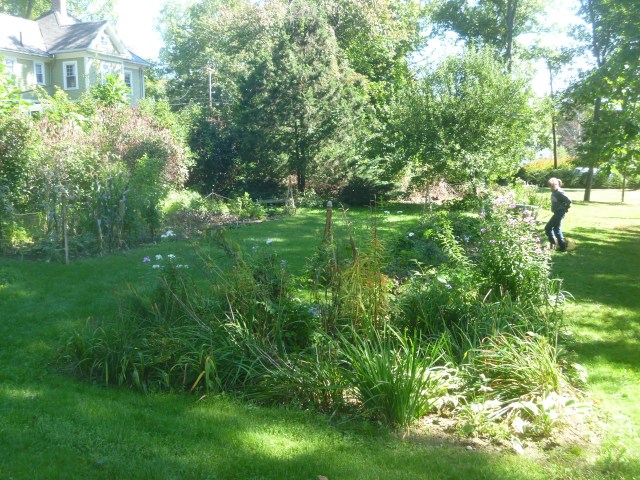
The Flower Garden

 First three stops are at the Flower Garden

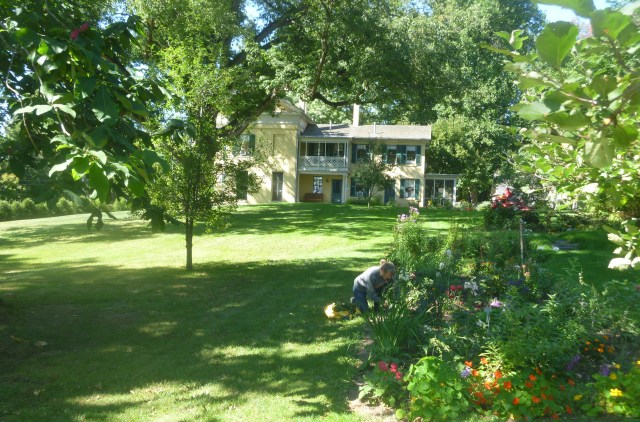
Flower Garden and Home

The Ornamental Flower Garden and the Homestead

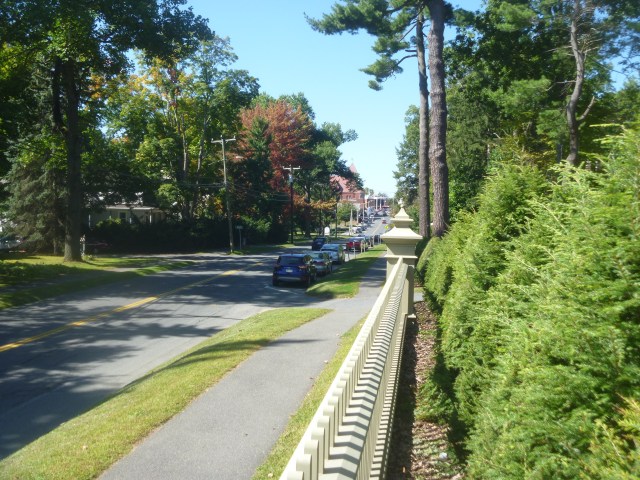
Main St and Amherst

Main Street looking towards Amherst

Evergreens

The West Bedroom (1st floor, RHS) was Emily’s

The Evergreens

The Evergreens – built by Edward Dickinson as a wedding gift to his son and daughter-in-law on their marriage

The grassy path

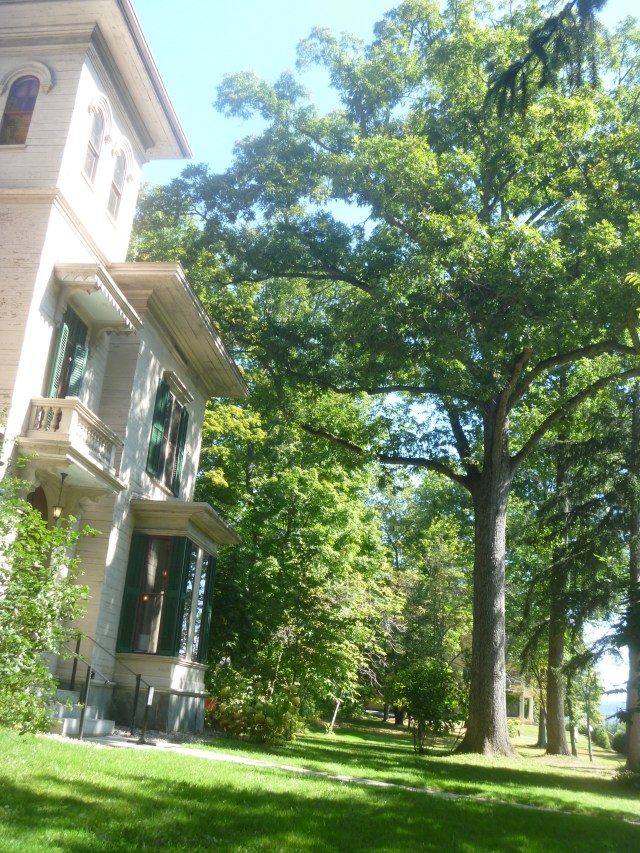
The grassy path between the two homes – “Just wide enough for two who love” (ED)

Here is a brief biography of the poet but the tour really brought to life her life and the lives of her family in particular her sister, Lavinia, her mother and father and her brother, Austen and his family.

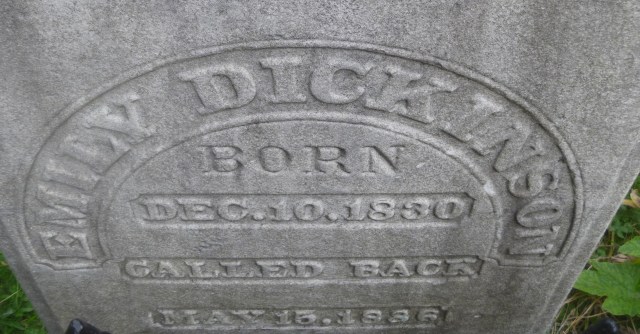
EMILY DICKINSON was born in Amherst at the Homestead on December 10, 1830. Her quiet life was infused with a creative energy that produced almost 1800 poems and a profusion of vibrant letters.

Her lively childhood and youth were filled with schooling, reading, explorations of nature, religious activities, significant friendships, and several key encounters with poetry. [She was not always the recluse that many choose to characterise her – at one  time she called herself The Belle of Amherst.] Her most intense writing years consumed the decade of her late 20s and early 30s; during that time she composed almost 1100 poems. She made few attempts to publish her work, choosing instead to share them privately with family and friends. In her later years Dickinson increasingly withdrew from public life. Her garden, her family (especially her brother’s family at The Evergreens) and close friends, and health concerns occupied her.

With a few exceptions, her poetry remained virtually unpublished until after she died on May 15, 1886. After her death, her poems and life story were brought to the attention of the wider world through the competing efforts of family members and intimates.” [source]

This was a house visit par excellence. The 90 minute houses tour was filled with interest and insight into the lives. The Dickinson Landscape self-guided audio tour complete with poetry readings added to almost complete immersion into ED’s life and thoughts. Our house guide was entertainment herself and added poetry quotations and a quick ‘class’ in the importance of word choice in a ‘schoolroom’ – in which we all participated. No photography was allowed in the house but the tour was such fun and so informative that I will forgive them for that. Having visited the home of a poet I had barely heard of I came away feeling as if I met her myself. Well done, Emily Dickinson House Museum!

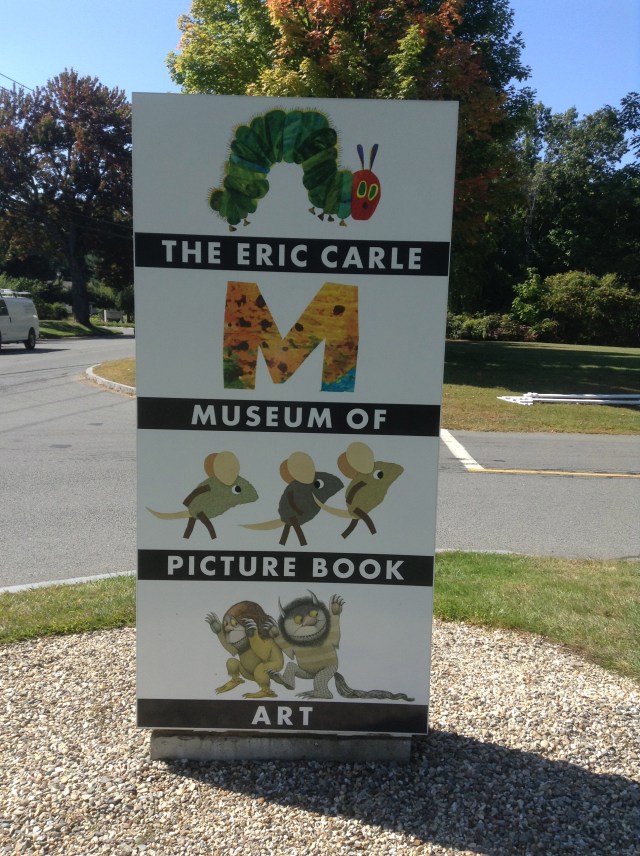
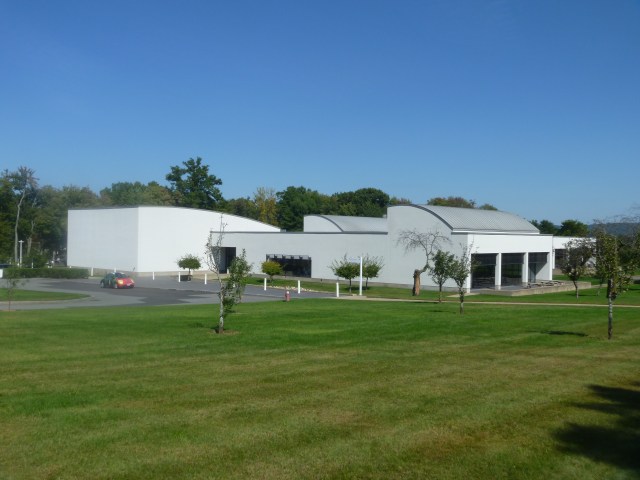
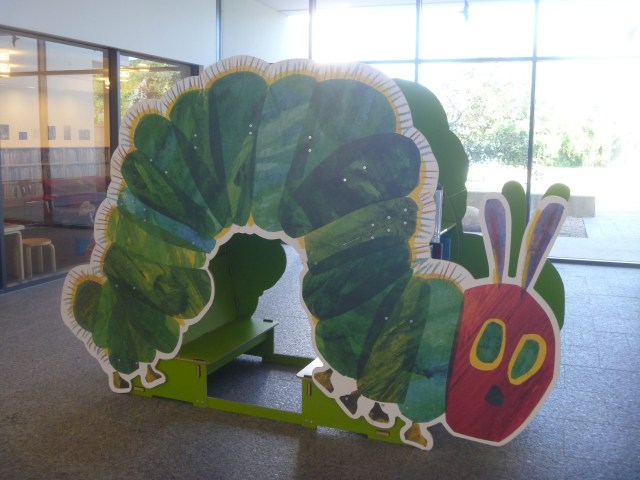
On leaving the Museum I couldn’t resist a quick visit to another nearby museum – almost from the sublime to the ridiculous – The Eric Carle Museum of Picture Book Art. A purpose-built centre devoted to the art of contemporary children’s book illustrator Eric Carle. We still have a very dog-eared copy of The Very Hungry Caterpillar at home.

Picture Book Art


Carle Museum

 The Eric Carle Museum

The very hungry caterpillar

This is what a Very Hungry Caterpillar looks like!

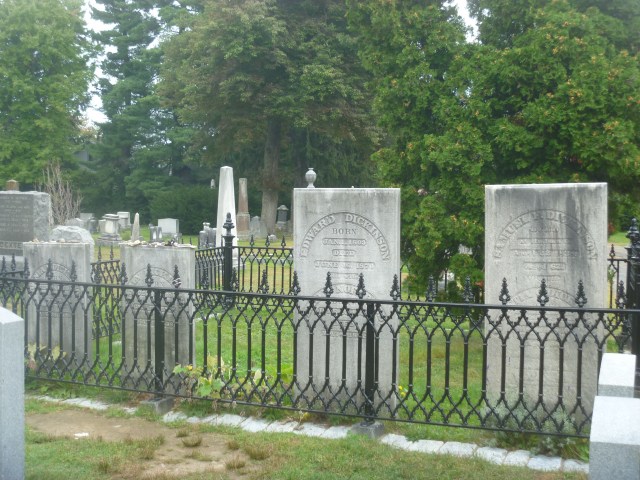
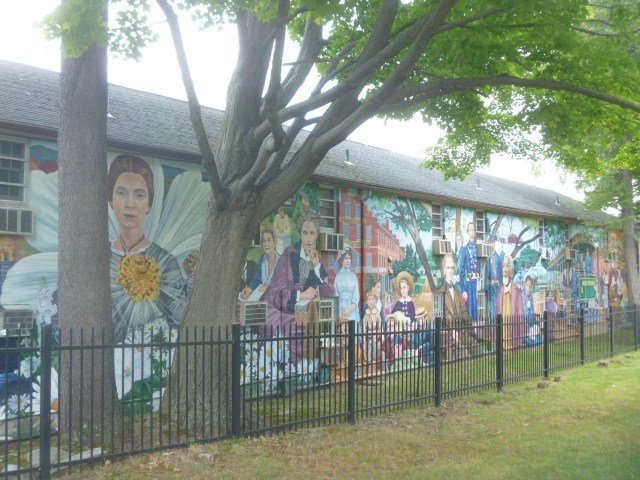
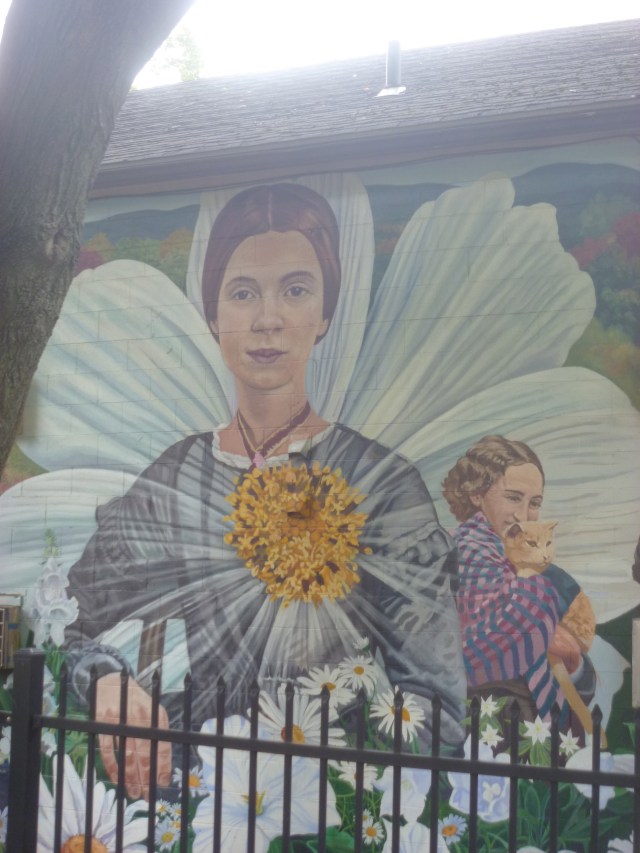
And finally, the next day we both made the journey back down to Amherst, enjoyed a decent lunch and I tracked down the Dickinson graves in West Cemetery where there is also a Community History Mural featuring characters from the Amherst story from all fields of experience (farming, literature, domestic life, education, military, industry and economic life) and including, of course, Emily Dickinson herself.

Dickinson family graves

The Dickinson Graves in West Cemetery, Amherst

Emily Dickinson grave stone

Wording on Emily’s Gravestone

History Mural West Cemetery Amherst

The Amherst Community Mural, West Cemetery

Emily Dickinson on History Mural

Emily Dickinson (Lavinia behind) on the Community Mural

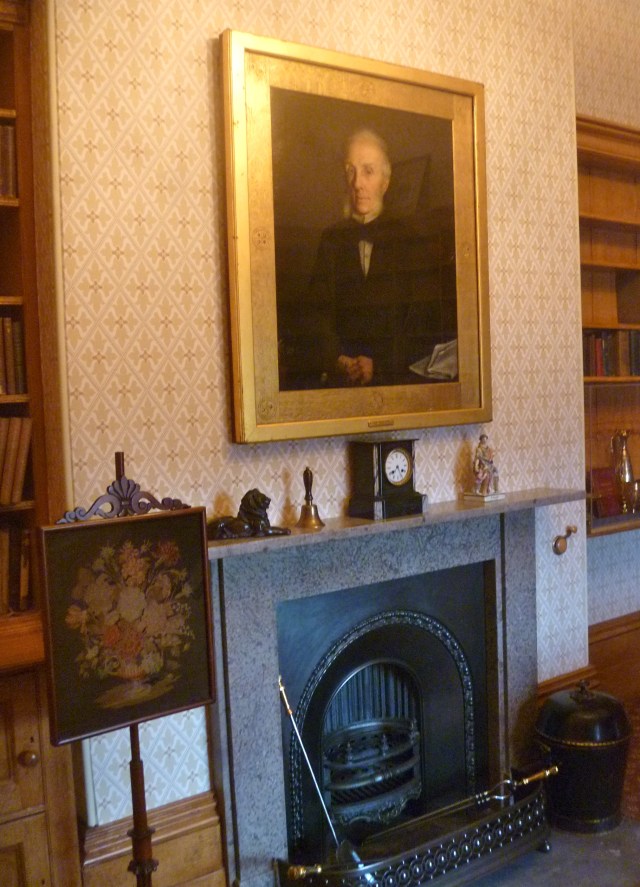
Elizabeth Gaskell’s House and Home

GH Blue Plaque

In the 28 September Arts and Books supplement to The Independent on Sunday I was pleased to read about the imminent opening in Manchester of the former home of Elizabeth Gaskell – more commonly known as the novelist Mrs Gaskell. Her Cranford books have been serialised on TV recently. But there is much much more to Mrs Gaskell and her writing than this rather cosy drama portrays. I recently read “Ruth” and for a novel written by the respectable wife of a Unitarian Minister it is really quite an eye-opener but an excellent read. Read a resumé here. In addition two excellent miniseries of her books ‘North and South‘ and ‘Wives and Daughters‘ were first broadcast on BBC TV in 2004 and 1999 respectively.

I straightaway headed to the house website and read this :

Tuesday, October 14, 2014 – 14:30 to 16:00

Book Launch: Carolyn Lambert ‘The Meanings of Home in Elizabeth Gaskell’s Fiction”

Book

Join us for the launch of Carolyn Lambert’s new book ‘The Meanings of Home in Elizabeth Gaskell’s Fiction’. Lambert explores how Gaskell challenges the convention of the Victorian home as a place of safety in her novels. In particular she illustrates her theme through the importance of homelessness in Gaskell’s work. Lambert’s book draws not only on the novels but also Gaskell’s letters and non-fiction writings and has recently been shortlisted for the Sonia Rudikoff Prize for the best Victorian book by a first time author.

A tour of the house and refreshments are included in the ticket price. Copies of the book will be on sale at a special price.

Gaskell House

84 Plymouth Grove, Manchester

So I booked a ticket for the talk and for the train and yesterday set off for Manchester. I’m afraid I don’t find Manchester any easy city to get around. Perhaps I don’t know it well enough. I eventually found a bus that would take me to Plymouth Grove and which  dropped me off outside number 84.

Welcome to Gaskell House

Carolyn’s talk took place in the Gaskell’s sitting room – yes, the very room in which Charlotte Bronte hid behind the curtains in order to avoid being seen by guests! Photography is allowed and we could sit on the comfy chairs, sofas and chaise longues. I was told that items covered in perspex were original to the house and had been gifted or lent by various donors or galleries and the rest of the furnishings and fittings were either of the period and style of the house during the time when the Gaskells had lived there or were reproductions.

Sitting room

The comfortable, relaxed sitting room

Carolyn began her talk with a resumé of Mrs Gaskell’s life. I have lifted this from the House website :

Elizabeth Cleghorn Gaskell was born in 1810 and lived at 84 Plymouth Grove with her family from 1850 until her death in 1865.

“To begin with the old rigmarole of childhood…” Wives and Daughters

She was born as Elizabeth Cleghorn Stevenson in London in 1810. A year later, on the death of her mother, she was taken to live in Knutsford, Cheshire, with her aunt, Hannah Lumb. The arrangement was a happy one – she was to refer to her aunt as “my more than mother” and was to use Knutsford as the inspiration for her fictitious town of Cranford. Knutsford also became ‘Hollingford’ in Wives and Daughters.

In 1832 Elizabeth married William Gaskell, the assistant minister at Cross Street Unitarian Chapel in Manchester. Their third home was a large house near open fields – 42 (now 84) Plymouth Grove. Here they grew flowers and vegetables, and kept a cow, pigs and poultry. The House was always bustling and the family entertained a stream of visitors, including many eminent people. Gaskell connections included such people as the Wedgwoods, the Darwins and the Nightingales, but girls from the Sunday School also came to the house regularly, as did William’s students and fellow clergy.”

She then went on to discuss some of the aspects of home touched upon in the Gaskell novels as well as in Mrs Gaskell’s own life. (Interestingly, she was a keen traveller and some years spent only half the year at home). The home in the novels symbolises security, it’s where relationships develop, it’s a place for creativity and self-expression. But she also wrote about homelessness and the role of servants. Elizabeth Gaskell was ambivalent about Manchester and was torn between family and a longing for the rural environment. Her large house looks rather incongruous these days amidst modern buildings and areas of wasteland on Plymouth Grove but when she was living and writing here it was rural area and the house had a long garden stretching back down Swinton Grove but now built upon by flats.

There wasn’t time in the end to do the full tour – so I will have to return on another occasion and make a more full report of the house but I did peep into ground floor rooms :

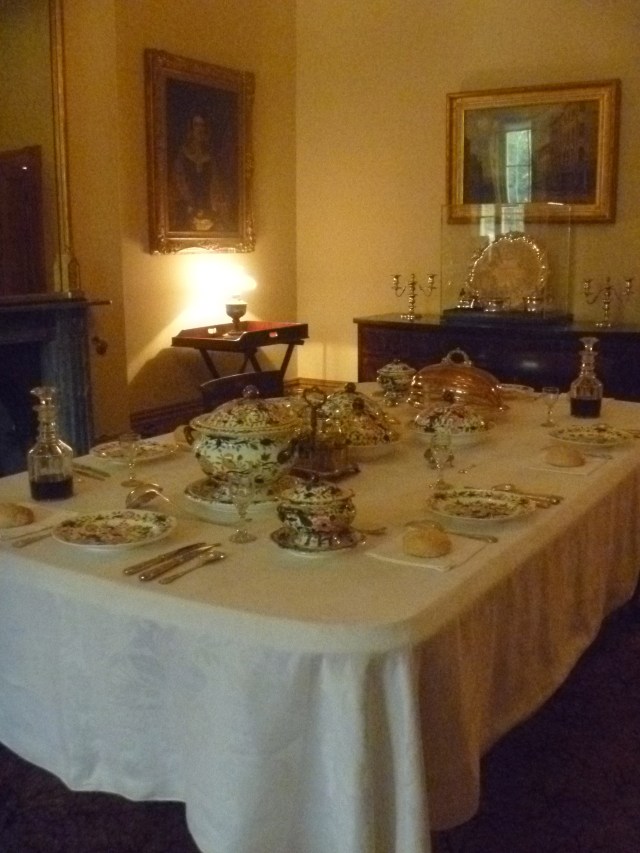
Dining Table

The Dining Room

Gaskell writing desk

Mrs Gaskell’s Desk at one end of the Dining Room

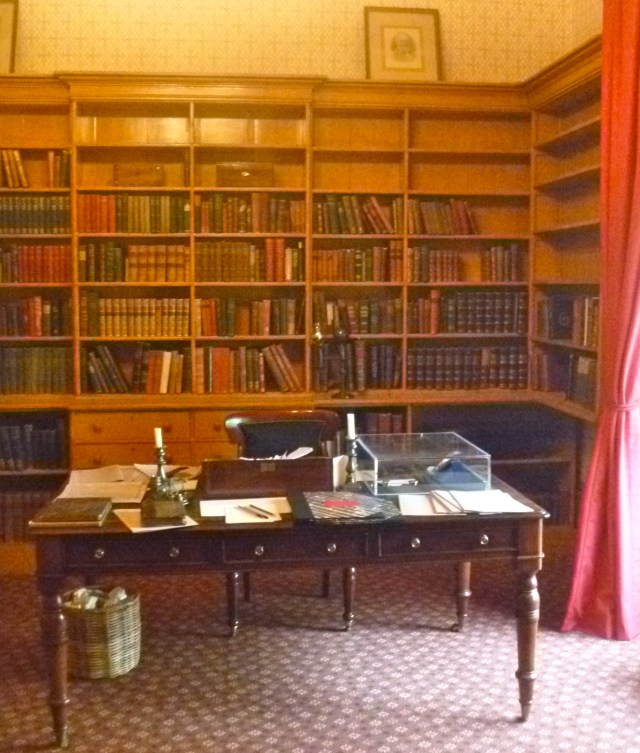
William's study

William Gaskell’s Study

William portrait in study

William Gaskell

and refreshments were served downstairs in the basement tea room and bookshop (new and secondhand).

Tea room

The Tea Room

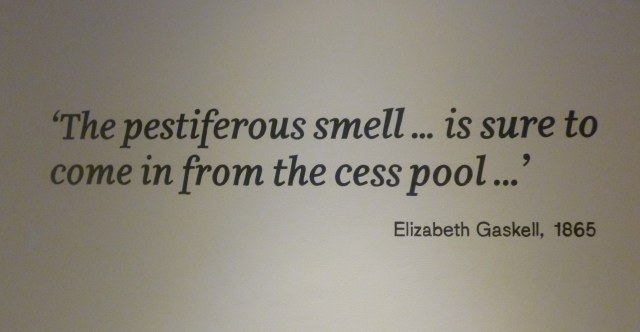
Pertinent quotations from Mrs Gaskell add a touch of humour

Quote 1


Quote 2

And in the Ladies Loos :

Ladies' quote

As the instructions for finding a bus that would take me back to Piccadilly Station didn’t work out I was thankful for one thing about Manchester – taxis with lights were easy to hail and thus I made my way back to the train and thence to my own home in comfort.

GH Rear view

Rear of Gaskell House


Diamonds and Dioramas in the Bern Natural History Museum

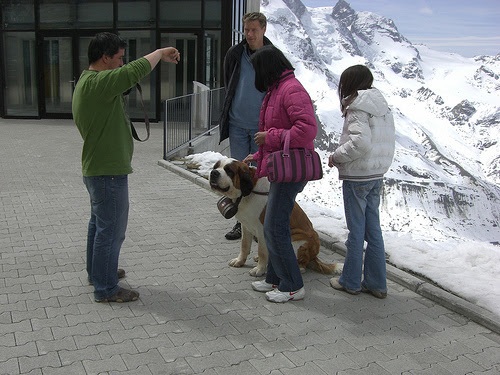
In addition to the Barry exhibition at the Bern Natural History Museum there were several other setions which attracted my interest. By the way, re-reading my post of yesterday reminded me that I’d seen a real live Barry on the Gornergrat a few years ago. I thought he was having a day out just like me but apparently he’s part of the scenery.

A St Bernard poses for the camera

A St Bernard poses for the camera

Like most Natural History Museums the world over the museum in Bern has its fair share of mammals from around the world but these were not of great interest to me. I prefer something of more local interest.

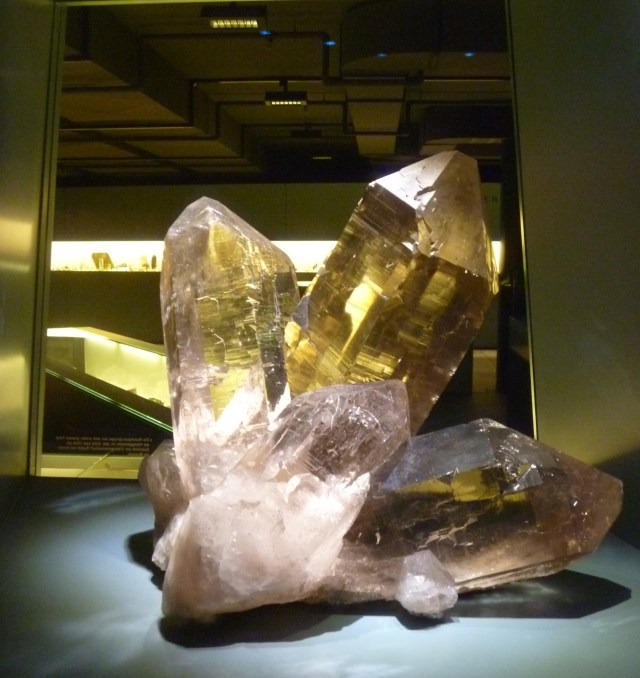
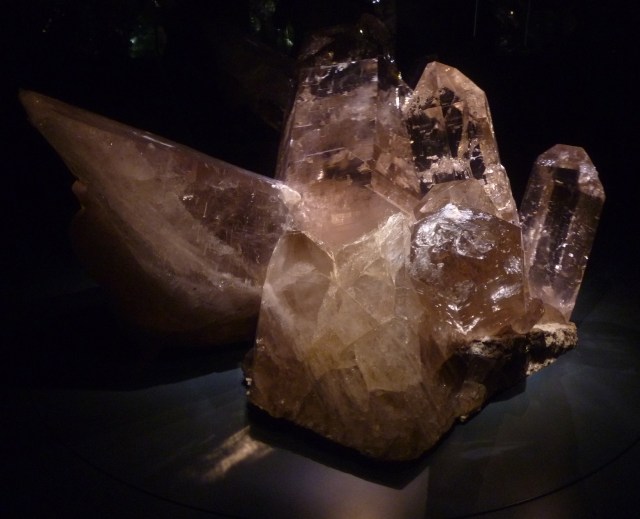
The Planggenstock Treasure has been on display in the Museum since 2011. These quartz crystals and crystal clusters were discovered under the Planggenstock Peak in the canton of Uri in Central Switzerland in 2005.

Planggenstock

The largest group of crystals weighs 300kg.

Smoky rock crystals

Smoky Rock Crystals

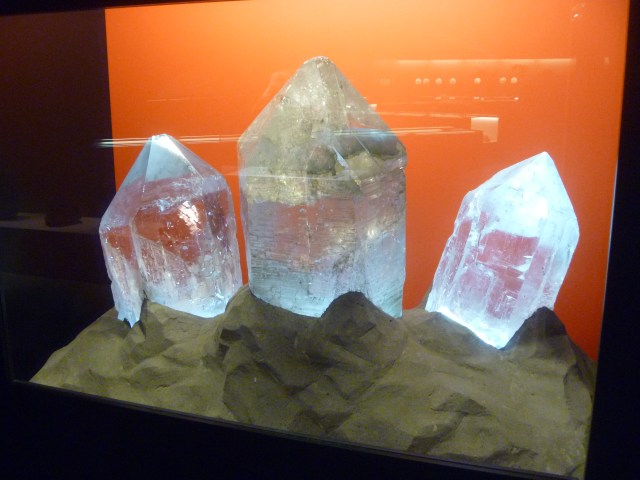
3 crystals group

The oldest objects in the collection are three rock crystals found in 1719 on the Vorderer Zingenstock.

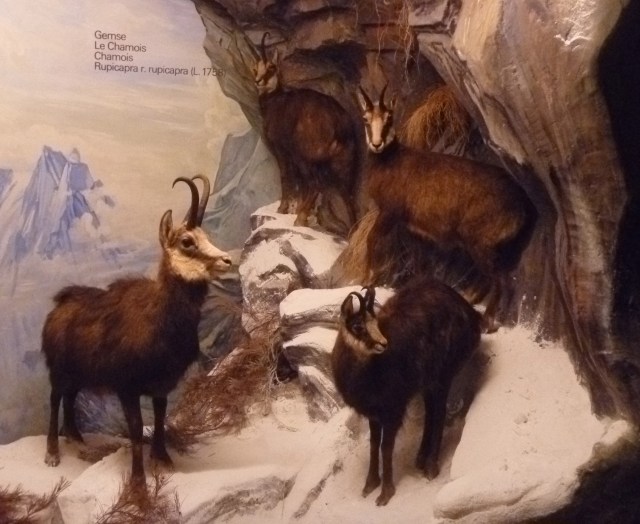
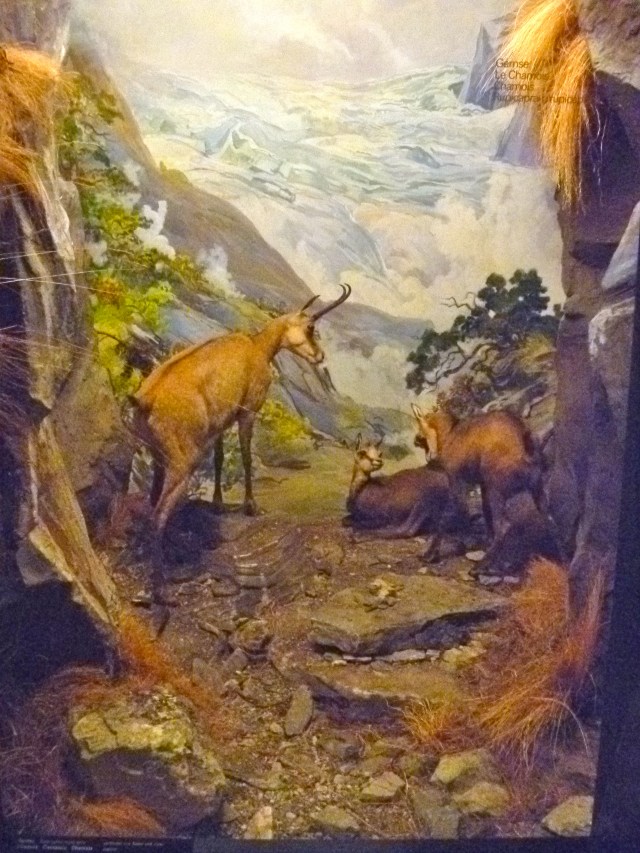
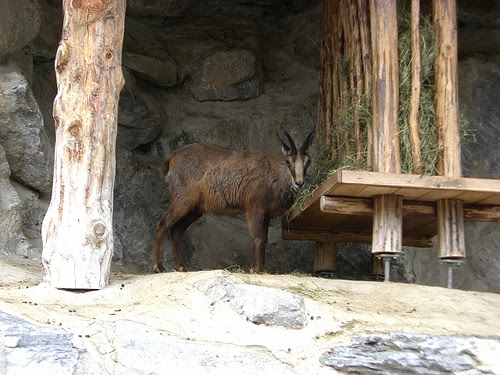
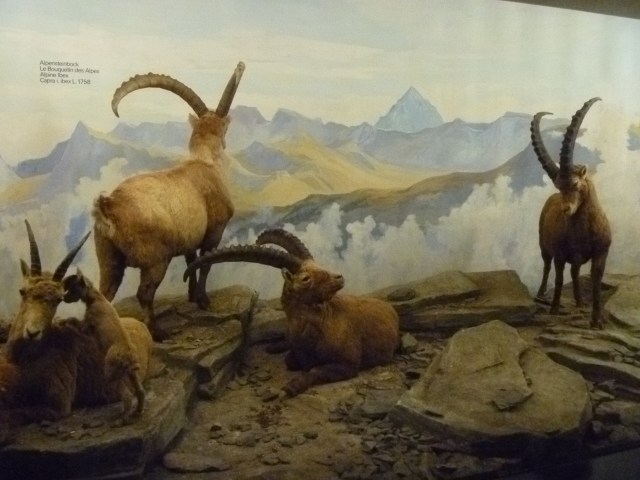
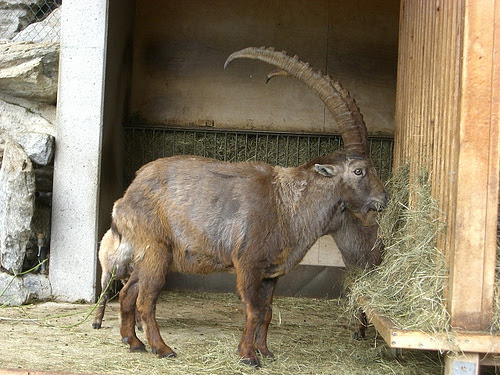
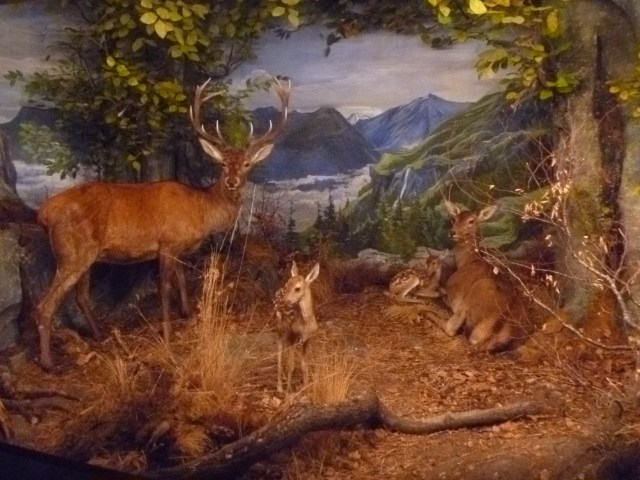
As time was limited I left the collection of minerals, crystals, diamonds and rocks and moved on to the section featuring dioramas of the wildlife of Switzerland. Here was diorama after diorama of birds and animals in their settings. I was particularly interested to se all the different types of deer. I would call a deer a deer but in Switzerland they always distinguish between roe deer and chamois and red deer and ibex.

Gemse

Gemse = Chamois

Chamois

More Chamois

Chamois feeding

Chamois feeding at Innsbruck Alpine Zoo (2010)

Ibex

Ibex Diorama

Ibex feeding

Ibex at Innsbruck Alpine Zoo

The Alpine Ibex is known at the Alpensteinbock in German. Chamois are Gemse and Reh is roe deer and Hirsch are Red deer.

Red deer

Red Deer or Hirsch

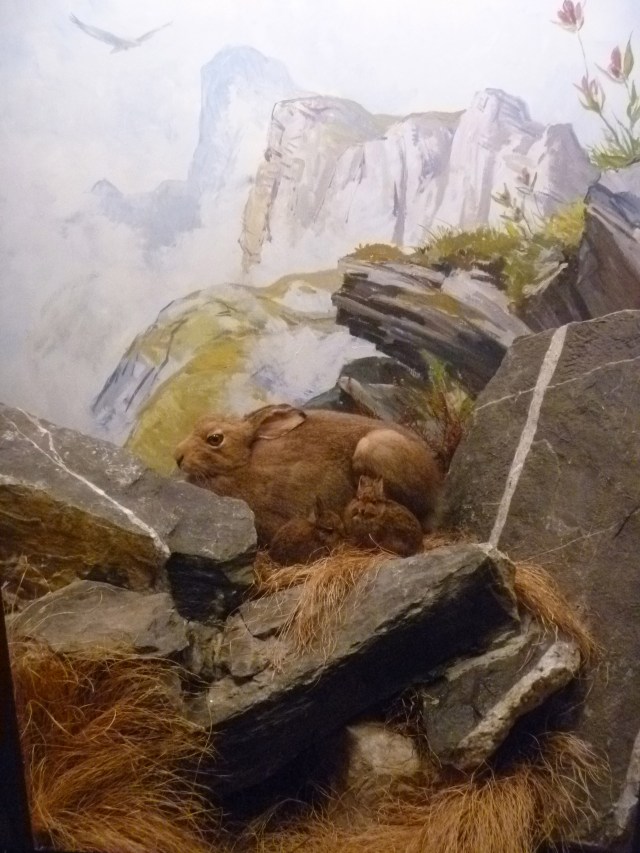
Mountain hares summer

Mountain Hares in Summer

Mountain hares winter

Mountain Hares in Winter

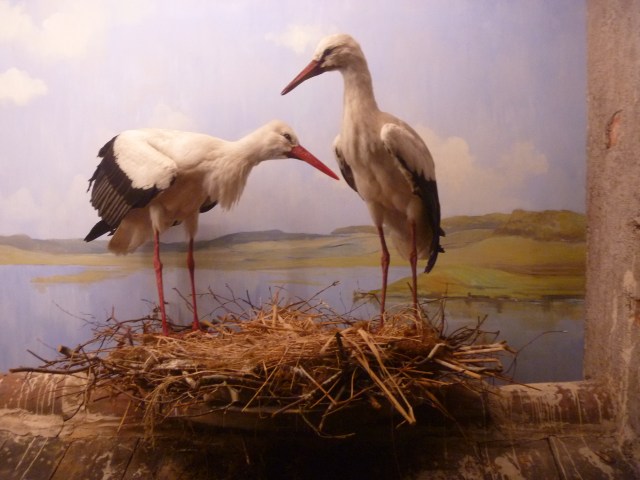
Storks

Storks

Please take me home!

And finally … Please take me home!