Bolton Percy : the Perfect October Morning Out

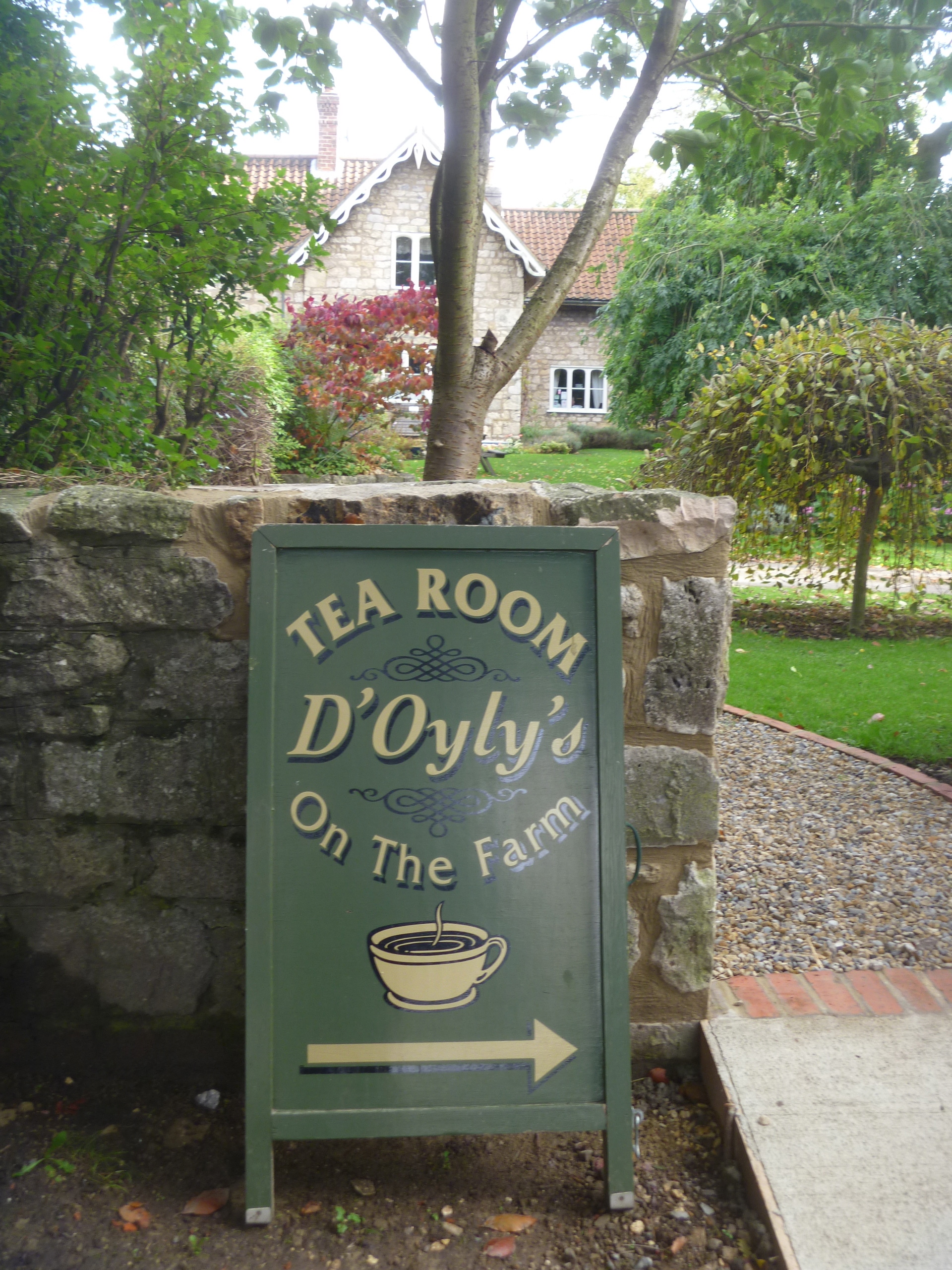
Barely half an hour’s drive from home we turned off the A64 Leeds to York road into Tadcaster and there’s a little sign ‘Bolton Percy’, which would be easy to miss, just after crossing the River Wharfe in the centre of town. About 3 or 4 miles down this lane and we arrived at the village of Bolton Percy. On the right as you enter the village there’s a cricket green and pavilion and soon on the left is the car park for D’Oyly’s Tea Room.
We parked up and went to explore the village. Right in the centre are the four other things we came to see –
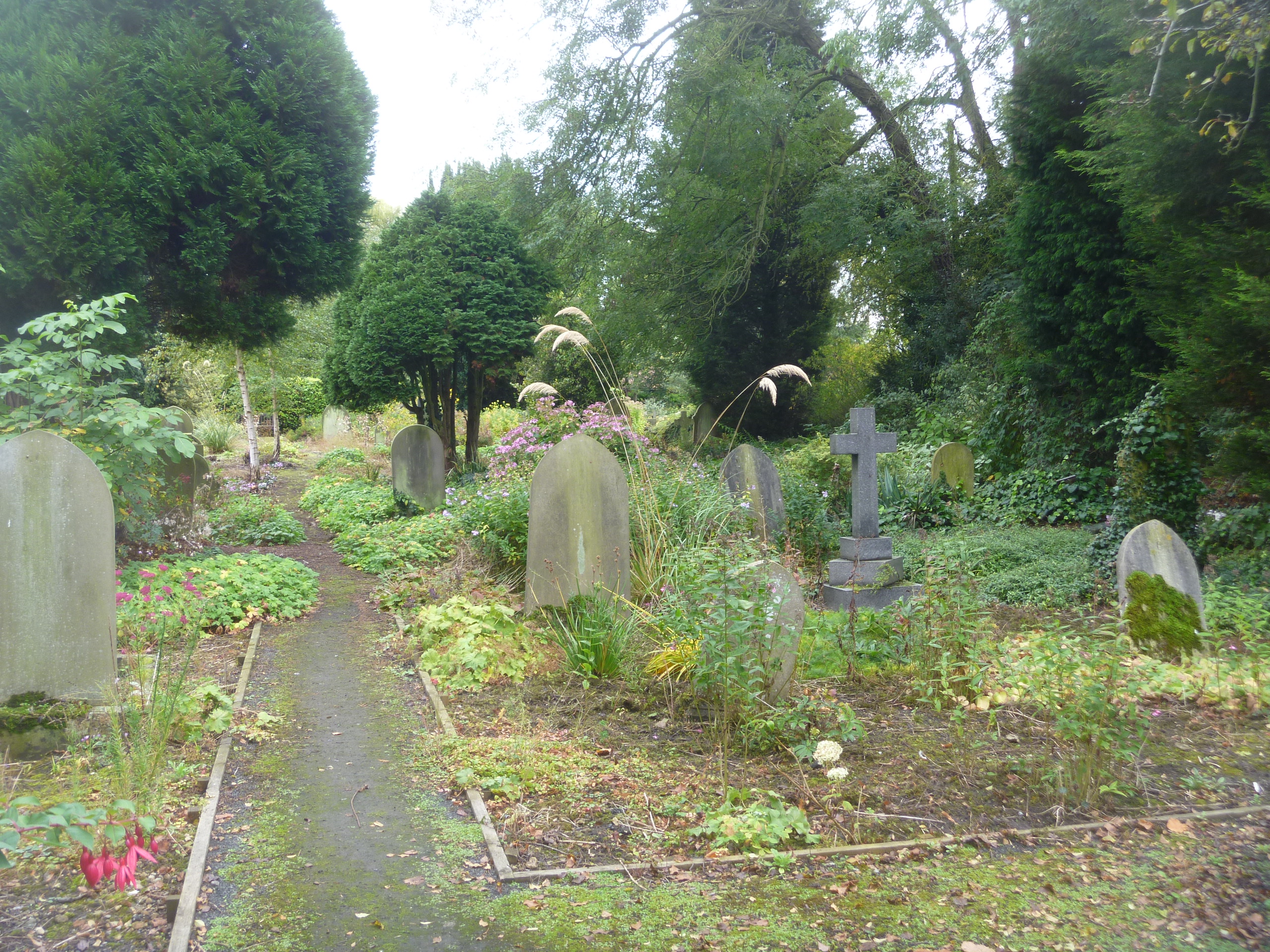
the No-dig churchyard,

All Saints church,

the Crown Inn

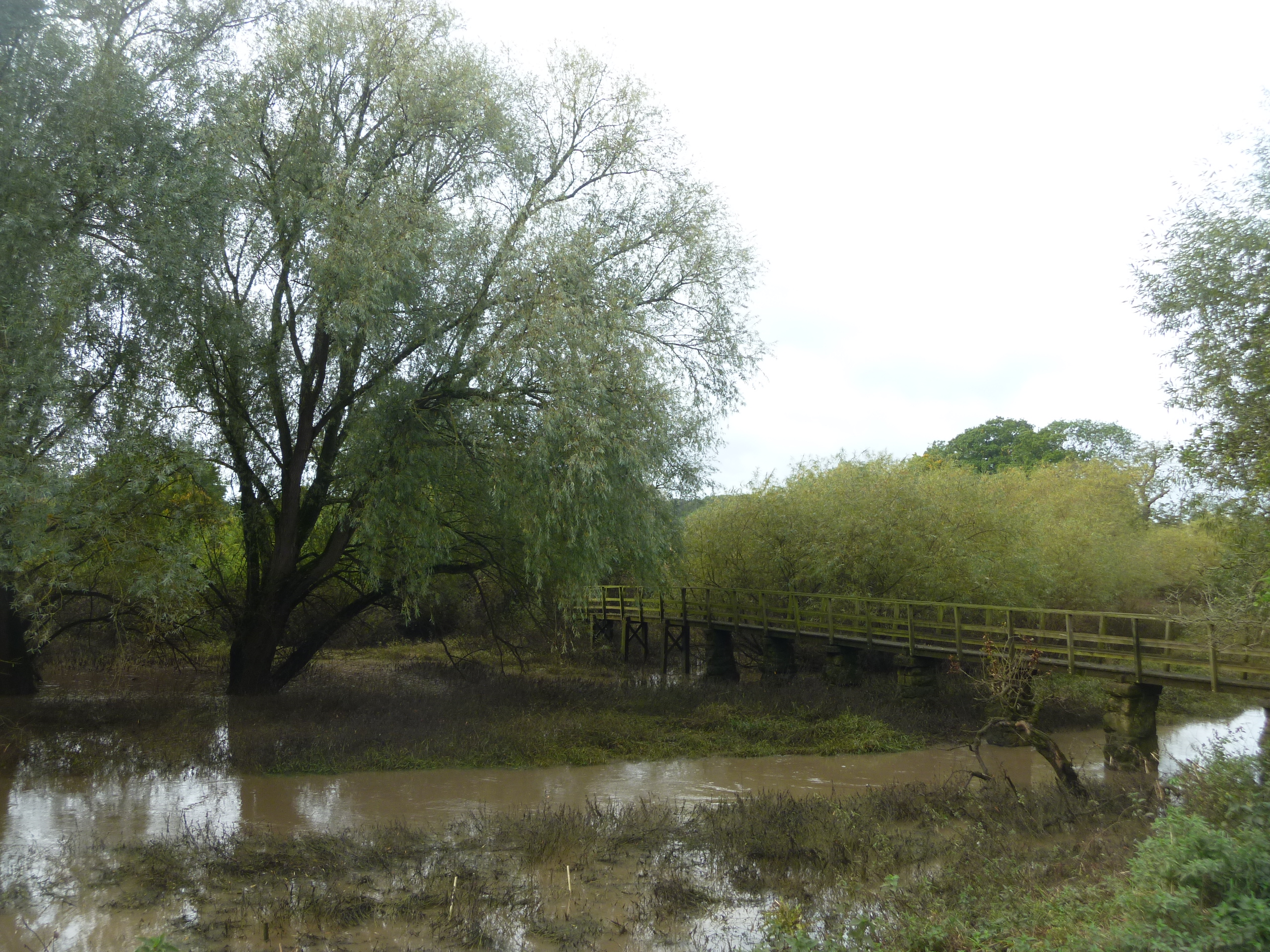
by the ancient river crossing
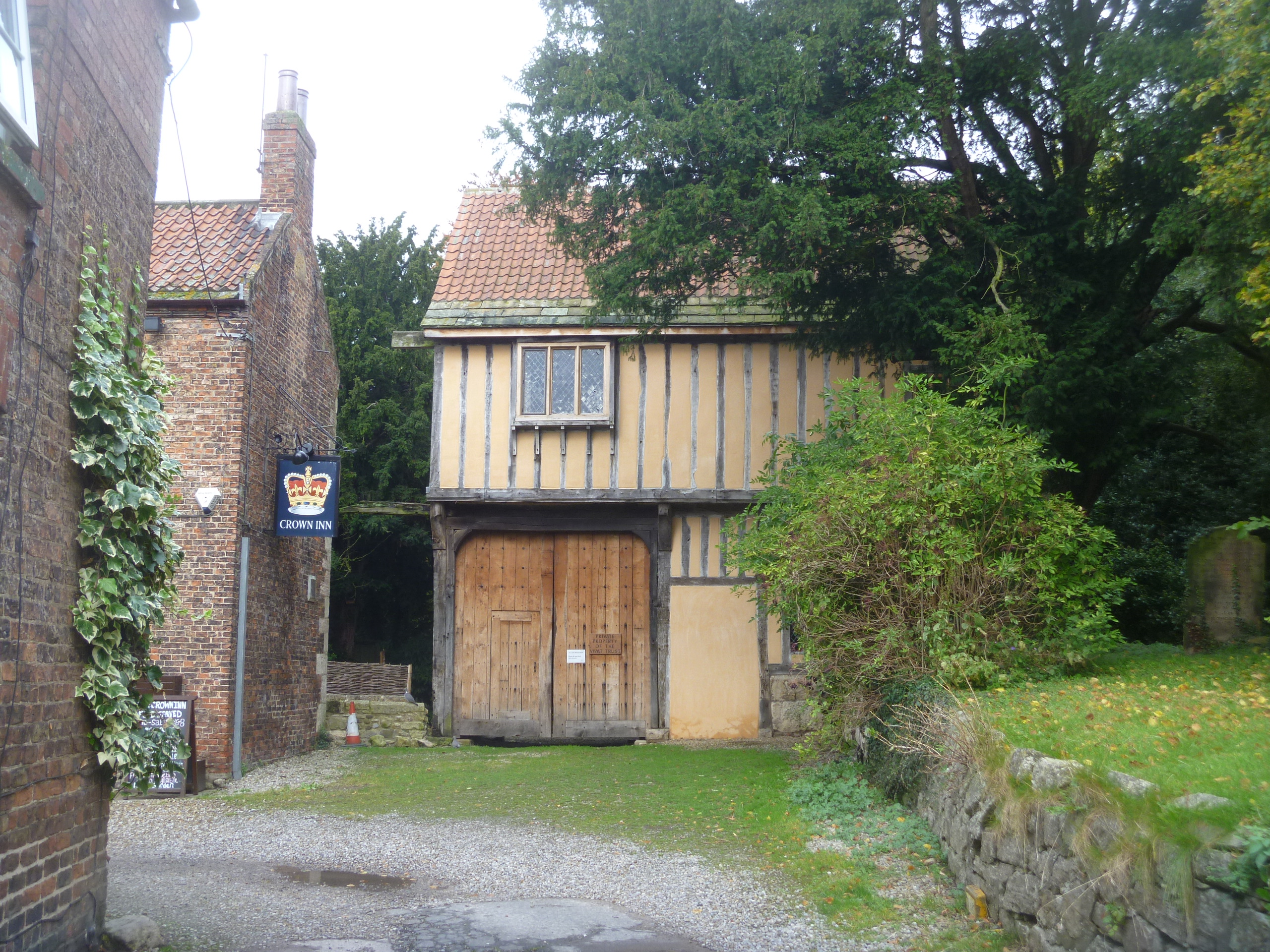
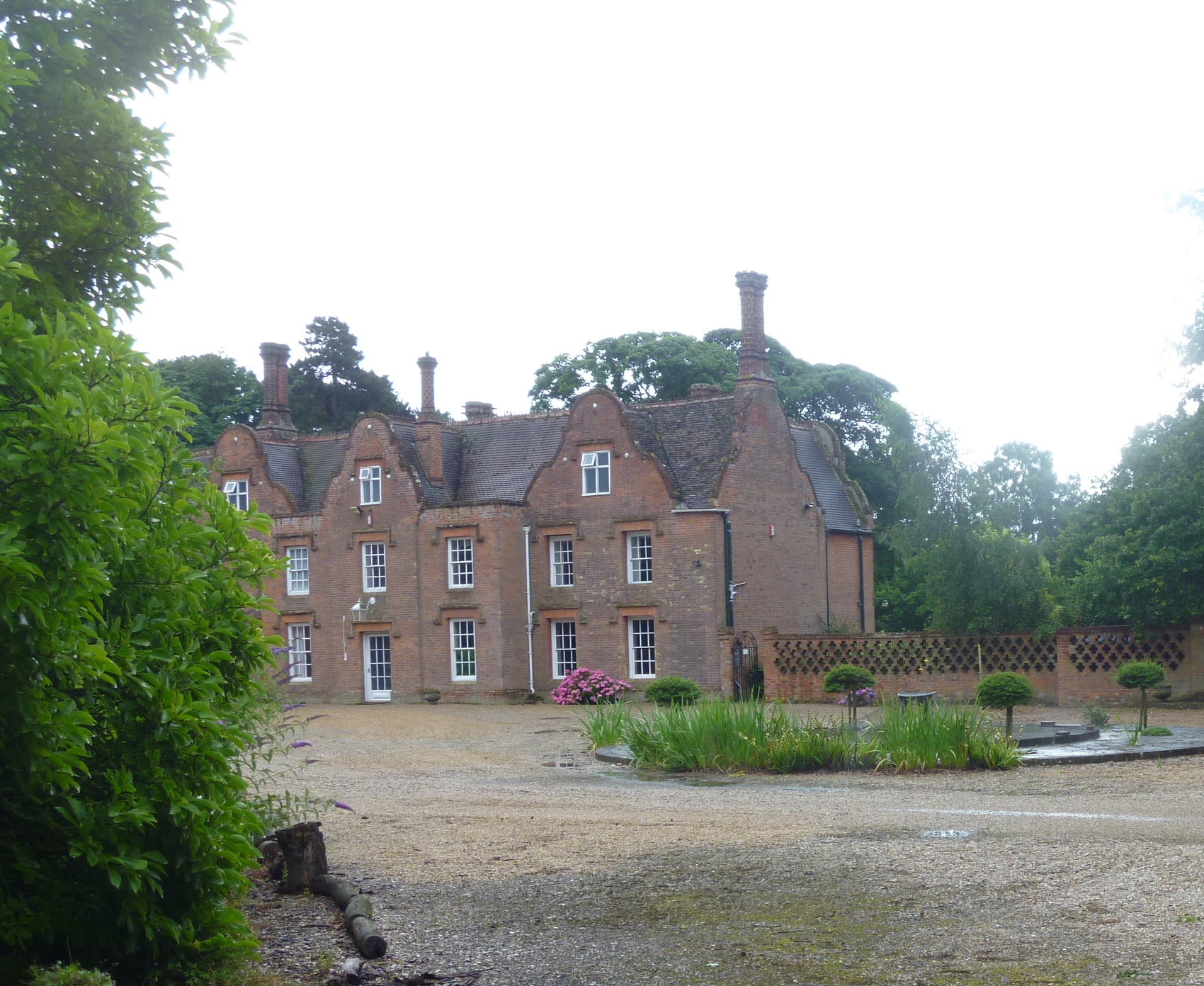
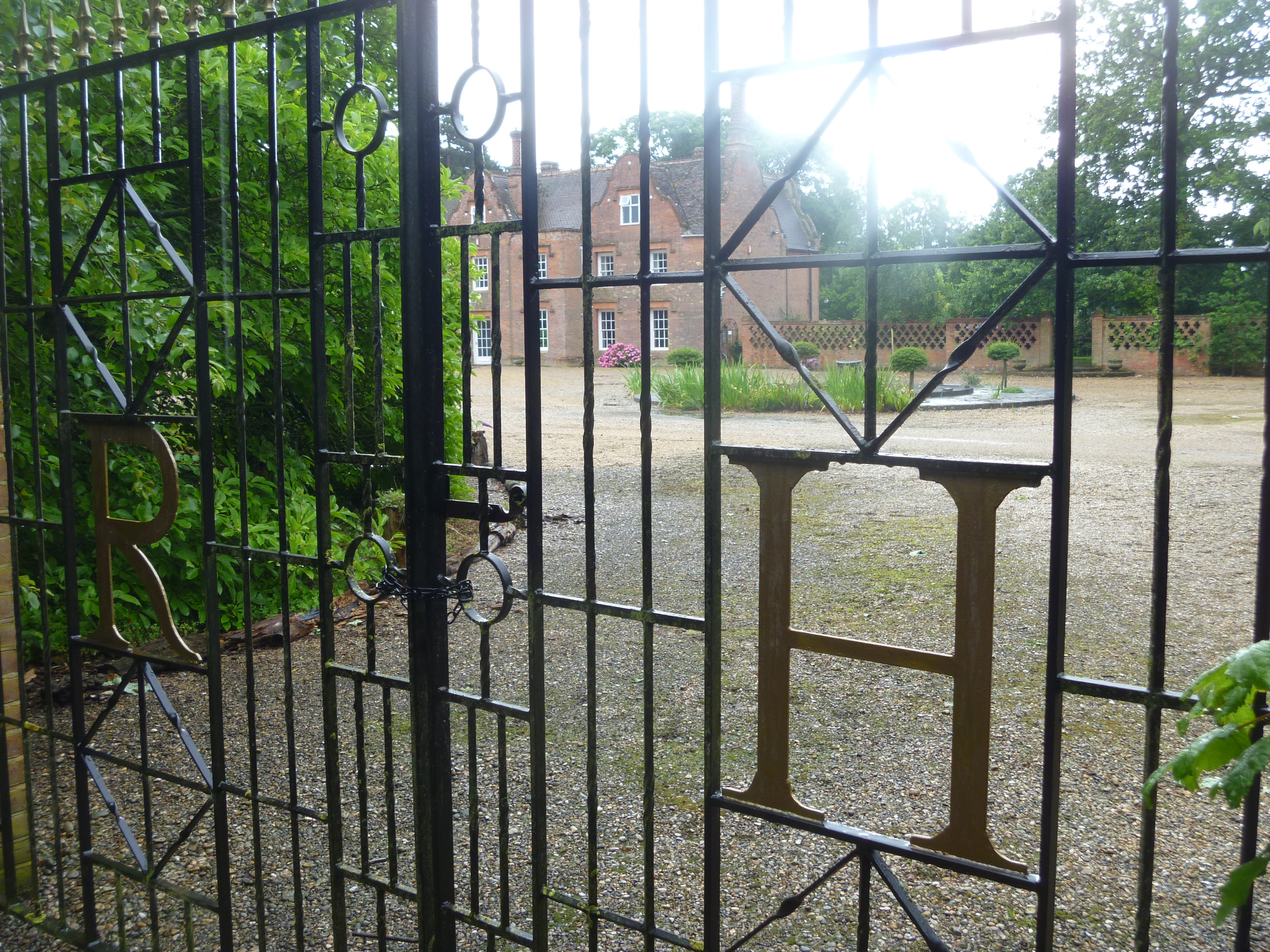
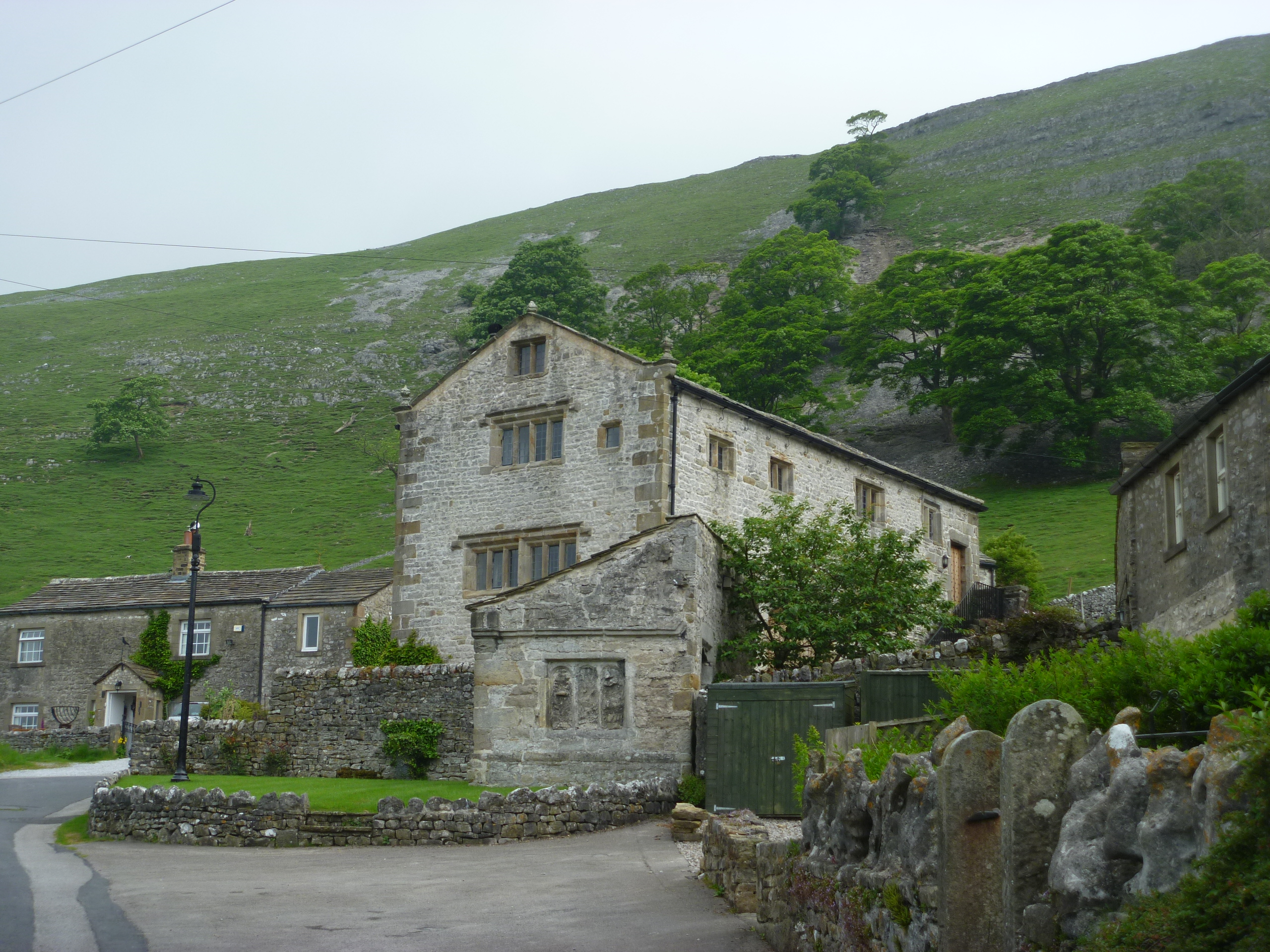
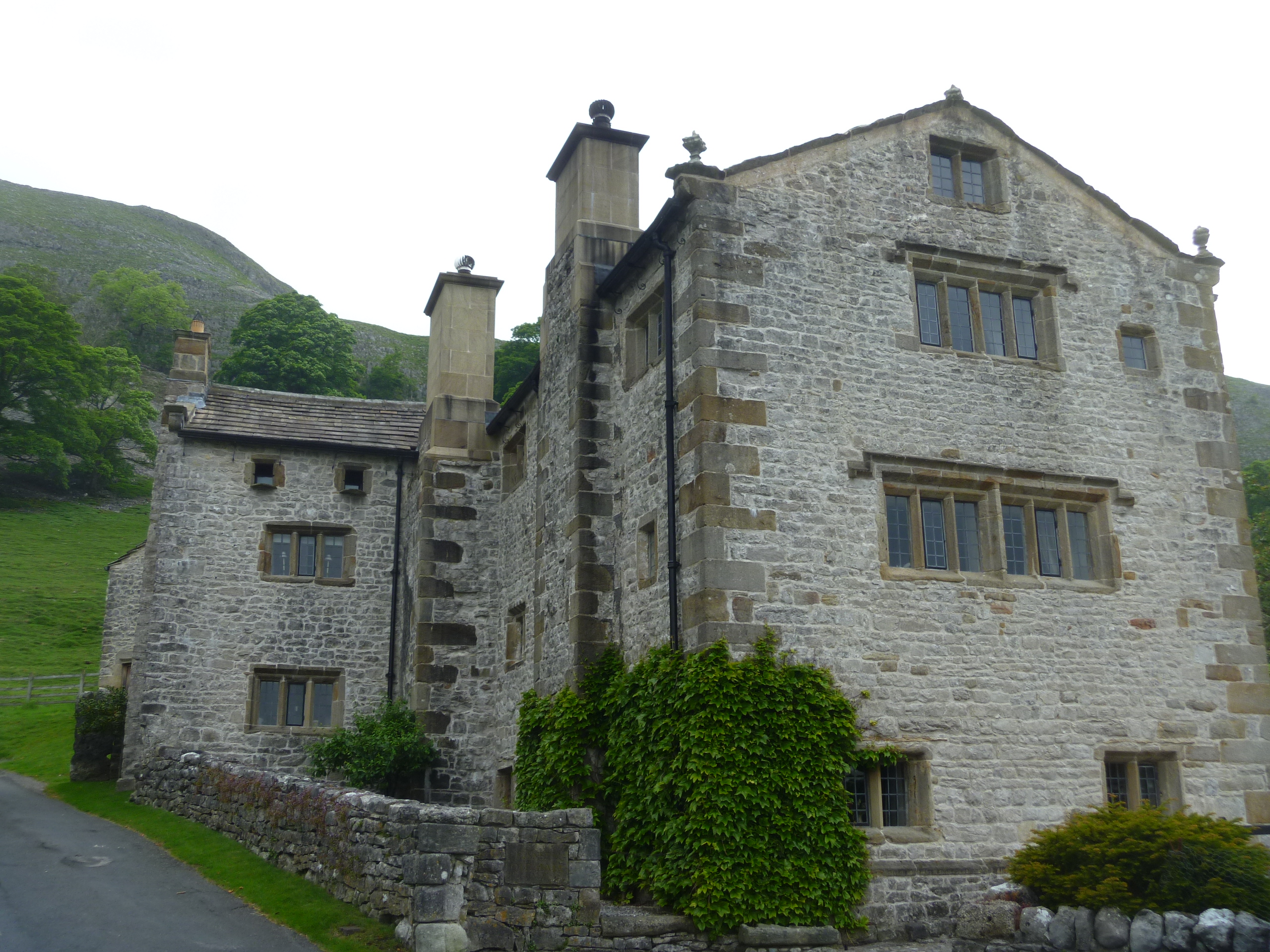
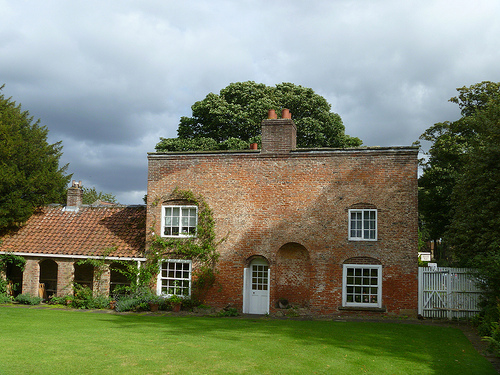
and the piece de resistance the fifteenth century Bolton Percy Gatehouse recently fully restored and now let as holiday accommodation by The Vivat Trust.

I first heard about the village of Bolton Percy when The Vivat Trust added the Gatehouse to its portfolio. Later I read a magazine feature in Intelligent Life about Tom Denny and the installation of the Millennium Window in All Saints Church. Any reference to English country (or other) churches always leads me to my Simon Jenkins’ ‘England’s thousand best churches(All Saints was awarded one star) and a couple of years ago Nun Appleton Hall (about a mile or so from BP) turned up in another book I was reading : Michael Holroyd’s ‘A Book of Secrets: illegitimate daughters, absent fathers‘. (I checked with the waitress at D’Oyly’s) and it’s impossible to see the Hall from the road and no Rights of Way pass through the estate). Internet searches for Bolton Percy bring up D’Oyly’s and further searches for All Saints church bring up references to Roger Brook and his No-Dig Gardening in the churchyard. So, when a walking friend urged me to let her treat me to lunch or tea as a ‘thank you’ for the lifts I’ve given her (I’m always happy to have her company anyway) I suggested we might give Bolton Percy a try.
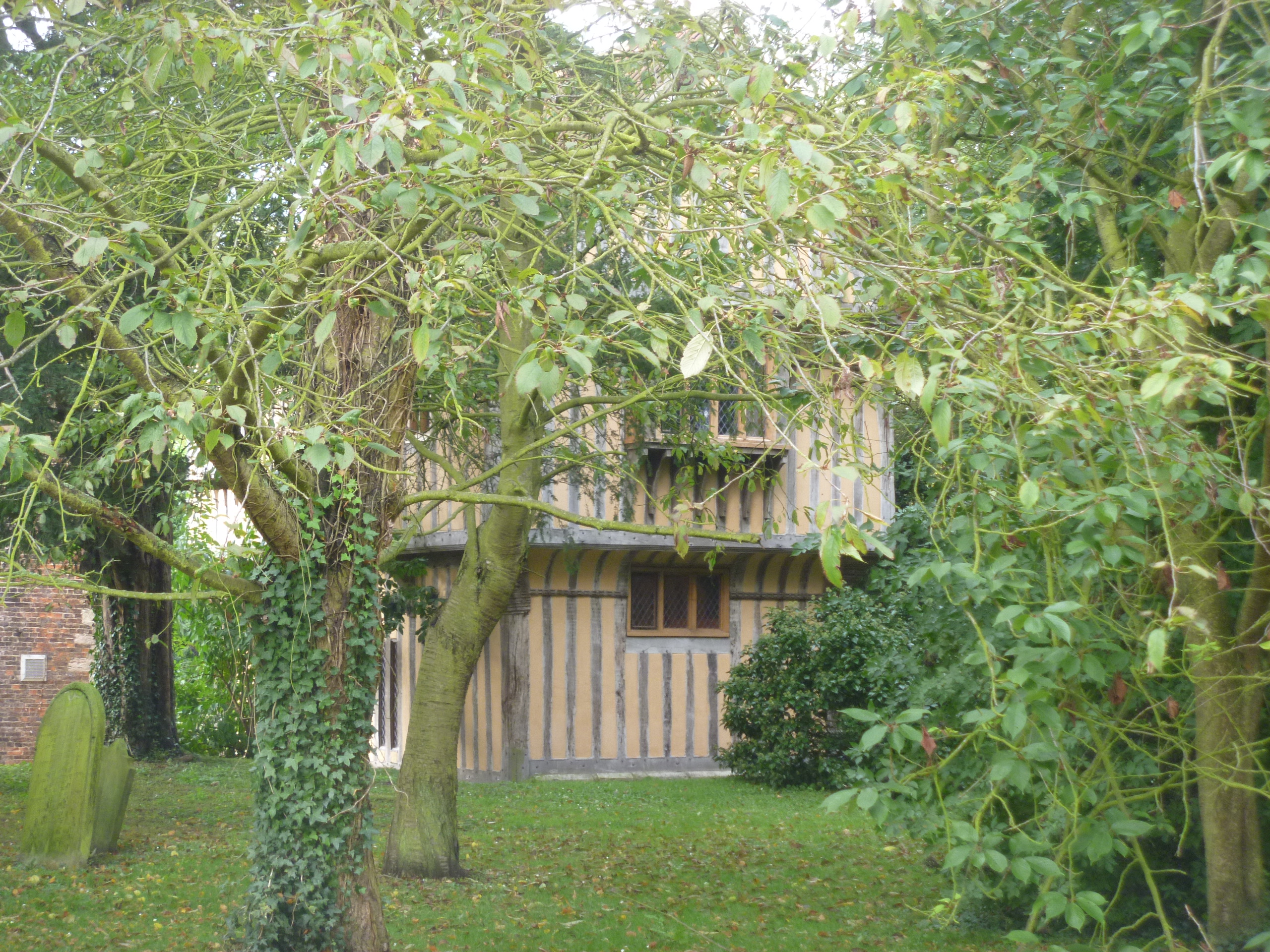
Jenkins says : “The church sits on the Yorkshire plain next to the remains of a river crossing. The gatehouse of an ancient manor lurks next  door among the trees”

The early 15th century church is big and grey, its white limestone interior darkened by age and stained glass, but saved from impenetrable gloom by some clear windows in the south aisle.”

“The Jacobean box pews are complete, with charming knobs as poppy-heads.” Currently decorated in anticipation of Harvest Festival.
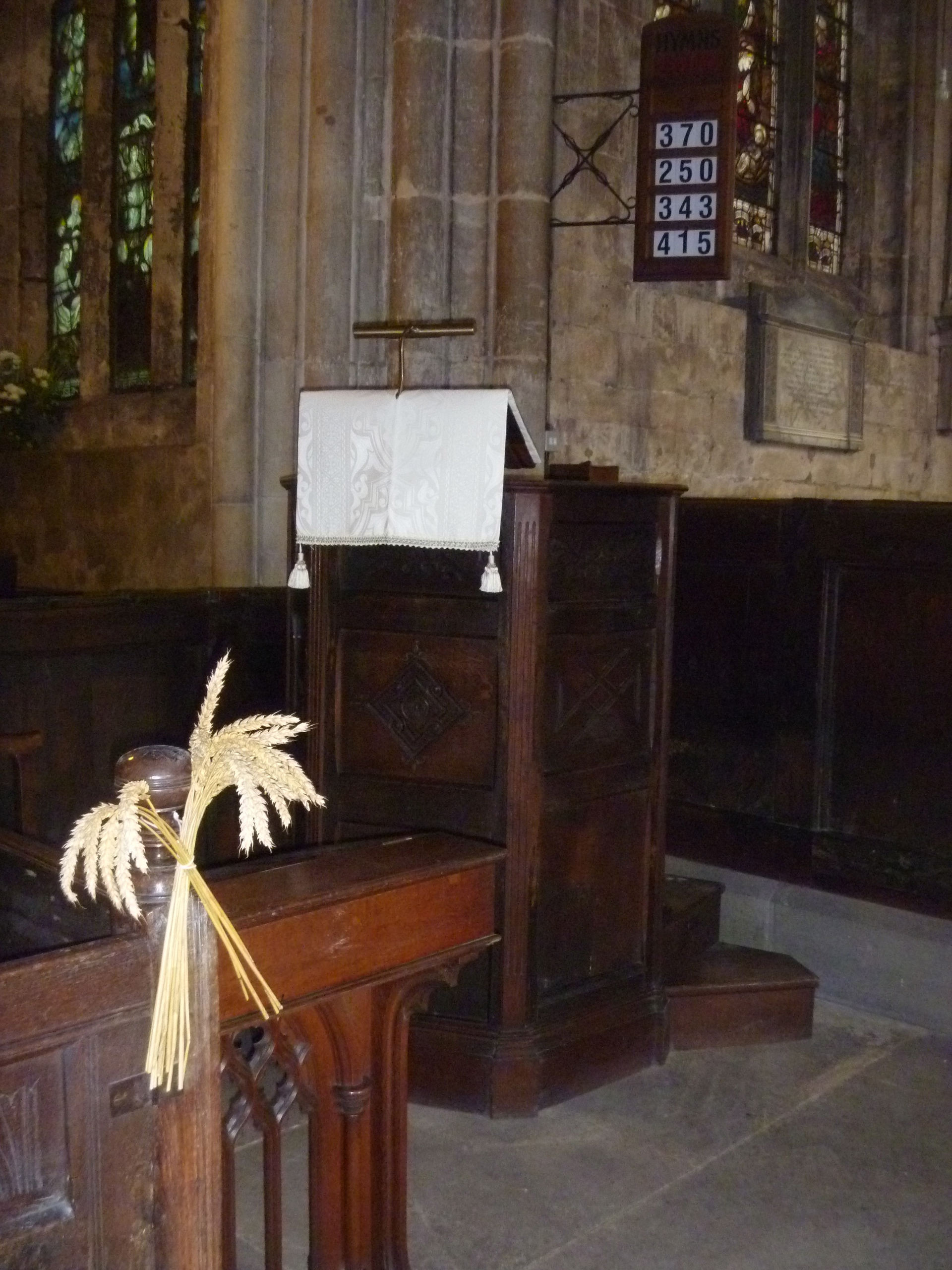
“There are two pulpits,  one early 17th century and one early 18th century, the former austere, the latter more flamboyant, its tester supported on an Ionic column.”

Then there are the stained glass windows : an east window with a rare depiction of the Virgin Mary as its centre piece;

the Burne-Jones for Morris and Co. Caritas window;

the Millennium window by Tom Denny inspired by Isaiah 43: “I will even make a way in the wilderness, and rivers in the desert.” The River Wharfe flows through it and an owl and a curlew are flying.
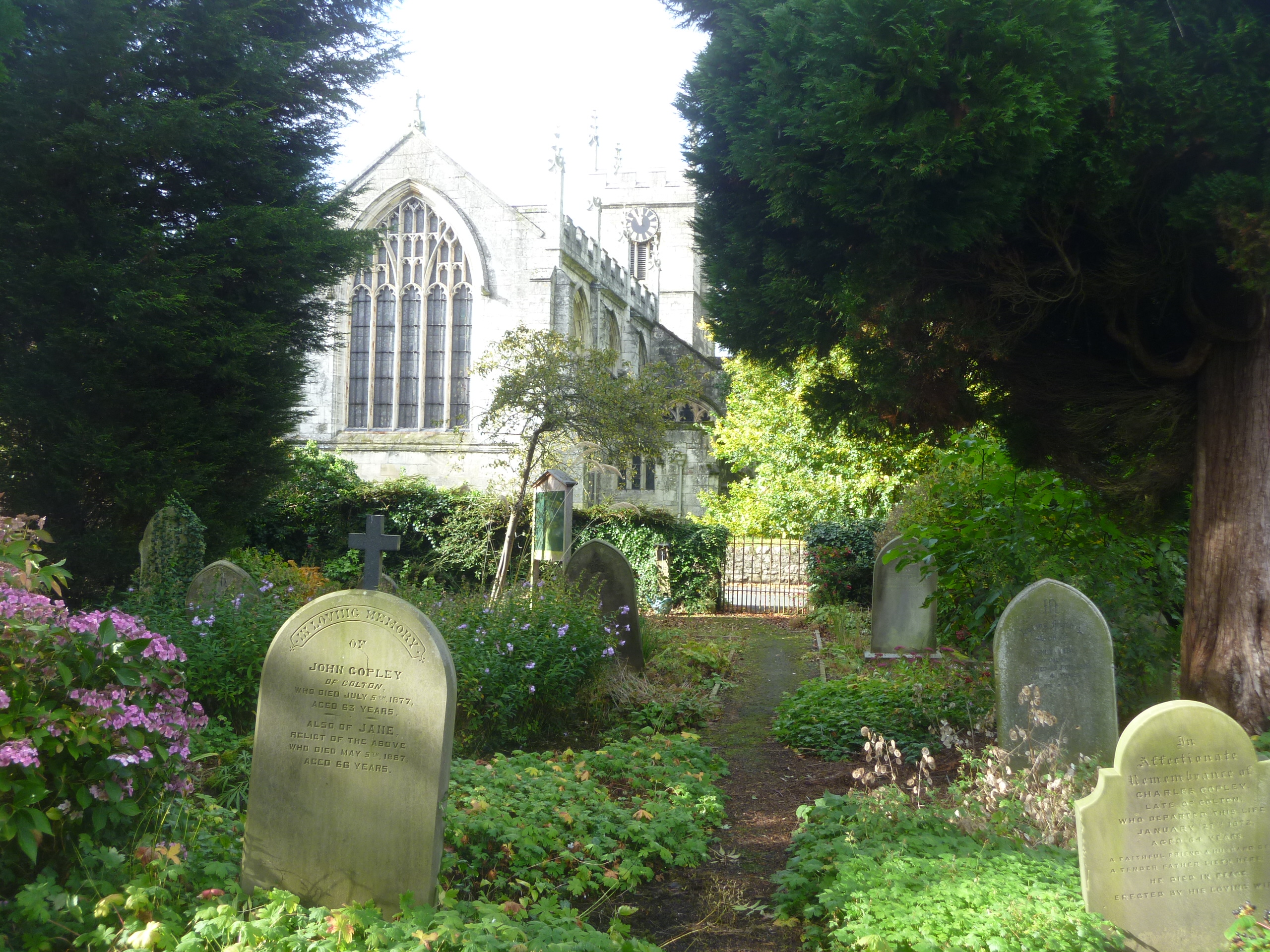
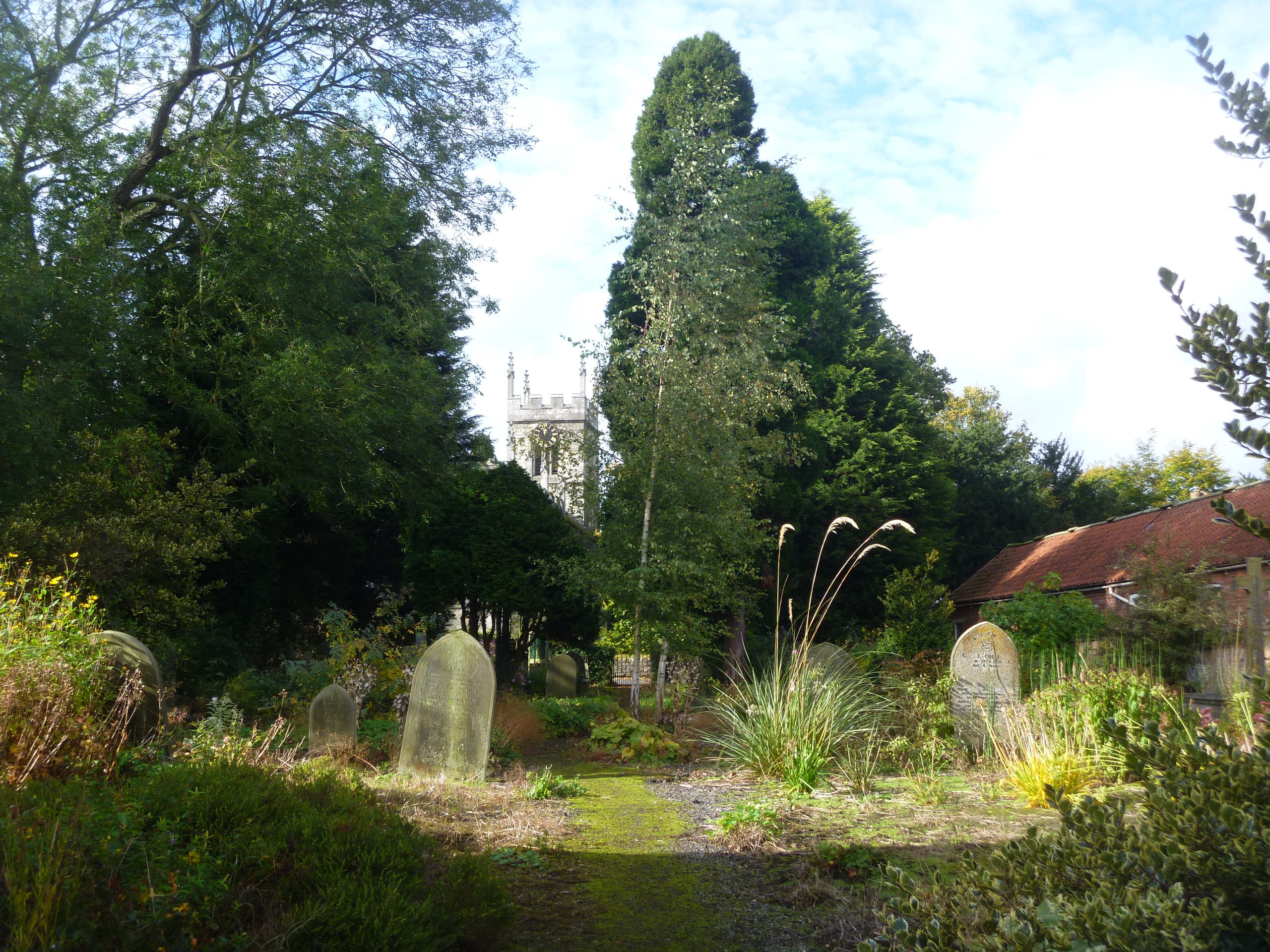
Outside and just across the road is the continuation of the churchyard. This lovely, natural space is full of wildflowers and a haven for wildlife and a peaceful resting place for Bolton Percy villagers. I’m sure it is hard work keeping it looking naturally ‘unkempt’.

It was a difficult decision as to where to take lunch but we finally chose the tea room and enjoyed a toastie followed by tea and lemon cake. All homemade and beautifully served on classic china. A perfect morning out.
Literary Lyme – from Jane Austen to Little Pig Robinson

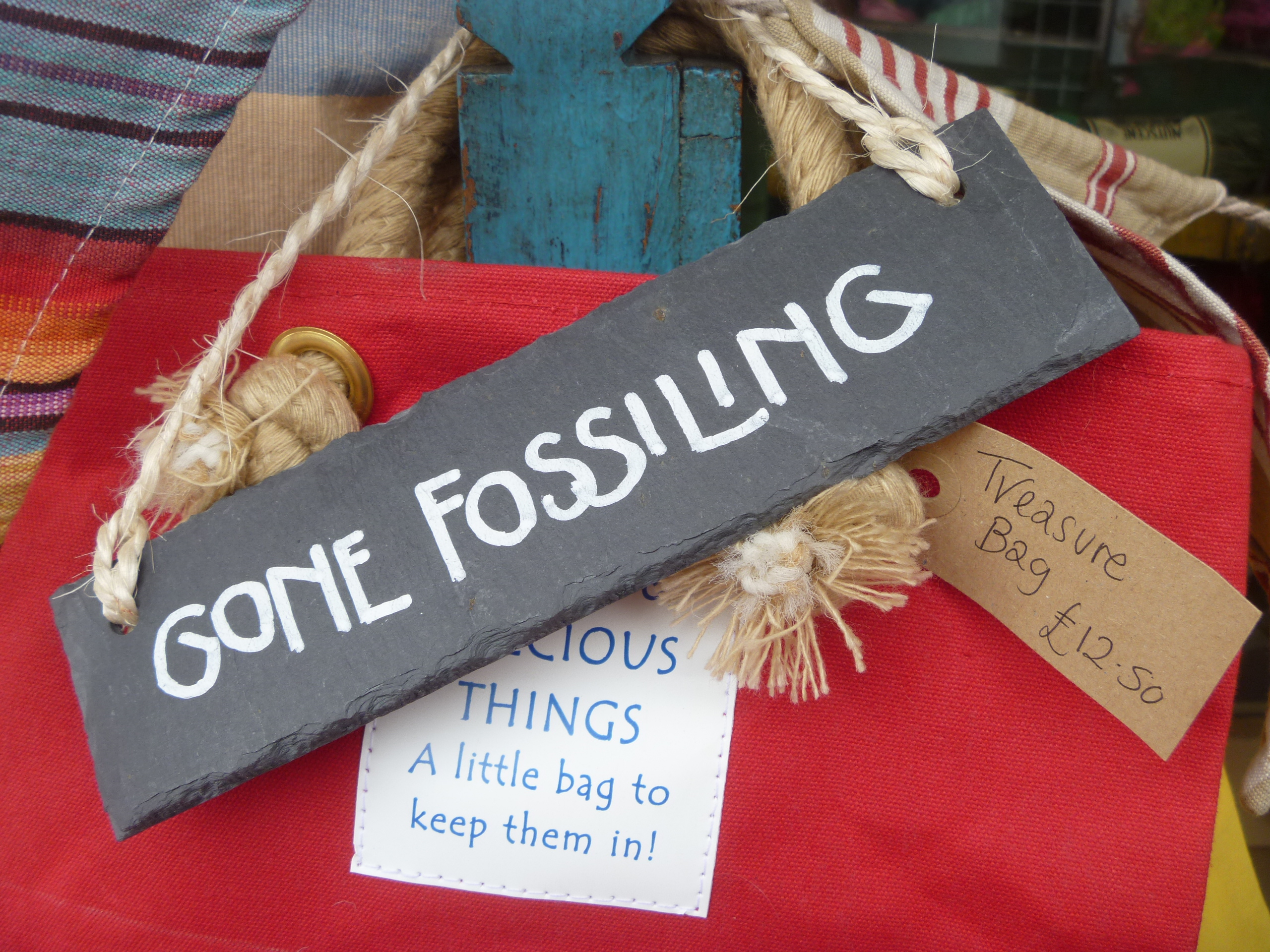
I’ve visited Lyme Regis on at least one occasion every year since I first came down to Branscombe in 2007. On several of the previous visits I’ve gone fossiling. Needless to say the five-year olds on these tours found many fossils and I found never found any. Of course, they are a lot nearer to the ground. That’s my excuse, anyway.

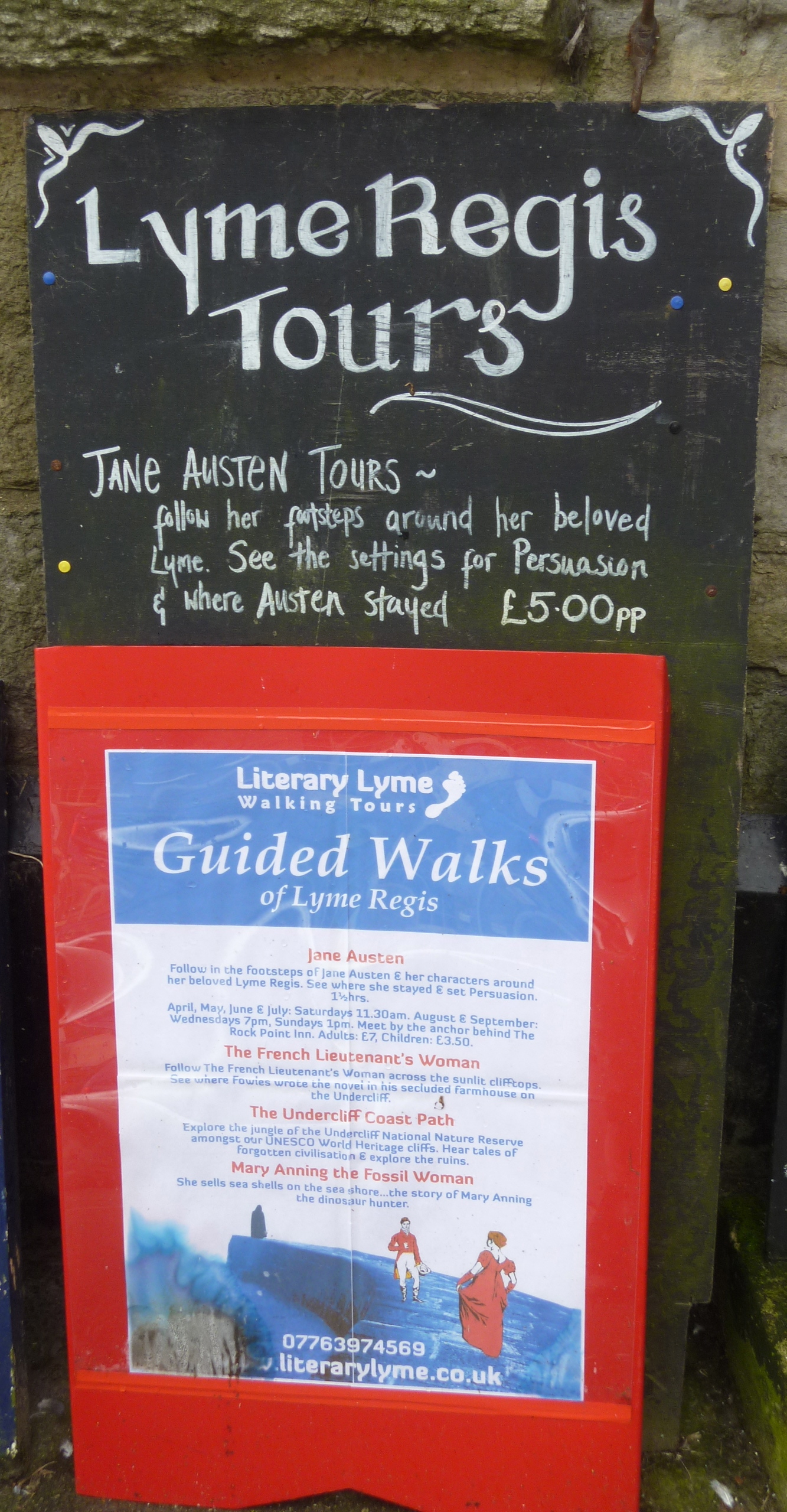
This year on the recommendation of one my readers I’d booked to go on a Literary Lyme Walking Tour on the theme of Jane Austen in Lyme Regis.

I should mention here that the weather on this August Bank Holiday Monday was simply appalling – wind, rain and high seas. This was such a shame at the end of summer and of most people’s holidays.

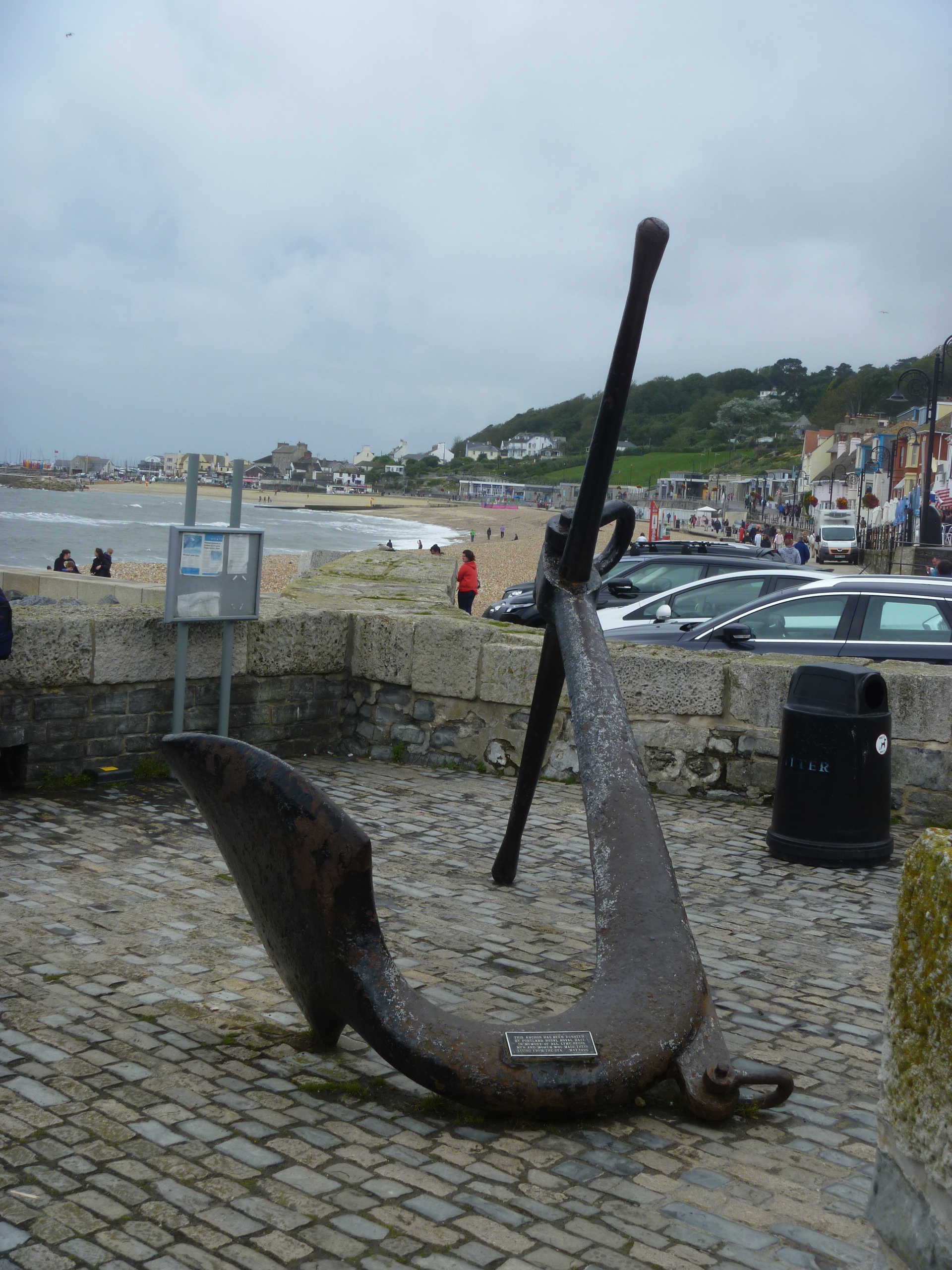
The arrangement was to meet at the anchor in the middle of town where the main shopping street drops down to the sea wall.

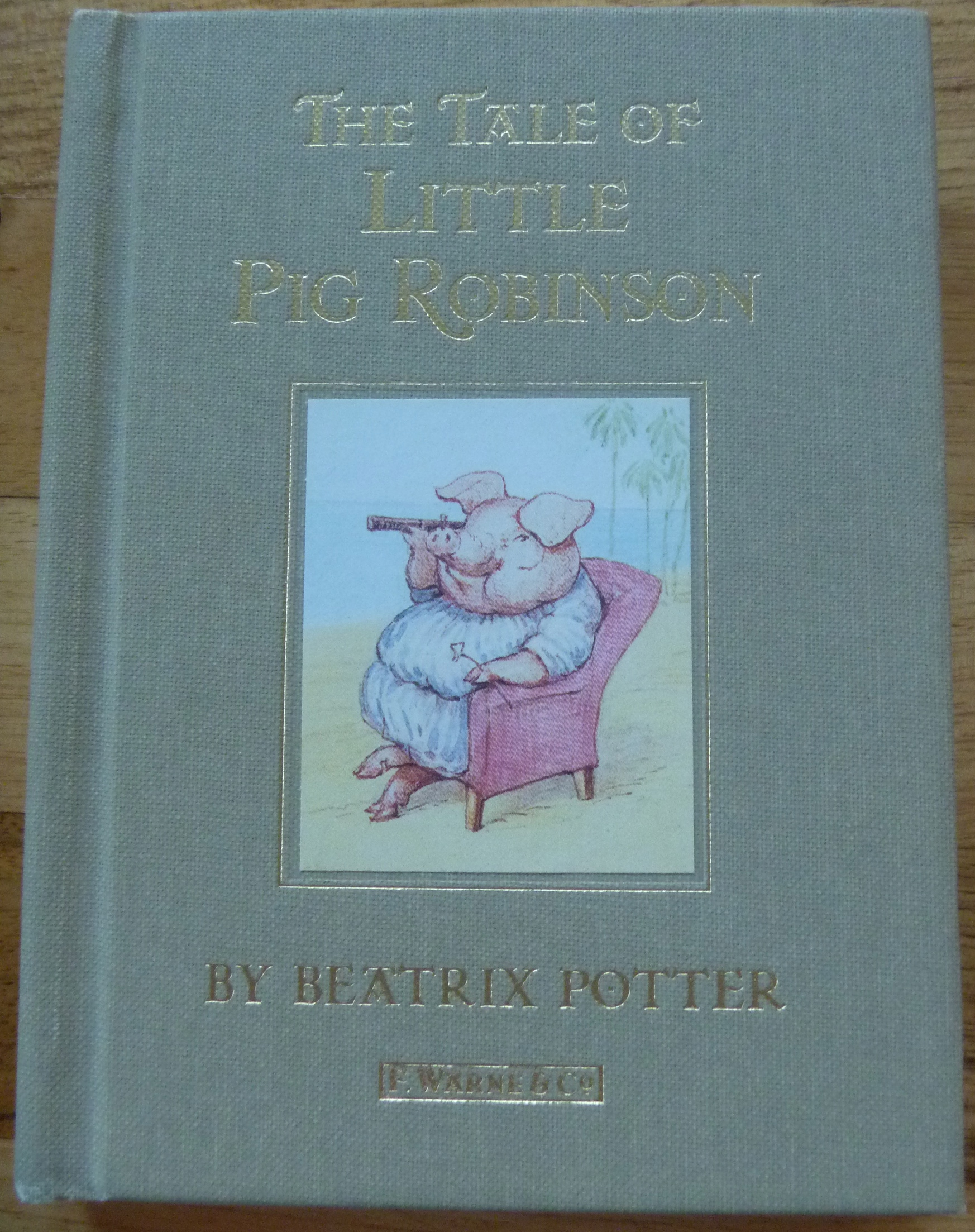
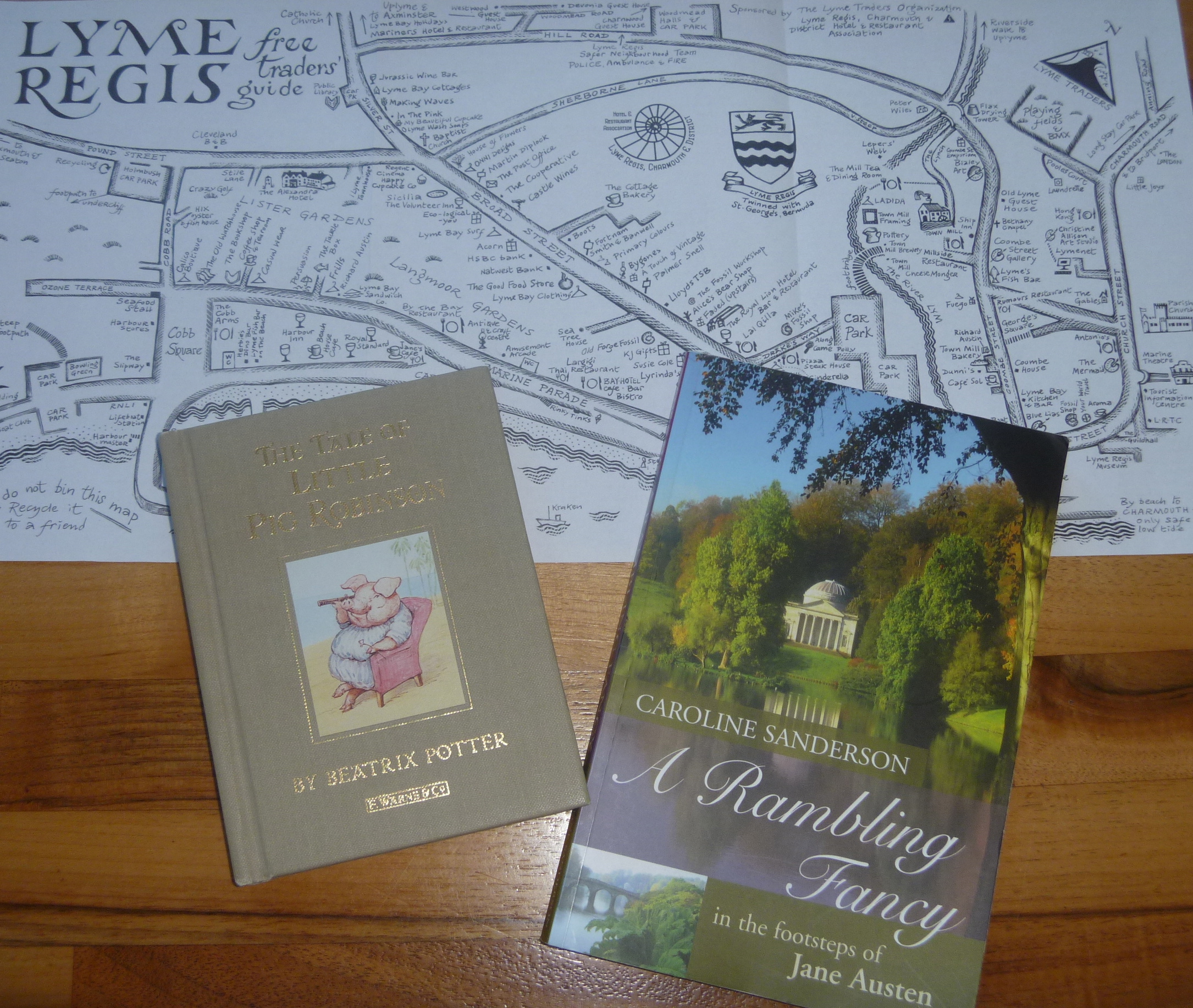
On a previous visit to the Town Museum I had noticed that Beatrix Potter had written and illustrated one of her longer children’s books here : Little Pig Robinson. I asked Natalie if she could pick out any of the locations featured in this book. She did and I made a note of these for future reference.

I had thought that I could probably work out a Jane Austen walk for myself using Google and Caroline Sanderson’s book A Rambling Fancy: in the footsteps of Jane Austen which has a chapter on Jane in Lyme but to have my own private and knowledgeable guide proved well worthwhile.

Using copies of old prints of the town Natalie Manifold (who is Literary Lyme) began our JA tour explaining the origin and history of the famous Cobb. The dates connected with The Cobb will prove to be important when we eventually arrive there!

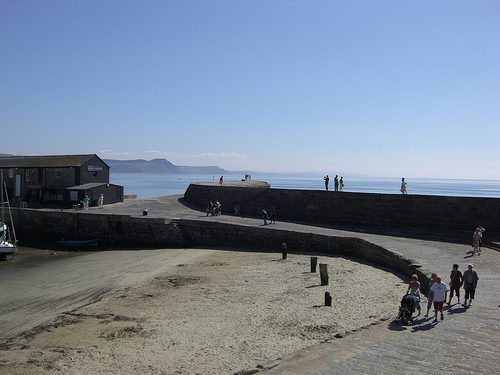
Photo taken on a previous visit when the weather was as it should be!

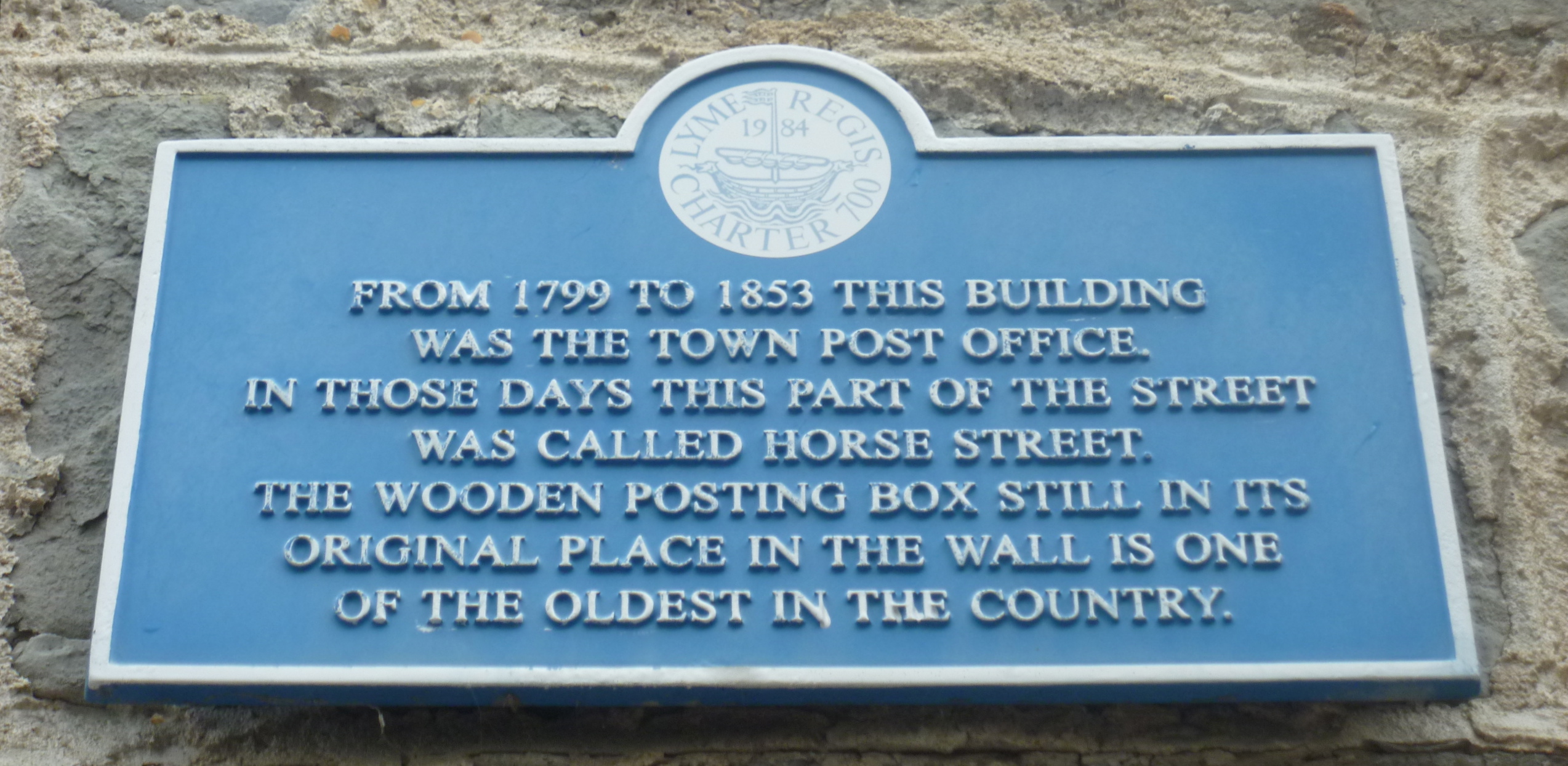
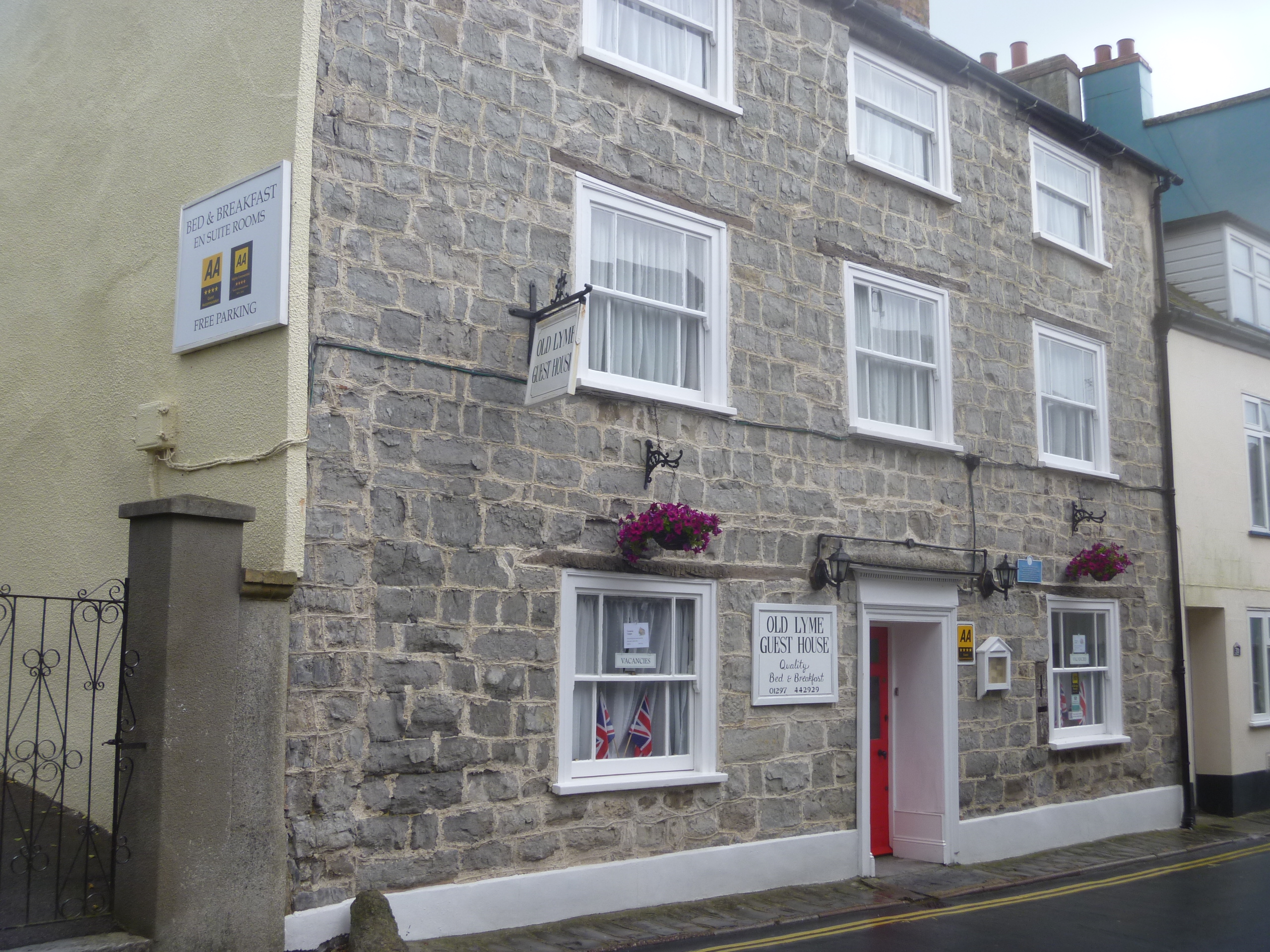
Our first stop was just a few paces away on Coombe Street where the old post office stood. It’s now Old Lyme Guest House but a plaque on the wall records the PO fact and the old letterbox is still in situ.

It’s said that at this very box Jane mailed her letters (single sheet and postage paid by the recipient) to her sister Cassandra after the latter had left Jane in Lyme in order to accompany other family members to Weymouth.

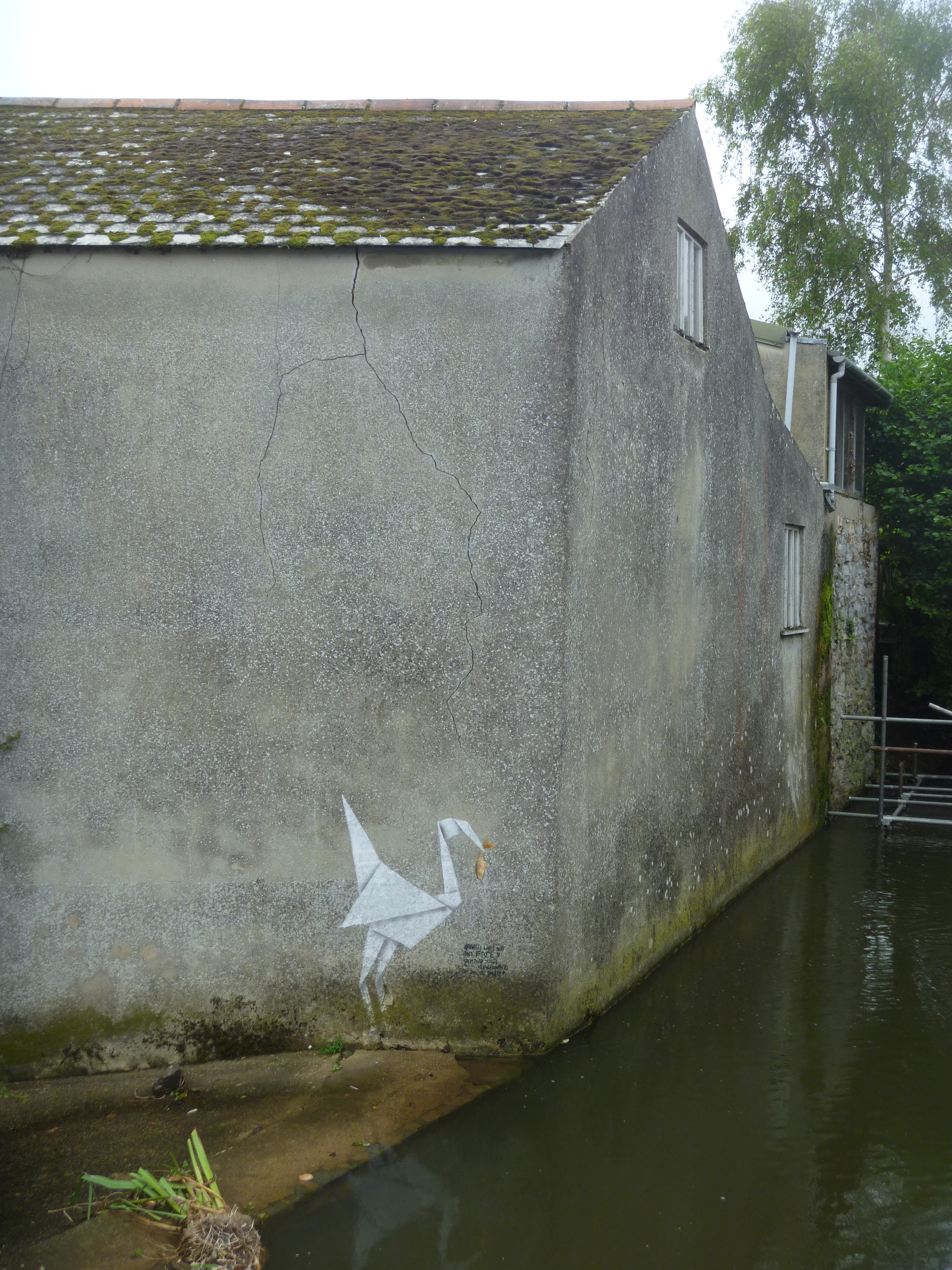
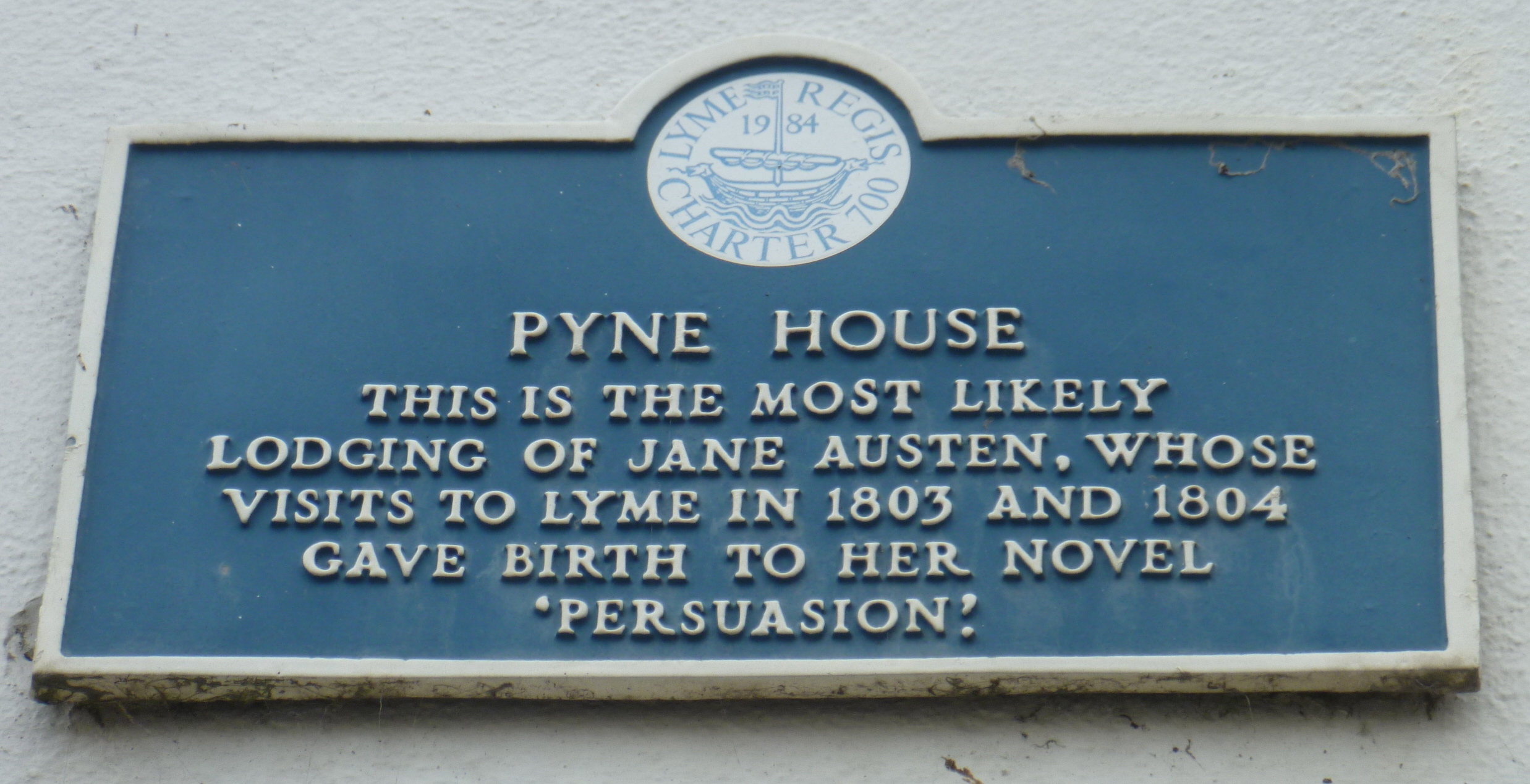
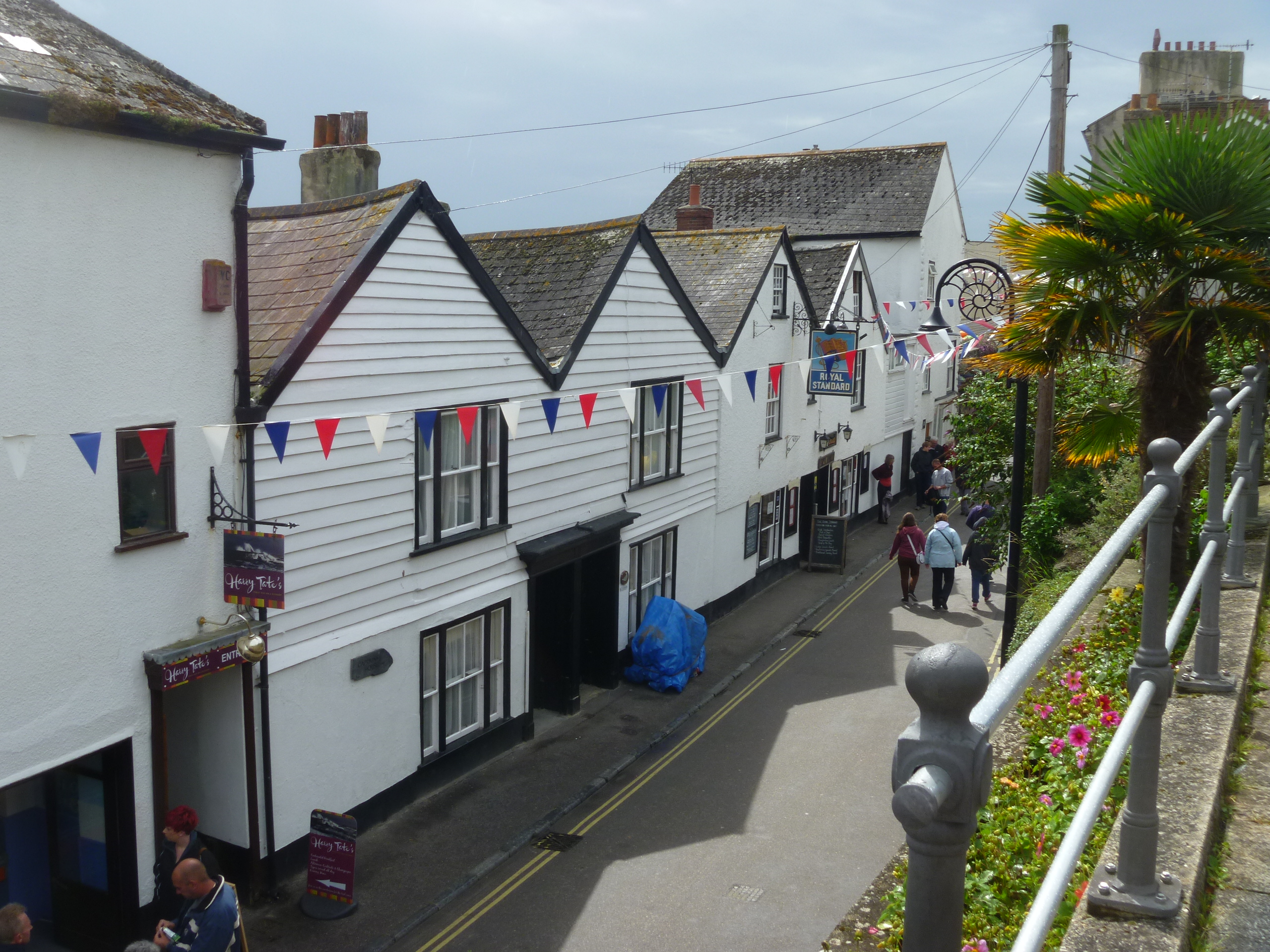
After a quick nod to Banksy (an origami crane with goldfish) we headed up Sherborne Lane. From there we arrived at Broad Street, Lyme’s main thoroughfare. Our next ‘Jane’ location was the now disused Three Cups Hotel which was Hiscott’s Boarding House in JA’s time and where she initially stayed on her visit to Lyme Regis. (Incidentally, it’s also the hotel where General Eisenhower stayed whist the D-Day Landings were being planned in 1945.) Jane also stayed a few doors down at Pyne House after several members of her family upped sticks and moved on to Weymouth.

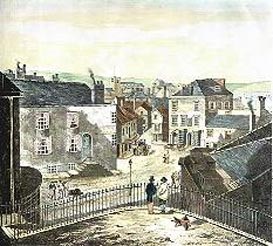
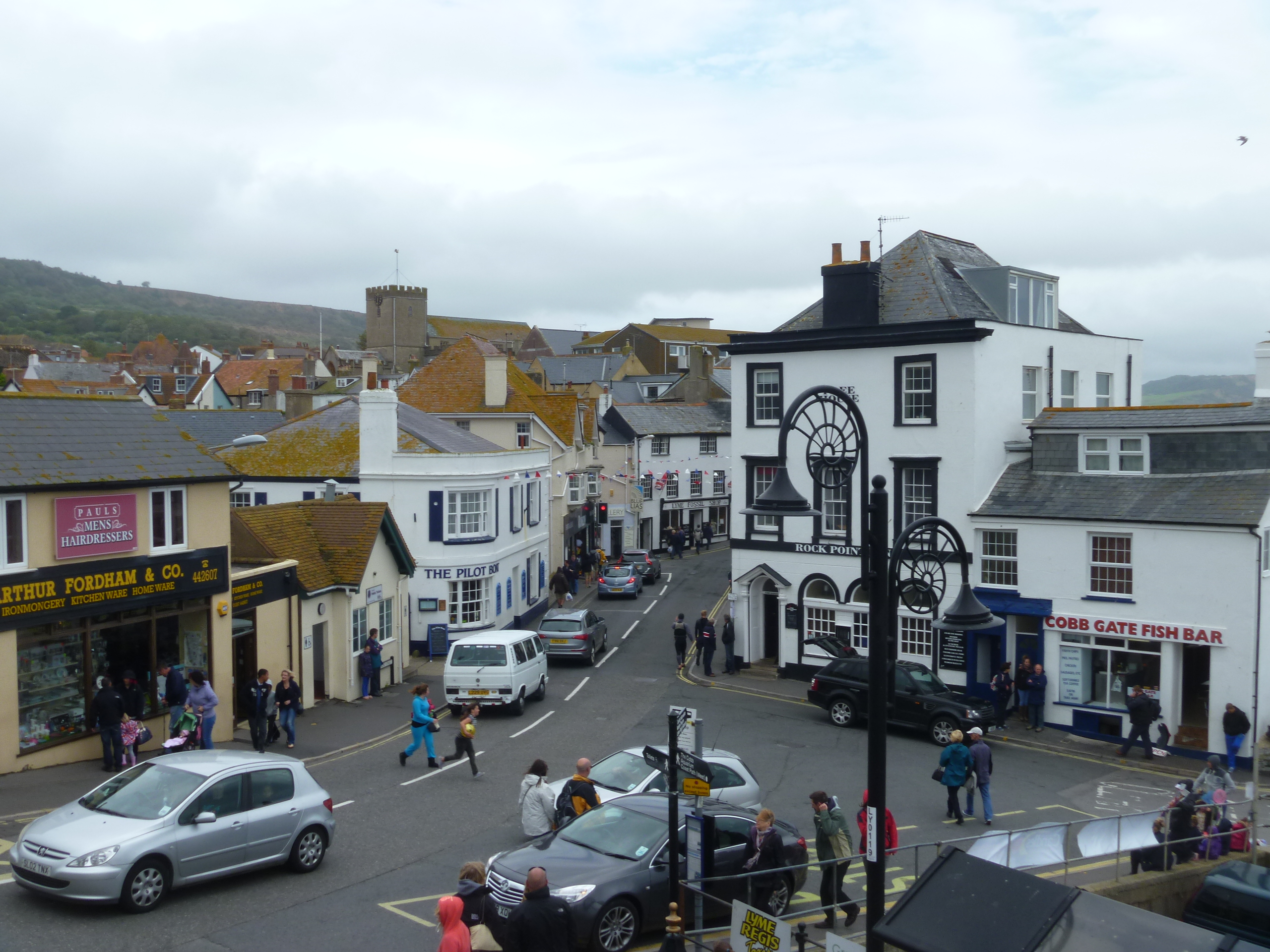
A couple of steps from Pyne House Natalie showed me an old print of Lyme :

View from Pyne House (courtesy of Lyme Regis Museum)

The same view on Monday 27 August 2012

A walk along Marine Parade took us past a couple of blue-painted cottages named Harville and Benwick. Built after the publication of ‘Persuasion’ (the Austen novel in which Lyme features) they were named following Francis Palgrave‘s mistaken identification of these buildings as the homes of Captains Harville and Benwick. Natalie showed me the more likely candidates for these homes a little further along the Parade.

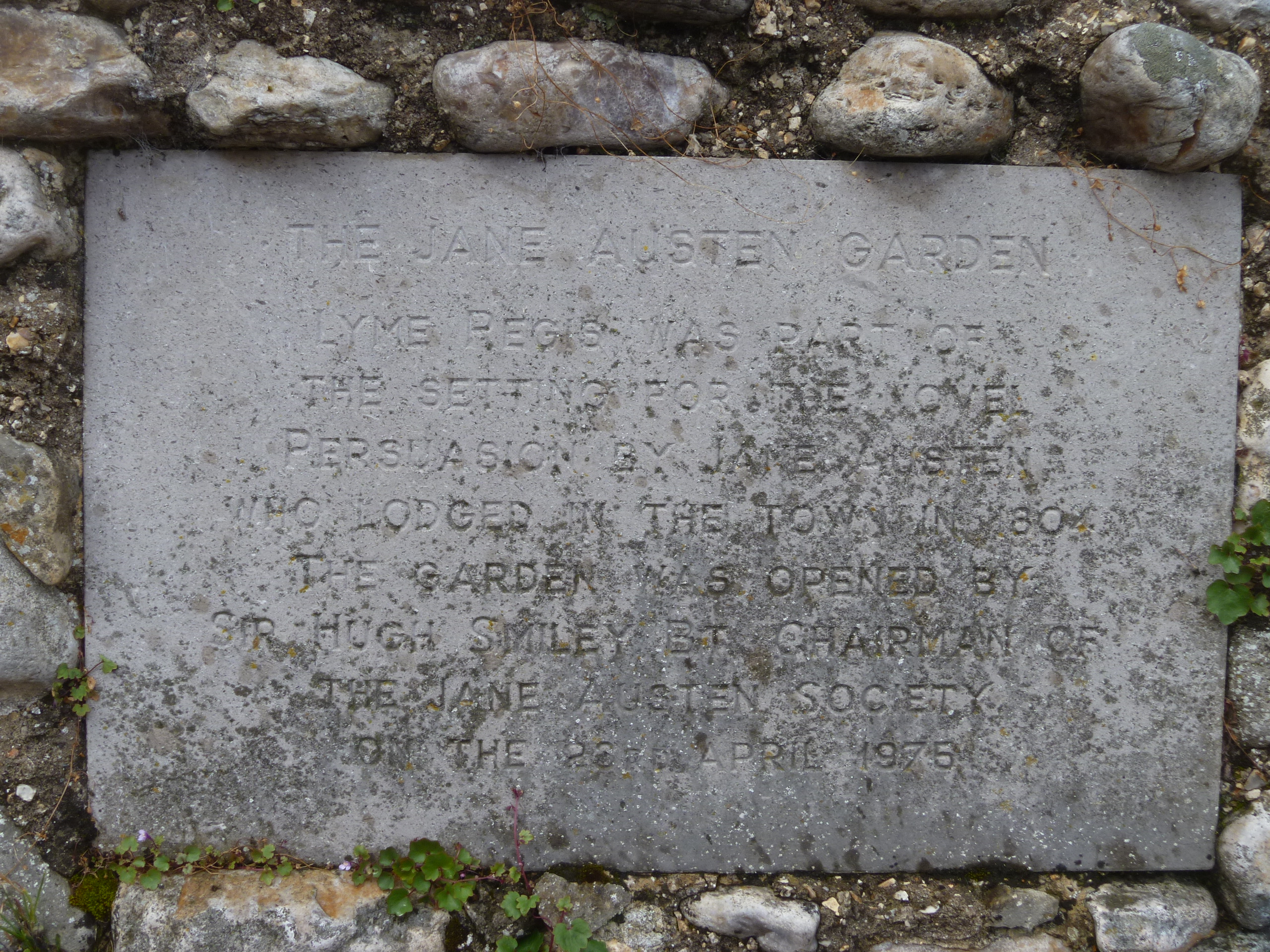
Harville and Benwick Cottages from The Jane Austen Garden

There’s a rather overgrown garden dedicated to Jane Austen but apparently all the references are wrong so it has been rather left to run to seed.

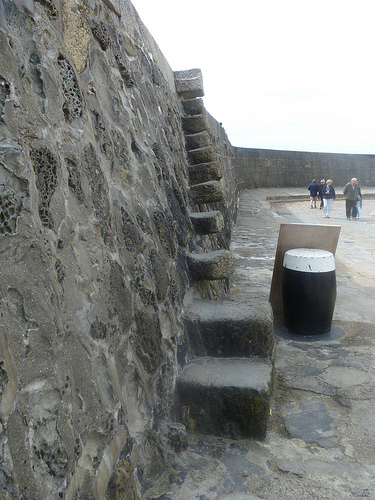
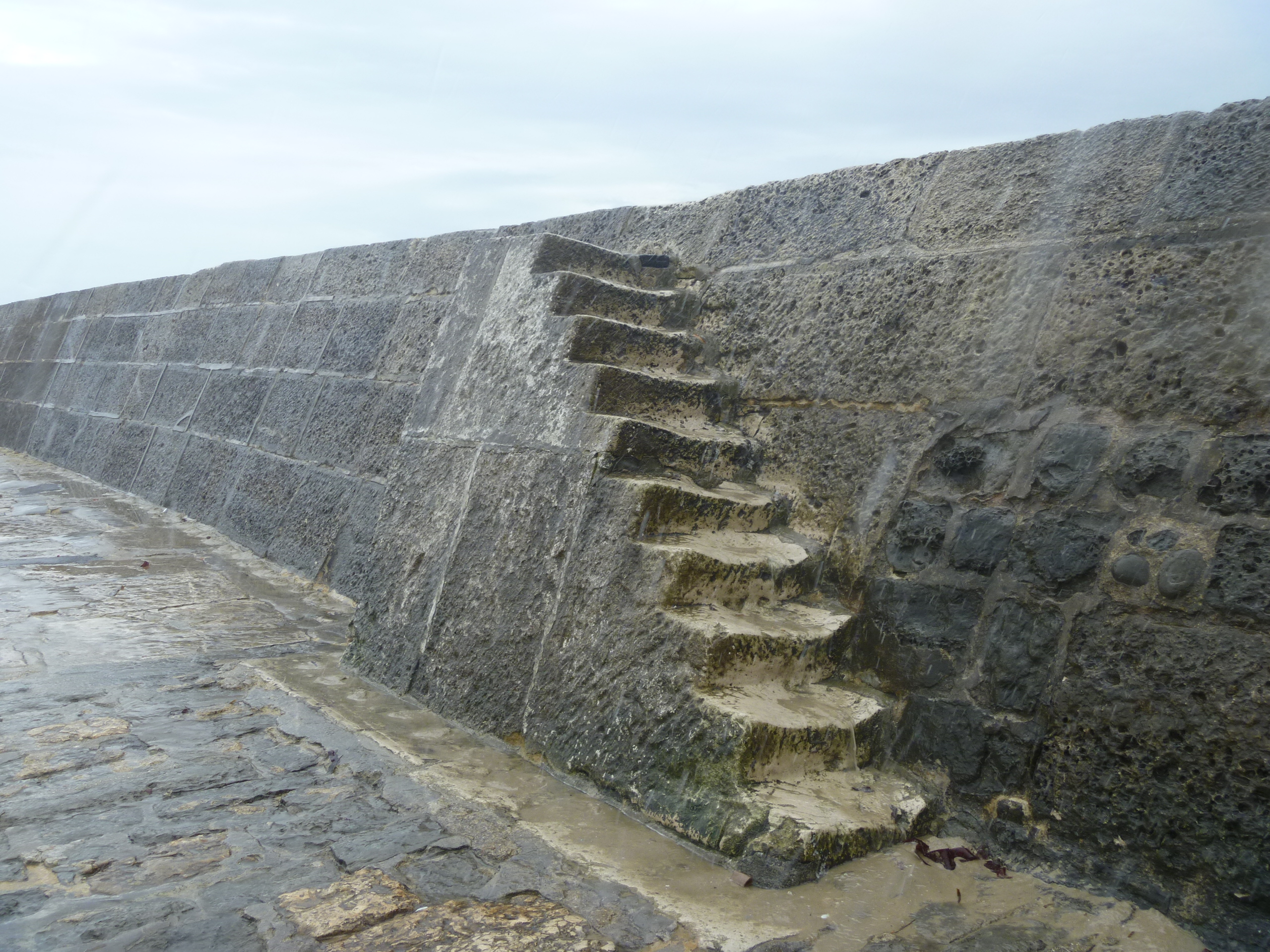
Finally, we walked along The Cobb. Not on the upper, exposed part but below at road level, and we studied the three sets of steps which have puzzled Jane Austen fans for some time. The set of “Gyn Steps” were not built until after Jane Austen’s time,

the second set called Granny’s Teeth were thought by many to have brought about Louisa’s fall

but Natalie maintains and insists (supported by a reading from the very passage in ‘Persuasion’) that these are the very steps from which Captain Wentworth failed to catch Louisa as jumped from the Cobb.

The walk ended here but we made our way back together to our starting point. A huge waved had blown right over the Cobb and soaked us both thoroughly and much as I would have liked to have investigated the Little Pig Robinson locations I decided that enough was enough and such pleasures must wait another day!

The Old Ways Part Two : Mastiles Lane Revisited and Meet the Author

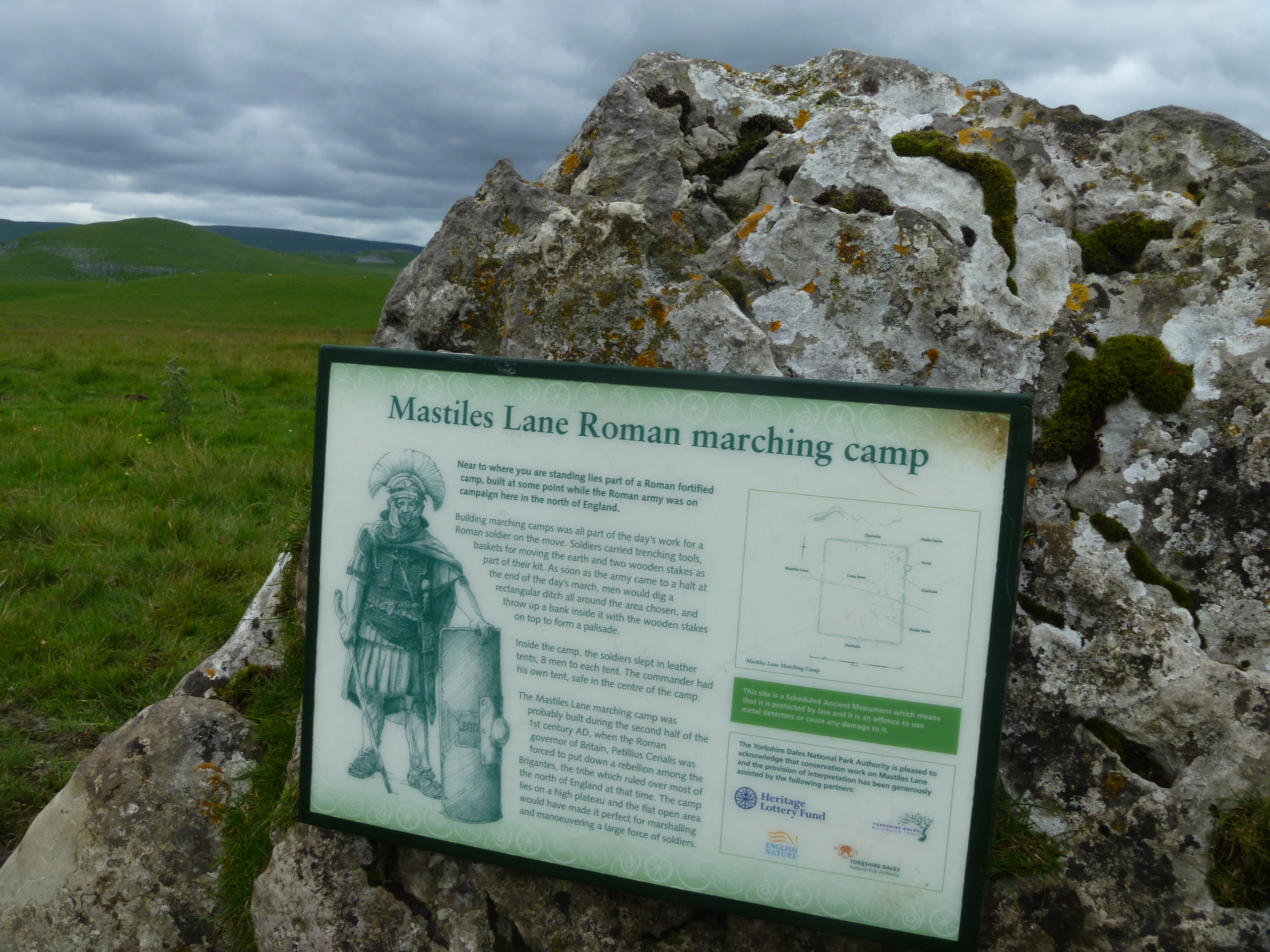
Well, it finally happened a few weeks ago in the middle of July, I walked the length of the Yorkshire old way, Mastiles Lane. The weather stayed reasonable and it’s a dry track most of the way but there was a fair wind blowing on the top. Amazing to see the remains of the Roman Camp – how did those soldiers feel about the winds and rain up there in such an exposed location? – and we managed to spot for sure one of the two remaining stone cross bases where the monks from Fountains placed crosses along the way.

“Along the lines of monastic roads it was the custom to place crosses at prominent points, partly to stand as landmarks pointing the way and partly as a symbol of consecration or dedication to the service of the church. Crosses were usually a very plain and rather stumpy shaft, roughly squared or sometimes bevelled to a rough octagon and set in a socket cut in a large base block but in others it is squared up and tooled. five of these crosses lie alongside the old road across Malham Moor, one near Strete Gate.” [Malham and Malham Moor, by Arthur Raistrick]

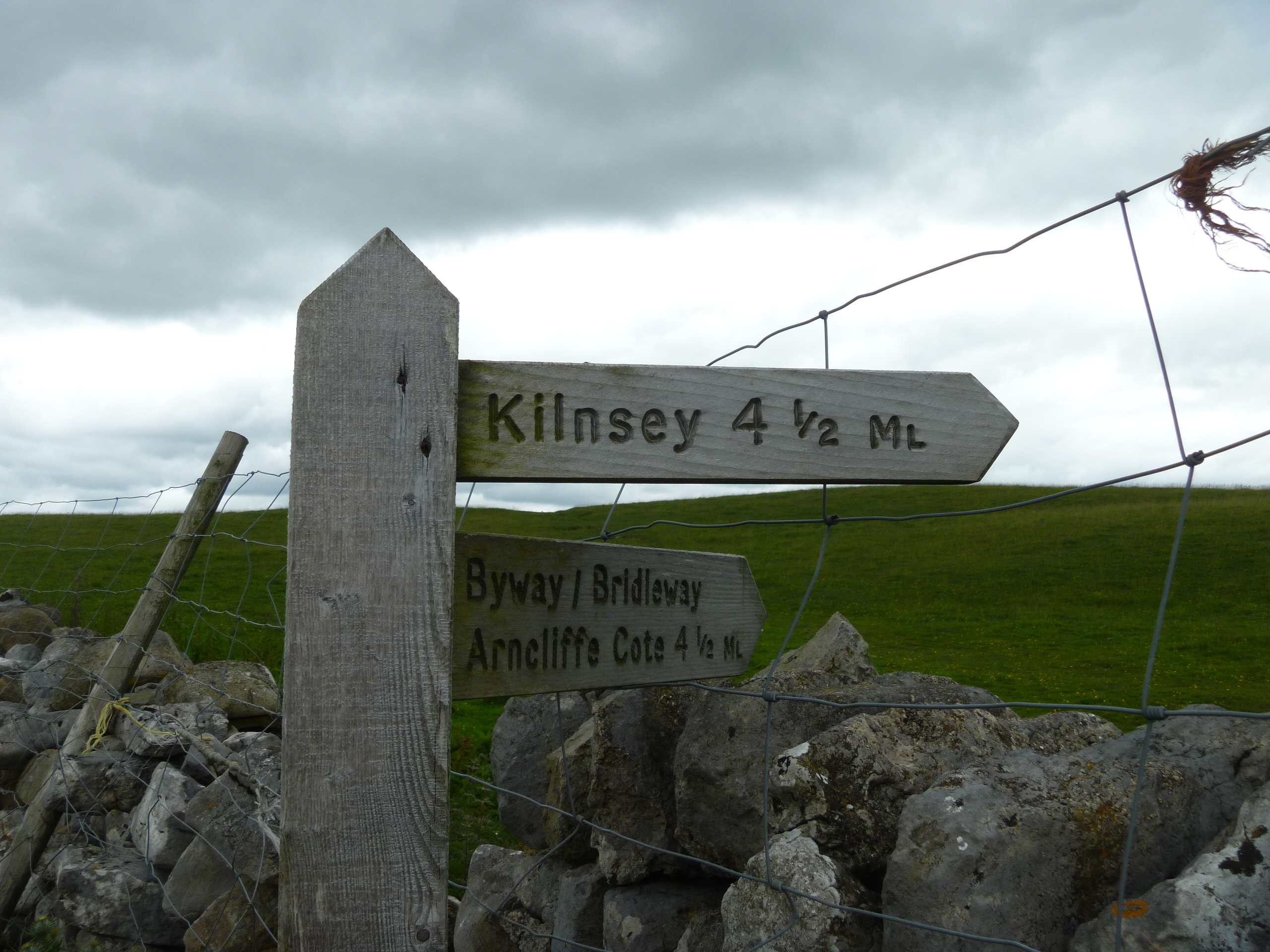
Most Dales hikes that I undertake tend to be circular but it made a nice change to do a there and back one and my fellow hikers agreed. Mastiles Lane starts in the village of Kilnsey.

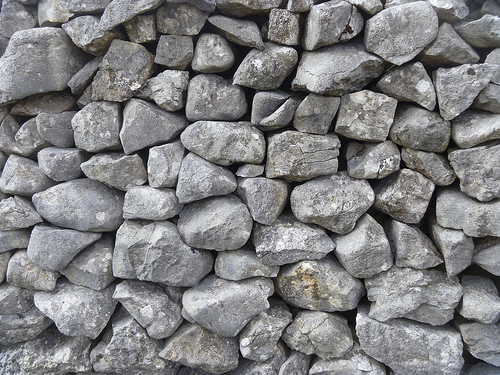
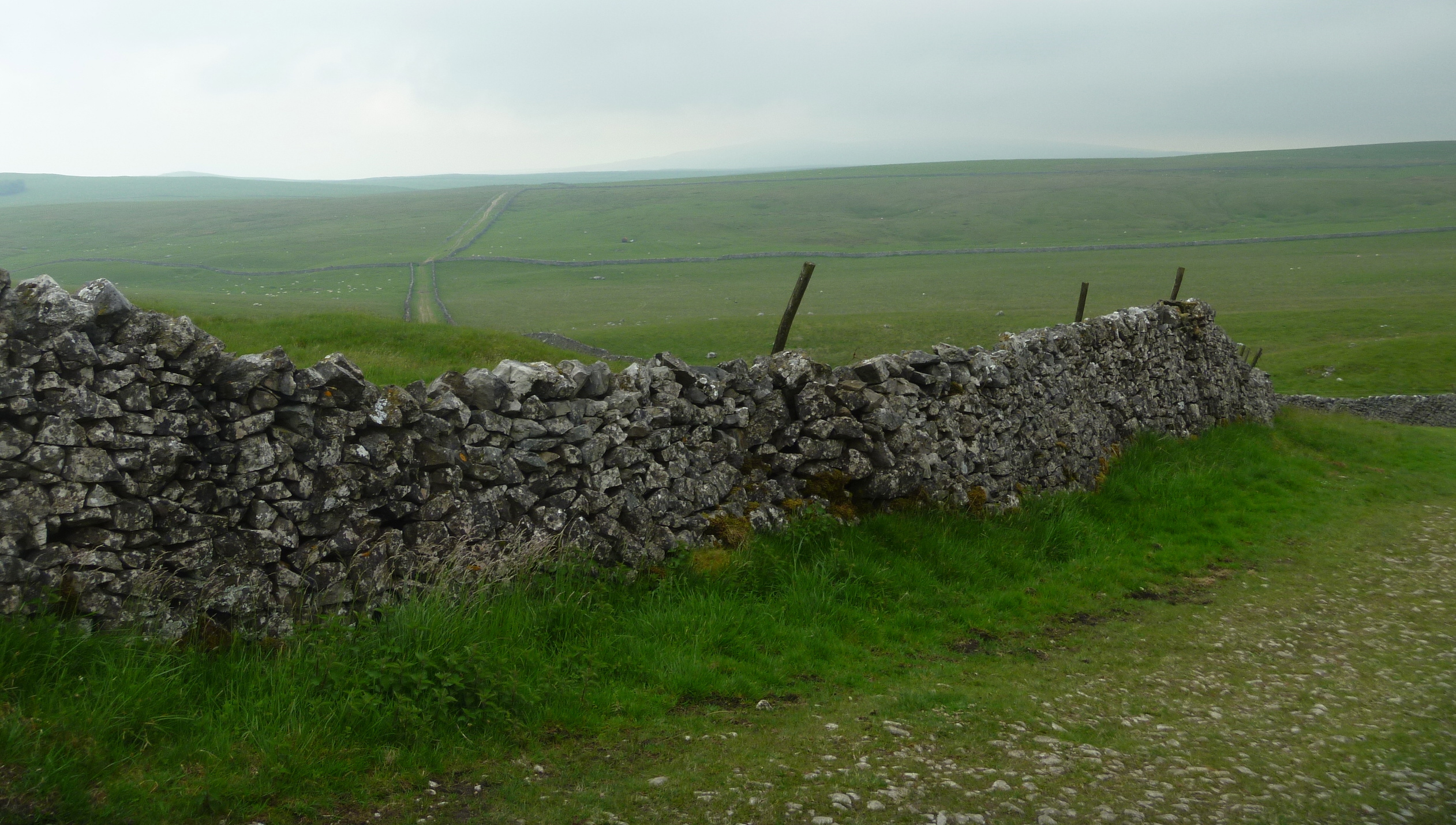
This high limestone landscape is unsuited to arable but the monks of Fountains Abbey brought their flocks of sheep to this area and the lane itself was established by them. Mastiles Lane is almost totally for its full length a walled lane and those walls are just a small proportion of the dry stone walls that criss-cross the county (and other counties too, of course).

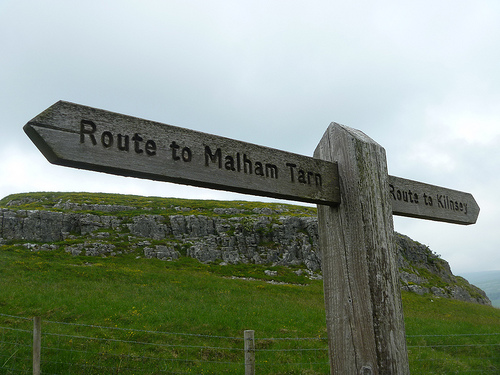
We reach Strete Gate

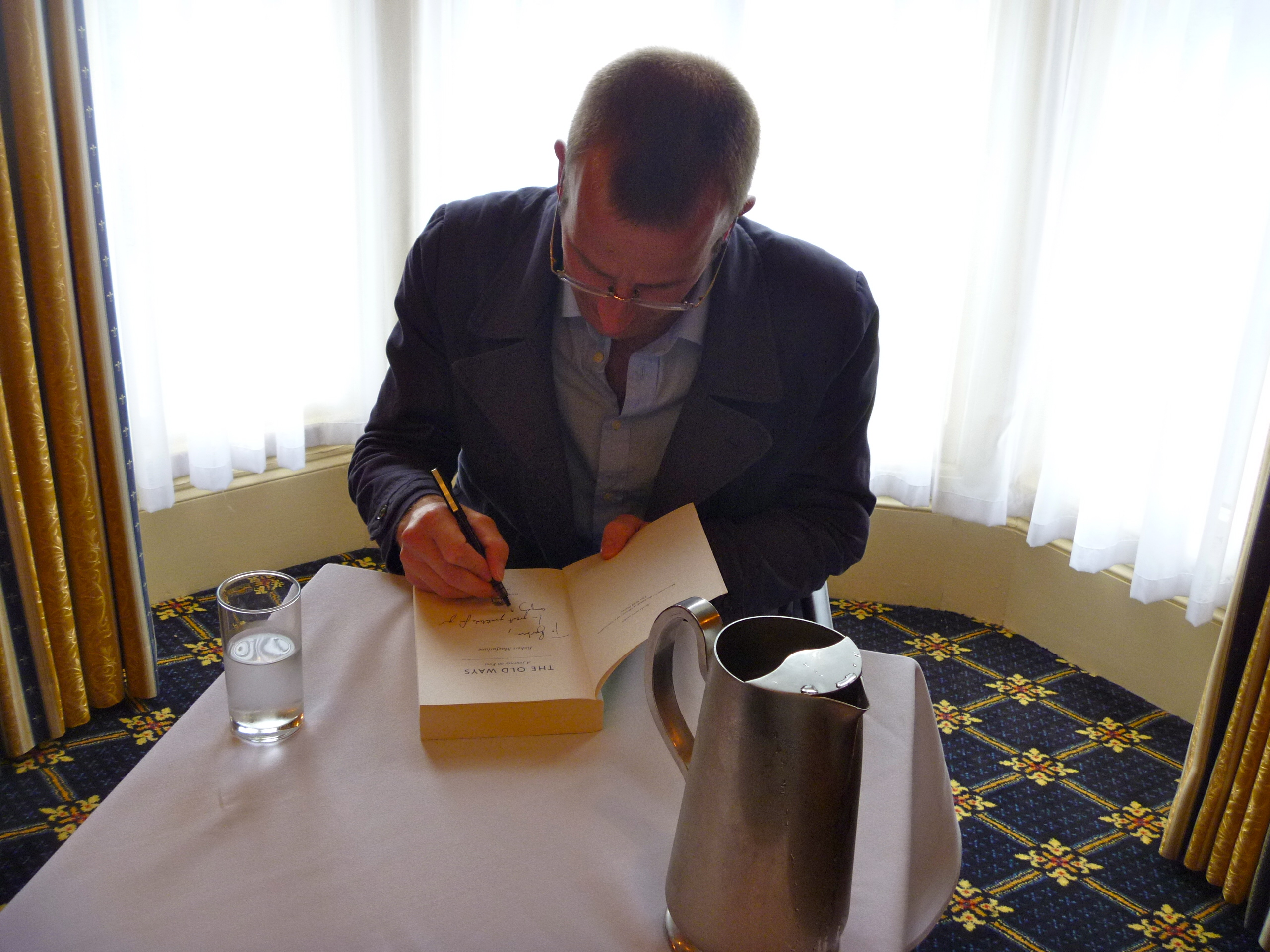
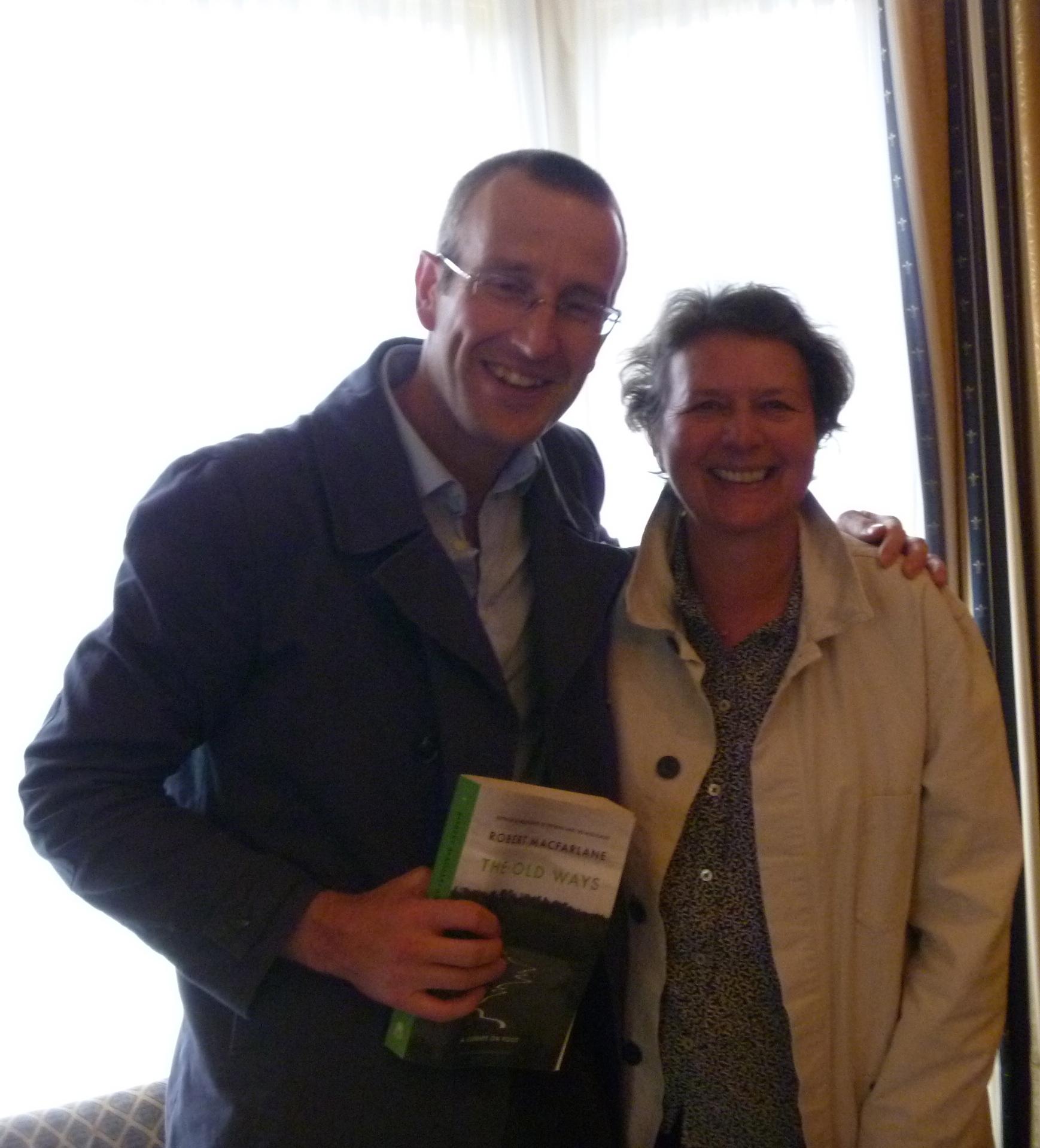
About ten days before the walk I had the good fortune to meet Robert Macfarlane author of The Old Ways book. He was speaking at The Buxton Festival. I was interested to hear him talk about how landscapes shape us and he talked (and wrote in the book) at length about the East Anglian walker and writer George Borrow who was one of the first people to note the connection between walking and health and memory-making and re-walking in the memory. His (Borrow’s) walks were full of meetings and conversations with people. A fine example is his book Wild Wales.

From Borrow Robert moved on to talk about his walk along The Icknield Way, which he chose because of its proximity to Cambridge where he lives. Edward Thomas’s “The Icknield Way was an inspiration to him as well. Thomas in turn was influenced by a poem by Robert Frost :

The Road Not Taken

Two roads diverged in a yellow wood,
And sorry I could not travel both
And be one traveler, long I stood
And looked down one as far as I could
To where it bent in the undergrowth;

Then took the other, as just as fair,
And having perhaps the better claim
Because it was grassy and wanted wear,
Though as for that the passing there
Had worn them really about the same,

And both that morning equally lay
In leaves no step had trodden black.
Oh, I marked the first for another day!
Yet knowing how way leads on to way
I doubted if I should ever come back.

I shall be telling this with a sigh
Somewhere ages and ages hence:
Two roads diverged in a wood, and I,
I took the one less traveled by,
And that has made all the difference.

Robert Frost
This poem prompted ET to sign up to serve in the army during The First World War. He was killed at The Battle of Arras on Easter Day (8 April), 1917. Thomas and Frost had become friends and Frost encouraged ET to move from prose into poetry. There’s much more in The Old Ways about the two poets, about Thomas’s war service and death and about the South Downs Way. And Macfarlane asked, do we trust Frost’s poem?

Strictly Agnes Strickland

So who is Agnes Strickland? And why am I writing about her today?

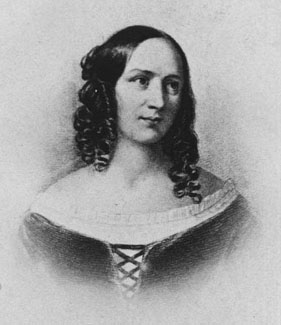
You may not have heard of her but she was a very well known author in her day. Although I had heard of her for a long time I can’t remember when I first knew that she was the author of a 12 volume history entitled : Lives of the Queens of England published between 1840 and 1848. Each volume was eagerly awaited by the public at the time.  I’ve kept a 2-page article about Agnes and her family, including her 4 literary sisters, which appeared in the Sunday Supplement to the Eastern Daily Press back in April 2009. Unfortunately, I can’t find a link to this article online.

Agnes first wrote what are now called ‘improving’ stories for children and later collaborated with her sister, Elizabeth, to produce her best-known work about the Queens of England. Elizabeth did not want her name included but Agnes was happy with her celebrity fame. Later her sister Jane Strickland wrote and published Agnes’ biography.

Two of her sisters found fame in Canada as writers – Catherine Parr Traill and Susanna Moodie – Catherine’s The Backwoods of Canada (1836) became a classic as did sister Susanna’s Roughing it in the Bush (1852).  I could write more about the sisters but as I’ve called this post Strictly Agnes Strickland  I’ll stick to my subject.

Agnes was born in London in 1796. She was the second of six sisters and two brothers. Her father had business interests in London, Norwich and the small Suffolk town of Bungay. He encouraged his daughters’ education and reading habit. The family  moved to Reydon Hall in Suffolk in 1806.

Reydon Hall

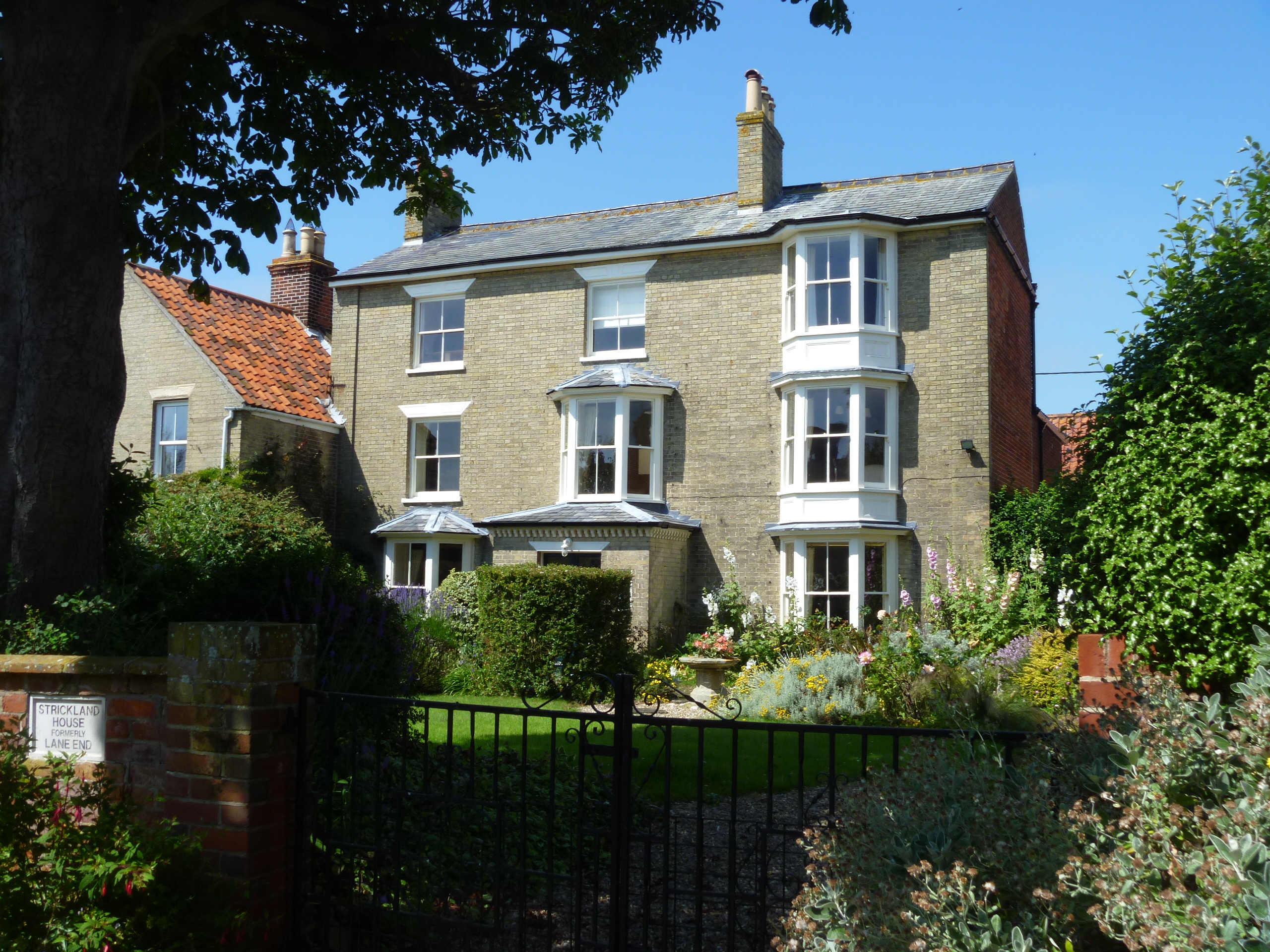
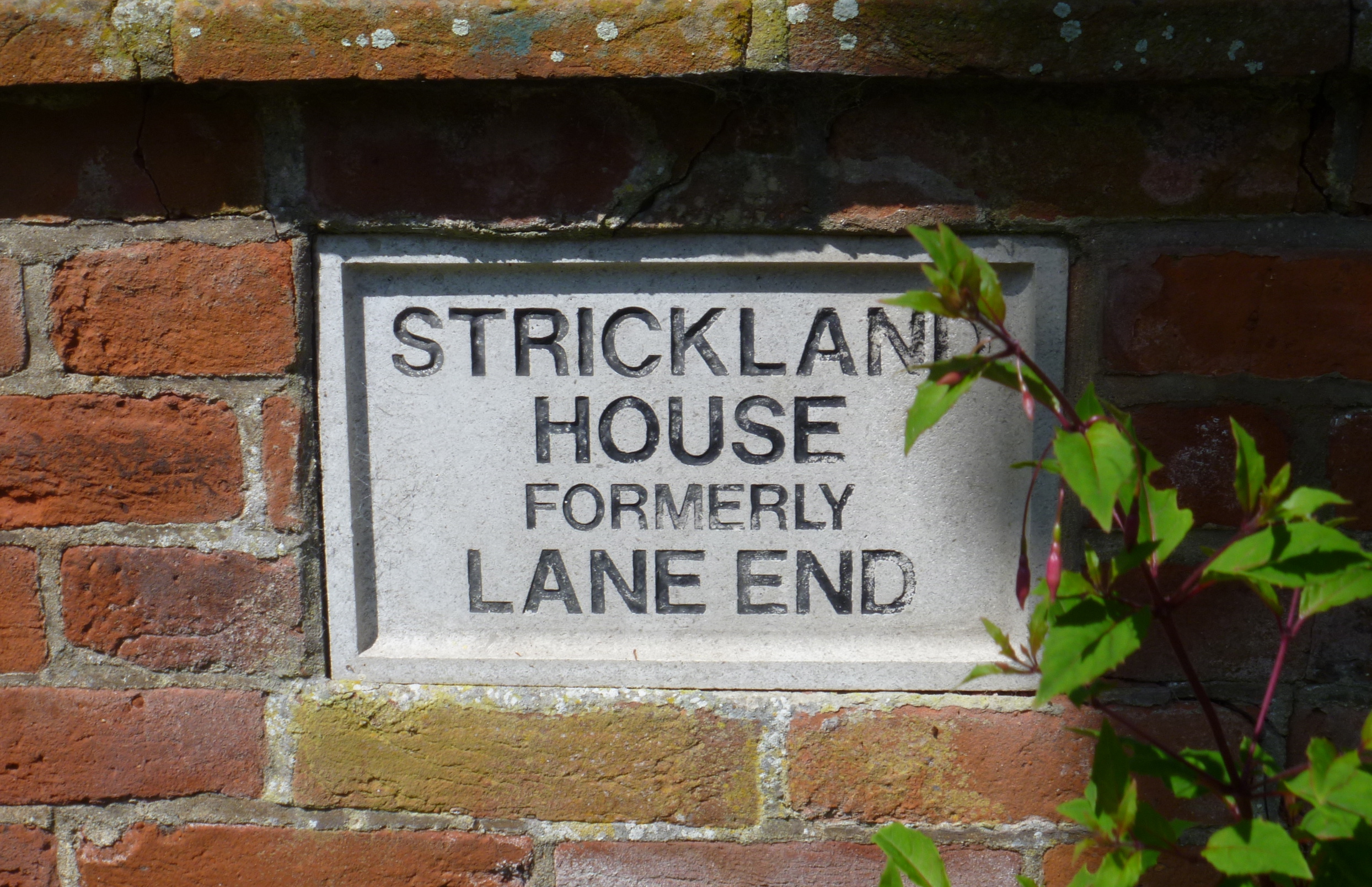
When her father, Thomas Strickland, died in 1818 he had lost most of his fortune from acting as guarantor to a firm that failed. The family stayed at Reydon Hall and the daughters set about earning their livings. In 1832 the two younger daughters sailed from Southwold via Greenock to Quebec with their husbands to start new lives in Canada. When Mrs Strickland died in 1864 the family home was sold and after travelling around with various addresses Agnes decided to settle in Southwold in Park Lane in the house that is now called Strickland House.

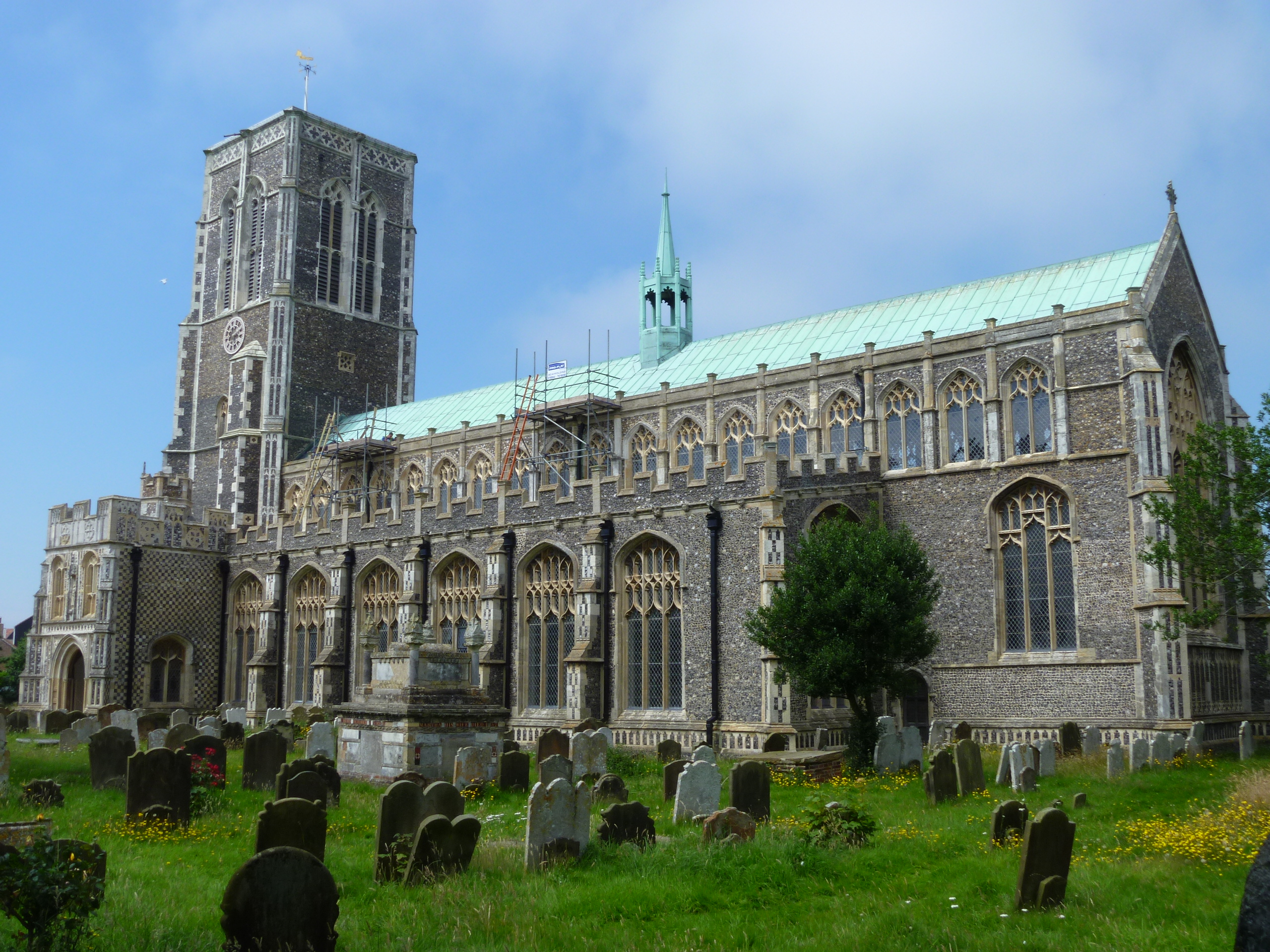
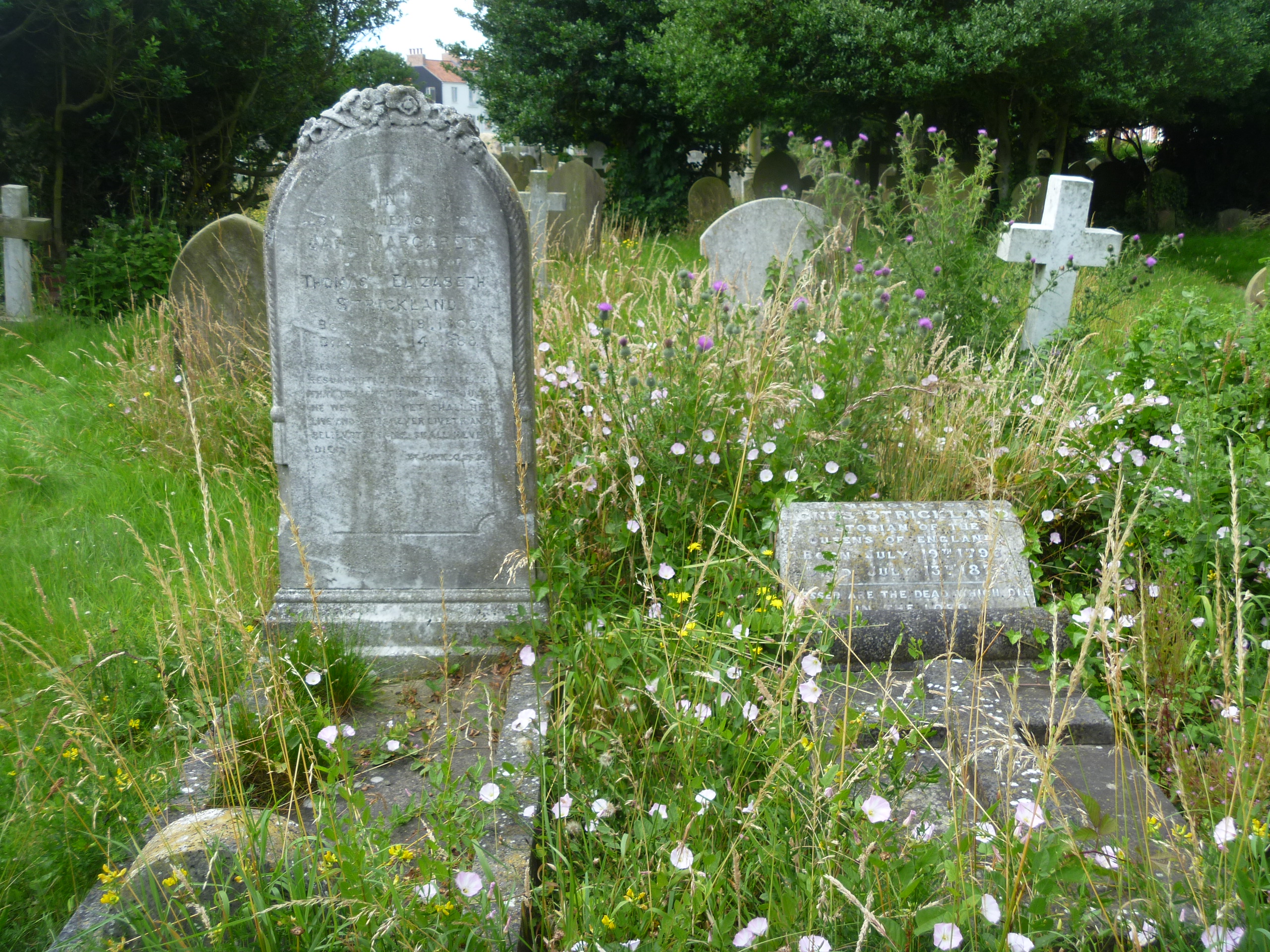
She died there in 1874 and is buried in the churchyard of St Edmund’s parish church.

Jane Margaret, Thomas and Elizabeth Strickland tomb beside Agnes Strickland’s.

Agnes and Elizabeth carried out much of their historical research at the British Museum. The 12 volume Lives details the stories of 38 queens – from Matilda of Flanders, the wife of William the Conqueror, to Queen Anne. They also wrote a Lives of the Queens of Scotland and other histories.

“Agnes Strickland’s Lives of the Queens of England (1840-8) marked a new era in the writing of English history by women. ‘Facts not opinions’ was the watchword of these historical biographies, which were based on pioneering manuscript research.” (Publisher)

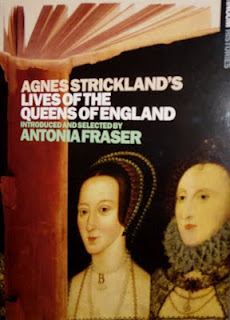
Last year I read the single volume selected and edited by Antonia Fraser. My friend Lyn has written a much better review than I could ever hope to do – especially as it’s some time since I read it.

Landmark Visiting In Deepest Norfolk

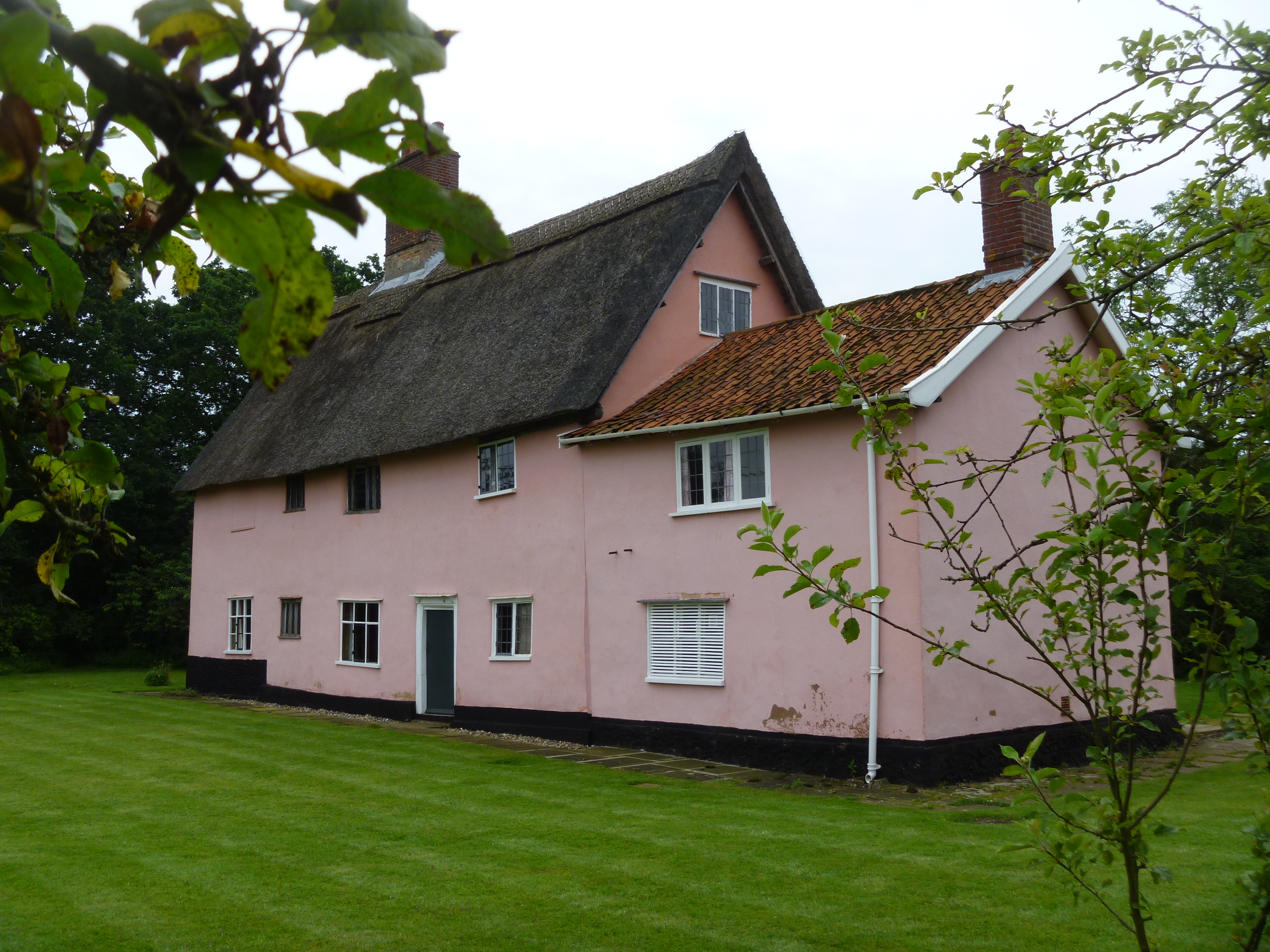
Landmark Trust properties are usually very easy to find. For each stay you are always sent meticulous instructions which in some cases may be totally unnecessary but on other occasions you really do wonder whether the building will ever materialise. As we drove further and further off the beaten track in South Norfolk this morning along narrow lanes, with grass growing down the middle, we did wonder if we were ever going to find our quest. Suddenly, on the other side a big field we spotted Manor Farm “in the pink” just as my friend’s directions suggested!

We were visiting the Norfolk Landmark – Manor Farm – on changeover day. The housekeeper very kindly allowed us to have a quick peep around and I must say it is a lovely old building in which one would very quickly feel at home. The Landmark staples are all there plus the advantage of peace and quiet and a lovely big grassy garden. There is birdsong and there are wildflowers. You are truly in the depths of the countryside.

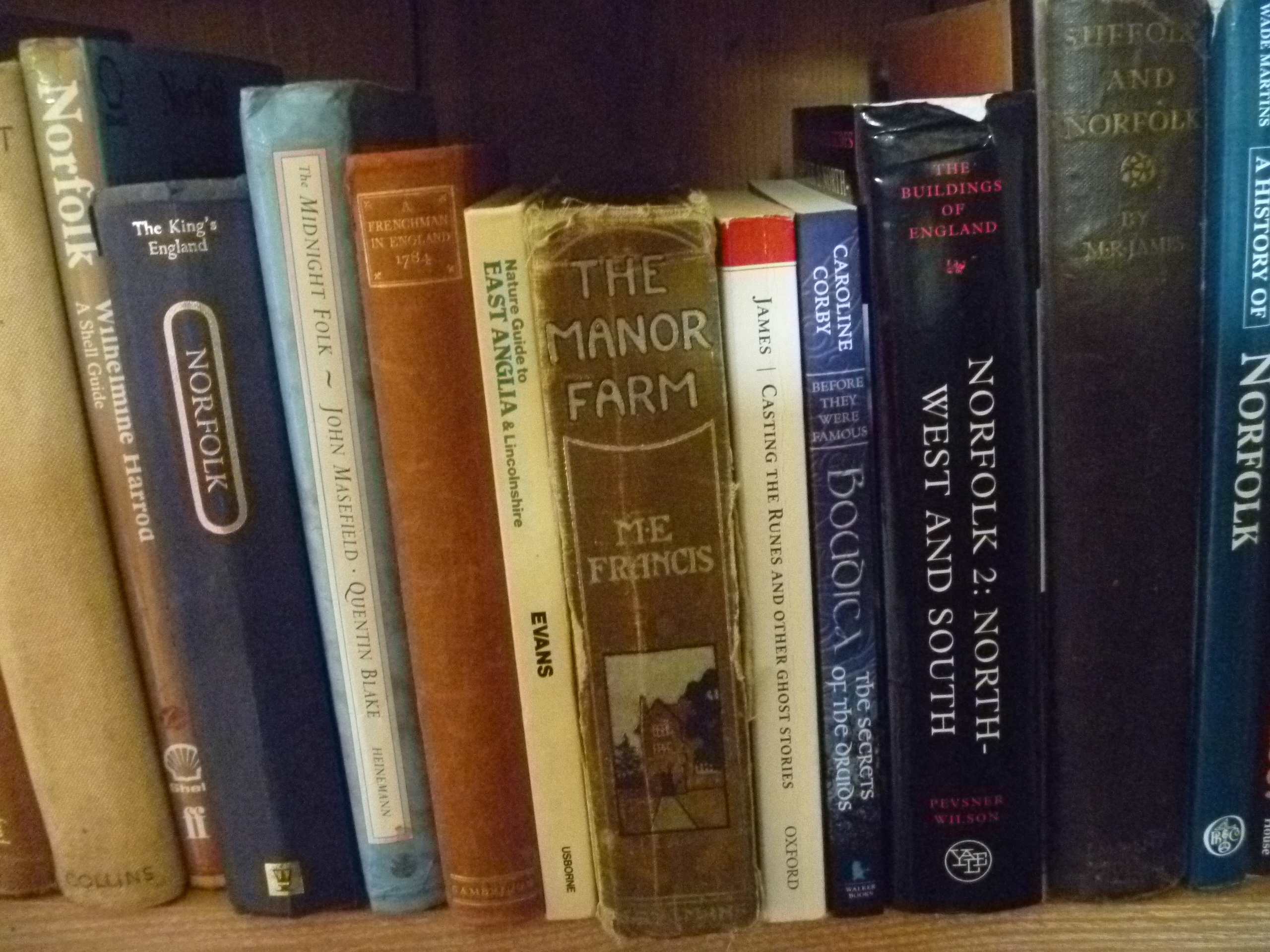
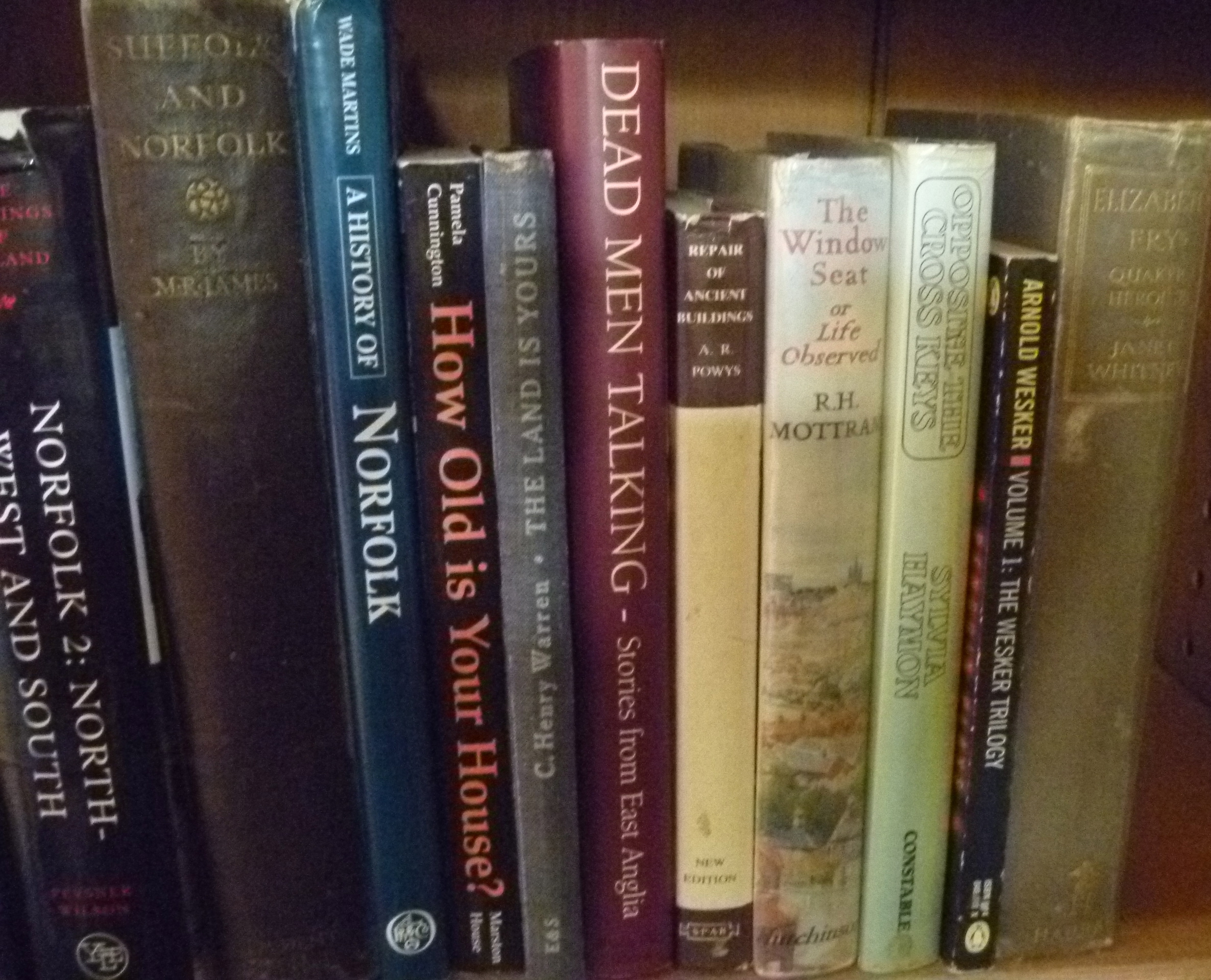
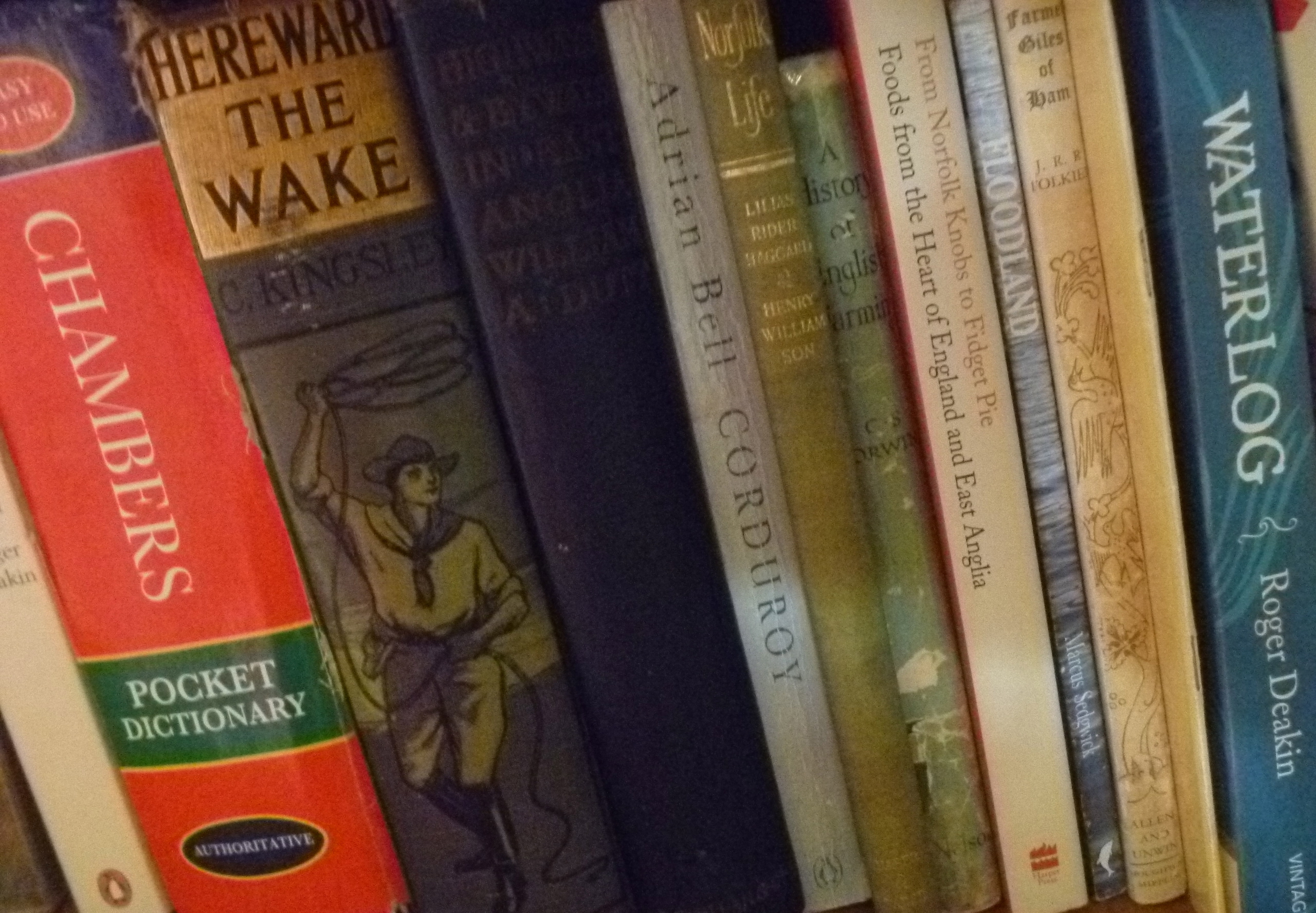
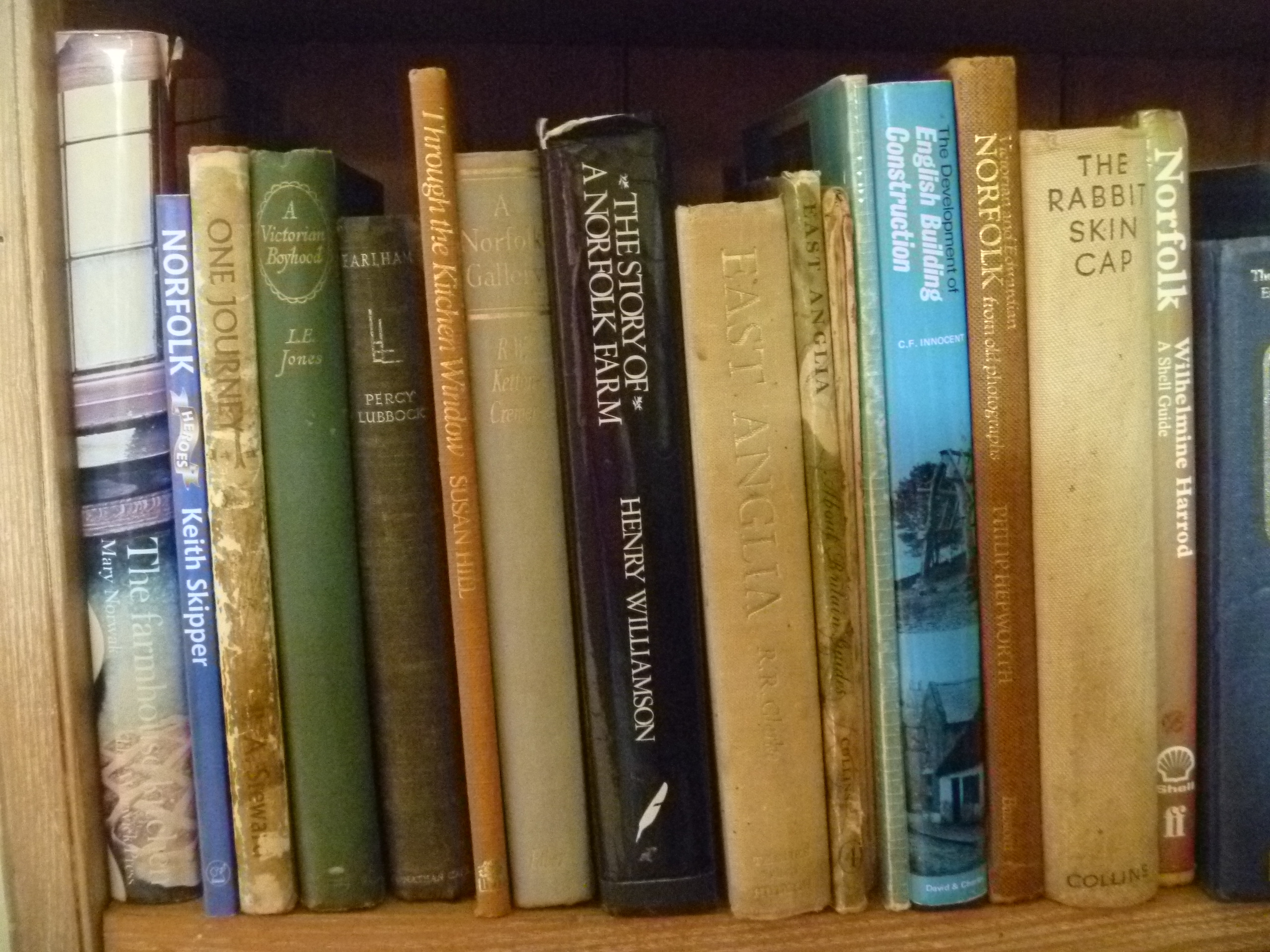
I took a particular interest in the Library at Manor Farm as Norfolk is my county of birth and I grew up and lived there for my first 18 years. I’ve read and I own lots of books about Norfolk and it’s always fascinating to see another’s take on what’s considered to be the essential reading matter for one’s own county.

I’d expect to see Henry Williamson’s The story of a Norfolk Farm and Ketton-Cremer’s A Norfolk Gallery. I love Susan Hill’s Through the Kitchen Window which would make a good addition to all country Landmarks. I know nothing about The rabbit skin cap but it sounds very cosy!

Ha! I love the fact that a copy of The Manor Farm by M. E Francis was tracked down. First published in 1902 it has no Norfolk connection (as far as I am aware) but the title is very fitting. Another good one is A Frenchman in England, 1784 Francois de la Rochefoucauld’s account of his observations of Britain and its people whilst living in Bury St Edmunds.

There’s a life of Elizabeth Fry the Victorian woman prison reformer born of a quaker banking family at Earlham Hall in Norwich and I note a copy of Arnold Wesker’s play Roots. I bet all Norfolk school pupils in the 1960s had to read this play – I know we did – the accents came easy to us! I’m familiar with several R. H. Mottram books. I’ve read his The Spanish Farm and If stones could speak but I don’t know The window seat. Will have to investigate. He was a prolific writer on many topics. See the list of works here.

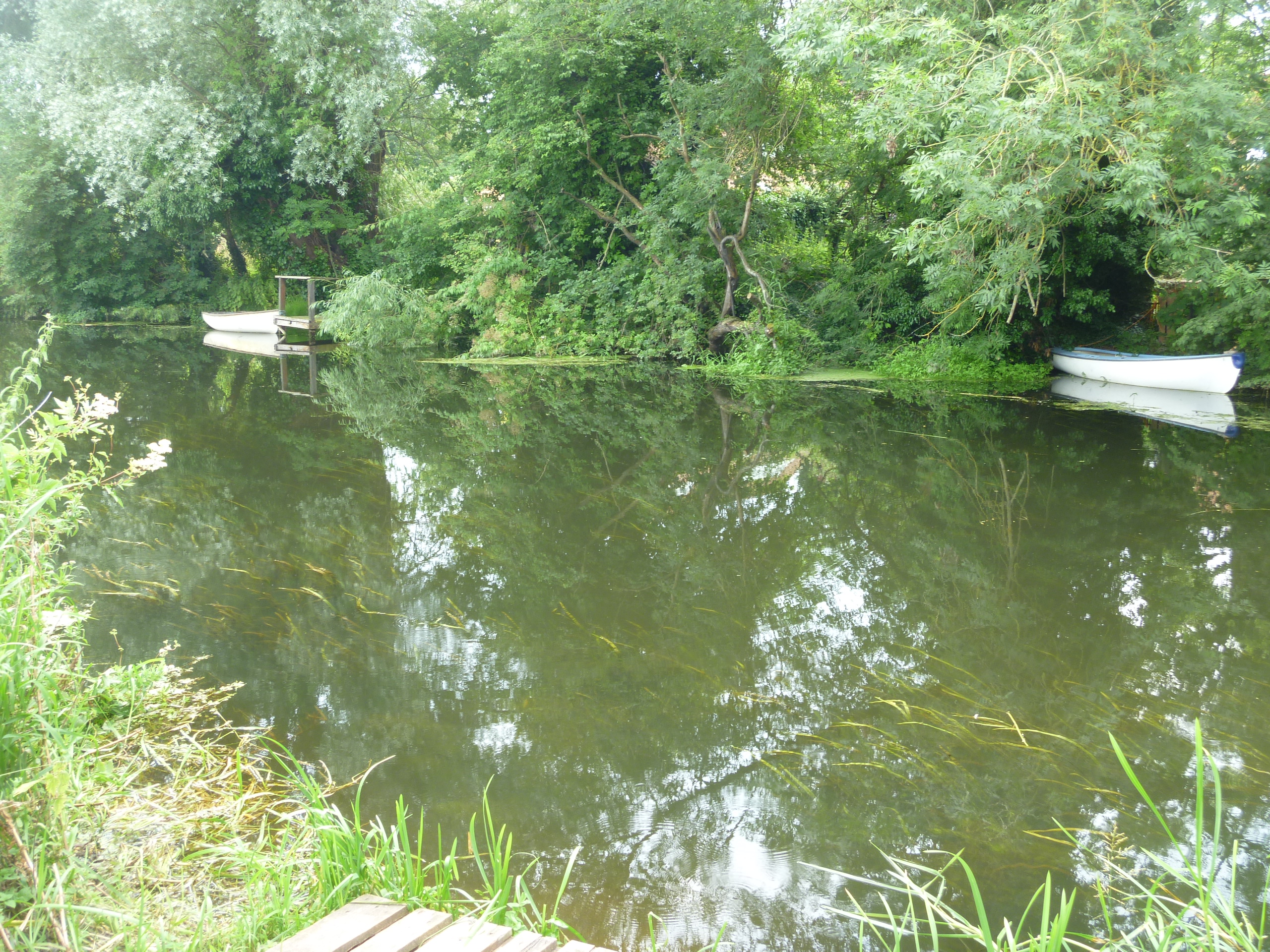
Parson Woodforde, The Go-Between, The Paston Letters all very necessary for Norfolk. And, oh yes, I’d definitely include works by Roger Deakin. That’s his Notes from Walnut Tree Farm at the end there. Excellent reading in this part of the country especially his Waterlog. I read this book when it first came out. With the subtitle A swimmer’s journey round Britain Deakin writes here about his travels around Britain swimming in lakes and rivers and the sea. The book begins by relating his daily swims in his own moat. Moats surround many old properties in South Norfolk and North Suffolk. Here’s a quiet reach of the local River Waveney in Bungay where Deakin enjoyed swimming.
Sadly, Roger Deakin died in 2006. It’s still possible to listen to his radio programme Cigarette on the Waveney.

On leaving Manor Farm we only got lost twice and had to check maps and turn back twice and puzzle over road signs before reaching the real world of Harleston, Bungay and Hempnall. No one gave us instructions for leaving the Landmark!

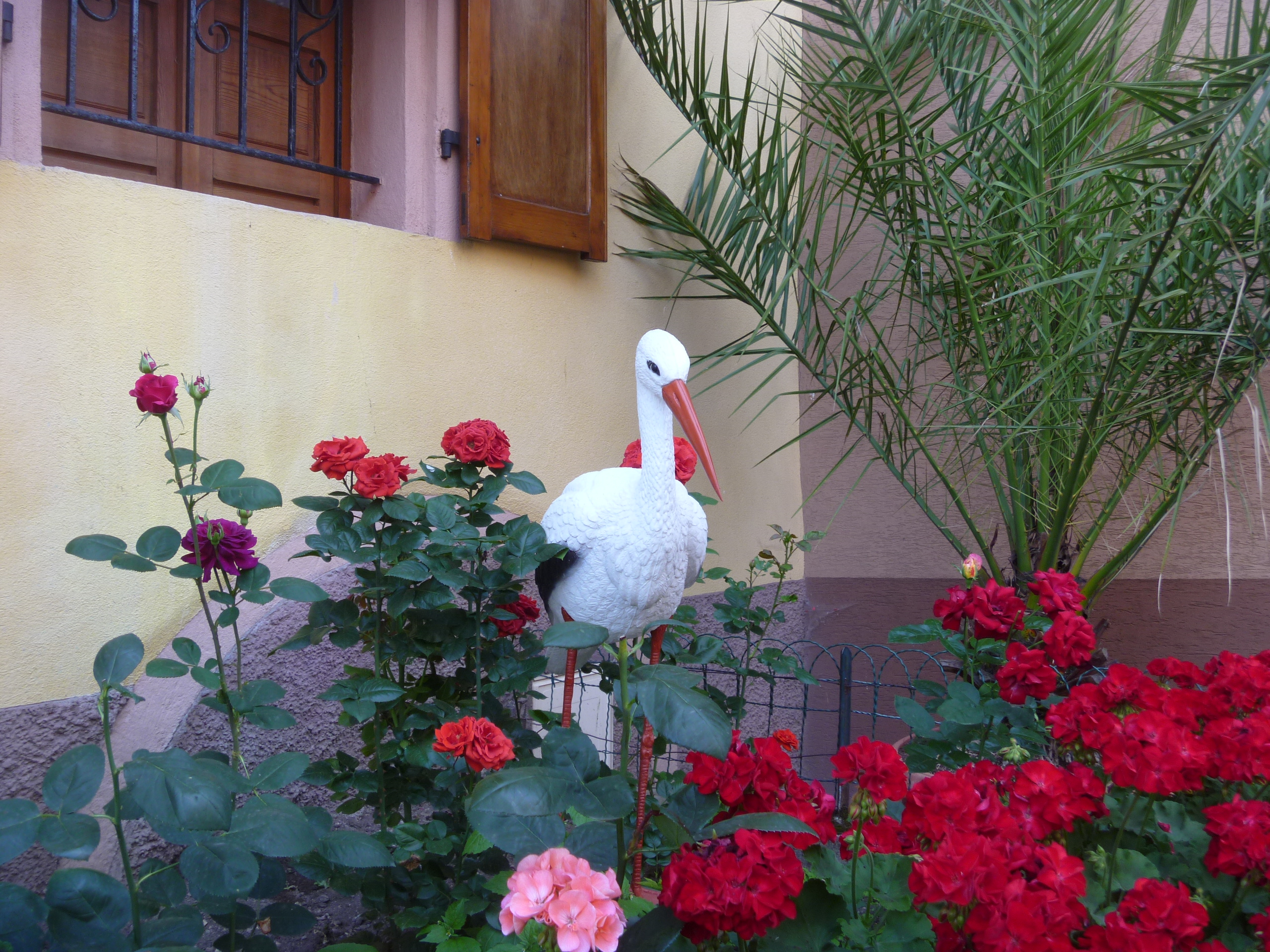
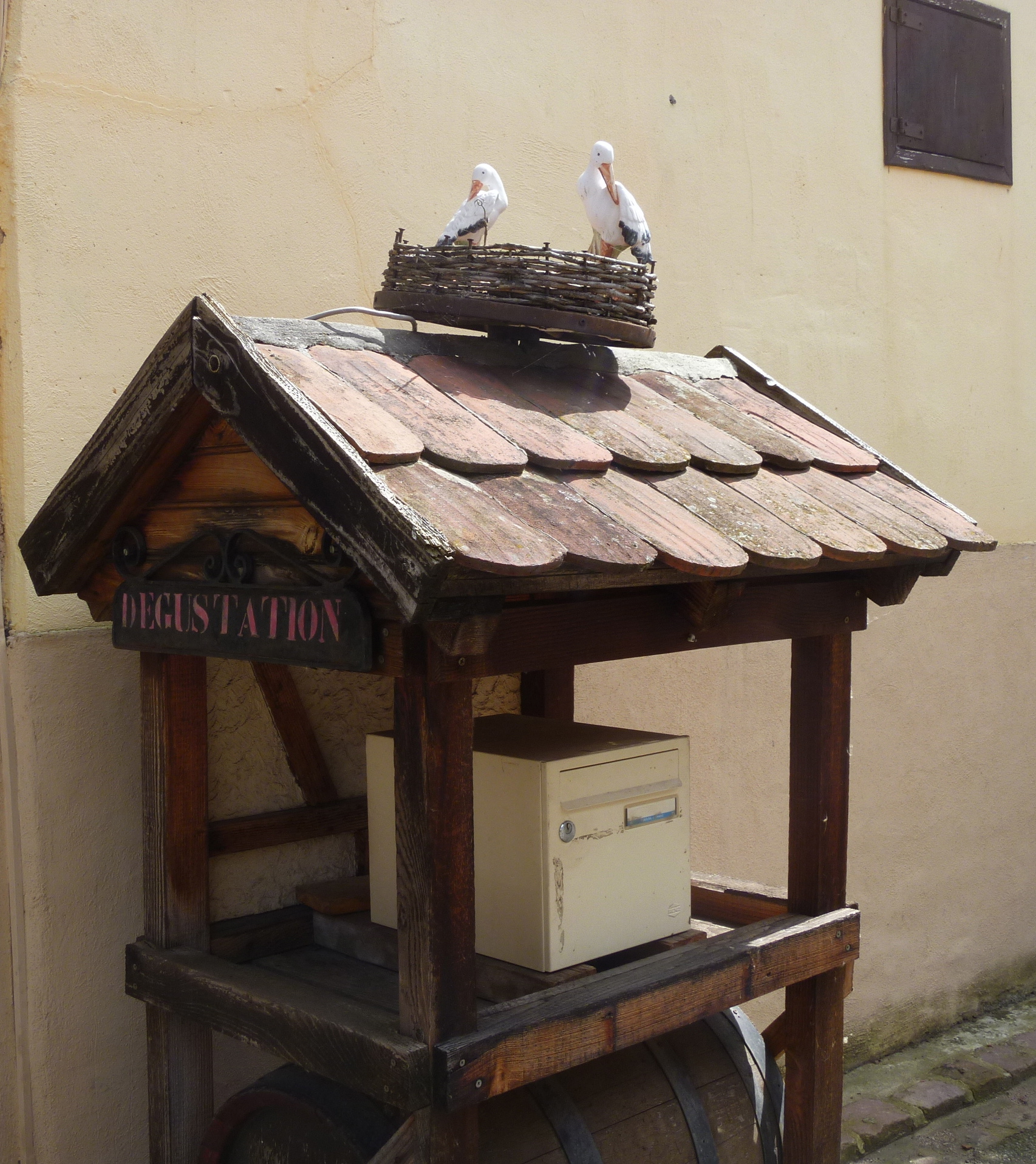
Ciconia ciconia – lucky to see you!

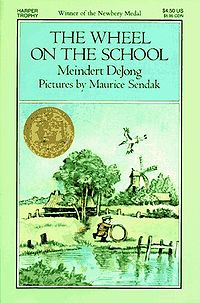
One thing I really hoped to see on my walking tour in Alsace was a stork on its nest. And my wish came true as we arrived at Dambach-La-Ville at the end of our first day’s walking. I used to read a book called ‘The Wheel on the School’ by Meindert Dejong to my sons when they were young.

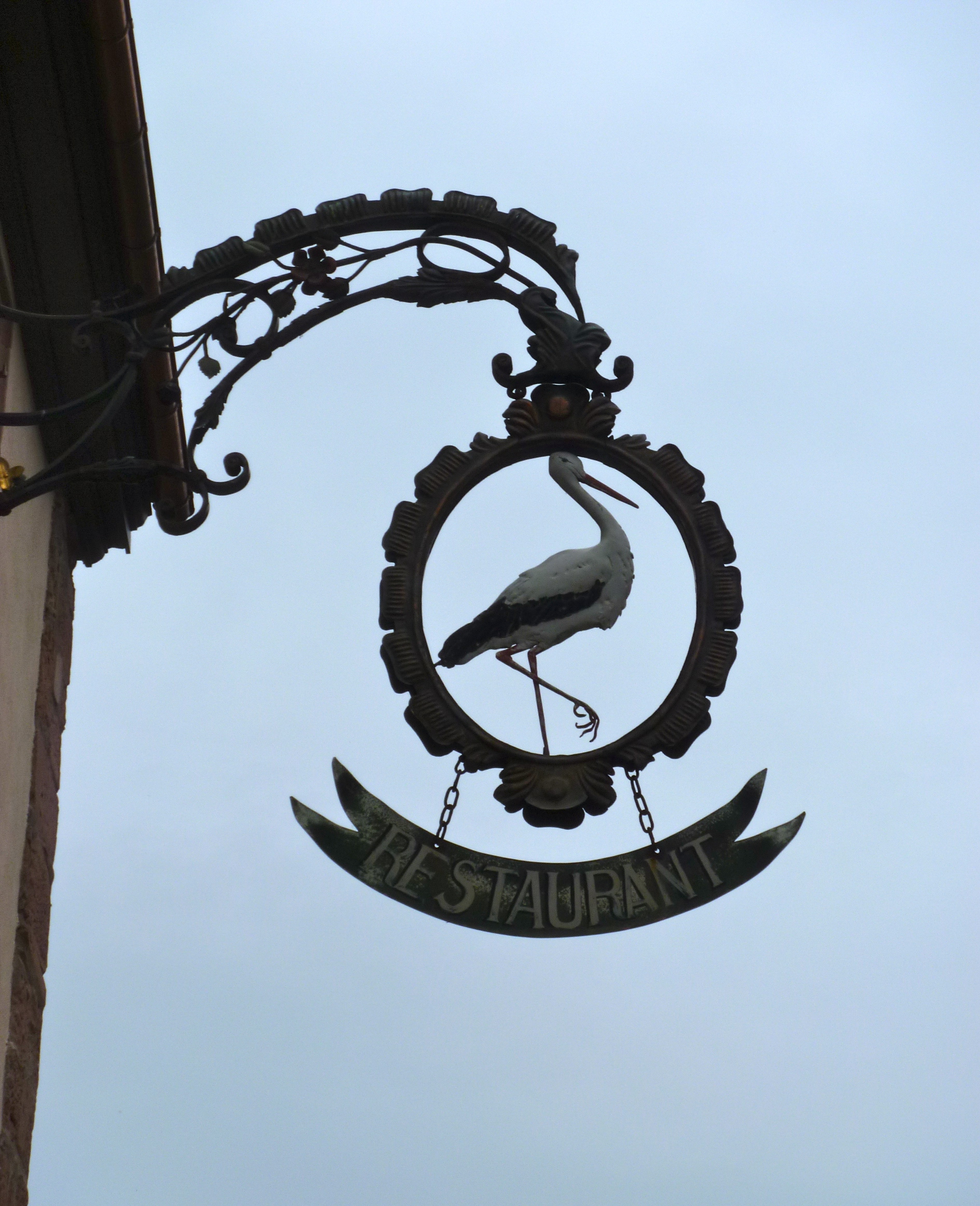
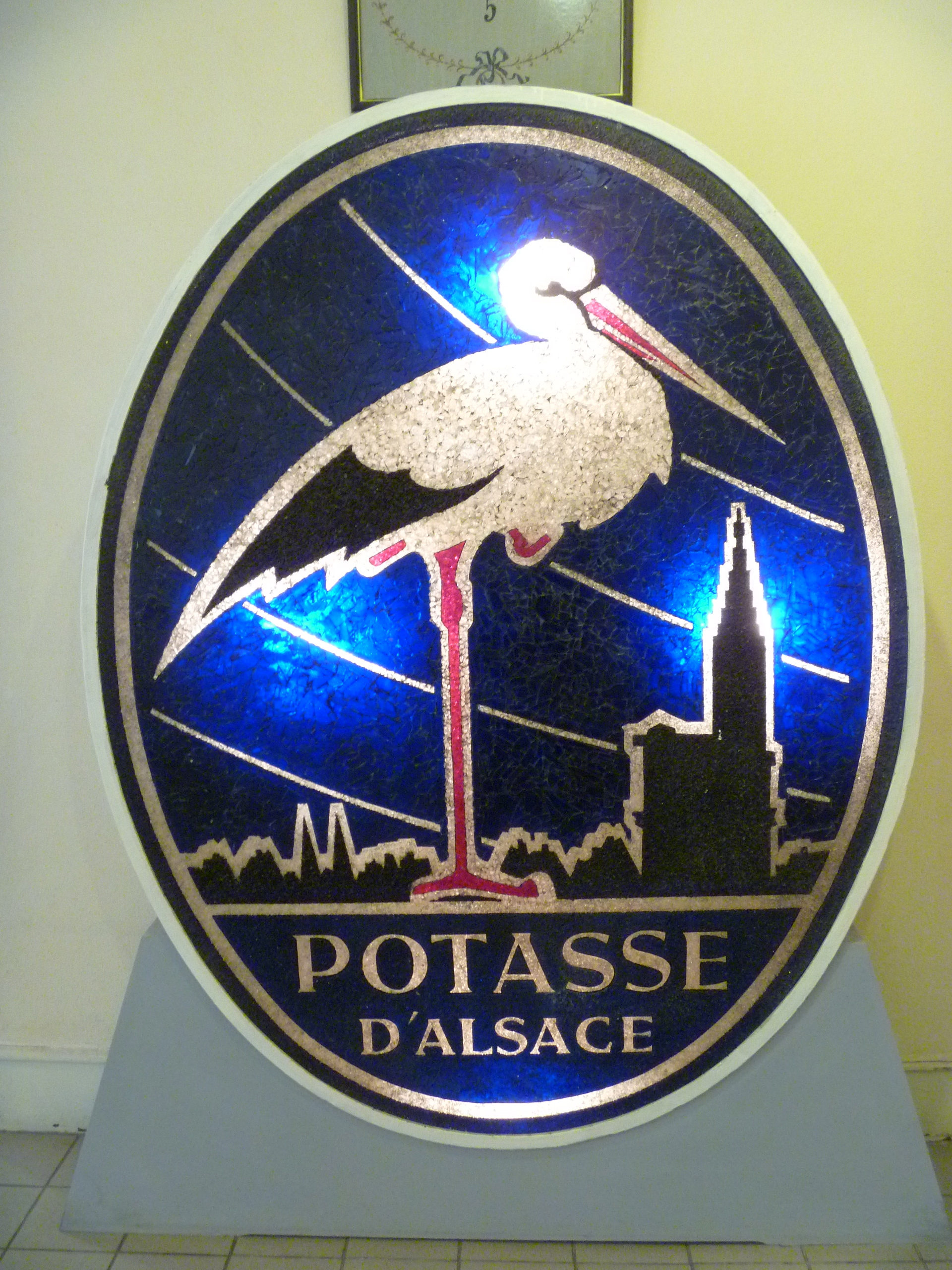
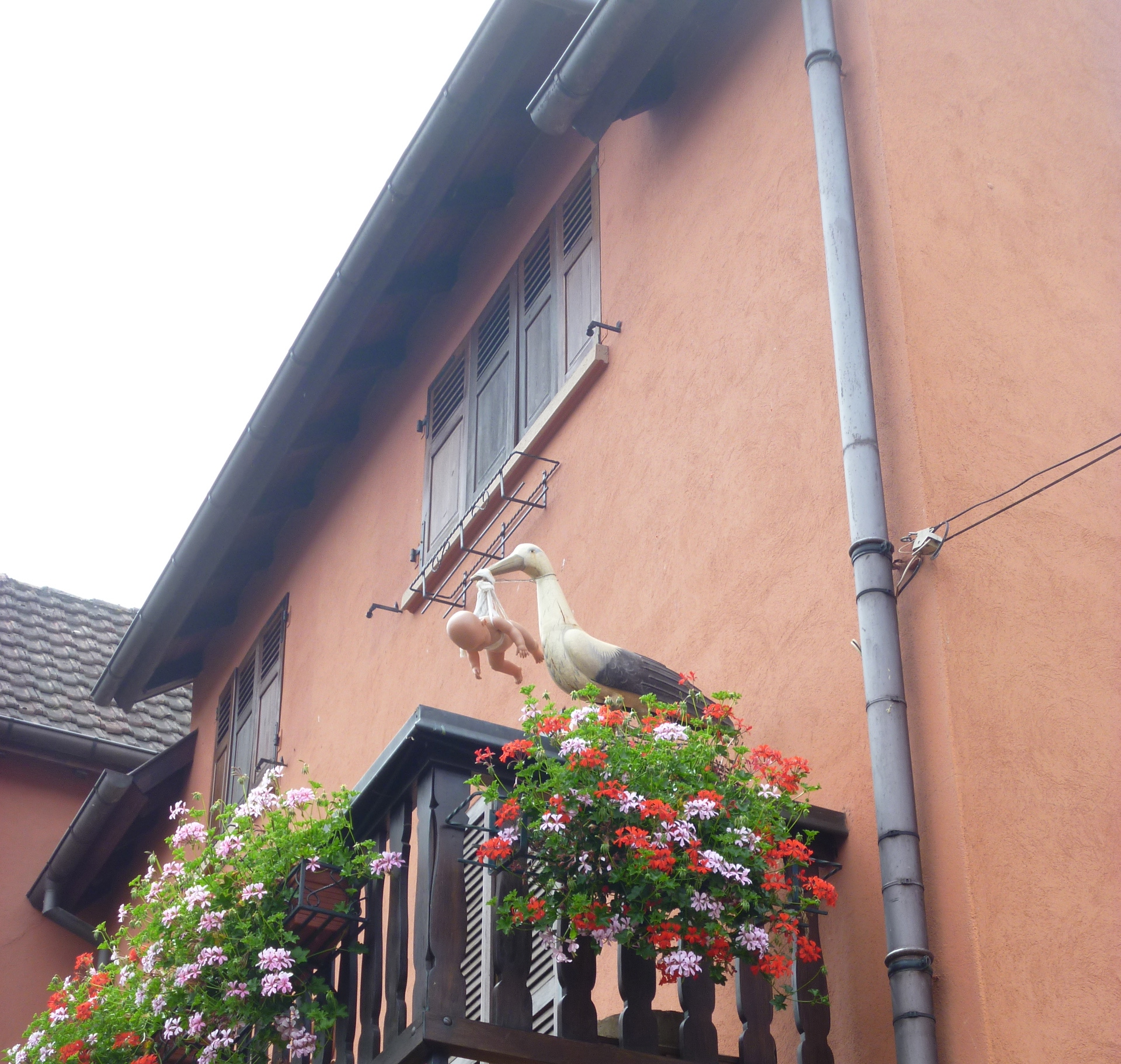
It’s the story of a village in Holland that the storks have forsaken and the efforts made by the villagers and especially the school children to encourage those birds to come back. Although this story is set in Holland I knew that storks could also be seen – if one was lucky – in Alsace. I was reminded of the Alsace-stork connection as we came across countless images of storks in every conceivable place during our journey.

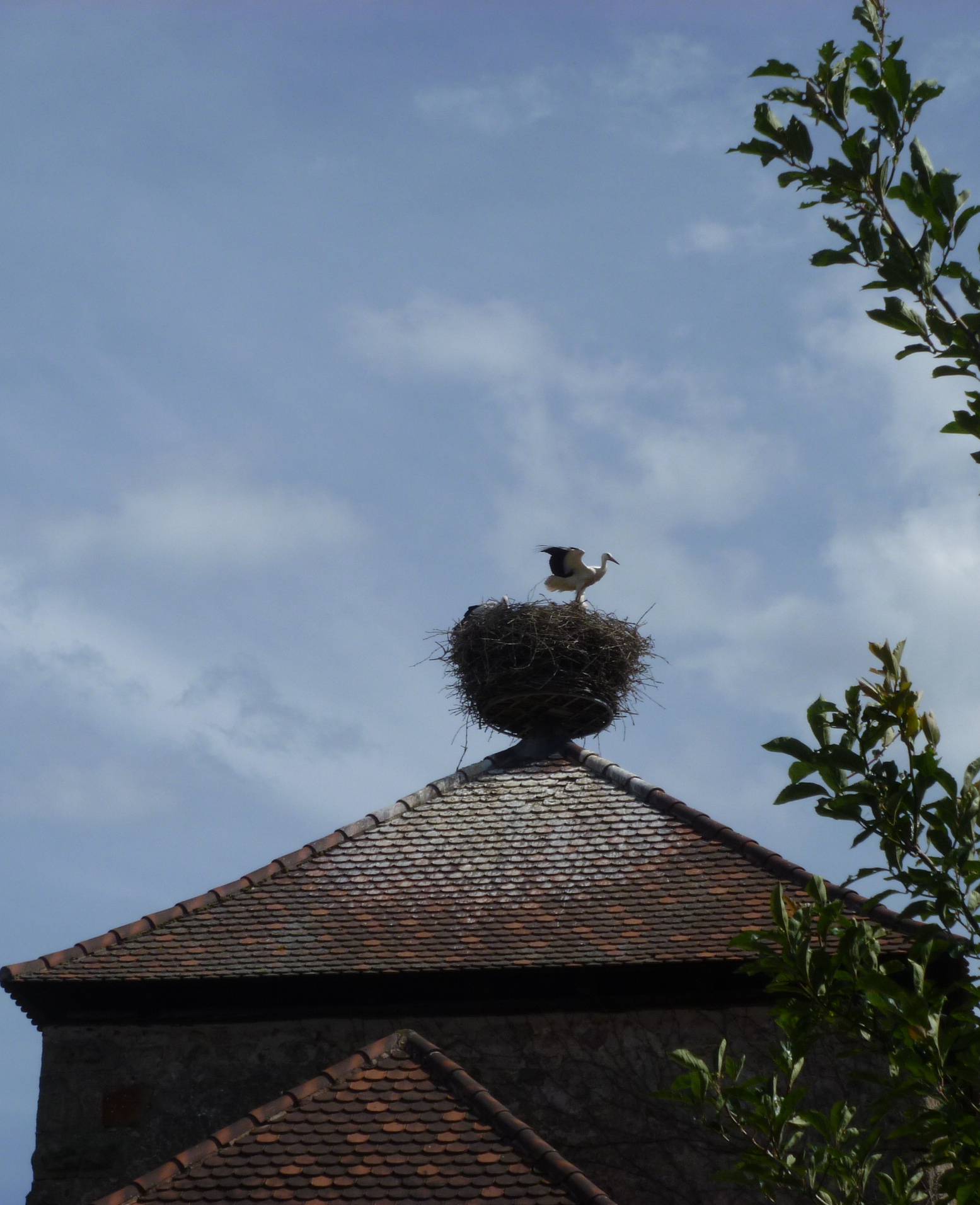
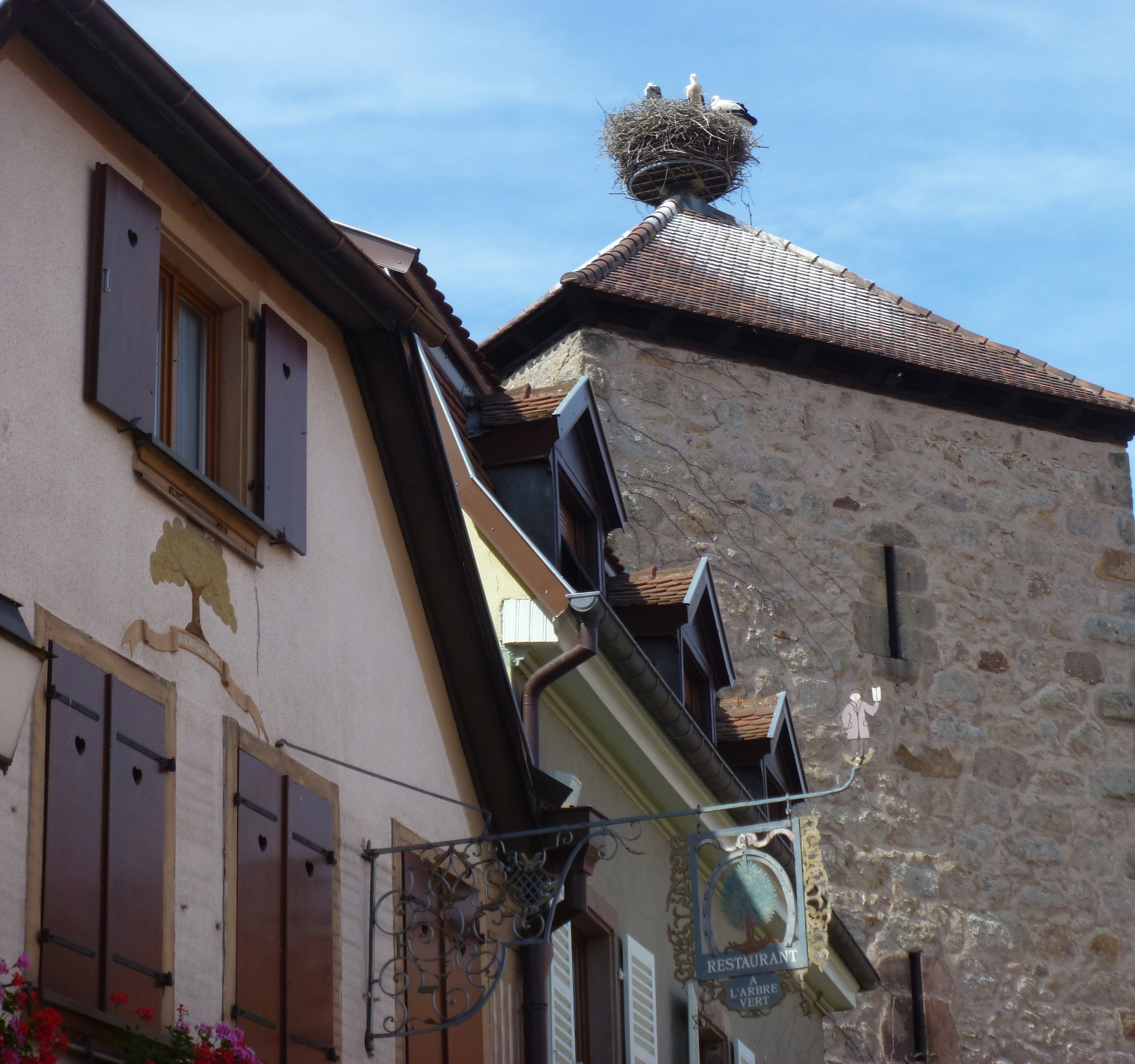
We saw storks again on the next day in the small town of Chatenois and had one further spotting of a stork in flight from its nest at Ribeauville on the third day.

On the Blienschwiller Gate at Dambach-La-Ville

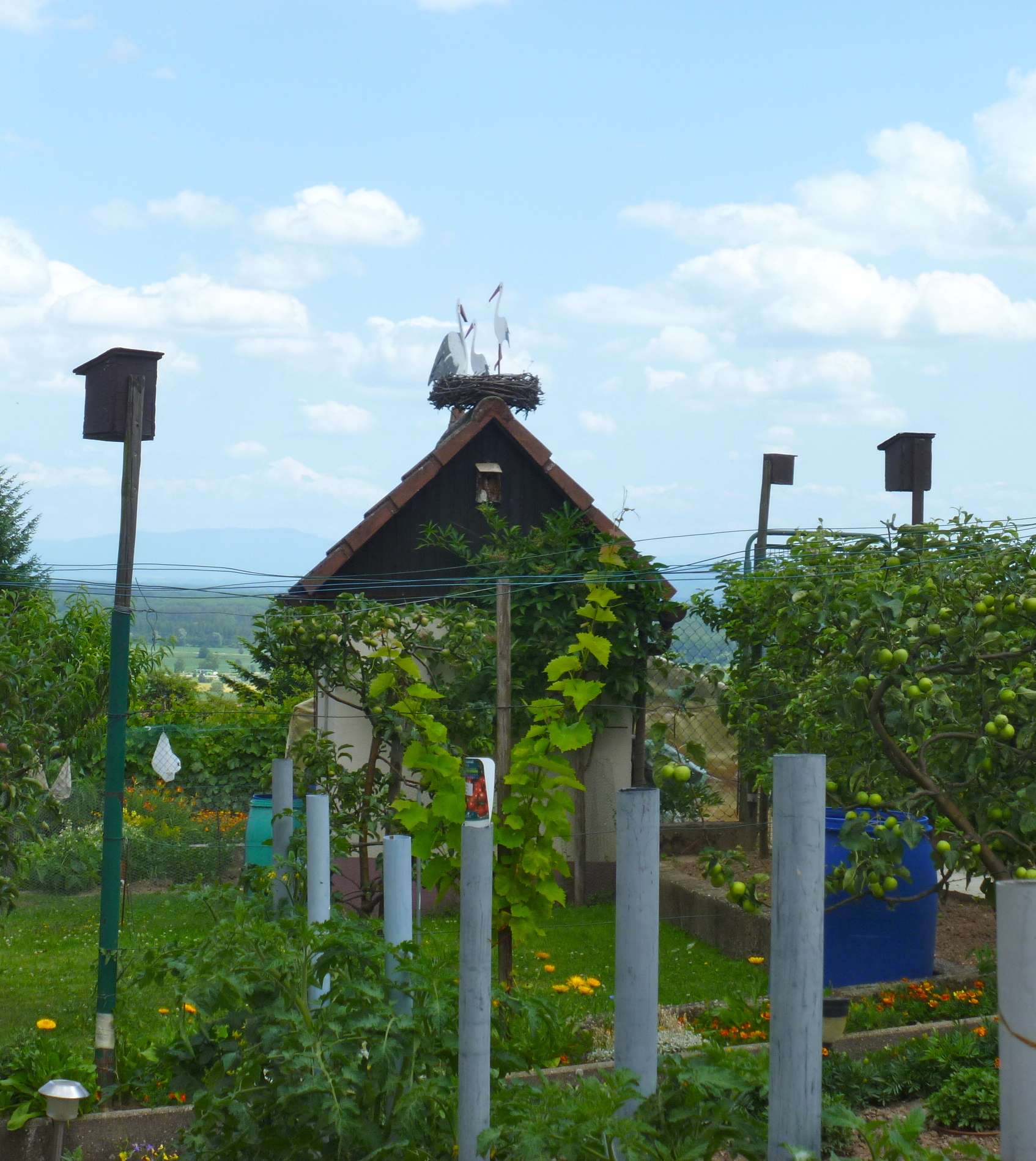
Dambach Storks

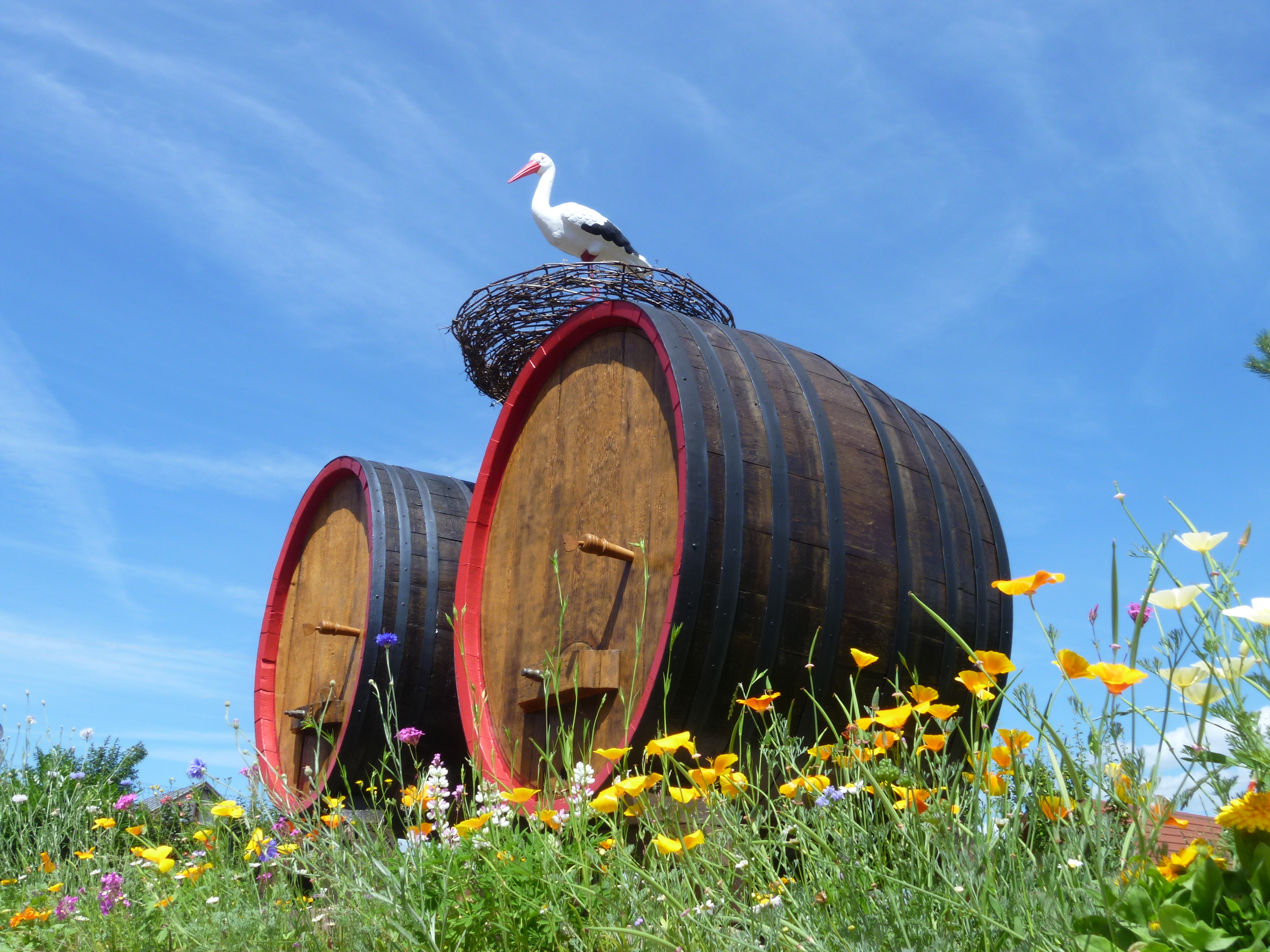
The storks we saw were White Storks – the best known of the 17 species of the stork family. With their long broad wings these long legged birds can apparently fly to great heights on upward convection currents.

Storks are a symbol of good luck and the traditional bearers of babies.

To encourage the storks to nest in the neighbourhood and therefore increase their chances of having good luck the villagers put up baskets or cartwheels. We saw many empty examples of these. Storks spend the winter in South Africa and think about heading north in March and April. They often return to their old nests adding to them and repairing them and in so doing increasing the weight and height of the nest substantially. The young birds tend to stay in the nests for about two months and I think we were lucky indeed to catch sight of occupied nests on our brief trip.

The Old Ways – Mastiles Lane Drovers’ Road

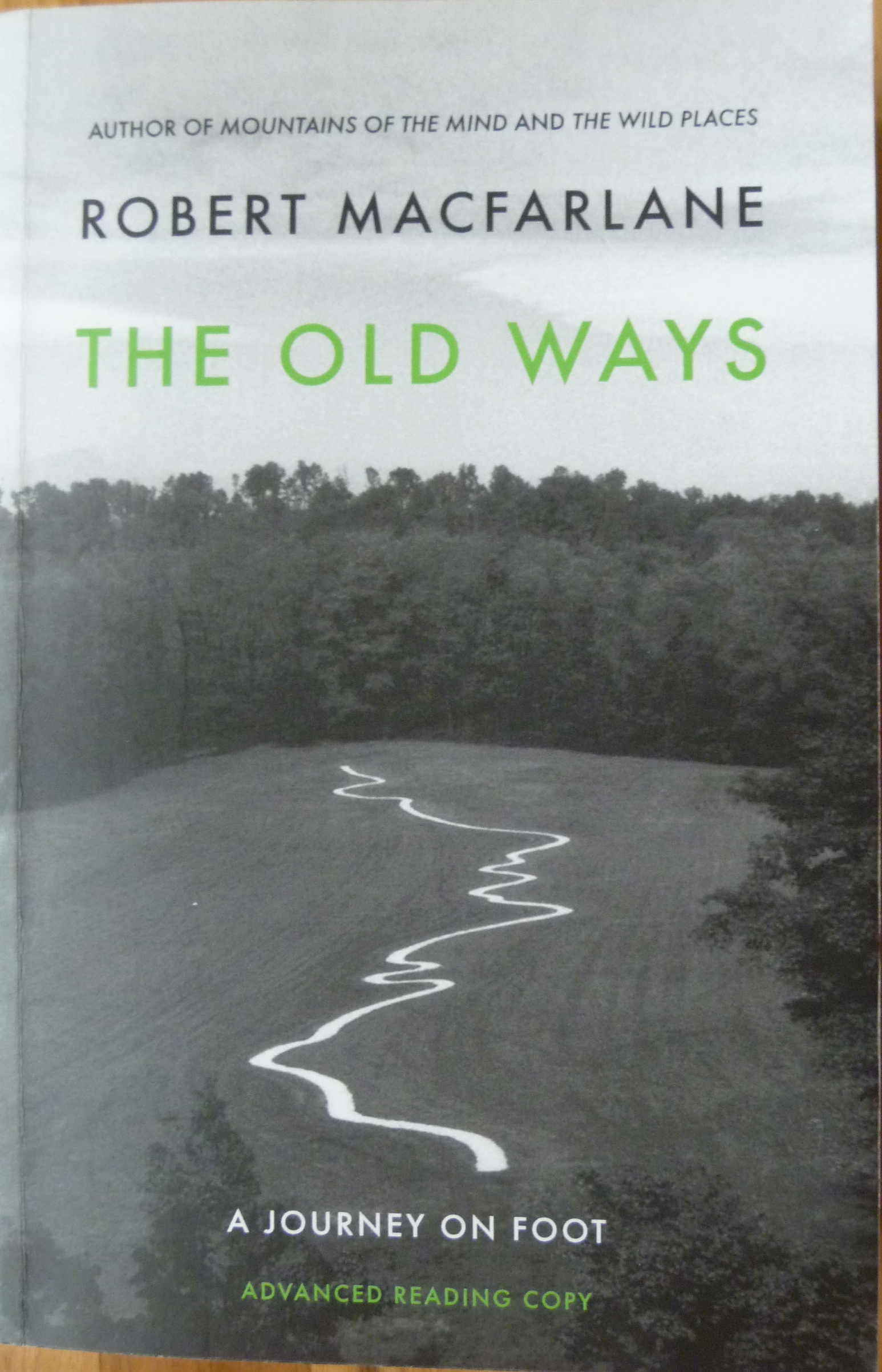
I’m currently reading a book called ‘The Old Ways : a journey on foot‘ by Robert Macfarlane. In fact, I have a pre-publication copy. A couple of months ago I decided that I would like to participate in a group read of the book organised by Lynne – the Dovegreyreader.

The plan is to read the book and and record our own ‘journey on foot’ along an ‘old way’. My hike was originally planned with a group friends for a Saturday in April but the weather on the days leading up to the trip was so bad that it has been postponed and hopefully the full walk will take place in July or August. Mastiles Lane is to be ‘my’ Old Way.

On Thursday I had been invited by my Landmarking friends to visit them during their stay at one of the latest Landmark properties : Cowside. It’s way up in Langstrothdale in Upper Wharfedale, North Yorkshire and as the invitation was for tea I set off early from home in order to fit in a couple of hours hiking along the beginning of Mastiles Lane. It is just part of an old monastic road which linked Cumbria with Fountains Abbey. Mastiles Lane itself is the stretch between Strete Gate, on Malham Moor, and Kilnsey – a distance of about 5 miles. The Cistercian monks of Fountains established a grange at Kilnsey which formed an administrative centre for the vast sheep farming estate.

Kilnsey is the village at the start of the route and it is most famous for its Kilnsey Crag a great rocky outcrop that juts out almost over the main road and is very popular with rock climbers. There are places to park in the village and along the main road and Mastiles Lane itself, although I never noticed an actual sign for it, is easy enough to find.

Kilnsey Old Hall

Built over the site of the former Kilnsey Grange

Kilnsey Old Hall (17th century) built on the site of the original Kilnsey grange (Fountains Abbey – by Herbert Whone, 1987.)

As you start uphill out of the village you notice Kilnsey Old Hall. The seventeenth century hall is built over the site of the original Kilnsey Grange

Kilnsey was the place to which the immense flock of this [Fountains] Abbey were driven from the surrounding hills for their annual shearing; a scene of primitive festivity to which the imagination delights on recurring'” 

from ‘The Deanery of Craven’ by T. D. Whitaker (1878).

The tarmac road is soon replaced by an open track which itself is replaced, after a passing through a gate, by a walled track.

Mastiles Lane walled track in the Yorkshire Dales

Mastiles Lane continues on in a WSW direction towards Malham Moor

 I walked for about an hour on a gradual incline until I reached the highest point of the track as indicated by 1384 feet/423 meter marks on my Ordnance Survey maps. A few paces further along and I was over the brow, round a bend and could see the walled track clearly wending its way for possibly another couple of miles before disappearing over another brow.

At this point I turned back. The picture above shows the return route to Kilnsey. Many of the members of the discussion group are keen on flowers and birds and I duly noted that these both existed along the route but my own interest lies in the influence of man on the landscape and I hope to report back later in the year on the walk in full and on the evidence man has had on the landscape.

And so back to Kilnsey and a further drive deeper into the more remote part of the Dales – Langstrothdale Chase where the kettle at Cowside was whistling on the stove and the fruit cake and Yorkshire parkin were lying in wait for one hungry walker!

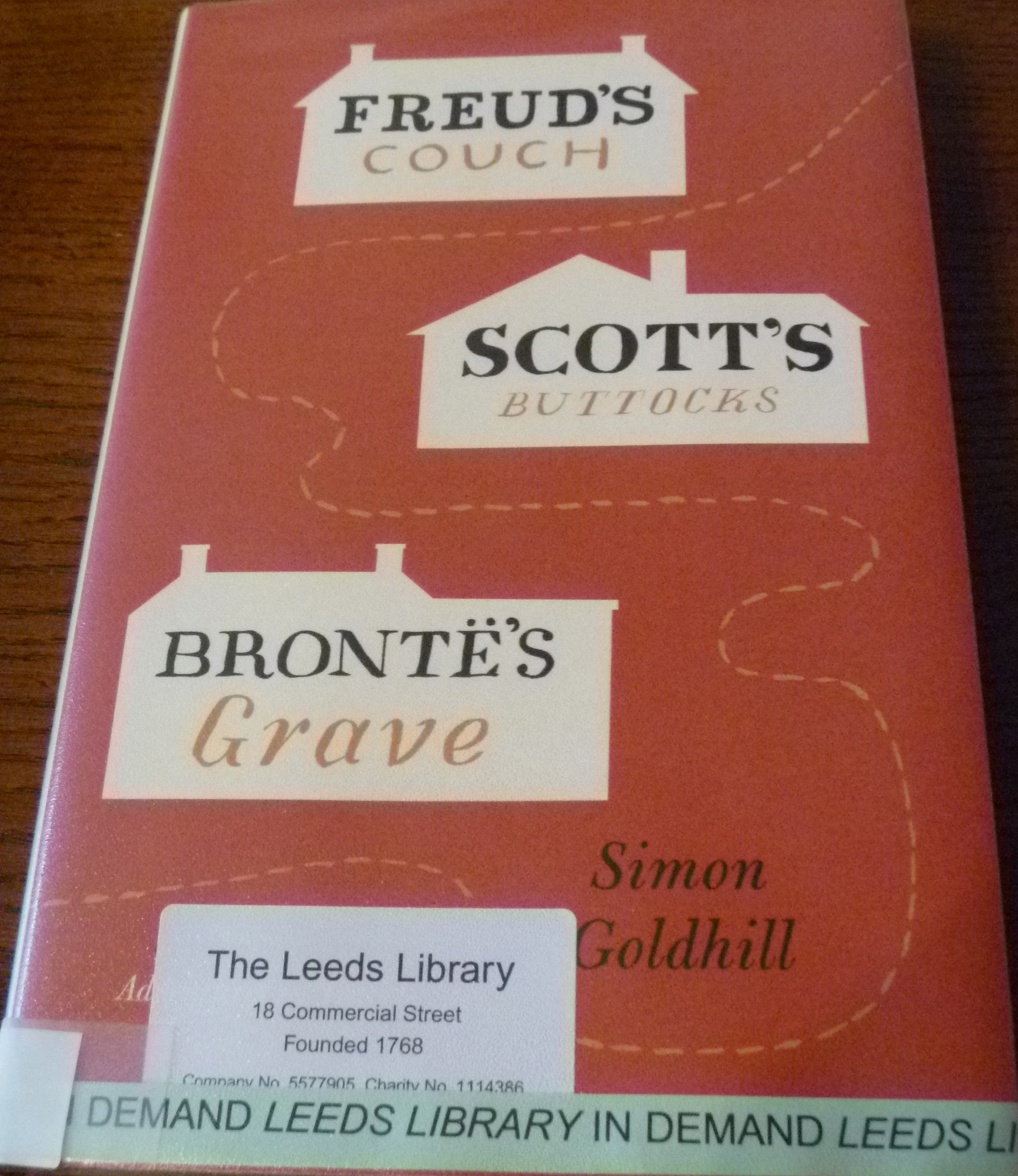
Freud’s Couch, Scott’s Buttocks, Bronte’s Grave

What a title! It’s the title of the book I have just finished reading. It was written by Simon Goldhill. He’s Professor of Greek Literature and Culture and Fellow and Director of Studies in Classics at King’s College, Cambridge and in addition he is Director of the Cambridge Victorian Studies Group.

But despite all his academic qualifications the book is very readable and very personal to him. His premise is to visit the homes of authors to discover what it is that attracts pilgrims to want to visit these houses and to try to find out just what they get from such visits.

Encouraged by his publisher to “do something Victorian” he plumped for visiting writers’ houses but is extremely sceptical about his proposed ‘pilgrimage’.  Apparently, such a tour was a very Victorian pastime and in the first chapter, “The Golden Ticket”, he tells of his intention to travel in as near a Victorian manner as possible and that unlike pilgrims he doesn’t wish to travel alone but with his wife and friends. Finally he lists which properties he’ll visit. He chose Sir Walter Scott’s Abbotsford in the Scottish Borders; Dove Cottage and Rydal Mount, William Wordsworth’s homes in the Lake District; the Bronte Parsonage at Haworth, here in West Yorkshire; William Shakespeare’s Birthplace in Stratford upon Avon; and finally, Freud’s House in Hampstead.

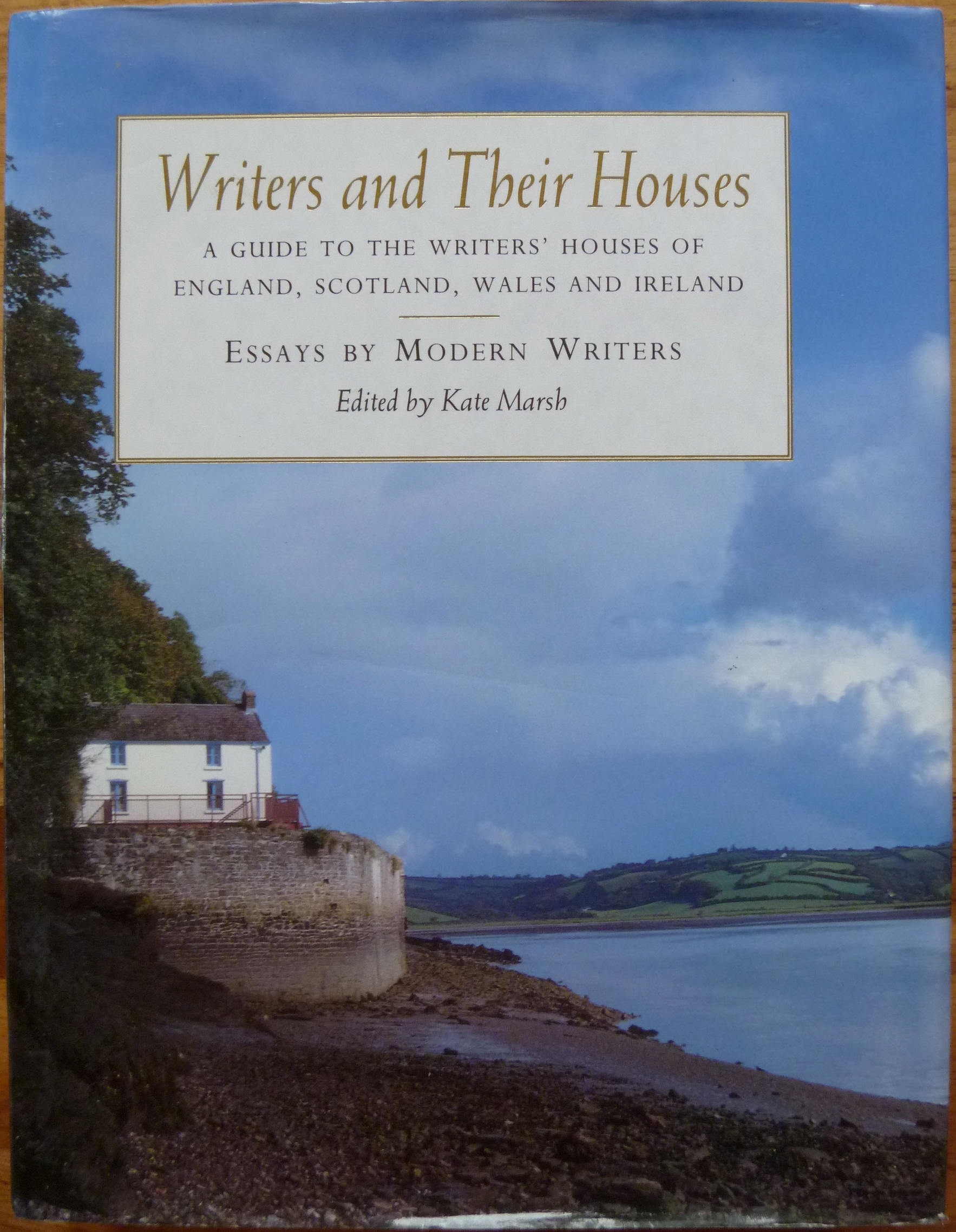
My impression after reading this book was that SG felt justified in his initial reaction that visiting writers’ homes was a pointless exercise and that the house/writer that got it most ‘right’ was Sir Walter Scott who built the house and decorated it intentionally in order to promote himself and his novels. His description of the visit to Abbotsford (and that of A. N. Wilson in my copy of Writers and their Homes) has encouraged me add it to my ‘list’.

“Abbotsford!” so writes A. N. Wilson “There is perhaps no writer’s house more expressive of its occupant’s literary personality. Indeed, one could say that Abbotsford was an extension of Scott’s oeuvre –an architectural Waverley novel, or a poem in stone of Border life and history.”

I love to visit authors’ homes but I never before thought of myself as a pilgrim. I suppose I like to visit houses full stop and the added attraction of it being an author’s home is that I can experience the atmosphere and see the surroundings that may (or may not) have influenced his or her work.

I have several books to help me in my choice of ‘pilgrimage’ to writers’ houses!

I would make quite a different choice for my own tour: Lamb House in Rye (Henry James); The Boat House at Laugharne (Dylan Thomas); Monk’s House at Rodmell in East Sussex; Kipling’s Bateman’s also in East Sussex; Thomas Hardy’s Higher Bockhampton and Max Gate, Dorchester.

Here are five that I have visited in the last few years :

Shandy Hall, Coxwold, North Yorkshire (Tristram Shandy)

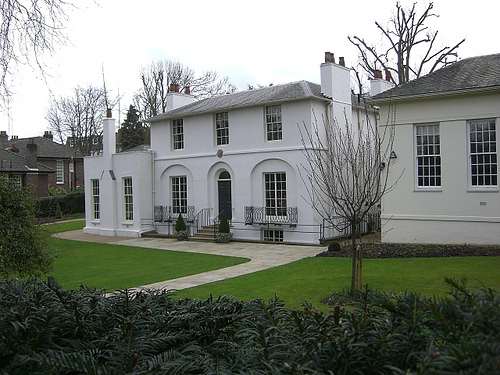
Keats House, Hampstead, London (John Keats)

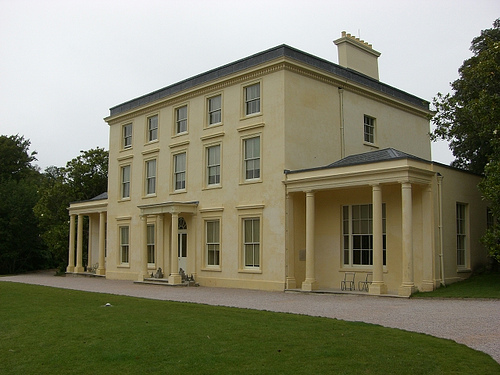
Greenway, River Dart, Devon (Agatha Christie)

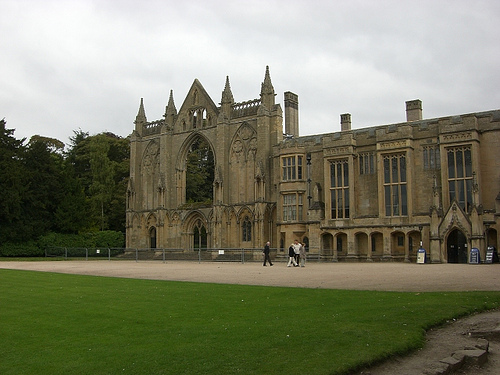
Newstead Abbey, Nottinghamshire (Lord Byron)

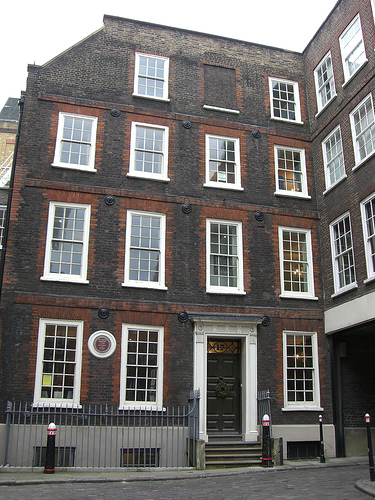
Johnson’s House, City of London (Dr Samuel Johnson)

The Irish Country House – Mount Stewart and The Argory

During recent years I have read several books on the theme of The Irish Country House. Titles include We Are Besieged by Barbara Fitzgerald (1946), Troubles by J. G. Farrell (1970), Two Days in Aragon by Mollie Keane (1941), The Dower House by Annabel Davis-Goff (1998). Although written at different times the general themes involve Anglo-Irish families during the first half of the twentieth century, their homes and their vulnerability during the times of trouble. Often the family itself is divided in its loyalties.

I was looking forward to visiting a couple of fine examples of Irish country houses on my Just Go! holiday last week.

Mount Stewart

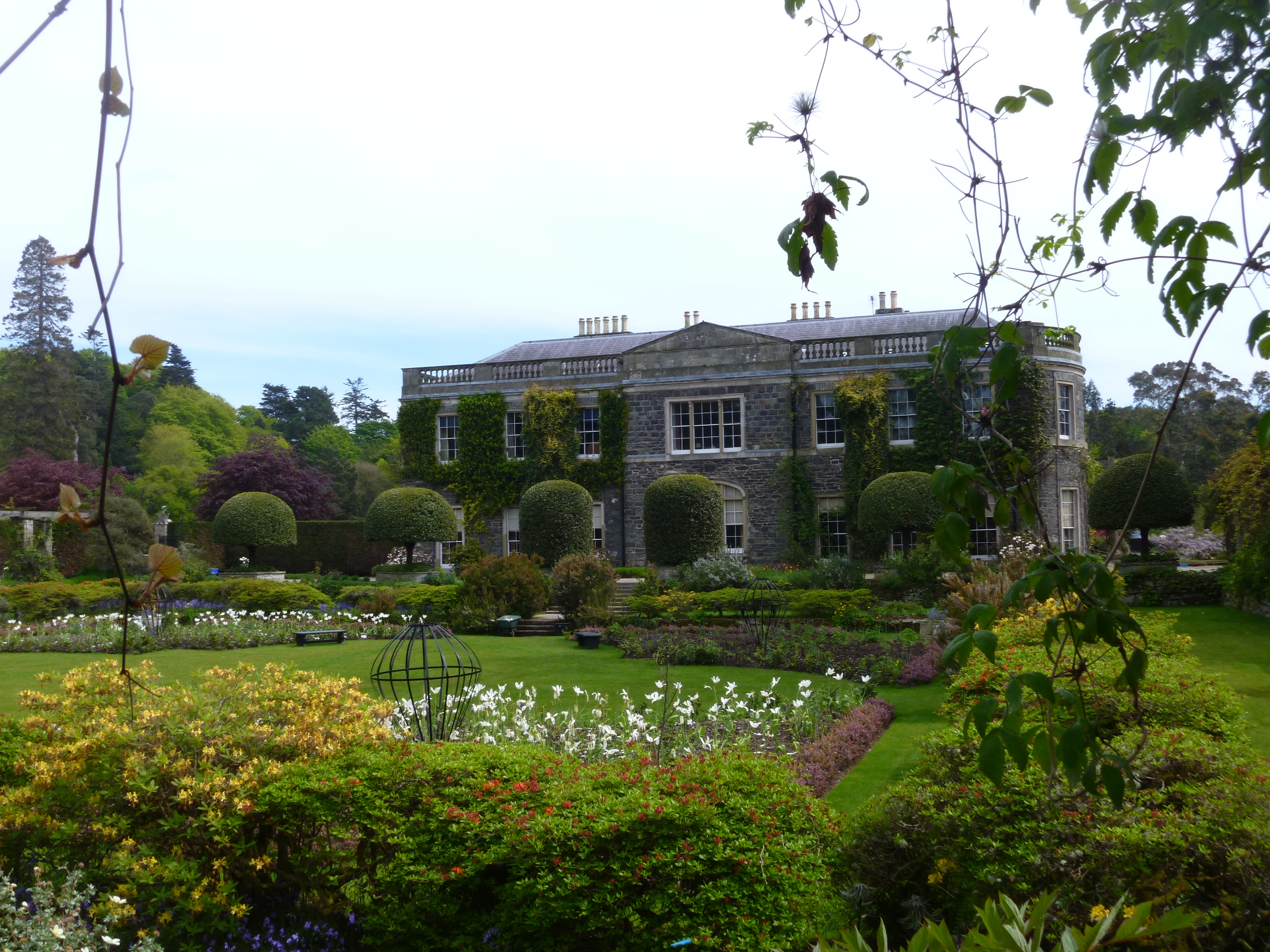
Located on the shores of Strangford Lough Mount Stewart stands in beautiful grounds enjoying a microclimate of its own which supports a lush and green garden of trees and exotic plants. The house was built in the eighteenth century and has been the home of the Marquesses of Londonderry (the Vane-Tempest-Stewart family) over many generations. Robert, Viscount Castlereagh, the 2nd Marquess of Londonderry made a name in politics in the early nineteenth century and was leader of the House of Commons. Edith, Lady Londonderry (1878-1959) wife of the seventh marquess was the major force behind the garden design that we see today. She gave the gardens to the National Trust in 1957 but the house itself was not bequeathed until 1977.

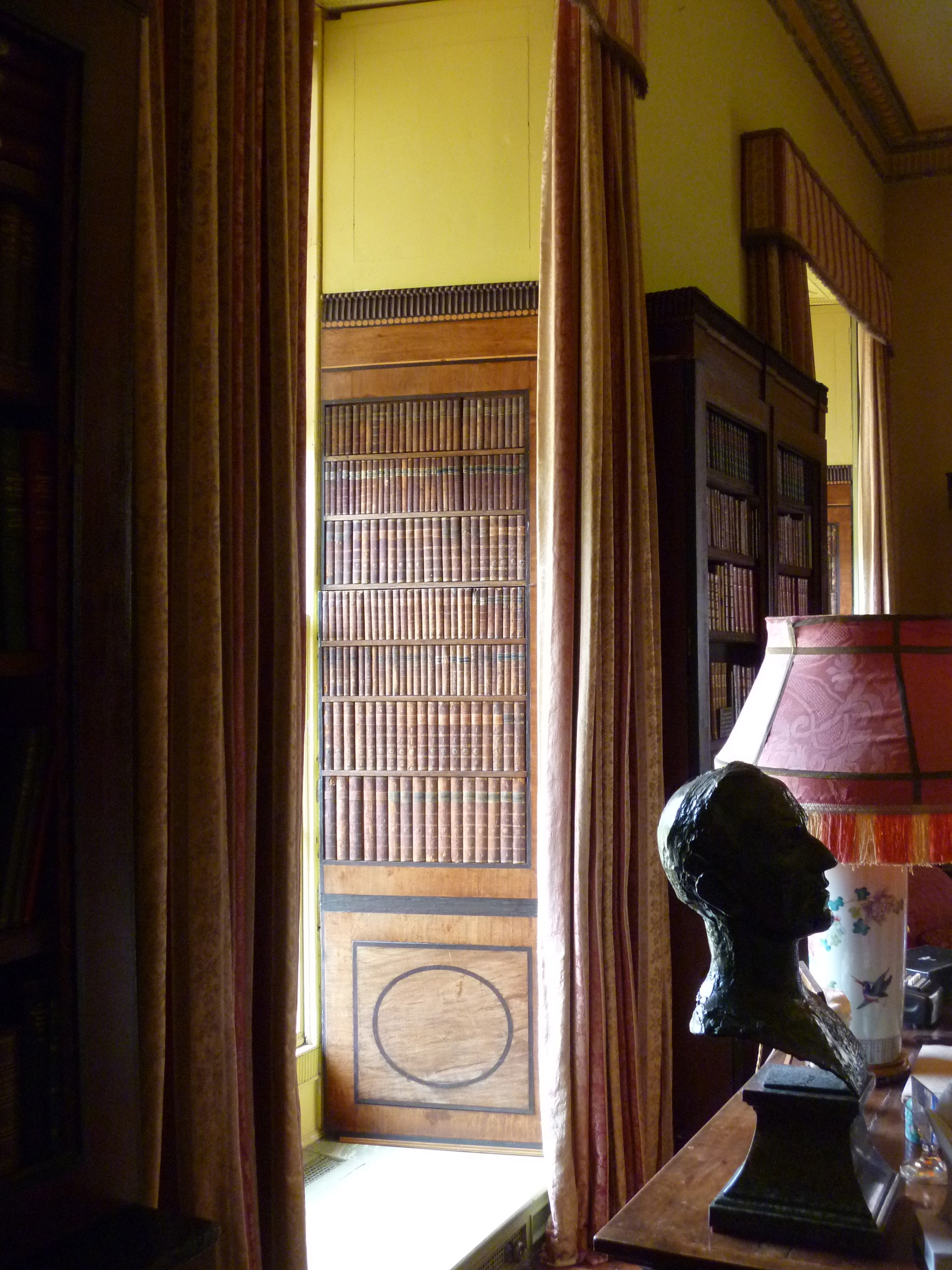
We had a fascinating tour of the house which is currently undergoing renovations but is open to the public in spite of this. I loved the library with its shelves and shelves of books – many looking not so very old at all – some members of the family still use the house and many of its rooms. But on closer inspection what looked like shelves right up to the windows are actually trompe l’oeil painted shutters.

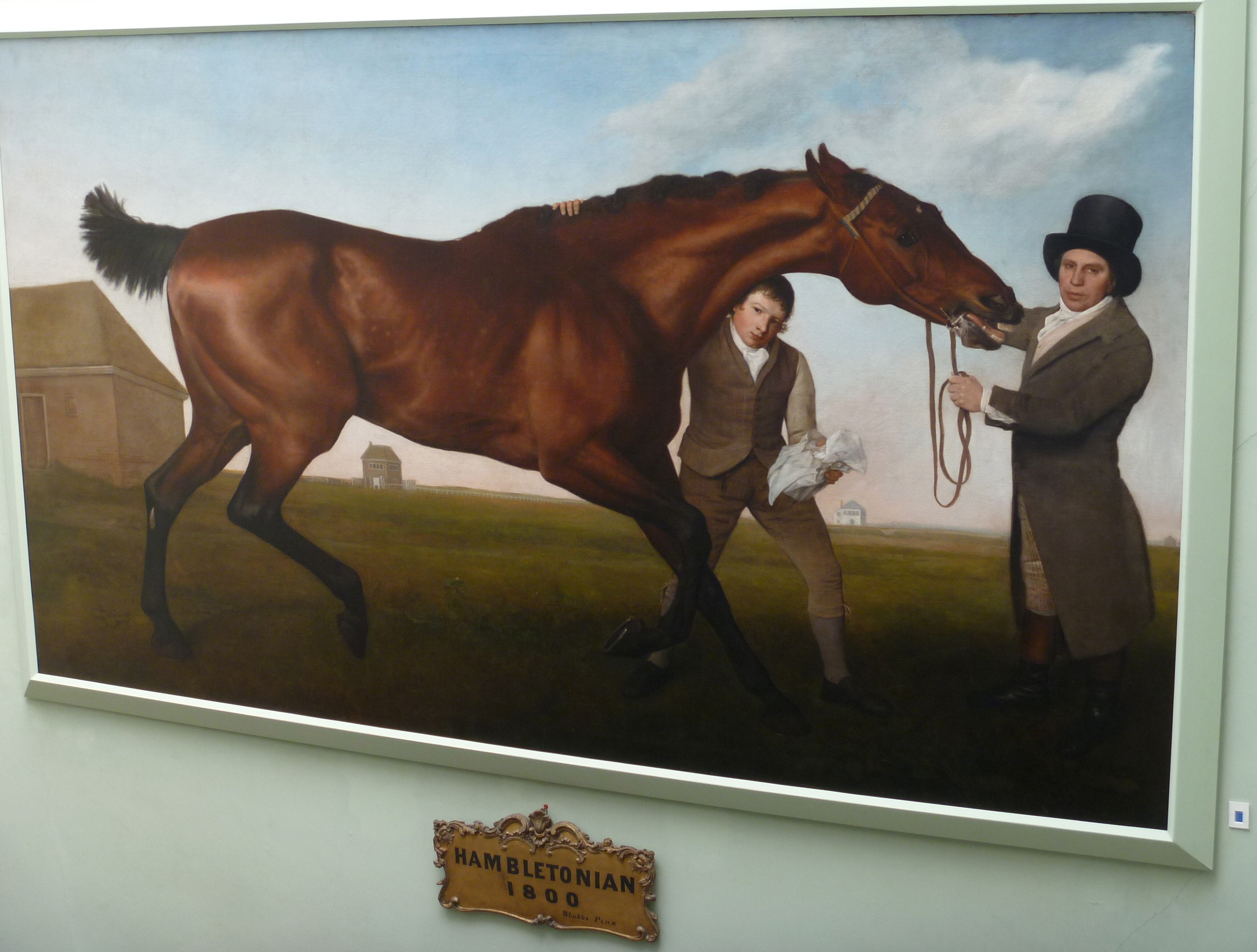
It’s hardly surprising to find evidence here of a love of the ‘sport of kings’. Horse racing has for a long time been popular in Ireland and with the aristocracy but to see the huge painting of Hambletonian by George Stubbs hanging above the staircase comes as quite a surprise.

 There’s another racing picture in the house, also reproduced in the above link to Thoroughbred Heritage. It’s a painting of the Hambletonian/Diamond Match run at Newmarket in 1799. We were told the story of the race by our guide. The version we heard differed somewhat from that of the Thoroughbred Heritage story.

 The Argory

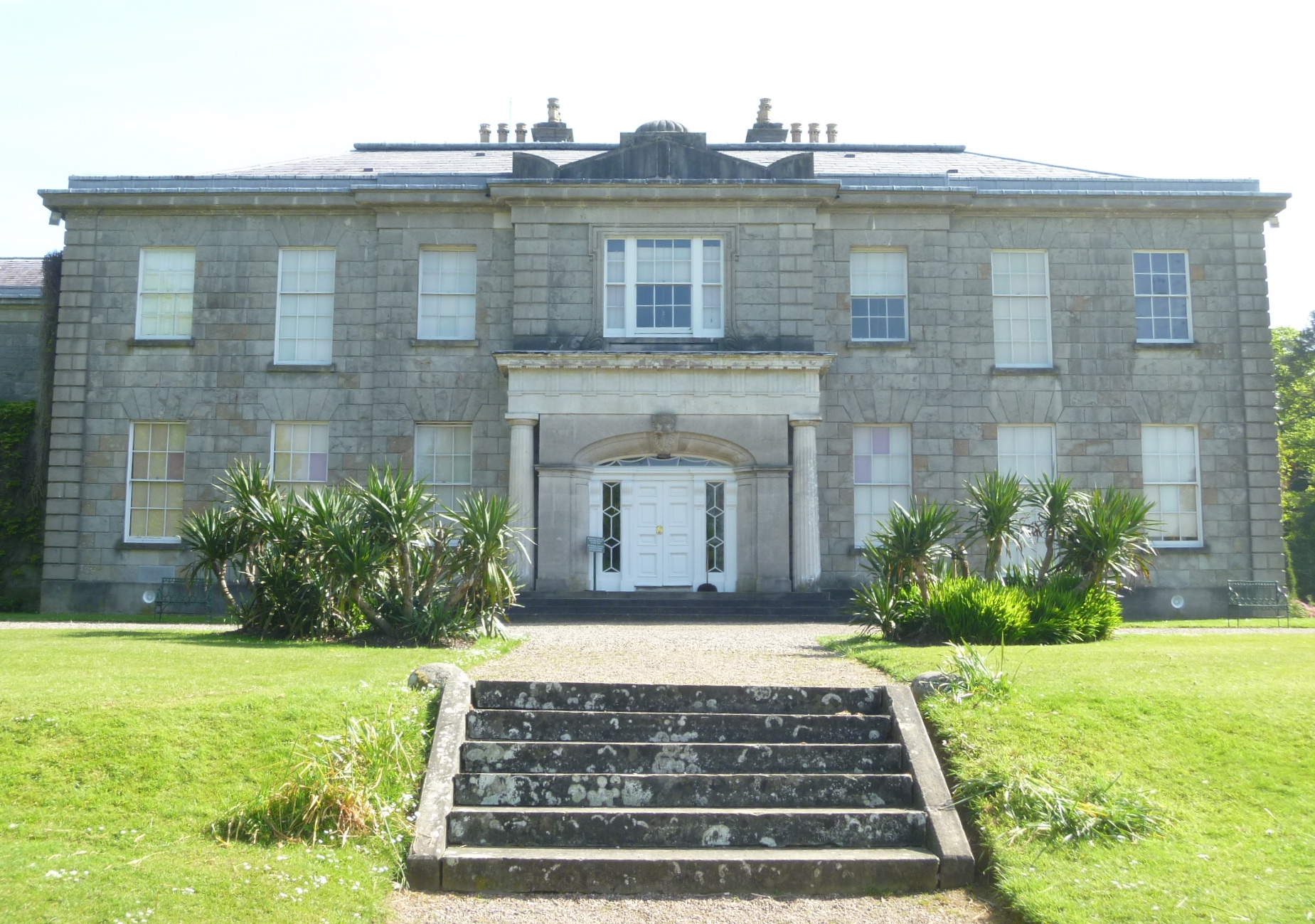
Later in the week our journey took us well into central Ireland and to a less grand but equally interesting house – The Argory. Argory means Hill of the Garden and to my mind it was more the kind of Irish country house that I have in mind when reading those novels I mentioned above.  Again we were given a warm welcome to the house  and a small group tour by one of the local volunteers.

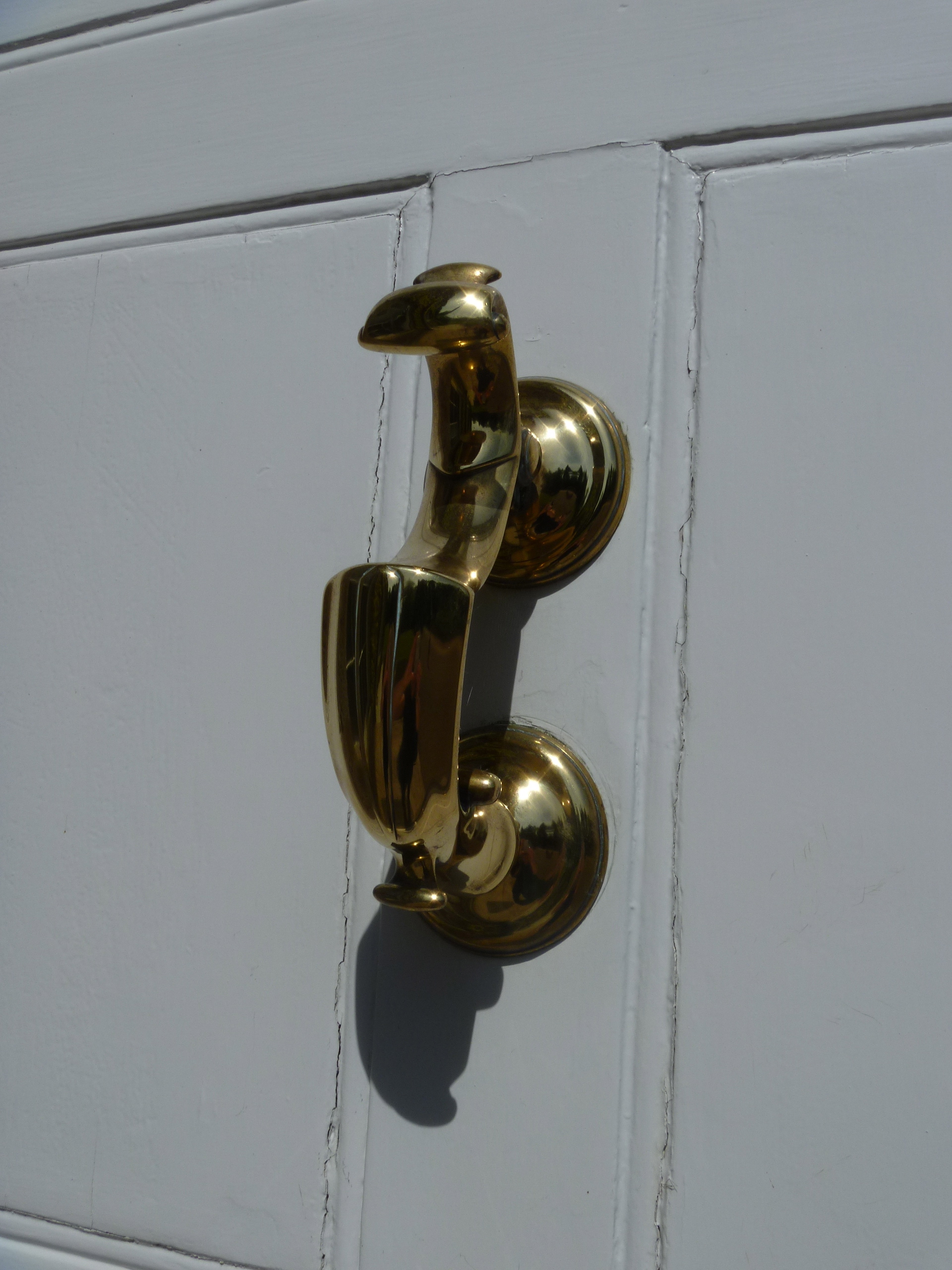
The Argory Door Knocker

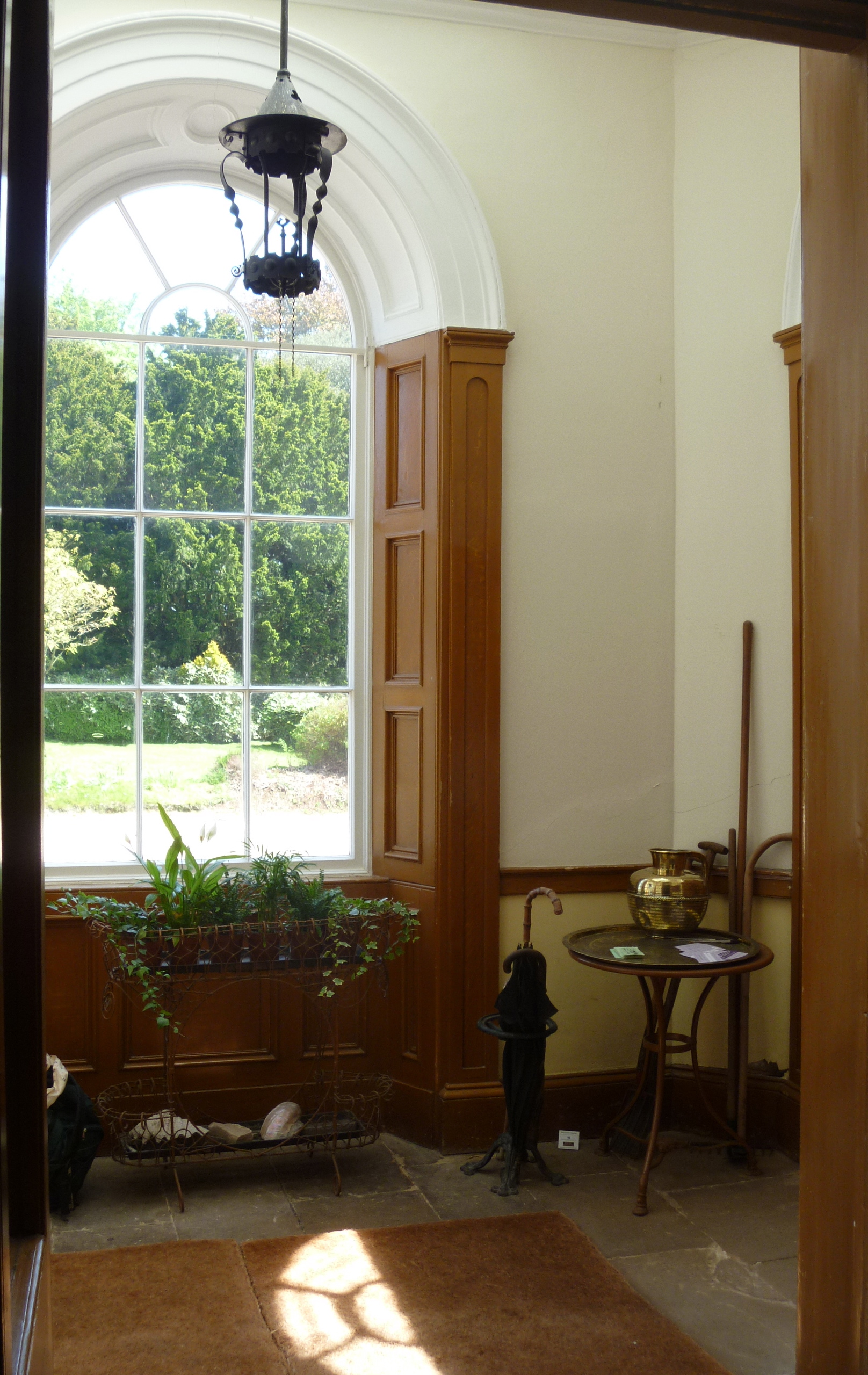
The Welcoming Argory Porch

Taken on by the National Trust in 1979 not much has changed in the house since 1900. To quote my guidebook ” the eclectic interior still evokes the family’s tastes and interests”. These include a large selection of Waterford crystal and a fantastically ornate  organ on the first floor. Click here to view the Argory Organ Gallery and other virtual views of the house.

Despite it’s inland location there’s a nautical connection here. Captain Shelton, the 2nd owner of The Argory, was aboard the H.M.S Birkenhead when it sank off the coast of Africa in February 1852. One of the most documented maritime disasters before the Titanic, it was also the first ever liner to exercise the phrase ‘Women and Children First!’ We were told how the Captain survived swimming the two miles to land in his mackintosh which protected him from sharks and the cold.

These actions later to be known as The Birkenhead Drill were immortalised later by Rudyard Kipling in his poem ” Soldier an’ sailor too” (1896)

To take your chance in the thick of a rush, with firing all about,
Is nothing so bad when you’ve cover to ‘and, an’ leave an’ likin’ to shout;
But to stand an’ be still to the Birken’ead drill is a damn tough bullet to chew,
An’ they done it, the Jollies — ‘Er Majesty’s Jollies — soldier an’ sailor too!
Their work was done when it ‘adn’t begun; they was younger nor me an’ you;
Their choice it was plain between drownin’ in ‘eaps an’ bein’ mopped by the screw,
So they stood an’ was still to the Birken’ead drill, soldier an’ sailor too

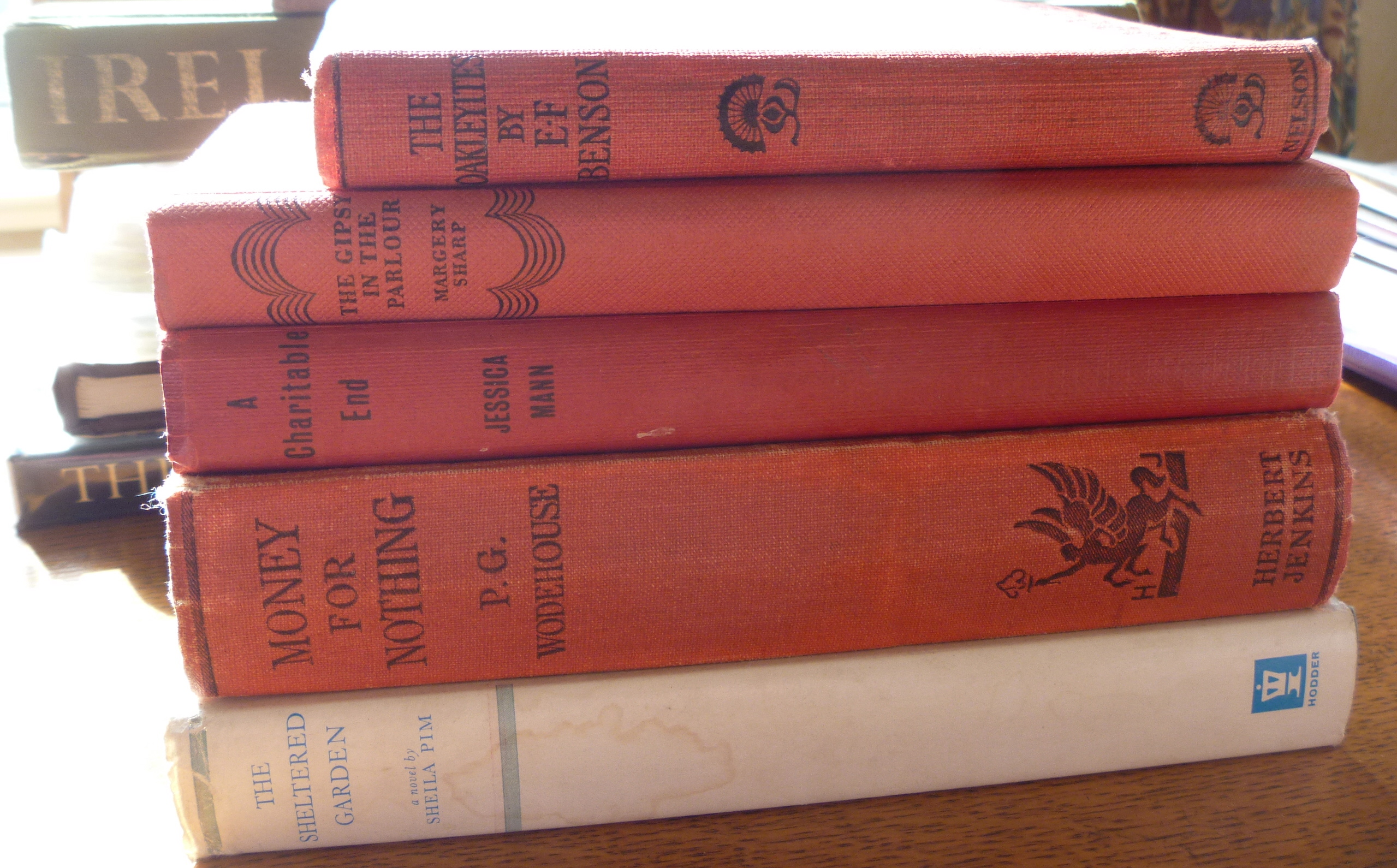
One excellent feature of National Trust properties these days is that they almost all now have secondhand bookshops. My eyes lit up in Blackwater Books at the Argory. They had a section just labelled ‘Old Books’. Here’s the selection that I came away with :

The Lost World of the Windsors

In one of the sitting rooms of the main building at The Moulin de la Tuilerie, or The Mill, as it is sometimes called, is a mural painted above the fireplace. It was put there by the Duchess of the Windsor and it says “I’m not the miller’s daughter but I’ve been through the mill.”

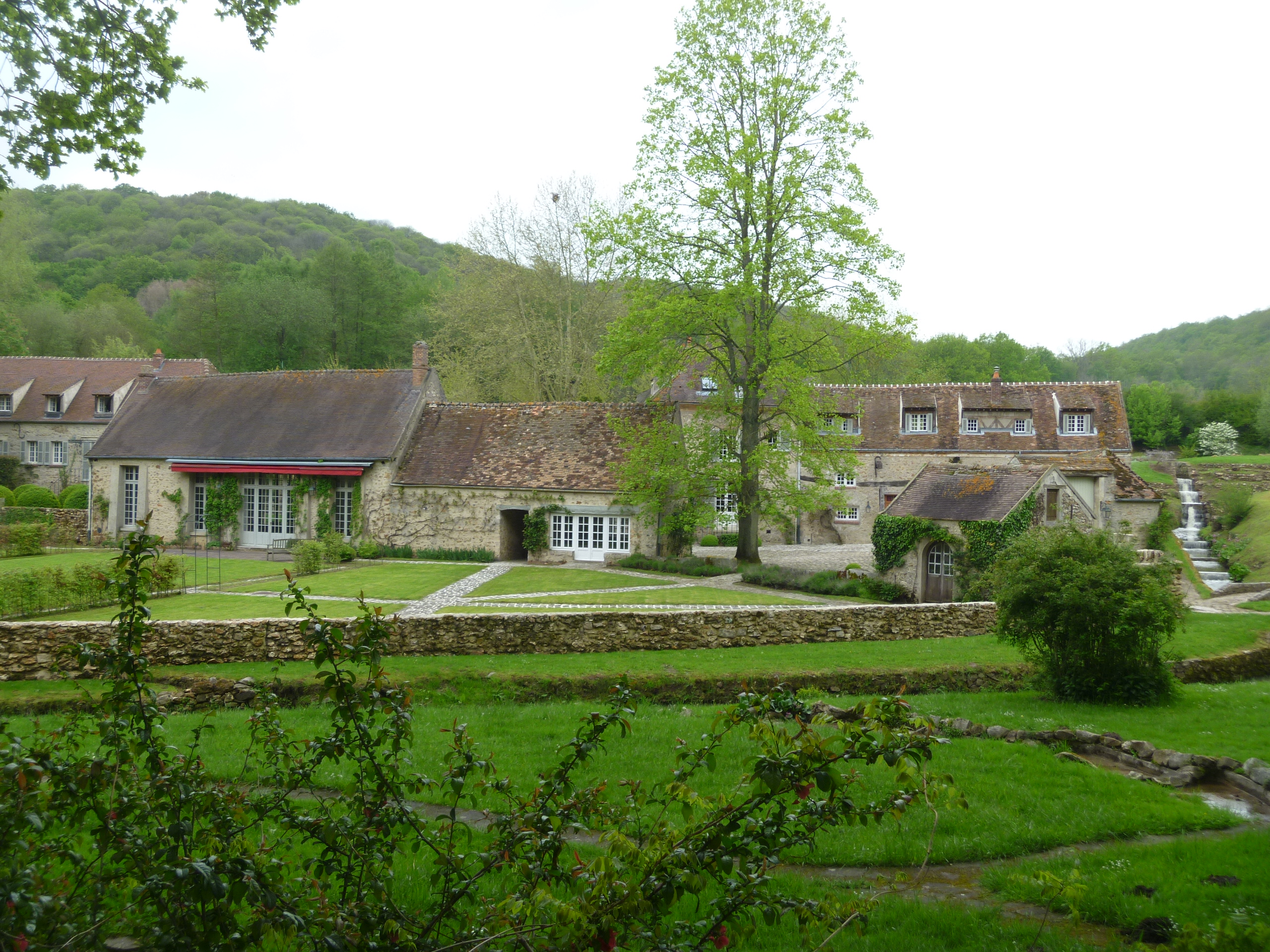
Over the years since 1734, the best date that can be given for the main building at Le Moulin de la Tuilerie, The Mill at Gif Sur Yvette has had many incarnations. The most glamourous being during the 1950s when it was the weekend home of the Duke and Duchess of Windsor. They bought the house in 1952 from the artist Drian and set about making renovations and improvements to both the house and the garden. During the 1950s and 1960s they were entertaining celebrities and the glitterati at weekend parties here just a 30 minute drive from their home in the Bois de Boulogne in Paris.

The Garden

Here is an interesting introduction  to Le Moulin and some comments by the daughter of one of the gardeners who worked with the Duke of Windsor.

Le Moulin De La Tuilerie

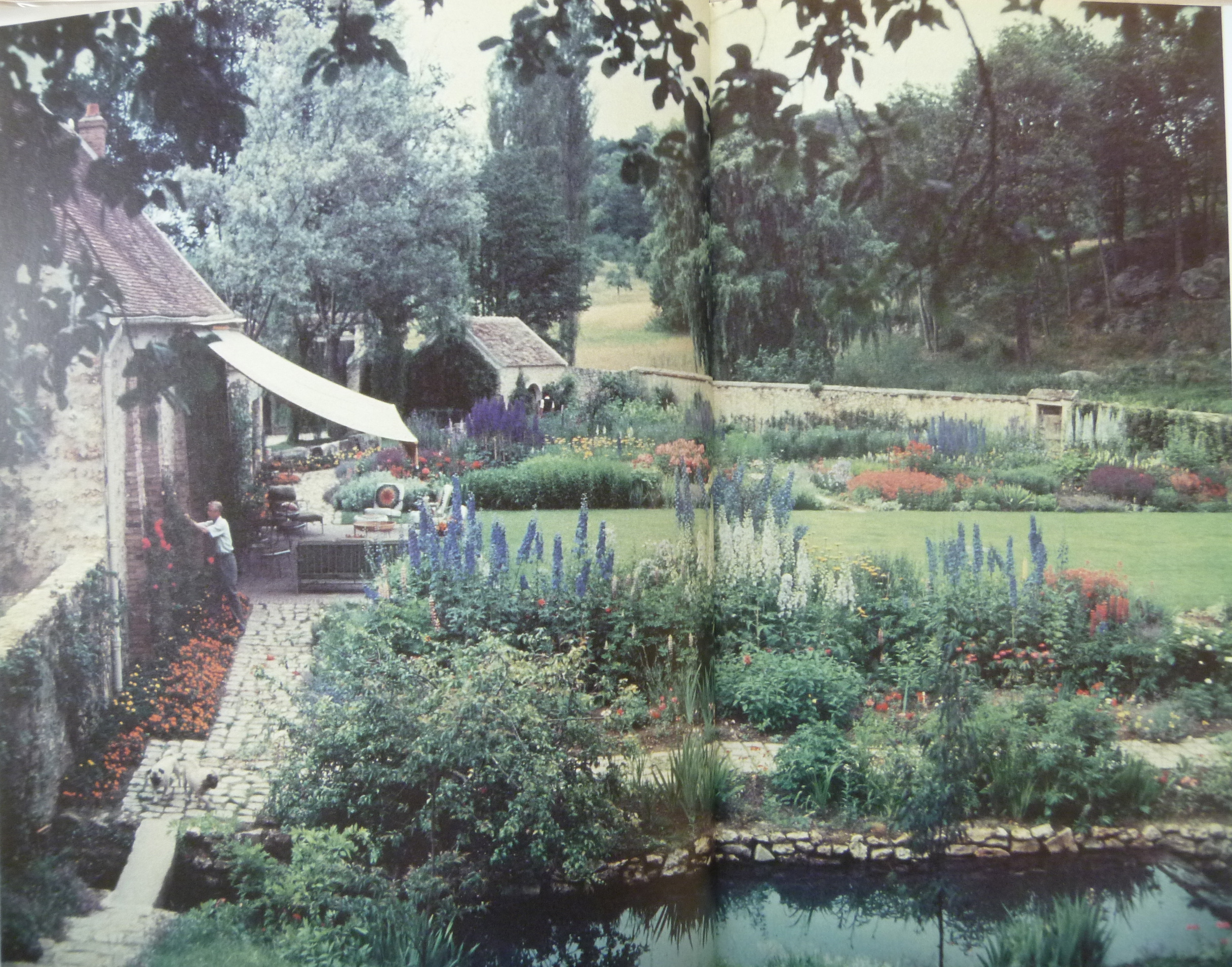
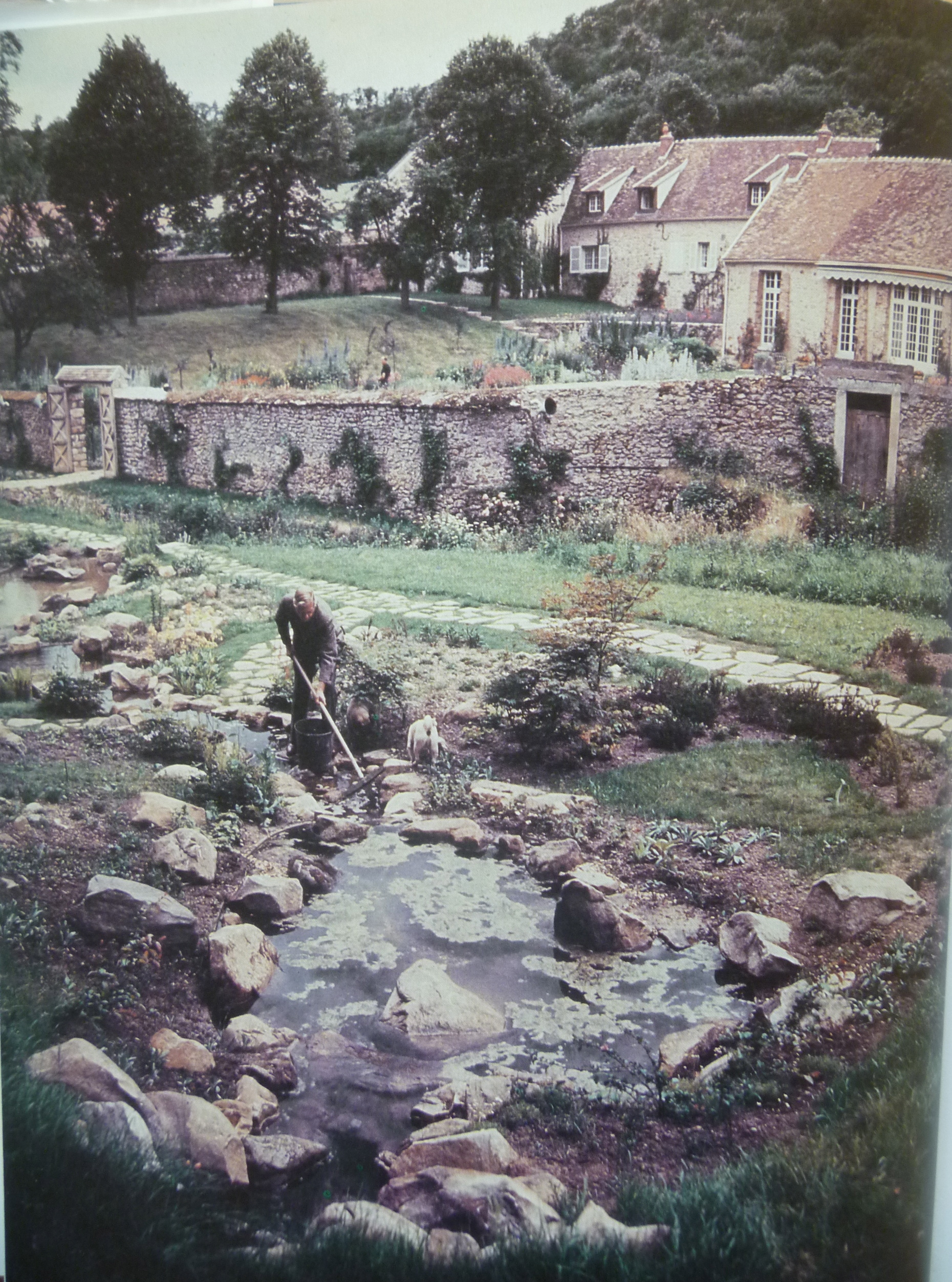
Looking at old pictures of the Mill I really do think that the Duke loved pottering in the garden. Russell Page, in his book, The Education of a Gardener makes several comments about the Duke’s choice of plants and about his keen interest in the garden in general.

Photo from The Windsor Style by Suzy Menkes.

The Garden at The Mill Today

“It was a lucky day for the Duke of Windsor, who loves stones as well as streams, when in his garden near Paris, he found the remains of an old quarry with enough stone to pave all the garden paths. We used them with fairly wide mortared joints in the enclosed garden, and spaced more widely and with grass between, in the wilder parts outside the garden walls.” (Russell Page – The Education of a Gardener)

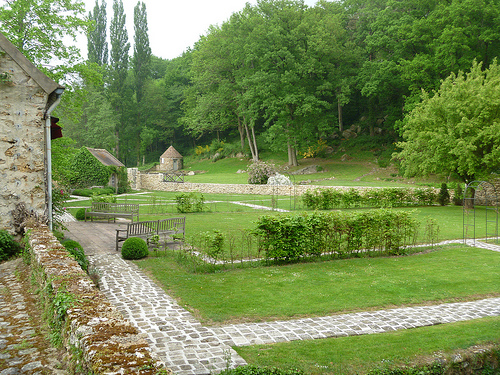
Both of my visits have been in May so very few flowers have been in bloom and the garden is generally tidier and less fussy than in the Windsor’s day.

The Grounds

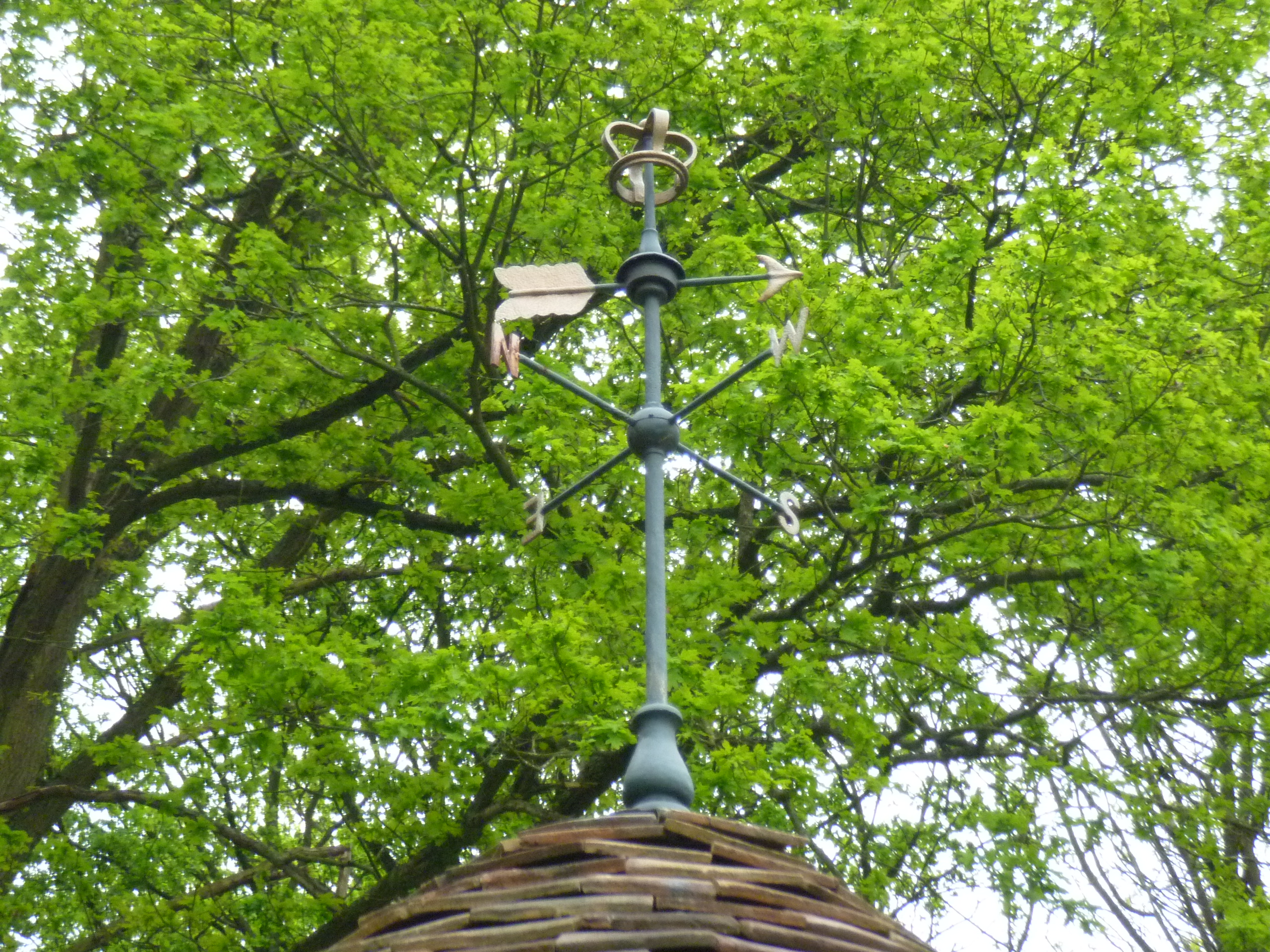
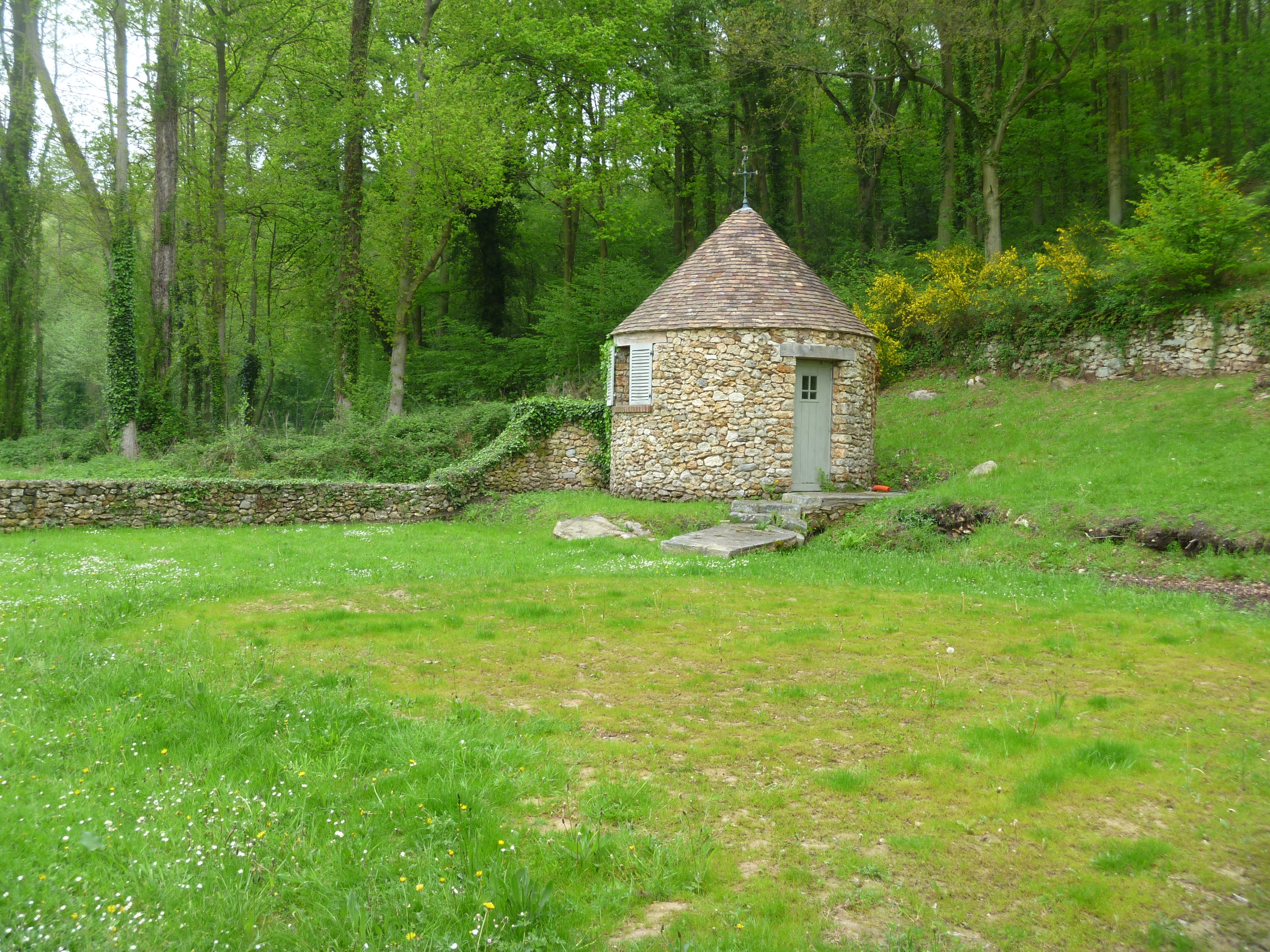
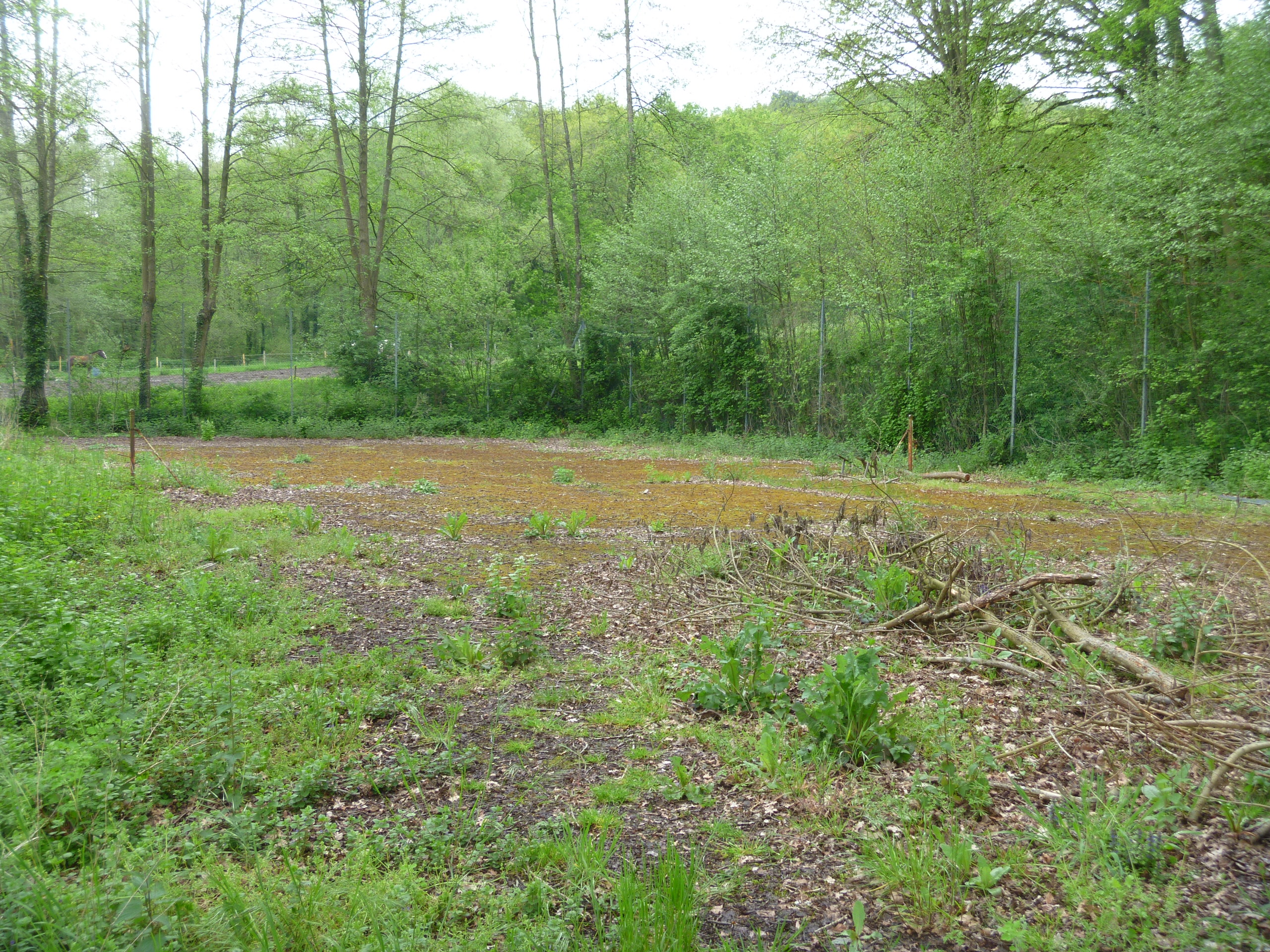
When the Duke and Duchess of Windsor lived here at the weekends and entertained their guests the grounds contained a swimming pool and a tennis court. Today these are overgrown and have all but disappeared. The pool was filled in but standing by it and still topped by a weather vane complete with coronet is a little round changing hut.
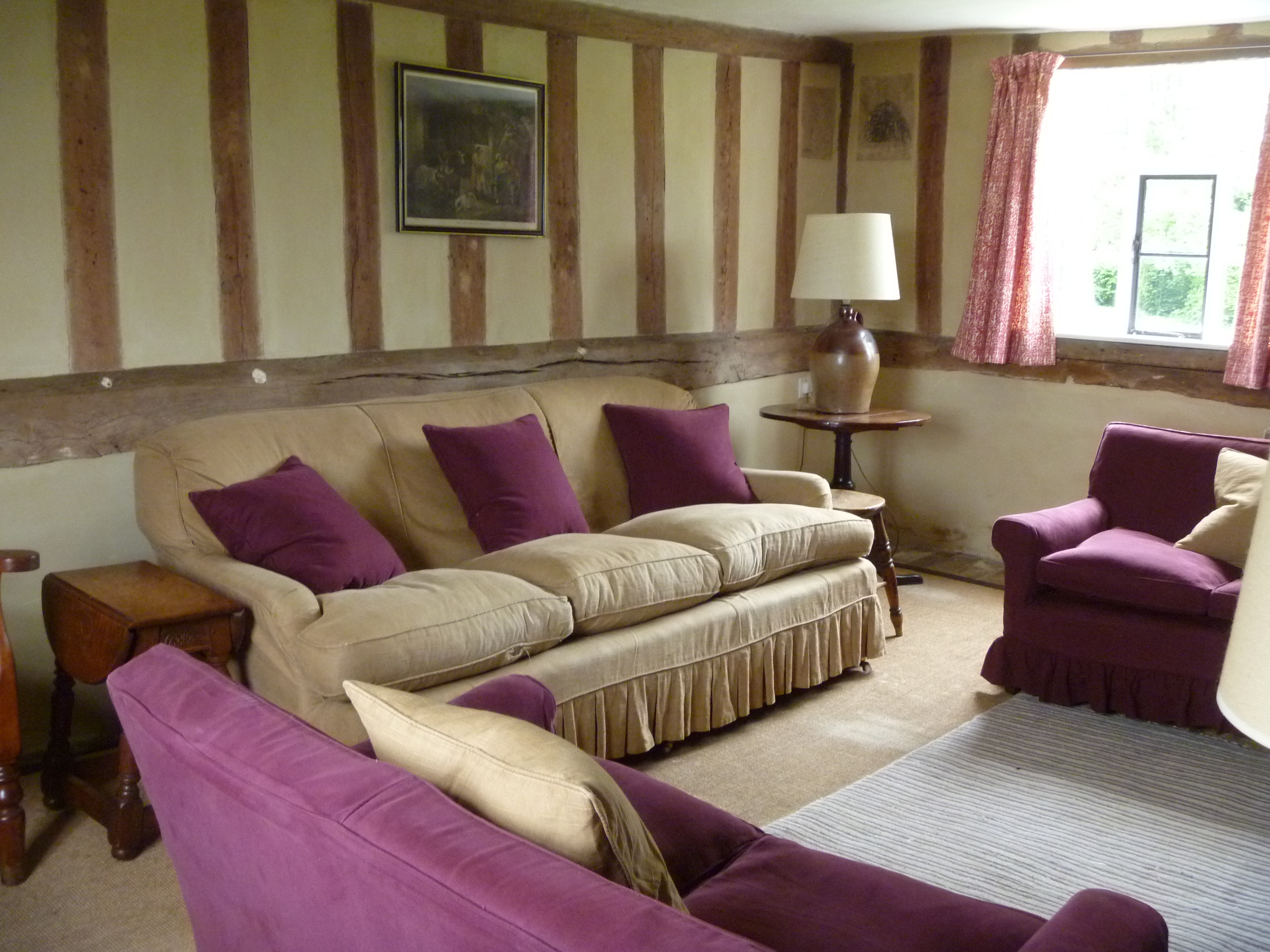
Photo from The Windsor Style by Suzy Menkes.
The garden at The Mill today

The tennis court today

The Pugs

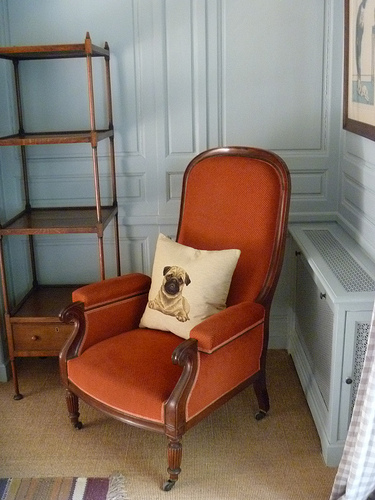
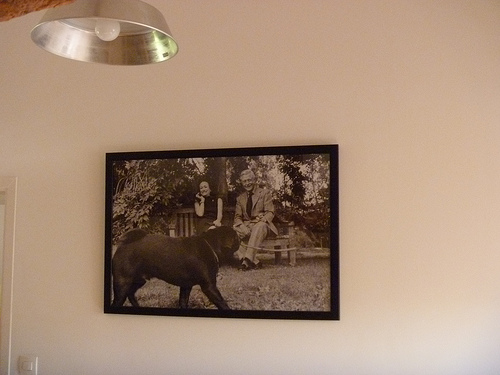
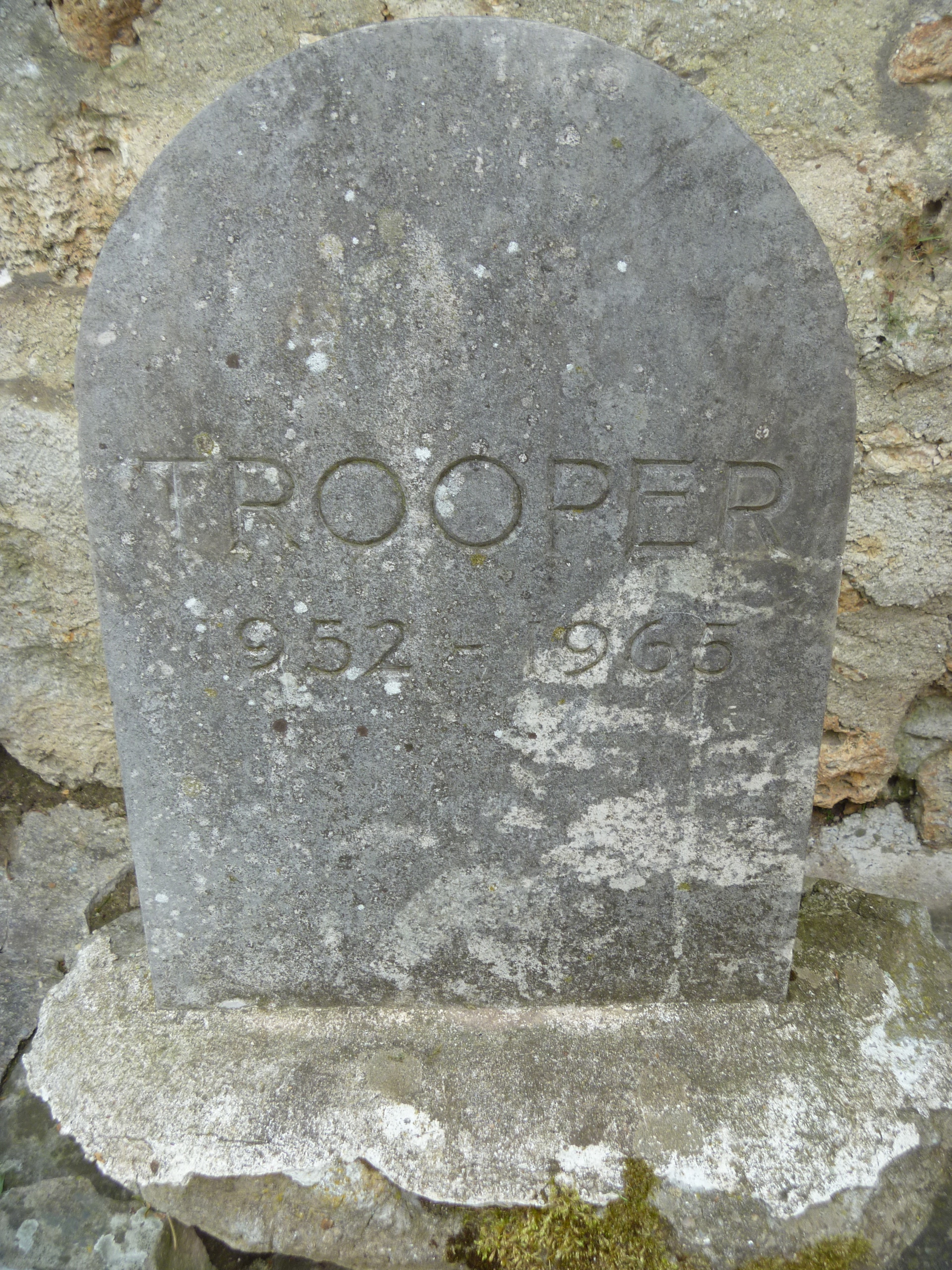
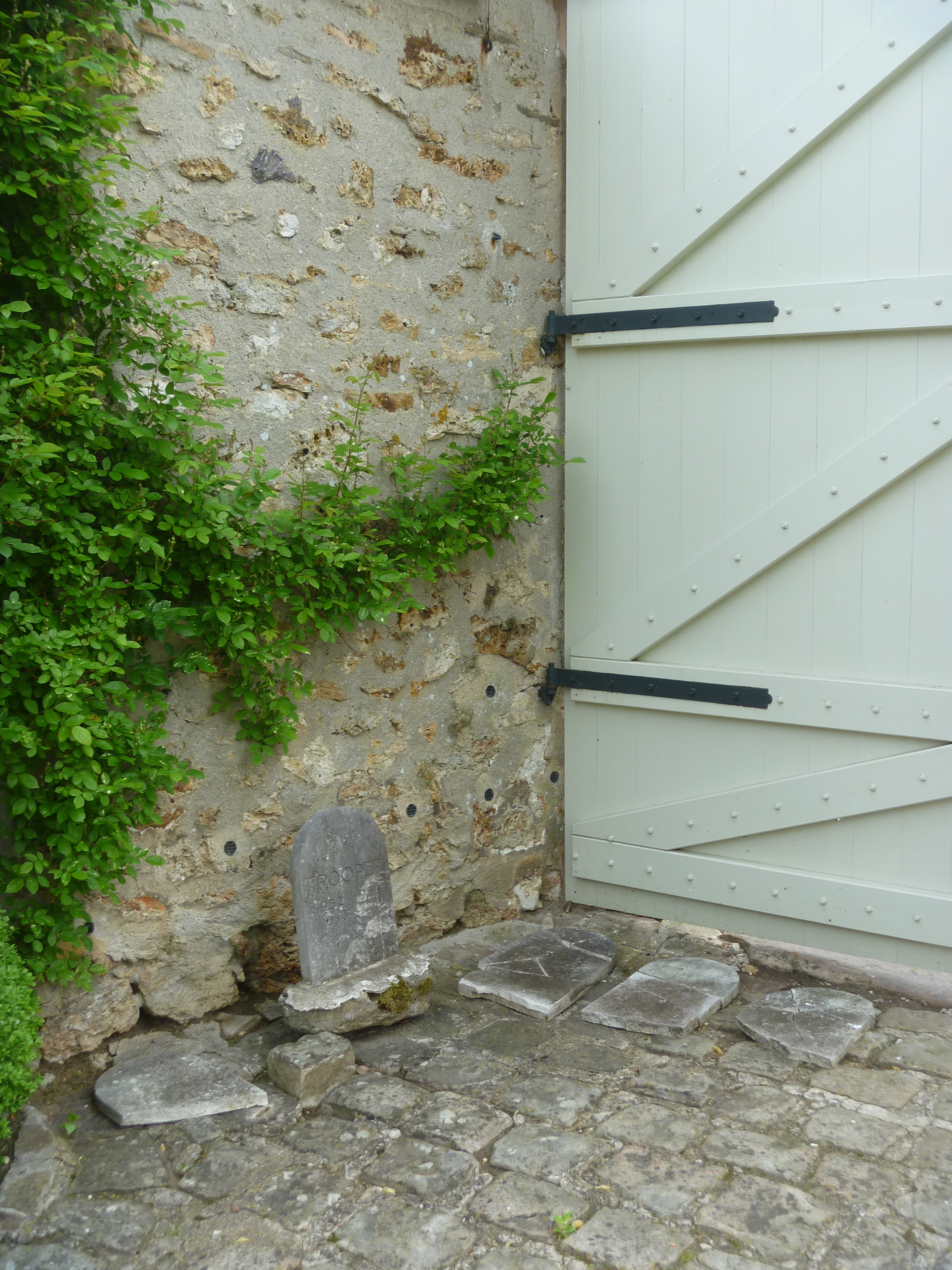
Evidence of the Duke and Duchess’s love for their pet pugs can be seen everywhere at The Mill. In the pictures hanging in each property, in the books in each library, on the cushions and by the fact that little individual tombstones were made for each pug that passed away and was buried in the Mill grounds.

The stones have been moved and now lie or stand near one of the garden gates.

 Trooper – 1952-1965 RIP

Pug Headstones

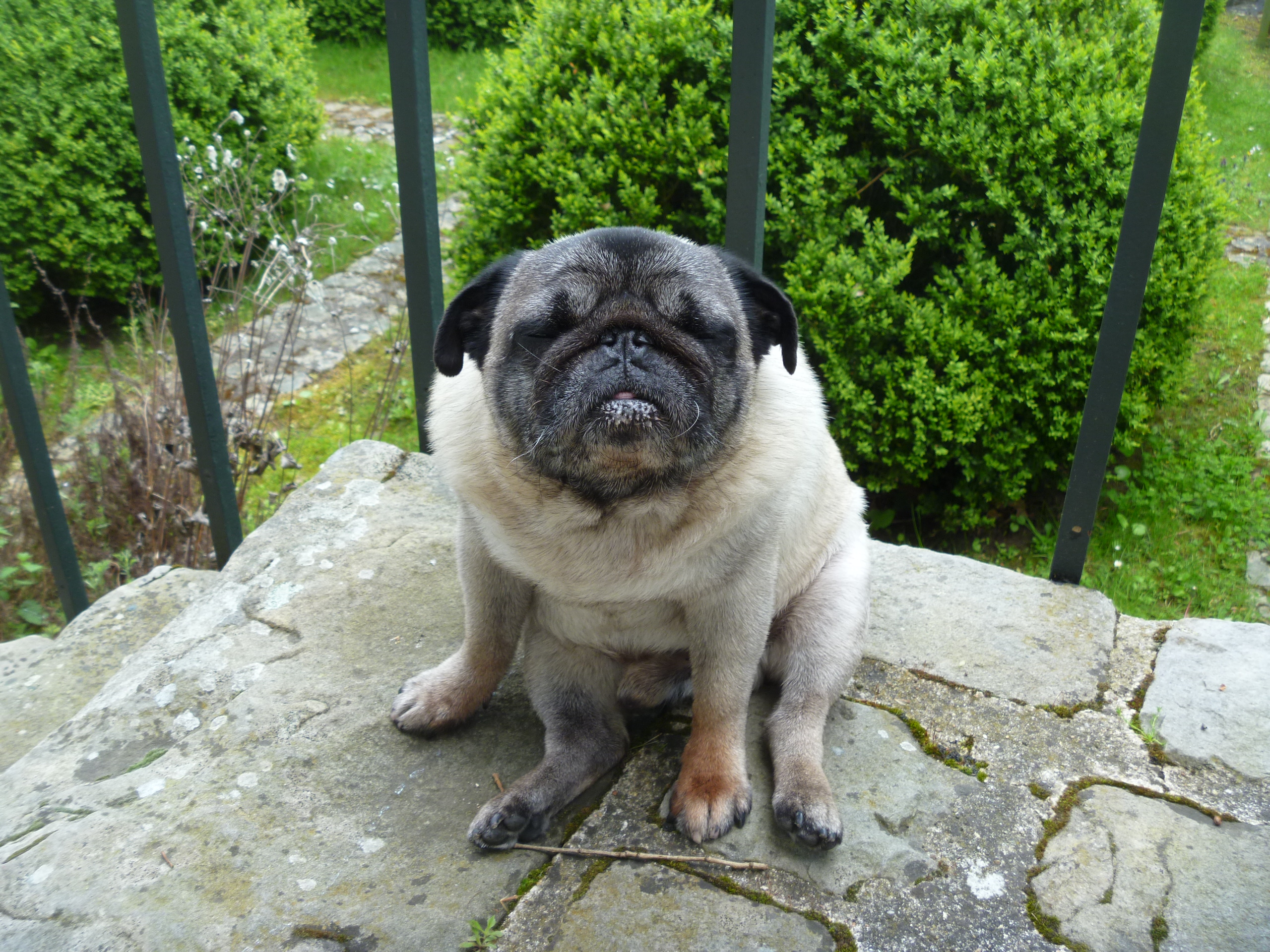
Of course, as our own contribution to try to bring Le Moulin back to its former glory we brought our very own pug Alfie to stay. He found that he had a taste for the Royal life and did not want to get back in the car to come home!