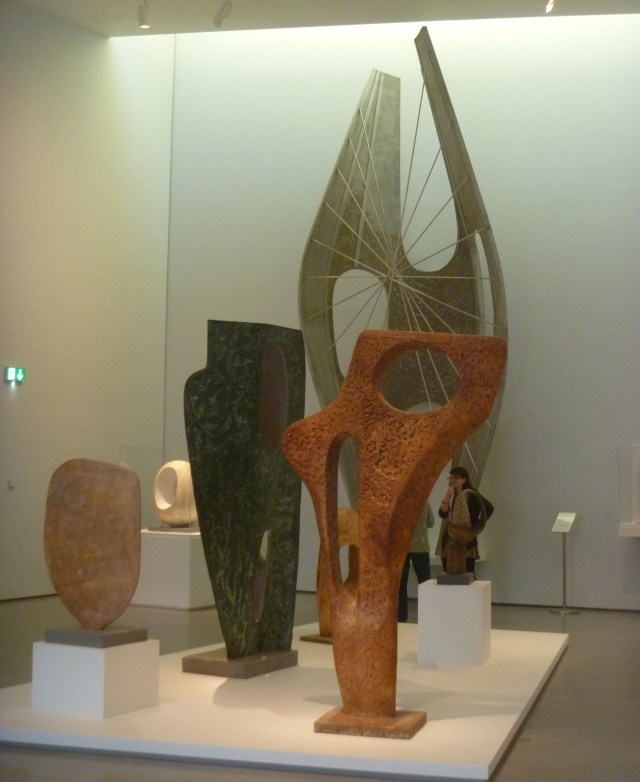
Matthew Darbyshire and The W.A. Ismay Collection at The Hepworth, Wakefield

Hepworth

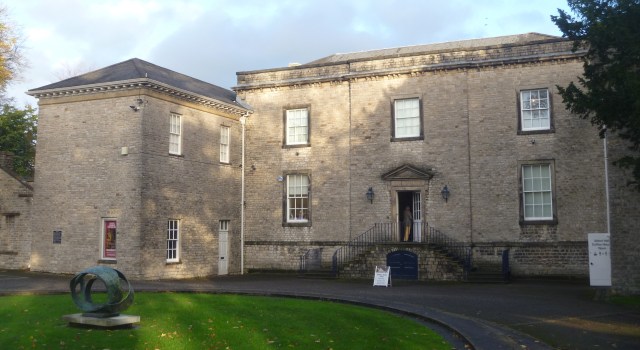
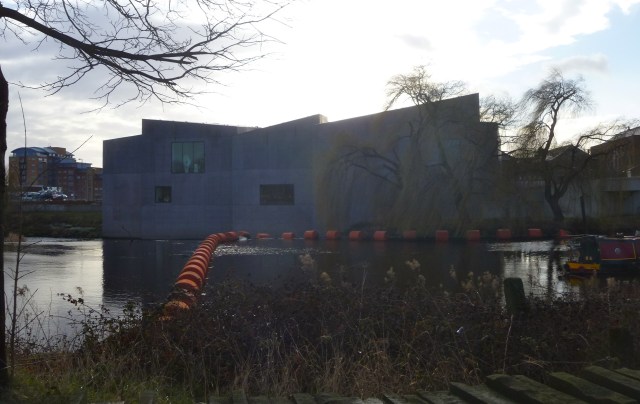
The Hepworth Gallery by the River Calder in Wakefield

On Thursday I revisited The Hepworth Gallery in Wakefield. I went back specifically to see the Matthew Darbyshire installation of pots juxtaposed with modern white goods in Gallery 10. Unfortunately this exhibition closes today but the pots, which belong to the York Art Gallery collection, will be back in a special new gallery to be created at York when the museum reopens in 2015.

With my new-found appreciation of studio pottery I was looking forward to seeing this exhibition. I was not disappointed.
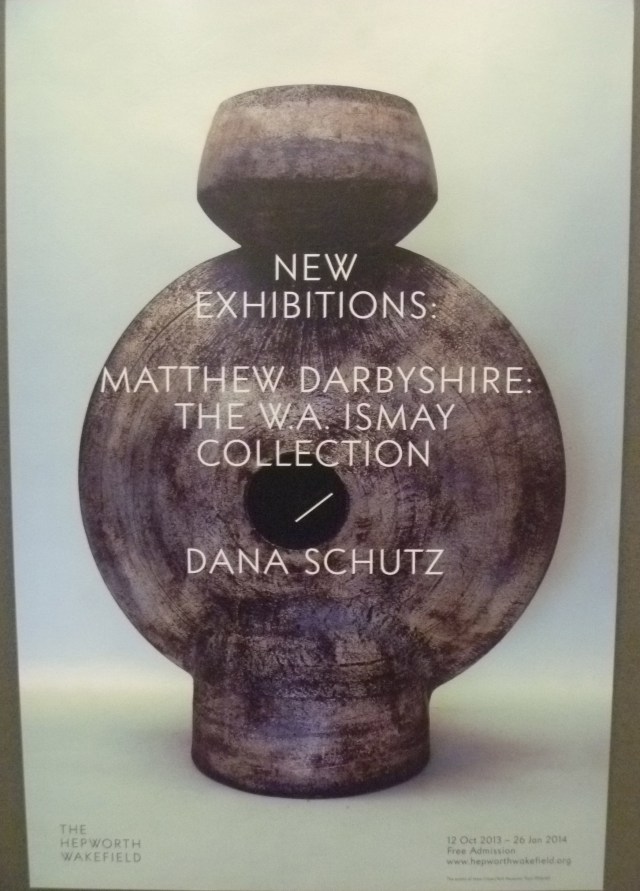
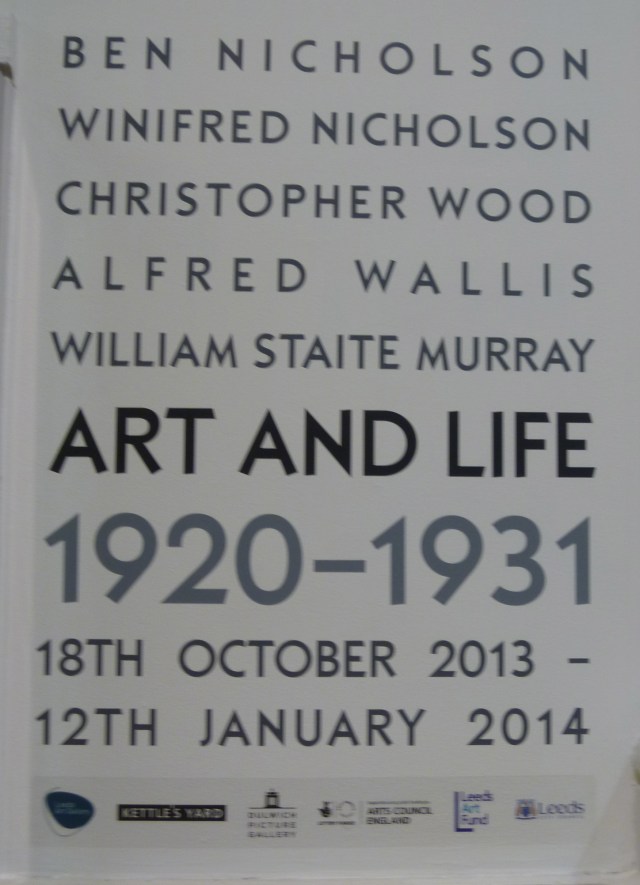
Hepworth poster

This fascinating project brings together one of Britain’s most exciting contemporary artists, Matthew Darbyshire, with one of the world’s most significant assemblages of post-war studio pottery, the W.A. Ismay Collection.
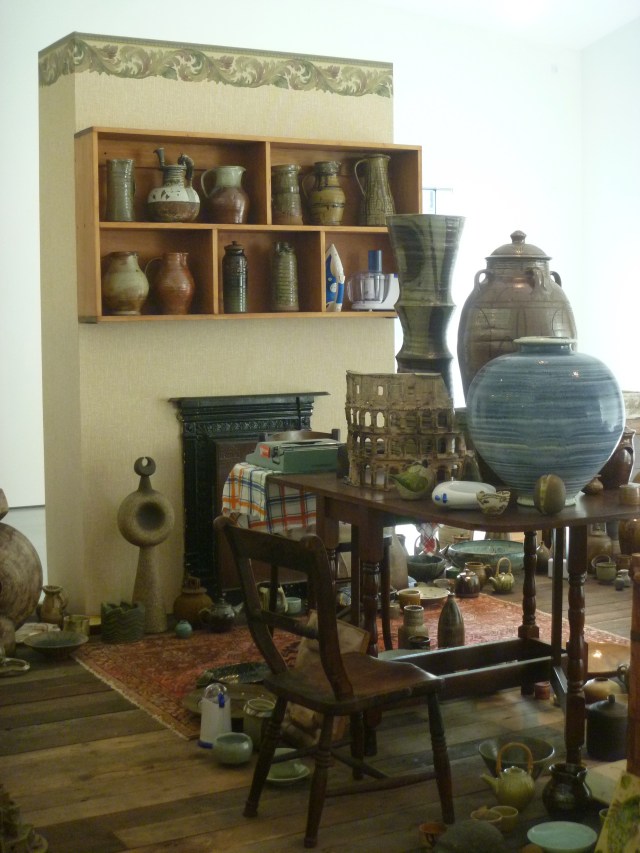
Ismay 2

Librarian and collector William Alfred Ismay (1910-2001) lived in Wakefield his whole life. From 1955 he began to collect pieces by some of the most renowned makers of studio pottery from Hans Coper and Shoji Hamada to works by local Yorkshire potters, Barbara Cass and Joan Hotchin, alongside lesser known ceramicists.

His extraordinary collection of 3,600 items, by 500 makers, covered all the available surfaces of his small terraced house in Wakefield. This extraordinary collection offers an insight into the compulsive and systematic habits and protocols of a unique and unusual collector.” [Introduction from The Hepworth website]
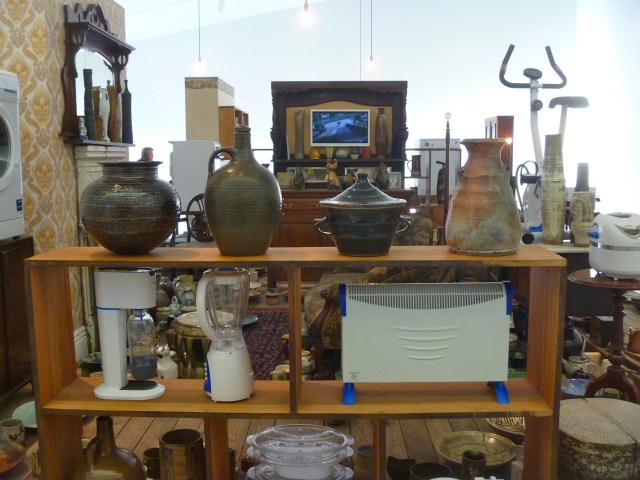
Ismay and TV

Contemporary installation artist Matthew Darbyshire assembled the display based on the floor plan and the furniture or kind of furniture that Ismay would have owned in his Wakefield terraced home; he added modern streamlined household white goods as a contrast to the handmade ceramics and he used just 700 of the total of 3,600 pots from Ismay’s collection. In addition a flat screen TV shows a loop of original motion picture clips that Darbyshire has put together on the themes of man and machines and dance including hip-hop and other natural human movement contrasting the manmade with machines and technology.

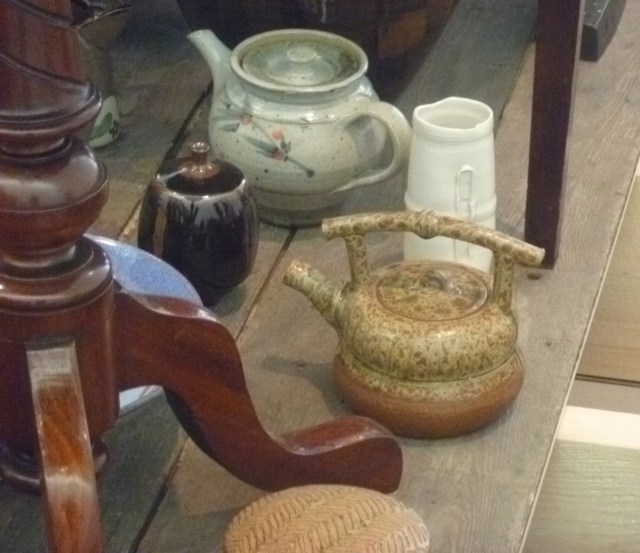
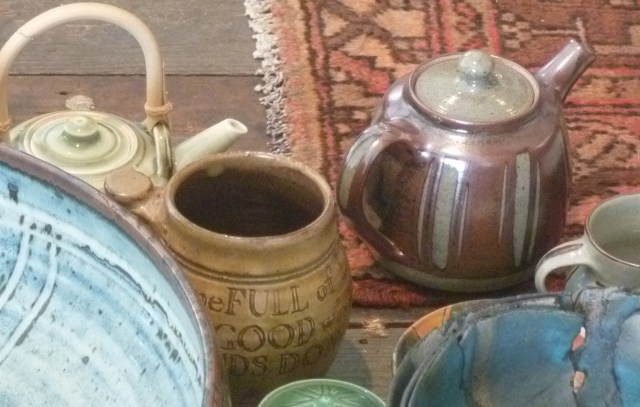
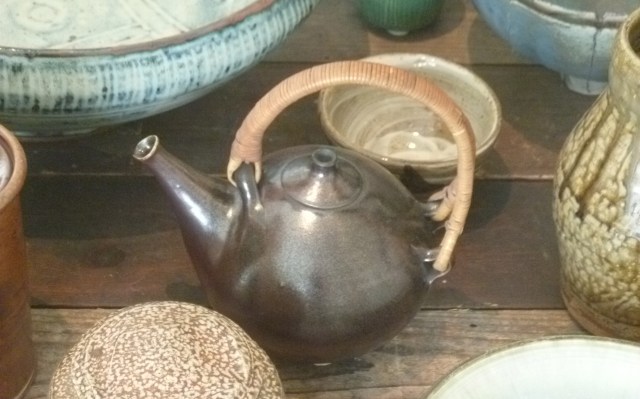
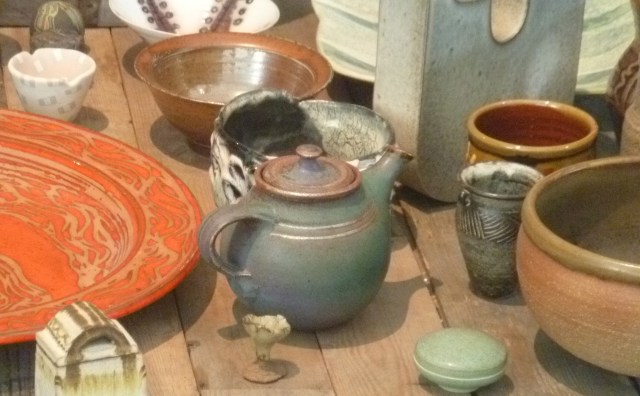
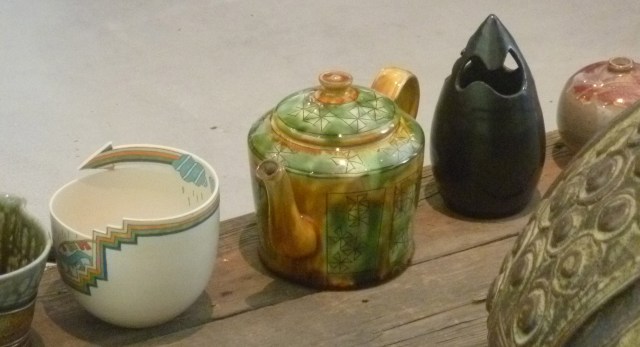
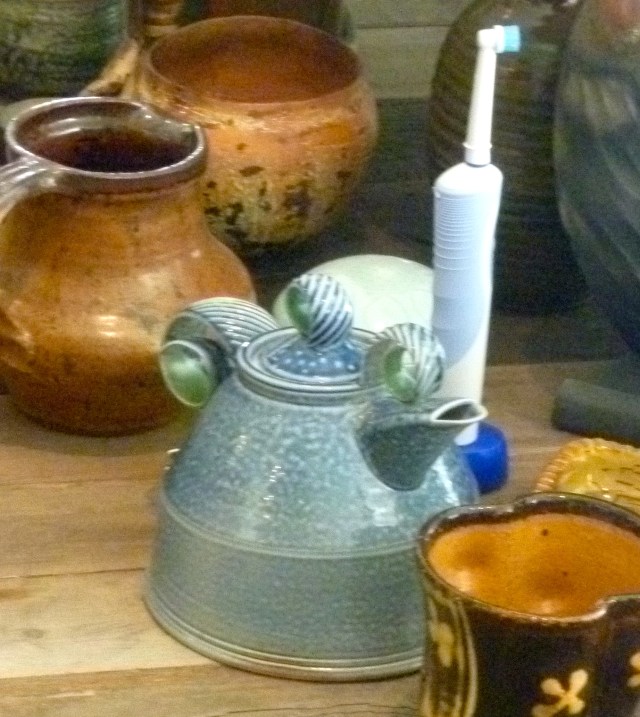
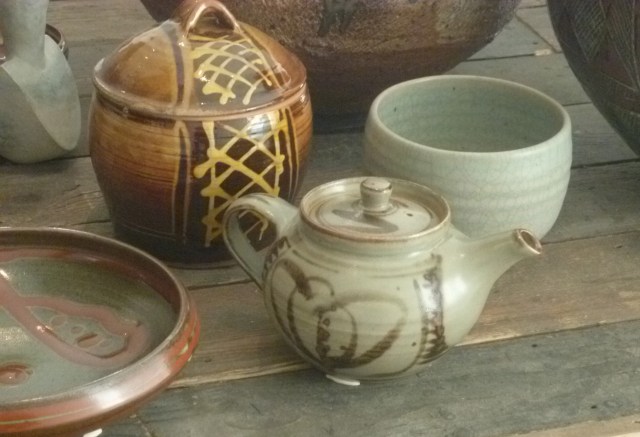
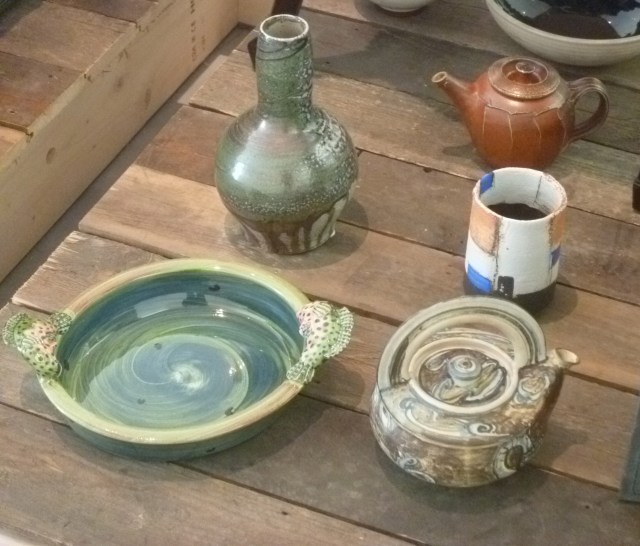
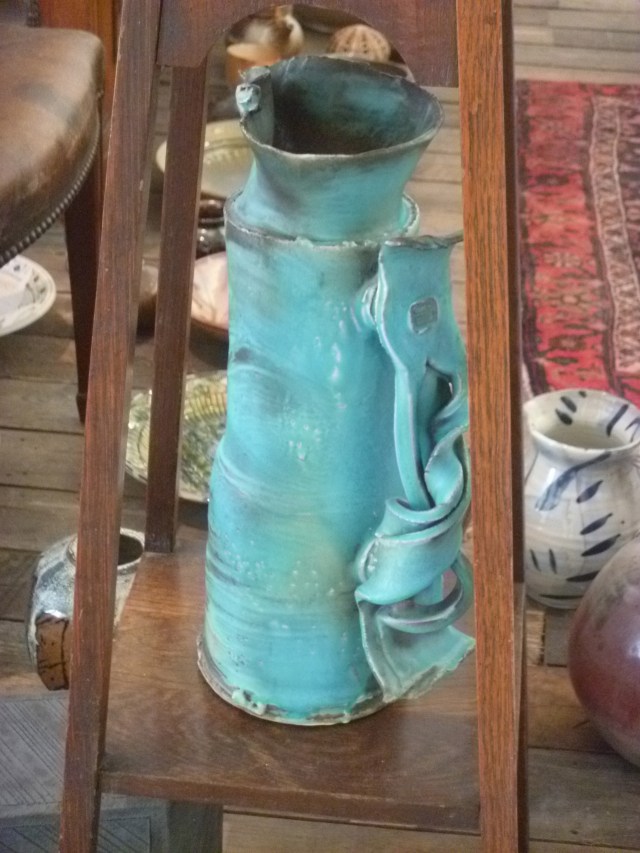
And here is my selection of pots (mostly teapots) :
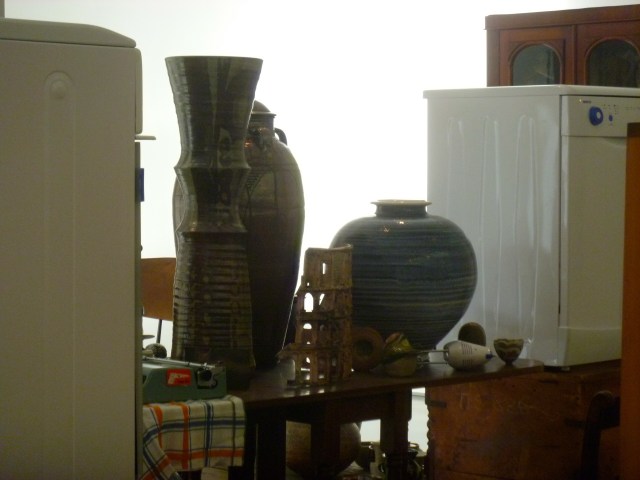
With Coloseum

Includes a Roman Colosseum ‘pot’
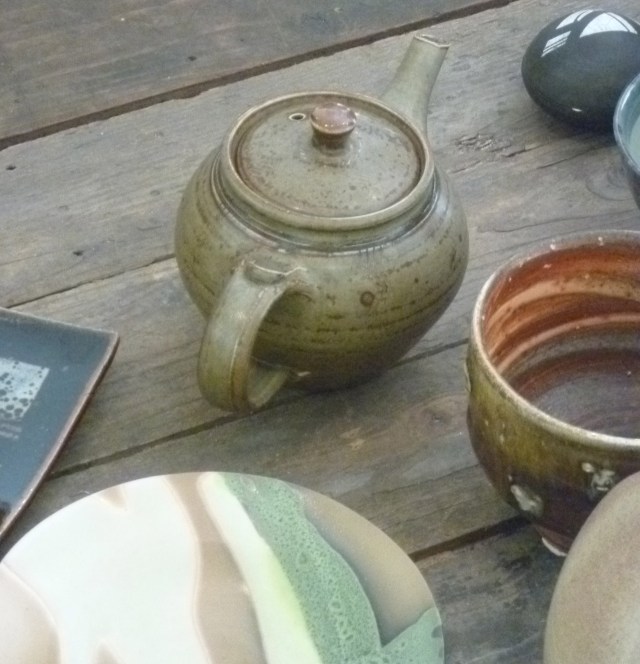
Teapots 1

Teapots 2

Teapots 3

Teapots 4

Teapots 5

Teapots 6

Teapots 7

Teapots 8

Teapots 9

Nice pot

Viewing the pots made you really want to pick them up so luckily there was a small selection of pots that you were allowed to feel and examine and another TV loop of potters talking about their first meetings with Bill Ismay.
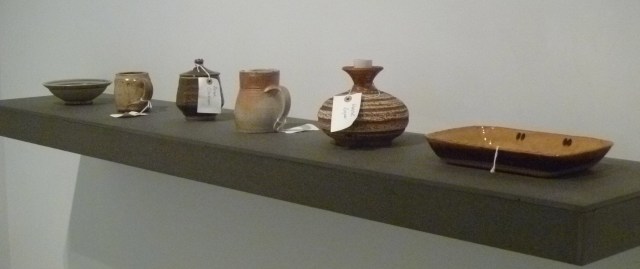
Examples

You may pick up these pots

See how Matthew Darbyshire put it all together here :

And here is Down By The Dougie’s view of “Lots of Pots” and more photos.
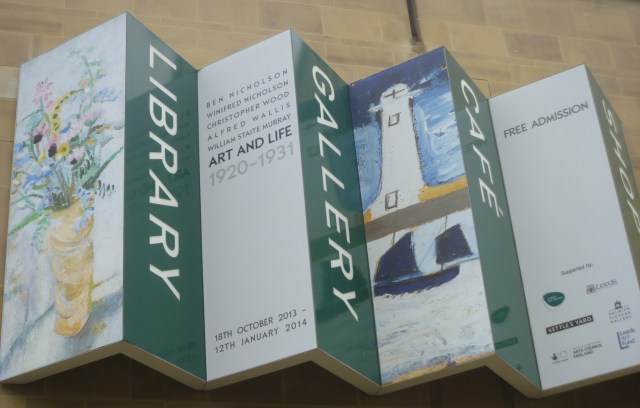
Art and Life 1920-1931: Studio Pottery

Until yesterday I thought a pot was a pot. What a difference a knowledgable speaker makes to the appreciation of art! In this case I’m talking about studio pottery and the pots on display at the Art and Life, 1920-1931 exhibition currently showing at Leeds City Art Gallery (but only until Sunday 12 January). The exhibition will then head down to Kettles Yard in Cambridge and thence to The Dulwich Picture Gallery in south London.

Art and Life 1

On some Thursdays throughout the year Leeds Art Gallery presents 30 minute free lunchtime talks. Yesterday the lunchtime talk was extended to 50 minutes and the visiting speaker, Dinah Winch from Gallery Oldham, told our small assembled group about the pots displayed in Art and Life. They were all made by William Staite Murray.

Art and Life 2

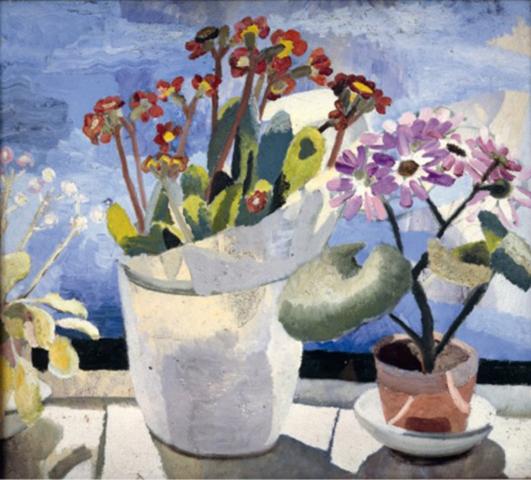
These pots, which I would have given barely a glance to before, I now look at quite differently. A stripey vase and a rough brown dish became works of art before my very eyes. The pots matched with the paintings and many appear in Winifred Nicholson’s paintings demonstrating the ideal light in which to view them – natural sunlight through the window – not the artificial light from above the glass cases in the gallery.

Polyanthus and Cineraria

Nicholson’s Polyanthus and Cineraria [source]

The stripey vase entitled The Bather was very tall and striking. Photography was not allowed and I have been unable to find a suitable picture to reproduce here. Most of the pots (including The Bather) came from York City Art Gallery (which is undergoing a big refurbishment over the next couple of years) and a couple from Kettles Yard. I visited Kettles Yard in 2011. It is a lovely homely gallery full of art and craft of the Art and Life era.

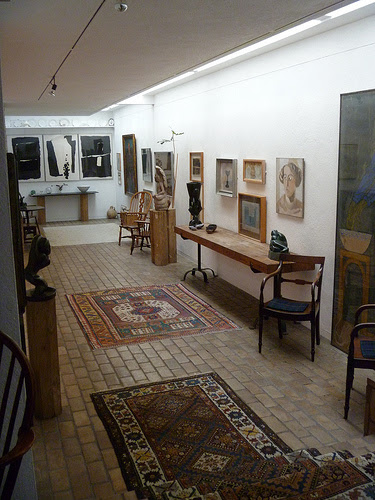
In Kettles Yard

Inside Kettles Yard (Ben Nicholson’s Bertha (No.2) on the right)

Here is what the Exhibition Guide says about Murray and his pots :

William Staite Murray was one of the leading artists of his time. Murray eschewed any functionality for pots and viewed pottery as a fundamental abstract art lying between painting and sculpture. Inspired by the Chinese Sung dynasty pots that had begun to appear in London, his pots are emotionally expressive with imaginative titles, all of which appealed to the Nicholsons with whom he was friends and exhibited widely. Ben Nicholson keenly distributed pictures by Alfred Wallis amongst his friends, and sent one to Murray, noting that it reminded him of one of Murray’s pots. We can only muse as to the exact link as it is not known which picture by Wallis Ben sent. Winifred gives us an idea for she wrote of one of Murray’s pots as having “the elemental depth of the sea.” When Ben Nicholson saw Murray’s solo exhibition at the Lefevre Gallery in London in 1931 he wrote “one big brown pot is one of the finest things I have ever seen.” Persian Garden was exhibited in the Lefevre exhibition, and widely seen as one of Murray’s masterpieces, it is probable this was the pot referred to by Nicholson. By the late 1920s remarkably Murray had a higher reputation than the Nicholsons. Arguably as good a potter as Bernard Leach, subsequently Murray’s reputation has suffered, perhaps partly because in 1939 he left England and with the outbreak of war settled abroad. Sadly he did not pot again.

I hope this brief introduction and excellent lecture will set me up for my visit later this month to the Matthew Darbyshire installation using the pottery collection of W.A.Ismay at The Hepworth in Wakefield.

Other bloggers have written about this wonderful exhibition here and here.

Masterpieces : A Wealth of Art in East Anglia

There is a marvellous exhibition currently showing at The Sainsbury Centre for Visual Arts at the University of East Anglia in Norwich.

A new exhibition, Masterpieces: Art and East Anglia is opening at the Sainsbury Centre for Visual Arts in September, in celebration of the rich and unique artistic heritage of the local region. Approximately 250 objects will be on show, from across the visual arts, ranging from the prehistoric period to the present day. Drawn from more than 60 major public and private collections, the exhibition will showcase the array of masterworks that East Anglia has inspired, produced and collected, and demonstrate the region’s importance in both a national and international context.

The oldest exhibit, the Happisburgh flint handaxe, crafted at least 700,000 years ago, will sit beside works by John Sell Cotman, John Constable, Thomas Gainsborough and Olive Edis. Sculptures by Barbara Hepworth will be dispersed throughout the SCVA’s newly-refurbished galleries and the iconic Lotus 72 sports car will take up pole position in the West End.

Masterpieces: Art and East Anglia will be the first show on display in the SCVA’s newly-refurbished galleries. The exhibition coincides with the University’s 50th Anniversary and will help to mark the significant contribution that UEA has made to the region.” [Source]

I was lucky enough to catch this show when I was down in Norwich a few weeks ago visiting family. The Exhibition comprises part of the 50th anniversary celebrations for the University of East Anglia, in Norwich. Oh dear, I can remember when it opened in one of my favourite parks (Earlham Park) and some of its offices occupied Earlham Hall (the childhood home of prison reformer Elizabeth Fry) …

E Fry

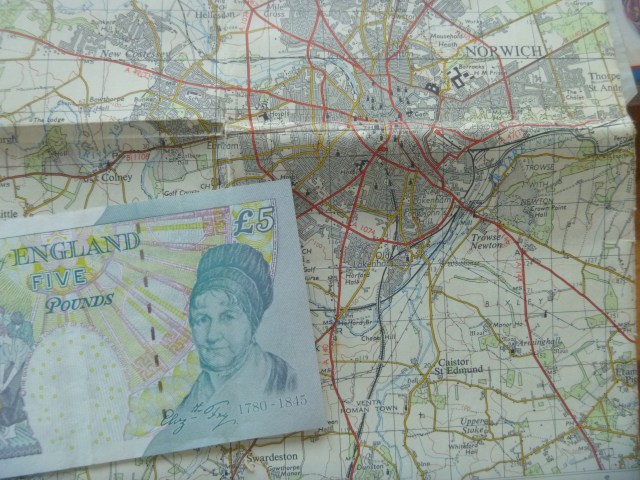
My Norwich OS map and Elizabeth Fry on the five pound note

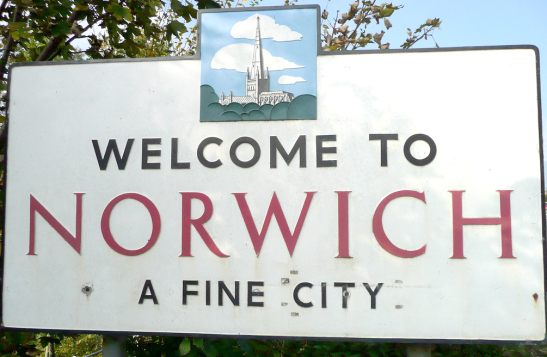
… and the neo-brutalist buildings were seen as an insult to our ‘Fine City’

norwich

[Source]

But I digress and return to the excellent exhibition which has the best opening times, ever. Although closed on Mondays and between 22nd December this year and 2nd January 2014 it’s open Tuesday to Saturday 10am – 8pm and on Sundays from 10am until 5pm. We made our visit on a Saturday at 5.30pm. We were able to park right outside and had the whole gallery to ourselves. With our Art Fund cards we paid half price for entry.

No photography is allowed in the main lower gallery but four large exhibits are displayed alongside the Sainsbury Centre for the Visual Arts permanent collection. A Lotus racing car is displayed in the restaurant but that was closed and too dark to photograph.

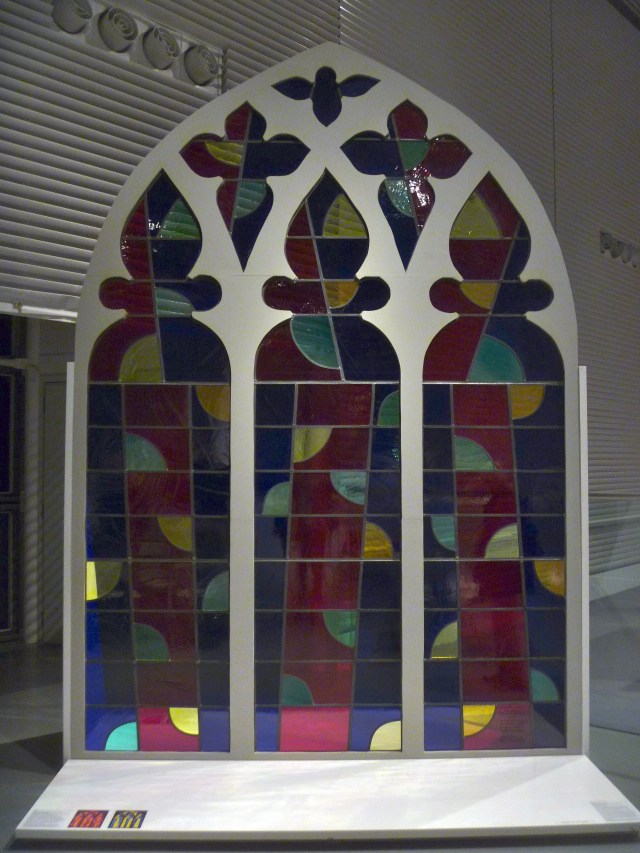
Conservatory Stained Glass

In the Conservatory Cafe is a 2013 stained glass window designed for Norwich Cathedral by John McLean

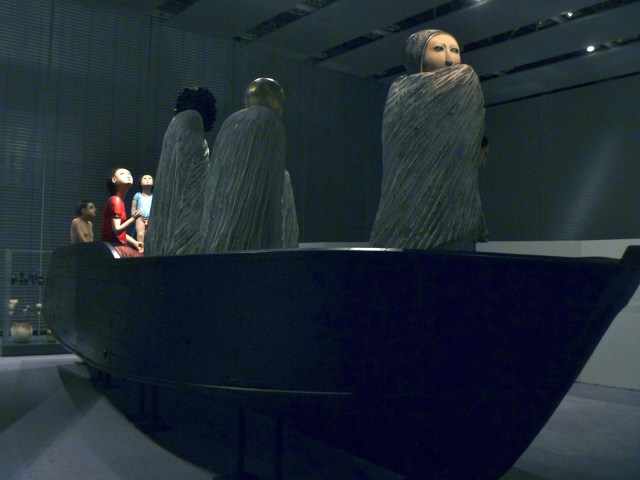
Longest Journey 1

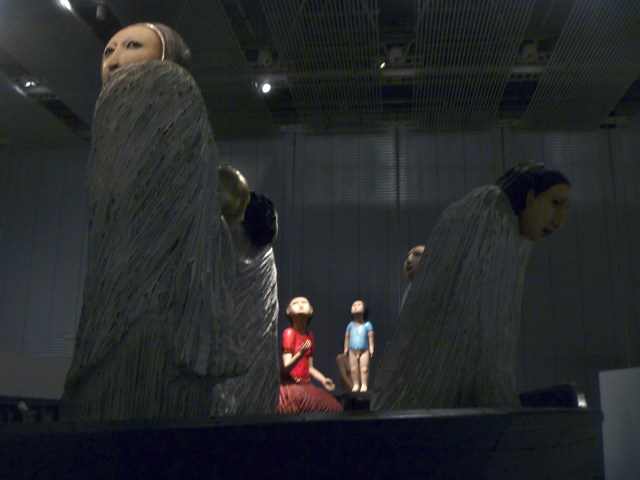
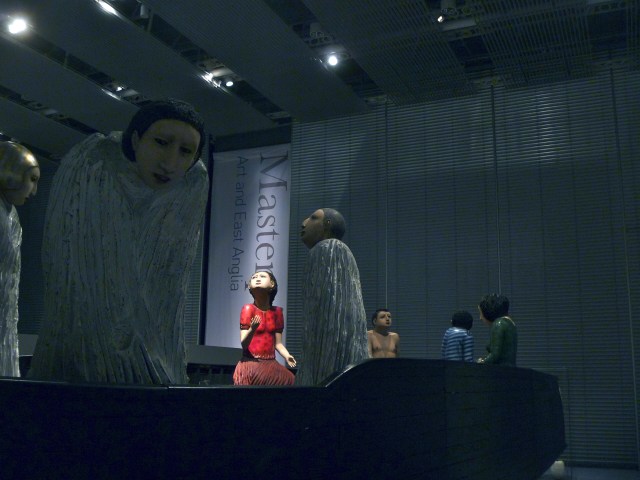
In the East End Gallery is ‘The Longest Journey’  made by Ana Maria Pacheco in 1994 of polychromed wood

Longest Journey 2

Longest Journey 3

More ‘Longest Journey’ pictures

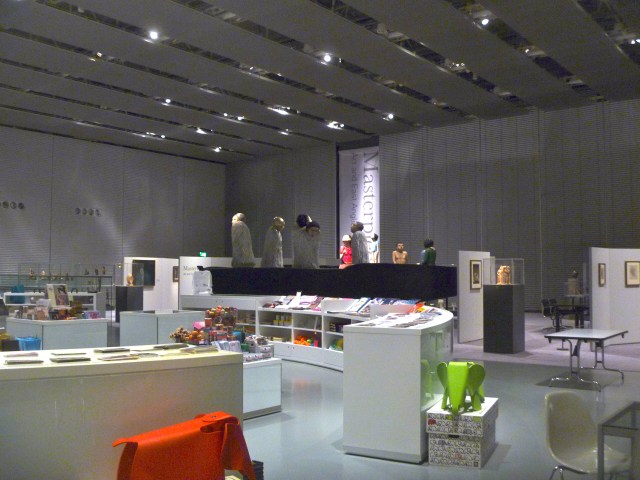
Reception, shop and Longest journey

East End Gallery, shop and ‘The Longest Journey’

8b._scva_masterpieces_-_worth_dress

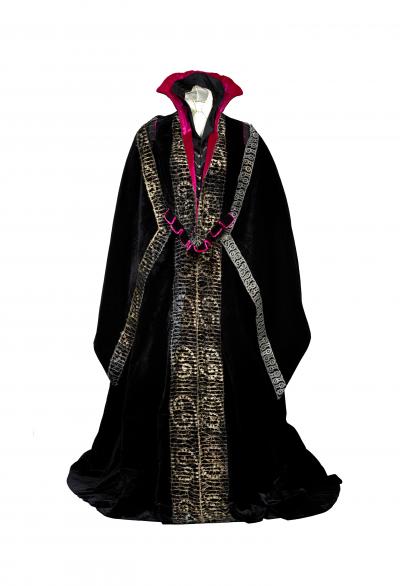
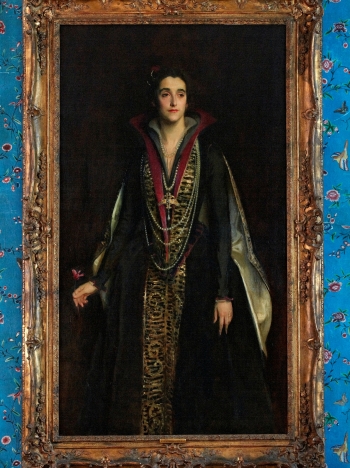
Here is an example from the displays. The Marchioness of Cholmondeley’s gown [photo source] made by Jean-Charles Worth stands next to her portrait painted by  John Singer Sargent and wearing the gown borrowed from Houghton Hall.

John_Singer_Sargent_(1856-1925),_Portrait_of_the_Marchioness_of_Cholmondeley,_1922_350_468_s_c1_smart_scale

Sargent’s portrait of the Marchioness of Cholmondeley [source]

Norfolk has been full of Masterpieces this year!

Debby Mason : Marine Life Etchings in Devon

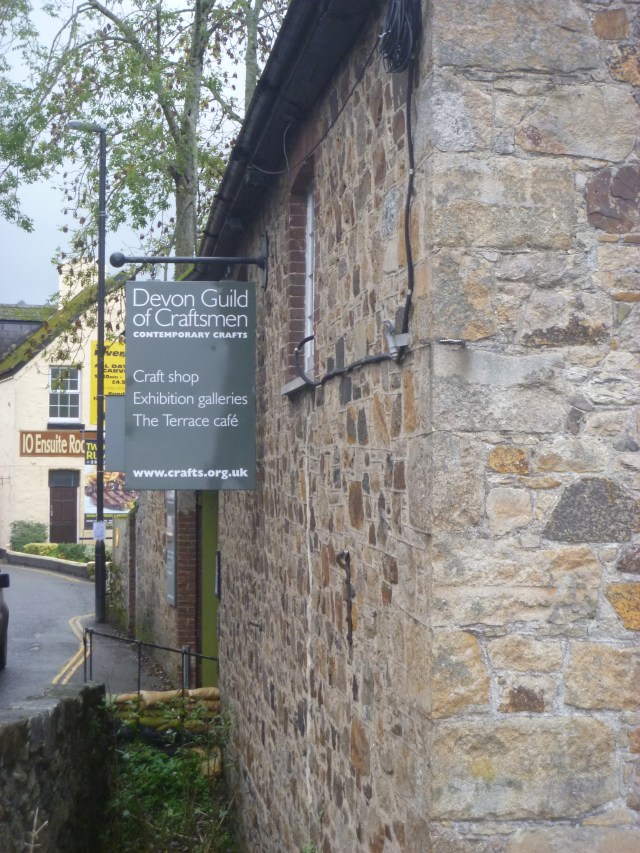
Every year, around this time, we visit Devon for a week. Whilst there we never fail to fit in a visit to some galleries and one of our regular haunts is The Devon Guild of Craftsmen in Bovey Tracey.

devon guild

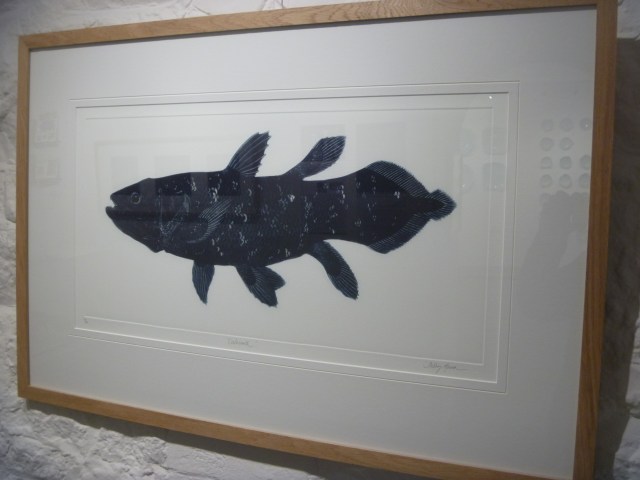
This year my favourite display was a small, one-room exhibition of Debby Mason‘s work. Her exhibition features just a few fantastically intricate fossil fish mezzotints. I also enjoyed the interesting assortment of additional information and artefacts.

Coelacanth

Debby’s Coelacanth Mezzotint

Visit our Members showcase gallery and follow the story of the elusive fossil fish told through Debby’s beautiful mezzotints. The Coelacanth has become a very familiar and favourite subject for Debby’s work. This showcase concentrates on this fascination and gives visitors an insight into the artist’s journey – from idea to final piece.

There was a digital slideshow demonstrating the sequence of production of a mezzotint and the many inspirations that lead Debby into her chosen field of artwork.

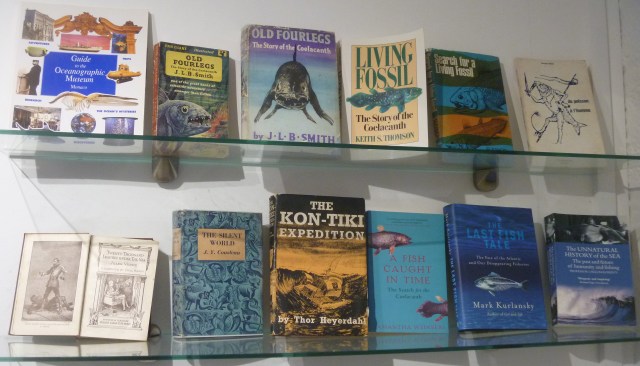
In addition there were two shelves of influential books; some related to her earliest interests like Thor Heyerdahl’s Kon-Tiki expedition, the underwater world of Jacques Cousteau and a visit to the Oceanographic Museum in Monaco :

Books

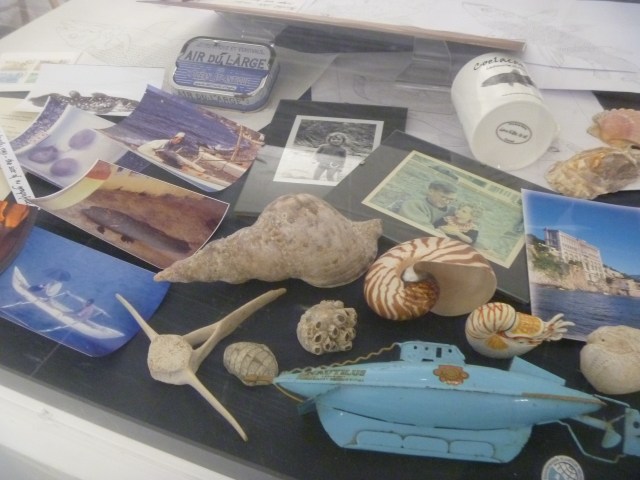
There was also a display case of photos, shells, flotsam and jetsam.

Photos and Flotsam

I suppose also the idea of the Coelacanth intrigued me and reminded me of trips to Lyme Regis to visit the Museum and  to try my luck at fossil-hunting.

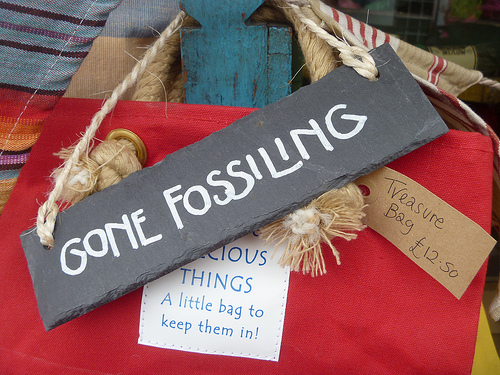
Gone Fossiling

In 1938 a live Coelacanth was caught off the coast of South Africa. This caused a sensation because it was thought that these fish had died out 85 million years ago.” [Devon Guild poster]

Debby’s show is on at the Bovey Tracey Gallery until 2nd December.

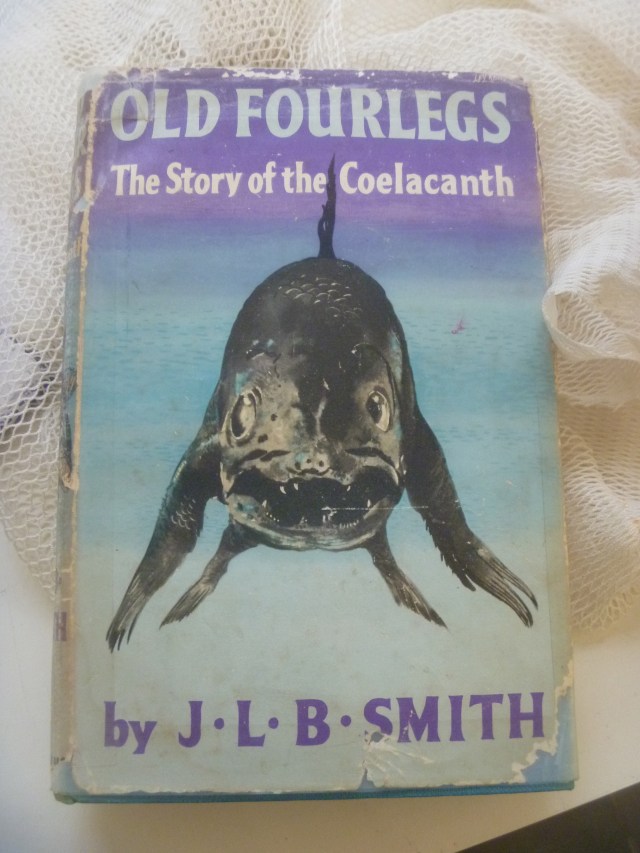
Old Fourlegs

Old Fourlegs by J. L. B. Smith

Bloomsbury and Beyond : The Radev Collection in Cumbria

Abbot Hall Gallery

The Abbot Hall Gallery, Kendal

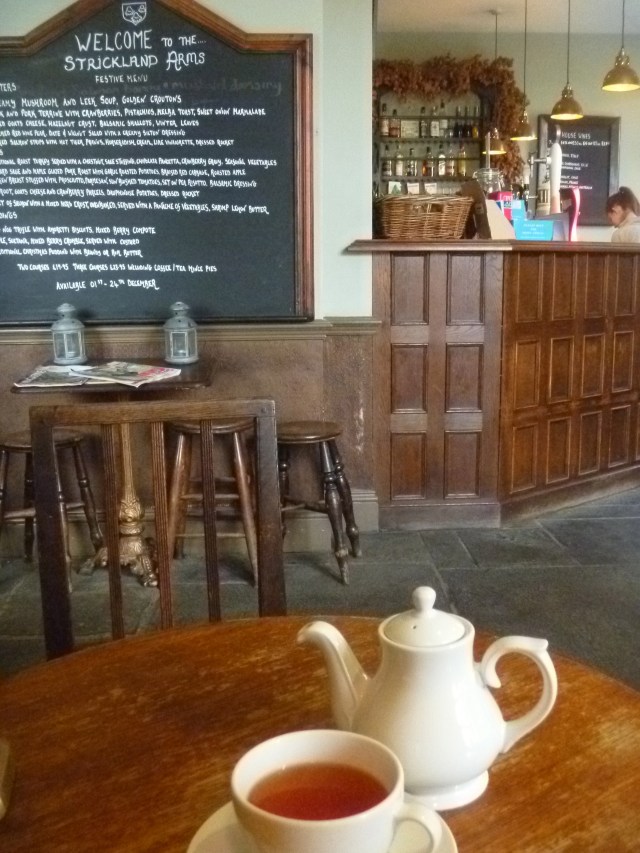
Today I went on a Yorkshire Branch of The Art Fund trip over to Cumbria. Our main intention was to view The Radev Collection at Kendal’s Abbot Hall Art Gallery. We travelled to Kendal by coach from Leeds picking up in Ilkley and Gargrave on the way. The first stop was for lunch at the Strickland Arms just by the gates to Sizergh Castle. We arrived way ahead of schedule so some members went to view the exterior of the Castle (it doesn’t open until 1pm) but I remembered the nearby Low Sizergh Farm Shop and took my companion for a brisk walk and some retail therapy in the well-stocked deli.

At Low Sizergh Farm Shop

Welcome to The Farm Shop

After the soup and sandwich lunch we headed off for nearby Abbot Hall where the curator was ready and waiting to tell us about the Radev Collection and point out some of the highlights.

Inside Strickland Arms

Inside The Strickland Arms

The Radev Collection

The collection takes it name from Mattei Radev, a native of Bulagria who arrived in Britain in the 1950s as a stowaway on a cargo ship after fleeing from communism.

Radev went on to build a new life in England, becoming a leading picture framer for the London Galleries and mixing in the influential Bloomsbury circle which included writers, philosophers and artists, such as Virginia Woolf and E. M. Forster.

He inherited most of the works from his friend the artist-dealer Eardley Knollys, who had in turn inherited them from music critic Eddy Sackville-West, following his death in 1965.

The impressive collection includes works by an array of notable artists including Duncan Grant, Alfred Wallis, Ivon Hitchens, Ben Nicholson, Keith Vaughan, Graham Sutherland, Pablo Picasso, Lucien Pissarro and Vanessa Bell.” [Source]

Photography was not allowed in the exhibition but the complete collection can be seen on the Radev Collection website of which 60 were selected for this touring exhibition. I had to be content with a photo from the gallery window.

River Kent from Abbot Hall

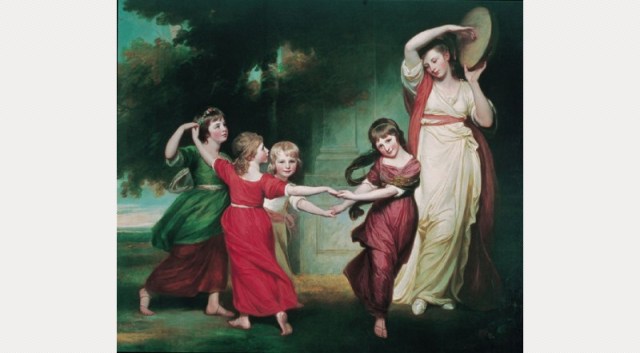
The Abbot Hall has an interesting permanent collection which includes a room of works by Kendal-born George Romney including the huge Gower Family in rooms furnished with a collection by local furniture-makers Gillows.

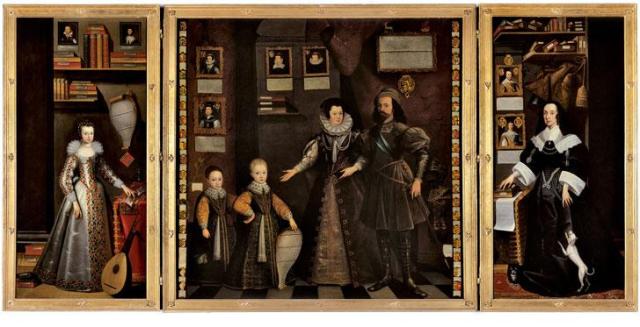
Gower Family

Romney’s The Gower Family

There’s also The Great Picture a magnificent tryptich of Lady Anne Clifford which used to hang in Appleby Castle. Read all about it here.

AH-Great-Picture-Header

The Great Picture

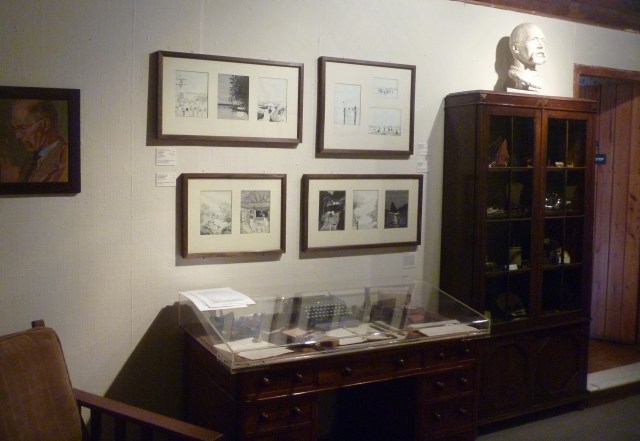
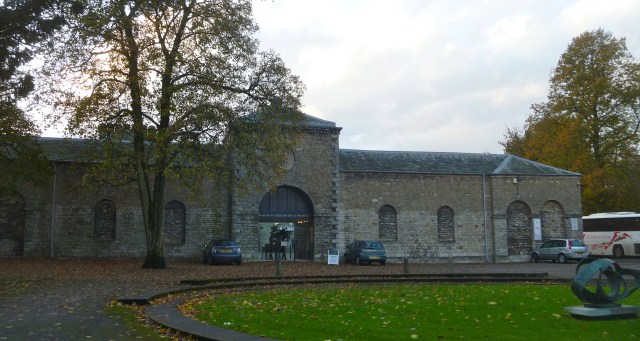
Our entry ticket to the Gallery also allowed us to visit The Museum of Lakeland Life and Industry where I’d remembered seeing years ago the display of Arthur Ransome memorabilia, books and prints and his desk. It’s still there.

Ransome's desk

We didn’t have time to inspect all the displays and it was soon time to return to the coach for journey back to Leeds.

Museum of Lakeland life

The Museum of Lakeland Life and Industry

Albert Wainwright at The Hepworth

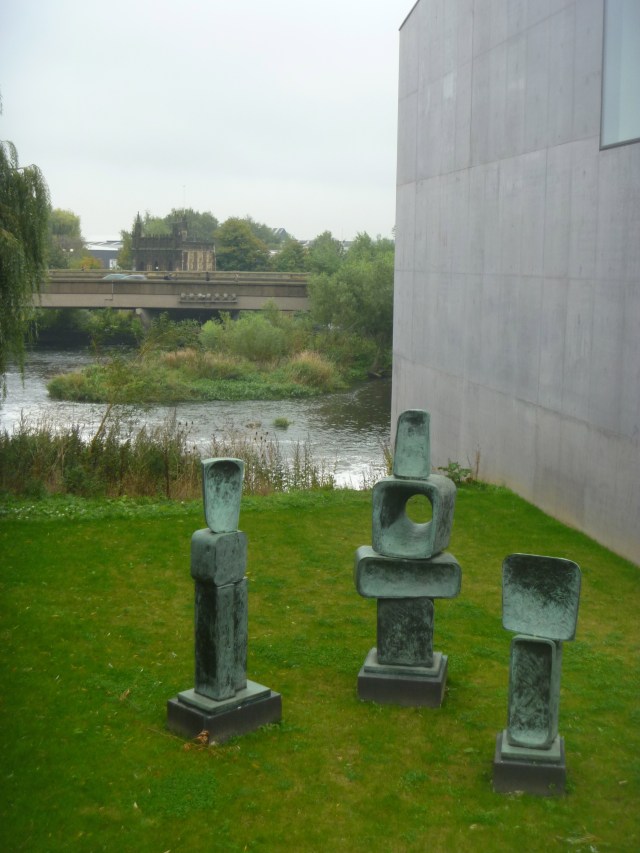
Family of Man

Family of Man by Barbara Hepworth outside The Hepworth, Wakefield

After spending some time admiring the Tissot display I decided to move on and see what else the Gallery had on show this autumn beside the spaces devoted to Barbara Hepworth herself.

Hepworth Winged Figure

In the background Hepworth’s Winged Figure (1961-62)

I found another display centred on works from The Wakefield Art Collection – In Focus : Albert Wainwright. Wainwright was born in nearby Castleford in 1898. At the time of writing, the link to his display at The Hepworth tells you about a different so artist so here is something about him.

From his school days he was a friend of Henry Moore, who became world famous as a sculptor. Albert’s life was not a long one (he was only 45 when he died) and he never became famous like his friend, but it is easy to see from his work that he was a talented artist with a colourful imagination and a strong personal style. Throughout his life he designed programmes, stage sets and costumes for the theatre and an impressive range of this work is now in the collection at The Hepworth Wakefield.

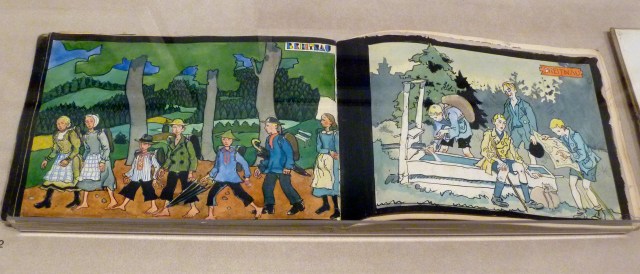
Over 30 years Albert created a number of sketchbooks which record his travels abroad and parts of his life, such as his time with the Flying Corps in the First World War.”

AW Sketchbooks

I particularly liked the travel ‘journals’ or sketchbooks which he made on his trips to Germany.

Whitby map

His Map of Whitby

Where's Albert?

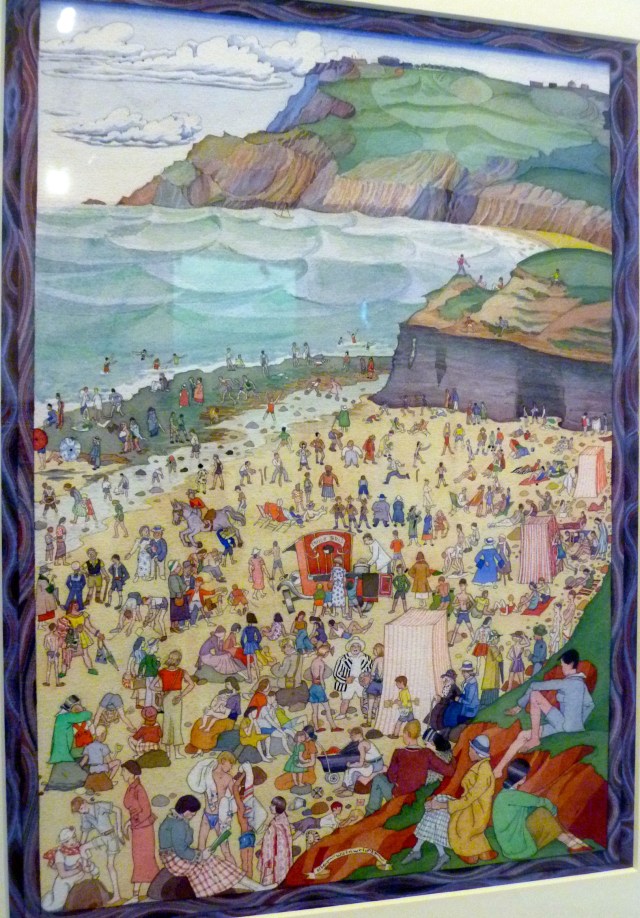
And his “Where’s Wally” or rather, Albert, at “Robin’s Hood Bay” (1930)

“The Wainwright faamily took a summer home at Robin Hood’s Bay during the 1930s. Visits to the bay became an annual occasion for the Wainwrights, who became part of the close-knit community there. Wainwright made a modest income from painting his fellow holidaymakers and their families. In this picture all are imaginary except a self-portrait of the artist centre left, wearing glasses and carrying a walking stick.” [Picture notes]

There's Albert

There’s Albert!

We don't live here any more

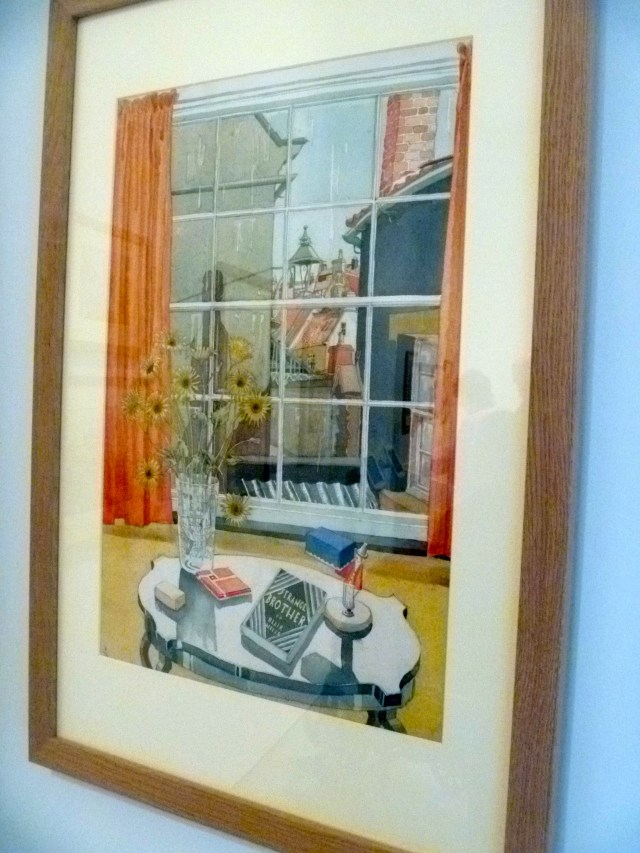
And, the poignant and wistful “We don’t live here any more” (1937)

This painting depicts the view from the window (possibly his studio) of Bramley Cottage at Robin Hood’s Bay. “The placement of the book on the table “Strange Brother” written 1931 by Blair Niles, is significant because it provides an early and objective documentation of homosexual issues in 1920s New York, and is a deliberate allusion to Wainwright’s own sexual identity.” [Picture notes]

There is a selection of books on a table for visitors to look at including a reprinted copy of “Strange Brother“.

The Hepworth Wakefield : James Tissot: Painting the Victorian Woman

Approaching The Hepworth

Approaching The Hepworth over The Aire and Calder Navigation

It was a miserable, grey, wet day last Wednesday and after my usual Nordic Walking session I decided to take a trip to Wakefield and revisit The Hepworth. Back in March I clipped a review of the Tissot exhibition from the Weekend Financial Times, Visual Arts section. Reading the review and knowing Tissot to be a Victorian artist I was intrigued that he should be showing at such a modern and avant-garde gallery as The Hepworth. The answer, as I found out upon enquiry to a steward, is simply that the Wakefield City Art Collection is also housed at The Hepworth and this show is based around pictures in the collection.

From the Tissot Exhibition webpage:

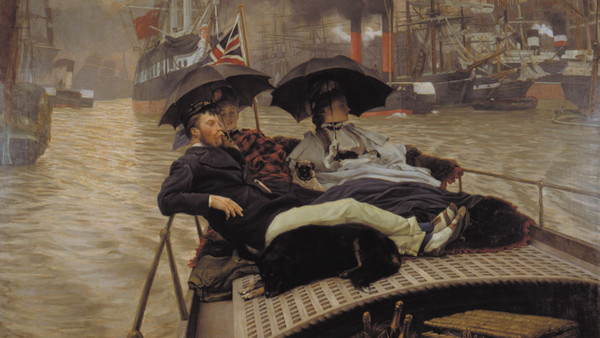
On The Thames

On The Thames (1876)

Taking the much cherished painting On the Thames, 1876, from our collection as a starting point, this new collection display explores the representation of women in the work of French born artist, James Tissot (1836-1902).

The display will also feature loans from Tate and several regional art galleries, and will discuss the portrayal of Victorian femininity in relation to Tissot’s life-history and the contrasting roles of women in the region’s coal industry.”

Subtitled “How happy I could be with either” the painting caused a scandal when it was exhibited at The Royal Academy.

Other paintings in this small single room show include:

Portsmouth Dockyard

Portsmouth Dockyard (1877) [Tate]

PD 1877

Portsmouth Dockyard notes

HMS Calcutta

The Gallery of HMS Calcutta (Portsmouth) (1876) [Tate]

GHC 1877

The Gallery of HMS Calcutta (Portsmouth) notes

The exhibition looks at the representation of women in Victorian England through two contrasting sets of images: the fashionable women of James Tissot’s society paintings (above) and photographs of female workers in northern coalfields (not so easy to photograph in the display cases). Costume was a key element in Tissot’s work. He was born in the French port of Nantes where both his parents worked in the fashion and textile industry.

The painting “On the Thames” was originally owned by Kaye Knowles whose wealth came from his family’s Lancashire based colliery business. The Lancashire “pit brow lass” was mostly associated with the Wigan coalfields where women worked at the pit head. Their costume was also central to the pictures since there are wearing trousers which in Victorian times were perceived as a threat  to the moral and social order.

I see from the press that another exhibition featuring James Abbot McNeil Whistler’s London and the River Thames has just opened at the Dulwich Picture Gallery in south London. I wonder whether I shall manage to get to see it before it closes on January 12th 2014?

d9198ee9-7193-43c8-a20f-8eb309d41518.img

Wapping (1860) [National Gallery of Art, Washington]

Houghton Revisited : Masterpieces from The Hermitage

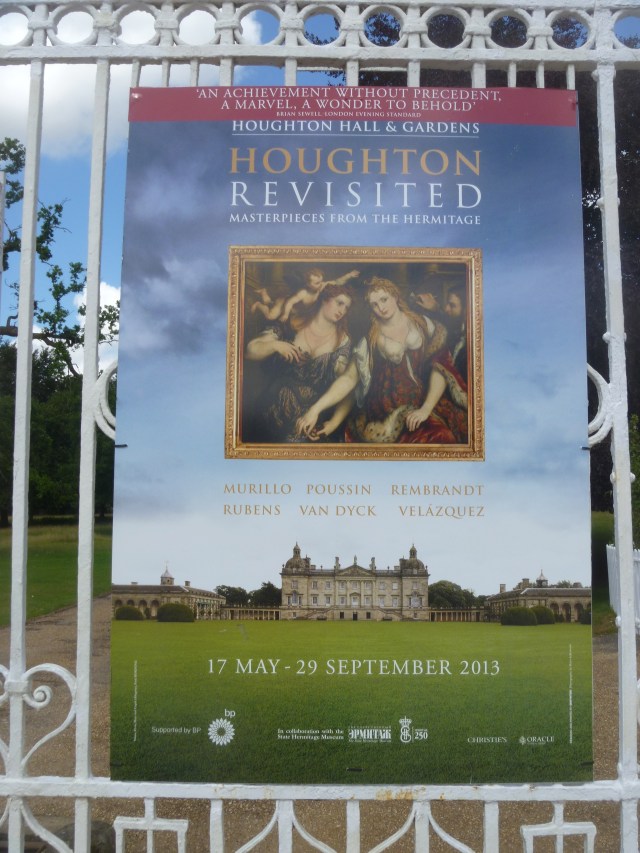
Houghton Revisited

Fellow WordPress member Visiting Houses and Gardens wrote about her visit to Houghton Hall and Gardens and remarked that had the pictures not all been sold she would have given the house a five star rating. Well, this summer the pictures, although sold to Catherine the Great, have all been re-hung in the exact locations from which they were lifted 250 years ago. This unique exhibition is the result of a collaboration between the Hall and the Hermitage Museum in St Petersburg and a great deal of work has resulted in an exceptional country house visit.

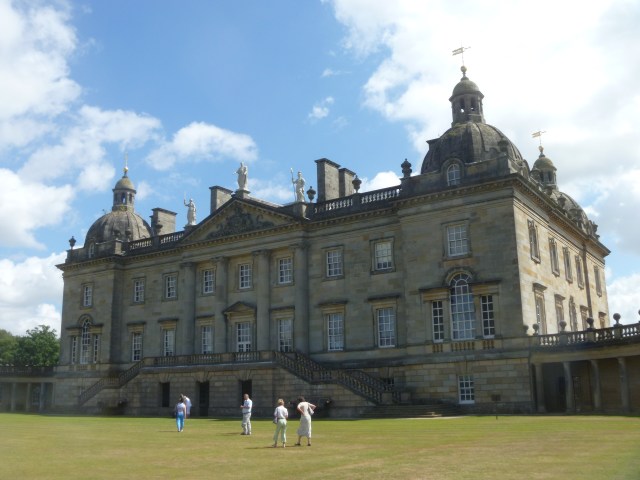
Houghton Hall

Houghton Hall

Last Saturday my sister and brother-in-law and I studied the Houghton Hall and other websites in order to get a foretaste of the show we were to visit the next afternoon.

http://www.bbc.co.uk/news/uk-england-norfolk-22439230

http://www.edp24.co.uk/news/gallery_and_mustard_video_prince_of_wales_says_houghton_hall_exhibition_is_once_in_a_life_time_experience_1_2187869#ooid=V1ZGVpYjpg7VNsOFDKDMBVTYD1rttT6-

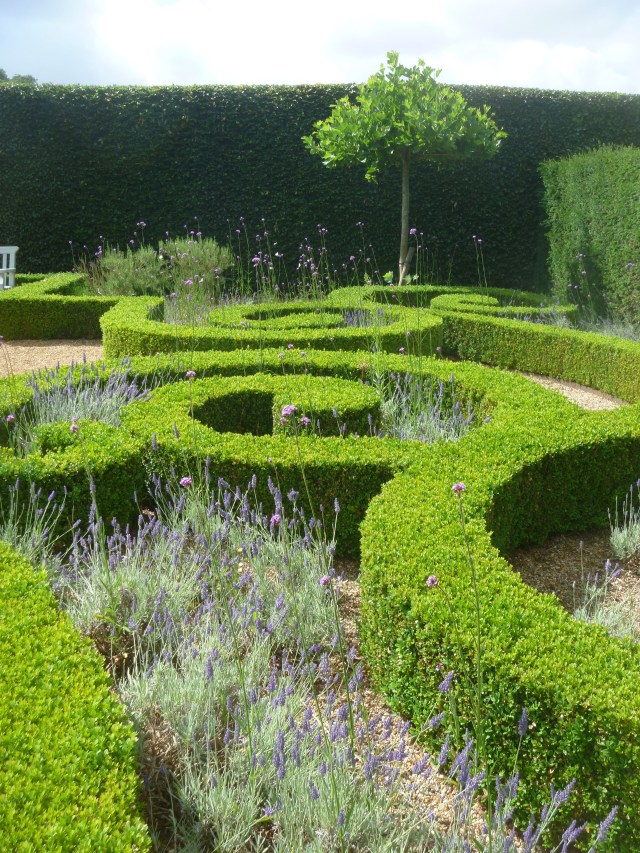
No photography is allowed in the Hall so my pictures show the beautiful garden. Luckily we arrived in good time before our timed ticket slot and had time to inspect the Walled Garden in all its glory and have a cup of tea before the highlight of the visit: Houghton Revisited.

Lavender knot garden

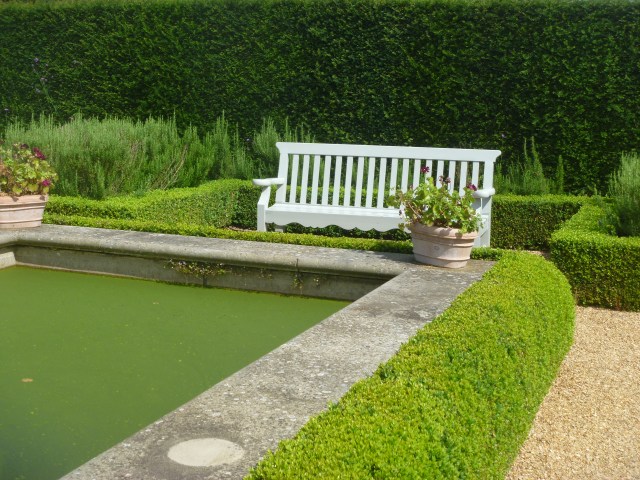
Corner of pool with hedging

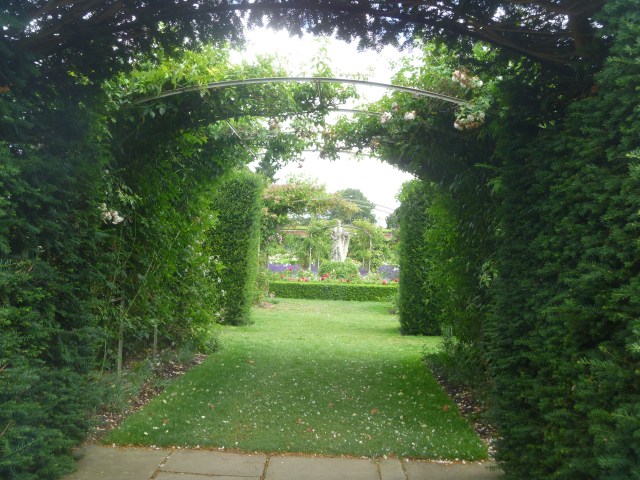
Garden arch

Near the beehives

Near the Beehives

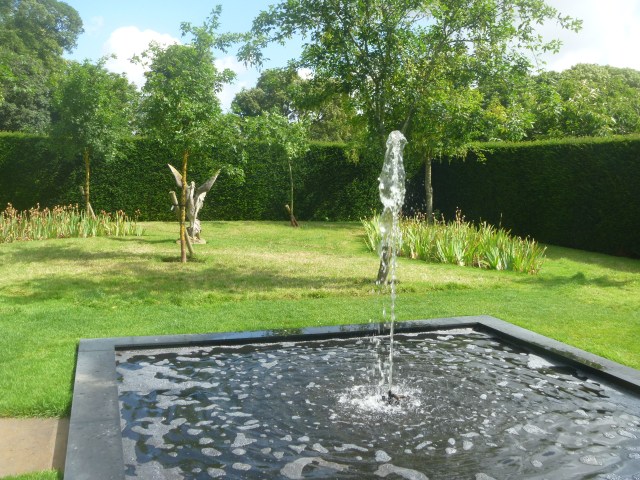
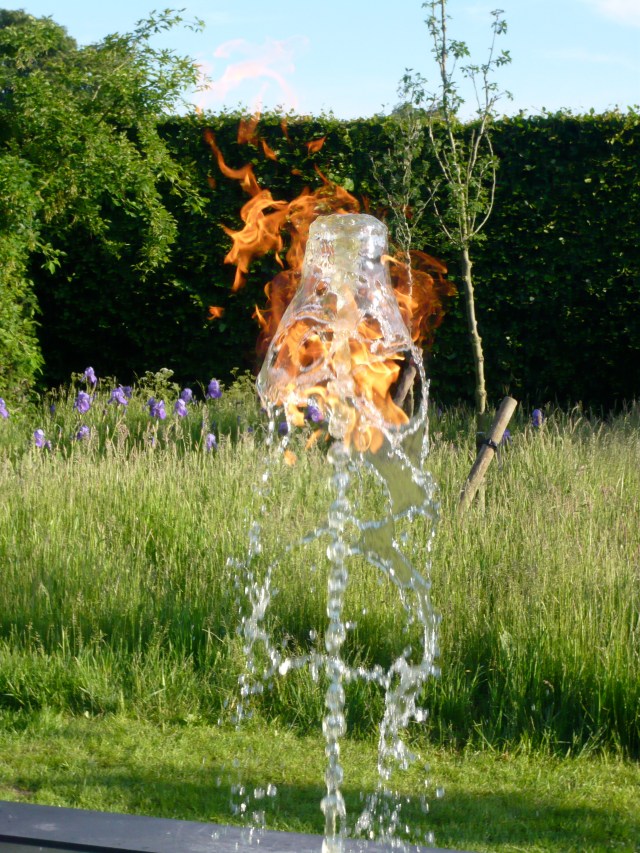
Jeppe Heins Waterflame

Waterflame by Jeppe Hein

Garden106

And here is the flame (source)

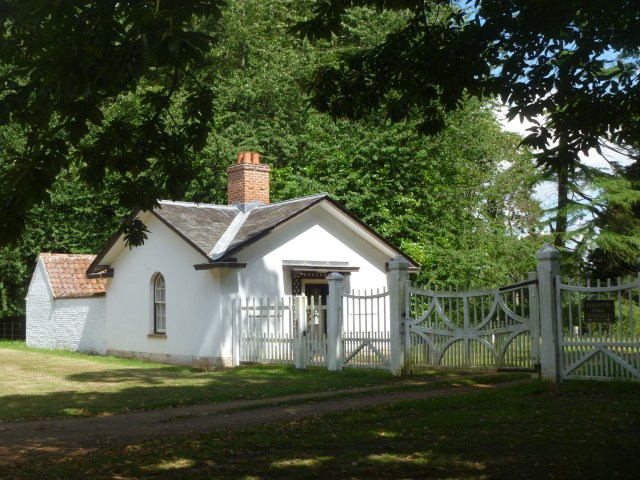
Before leaving the Houghton Estate I just had time to take a quick look at the Landmark Trust property : Houghton West Lodge. Not surprisingly it’s fully booked until October.

Houghton West Lodge

Houghton West Lodge

Paula Rego – coincidence

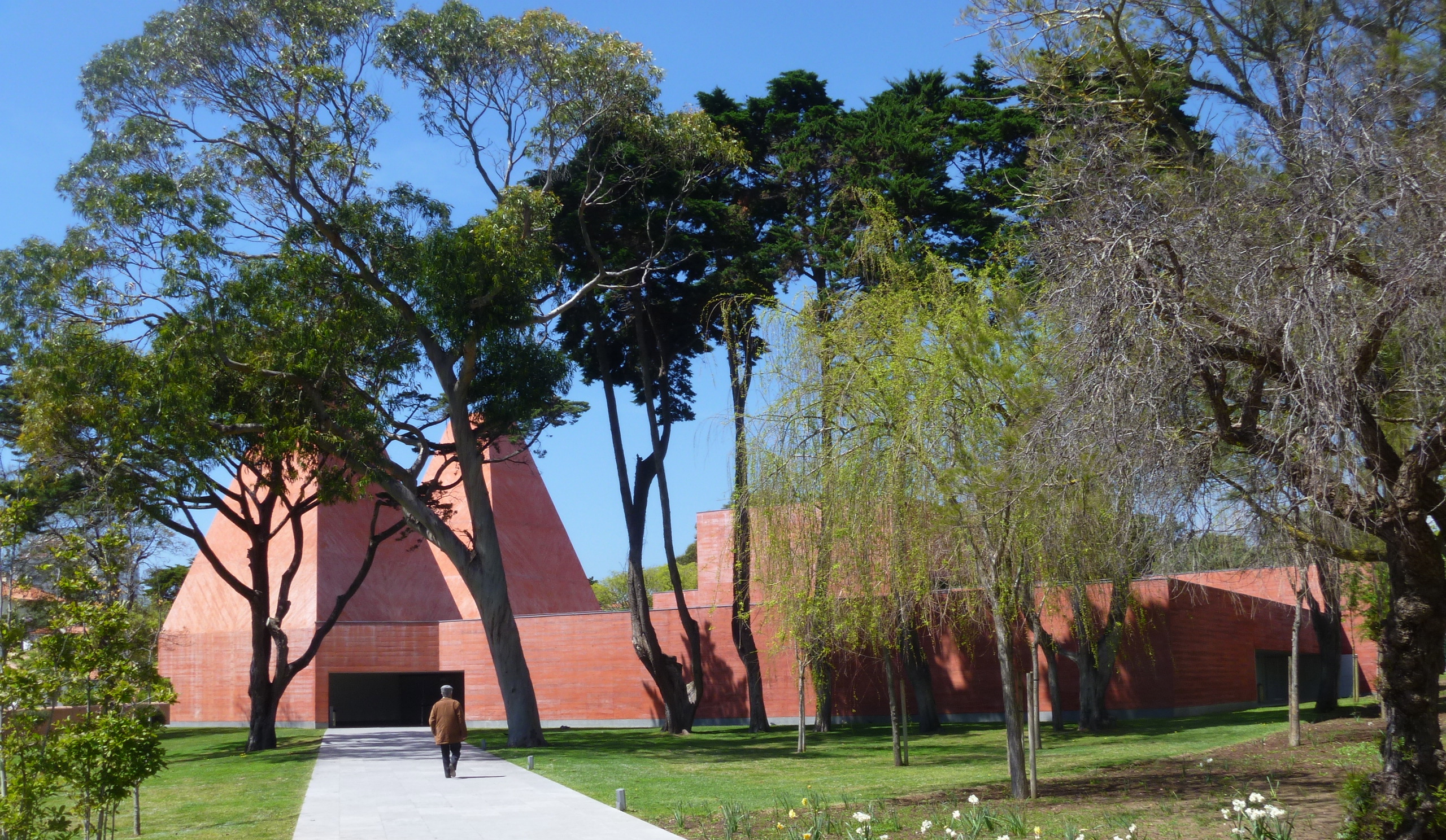
If you watched all of the video recording of The Brilliant Brontes in the last but one post you will have seen Sheila Hancock inspecting and discussing the drawings of Jane Eyre with the artist Dame Paula Rego. By coincidence a week later one of the most prominent museums (yes, there are several!) in Cascais turns out to be devoted to the work of Paula Rego (and it has a nice cafe too). Shortly after our arrival we decided to take a walk and investigate.

Casa das historias

The Casa das Historias opened in Cascais in 2009

Rego was born in Lisbon in 1935 to keen Anglophile parents who sent their daughter to an Anglican English language school in Lisbon and later to school near Sevenoaks and art school (The Slade) where she met her future husband Victor Willing. She became a naturalised British subject and was created a Dame of the British Empire in 2010. She divides her time between Britain and Portugal.

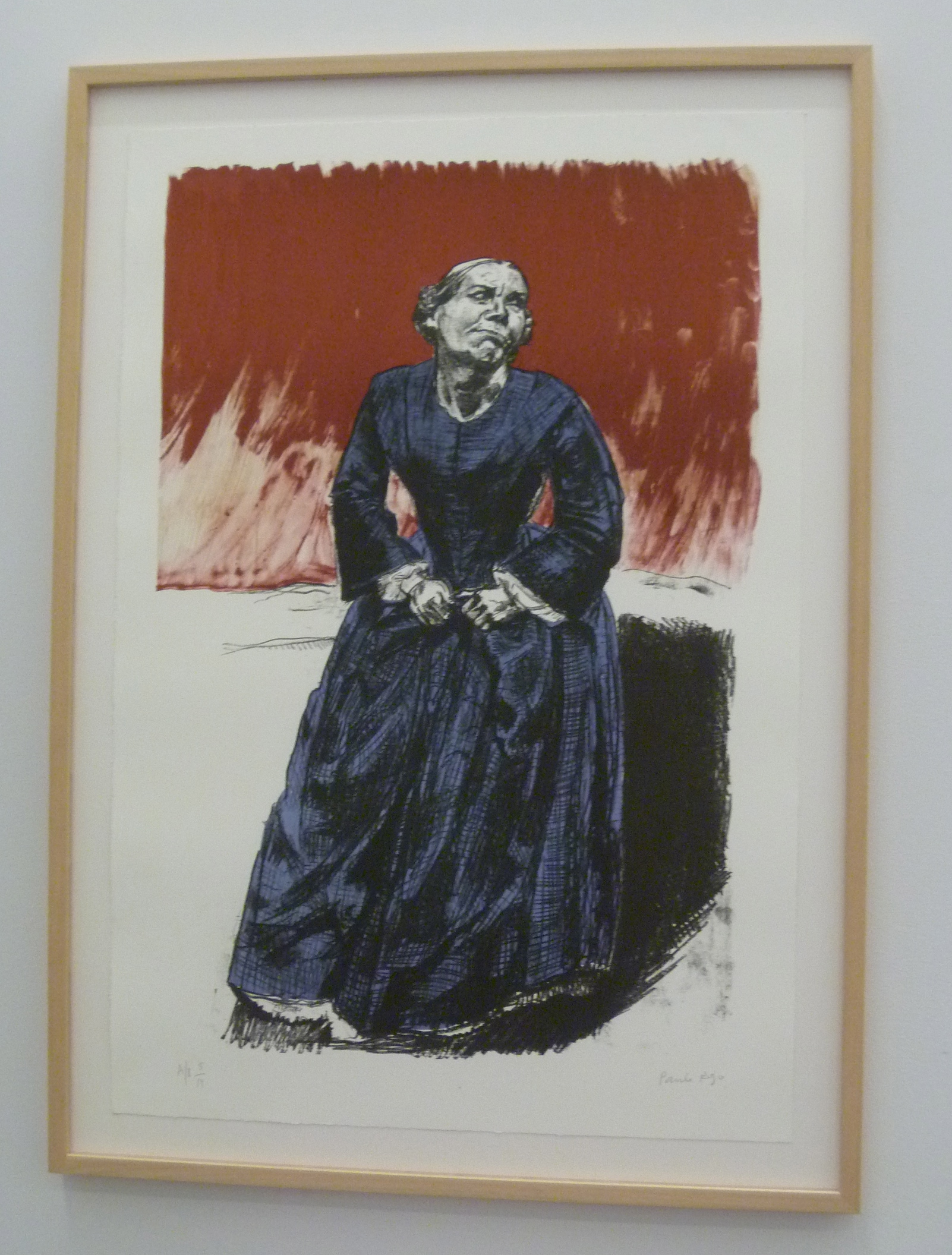
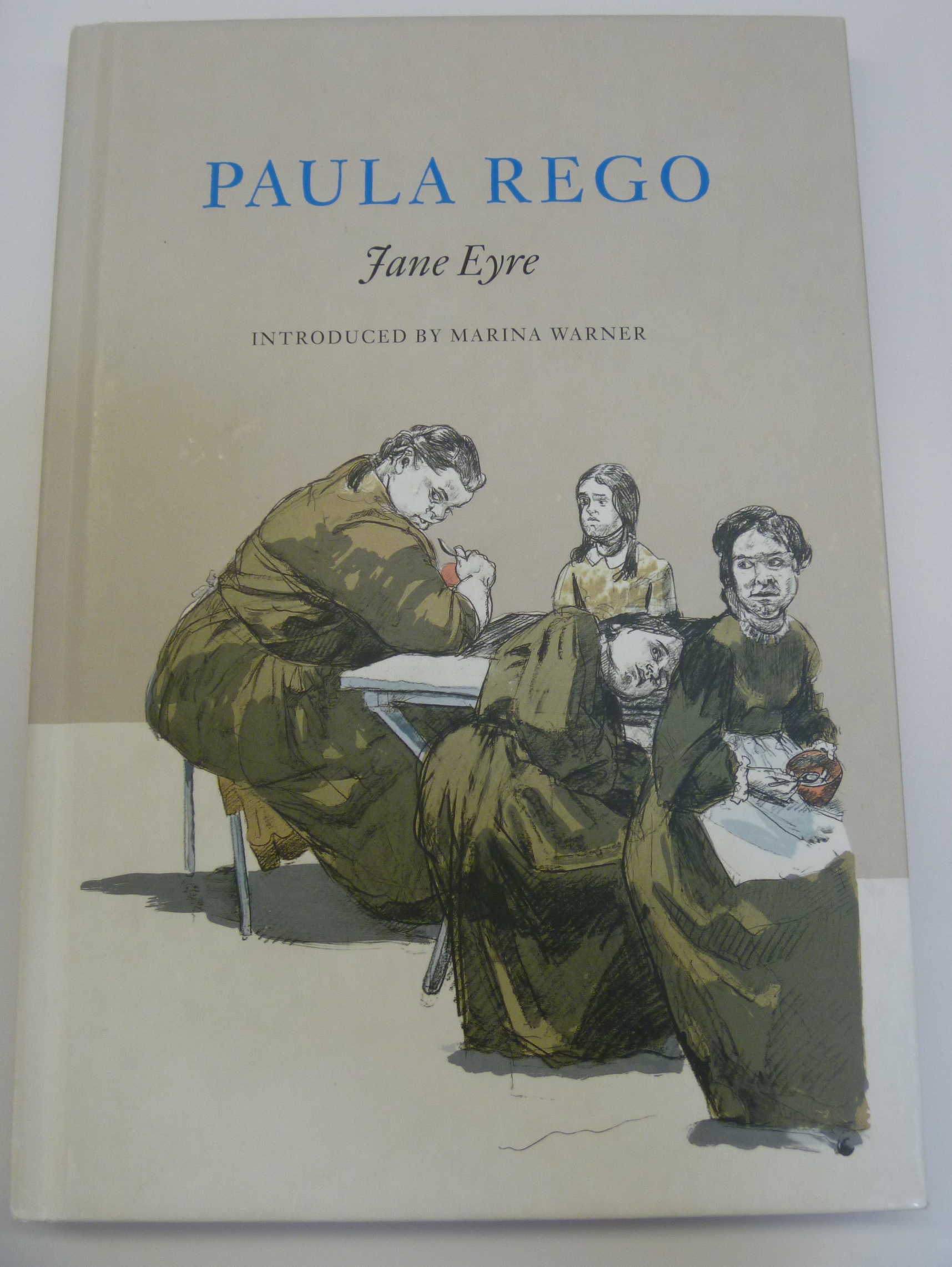
Here are some of her Jane Eyre works  currently on display at the gallery Casa Das Historias in Cascais.

Paula Rego Jane Eyre

Paula Rego’s Jane Eyre

Paula Rego Jane Eyre 2

Paula Rego’s Lithograph Jane Eyre

Paula Rego Jane Eyre book

The Book of the Exhibition

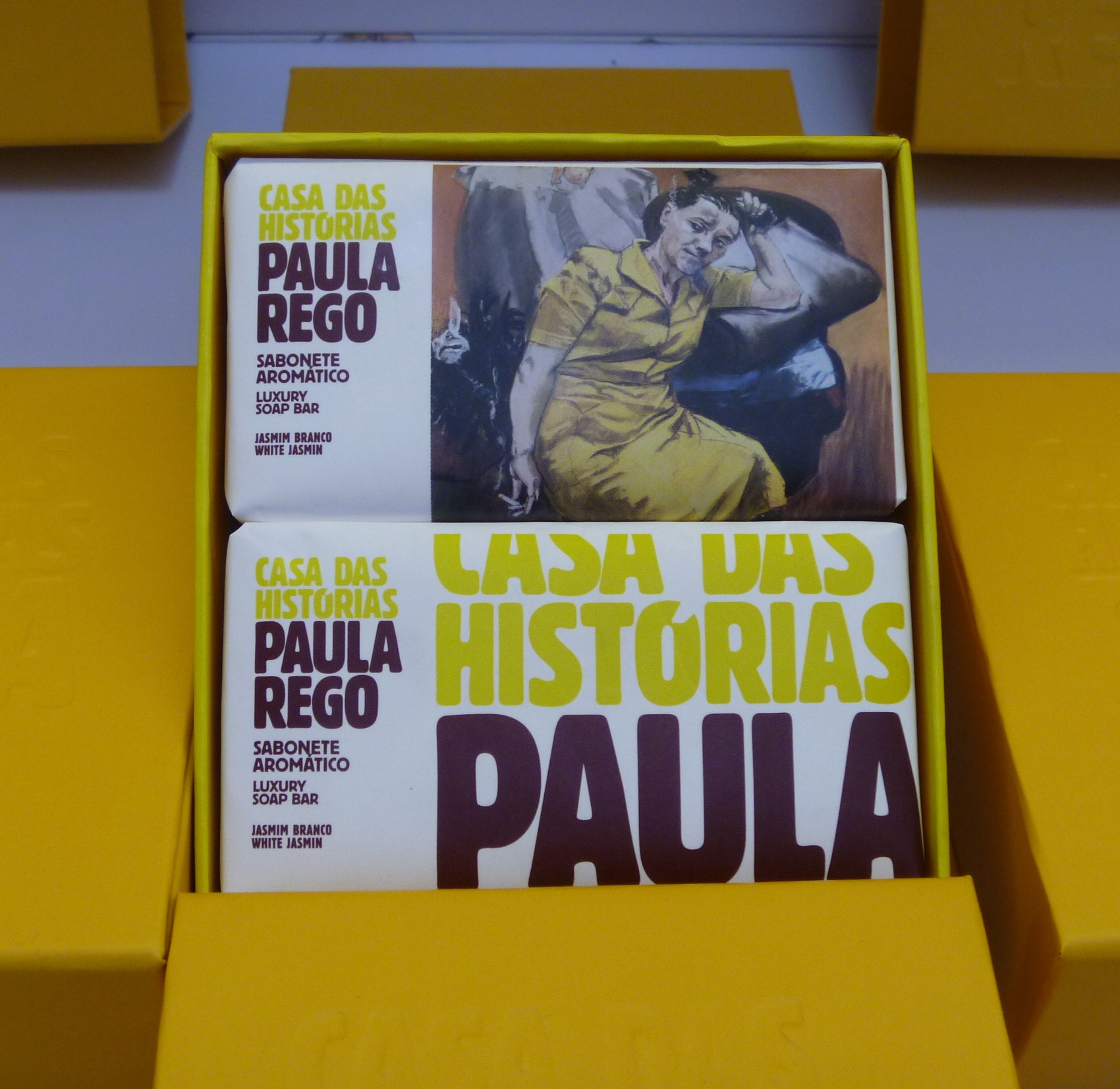
Didn't have room for the PR soap

I had no room for the Paula Rego soaps in my luggage!

“If it doesn’t tell a complete story … it won’t do as a Post cover” : The Norman Rockwell Museum

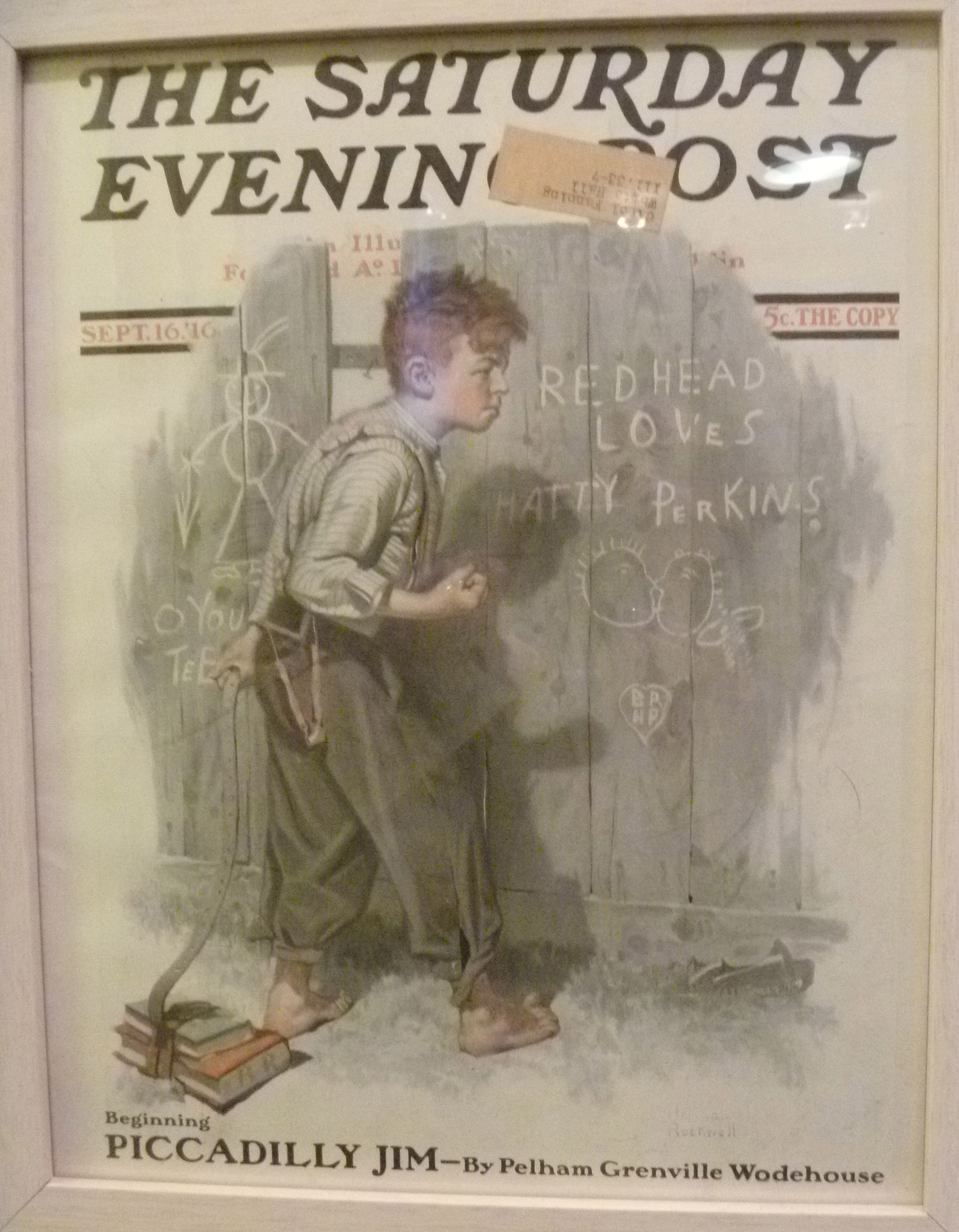
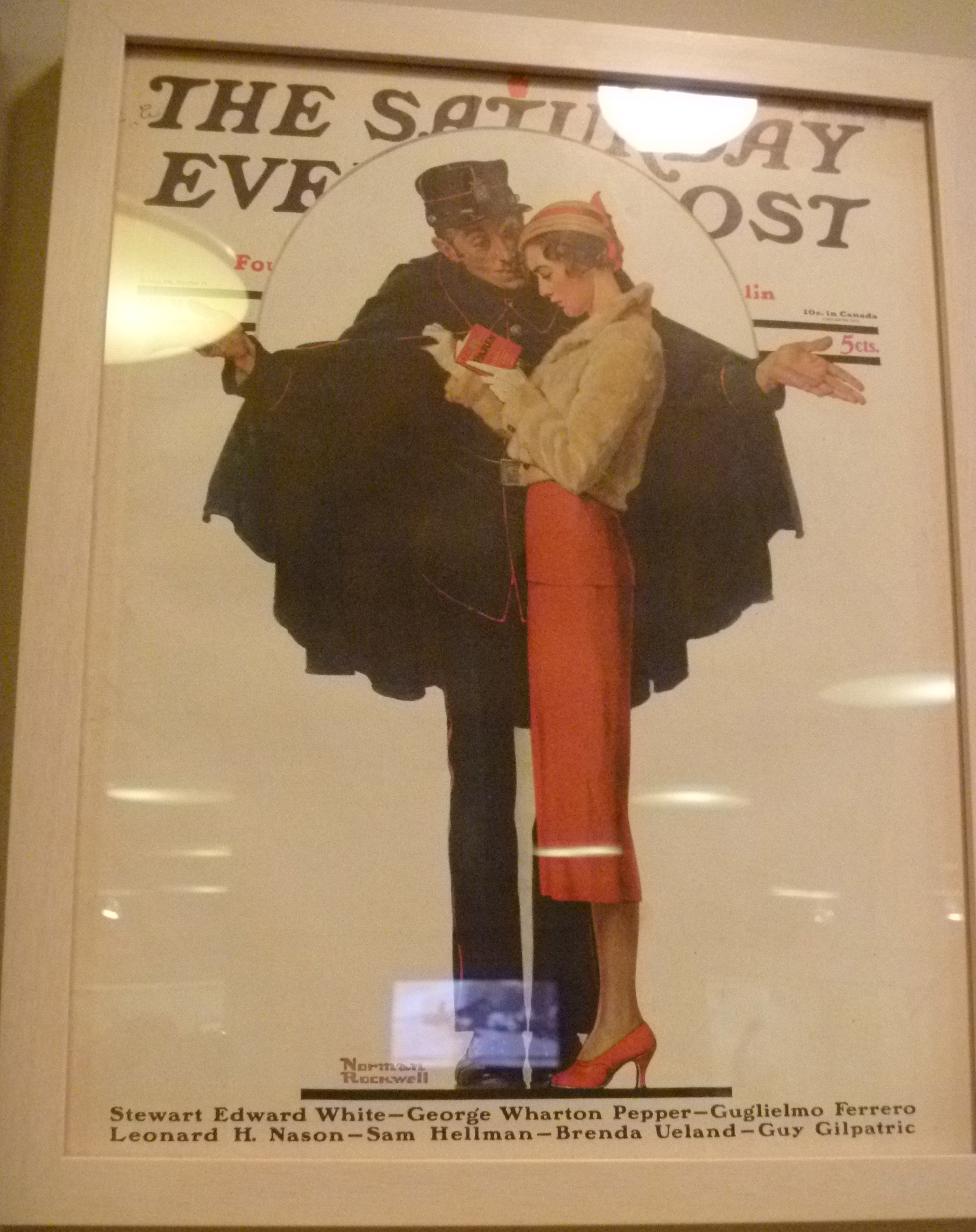
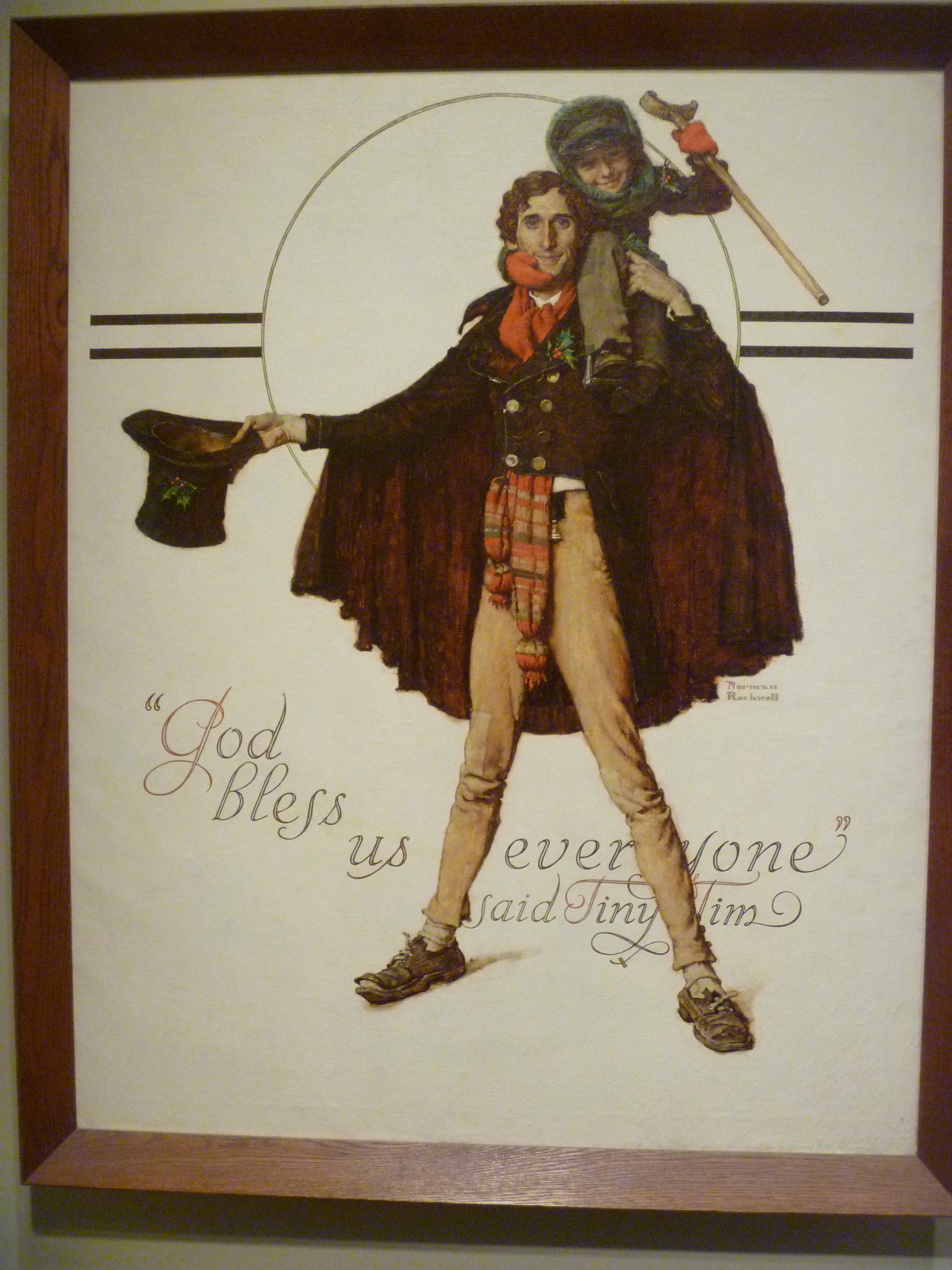
The ‘Post’ in question was ‘The Saturday Evening Post’ and the statement was made by the prolific, American illustrator who, between 1916 and 1963, produced 323 covers for the weekly magazine.  Some of Norman Rockwell’s covers are very well known and are used today on posters, postcards and greetings cards throughout the world. Rockwell was born in New York City in 1894 and died in Stockbridge, MA in 1978. One’s first impression is that his paintings depict cosy, inter-war-years, small town American home life. In fact this is far from the case. He covered a huge range of topics and he used local people as models and meticulously planned each picture he created.

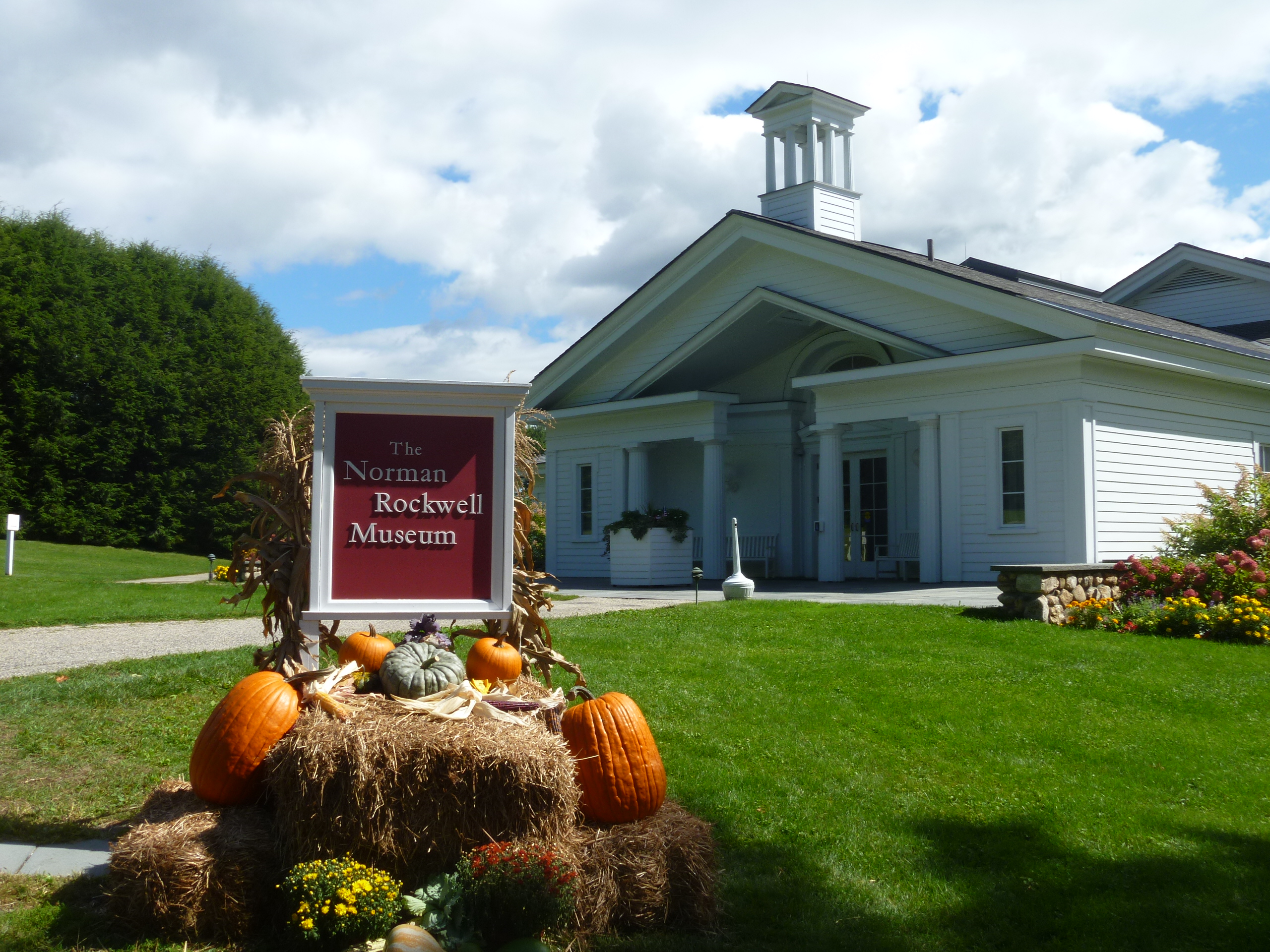
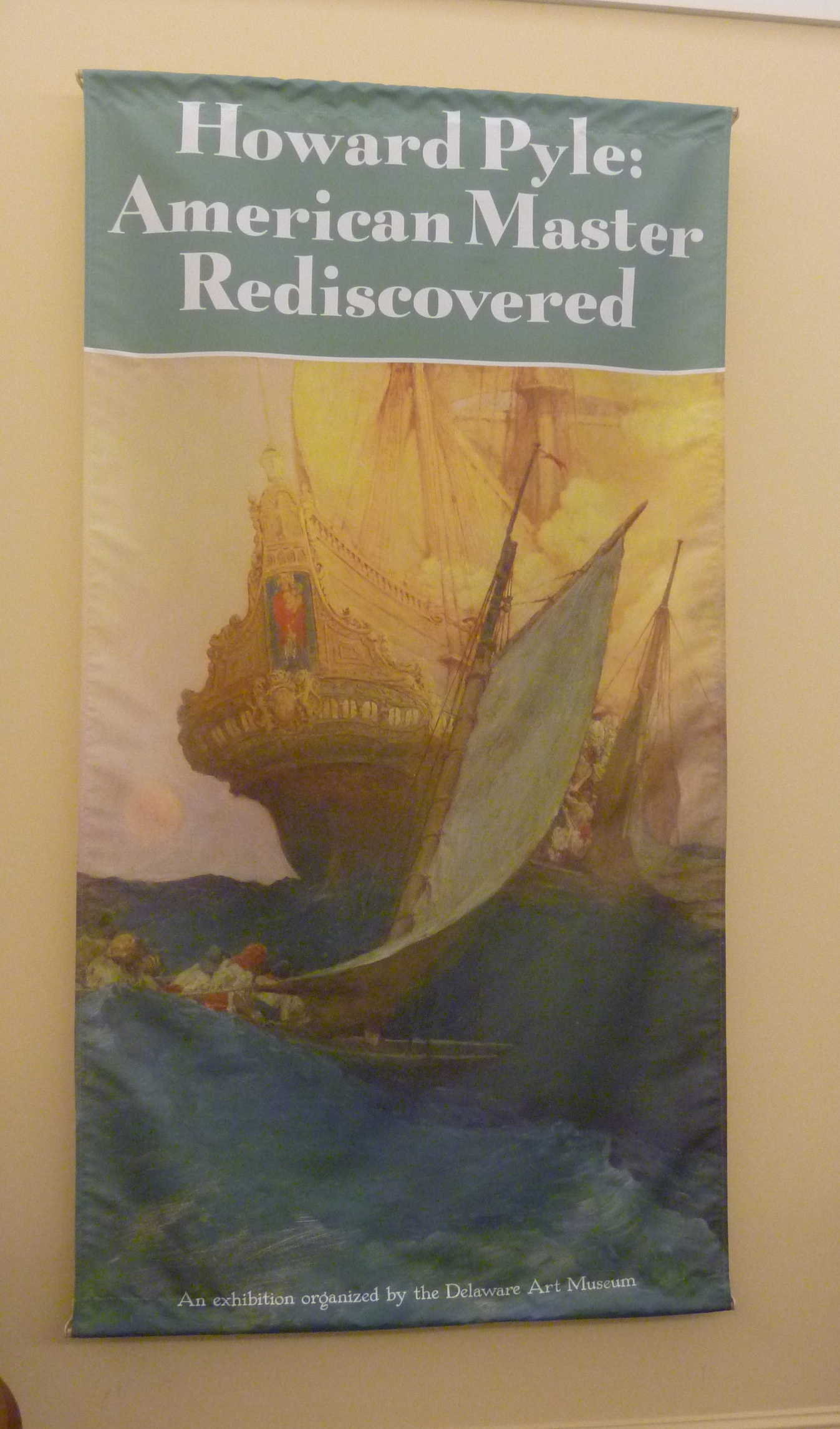
On Saturday 15 September we made a visit to the Norman Rockwell Museum at Stockbridge, MA. We thought we’d maybe spend an hour or so there but three hours later we decided to leave and I still had not seen everything that the Museum had to offer, including the current special exhibition ‘Howard Pyle: American Master Rediscovered’.

I think we’d expected a Disneyfied exhibit and we’d have sentimental America overload. Far from it. This was an excellent presentation of the work of one of America’s best-known illustrators.

All 323 covers are on display in publication order on the walls of the basement gallery. In the same room is a video loop about Rockwell’s life and painting narrated by his son Tom Rockwell. Also in the basement is a Library and Archive.

composed primarily of business, personal, and fan correspondence, together with reference material. Of particular note is a collection of several thousand black-and-white photographs of models and scenes used by the illustrator in the development of his work.” [from the NRM website]

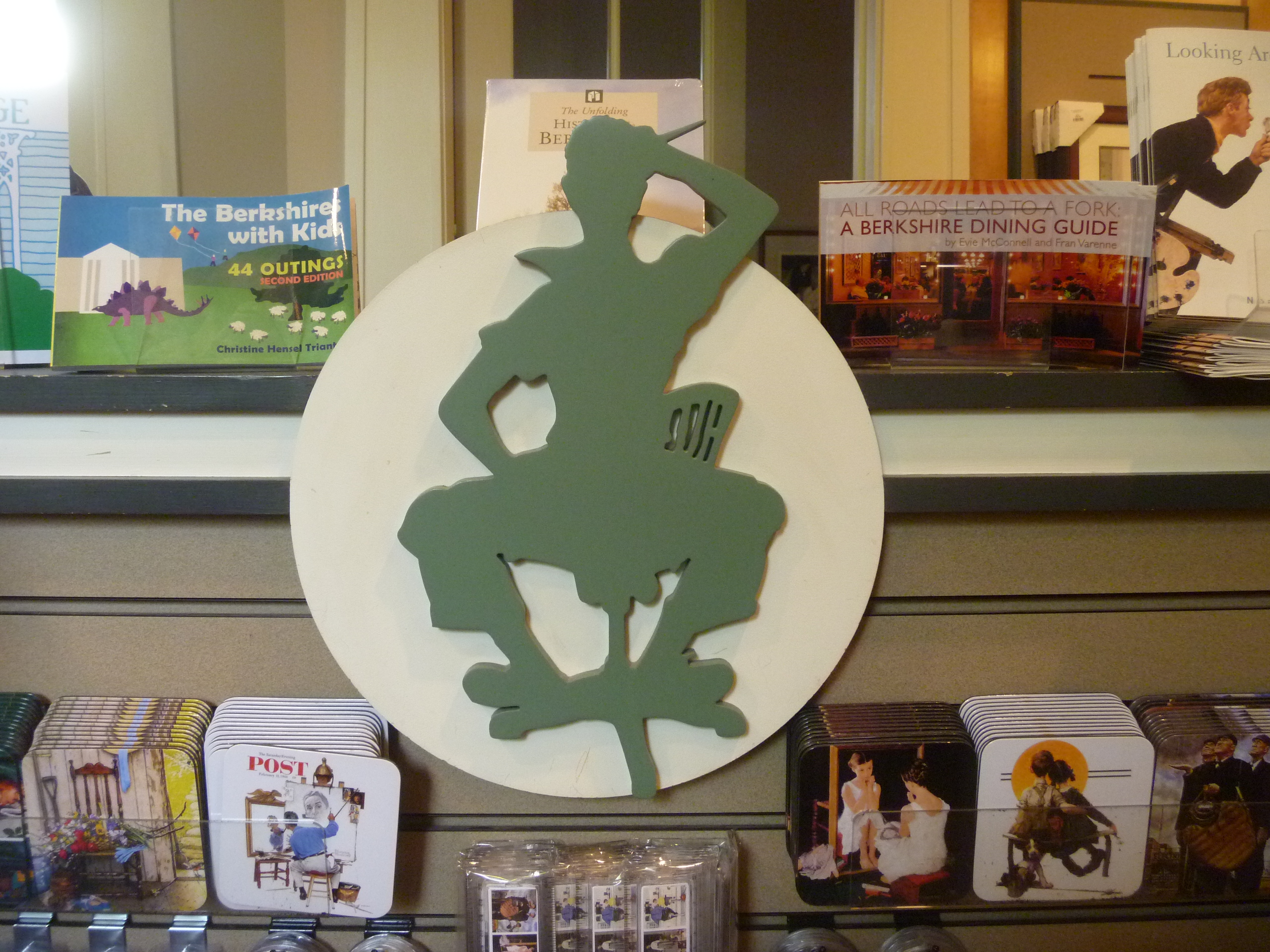
The NRM Gift Shop

For nearly fifty years, millions of Americans brought Norman Rockwell’s art into their homes, enjoying the artist’s Saturday Evening Post covers while seated in their favorite chairs, surrounded by their belongings in the company of their families. This intimate connection with Rockwell’s art made his images a part of the fabric of American lives.

On the ground floor of the Museum are the main galleries which include his paintings of the Four Freedoms or Four Essential Human Freedoms (of speech, of worship, from want, from fear). The theme was derived from the 1941 State of the Union Address by President Roosevelt.

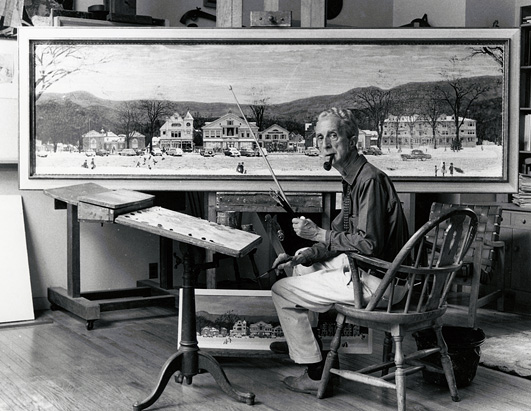
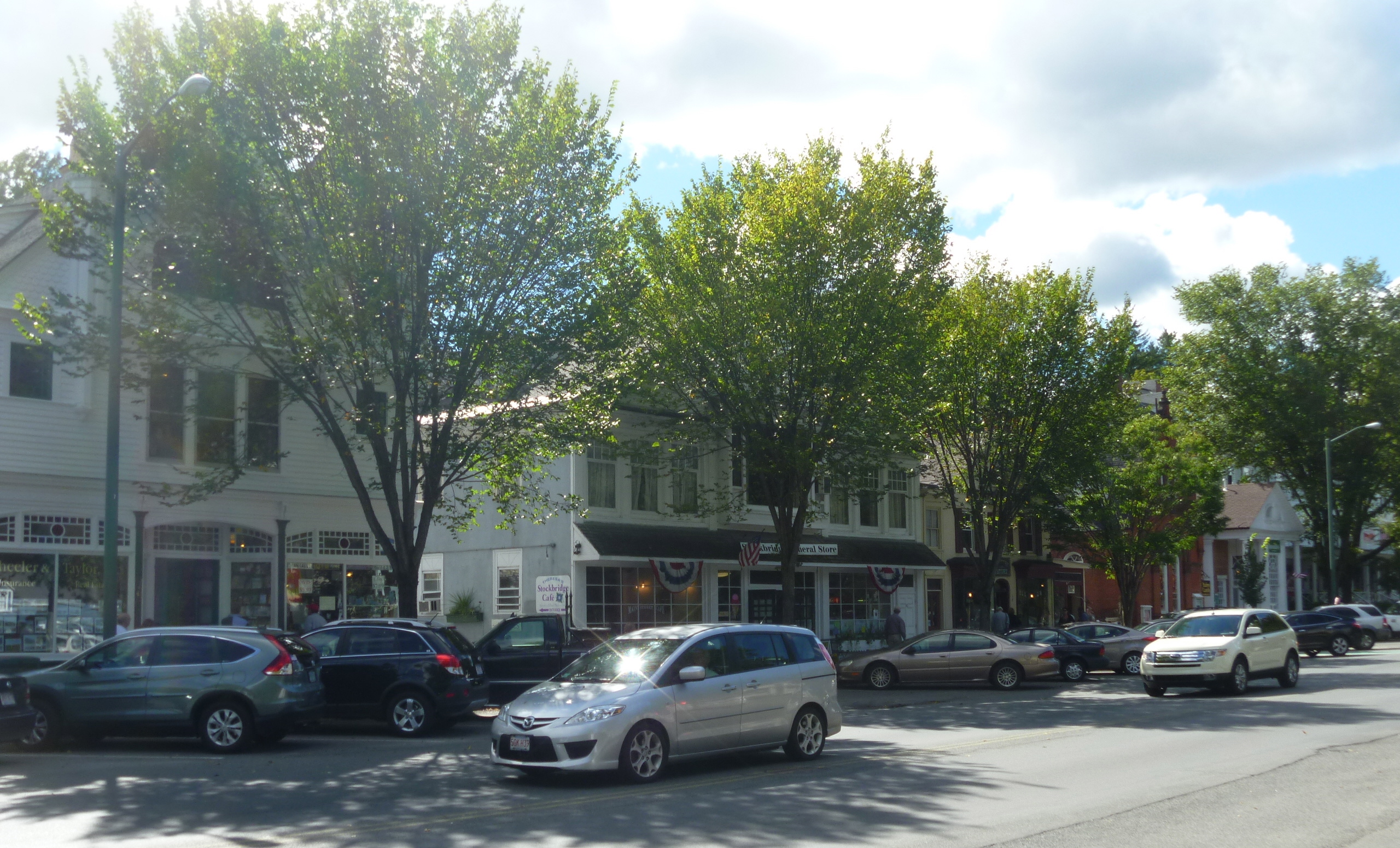
Also, in pride of place, and this was the painting about which my tour guide spoke, was Stockbridge Main Street at Christmas. Later I found the Main Street almost impossible to photograph in September (the result is below). Each year there’s a programme of events in the town based around a recreation of this painting. This year it’s 30 November, 1 and 2 December.

Norman Rockwell in his studio with the painting Stockbridge Main Street at Christmas

[http://abcnews.go.com/widgets/mediaViewer/image?id=9321573]

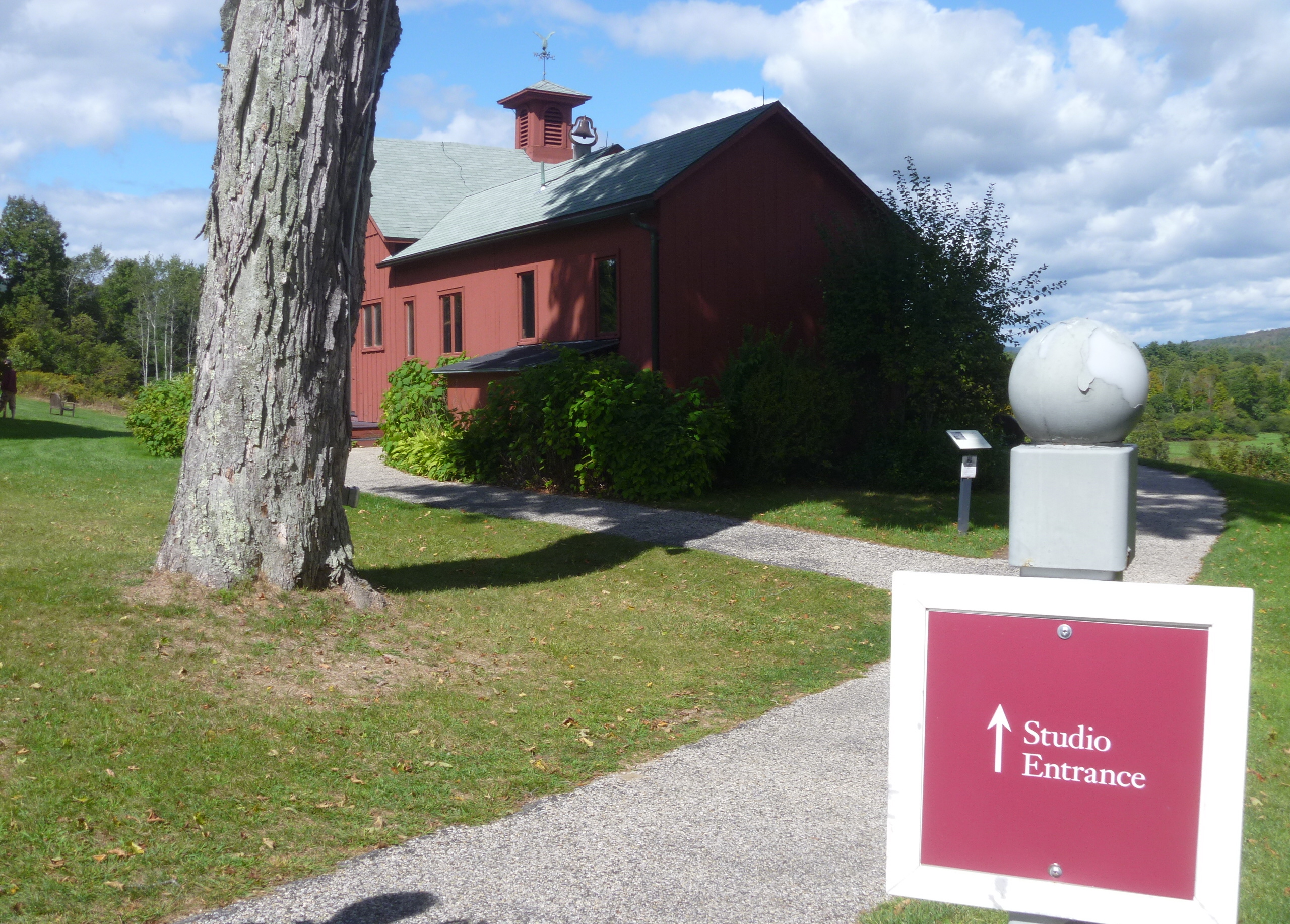
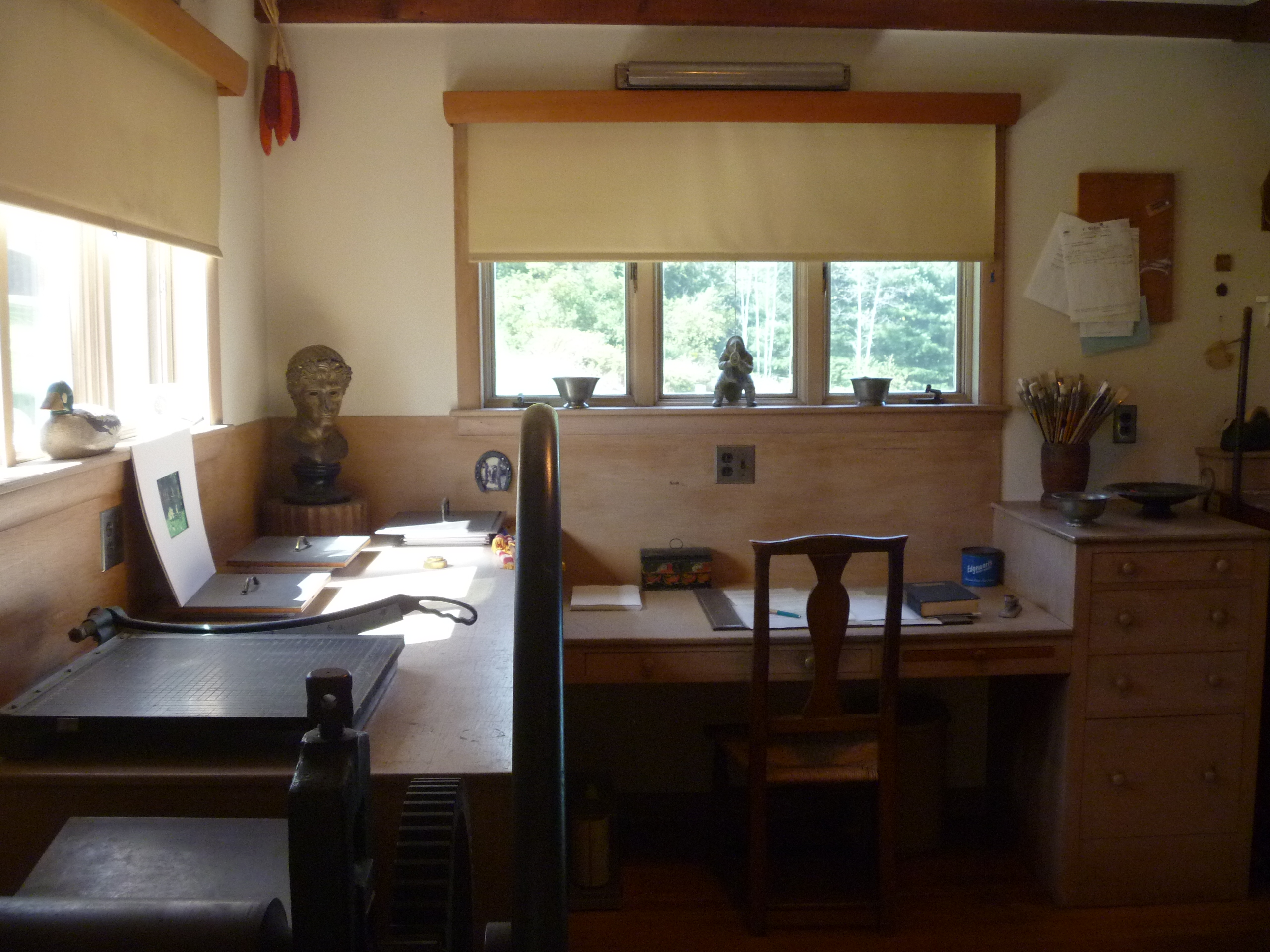
When we’d exhausted the Museum itself (or rather it had exhausted us!) and spent time in the well-stocked Gift Shop we took the short walk to Rockwell’s Studio.

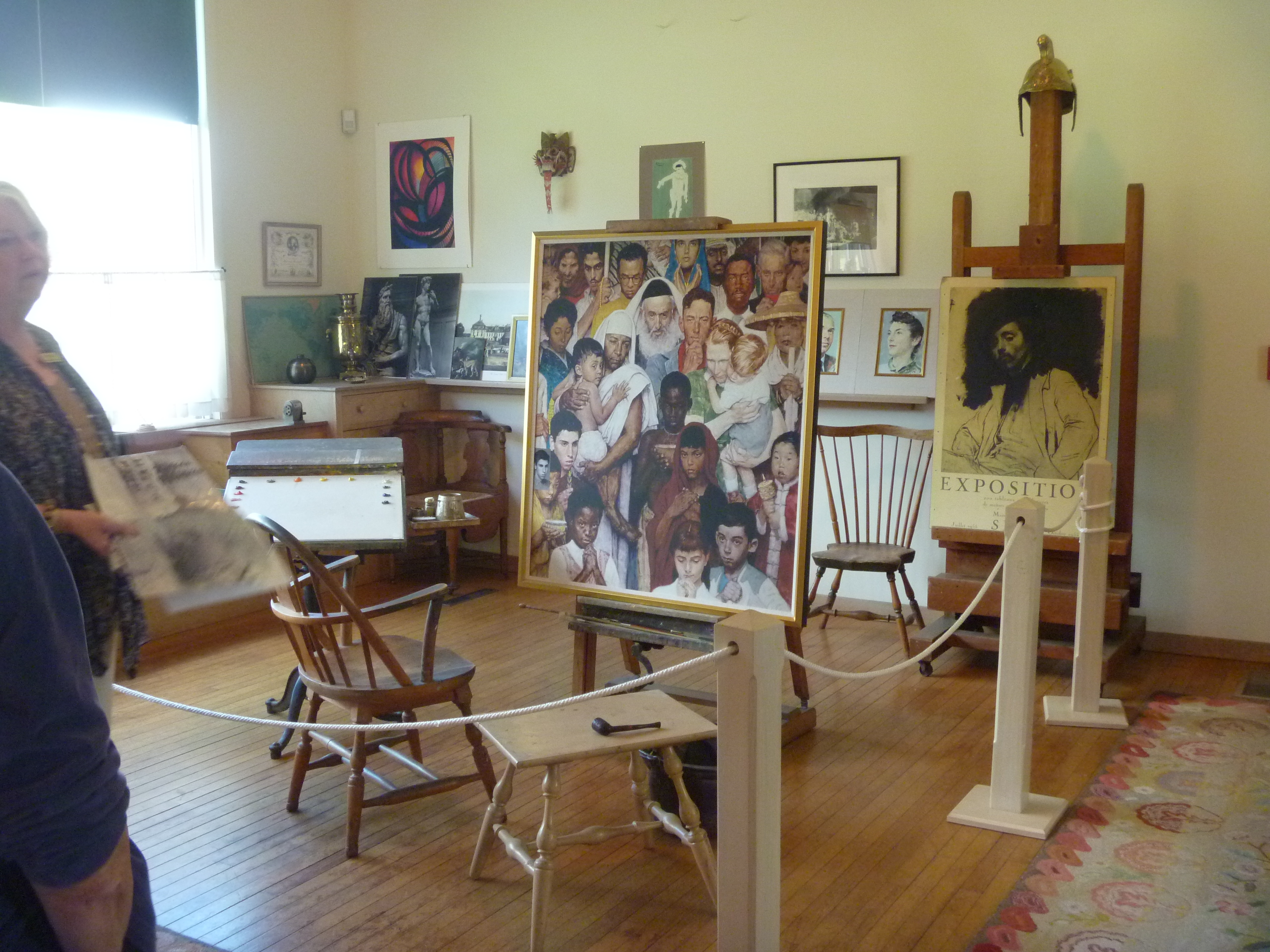
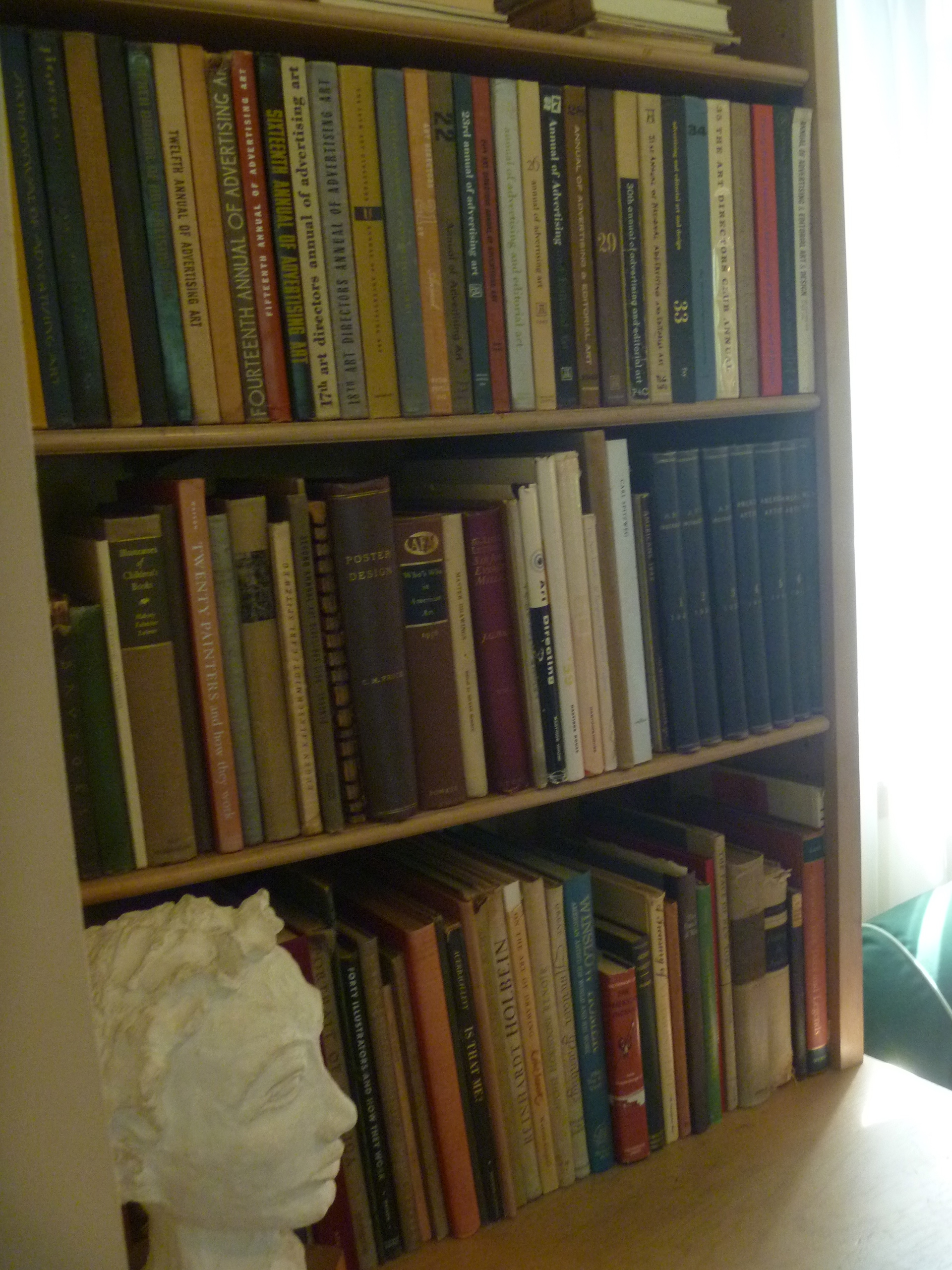
The Museum (opened in 1993) is located in lovely extensive grounds (36 acres) a few miles outside the small town of Stockbridge, Massachusetts – there’s plenty of parking and green spaces. The Studio itself was moved to the grounds in 1986 and is fitted out now as it might have been in October 1960 with his equipment, books, inspirations.

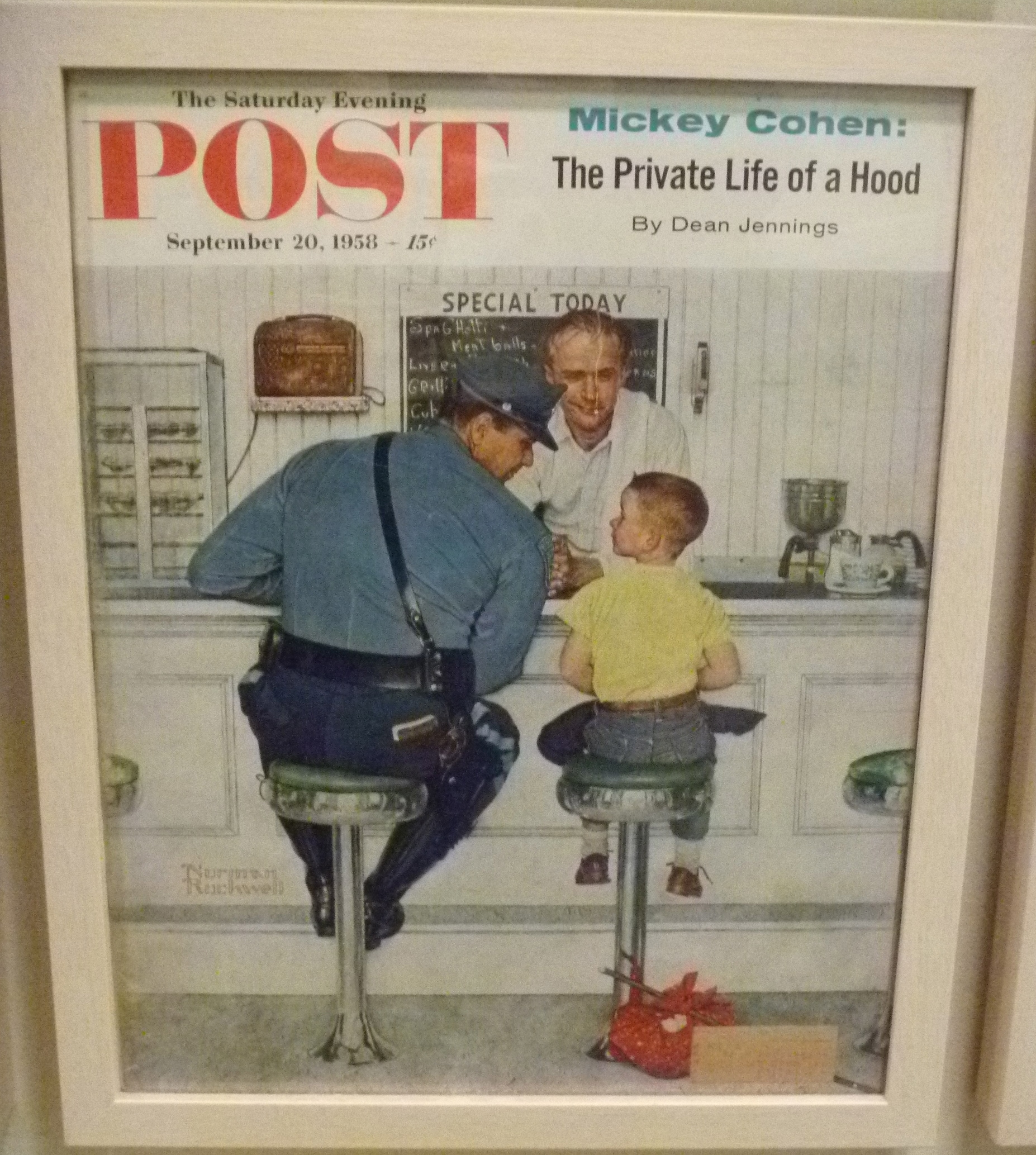
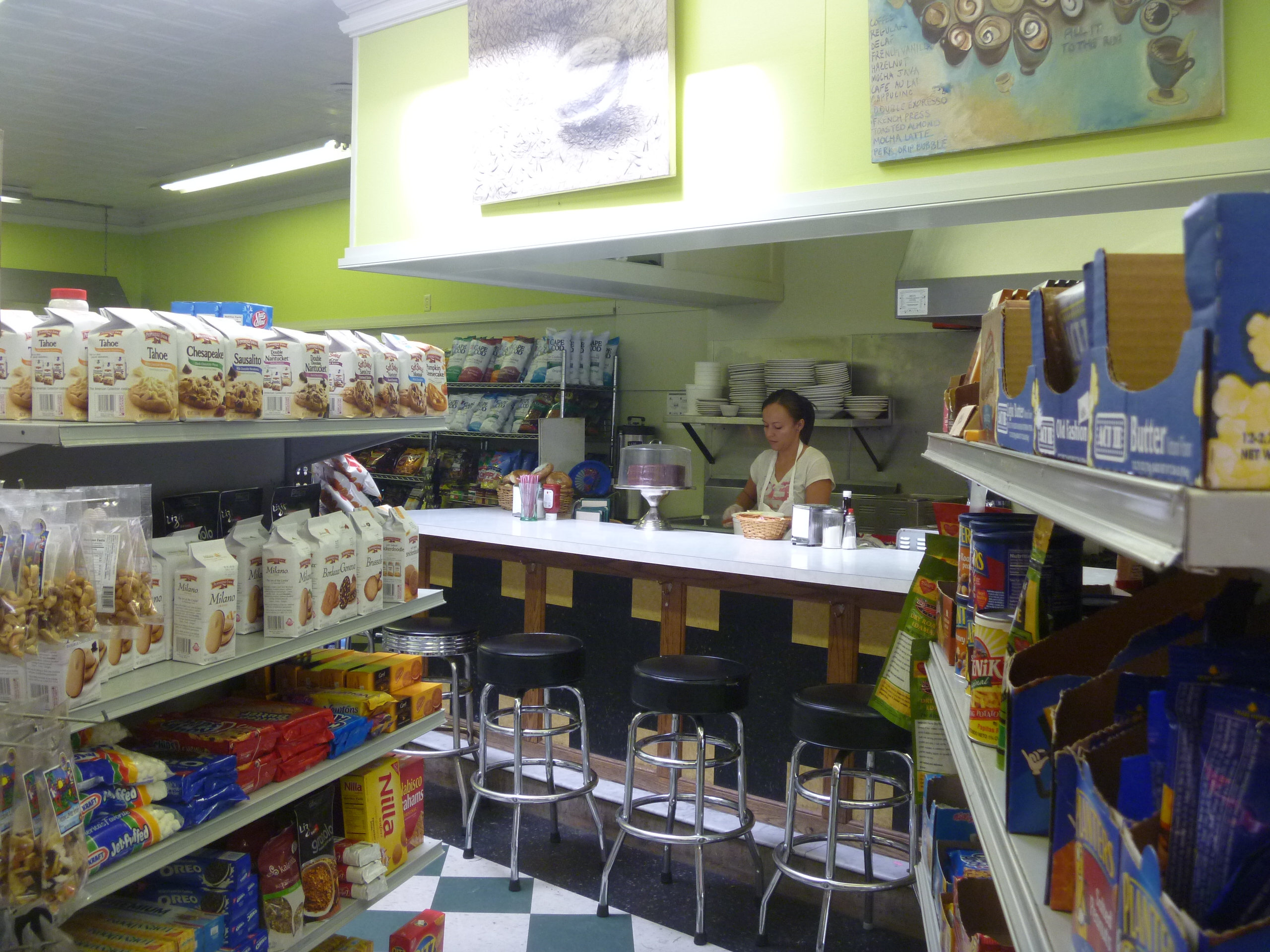
After visiting the Museum, we parked up in Stockbridge and took a walk around the town. When I walked into the Stockbridge General Store I suddenly remembered that I had watched a programme on TV back in December called “America on a Plate : The story of the Diner” in which Stephen Smith visits various diners throughout America and reflects on their connections with popular culture. At one point he visited Stockbridge and set up one of the Rockwell covers – The Runaway – using the original models for the police officer and the runaway boy. I realised that I was in the diner where this had taken place. The programme in full is not currently available via iPlayer but I found two YouTube recordings of the programme. The Norman Rockwell part begins in Part One 12.22 minutes in and continues through the beginning of Part Two.