When I last went over to Lancaster from Shipley (West Yorkshire) Station I noticed several people dressed for hiking in the Dales waiting on the platform. They seemed to recognise each other but were obviously not specially friends. They were joining walks organised by the Friends of the Settle Carlisle Line or Dalesrail and had obviously met each other on previous walks. It seemed like an excellent way to enjoy walking in more distant parts of the Yorkshire Dales so I decided to find out more.
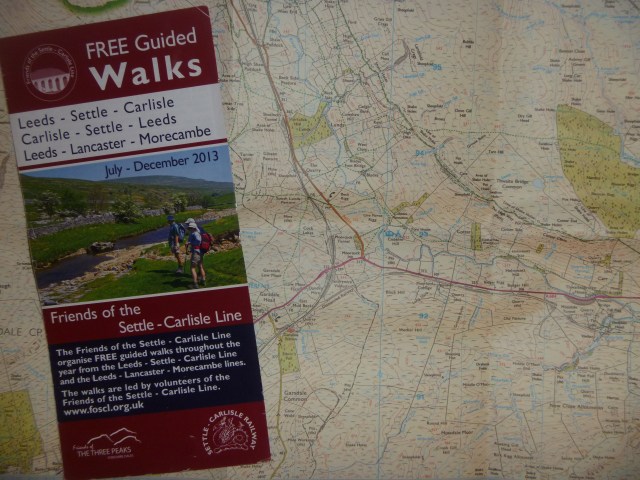
Later in the Tourist Office at Leeds Station I picked up two walks leaflets and, being aware that I was not interested in 14+ mile strenuous walks and being away or otherwise engaged some weekends, I selected a few walks on dates towards the end of 2013 that I thought I be able to manage. The first of these was today:
Walk leader: DW/BH (Bob had stepped in for Duncan W) Garsdale Station – Yore House – Thwaite Bridge – Cotter End – High Dyke – Blades – Moorcock Inn – Garsdale Station.
Special Instructions: Alight (10.21) and return Garsdale.
Date and time: Sat, 30/11/2013 (All day) Grade: M(oderate) Length: 8 miles
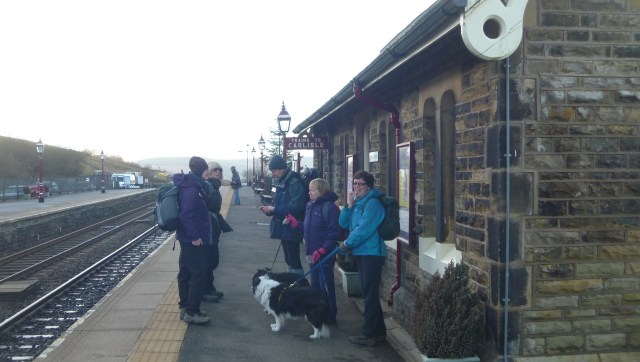
Assembling at Garsdale Station.
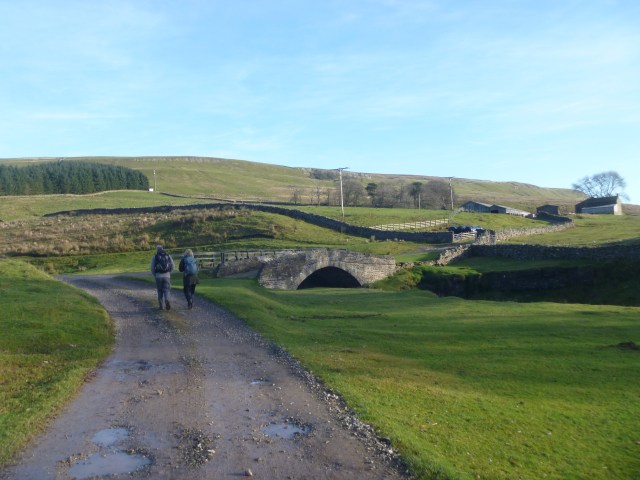
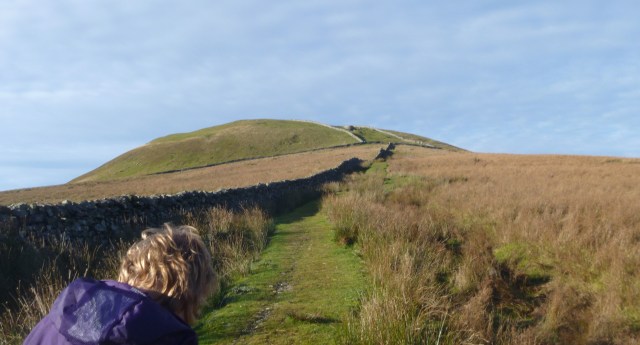
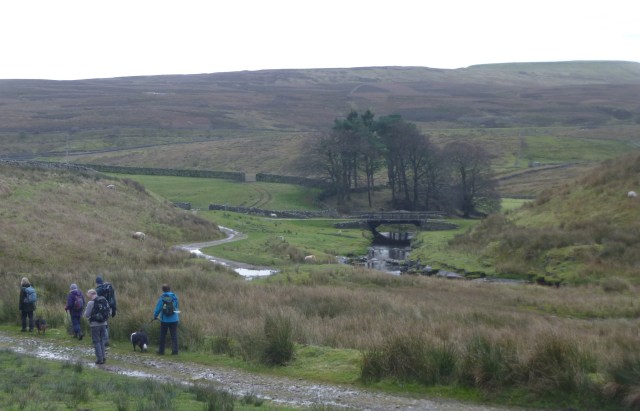
Five walkers and two dogs joined two leaders (Bob and Brenda) on Garsdale Station northbound platform this morning in bright sunshine and enjoyed the 8 mile hike. There was one steepish climb – but remember ‘No pain, no gain’ – to a high ridge path with wonderful views and the perfect late November picnic spot. The day could not have been better.
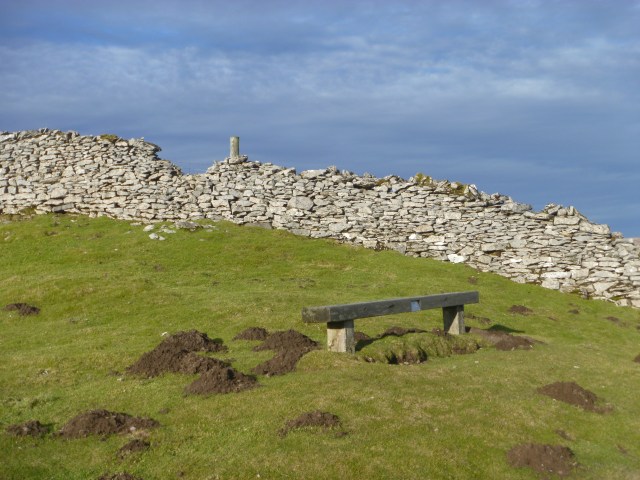
And enjoyed a picnic (our bench awaits) at the highest point of the walk – Cotter End
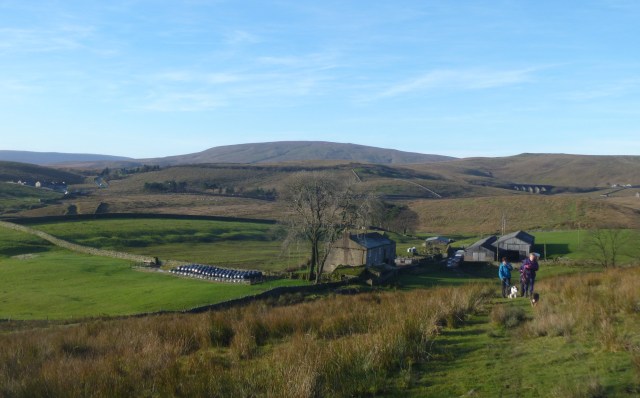
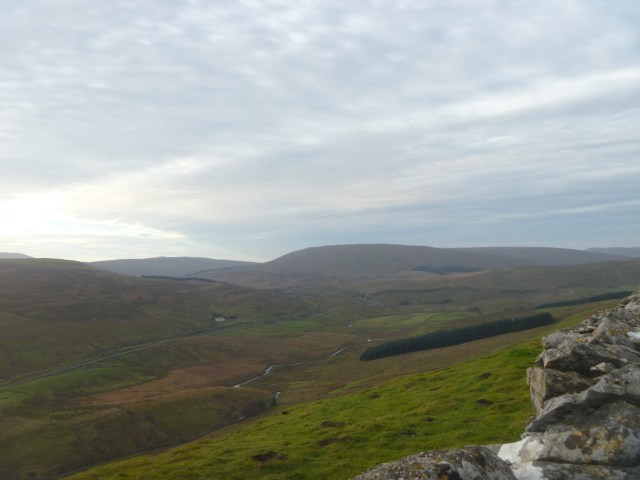
From the High Way we could see the extent of our walk
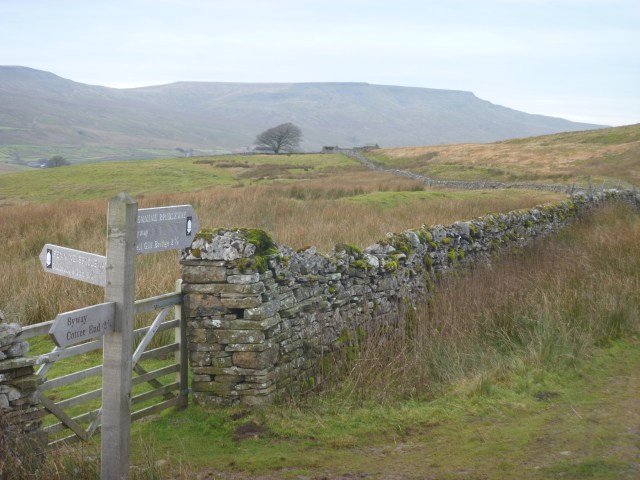
We descended from the High Way to join the Pennine Bridleway
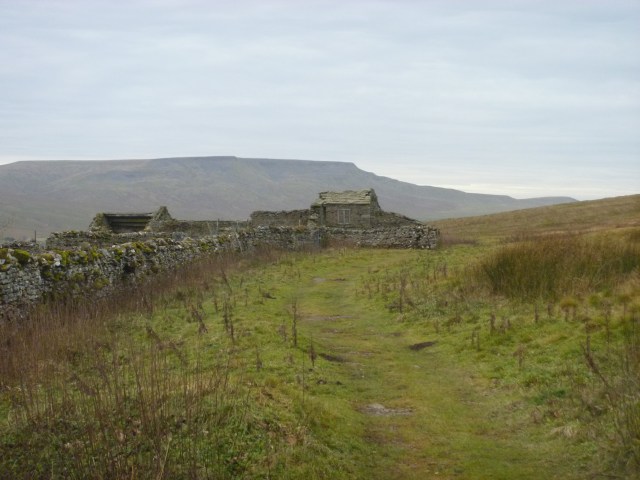
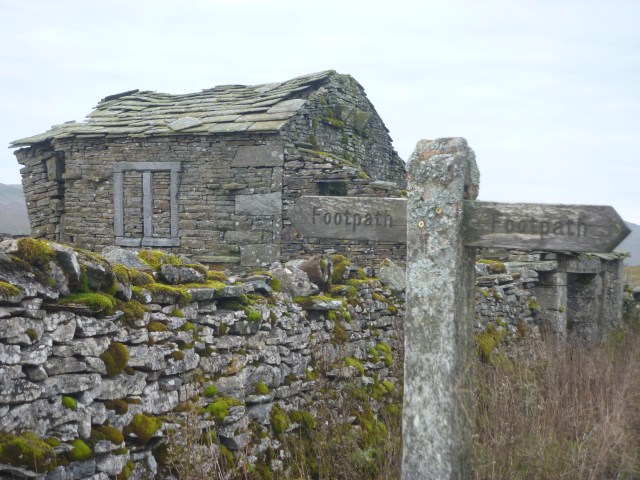
With plenty of time to spare we took a short detour to view the ruins of an Inn on the High Way
Once a busy inn along a main thoroughfare for sheep drovers and the like now a ruin
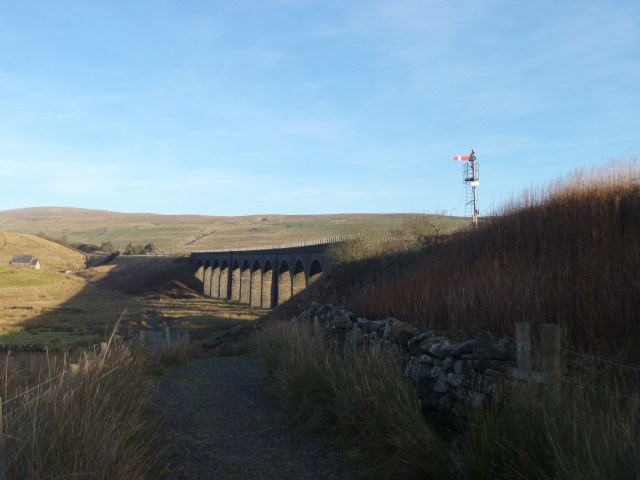
As the sun went down we headed back down to the River Ure and …
Garsdale Station
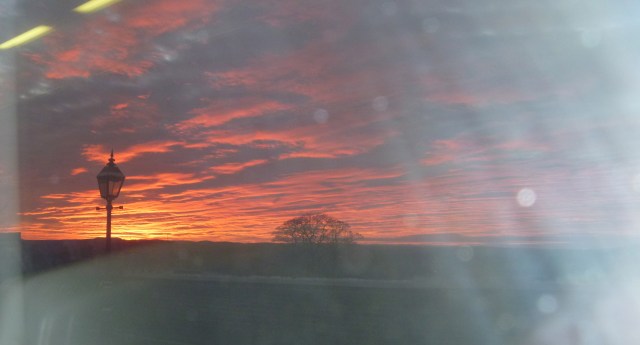
Sunset at Settle Station from the train window
Our train left at 3.35pm and we witnessed a wonderful sunset over the hills and moors. My photo taken through the train window doesn’t do justice to it. It was great to get out on this beautiful day in an area I was not at all familiar with and I think I will try more of these walks in future.
Amongst many generous donors towards the reconstruction of Astley Castle the Heritage Lottery Fund was one of the major ones; giving a grant of well over a million pounds to help the project on its way. HLF grants come with strings attached. So Astley Castle, quite rightly, enjoys many features and events not normally connected with Landmarks, in which the general public may be involved such as local school visits, open days and living history weekends. Public involvement has also included art exhibitions and a competition to design an Elizabethan knot garden in the grounds.
The Winning Knot Garden
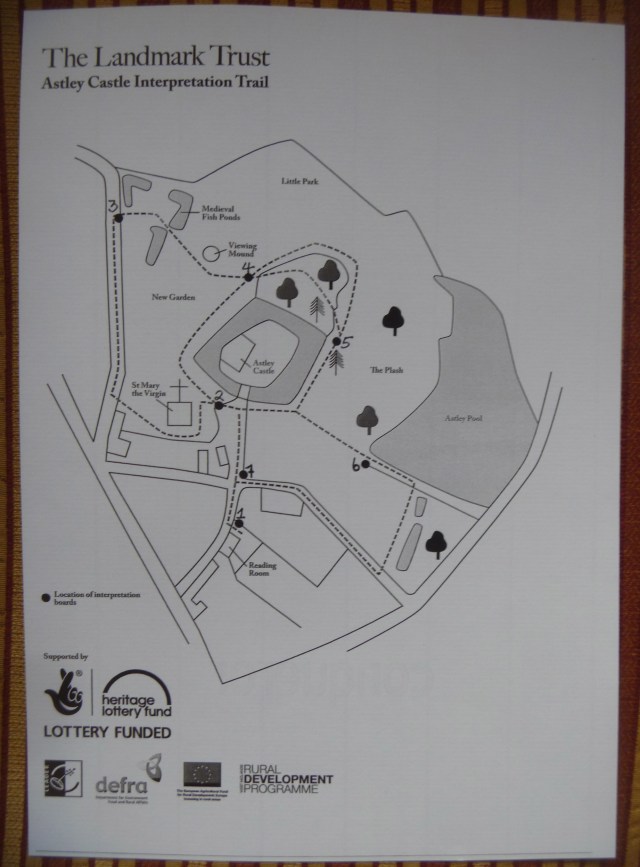
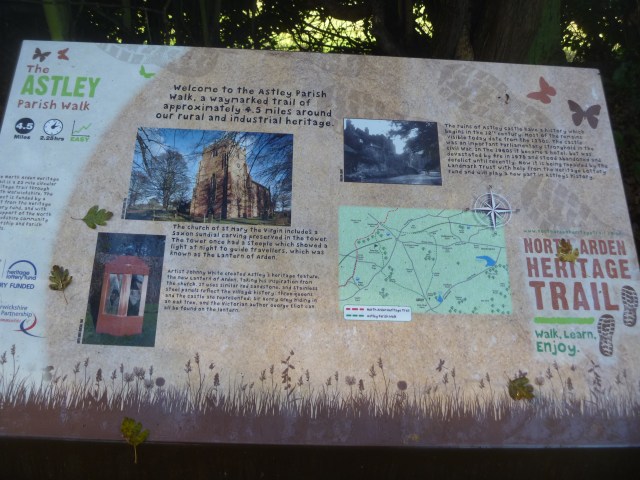
One excellent result of the HLF involvement lead to the establishment of an Interpretation Trail on public footpaths through the area surrounding the castle (but keeping to the other side of the moat!). Information boards along the route explain the views and relate the history of the castle and its royal connections. Of course, I walked this trail many times in both directions. The views changed as the weather and light did throughout each day.
Let me take you along the trail. (Numbers refer back to the map above)
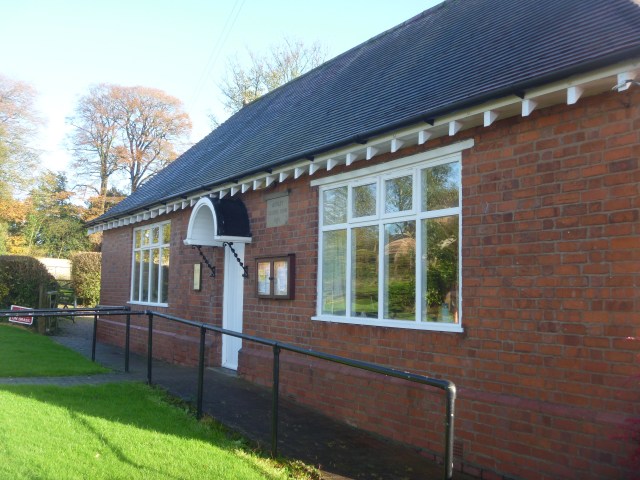
Astley Reading Room
1. At The Astley Reading Room two boards give a general introduction and explain the creation of Astley Castle as a ‘Landmark for the 21st Century’.
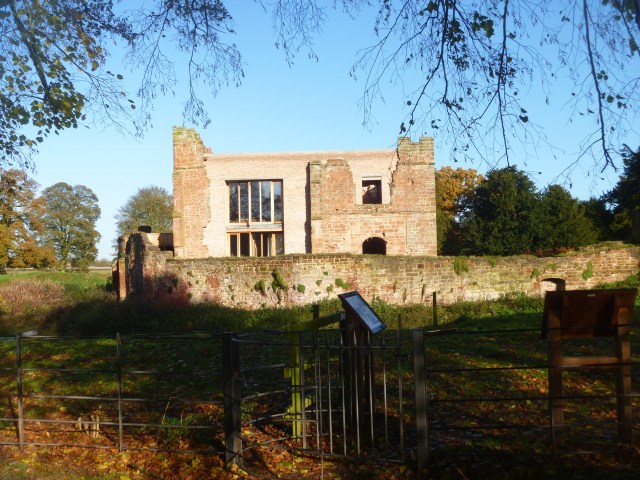
Astley Castle : South Elevation
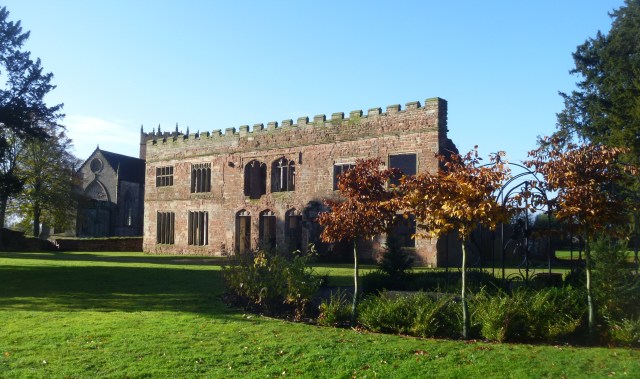
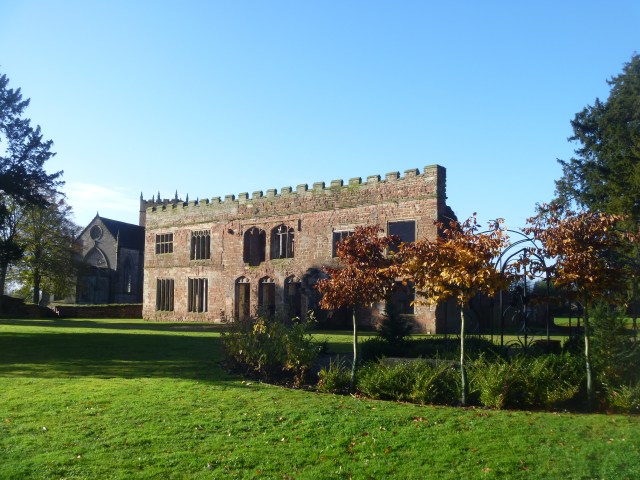
2. Astley Castle : South Elevation. Staying at the castle; this is where I began the trail each time.
“This ancient structure still remains, and the grounds surrounding it being tastefully laid out and kept in good order.” (Smith’s“A new and complete history of the County of Warwickshire”, 1829)
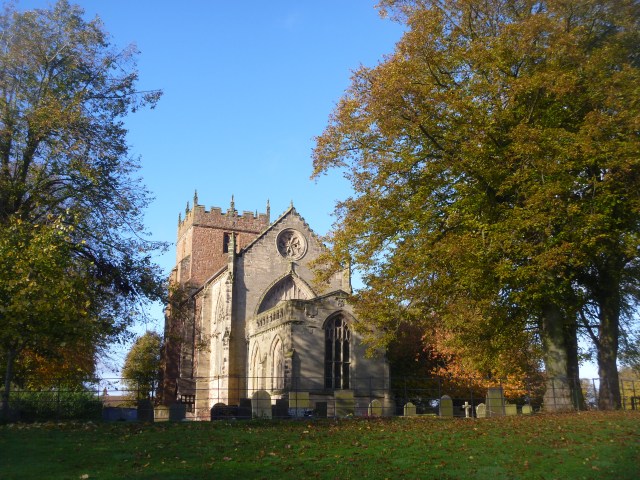
Astley Church
From the Interpretation Panel
From here there’s an excellent view of Astley Church of St Mary the Virgin. [To be the subject of another post] Proceed through the churchyard to a rather muddy lane and panel 3.
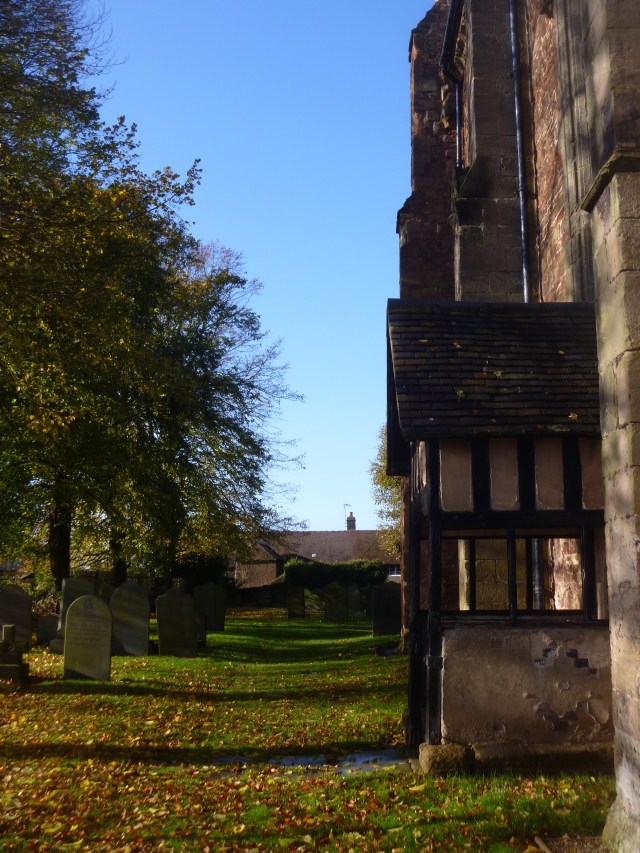
Path through churchyard
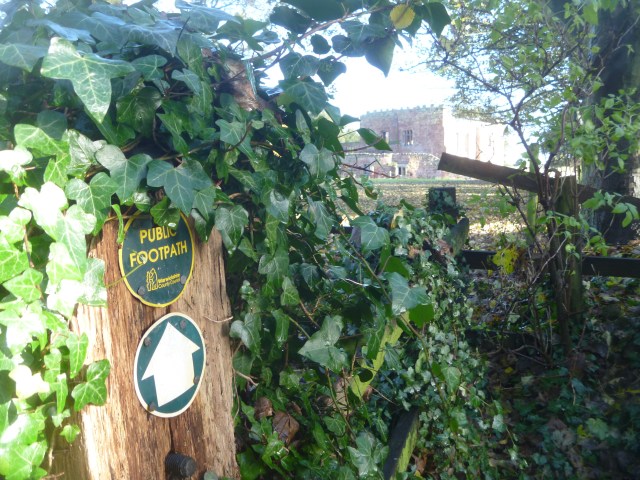
Follow the Trails this way
The Astley Parish Walk shares this lane with the Trail
3. The New Garden. “Today the New Garden is used as pasture but the many lumps and bumps hint at significant buried archaeology, especially in this north-western corner” [Interpretation Board] In fact from this point we re-enter the Castle grounds and here are ancient fish pools and a man-made ‘Viewing Mound’.
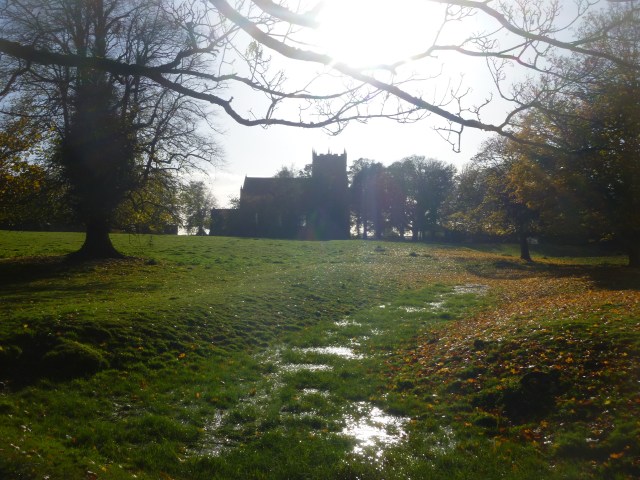
The former Fish Ponds and Astley Church
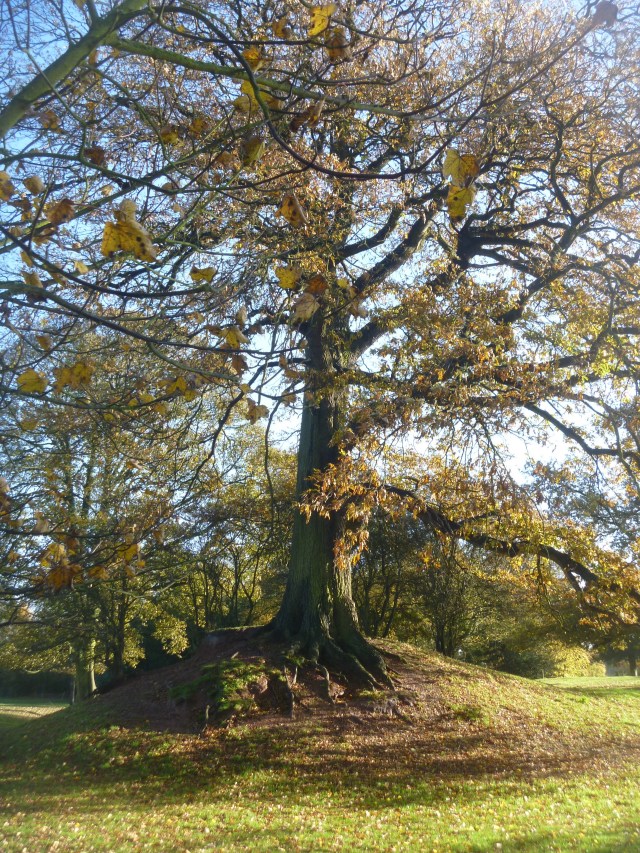
The Viewing Mound topped by an ancient oak tree
“There can be no real doubt that the New Garden was designed as a garden for the adjacent castle and it was probably laid out with paths, raised-bed type planting, arbours, hedges, and seats, perhaps in the late 15th century. The viewing mount could date from this period too.”.
The area is labelled as New Garden on this estate map dated 1690.
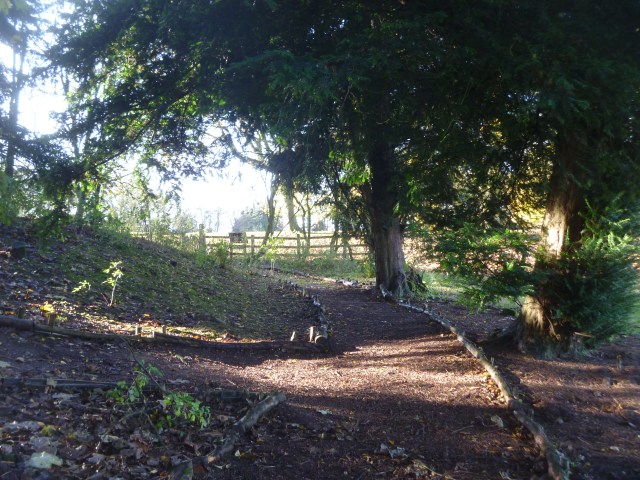
4. Little Park and Shrubbery. Here we leave the meadow and pass through a gate into a small wood or copse now known as The Shrubbery. It contains the kind of cultivated shrubs popular in the 19th century and is only shown on maps as a separate area on maps of the late 19th century and after.
BCTV footpath through the Shrubbery
Just as building work on the castle began and continued from 2008 “volunteers from the British Trust for Conservation Volunteers (BCTV) worked tirelessly to clear fallen debris, self sown trees and invasive weeds along the footpaths, here in the Shrubbery and around the banks of the moat.”
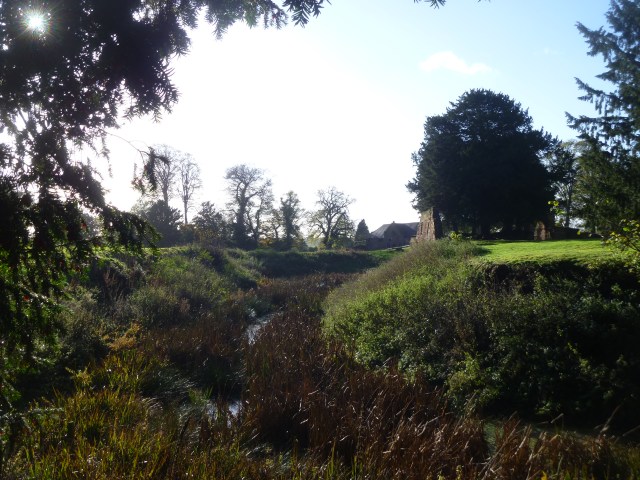
The Moat contains water in places
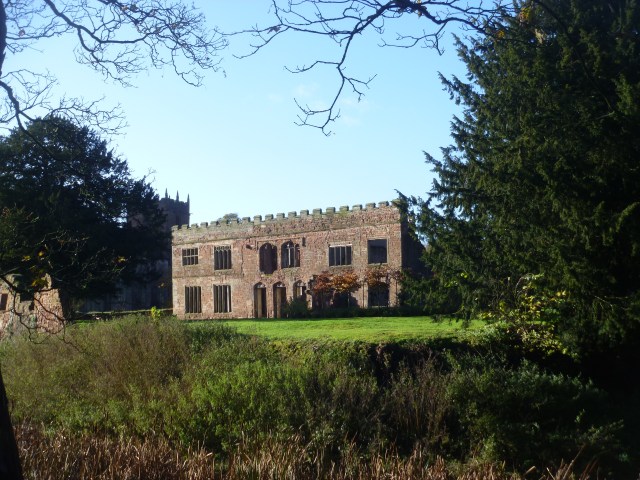
5. East Elevation and The Plash. Emerging from the Shrubbery we gain another view of the Church and the Castle. The East Elevation is to all intents and purposes the Front and Entrance to the building. But looking in the opposite direction there’s a broad green meadow (The Plash) and the still waters of the Astley Pool fishing lake.
The East Elevation (Front) of Astley Castle
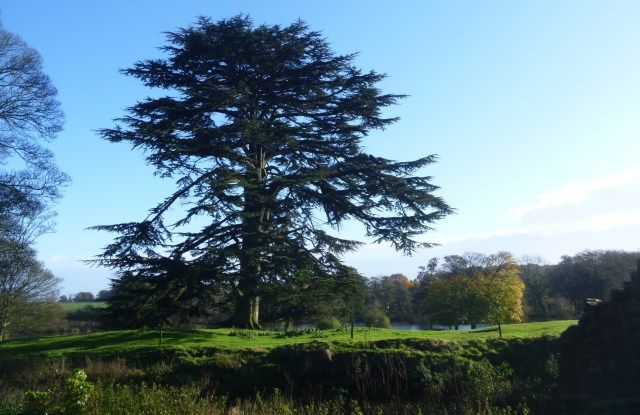
“The Old English plaesc, modernised as ‘plash’ means ‘a shallow piece of standing water, a marshy pool’ so this is likely to be an ancient natural feature, enhanced and adapted by the castle residents. … The Plash is dotted with trees, several of which are mature specimen trees – including a fine cedar tree.”
The Cedar Tree
The Plash and the Pool
6. Astley Pool and New Road. Our path takes us across The Plash to Astley Pool, a man-made lake. Although it may seem a typical 18th or 19th century creation it is first referred to in 1501. It is now a private fishing lake.
“The New Road was created to link the drive from Arbury Hall to a new access to Astley Castle. The first part of this was across the top of the pool dam and this would have provided a suitably attractive route up to the castle.”
7. Dark Lane and Castle Approach. The BTCV volunteers had been busy clearing the last lane that leads back to the village and the Castle. I was surprised to read in the interpretation notes that this lane was in fact a disused ‘holloway’. I have recently read Robert MacFarlane’s recent book “Holloway“. I had assumed that these features of the landscape only occurred in Dorset and the Downs of the South of England but here was one in the Midlands.
The Holloway
“‘Holloway – the hollow way. A sunken path, a deep and shady lane. A route that centuries of foot-fall, hoof-hit, wheel-roll and rain-run have harrowed into the land. A track worn down by the traffic of ages and the fretting of water, and in places reduced sixteen or eighteen feet beneath the level of the fields.’ “
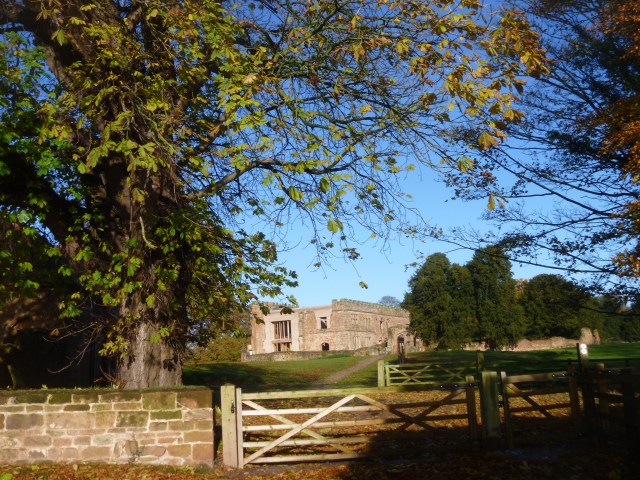
And here we are back where we started at the approach to the castle. On the left is the Coach House like the Castle left to ruin but now repaired and water-tight although it has no use at the moment. Behind are the 18th century Gothick stables.
The Coach House
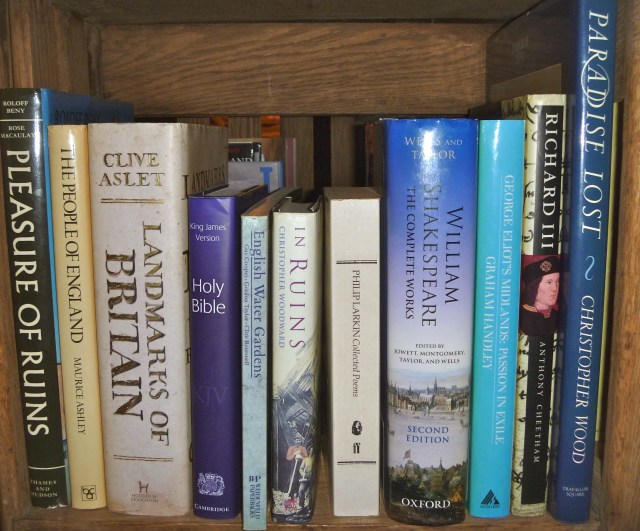
I return to the Castle to study the library and read more about ruins and the rich history of Astley and England.
“The Building Bears Strong Marks of the Ravages of Time and Presents an Extremely Picturesque Appearance” Britton’s “Beauties of England and Wales“.
The Stirling Prize is the most prestigious prize for British architecture awarded annually :
“to the architects of the building that has made the greatest contribution to the evolution of architecture over the past year. The prize is for the best building in the UK by RIBA chartered architects and International Fellows, or in the rest of the EU by an RIBA chartered architect.”
“The RIBA Stirling Prize was born in 1996 out of its predecessor The Building of the Year Award. The Building of the Year Award had been running since 1988 and the winner was chosen by the RIBA President from a handful of National Award winners. This was thought of as neither transparent nor democratic. The aim with the Stirling Prize was that the winner should be decided in an unbiased way, with different juries visiting the ‘midlist’ and shortlist.
The new prize was named after James Stirling, the great British architect who died in 1992. The aim was that the Stirling Prize would be for architecture what the Booker Prize was for literature, and a £20,000 cash prize for the winning architects made the prize covetable as well as prestigious.” [Source]
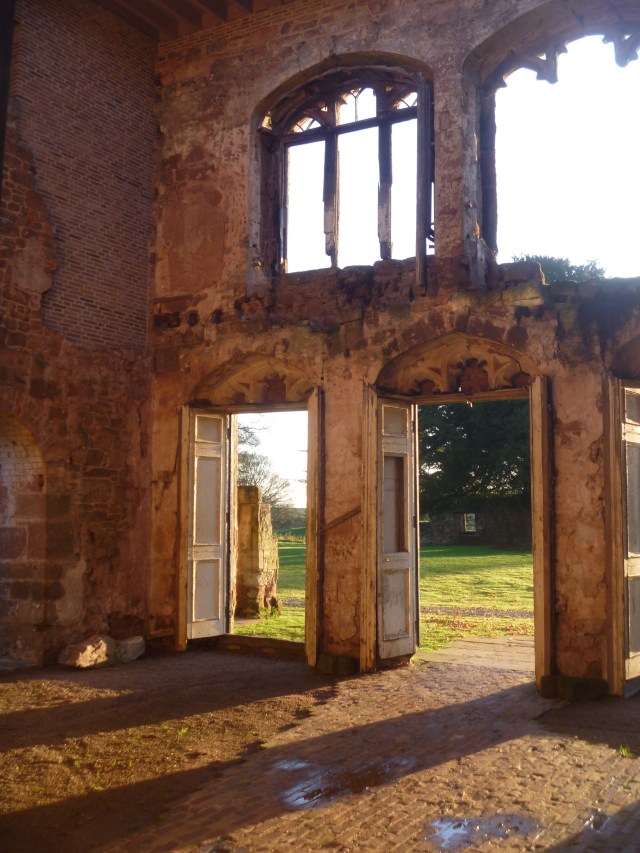
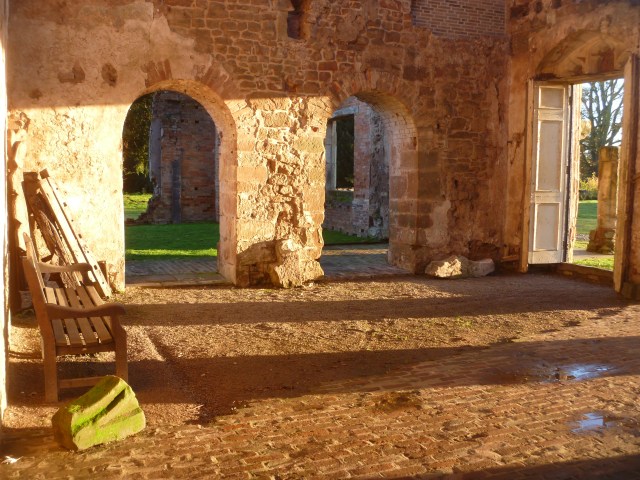
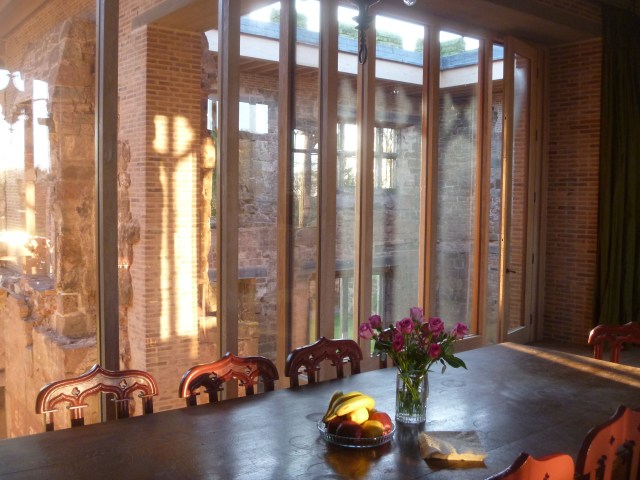
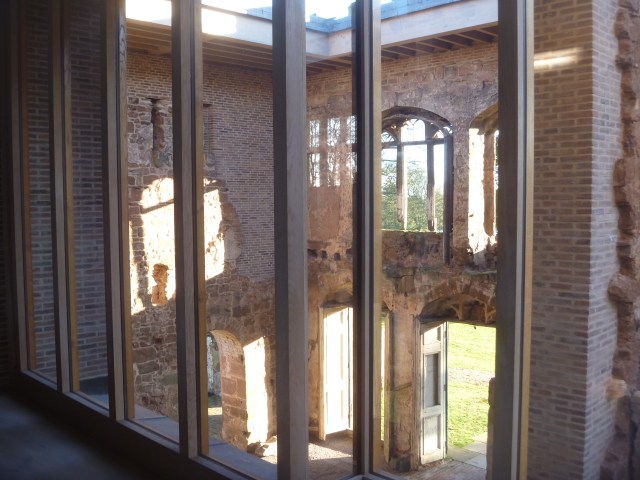
In 2012 I was fortunate enough to be invited by friends who are Patrons of The Landmark Trust to attend the celebration opening of Astley Castle in July 2012. Immediately on leaving the reception and arriving home I decided to book the castle for a week (Monday to Friday) in November 2013.
Here are some of the highlights and light effects from this unforgettable stay.
“Mr. Bennet, how can you abuse your own children in such a way? You take delight in vexing me. You have no compassion for my poor nerves.” “You mistake me, my dear. I have a high respect for your nerves. They are my old friends. I have heard you mention them with consideration these last twenty years at least.”
Pride and Prejudice, by Jane Austen. Chapter 1.
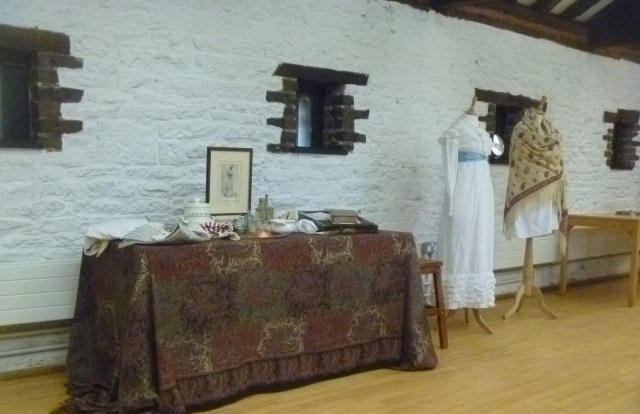
The Set for Oh My Poor Nerves in the Barn at Red House
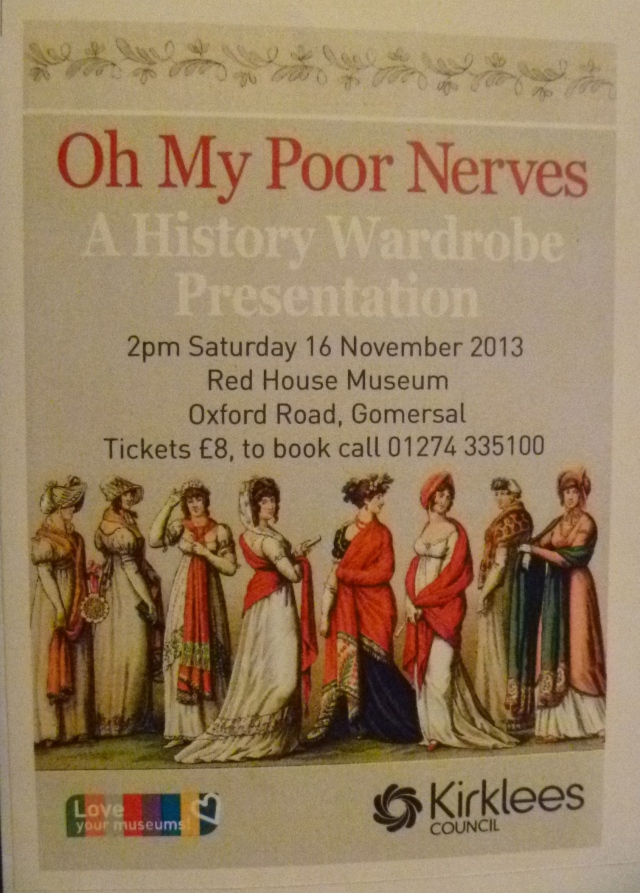
What fun I had at The RedHouse this afternoon! And not just fun – I learnt a lot too. A few weeks ago I noticed a flyer for a History Wardrobe performance this Saturday, checked their website and knew that I had to book a ticket to see what it was all about.
Lucy and her costumes. Left – original Georgian gown. Right – copy of Georgian maternity support corset
Here is Lucy’s witty introduction to the presentation :
“This talk focuses on an often overlooked period in the history of healthcare, giving an overview of living conditions in late Georgian England that hardly squares with our usual picturesque view of Regency life. Details of home cures, quack remedies and crude surgery highlight the battle between science and superstition, putting the later medical advances into context. For those who feel faint after viewing a pregnancy corset or the leech jar, I do have plenty of ‘infallible’ Regency advice for good health and long life. And sal volatile.”
Interspersed with quotations from Austen’s books (Jane Austen loves hypochondriacs) Lucy entertained us for nearly two hours with details and examples of all kinds of diseases and dangers prevalent in Georgian England and how they were treated by dubious doctors and questionable quacks.
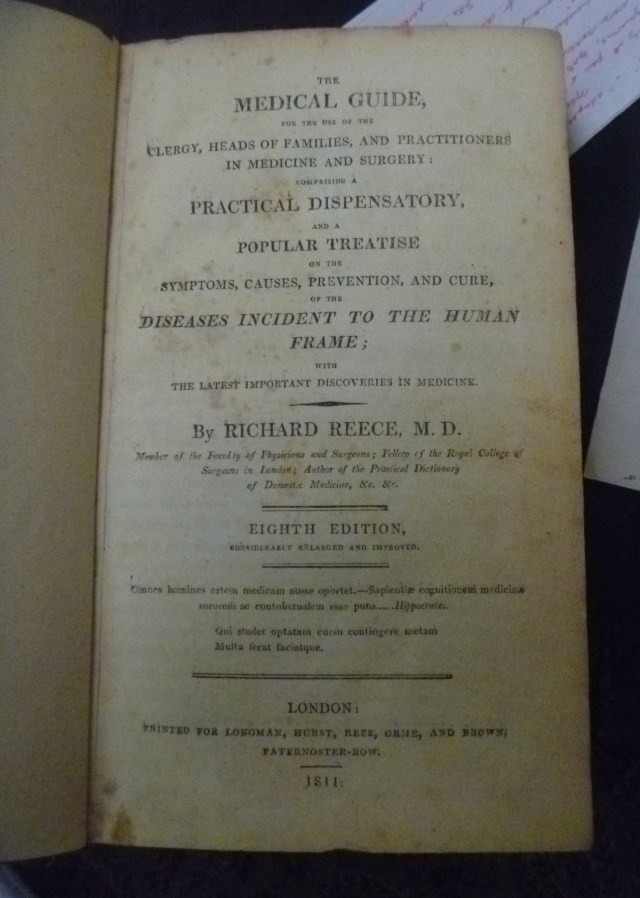
Dr Richard Reece’s Medical Guide
She read to us the list of diseases from which one could die in the late 18th and early 19th centuries – the list extracted from Doctor Richard Reece’s “The Medical Guide” of 1811 which, along with all Lucy’s other original and reproduction props, we were able to inspect for ourselves after the performance.
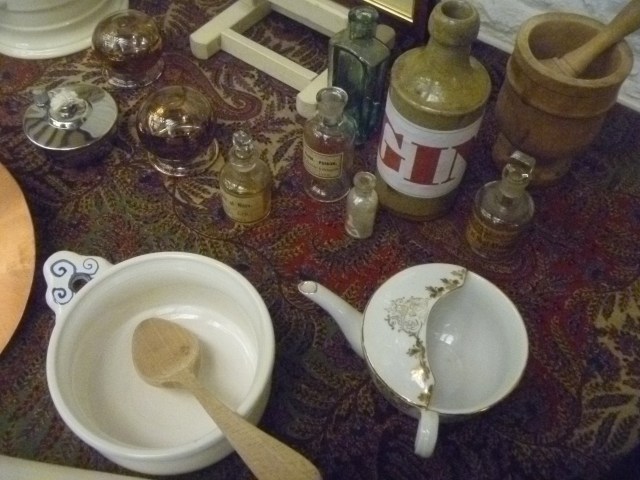
Reproduction and original props
I am now highly enlightened on subjects as diverse as the dangers of red stockings (the dyes); that wallpaper killed Napoleon (arsenic); the extent of cholera epidemics and the locations of cholera burial grounds; body snatching (for medical dissection purposes); the benefits of a porringer of gruel (as recommended by Mr Woodhouse in “Emma“); the greatest danger for the Georgian militia and navy (disease); the biggest killer of women (childbirth); shifts and chemises; detoxing Georgian style; drugs and leeches; lancets and forceps; operating theatres and quack medicine.
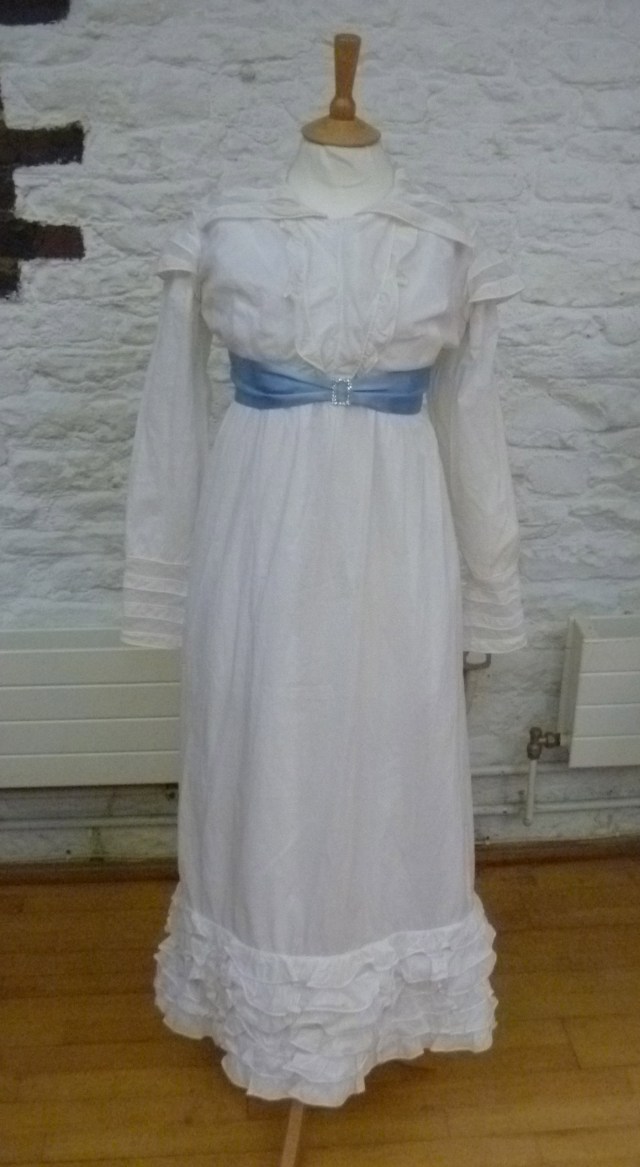
The prize item in Lucy’s collection of historic costumes must be the original Georgian gown.
Lucy’s entertaining presentation this afternoon went to prove that history, science and medicine can all be fun.
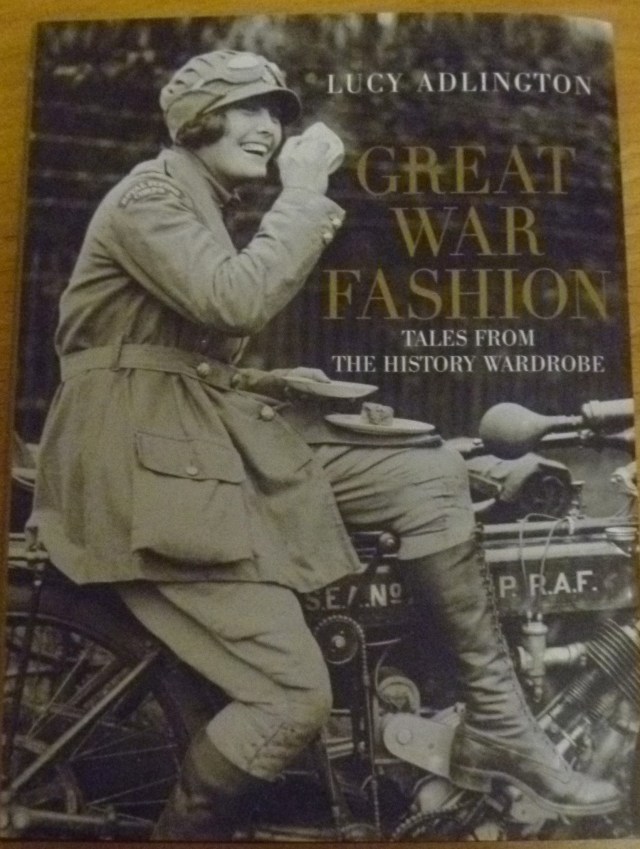
She even made reference throughout to her new book in which, although titled “Great War Fashion“, she demonstrates that even by the early decades of the 20th century some clothes, medical treatments and aspects of hygiene had never changed.
Before I left the Red House I bought a ticket for another presentation next year – Titanic!
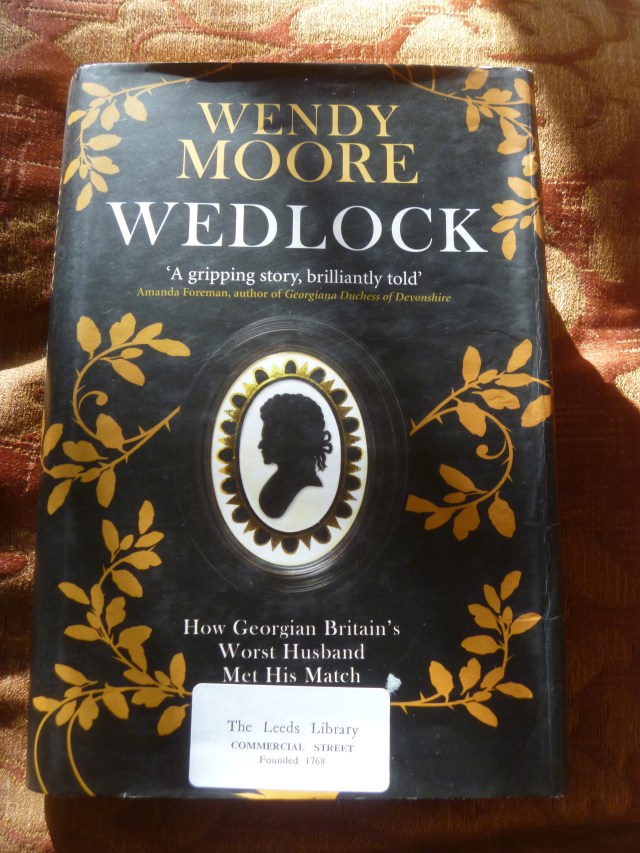
Last week I finished reading ‘Wedlock’ by Wendy Moore, subtitled on the cover ‘How Georgian Britain’s Worst Husband met his Match’. And what a tale it tells. It’s been recommended to me from several sources not least from Nilly Hall‘s wittily titled ‘Bowes and Cupid’s Arrows‘ published last February.
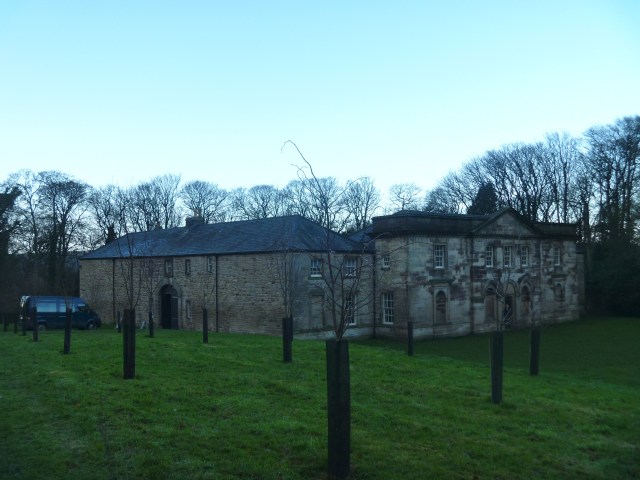
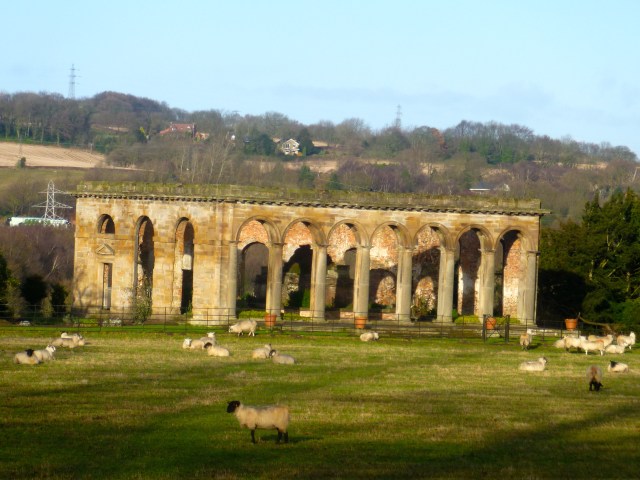
The book is the story of Mary Eleanor Bowes (1749-1800) daughter of the coal baron creator of “Gibside, a Georgian ‘grand design’ on a spectacular scale. The vision of coal baron George Bowes, the Palladian chapel is an architectural masterpiece, the stable block is a vibrant learning and discovery centre, and the once grand hall is now a dramatic shell. Gibside is also a haven for wildlife with red kites often circling in the skies above.” [NT]
The Stable Block
Gibside just a few miles from Newcastle is now the property of the National Trust. I have visited Gibside twice. The most recent time was just last December on my way to a course at Sage plc.
The Chapell
The Greenhouse or Orangery
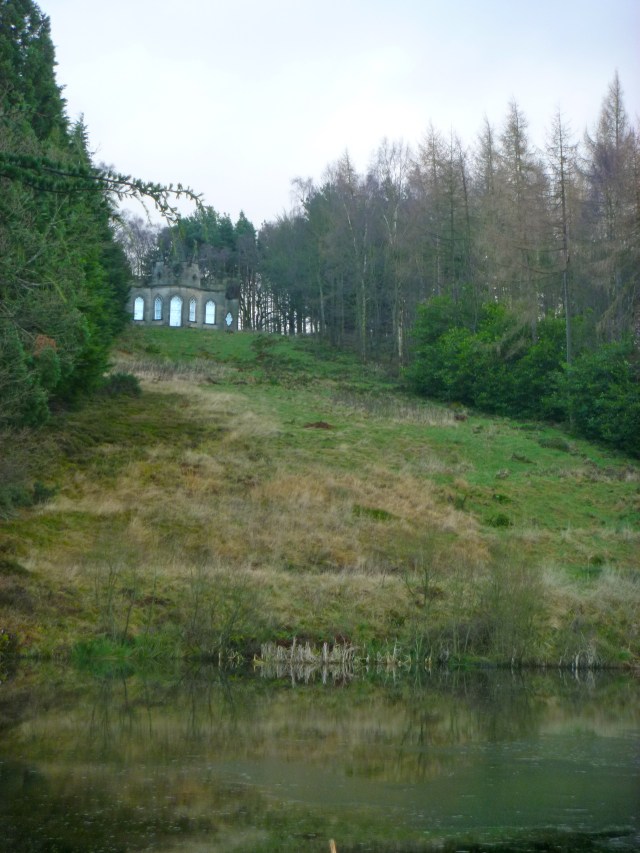
The Banquiting House
The water feature below the Banqueting House was an elegant octagonal pond built in the Greek style to add to the stately vistas. A fountain cooled he air and statues stood on the terraces above. The Banqueting House was restored by The Landmark Trust after many years of neglect. That same neglect has had some happy consequences for the pond. It is now a Site of Special Scientific Interest (SSSI) for its population of great crested newts. There are no plans to restore the Octagon Pond as any such work could destroy the habitat of these shy and rare creatures, as well as upsetting the many other types of bird and aquatic life that thrive here. [Extracted from the Information Board at the Pond]
A highly educated woman for her time Mary Eleanor’s father, George Bowes, died when she was 11 leaving her a vast fortune and prey to future gold-diggers. She married her first husband, John Lyon, the 9th Earl of Strathmore, in 1767, gave birth to five children in six years and was left a widow when Lyon died of tuberculosis in 1776.
Her second marriage to Andrew Robinson Stoney, an Anglo-Irish adventurer, was a total disaster. Self-styled ‘Captain’ Stoney duped Mary into marriage in 1777. From then on she was brutally treated and virtually held captive by him. Finally, she did manage to escape his clutches and even to divorce him – highly unusual at the time. He is the origin of the term “stony broke” – he died in a debtor’s prison – and he was the inspiration to William Makepeace Thackeray who learned of Stoney Bowes’ life story from the Countess’s grandson John Bowes and used it in his novel “The Luck of Barry Lyndon.”
Stoney’s or Bowes’, as he is called in the book (in compliance with Mary’s father’s will, Stoney changed his name to Bowes his marriage to Mary Eleanor), greed was responsible for the ruin of Gibside and the destruction of thousands of trees on the estate .
It is ironic that Mary’s father constructed the Column of Liberty in the grounds of the estate when for several years during her marriage to Bowes she was very far from being at liberty.
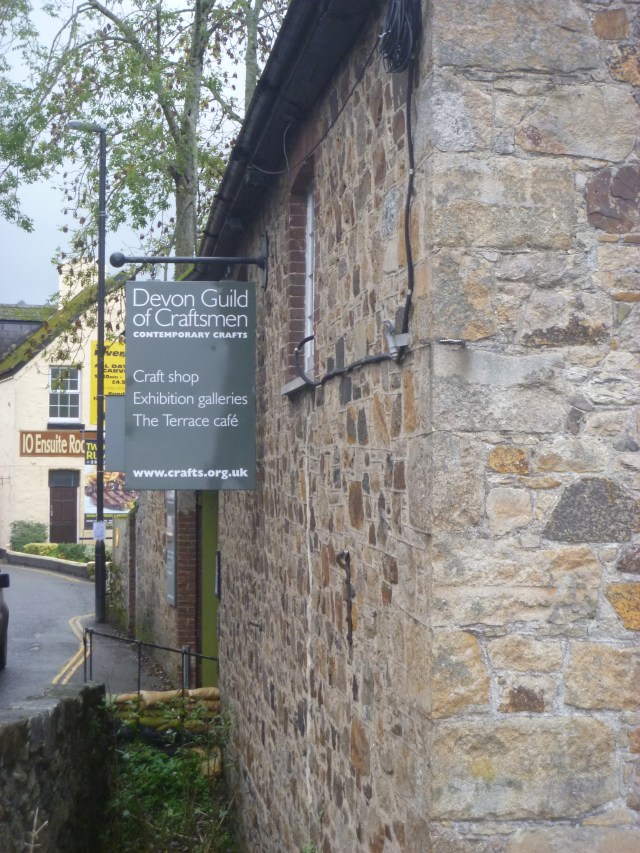
Every year, around this time, we visit Devon for a week. Whilst there we never fail to fit in a visit to some galleries and one of our regular haunts is The Devon Guild of Craftsmen in Bovey Tracey.
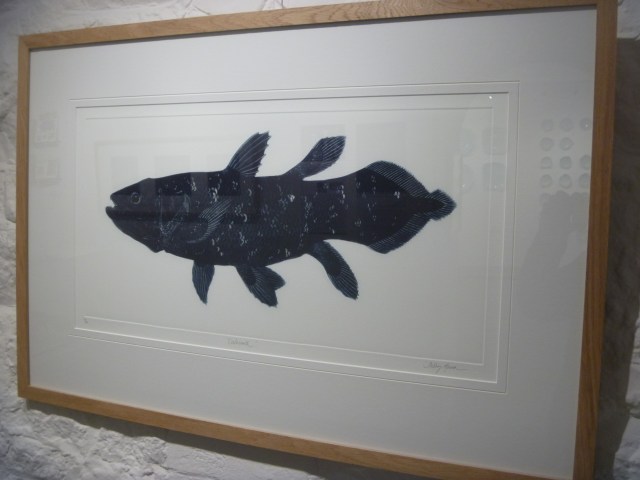
This year my favourite display was a small, one-room exhibition of Debby Mason‘s work. Her exhibition features just a few fantastically intricate fossil fish mezzotints. I also enjoyed the interesting assortment of additional information and artefacts.
Debby’s Coelacanth Mezzotint
“Visit our Members showcase gallery and follow the story of the elusive fossil fish told through Debby’s beautiful mezzotints. The Coelacanth has become a very familiar and favourite subject for Debby’s work. This showcase concentrates on this fascination and gives visitors an insight into the artist’s journey – from idea to final piece.”
There was a digital slideshow demonstrating the sequence of production of a mezzotint and the many inspirations that lead Debby into her chosen field of artwork.
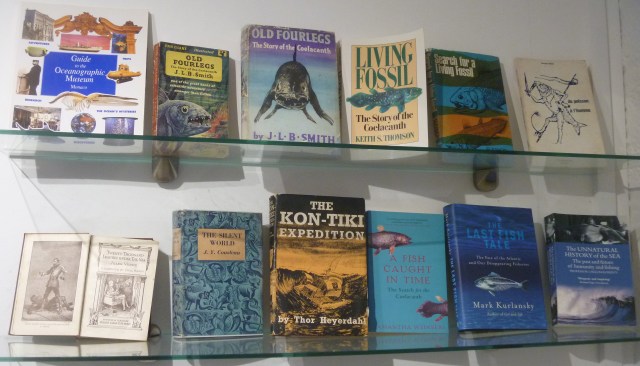
In addition there were two shelves of influential books; some related to her earliest interests like Thor Heyerdahl’s Kon-Tiki expedition, the underwater world of Jacques Cousteau and a visit to the Oceanographic Museum in Monaco :
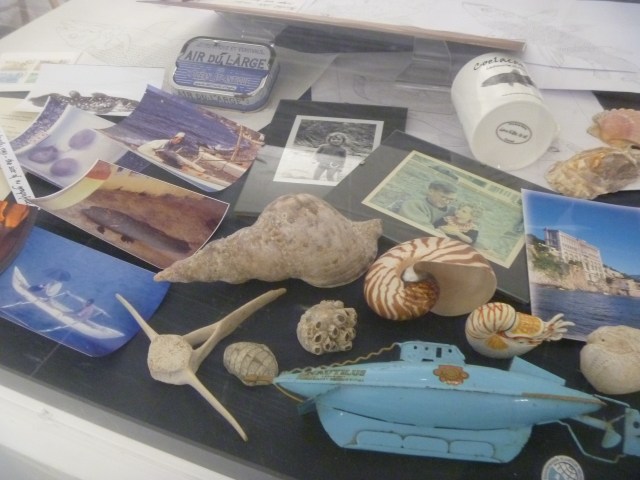
There was also a display case of photos, shells, flotsam and jetsam.
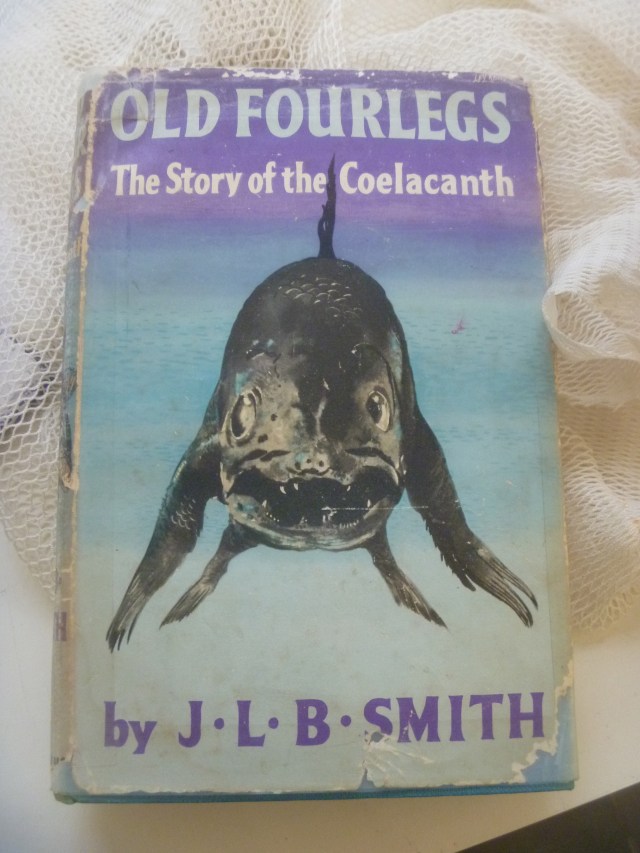
I suppose also the idea of the Coelacanth intrigued me and reminded me of trips to Lyme Regis to visit the Museum and to try my luck at fossil-hunting.
“In 1938 a live Coelacanth was caught off the coast of South Africa. This caused a sensation because it was thought that these fish had died out 85 million years ago.” [Devon Guild poster]
Debby’s show is on at the Bovey Tracey Gallery until 2nd December.
In addition to a shared love of reading Lynne (alias Dovegreyreader) and I have a love of houses and a nosey poke around in other people’s – especially the grander sort – when we get an opportunity. The chance arose when I was wondering how to belatedly celebrate her big birthday on our annual Devonshire Day Out.
Dovegreyreader can’t wait to get inside Lukesland
Then I remembered “Invitation to View” an organisation that brings together house owners and those inquisitive members of the public prepared to pay to have a private guided to tour of their homes followed by tea and cake or a light lunch by the fire or in the garden depending on the time of year. A small number of houses in Norfolk and Suffolk were included in the early years. This number has increased quite significantly and a few years ago The Southwest joined the group and there are now 23 houses in Devon, Cornwall and Somerset included in the scheme.
So, a couple of weeks ago I extended An Invitation to View to Lynne who accepted right away and we made our arrangements to meet last Thursday. Meeting at 11.30 in a favourite cafe of ours in Ashburton – Moorish – we allowed ourselves an hour and a half to catch up on each other’s families and reading and what-not, to drink tea, eat soup and, oh dear, have the first cake of the day. (Well, we were celebrating a birthday – any old excuse will do when the Moorish Tunisian Orange Cake is winking at you!).
Comfortably sustained by soup and cake Lynne drove us to Ivybridge and up out of town onto the edge of Dartmoor to Lukesland; the house we were booked to visit. From about 1.30pm the gardens were opened to us and the house tour began at 2.30pm.
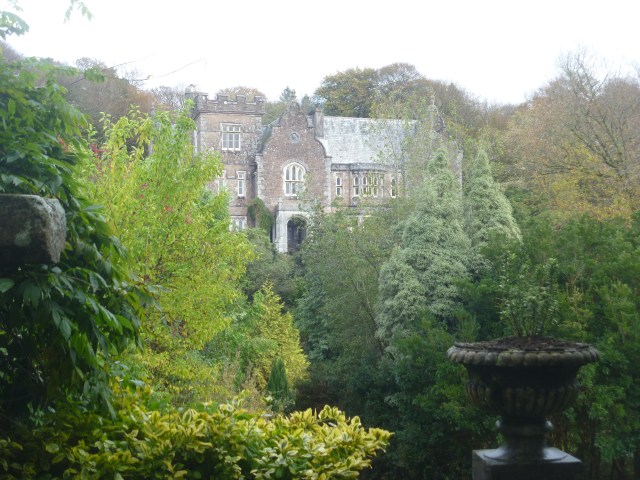
Lukesland House and Garden
The gardens at Lukesland are generally open to the public in the spring and in the autumn. We thought there would be more autumn colour in early November than there was but nevertheless we enjoyed a chatty wander and took some photos as photography inside the house is not permitted.
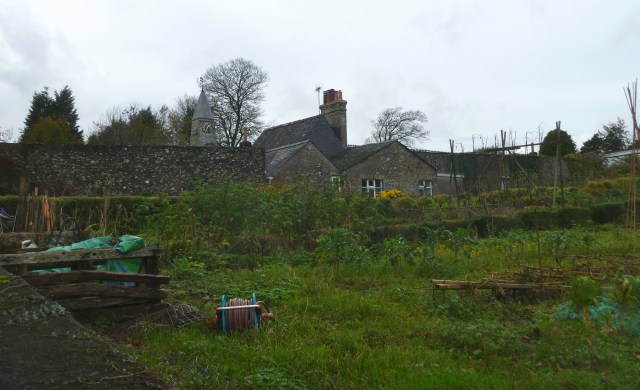
The Kitchen Garden
The Kitchen Garden was the main garden of the original Tudor estate. It was much reduced in size by the Victorian owners in order to build a drive between the house and the stables (under the clock in the photo). The garden produced vegetables for the family, the domestic staff and for the farm workers on the estate until the 1940s. Since 2005 parts of it have been let as allotments to local Ivybridge residents.
Lukesland
Milady and Dovegreyreader at Lukesland
By 2.30 about 14 of us were assembled in Rosemary Howell’s sitting room waiting for the talk and tour to begin. Rosemary and her daughter-in-law Lorna welcomed us to the house and told us the brief history of the place.
“The Place Names of Devon lists “Lukesland” as being derived from the family of John Lucas in the 1330 Lay Subsidy Rolls.” There is evidence – written and in carved stonework – of settlement at Lukesland during and ever since Tudor times. The Tudor house was called Lukesland Grove. In 1863 a new (the current) house was built of Dartmoor granite and Portland stone on a new site and in the popular Victorian Gothic style for William Edwin Matthews, as a base for hunting on the moor. “Around 1875, Matthews was obliged to sell Lukesland and it was bought by James and Barbara MacAndrew, who came from the family of the London-Liverpool shipping line of that name.”
Howard Howell, a Canadian who came to Britain with the Canadian Expeditionary Force during the First World War, worked locally in forestry and married a Welsh woman, Muriel Neale and they settled in Exeter later buying Lukesland. The estate was in its heyday before the Second World War.
“A second phase of landscaping of the garden took place. A pond was dug (‘The Lower Pond’ as it is now), many waterfalls installed and three stone-arch bridges built (one, just below Rh. smithii, collapsed after a flood undermined the foundations in the early 1970s). A bathing pool was built on the island in front of the house, and a much bigger range of rhododendrons was planted, along with other shrubs and trees. Although the Victorians had planted some newly introduced exotic trees in the Cleave, including some Wellingtonias, this was the first time that the garden was really diversified. Many more flowering shrubs were available by the 1930s, and Howard was a forester who took a keen interest in them.”
Despite all the social changes in Britain since the War the Howell’s have lived on at Lukesland making changes and adapting the house and garden. Rosemary and her husband Brian moved in in 1975. Brian’s background was also in forestry. A lot of work needed to be done on the house. Brian died in 2003 and his son John and wife Lorna moved in in 2004. Adaptations include opening the gardens and tea room and letting holiday accommodation in out-buildings and in a wing of the house itself. [Adapted from Source]
Rosemary’s sitting room was in a separate wing of the house created by the insertion of a gothic-style but fully glazed door which separates it physically from the main body of the house. But done in this way I’m sure she still feels very much a part of the family.
We were then shown a larger sitting room and the big family kitchen created from a butler’s pantry and other servants’ quarters. It seems as if nothing is thrown away at Lukesland. Lorna joked as we moved from one scullery or dairy to the next that after the national collection of wallpapers we moved on to the national collection of flower vases. I kept making mental notes to self – get that loft and cellar cleared out!
Upstairs there seemed to be a multitude of bedrooms and bathrooms created from bedrooms all of which seem to be in use. There is also a separate apartment which is let a long-term holiday let. The house has a sheltered courtyard behind and here as well is the old billiard room and former nursery converted to a tea room and in use when the gardens are open.
Finally we returned to Rosemary’s sitting room where DGR remarked that the shabby, but not threadbare, rugs seem to be a feature of these old properties and I was able to tell her that the Landmark Trust would never use a new rug in an old property and that they have a huge store of suitably worn rugs ready to furnish future properties.
Tea and delicious home-baked cakes (yes, we carried on in the tea- and cake-tasting tradition established over the years) were served by the log fire and we discussed further what we had seen and how these lived-in houses are constantly evolving and adapting and how nice it was to see bookcases in every room, everyday objects and even imagining ourselves descending the stairs in Edwardian times as if we lived there!
I could not dig; I dared not rob:
Therefore I lied to please the mob.
Now all my lies are proved untrue
And I must face the men I slew.
What tale shall serve me here among
Mine angry and defrauded young?
Rudyard Kipling
After last year’s “Remembrance” post about the life and death of and memorials to Norfolk heroine Nurse Edith Cavell I decided to carry out some research of my own. I chose to follow the life to death of a young man born in Norfolk who died on the battlefield far away on the Turkish Gallipoli Peninsula. I managed to visit several of his Memorials in England and maybe one day will visit Gallipoli itself. 2015 will be a big year for visitors to the area to pay their respects. The significance of the Gallipoli Campaign is felt strongly in both New Zealand and Australia. ANZAC (Australian and New Zealand Army Corps) Day (25 April) is commemorated annually by both countries.
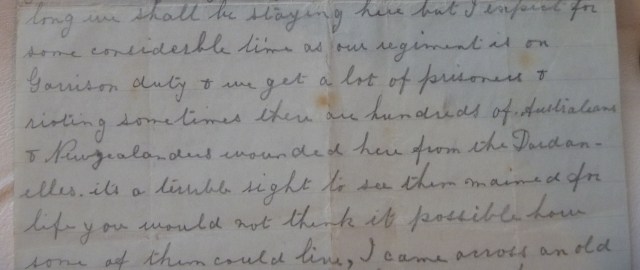
Private Howman in a letter home :
[… we get a lot of prisoners & rioting sometimes there are hundreds of Australians & New Zealanders wounded here from The Dardanelles. its a terrible sight to see them maimed for life you would not think it possible how some of them could live …]
Marshall Howman was born in June 1887 in Whitlingham, just south of Norwich. He was the eldest child of Mark and Celia. Mark was a herdsman and Celia was in service at ‘the big house’ wherever they moved to and the family did move around the country. By 1901 Marshall and his parents were living at Stenigot in Lincolnshire with additional sisters and brother : Lena (born in 1891), Hilda (in 1894), Maxwell (in 1895) and Kathleen (Kit or Kitty) who was born in Cheadle [Staffs] in January 1900. Later, in a letter home Marshall tells his family that he ‘came across an old pal I went to Cheadle School with he is in the 6th Manchesters back from the Dardenelles.’
By 1911 when Marshall was 24 he had three further siblings, born at Strensham in Worcestershire where his family had been living for several years : Ruth (born in 1903), Mabel (in 1906) and Norman (in 1910). By this time, although Marshall was still living at home (and adored certainly by his little sister Kit then aged 11), Lena (aged 20) was already making her own way and living in London as a domestic servant in the Mumford Family home in Westbourne Park Crescent, Paddington.
Next year will see the Centenary of The First World War; the, so-called, “war to end all wars”. When Britain declared war on Germany on 4 August 1914 Marshall (then 27) and his parents and most of the rest of his siblings were living in Corner Cottage, Strensham in Worcestershire. At some point very soon after; Marshall volunteered to join the Worcestershire Yeomanry The Queen’s Own Worcestershire Hussars. He was assigned to No. 2 Troop, D Squadron.
The 1st Worcestershire Yeomanry was mobilised in Worcester on August 4, 1914 as part of the 1st South Midland Mounted Brigade. On August 11 the regiment moved to Warwick, with the rest of the brigade and on August 14 the brigade proceeded to Bury St. Edmunds, Suffolk. The brigade moved to Newbury, Berkshire, on August 30, where it joined the 2nd Mounted Division. On November 17 the regiment and the rest of the division moved to Barningham, Norfolk, then on to Kings Lynn. Mention here of King’s Lynn and Norfolk reminds me of :
The 1999 BBC film “All the King’s Men” tells the story of the men of the Sandringham Estate who signed up in 1914 and fought in the Gallipoli Campaign
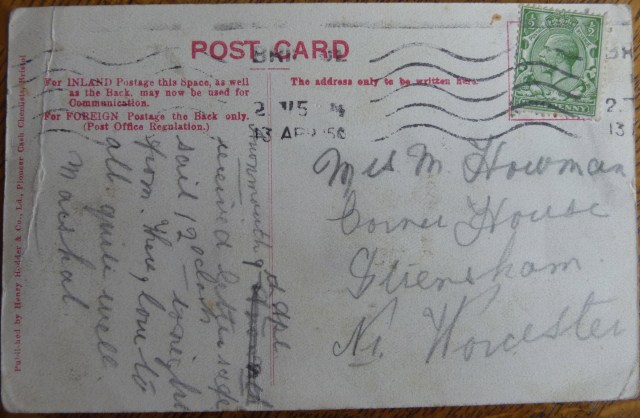
On the reverse of a picture postcard of Bristol dated 9 April 1915 Marshall tells his family that he’s due to sail at midnight from Avonmouth :
In fact the records state that it was on April 11, 1915 that the regiment sailed for Egypt from Avonmouth, Gloucestershire, on H.M. Transport Saturnia, arriving in Alexandria on April 24.
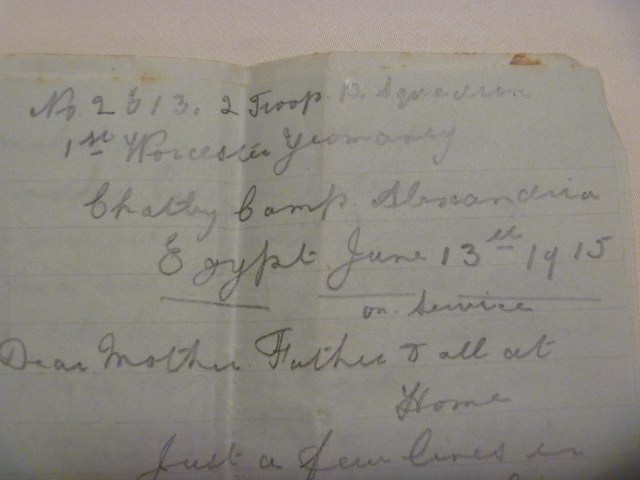
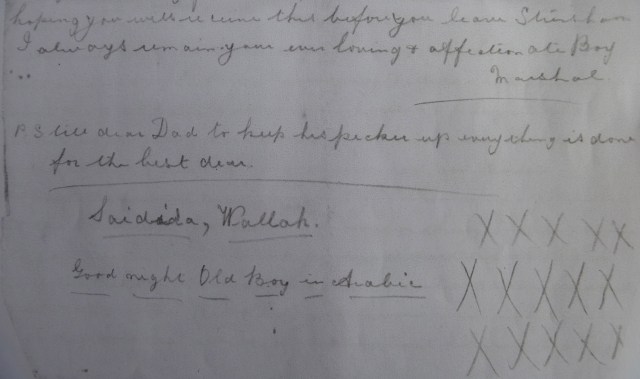
After disembarking the regiment went into camp at Chatby, near Alexandria. Here is a letter dated 6 June from Kom el Dik Fort and another dated 13 June (his birthday was in June) from Chatby Camp, Alexandria. In civilian life Marshall had been an assistant herdsman and he seems happy to have charge of horses at the Camp.
His letters home show that he had neat, clear handwriting and a very nice turn of phrase reflecting a reasonably good standard of education for an assistant herdsman a century ago. He was a loving and caring brother and son.
However, when the regiment was notified that it would be going on active service on August 10 its horses would be left behind. This must have been a blow for Marshall. On August 14 the regiment – 366 men strong – embarked for Gallipoli on H.M. Transport Ascania. On August 17 the transport arrived at the Greek island of Lemnos, and there the men transferred to the H.M.S. Doris. The following day (August 18), the regiment landed at “A” Beach, Suvla, under shellfire.
Here is what happened on 21st August 1915 :
“The 29th Division assaults 112 Metre Hill and Scimitar Hill, and 11th (Northern) Division assaults Green Hill and the “W” Hills in the Suvla sector, with the 2nd Mounted Division and the 10th (Irish) Division in reserve, out of sight of the Turks. The intention is to capture Scimitar Hill and to proceed on, if possible, and ultimately is to capture these positions, and thus protect the units scattered across the Suvla Plain from Turkish shellfire. At 3:30 p.m., after the failure of the 29th and 11th Divisions to take their objectives (due to strong Turkish defences, lack of adequate artillery support, lack of proper orders and lack of rest) the Worcestershire Yeomanry, along with the rest of the 2nd Mounted Division and the 10th (Irish) Division, is detailed to proceed against the original objectives. The assault is organized in five waves, each wave consisting of one of the five mounted brigades and spaced 200 yards apart. The Worcestershire Yeomanry, along with the rest of the division, moves off across the Salt Lake, under fire from Turkish artillery (the Royal Gloucestershire Hussars advancing behind the Worcestershire Yeomanry). Halfway across the Lake orders are given to advance at the double. Due both to Turkish resistance and confusion, the regiment is able to advance only as far as the line held by the 29th Division. The regiment digs in on Green Hill, but at 2 a.m. on August 22, it is ordered to retire to Lala Baba. No ground is gained in the assault.” [Information from The Gallipoli Association]
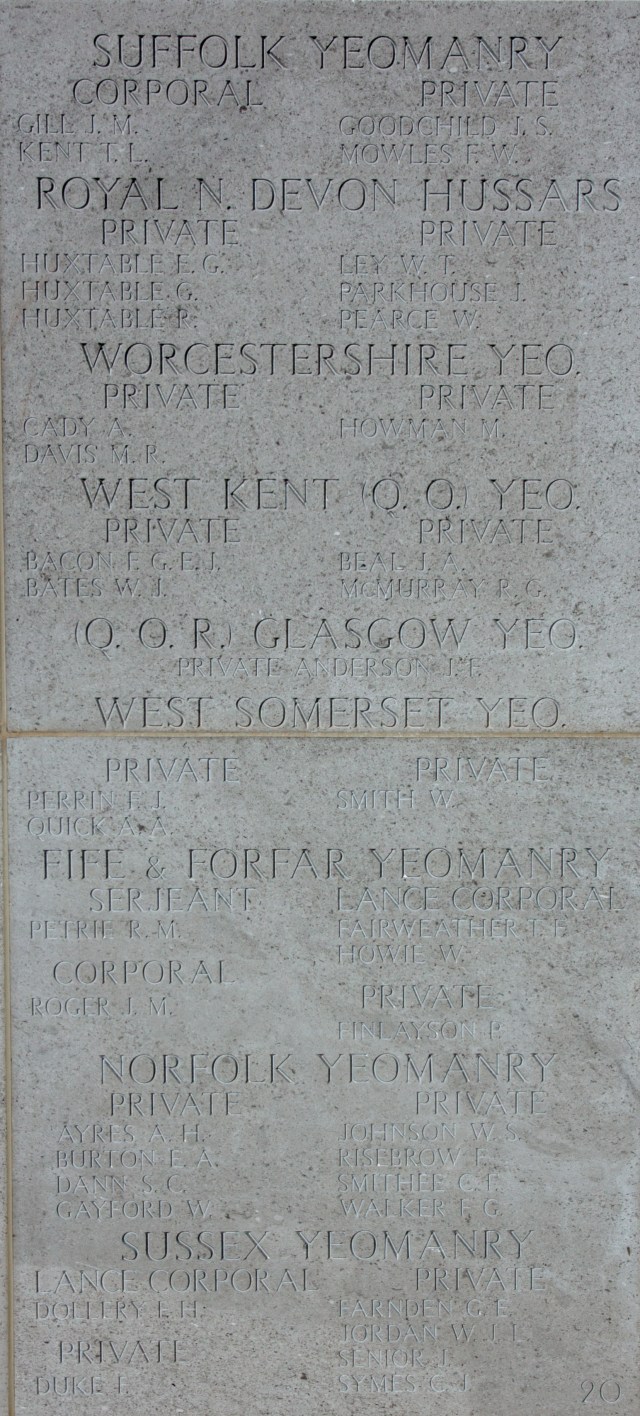
The regiment reported 26 men killed and wounded in the assault, though only two fatalities were known to have occurred. One of these was Private Marshall HOWMAN, No.2613, aged 28. He was killed in action in the assault on Chocolate Hill, Suvla, on August 21, 1915. His name is commemorated on Panel 19 of the Helles Memorial, Gallipoli Peninsula.
Marshall listed on the Helles Memorial [Photo kindly supplied by Keith Edmonds of The Gallipoli Association]
The Helles Memorial 2013 [Photo kindly supplied by Keith Edmonds of The Gallipoli Association]
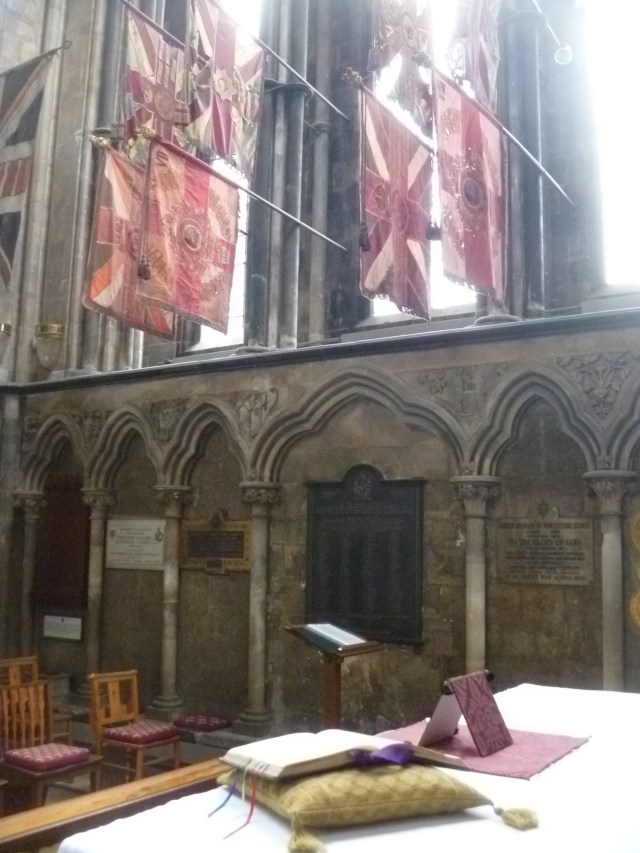
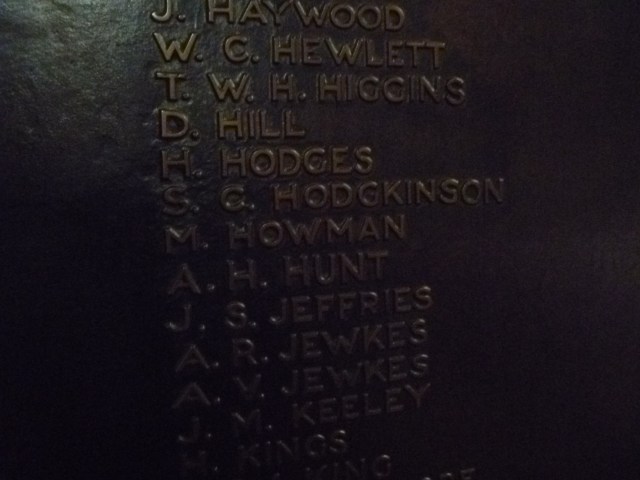
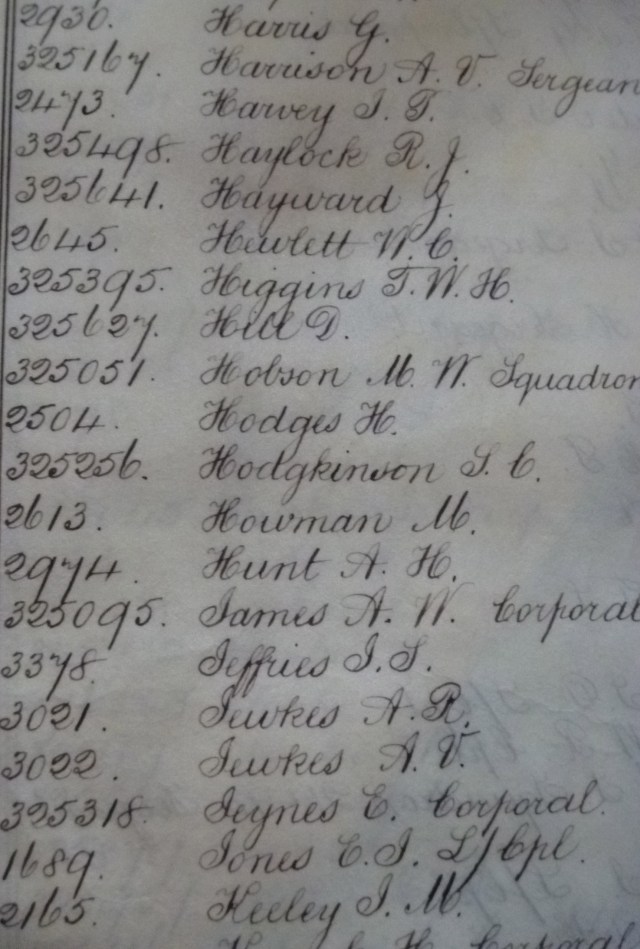
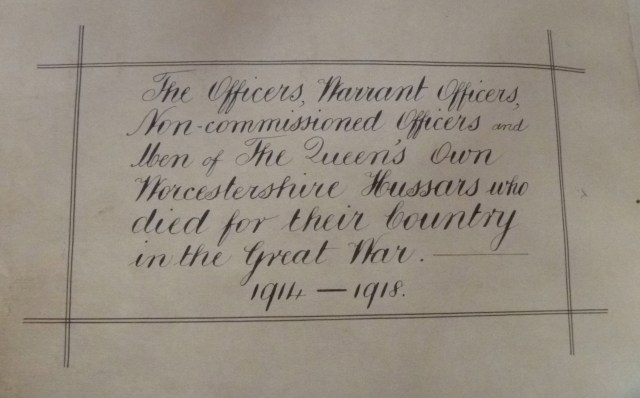
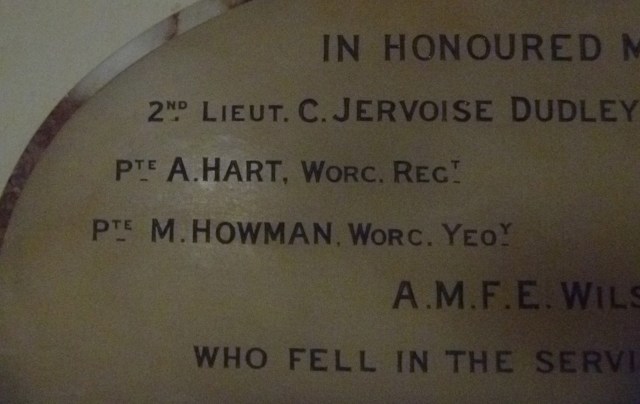
Back home Marshall’s family were devastated. Marshall’s name was eventually listed on the wall-mounted Honours Board in St George’s Chapel at Worcester Cathedral and was inscribed in the Roll of Honour there.
St George’s Chapel, Worcester Cathedral. The Honours Board hangs below the flags.
Marshall’s name on the Honours Board
Marshall listed in the Worcestershire Regimental Roll of Honour Book described below
He is also listed on the Honours Board in St John’s Church, Strensham :
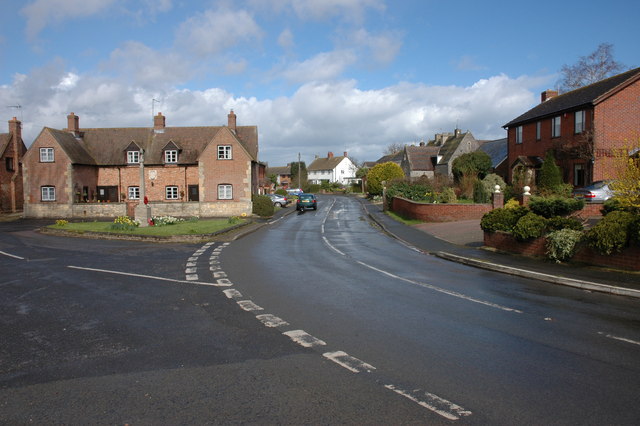
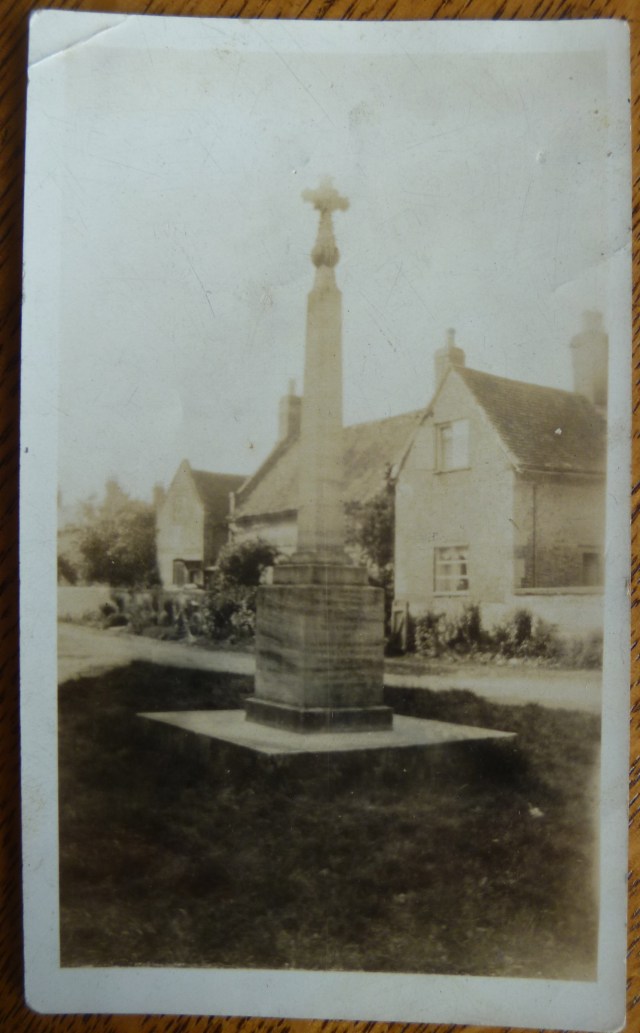
Original War Memorial in Strensham
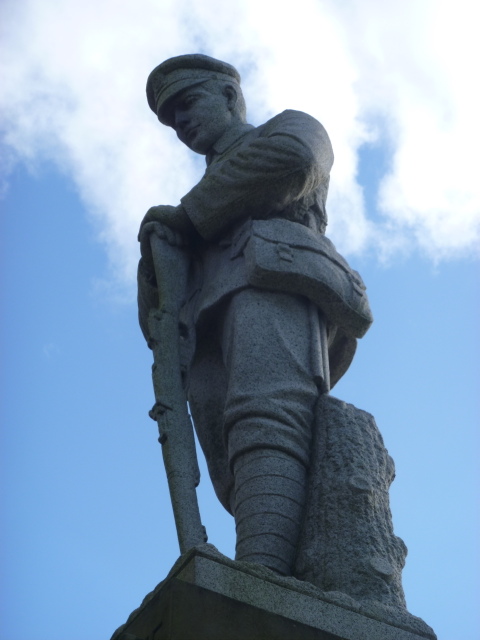
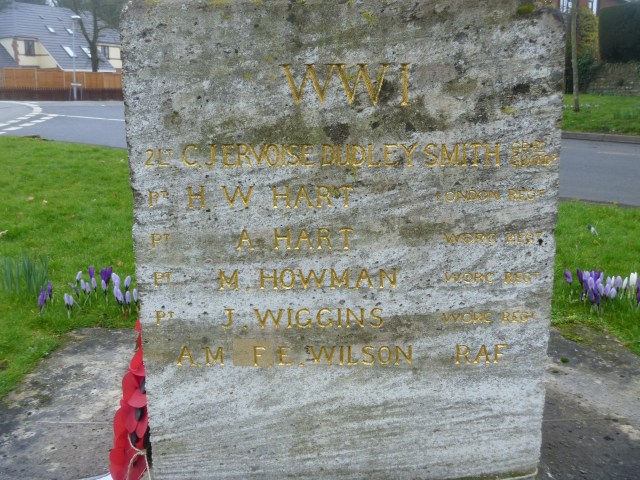
More recently his name, and those of the others who fell in both World Wars, has been inscribed on the War Memorial in the village of Strensham itself.
Names recently added to the Strensham Memorial including Pt M. Howman
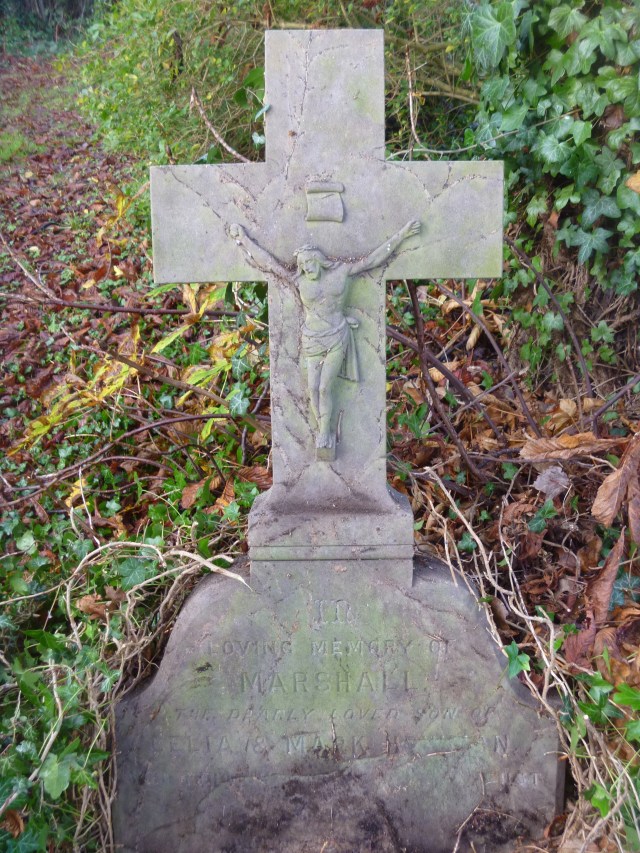
Marshall’s parents soon returned to Norfolk. There had been mention of their going in the letters between Marshall and his mother. Towards the end of the decade they paid for this memorial to him in the churchyard of St Andrew’s, Trowse-by-Norwich.
Trowse churchyard memorial now overgrown, weather-beaten and almost forgotten
[In Loving Memory of MARSHALL the dearly loved son of Celia and Mark Howman. There was more but sadly the rest of the text has disintegrated]
MARSHALL HOWMAN was my Great Uncle and KIT (KATHLEEN) was my Grandmother.
I have memories of Gran telling me about her beloved brother Marshall and her pride in the memorials to him in both Norfolk and Worcestershire. I have a number of Marshall’s original letters but sadly no photograph has materialised.
Acknowledgements
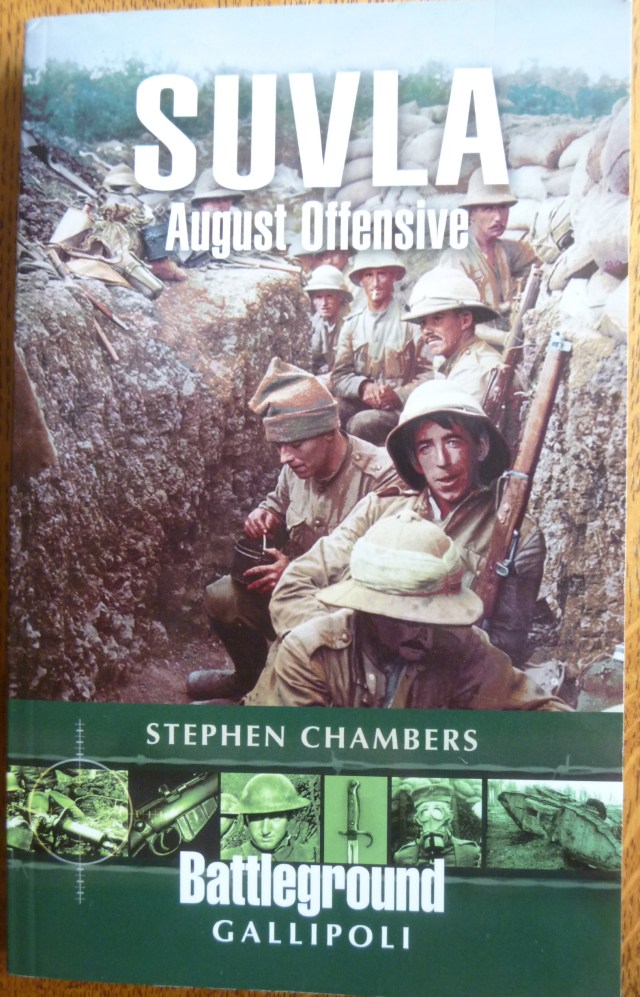
I’m extremely grateful to the following for information and inspiration. My sister Kathy for her research into the broader Howman family. My friend Ann and her husband who have been to Gallipoli and lent me books and sent me links on researching military records and helped in many other ways. My three contacts at The Gallipoli Association who provided me with material about the Worcestershire Yeomanry’s movements and Marshall’s final days; thank you Stephen, Keith and Mal.
“We have done that which was our duty to do”
[St. Luke XVII.10]
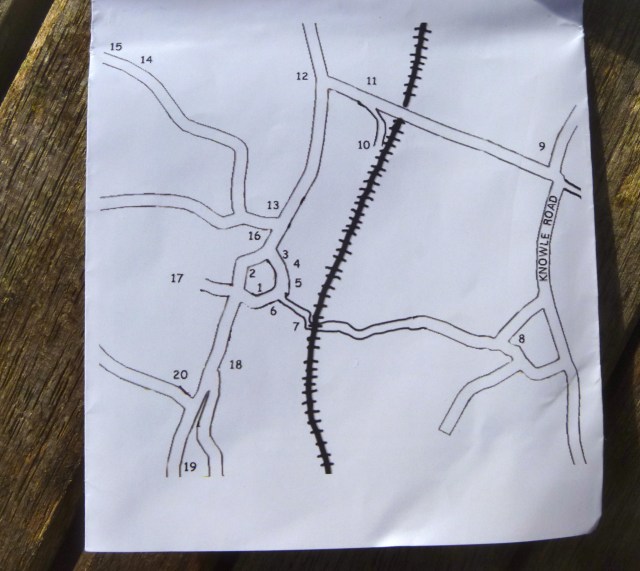
9. Brookfield also originally belonged to Bovey Tracey [3 miles down the A382]. The first houses here were built in the late 19th century for the men who worked at Kelly Mine.
10. Station House : The Newton Abbot to Moretonehampstead Railway opened in 1866 running for just under 100 years and being famed for its well-kept garden [presumably, The Station House]. The passenger service ended in 1959.
The Station House [private drive]
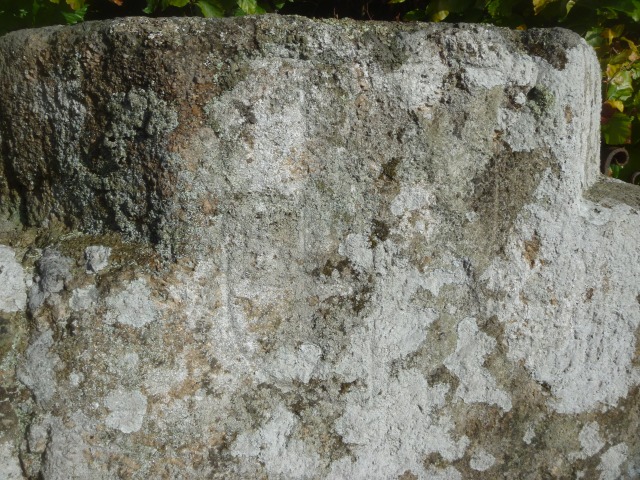
11. Bishop’s Stone : the indistinct coat-of-arms carved on the front may be that of the See of Exeter but little is known of the history surrounding the stone.
Bishop’s Stone
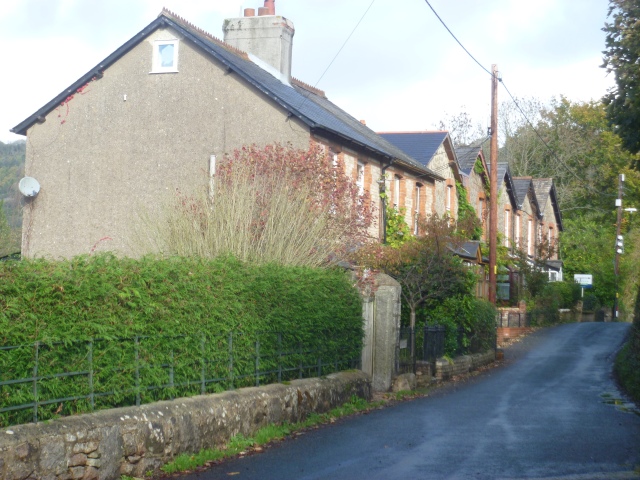
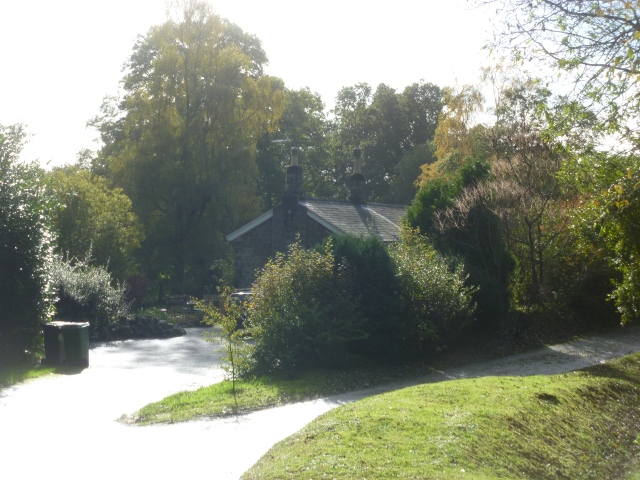
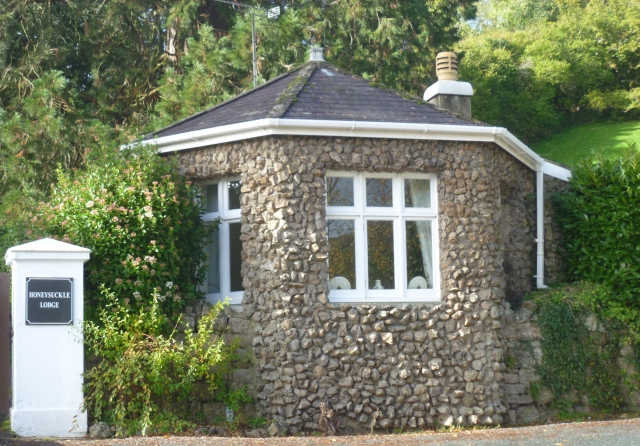
12 : Old Gatehouses: built for Coombe Hill but are now private dwellings.
One of the Gatehouses
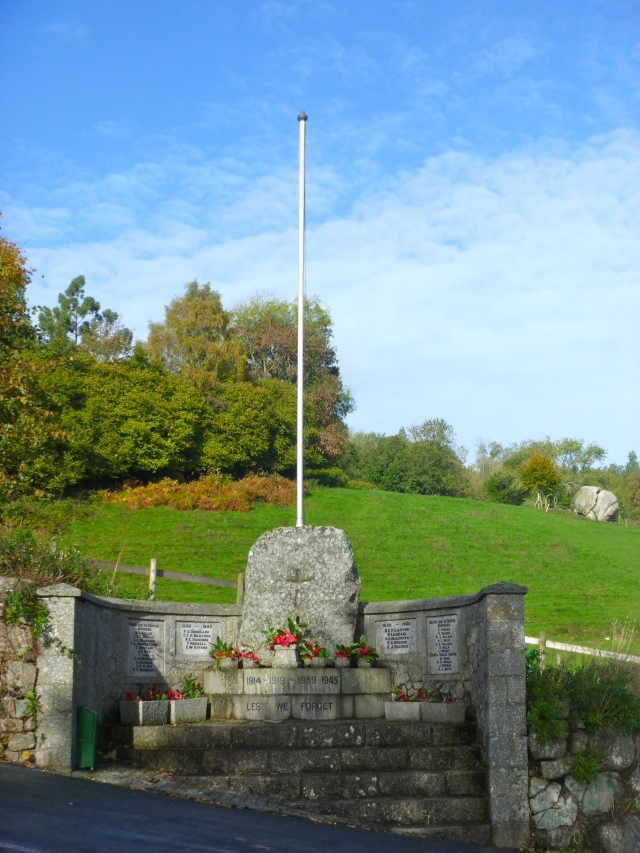
13. War Memorial: dedicated to the memory of all who fell in the two World Wars.
14. Great Hall, or Old Rectory: This historic building with its 14th century timber roof was once the home of the Lords of The Manor and later the Rectory. It was divided up into three private properties in the 20th century.
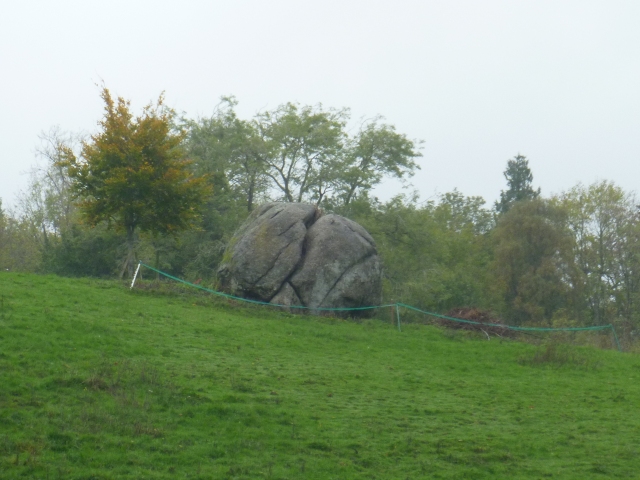
15. “Parson’s Loaf” : There is only speculation as to why this unusual rock came to be so called.
“Parson’s Loaf”
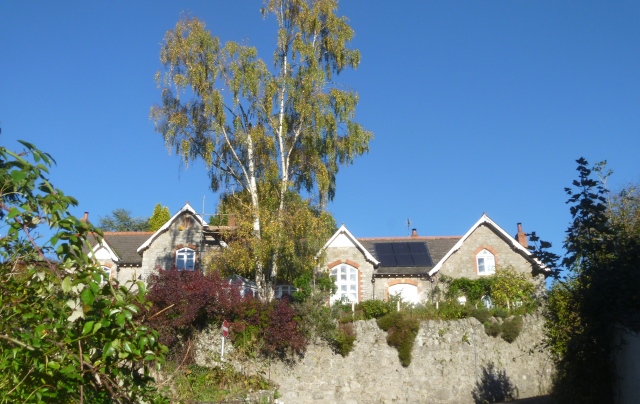
16. School House. The Board School built following the Education Act of 1870 for Infants and Juniors also provided accommodation for the Head Teacher. It was closed in 1963 and is now a private dwelling.
[The Infants School on the rights is now holiday accommodation and that is where we stayed in Lustleigh]
The School House
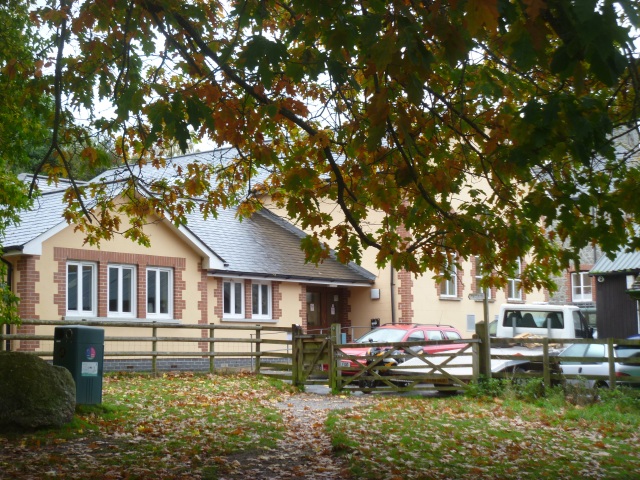
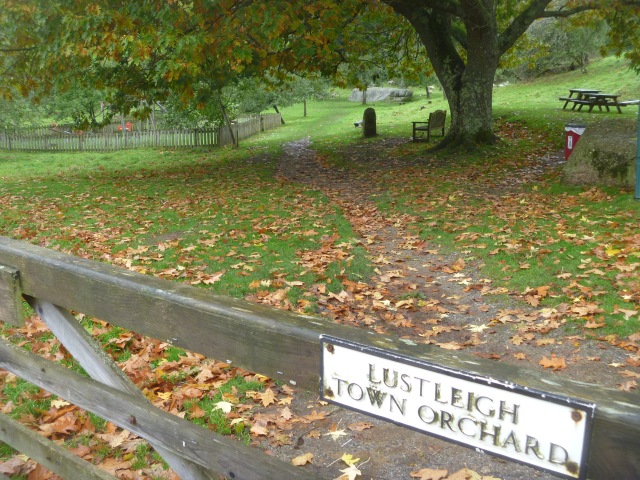
17. Town Orchard: The road between The Dairy and the Former Post Office leads past the recently-rebuilt Village Hall to The Town Orchard given to the people of Lustleigh by a resident, Mr W. Bennett. It is where the annual May Day festivities take place.
Village Hall
Town Orchard
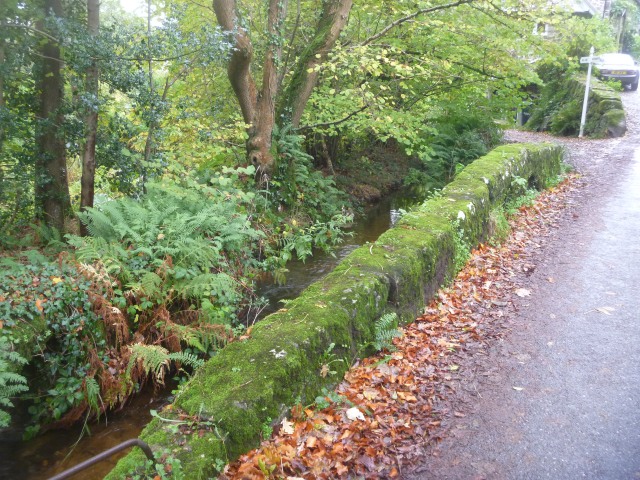
18. The Bridge over the leat taking water the the Old Corn Mill, now a private dwelling.
The Bridge and Leat
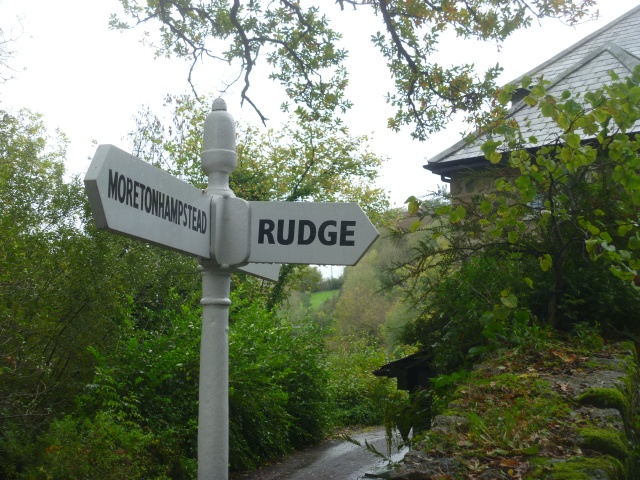
19. The road leads to Rudge, one of the old farms of the Manor of Lustleigh, and from where a footpath continues past another old farm, Lower Hisley and on to Hisley Bridge in Lustleigh Cleave.
Road leads to Rudge
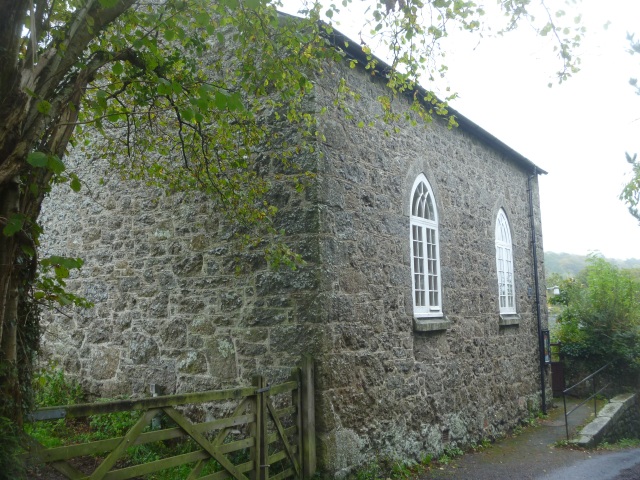
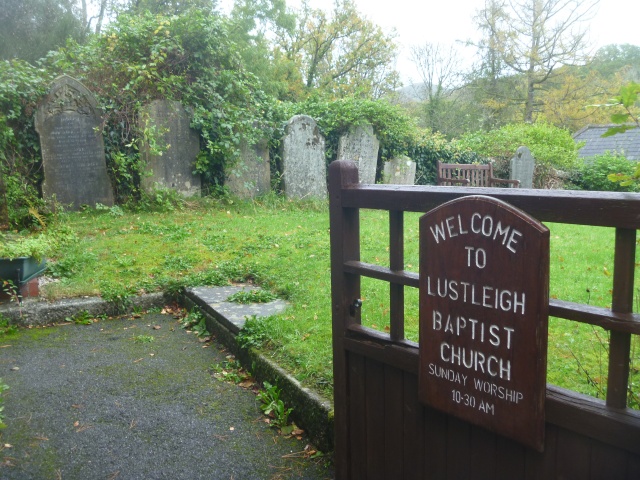
20. Baptist Chapel : built in 1853 and still in regular use as a place of worship.
Last week I was staying in deepest Devon in the lovely village of Lustleigh on the edge of Dartmoor but within the boundary of the Dartmoor National Park. In addition to everything listed on the walk leaflet there is an excellent community shop called The Dairy. It houses the Post Office (open 9-1 each weekday) and itself is open every day including Sunday. Come with me on a walk through Lustleigh …
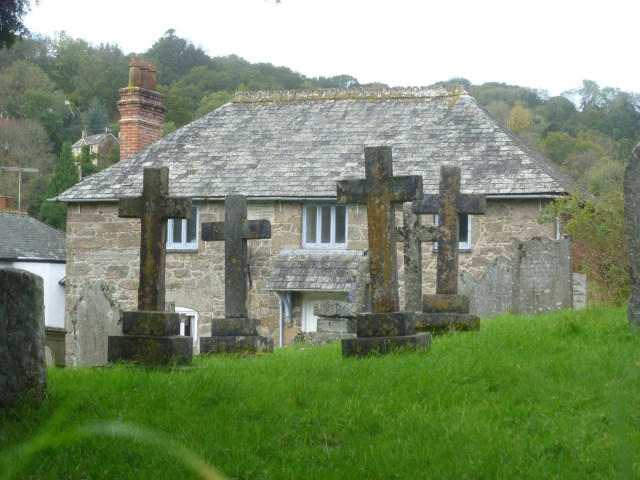
Starting at the village centre, outside the Church.
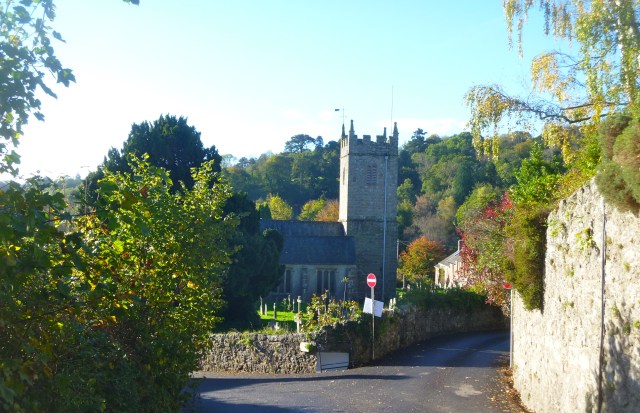
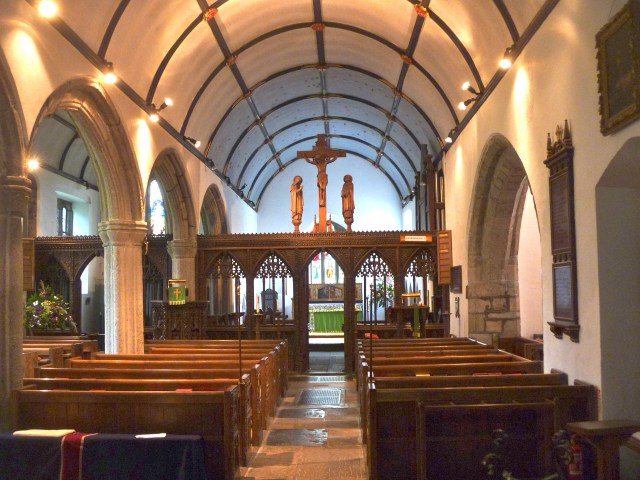
1. Church of St John the Baptist: built in the 12th century on a Celtic site. Inside see the raised Celtic stone and the beautiful rood screen.
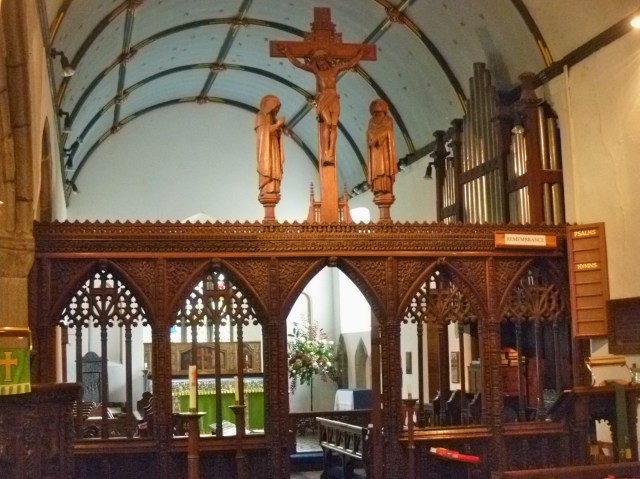
The Nave with Rood Screen, Barrel Roof and Carved Pew Ends
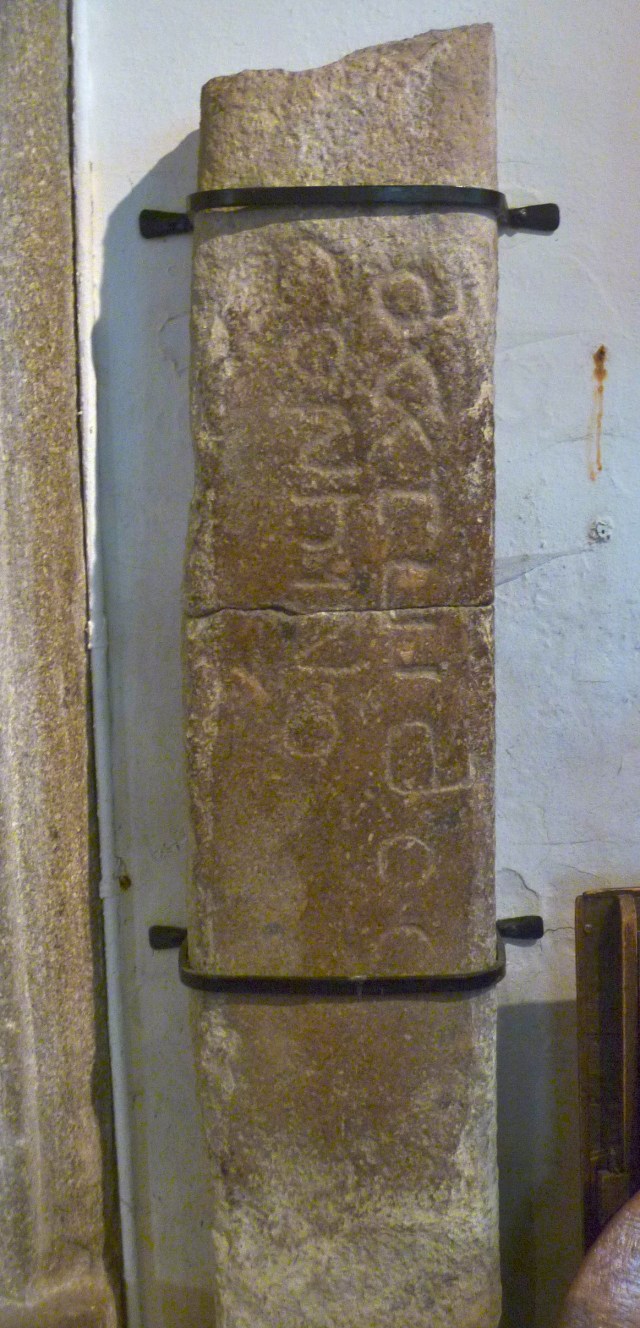
The Raised Celtic Stone
[This ancient stone was removed from the position in the paving below the inner doorway of the church porch in 1979 in order to preserve it from further wear. It belongs within a well-recognised series of commemorative stones erected in the post-Roman period between about AD450 and AD600. The inscription probably read ‘DATUIDOCI CONHINOCI FILIUS’ – the stone Datuidoci the son of Conhinoci’.]
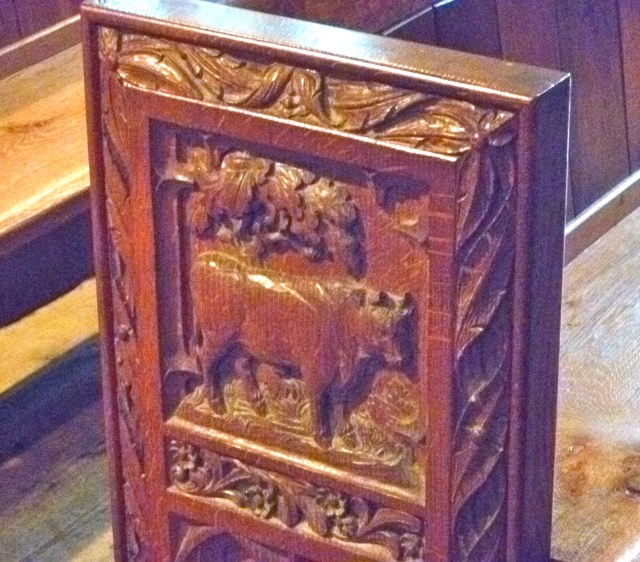
Carved Pew End
Rood Screen and Carved Pulpit
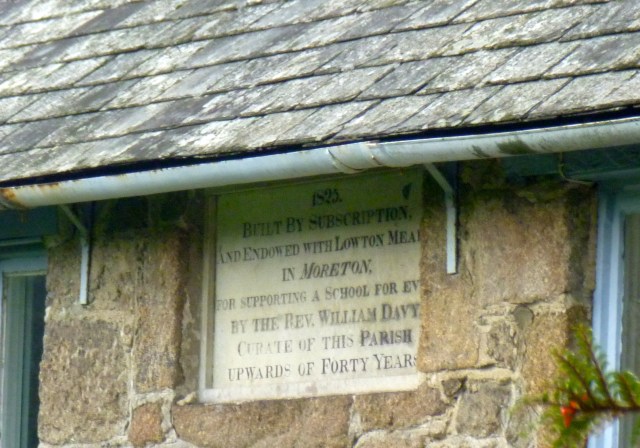
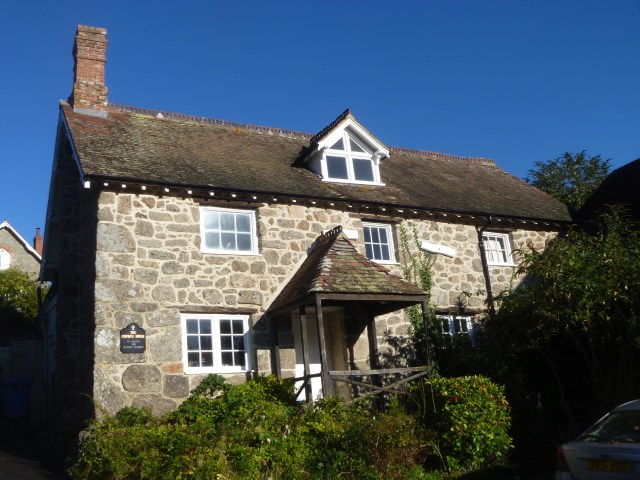
2. The Old Vestry: originally a school (see tablet on wall above the door). Now used for church choir rehearsals, parish council meetings and by the Lustleigh Society for the Community Archive.
The Old Vestry
Tablet on The Old Vestry
3. Church House: built around the 14th century. It was once a centre for village social activities, later became a Poor House and then a Reading Room.
Church House
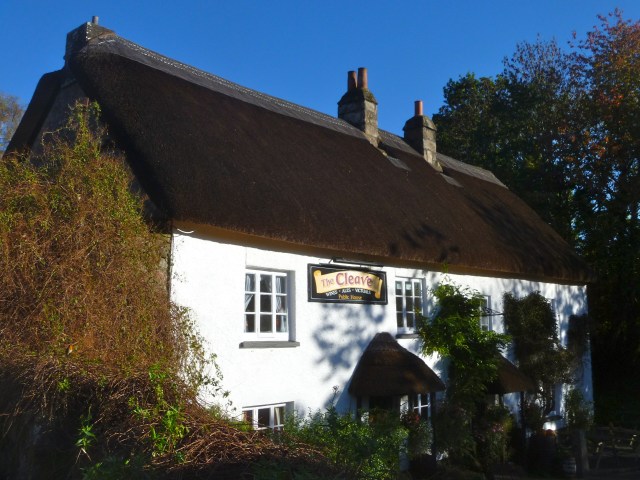
4. The Cleave Hotel: originally an old farm “Gatehouse” and became a public house in the 19th century.
The Cleave Public House
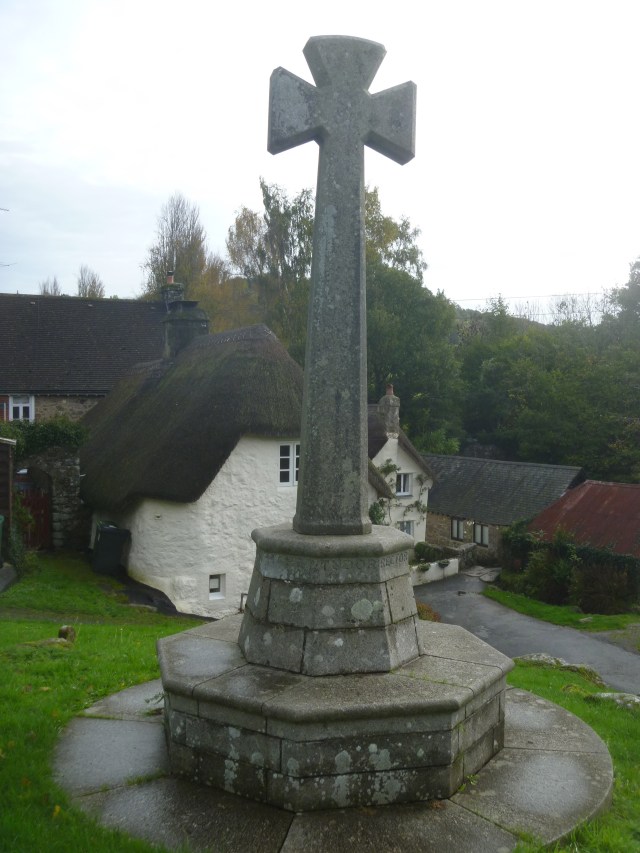
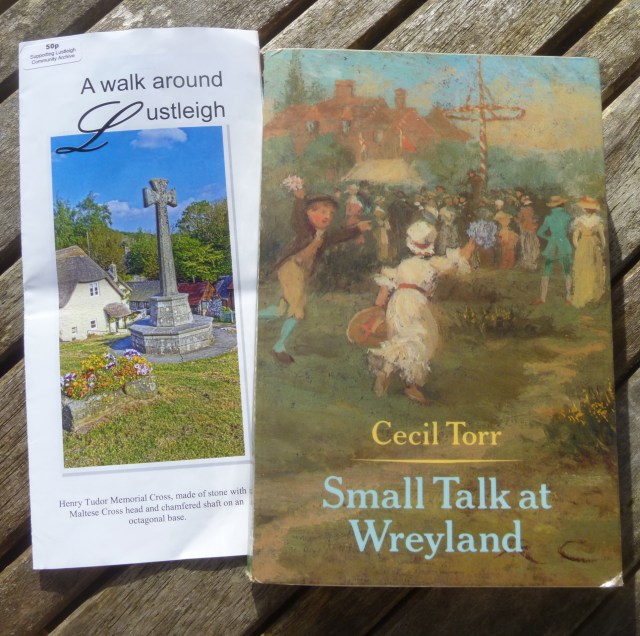
5. Tudor Cross on the village green. Made of stone with a Maltese Cross head and chamfered shaft on an octagonal base. Erected in memory of Rector Henry Tudor (1888-1904). Nearby was the site of the village pump. Only the granite trough remains.
Tudor Cross
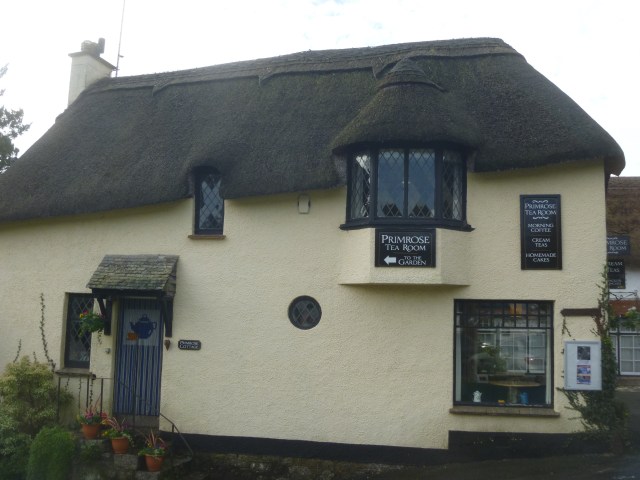
6. Cottages around the green: In the mid 19th century many were shops and one a Post Office. Primrose Cottage [tea rooms] was built in 1940 on the site of a hardware shop.
Primrose Tea Rooms
7. Old Gospel Hall: formerly used for worship by the Plymouth Brethren.
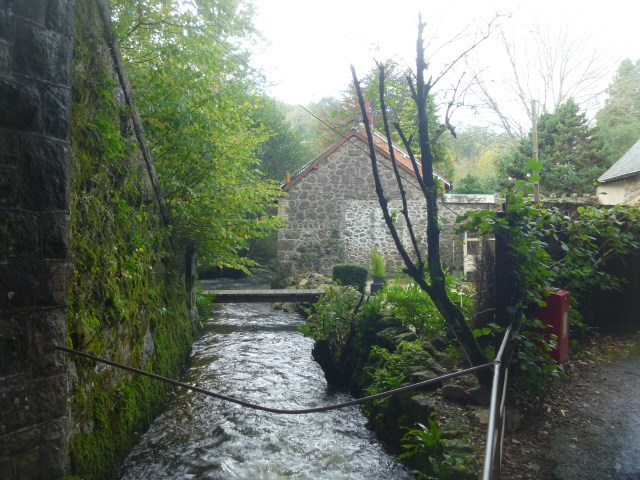
The Old Gospel Hall and Wrey Brook
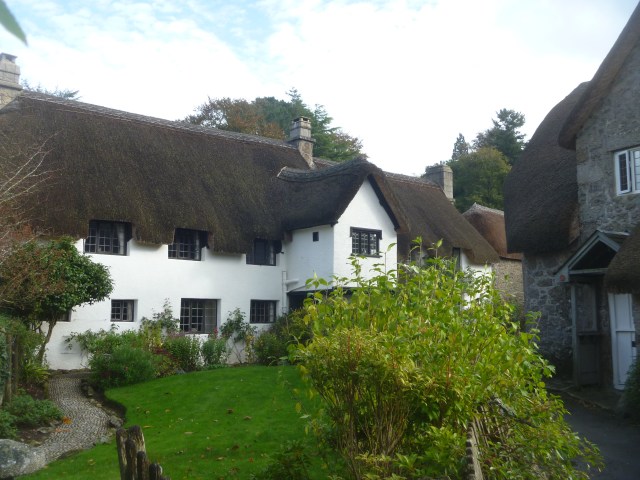
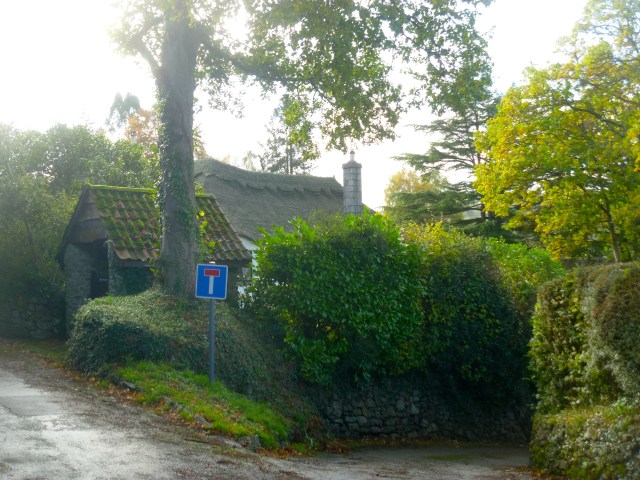
8. Wreyland: Approached from under the railway bridge Wreyland (or Wrayland) is a small hamlet that was part of the parish of Bovey Tracey until 1957. The Wrey Brook being the boundary between Lustleigh and Bovey. The thatched cottage on the left, known as Wreyland Manor, was where early manorial courts were held. Cecil Torr’s family owned properties here, including Yonder Wreyland where “Small Talk at Wreyland” was written.










 miladysboudoir