Strolling Hand in Hand with Romance

Perhaps I should mention first of all that the romance is all Daphne Du Maurier’s.
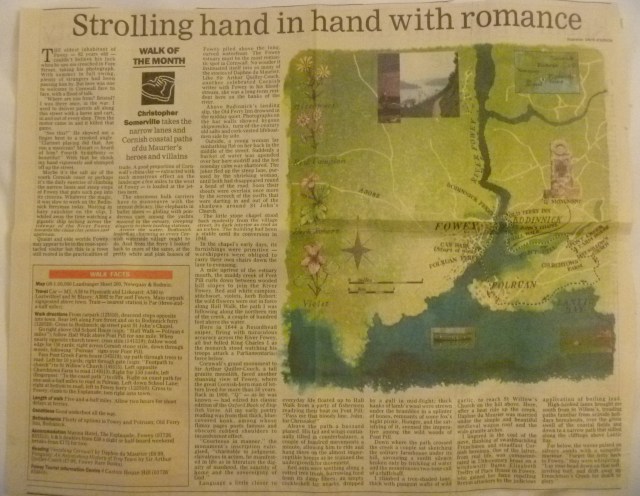
Walk details

I snipped this walk out of The Observer (I think it was) decades ago and at last I have had the chance to actually step it out for myself! I stayed at a B&B for five nights in Cornwall in the village of Tywardreath (pronounced “towerdreth”). Almost all my daytime hours on Friday, Saturday and Sunday were spent at Port Eliot Festival but on Thursday I was not required until the afternoon so decided to do the walk that morning.

I took the bus to Fowey and arrived back at Par Station to take the train to St Germans, which is where Port Eliot House and the festival are located, at about 1pm. Unfortunately the day started with rain but I was glad I’d set out and the weather improved as the day progressed.  I’ve added my photos to some of Christopher Somerville’s text and instructions.
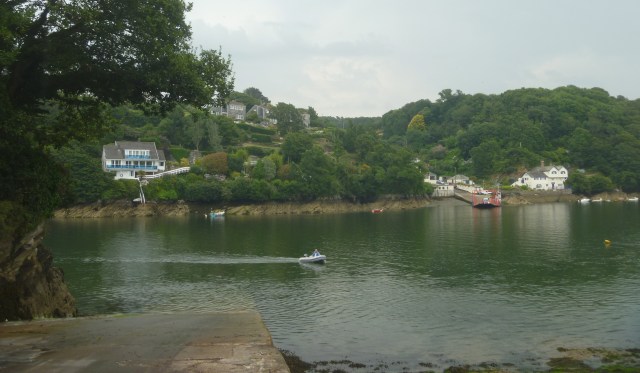
Bodinnick car ferry

Bodinnick Car Ferry leaving Bodinnick for Fowey
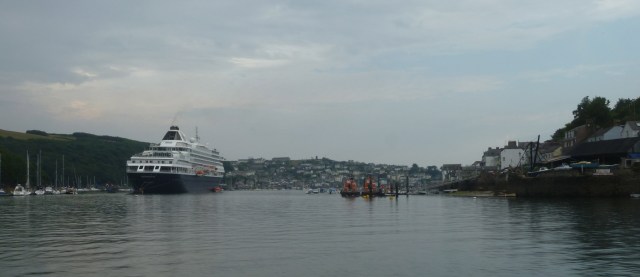
Prinsendam

MS Prinsendam Cruise Liner in the Fowey Estuary

From car park (I took the bus from Par Station) descend steps into town. Bear left along Fore Streetand on to Bodinnick ferry. Cross to Bodinnick;
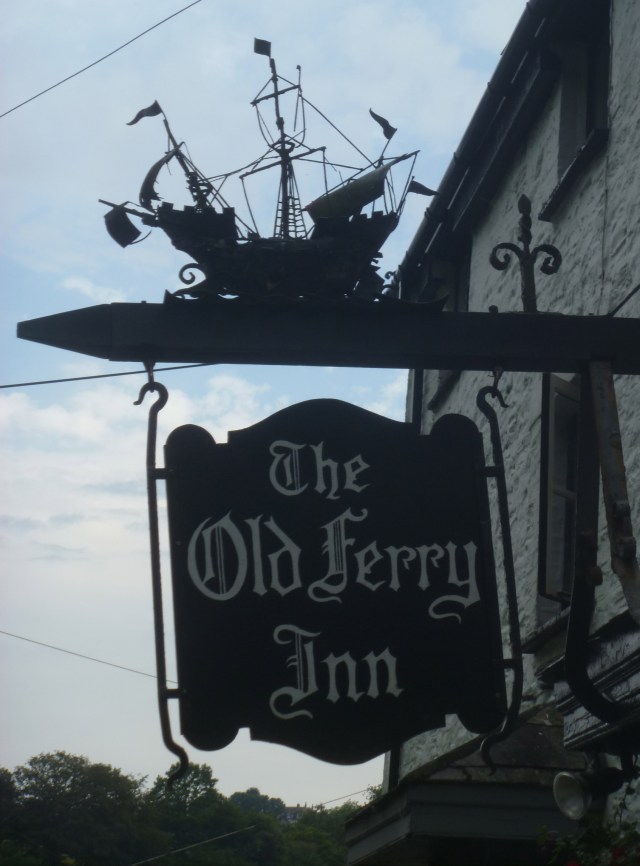
Old Ferry Inn

The Old Ferry Inn Sign near the Ferry

go up the street past St John’s Chapel.
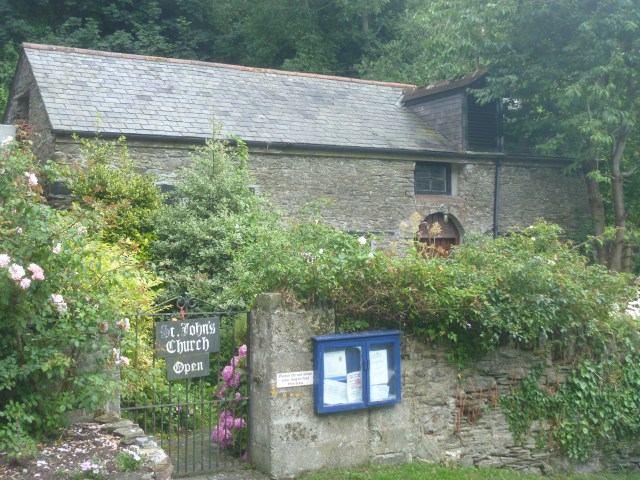
St John's Chapel

St John’s Church, Bodinnick

The little stone chapel stood back modestly from the village street, its dark interior cool as an icebox. The building had been a stable until  its conversion in 1948. In the chapel’s early days, its furnishings were primitive – worshippers were obliged to carry their own chairs down the lane to evensong.
Hall Walk

Go right above Old School House (sign “Hall Walk – Polruan 4 miles”); follow Hall Walk above Pont Pill [the muddy creek curls down between wooded hill slopes to join the River Fowey … Hall Walk follows the northern rim of the creek a couple of 100 feet above the water] for one mile.
Glimpse Fowey

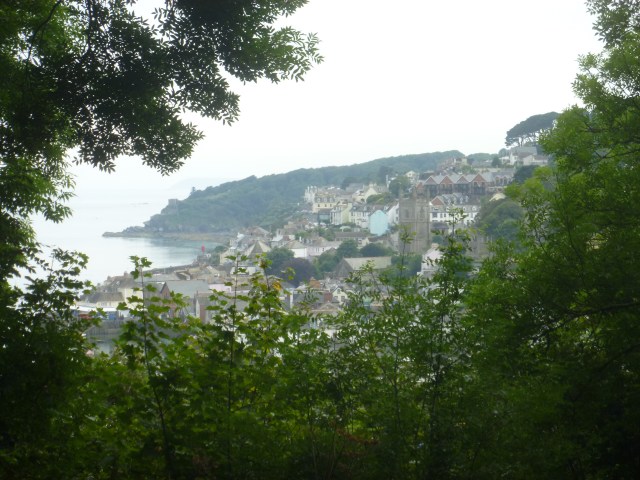
A Glimpse of Fowey from Hall Walk

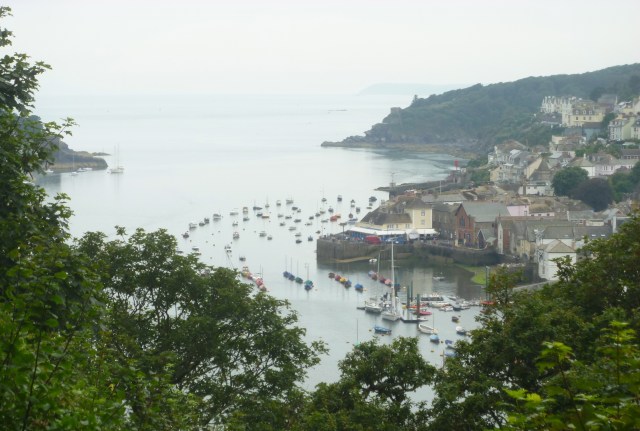
Boats bobbing

Boats Bobbing in the Fowey Estuary

With the rain coming down luckily most of Hall Walk was covered over by trees with occasional glimpses of the creek below and now and again a viewpoint opened up to reveal the boats bobbing in Fowey harbour and estuary.
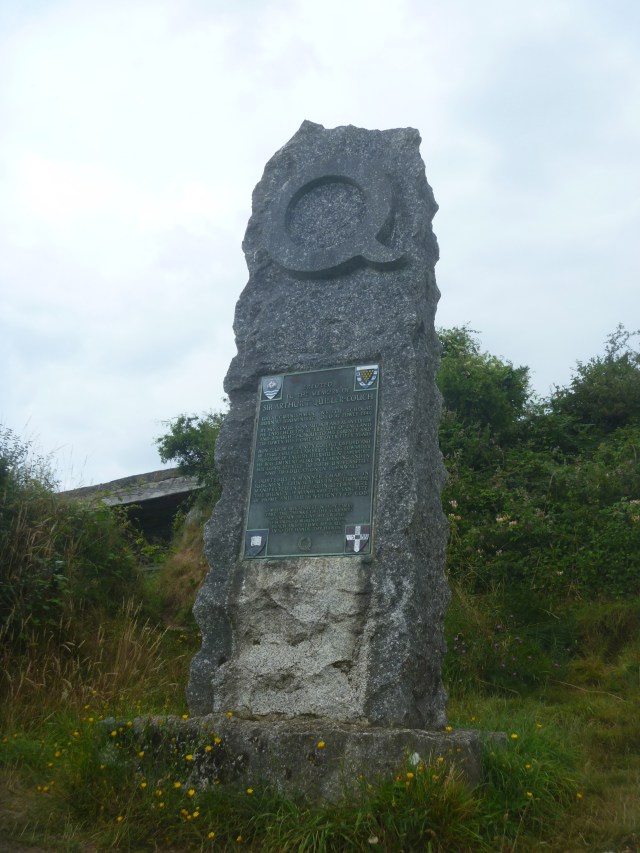
Q memorial

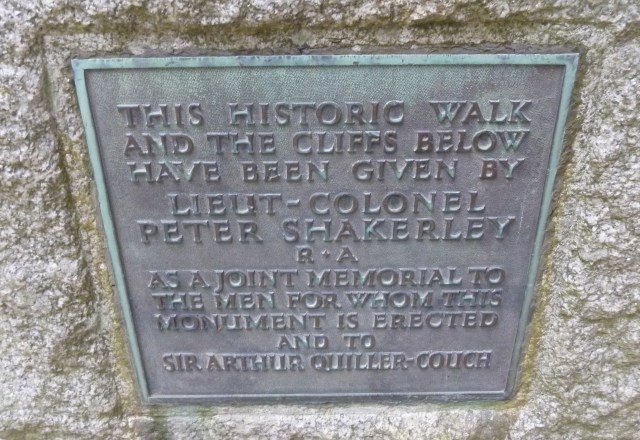
Cornwall’s grand monument to Sir Arthur Quiller-Couch, a tall granite monolith, faced another stunning view of Fowey, where the great Cornish-born man of letters lived for more than 50 years. Back in 1900, “Q” – as he was known – had edited his classic edition of the Oxford Book of English Verse. … “Courteous in manner,” the monument’s inscription eulogised, “charitable in judgment, chivalrous in action, he manifested in life as in literature the dignity of manhood, the sanctity of home and the sovereignty of God.”
Cornish stone stile

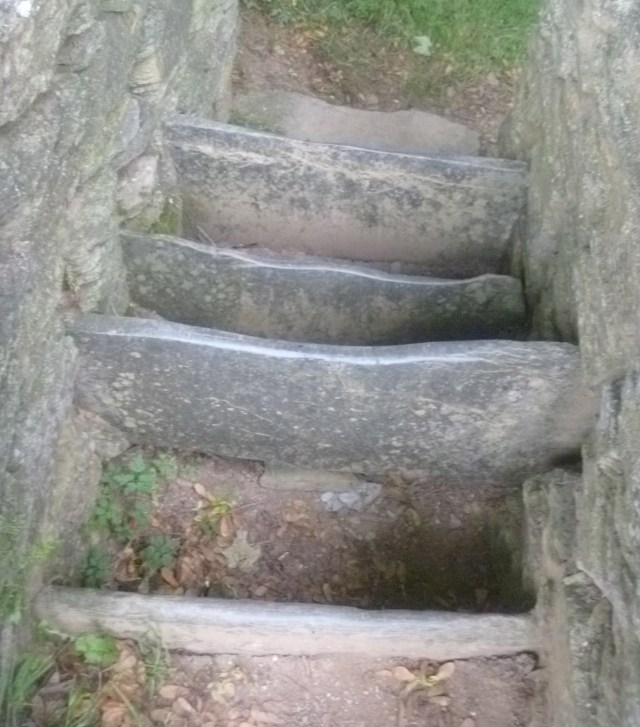
Cornish Stone Stile

When nearly opposite church tower, cross stile; follow wood edge for 150 yards; right across Cornish stone stile; down through woods following “Polruan” signs and over Pont Pill.
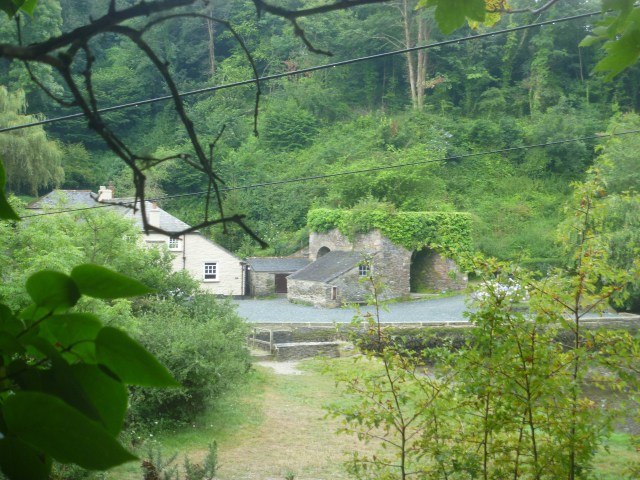
Pont Pill

Pont Pill with National Trust Holiday Cottages clustered around

Pass Pont Creek Farmhouse; up the path through trees to road. Left for 10 yards; right through gate (sign “Footpath to church”) to St Willow’s church.
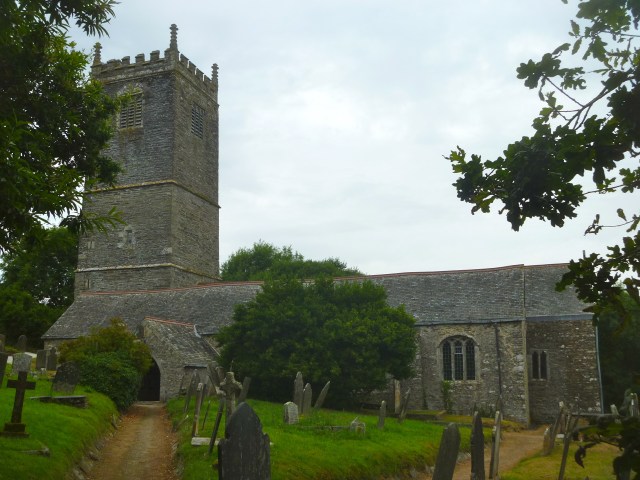
Lanteglos church

St Willows Church Lanteglos

Here, after a boat ride up the creek, Daphne Du Maurier was married under the simple and beautiful wagon roof and the wide granite arches in 1932. St Willows also features as Lanoc Church in her first novel “The Loving Spirit”.
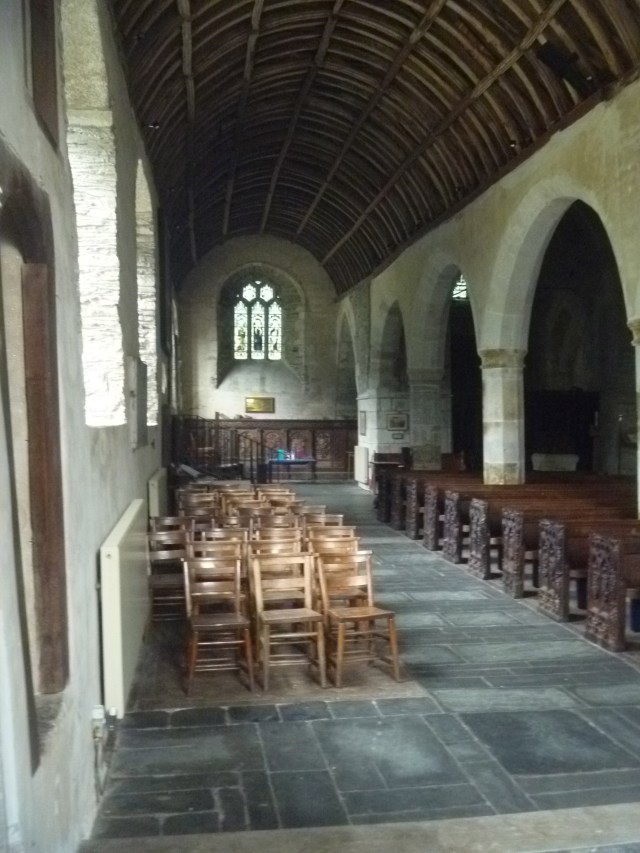
Barrel roof

The Wagon Roof, St Willows Church, Lanteglos-by-Fowey
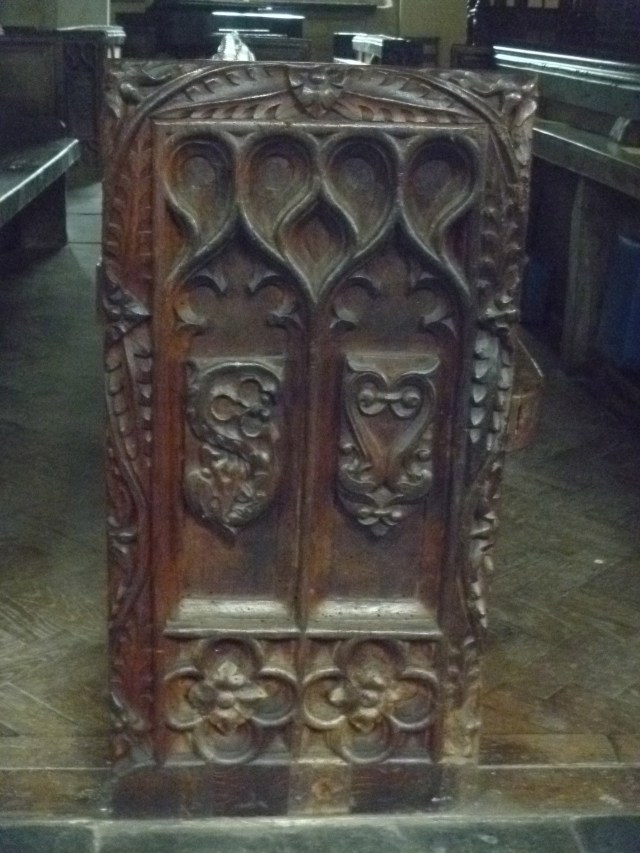
Pew End

Close-up of Pew Ends

Left opposite Churchtown Farm to road. Right for 150 yards [now a field path that avoids walking on the road]; left (fingerpost “To the Coast Path” to cliffs. Right on coast path for one-and-a-half miles to road in Polruan. 
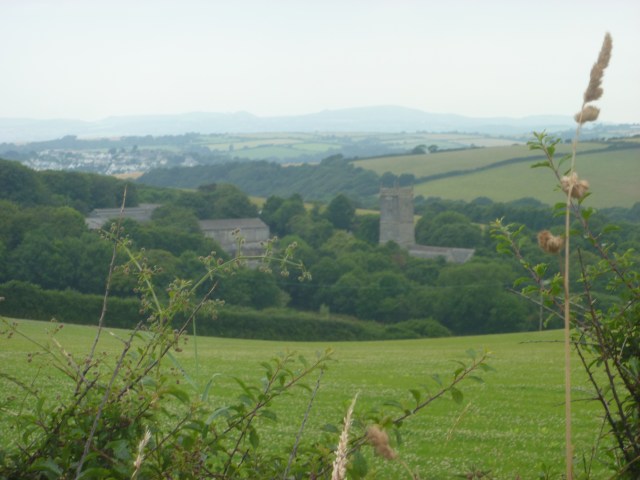
Looking back

Looking back to the church, Hall Walk woods and Fowey
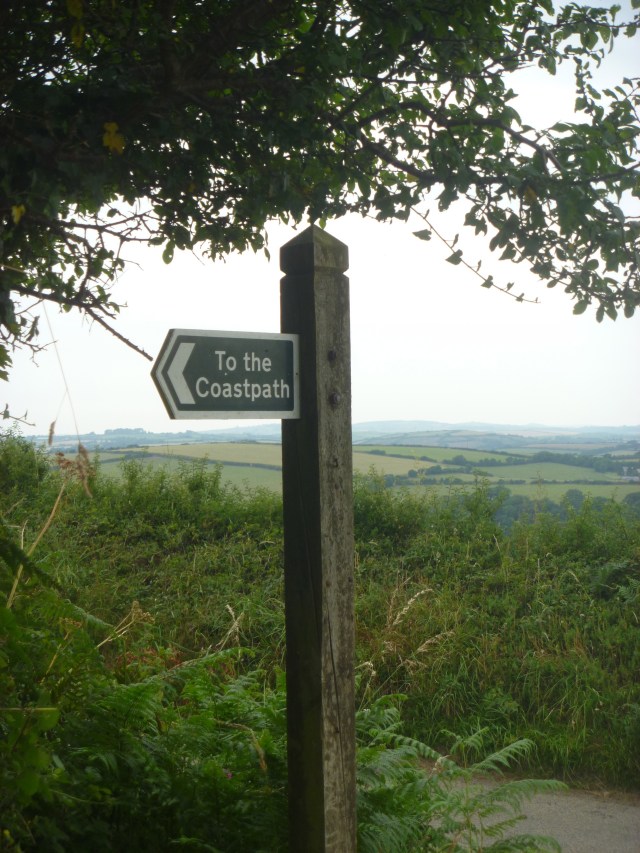
To Coast Path

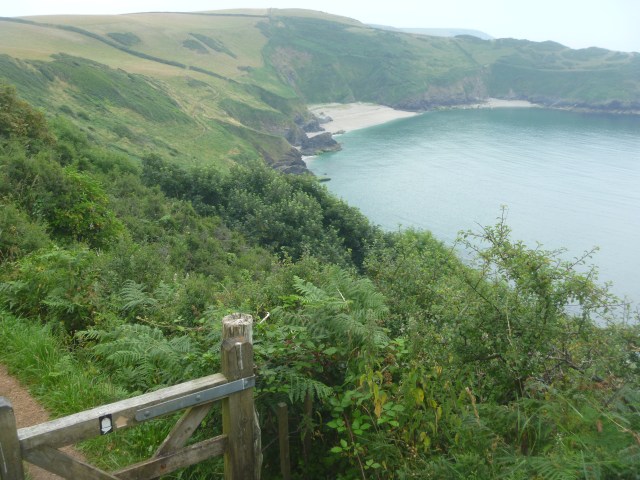
The coast path walk is part of the national trail – The Southwest Coast Path. The rain had stopped by this point but the skies were still overcast.
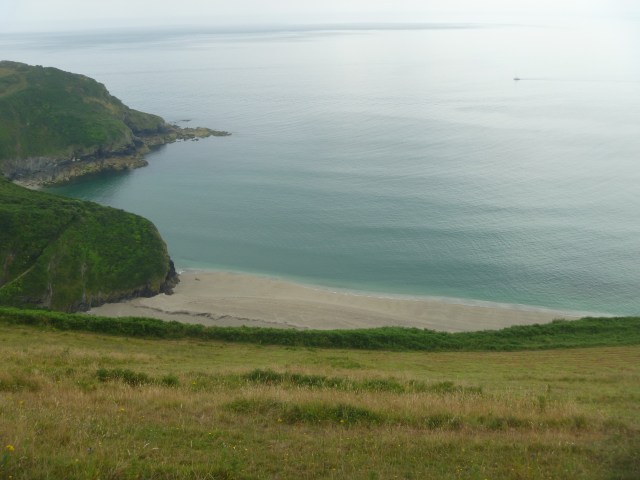
Beach and Lantic Bay

Lantic Bay from the Coast Path

From SW Coast path

View from Coast Path near Polruan

Left down School Lane; right at bottom to road; left to Fowey Ferry. Cross to Fowey; climb to the Esplanade; turn right into town. I then had a stiff walk uphill to the bus stop with only seconds to spare. Luckily for me the bus was a few minutes late arriving but I still managed the train with time to spare.
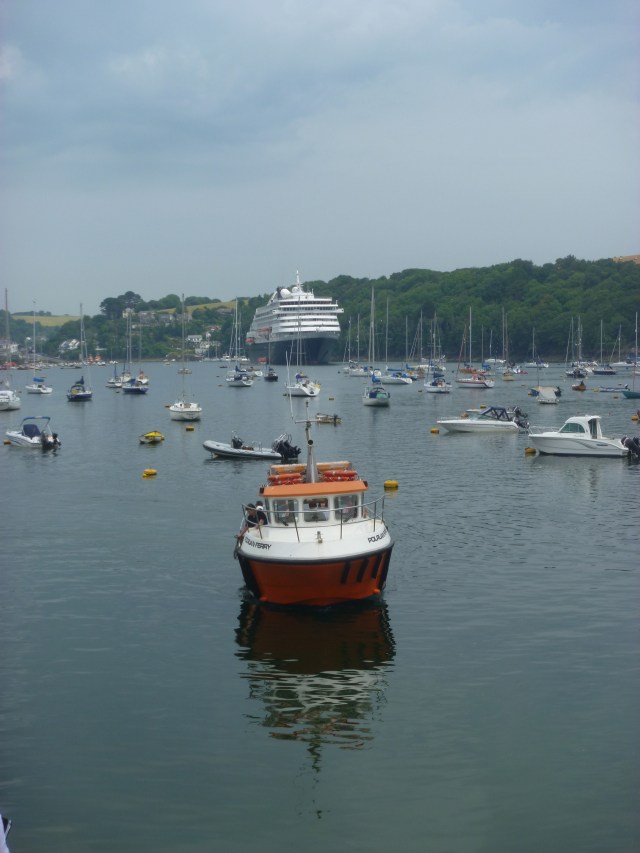
Polruan Passenger Ferry

The Polruan Foot Passenger Ferry Approaches

OS Map

Map Showing Places Mentioned
Mad March Hares in Cirencester in July

After moving at what seemed like snails pace on the M1 this morning I was glad to slip onto the Fosse Way and make my way to Cirencester a lovely mellow stone Cotswold town with Roman (and even pre-Roman) origins. My goal was to visit the Corinium Museum to see the  mosaics and other treasures of the town. With my Art Pass I gained free admission.

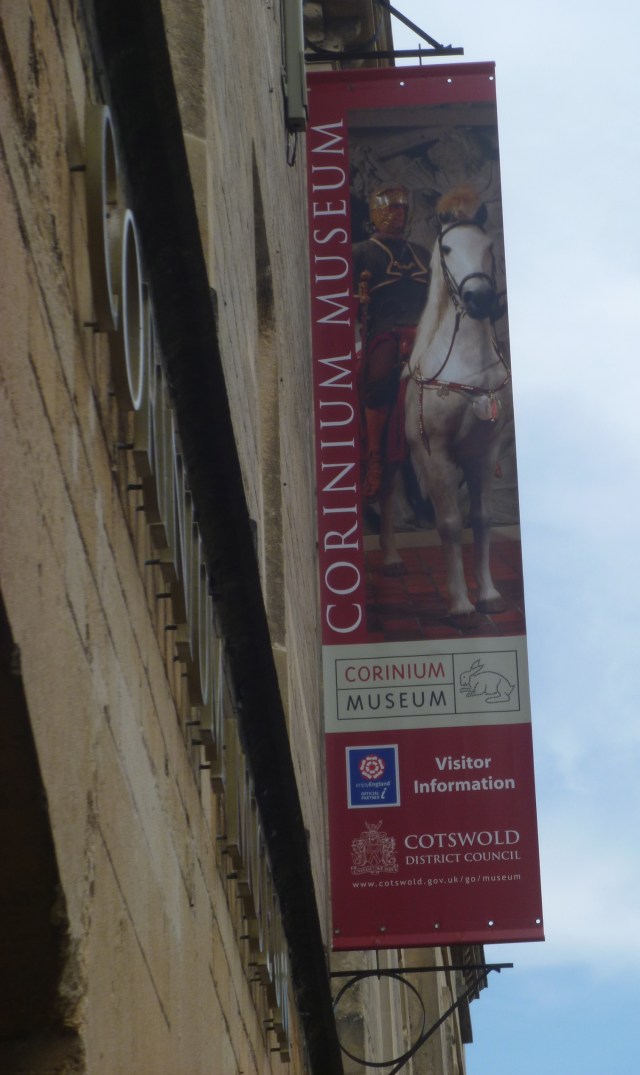
Corinium sign

The Corinium Museum

Museum entrance

Museum Entrance

Abberley House and Corinium Museum was built by John Cripps as a town house in c.1765. It was purchased in 1936 by the local Bathurst and Cripps families and given to Cirencester Urban District Council to house the Museum.

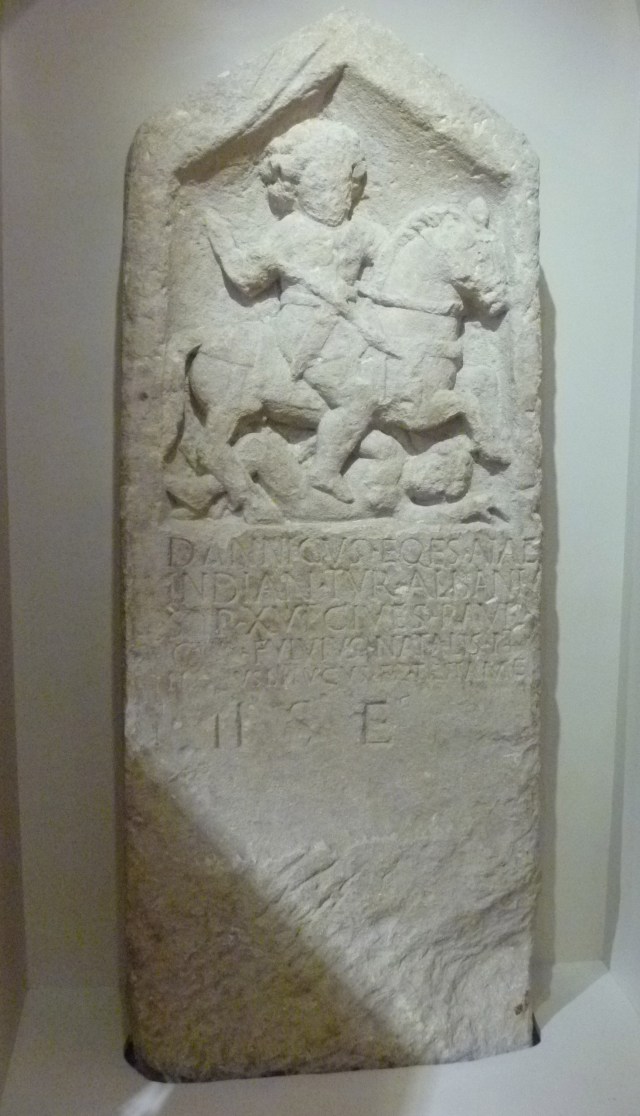
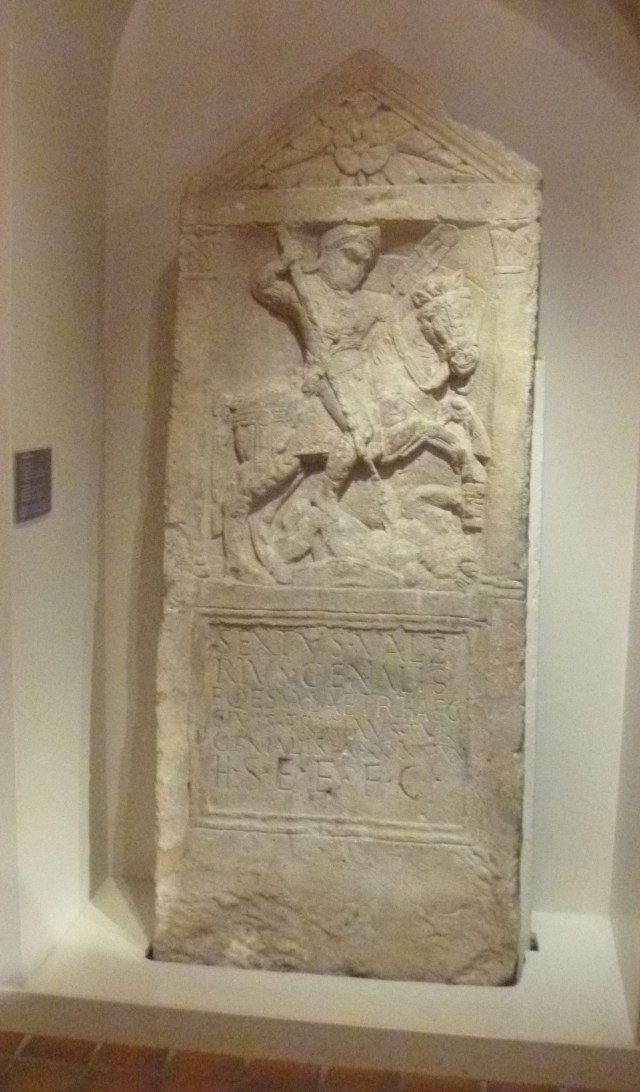
Including the mosaics Corinium Museum lists Ten Treasures as you go round the displays. Two Roman Tombstones were discovered. Soldiers of the Roman Army who died in service were awarded full military honours but they had had to pay a small sum out of the pay packet towards this. Families who wished to have a more elaborate memorial to their sons could pay the extra. The tombstones found near Cirencester were two such memorials.

Tombstone of Dannicus

Tombstone of Dannicus found in Watermoor, Cirencester in 1835

Tombstone of Genialis

Tombstone of Genialis dates to 60AD and also found at Watermoor

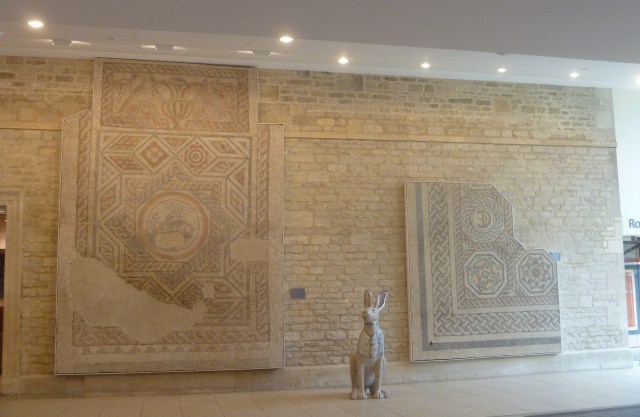
The Museum is famed for its mosaics. Chief among these are four fine (though damaged) mosaic floors, each with striking picture panels set within patterned borders.” 

Mosaics 1

Mosaics (and Hare) in the Museum Foyer – a taste of what’s to come!

Hare mosaic

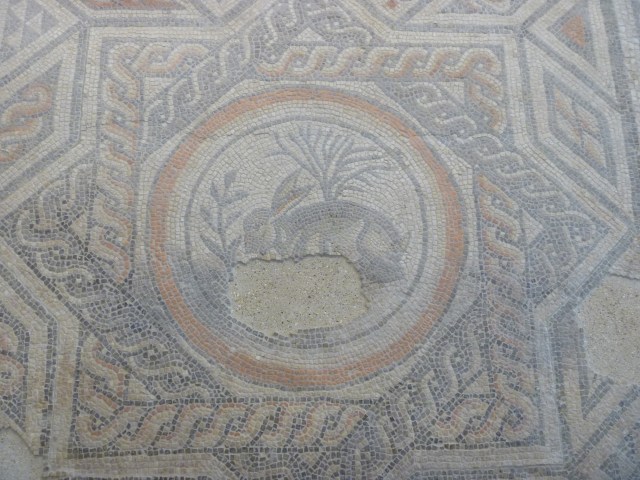
Hare Mosaic

This virtually complete mosaic was found in a Roman town house at The Beeches, Cirencester. It dates to the 4th century AD. The hare motif is unique as a centrepiece in Britain.

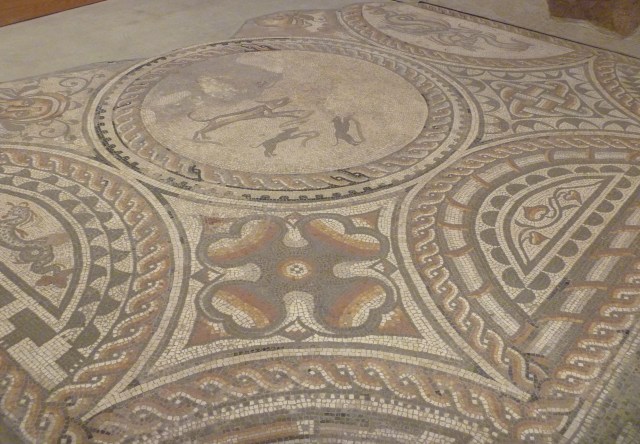
Hunting dogs mosaic

Hunting Dogs Mosaic Pavement found in Dyer Street in 1849

column

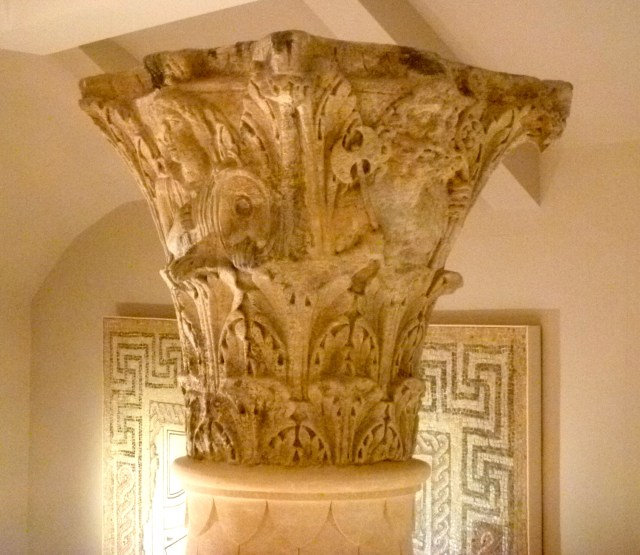
The Jupiter Column

The Jupiter Column has an original carving of the Greek god Bacchus and his drunken companions. The rest of the column has been reconstructed, and gives a hint of the size and grandeur of Roman public building even in this distant part of the Empire.

Roman garden

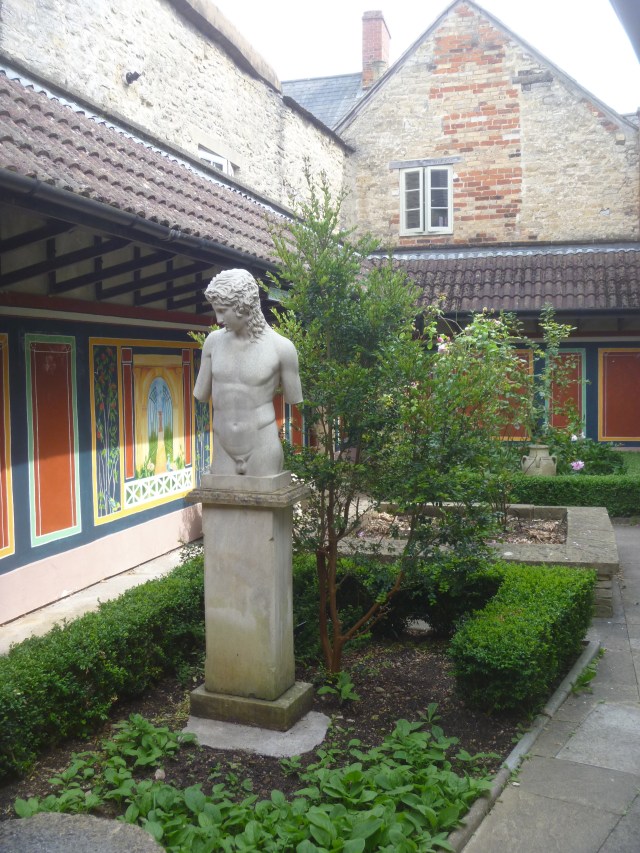
The Roman Garden

This small patch of garden has been planted out as might have been by Romans. The Museum is currently advertising for a volunteer to help keep the garden in shape.

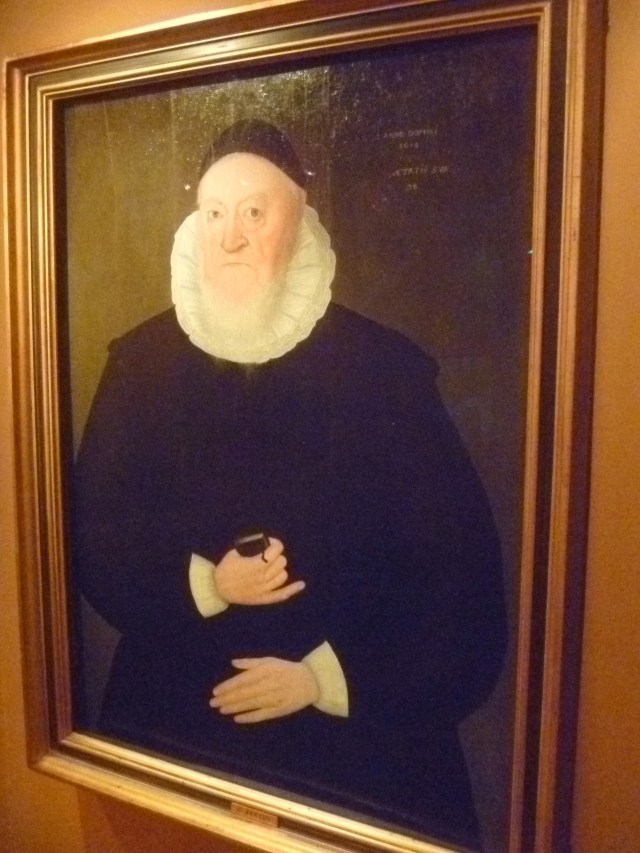
John Coxwell

John Coxwell (1516 – 1618)

Finally, in the Museum, as we moved away from the Romans we arrived at the last room where the displays are concerning the growth of Cirencester as a very significant wool town. John Coxwell played a big part in the history of wool on the town.

The Museum describes his painting :

An old man looks directly at us. Now aged nearly 100, he is dressed in costly black and carries what appears to be a prayer book. During his life, wool had made him rich; and the wool trade had brought the wealth to build churches and grand houses throughout the Cotswolds.”

When I left the Museum I realised that I still had enough time to visit the Parish Church of St John the Baptist to see The Boleyn Cup.

Parish church

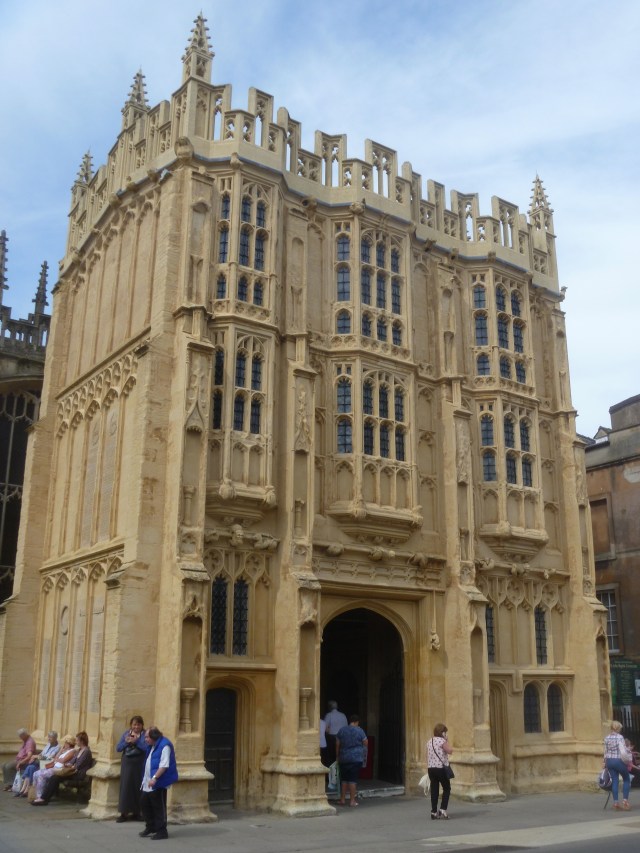
The Parish Church Tower

Cirencester parish church is one of the biggest parish churches in the country. It is an historic Wool Church and is sometimes confused with the former Cirencester Abbey which was situated nearby. The tower was erected in 1400 with funds taken from the rebellious Earls of Kent and Salisbury arrested by the townspeople and executed in the market place. Built on the site of an old Roman ditch it needed the support of flying buttresses. [From the church leaflet]

Boleyn cup

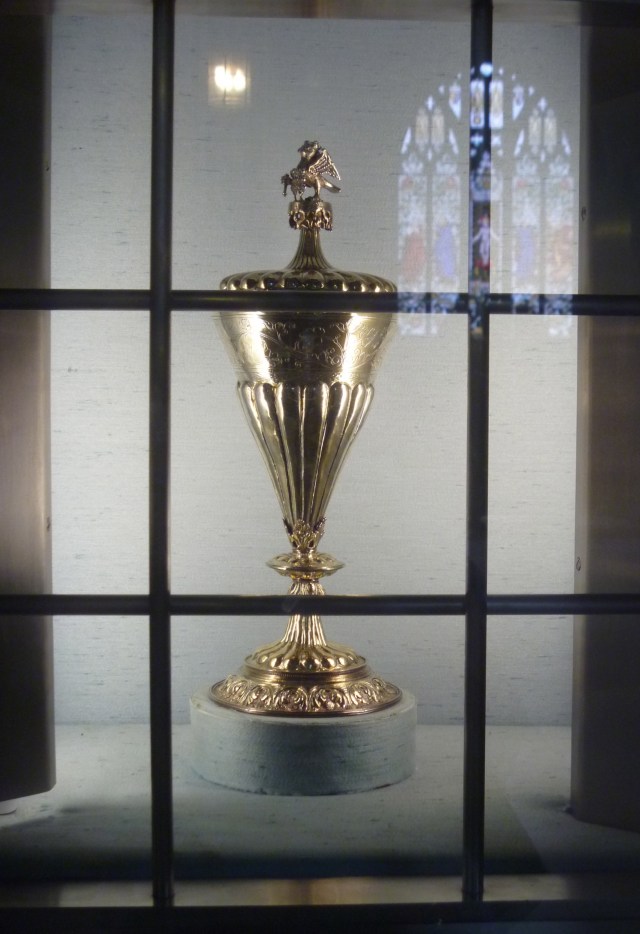
The Boleyn Cup

The Boleyn Cup was made in 1535 for Anne Boleyn and given first to her daughter Elizabeth, then by the Queen to her physician, Richard Master, who lived nearby,  and finally, by him to the church.

Church gate

The Fan-Vaulted South Porch has rooms above. It was built in 1500 for the Abbey but after the Reformation it served as the Town Hall.

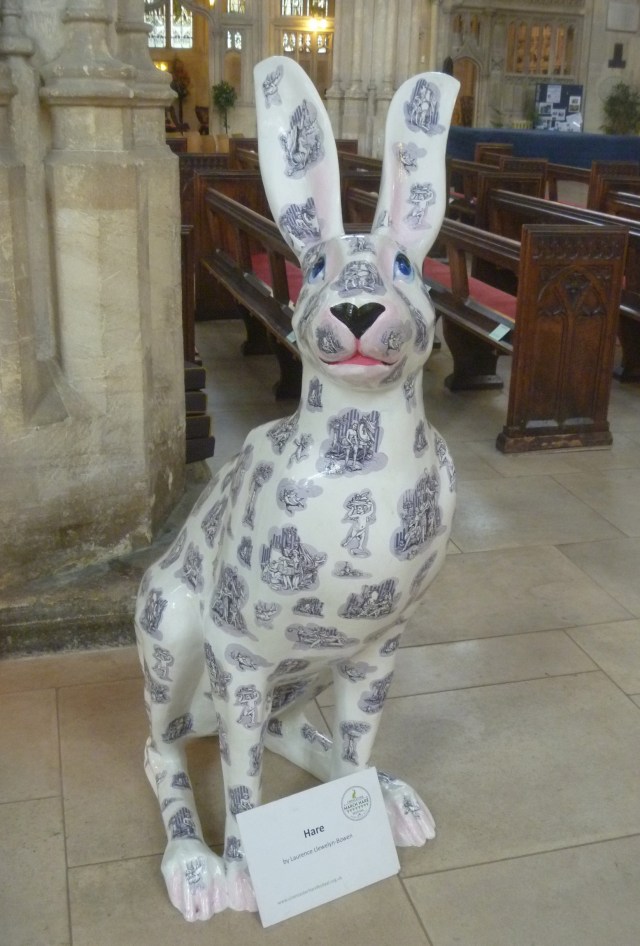
The significance of the March Hare Festival only dawned on me when I looked closely at the Hare in the church and noticed that it had been designed by Lawrence Llewelyn Bowen (of TV fame).

LLB hare

The LLB Hare

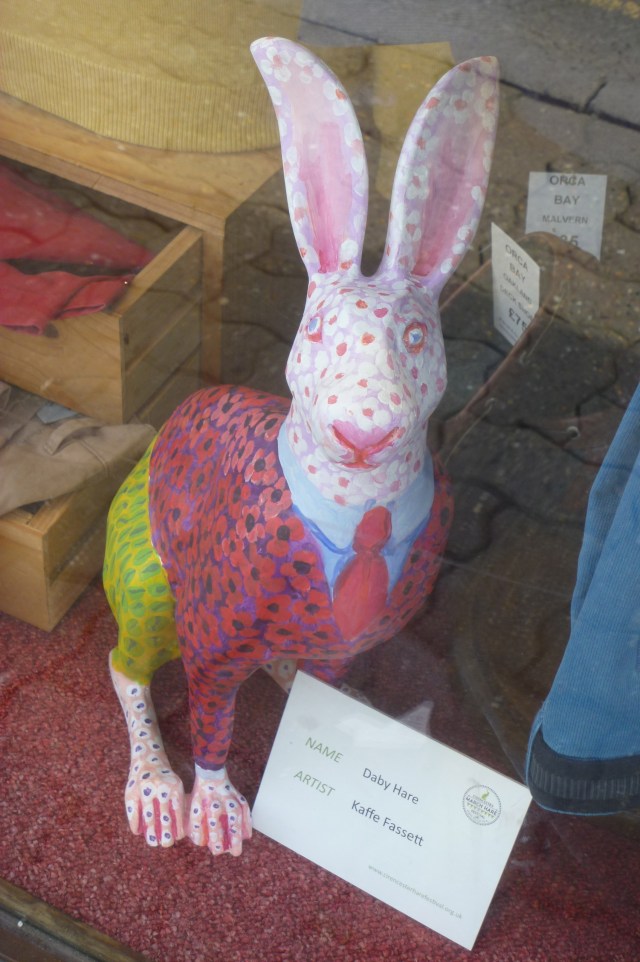
I then saw this hare by Kaffe Fassett in the window of a men’s outfitters shop.

K Fassett hare

The KF Hare

Marshall Howman (1887 – 1915) Redux

One of the most commented upon posts here is the one about my great uncle Marshall. The most recent comment was from Rosemary Braby on 11 May this year.

Such an interesting and moving story, Barbara.
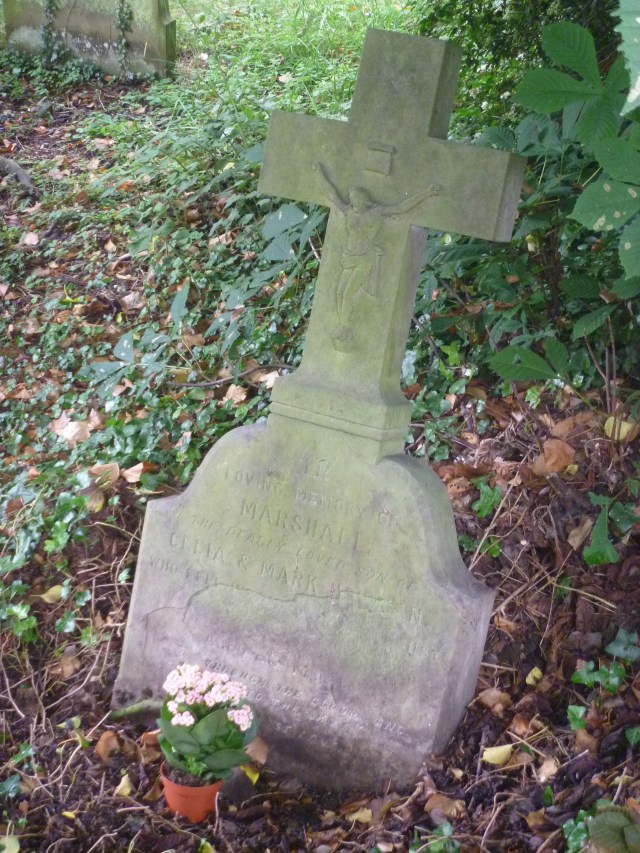
I am assistant priest at Trowse Church, where Marshall’s memorial is in the churchyard.
We are planning a weekend at the end of June, commemorating the outbreak of World War One, and especially honouring those whose names appear on our war memorial and others with local connections. We would be very grateful if you would allow us to use your information about Marshall in the display that we’re putting together. We have been trying to trace living relatives of those named on our war memorial, unfortunately without much success. Marshall’s memorial is somewhat unusual, looking more like a normal gravestone. It’s good to know that his great-niece still cares about him.”

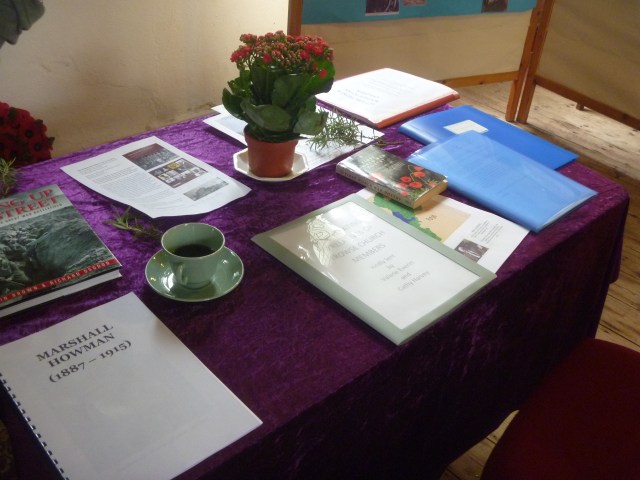
What a stroke of luck that I just happened to be in Norwich from Tuesday until Saturday (28 June) morning and was able to go with my mum, who lives very near the Trowse parish church, to visit the exhibition before leaving for Felixstowe.

Trowse Church

Trowse St Andrew’s Church, Norwich

I assembled the information from the blog and a few other bits and pieces and made it up into a booklet and sent Rosemary a copy for the display.

Display 2

On the Saturday we made our way down to Trowse and enjoyed lovely home made cake and cups of tea and chat with other visitors and met Rosemary, Janice (the priest) and Rosemary’s husband Jim who had put together a powerpoint presentation of pictures and statistics about the War.

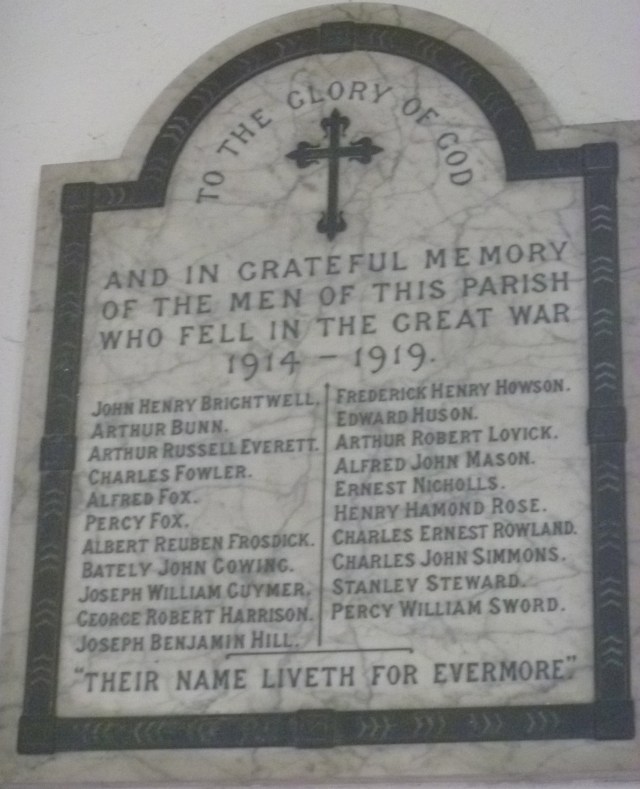
Honours Board

The Honours Board

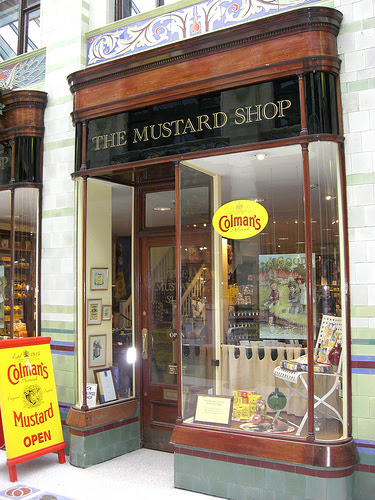
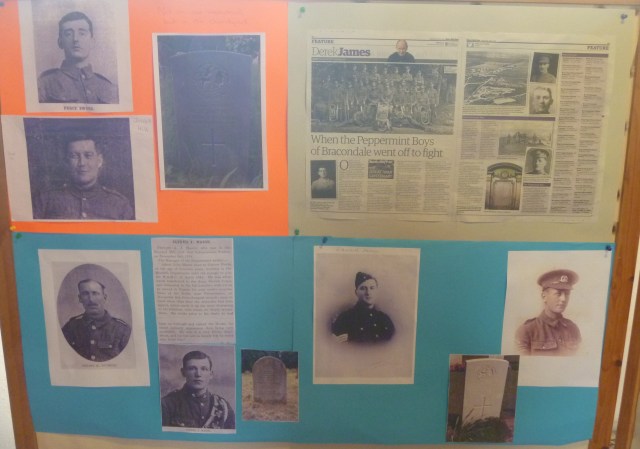
Trowse-by-Norwich was mostly a purpose-built village built to house the workers at Colman’s Mustard Factory nearby. Although now part of Unilever there is still a popular Mustard Shop in the lovely Royal Arcade in the city centre and the archivist was able to help Rosemary to track down details of many of the men named on the Honours Board in the church. There were photos of many of them too but sadly I haven’t yet found one of Marshall.

Mustard Shop

The Mustard Shop in Norwich

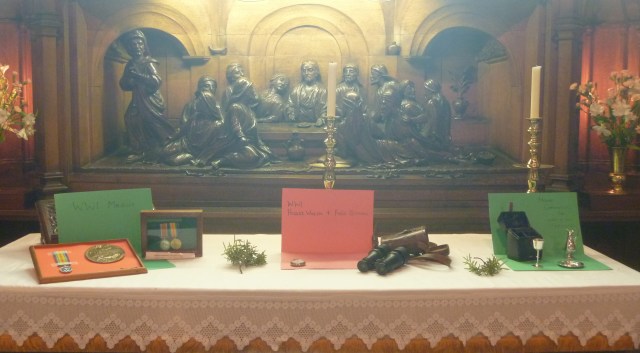
Altar display

The Altar Display

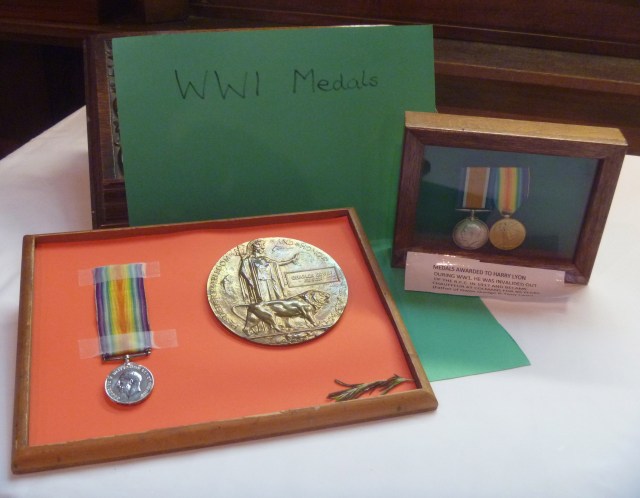
WW1 medals

Medals (the two boxed medals are those of Harry Lyon invalided out of the RFC in 1917 and who worked as chauffeur at Colmans for 40 years)

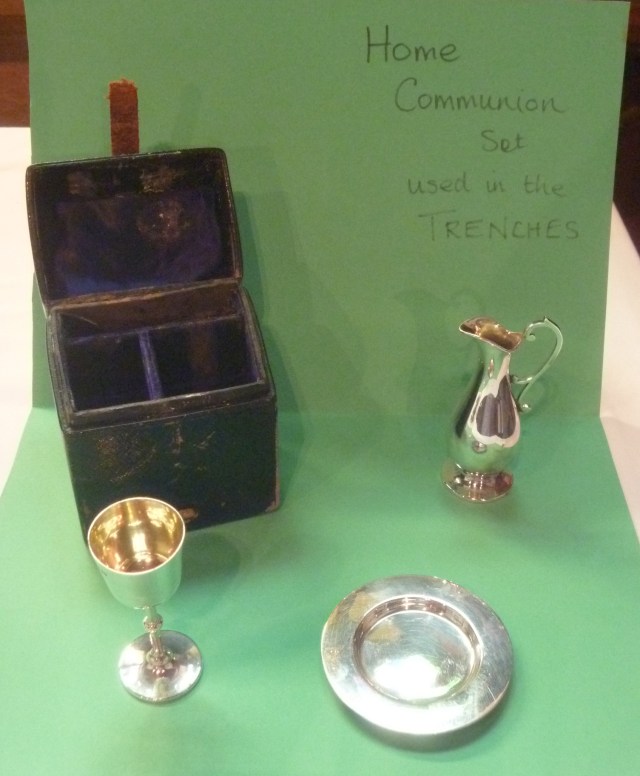
Communion set

Communion set used in the trenches

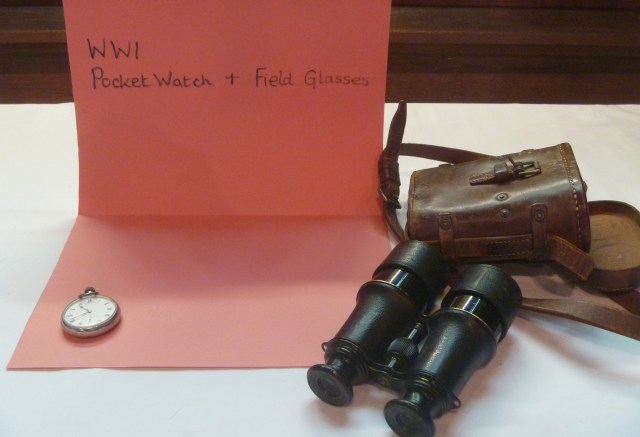
Field glasses

Field Glasses and Pocket Watch

display 1

Display Board with many photos

Marshall's Memorial

I was very touched to see that flowers had been placed by Marshall’s memorial

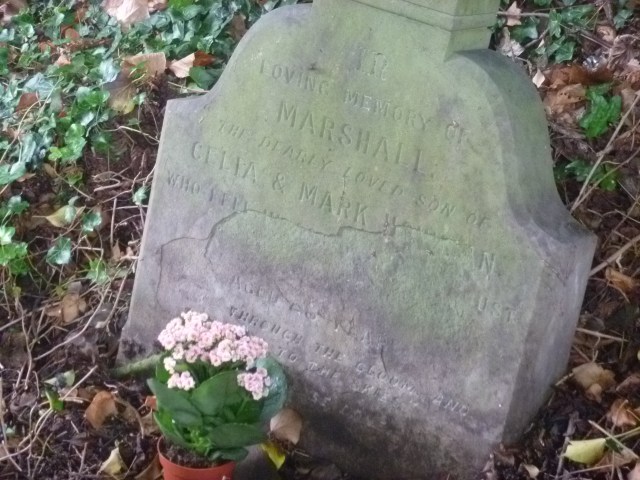
Memorial close up

The wording from ‘Abide with me’ has now been revealed

During the course of further correspondence Rosemary told me this :

We managed to decipher a little more of the inscription – a line from the hymn “Abide with me”: “Shine through the gloom and point me to the skies“.”

I have memories of Gran telling me about her beloved brother Marshall and her pride in the memorials to him in both Norfolk and Worcestershire. I also remember that she loved the hymn ‘Abide With Me’.

Abide with me; fast falls the eventide;

The darkness deepens; Lord, with me abide;

When other helpers fail and comforts flee,

Help of the helpless, oh, abide with me.

Swift to its close ebbs out life’s little day;

Earth’s joys grow dim, its glories pass away;

Change and decay in all around I see—

O Thou who changest not, abide with me.

I need Thy presence every passing hour;

What but Thy grace can foil the tempter’s pow’r?

Who, like Thyself, my guide and stay can be?

Through cloud and sunshine, Lord, abide with me.

I fear no foe, with Thee at hand to bless;

Ills have no weight, and tears no bitterness;

Where is death’s sting? Where, grave, thy victory?

I triumph still, if Thou abide with me.

Hold Thou Thy cross before my closing eyes;

Shine through the gloom and point me to the skies;

Heav’n’s morning breaks, and earth’s vain shadows flee;

In life, in death, O Lord, abide with me.

Henry F. Lyte, 1847

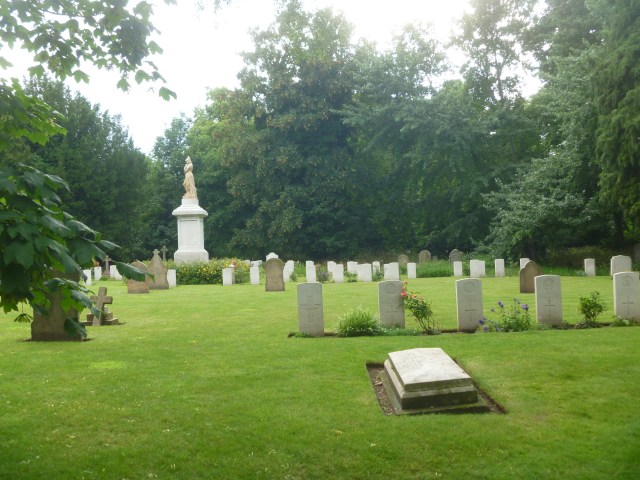
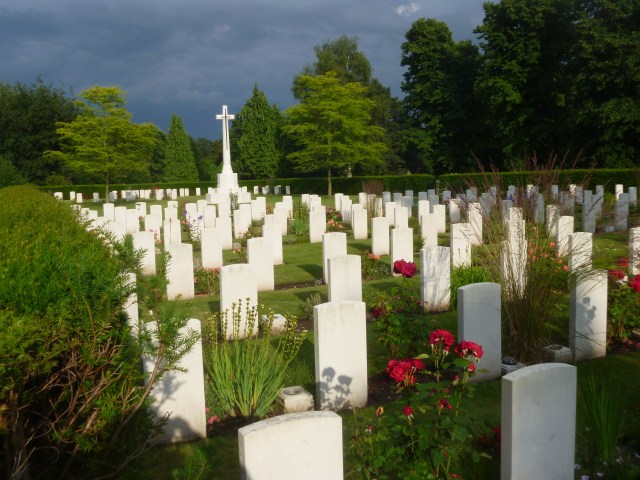
 Earlier that week I had visited the Earlham cemetery where there are two War Cemeteries. The Old Cemetery which is mainly First World War burials and a further newer Commonwealth War Graves cemetery mainly Second World War. There are other CWGC graves scattered throughout the cemetery itself.

Old War Graves

The Old Cemetery

Earlham CWG

The Newer Commonwealth War Graves Cemetery

Two Henrys : The Fourth Part Two and Moore

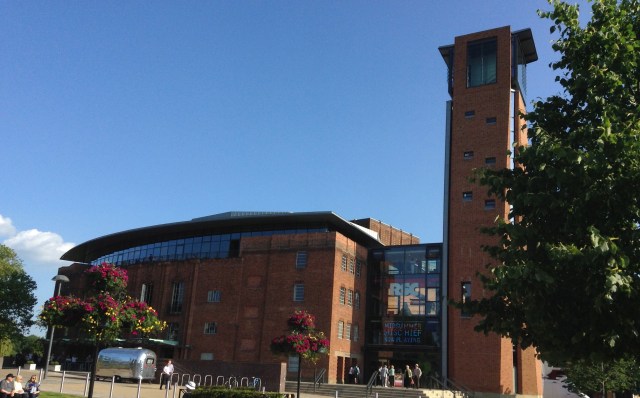
From Renishaw Hall on the eighteenth of June we made our way to Stratford upon Avon where we checked in at our hotel in time to wash and brush up before heading on foot (only a few minutes distant) to the Royal Shakespeare Theatre by the River Avon. It was a lovely warm evening and there were lots of people about enjoying relaxing by the River and the Canal.

RST

We were booked for supper at The Rooftop Restaurant followed by a performance of Shakespeare’s Henry IV Part Two by the Royal Shakespeare Company. This was no dull, boring history play rather it seemed to me dominated by comedy. Anthony Sher played Falstaff and the whole performance was being filmed and relayed simultaneously to a greater audience in cinemas throughout the country. This meant that the director, Greg Doran, came on stage at the beginning to introduce the play.

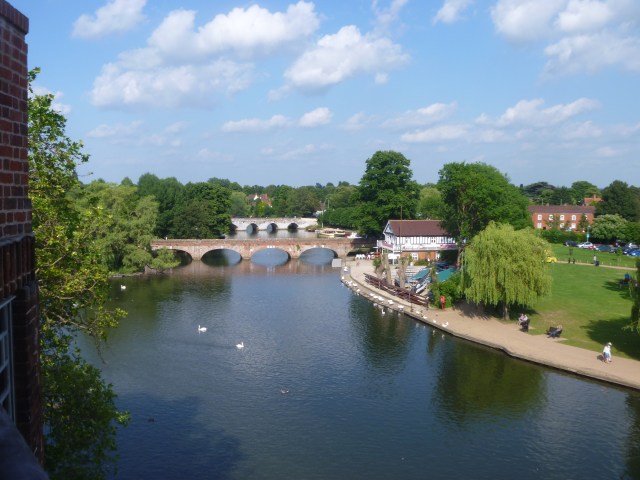
Swans of Avon

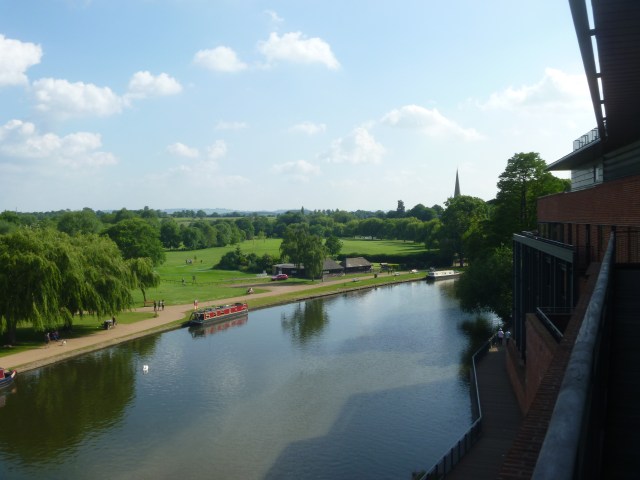
The Swans of Avon and Clopton Bridge from The Rooftop Restaurant

HT Church

River Avon and Spire of Holy Trinity church from The Rooftop Restaurant

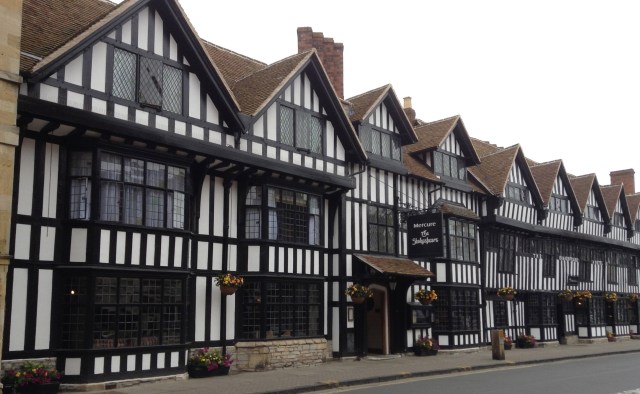
Shakespeare Hotel

The Shakespeare Hotel – one time I stayed here

Grammar School

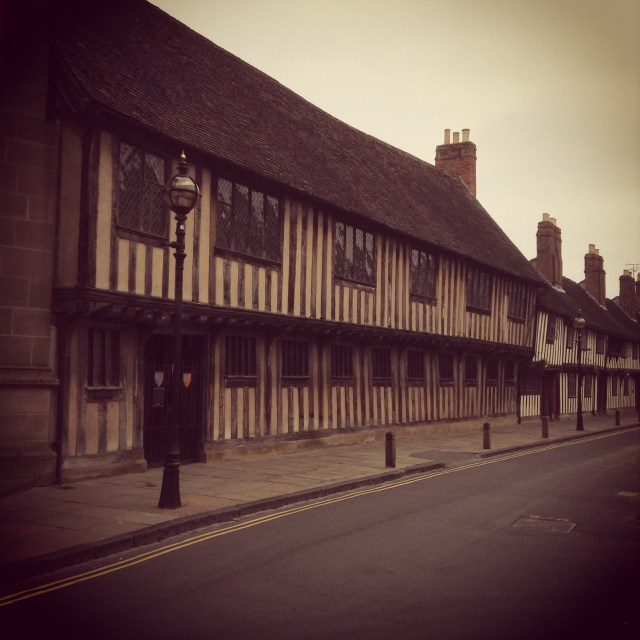
The Grammar School, Stratford upon Avon

Birthplace

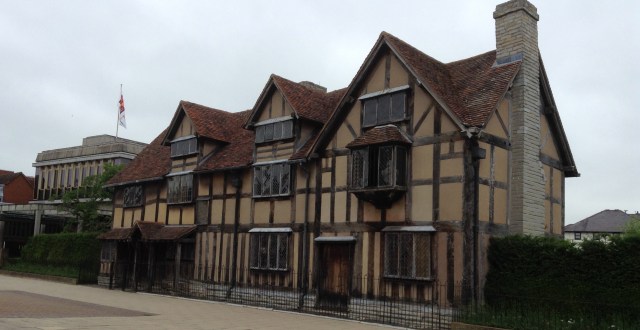
The Birthplace

The next morning after a leisurely breakfast and opportunity to take a walk in Stratford we headed off to nearby Compton Verney where we had a full programme of tours, a sandwich lunch and time also to walk in the park, visit the chapel and spend time (and money) in the attractive gift shop.

Approaching CV

CV and 3 piece

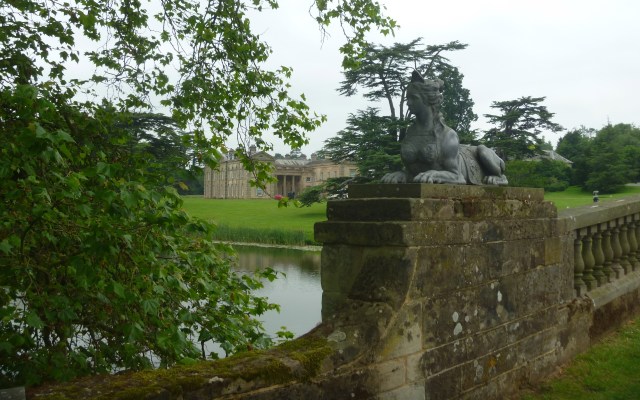
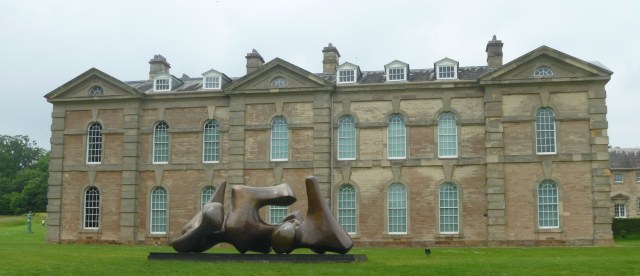
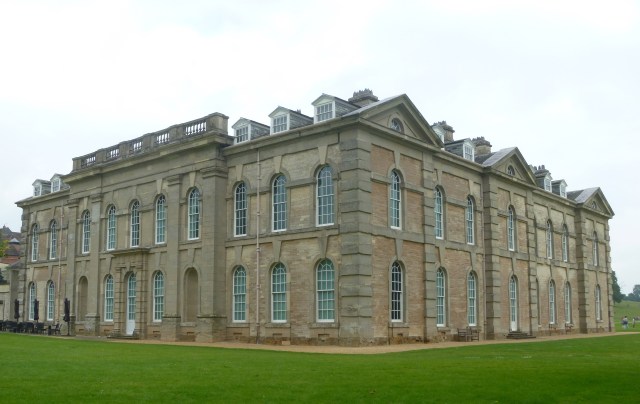
CV House

“10.30am Depart for Compton Verney. Set in a park designed by the ubiquitous ‘Capability’ Brown, this long-derelict house of the Willoughby de Broke family is now resurgent under the inspiration of the [Peter] Moore’s Foundation. The collections are numerous and varied. The morning will be given over to the current display of sculptures by Henry Moore and Auguste Rodin, while the afternoon will feature a guided tour of salient points of the main collection which encompasses British Portraits, Chinese Ceramics and Bronzes, British Folk Art and for Textile-buffs The Marx-Lambert Collection. You will be free to visit those parts of the collection which are your particular interest. www.comptonverney.org.uk” [Our Programme]

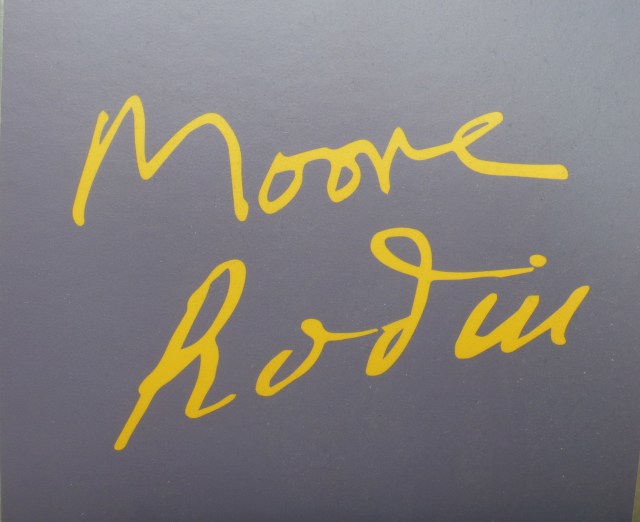
Moore Rodin

Moore – Rodin

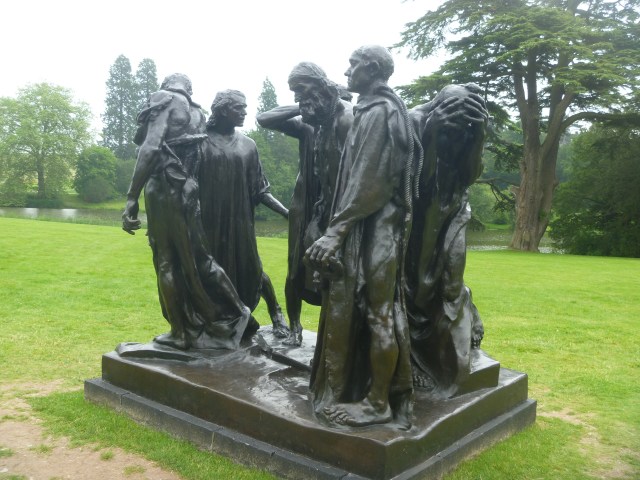
Calais Burghers

Rodin’s Burghers of Calais

Exhibition
Moore Rodin
15 February 2014 to 31 August 2014
10th Anniversary Year – Moore Rodin at Compton Verney

This ground-breaking international exhibition compares the work of two giants of modern sculpture: Henry Moore and Auguste Rodin. This is the first exhibition to be devoted exclusively to these artists, with major works being displayed in our ‘Capability’ Brown landscape as well as in our exhibition spaces.

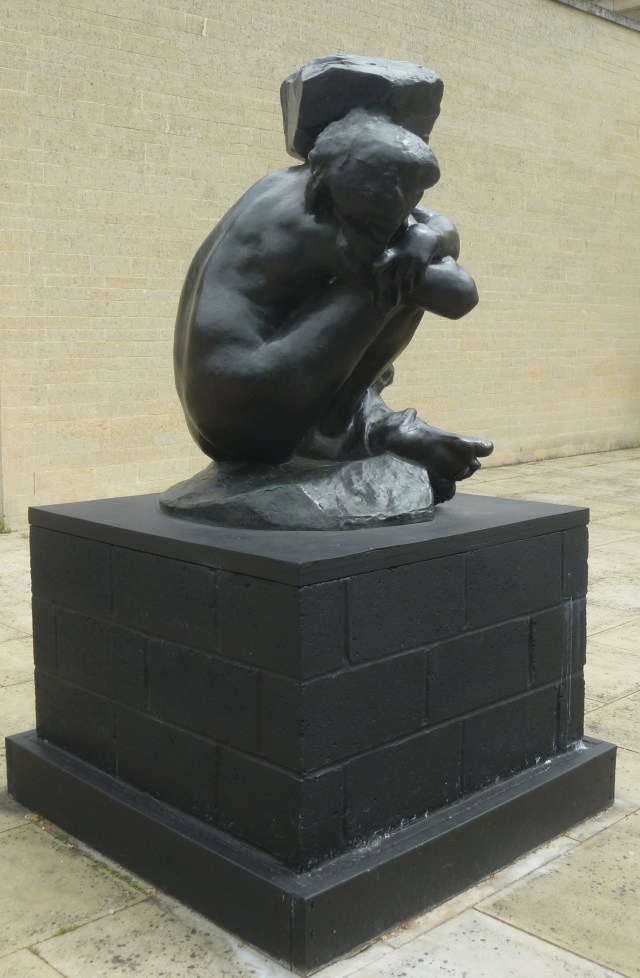
Fallen Caryatid

Fallen Caryatid by Rodin

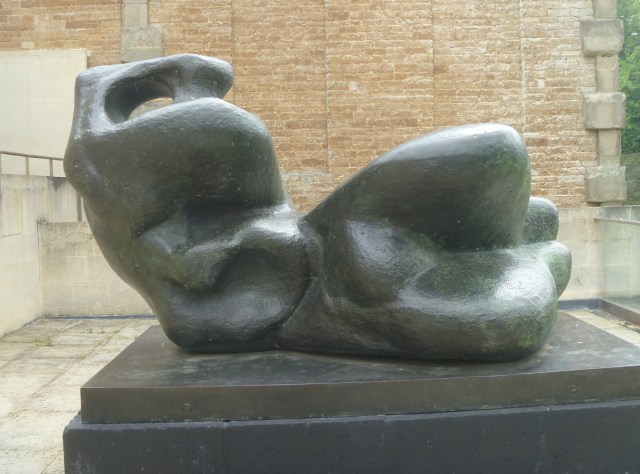
Bunched figure

Reclining Figure : Bunched by Henry Moore

In the grounds
Enjoy eleven large scale works which complement, challenge and create new perspectives to vistas ‘Capability’ Brown formed in the 1760s. Amongst these amazing pieces is one of Rodin’s most famous works, Monument to the Burghers of Calais (usually on display outside the Houses of Parliament), Moore’s magnificent monumental Three Piece Sculpture: Vertebrae and The Arch.

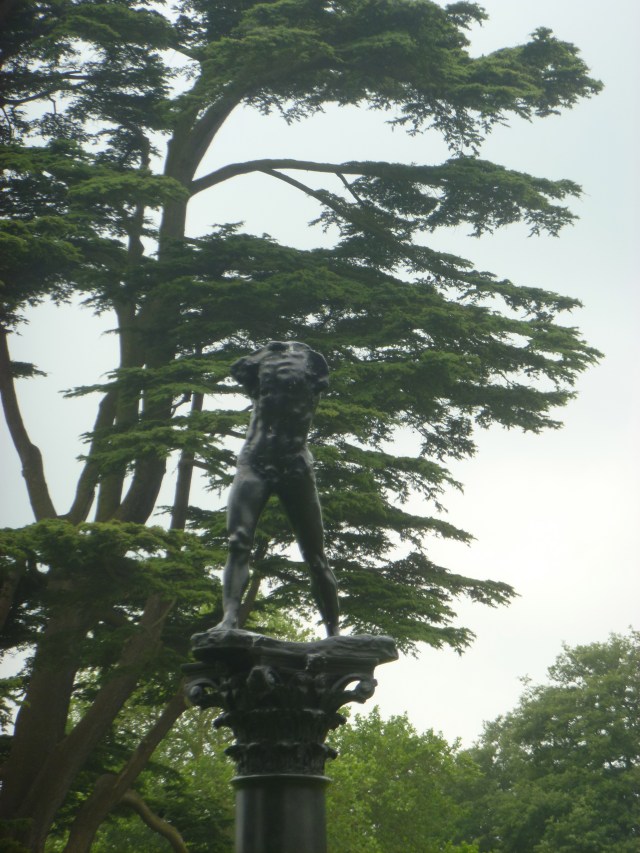
Walking man on column

Rodin’s Walking Man on Column

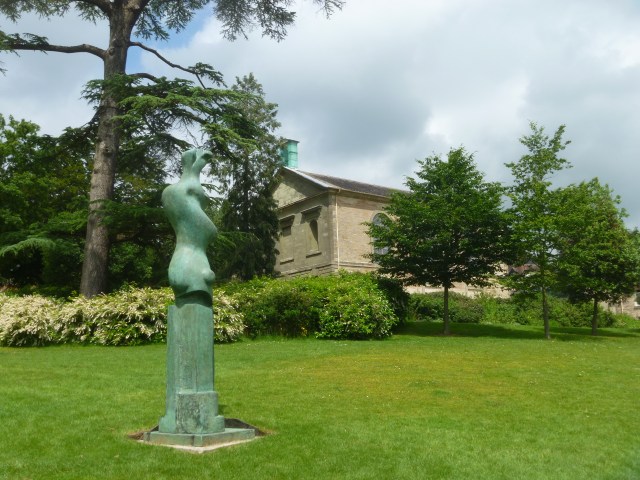
Upright Motive No. 9

Henry Moore Upright Motive No. 9 with Chapel

Inside the galleries

Gain an amazing insight into the works of these two artists. Explore the parallels between their treatment of the figure through a beautiful collection of drawings and models made for larger works. See a special display curated by Moore’s daughter Mary which reveals both artists as keen collectors of antiquities and found objects which profoundly influenced their work. The final treat is a display of rarely seen archival documents and photographs taken by Henry Moore revealing that … ‘as time has gone on, my admiration for Rodin has grown and grown’.

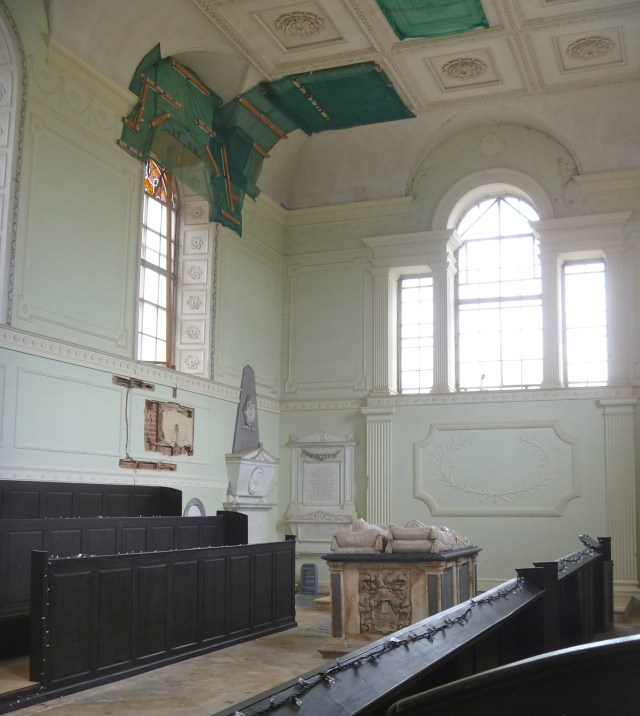
After our sandwich lunch I wandered round the grounds and visited the Capability Brown Chapel.  This was built in 1776 as part of the relandscaping of the site and is one of the few surviving Georgian chapels in Britain, and one of the very few remaining architectural works by ‘Capability’ Brown. It is currently undergoing a restoration project and more funds are needed to support this work as it’s hoped to use the building in future for music and learning.

CB's chapel

The Chapel Interior

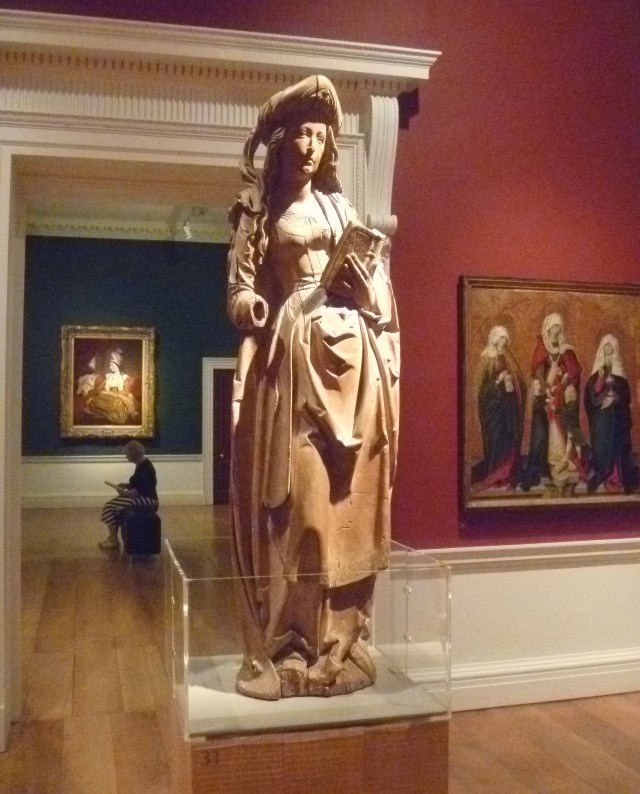
And in the afternoon we had a tour of the permanent collection – British Portraits

Beautiful display

Beautiful Displays

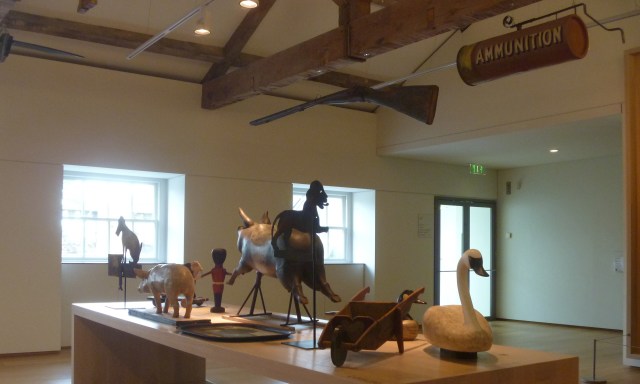
and British Folk Art. Currently there is an exhibition of British Folk Art at Tate Britain and this will then come to Compton Verney  from 27 September 2014 to 14 December 2014.

British Folk Art

British Folk Art

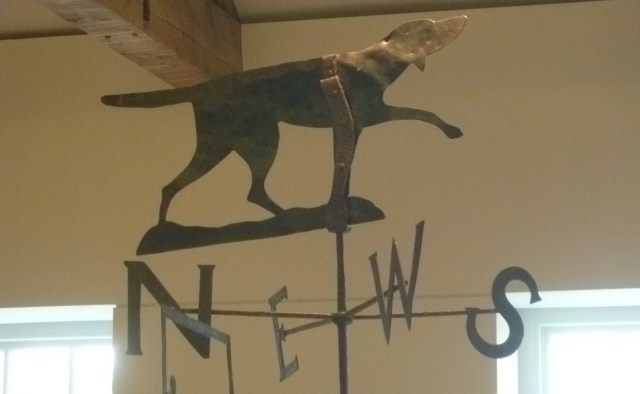
Weather vane

Weather Vane

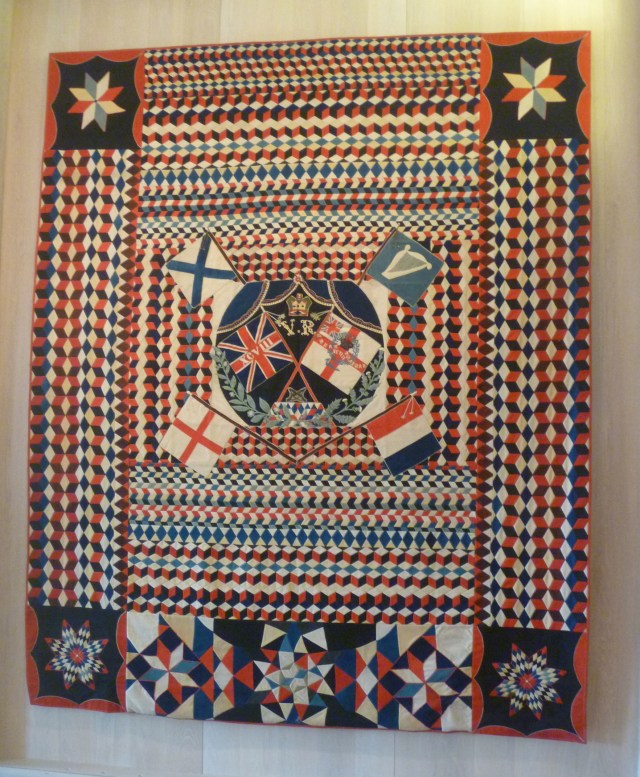
Quilt

Quilt

And finally, the Marx-Lambert Collection.

Marx Lambert collection

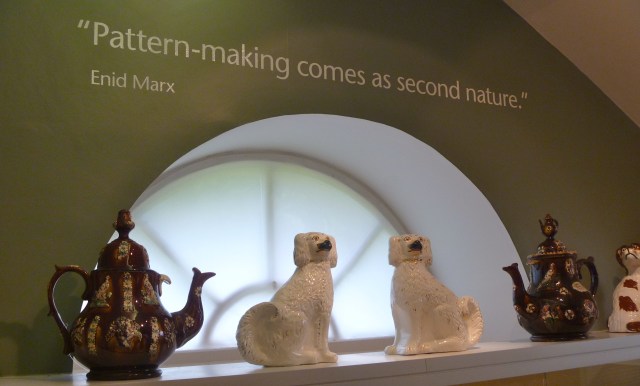
Enid Marx (1902-1998) was one of the brightest design stars to emerge from the Design School of London’s Royal College of Art (RCA) during the interwar years. She was an author and illustrator of children’s books, a book designer, a printmaker, a textile designer and a painter.
The Marx-Lambert collection at Compton Verney features both work produced by Marx and a large number of pieces of folk or popular art which were collected by Marx and her friend Margaret Lambert (1906-95). These then inspired Marx’s own work -sometimes directly, as seen in the pair of ceramic wall-mounted cornucopia cases which inspired her ‘Cornucopia’ textile design.”

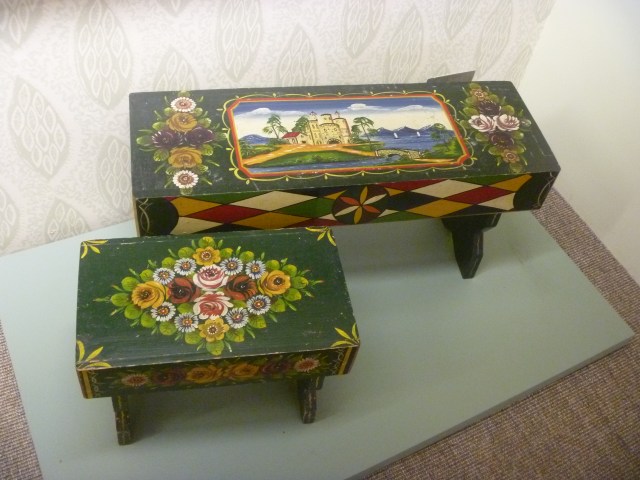
Canal art and wallpaper

Canal Art and Wallpaper

A wonderful trip full of interest and variety marred only by a 3 hour delay on the M1 due to a lorry on fire.


The Gems of Bewerley Village, Nidderdale

SUNDAY 8TH JUNE 2014: THE GEMS OF BEWERLEY VILLAGE
After discovering some interesting facts about this beautiful village we climb to join the Nidderdale Way before returning via field and woodland paths.
Start: Pateley Bridge, Bus Stand 10.50
Finish: Pateley Bridge approx. 15.30
Distance/Grading: 4.5 miles / Easy to Moderate

Last Sunday's walk

Nidderdale is my new favourite rambling region so I was happy to join fellow members and supporters of The Dalesbus Ramblers last Sunday for a shortish walk full of interest.

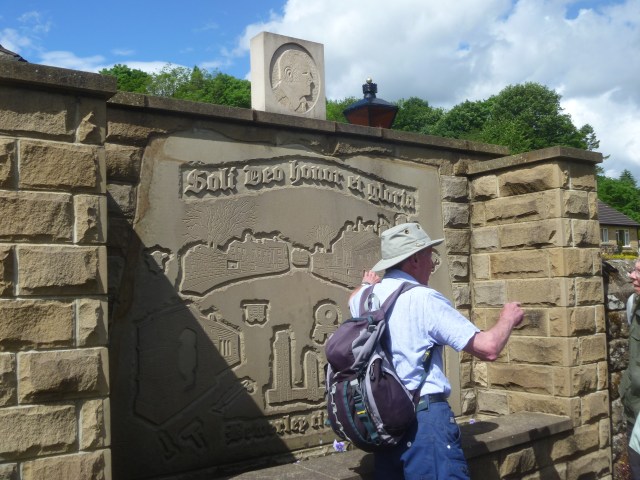
From Pateley Bridge it was a short walk to Bewerley where we stopped to study the local stone mason’s work – a depiction of the major features of the village carved in stone.

Stone carving of Bewerley

The Stone Mason’s Work. Frank explains the Latin Motto.

“soli deo honor et gloria” Honour and Glory to the only God.

Yorkes Folly picked out

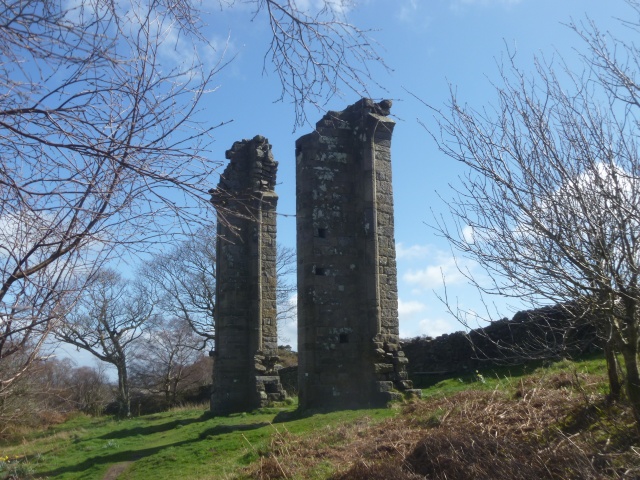
Yorkes Folly picked out in stone


Leaving Yorke's Folly

Yorkes Folly for real (on a previous walk)

“Built around 1810 the folly was constructed by labourers working for John Yorke of Bewerley Hall. He commissioned the folly during a depression to keep his labourers in work and above the poverty line. Each labourer was paid a shilling a day and an loaf of bread. The folly was known as Three Stoops until a violent storm during the night of 17th November 1893 blew one of the towers down. Today it is known locally as the Two Stoops.” [Information Board at the folly]

Further along through the village we arrived at The Chapel of Ease.

“A small grange chapel of Fountains Abbey built by Marmaduke Huby which has remained intact. The Chapel was fully restored for worship in 1965. The chapel is open during daylight hours. We have services on the first and third Sundays of the month at 9am.”

Latin motto

Our leader Frank showed us the Latin motto on the exterior rear wall of the Chapel and Marmaduke Huby’s initials carved on the wall and in the windows.

Chapel window


MH window

MH

MH on windows and walls

From the Chapel we hurried along to meet, as arranged, the owner, Dr Peter Brambleby, of Fishpond Wood. We had a guided tour through the wood which Dr B called his “Natural Health Service”.

Peter says one of his priorities will be to support educational use, and especially to encourage a love and respect for nature amongst children. He has already entered into an agreement to permit the Bewerley Park centre for Outdoor Education to use the area to the east of the public footpath and pond.

Woodland, like much of the English countryside, is shaped by generations of active management, and Fishpond Wood is no different. It will benefit from thinning out of invasive rhododendrons, from planting young trees to renew the aging stock, and from restoration of the pond, paths and walls.” Read more about Peter’s work and plans here.

Ice House

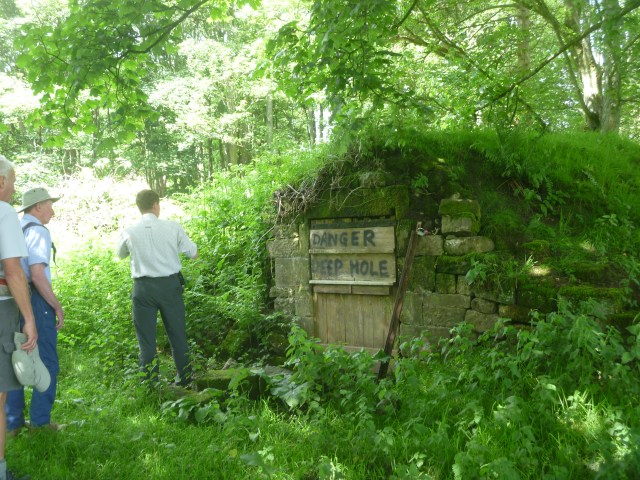
The Recently Rediscovered Ice House – we were able to go in and look down at its full depth

Fishpond

The Fishpond

Footpath

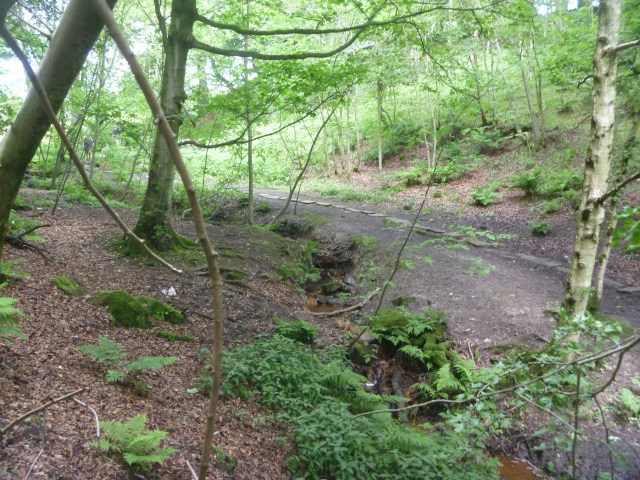
Improved Footpaths through the Woods

Dr Brambleby showed us the route out of the wood and we were soon climbing up, up, up steadily before the walk levelled out and we crossed the busy B6265 and descended to The Nidderdale Way and thence back to Pateley Bridge.


Charleston Farmhouse : An Artists’ Home and Garden

Welcome to CF shop

Welcome to Charleston Farmhouse Shop

In some ways very different from Monks House but in other ways similar; on the Friday of our stay we headed to Charleston Farmhouse just a few miles from Laughton Place. It’s a rather more slick presentation in that tickets are sold and one is booked on one of the timed tours which take place at twenty minute intervals throughout the opening hours (just Wednesday to Sunday during the season). No photography is allowed in the house. But like Monks House there is colour inside and out and the garden is relaxed and colourful and again reflected the atmosphere of the house itself.

Chareston

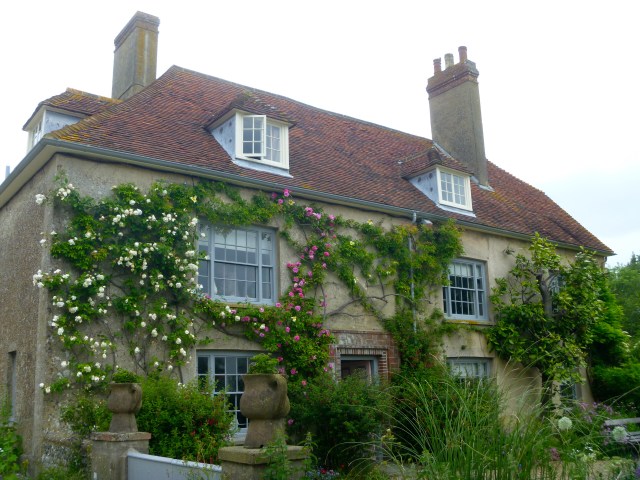
Charleston Farmhouse

“Charleston is a property associated with the Bloomsbury group. It was the country home of Vanessa Bell and Duncan Grant and is an example of their decorative style within a domestic context, representing the fruition of over sixty years of artistic creativity.

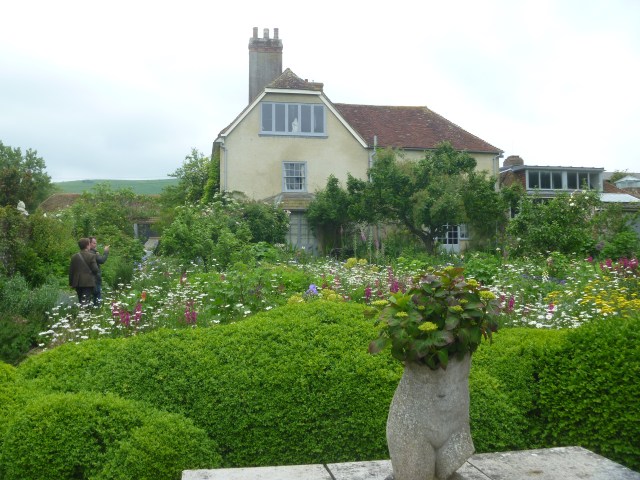
In 1916 the artists Vanessa Bell and Duncan Grant moved to Sussex with their unconventional household. Over the following half century it became the country meeting place for the group of artists, writers and intellectuals known as Bloomsbury. Clive Bell, David Garnett and Maynard Keynes lived at Charleston for considerable periods; Virginia and Leonard Woolf, E. M. Forster, Lytton Strachey and Roger Fry were frequent visitors. Inspired by Italian fresco painting and the Post-Impressionists, the artists decorated the walls, doors and furniture at Charleston. The walled garden was redesigned in a style reminiscent of southern Europe, with mosaics, box hedges, gravel pathways and ponds, but with a touch of Bloomsbury humour in the placing of the statuary.

Statuary

… humour in the placing of the statuary

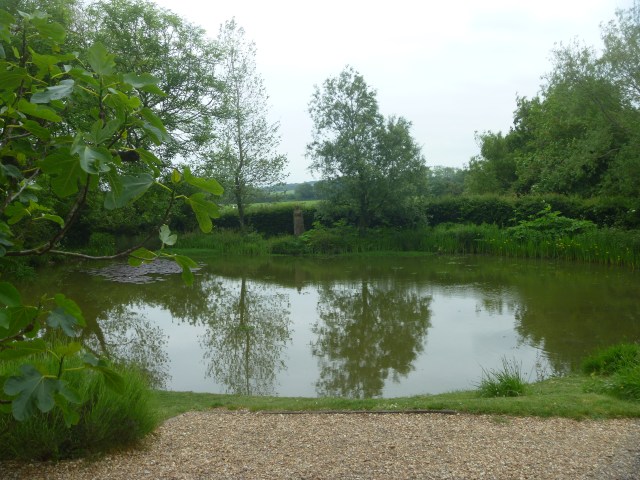
“It’s most lovely, very solid and simple, with … perfectly flat windows and wonderful tiled roofs. The pond is most beautiful, with a willow at one side and a stone or flint wall edging it all round the garden part, and a little lawn sloping down to it, with formal bushes on it.” — Vanessa Bell

Charleston Pond

The pond is beautiful

The rooms on show form a complete example of the decorative art of the Bloomsbury artists: murals, painted furniture, ceramics, objects from the Omega Workshops, paintings and textiles. The collection includes work by Auguste Renoir, Picasso, Derain, Matthew Smith, Sickert and Eugène Delacroix.” [Adapted from here]

We arrived by 12 noon, when tickets go on sale, and our tour was booked for 1.20pm. In the meantime there was a delicious shop to mooch around and a video to watch. There is a cafe but it’s very limited in what it serves.

Our House Tour with Meg focused on A Day in the Life of Charleston, taking us on a journey of daily life in the house which included the Charleston kitchen not normally visited on other days. In fact the gardener actually lives in the house and it is his private kitchen.

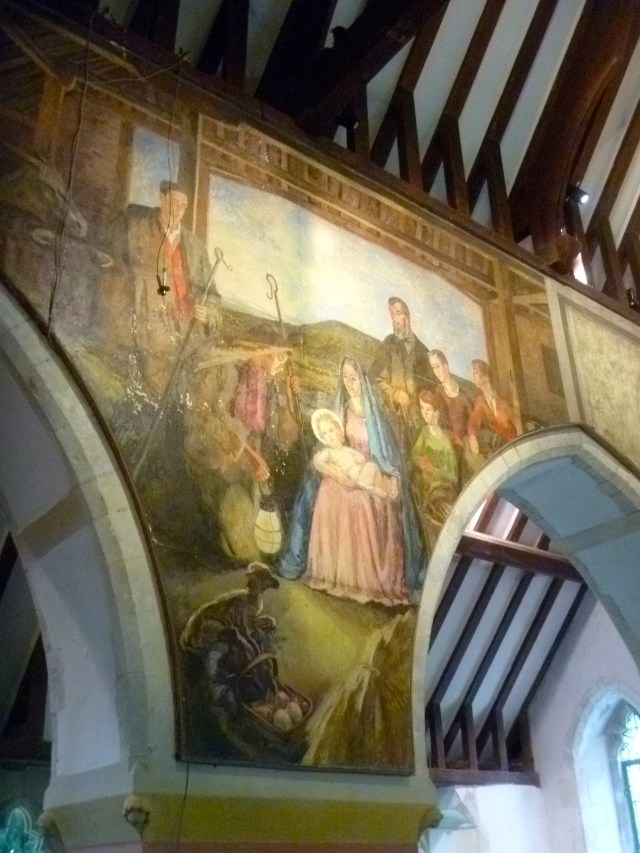
From Charleston we headed for the nearby village of Berwick where we had lunch at Cricketers Arms and afterwards visited the Church of St Michael and All Angels where Duncan Grant and Vanessa Bell decorated the walls with murals. The church itself had a rather unusual feel not just because of the famous murals but because in contrast to so many churches the windows are plain glass.

All the scenes are set in the local Sussex countryside and they were painted, for the most part, during the Second World War and they used members of their families and their Bloomsbury circle as models.


Nativity

The Nativity by Vanessa Bell

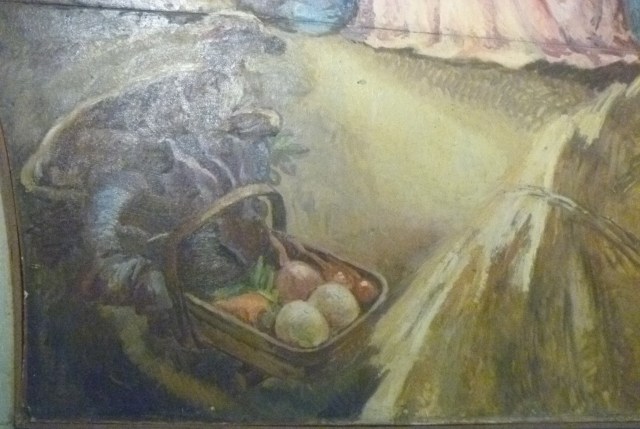
A Sussex trug

The Nativity Close-up : A Sussex Trug

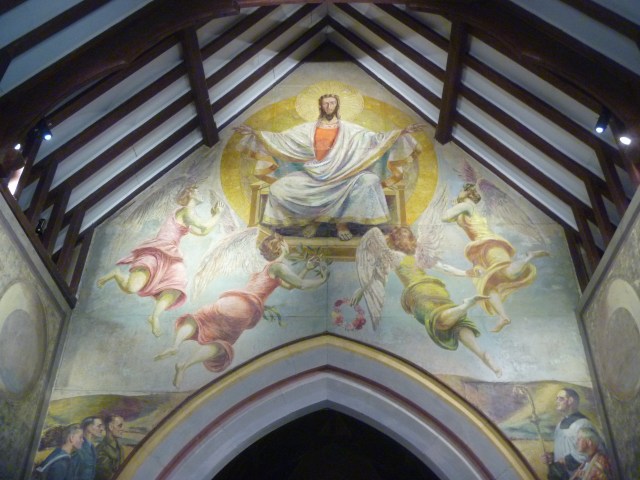
P1130644

Christ in Majesty by Duncan Grant

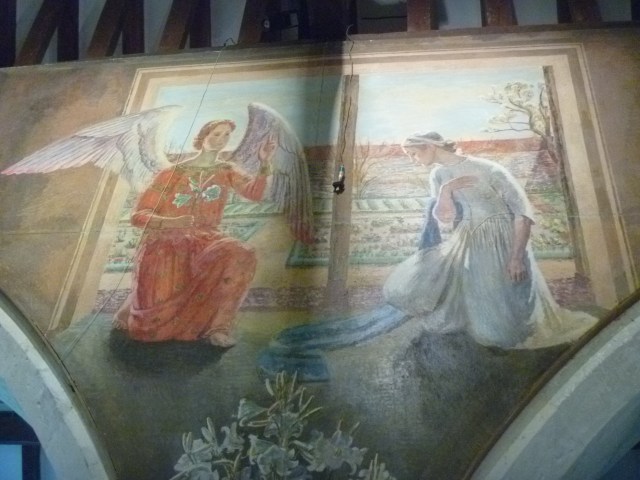
Annunciation

The Annunciation by Vanessa Bell


Walking in East Sussex

The main aim of my stay in Sussex was to meet up with two Swiss friends. Last year when I was staying with Barbara in Bern for the weekend the idea of visiting Charleston and all those ‘Bloomsbury’ related places in Sussex was suggested. I said I’d also wanted to visit them and showed Barbara the Landmark Trust website. When she saw Laughton Place tower she would not be budged to look elsewhere for accommodation. So we ended up last weekend in the tower and visiting as many Bloomsbury locations as we could manage.

Alfriston Church

Alfriston Church and Village Sign

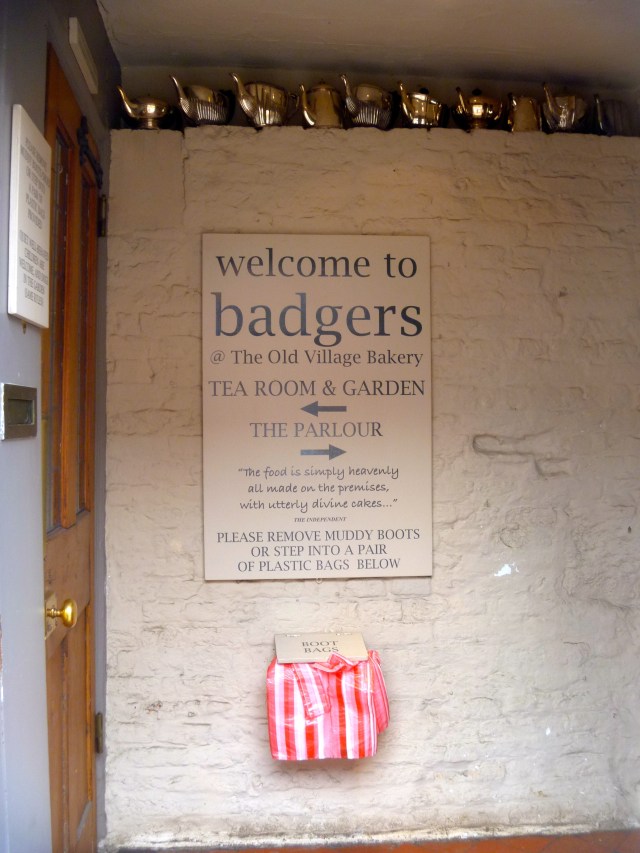
Badgers

Badgers Alfriston (Note the Boot Bags – it’s on the route of the South Downs Way)

Barbara and Kathryn first wanted to have a few days in London so I spent the first two nights at Laughton Place on my own. But for the most part I wasn’t alone thanks to Fran being able to spend Tuesday afternoon and all day Wednesday with me.

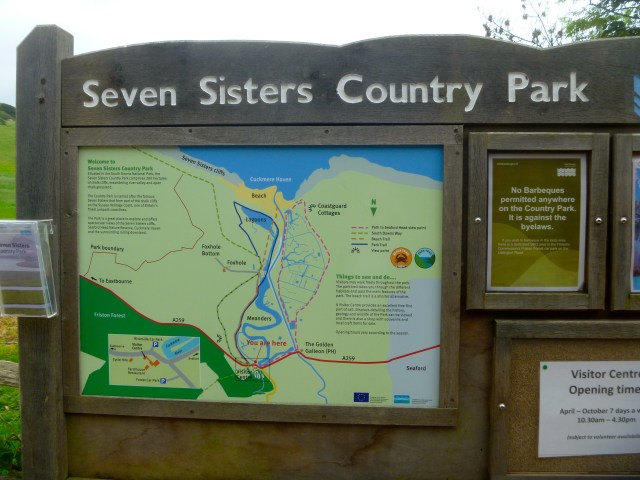
Seven Sisters Info

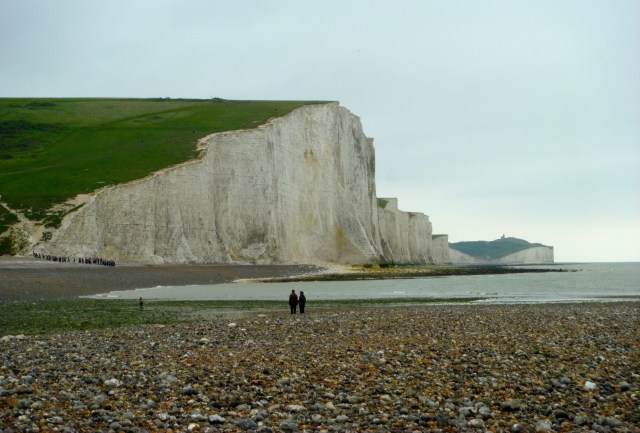
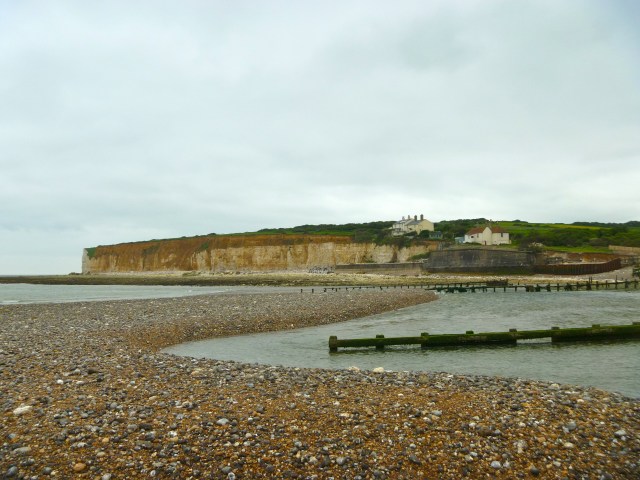
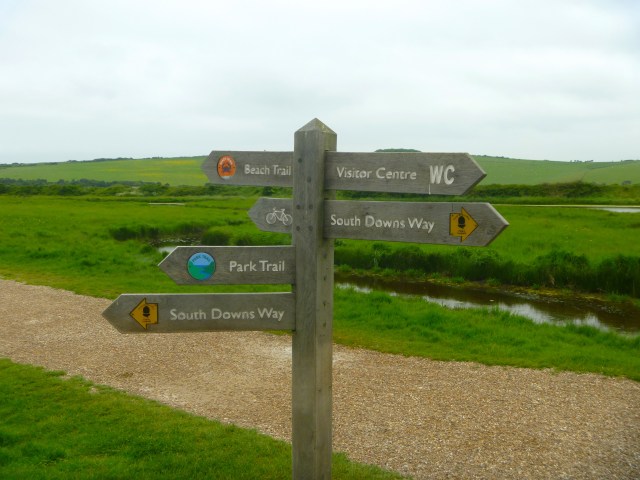
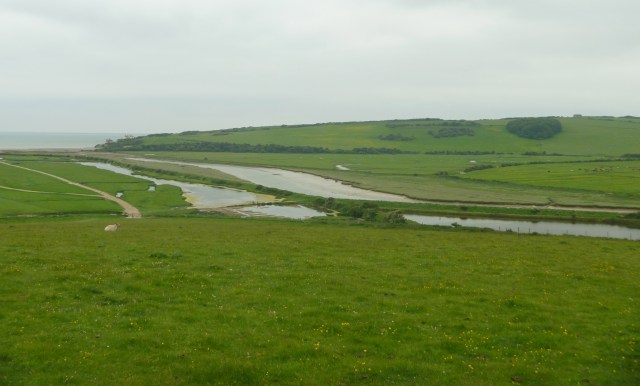
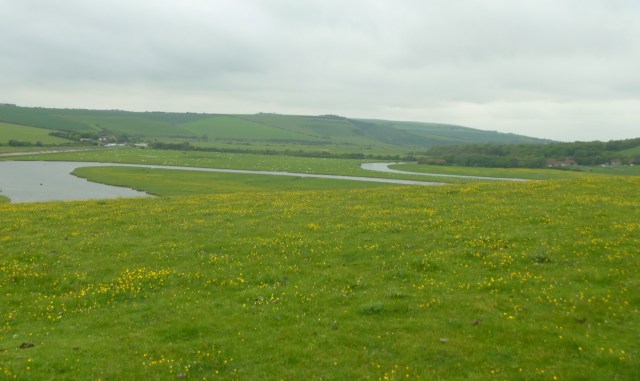
Knowing my love of hiking she had planned a walking expedition for us but the weather was not kind on the Wednesday morning so we took lunch in Alfriston and drove later in the afternoon to the Seven Sisters Country Park car park, donned our boots and set off on a shorter walk following the River Cuckmere to where it joins the English Channel. At the sea’s edge you have a wonderful view of The Seven Sisters cliffs over which we might have walked part of the South Downs Way had the morning’s weather been different.

Seven Sisters

The Seven Sisters (looking east)

Looking west at 7 sisters

Looking west

Sign and River

River Cuckmere behind the Footpath Signpost

River Cuckmere

River Cuckmere with Ox Bow Lakes, Meanders and the English Channel

Meanders and Buttercups

Meanders and Buttercups

Thank you, Fran, for your good company and for being the most informative guide possible!

Firle

The Village of Firle nestled below the South Downs

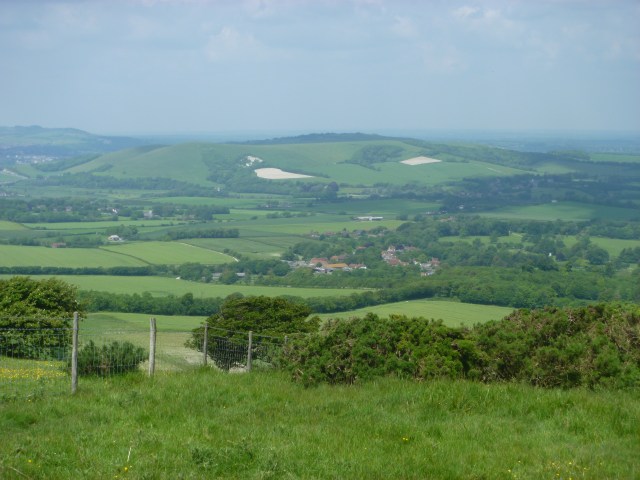
On Sunday Barbara, Kathryn and I drove to the car park above the village of Firle and walked a mile or so each way to Firle Beacon and back. At the Beacon (an Ordnance Survey Triangulation Point) we could see the Channel and a cross-channel ferry arriving at Newhaven in one direction and the flat levels and meadows that surround Laughton Place in the other. There right in front of us but a little distant was our Tower itself.

On South Downs

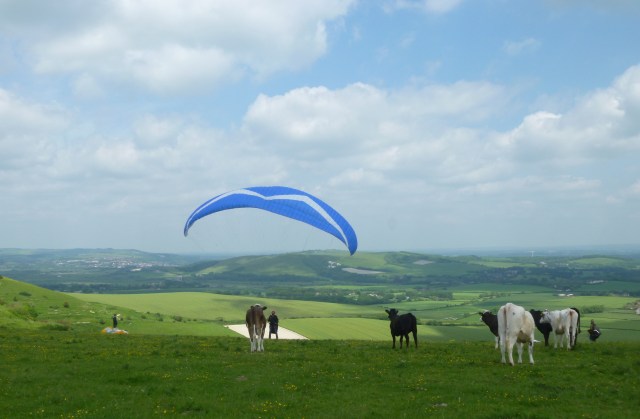
Sunday Morning on the South Downs

After our walk we headed down into Firle village. Vanessa Bell and Duncan Grant (see future posts about ‘Bloomsbury-on-Sea) are buried in the churchyard; Virginia and Leonard Woolf had a house in Firle before they moved to Monk’s House and we had a drink in the warm sunshine at The Ram Inn.

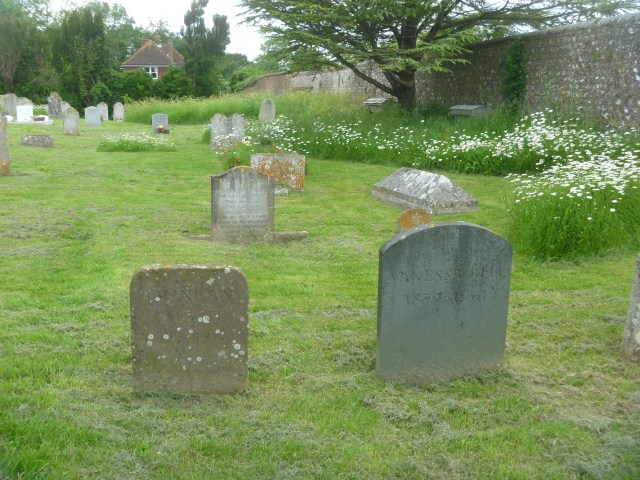
Firle churchyard

Firle Churchyard : Graves of Duncan Grant and Vanessa Bell

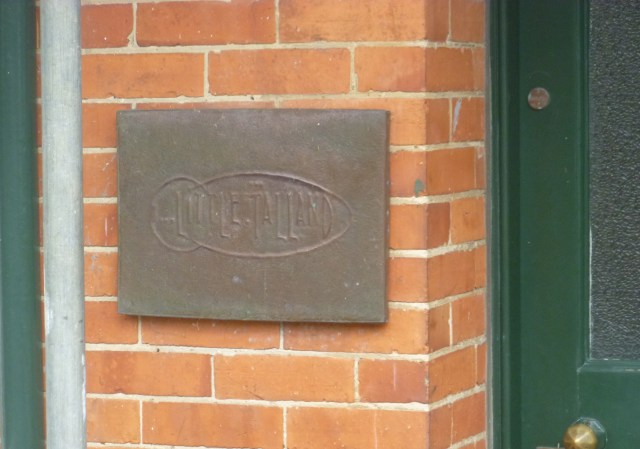
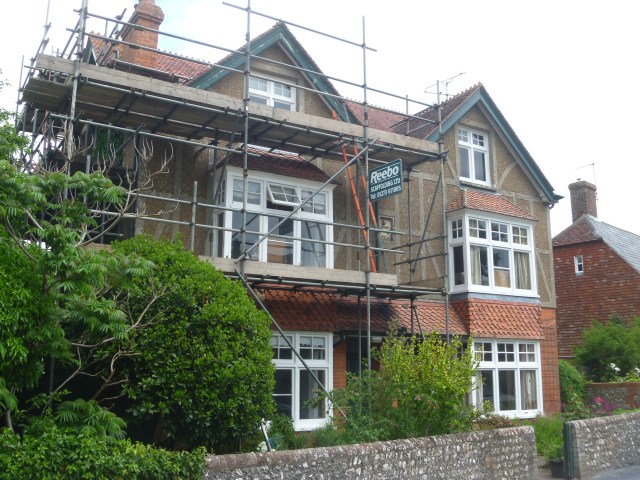
LT Firle

Little Talland

Little Talland House, Firle

I also managed to fit in a short walk directly from the Tower towards Laughton village but I never quite made it. I was anxious to see the village but had the time constraint of meeting the London train too so after a mile or so I turned back and drove to Laughton (the village of the buckle).

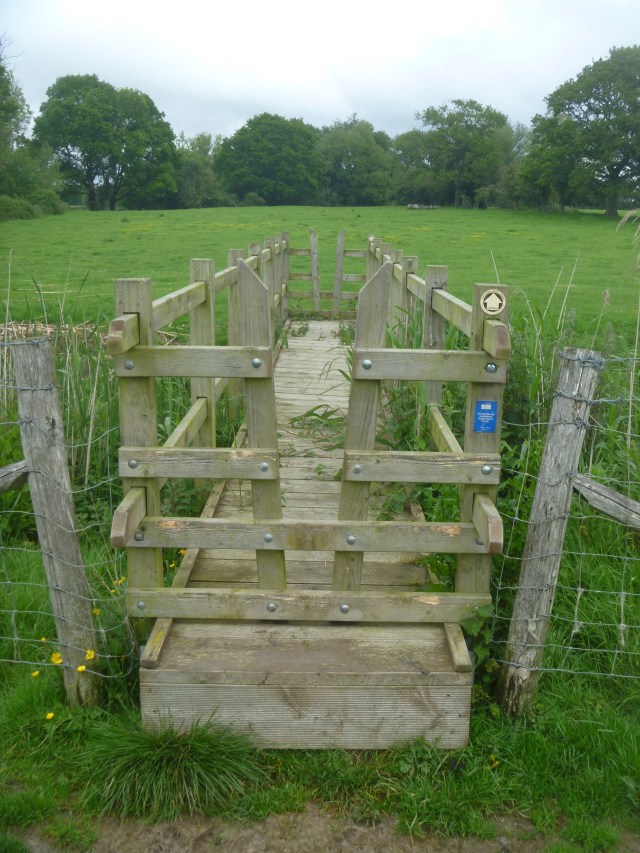
Bridge Stile

Complicated Bridge/Stile near Laughton Place

LP from footpath

Laughton Place in its Landscape

Laughton, East Sussex : The Village of the Buckle

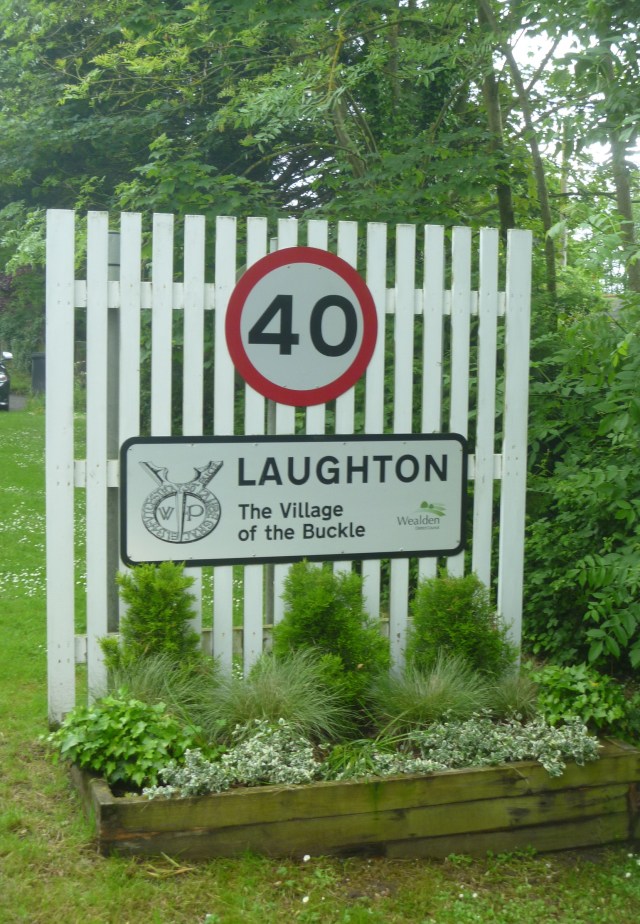
Road sign Laughton

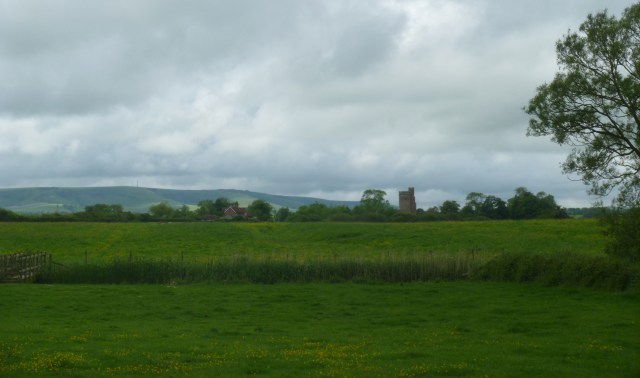
Laughton in East Sussex lies about 5 miles NE of the county town of Lewes and that is where I spent 6 nights last week. Actually, not quite in Laughton itself but at the Landmark Trust property Laughton Place about a mile and a half from the village on foot but probably two miles by road. I’ll write more about Laughton Place next time but just show some pictures of the village and explain about the Buckle here.

What time ye French Sought to have Sackt Seafoord;

This Pelham did Repell them back Aboord”

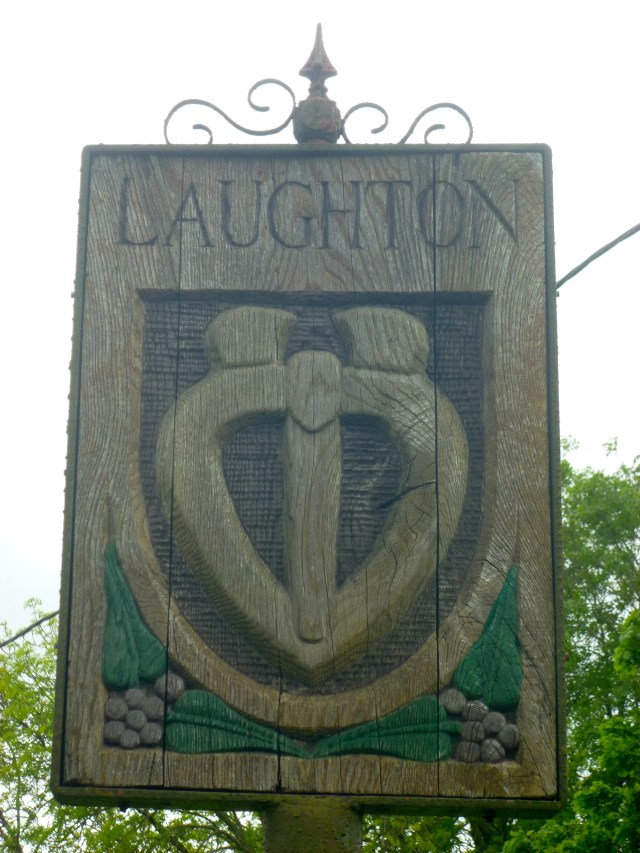
Laughton Village sign

This poem and the buckle on the village sign represent the colourful Pelham family whose own history dominates that of this area. During battle in 1356 Sir John Pelham managed to capture the King of France. The English king [Edward III] was so impressed that he removed the buckle of his sword belt and handed it to Sir John as a reward. It henceforth became the badge of the Pelhams and can be seen throughout the village. [Adapted from Wealden Walks leaflet]

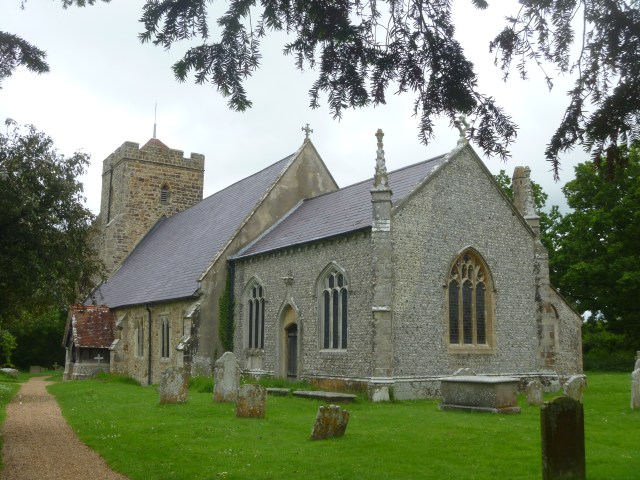
Laughton Church

All Saints Church, Laughton

Below Laughton church lie the remains of over sixty Pelhams, including two Prime Ministers [Henry Pelham (1694-1754) and his brother Thomas Pelham-Holles (1st Duke of Newcastle) (1693-1768)]. The latter rebuilt the chancel and donated a new set of bells to the church in 1724, which he had cast on the spot by a travelling founder.

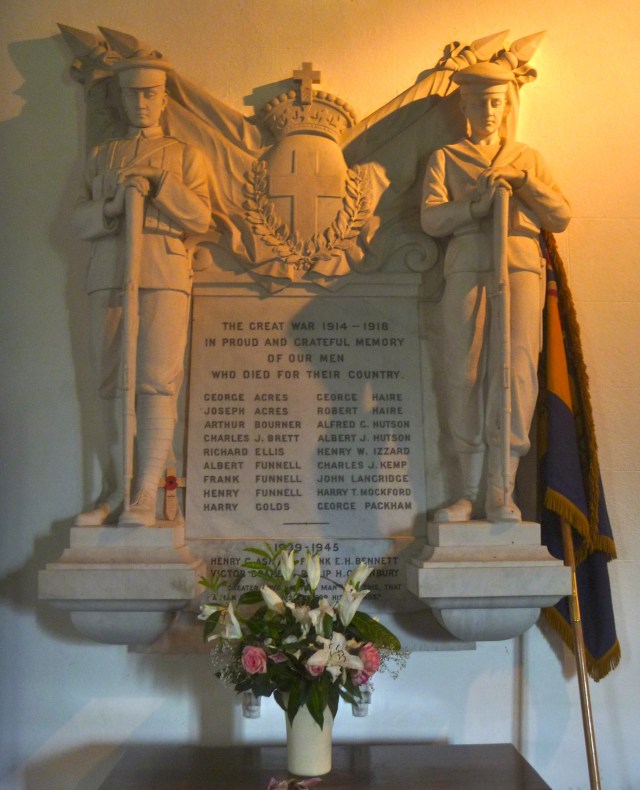
War Memorial Laughton Church

War Memorial in Laughton Church

“In front of the now blocked north door an impressive war memorial was erected in 1921 in honour of the eighteen Laughton men killed in the Great War. The striking war memorial in the nave was dedicated in 1921. Sculpted in Italy of Carrara marble, it was paid for in Italian lira to take advantage of the exchange rate at the time. Four names were added following World War II.” [Source]

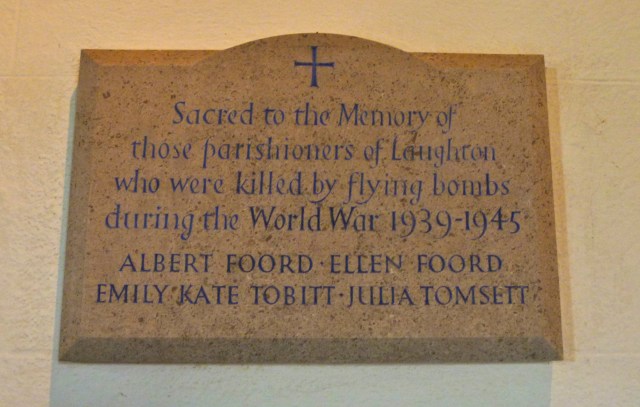
Flying Bombs memorial

A tablet on the same wall records the death of five people killed by a flying bomb in Shortgate.

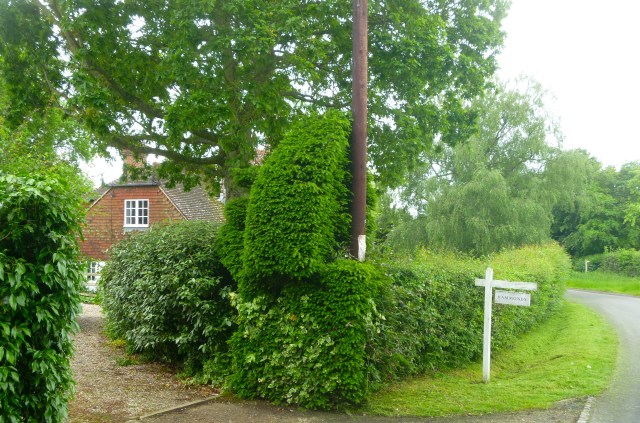
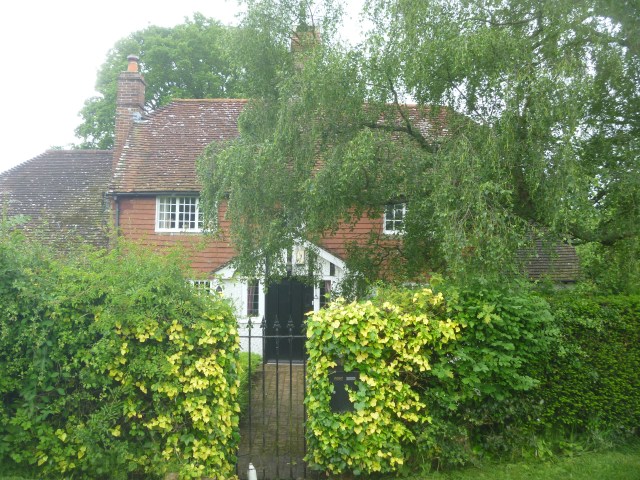
Laughton has a pub, the Roebuck (shouldn’t that be Roebuckle??) which I didn’t try and a village shop and Post Office, which I did. The kind shopkeeper was able to point me in the direction of The Hammonds where the poet and author Eleanor Farjeon lived during the First World War.

Hammonds

Hammonds Laughton

Eleanor Farjeon wrote The Little Bookroom for children and the Martin Pippin books which are based on the East Sussex countryside.

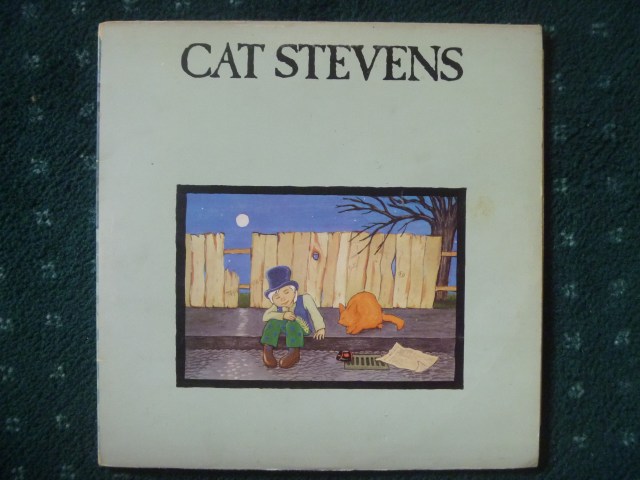
Farjeon is most famous for her hymn Morning Has Broken which became a popular track on Cat Stevens’ album .

Morning has broken,
like the first morning
Blackbird has spoken,
like the first bird
Praise for the singing,
praise for the morning
Praise for the springing
fresh from the word

Sweet the rain’s new fall,
sunlit from heaven
Like the first dewfall,
on the first grass
Praise for the sweetness
of the wet garden
Sprung in completeness
where his feet pass

Mine is the sunlight,
mine is the morning
Born of the one light,
Eden saw play
Praise with elation,
praise every morning
God’s recreation
of the new day

Oh, yes, we’ve still got our Teaser and the Firecat LP record (1971)!

Teaser and the Firecat

Teaser and the Firecat LP Cover


In a Quiet Corner of Rome – The Aventine

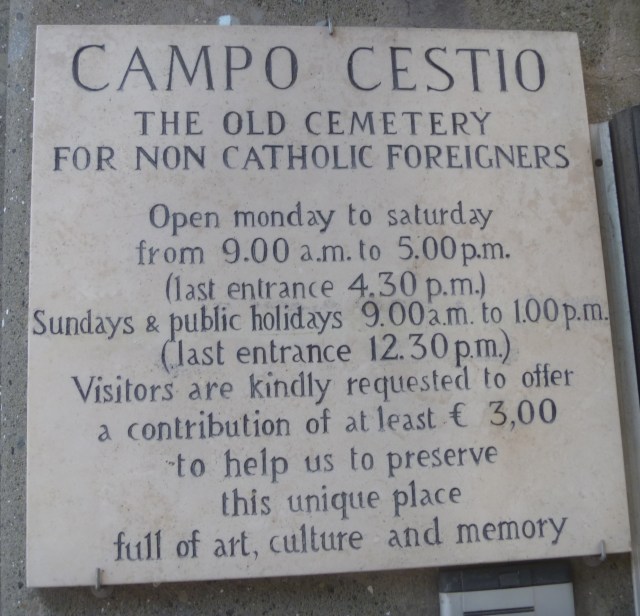
Cemetery sign

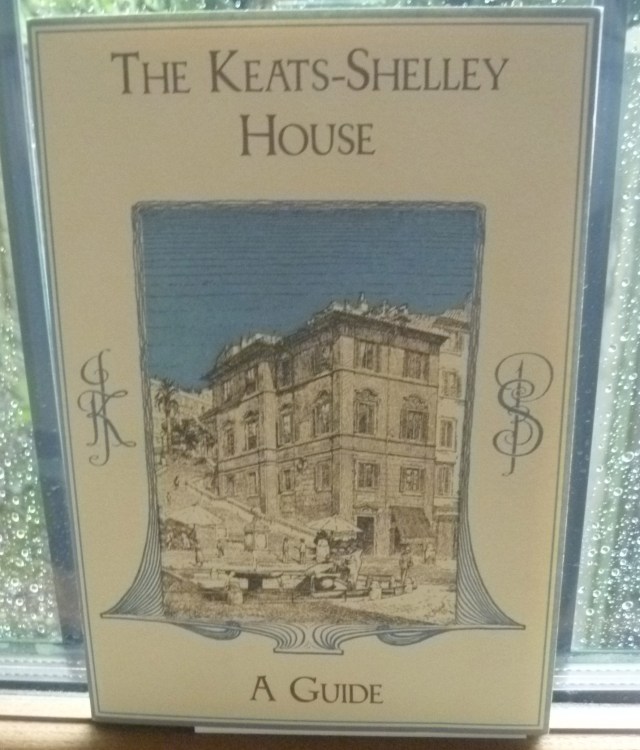
We’d both visited Rome before so I decided to book us at a hotel in an area slightly out of the main hustle and bustle of the centre of Rome and in a leafy residential area within walking distance of a certain cemetery that was brought to my attention on my first visit. The highlight of that trip, although we visited The Forum and The Coliseum and the Trevi Fountain and The Spanish Steps and The Pantheon and I had my picture taken at the Bocca della Verita, turned out to be the peaceful and tranquil Keats-Shelley House.

Keats House

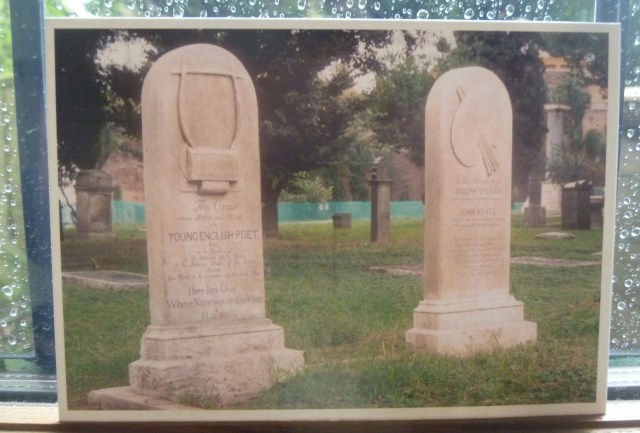
John Keats and Percy Bysshe Shelley are both buried at The Non-Catholic Cemetery in Testaccio and the more I have read about the place the more I have wanted to visit what sounds like a peaceful rural idyll so close to the centre of Rome.

K and S graves

The Keats and Shelley Graves in the Protestant Cemetery [postcard]

What I had failed to take into account – and I could have done nothing about it anyway – was the fact that a second Italian public holiday was to fall during our week’s visit. The 1st of May is a public holiday in Italy. So, after dropping our bags at our hotel room, we made our way at about 1.30pm to the Campo Cestio a 10 minute walk away only to find that it had closed that day at 1pm.

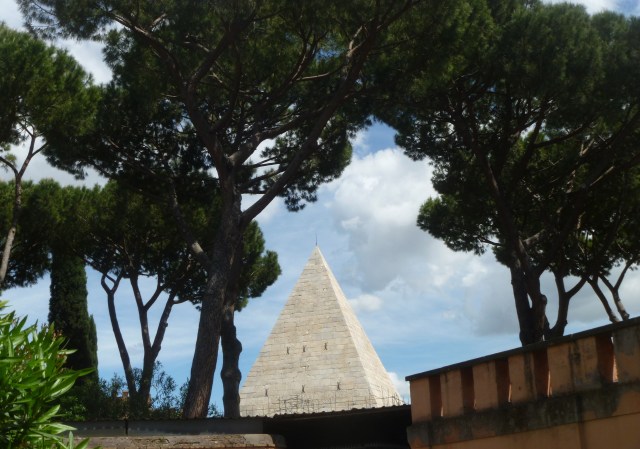
Pyramid

Very near to the Cemetery is the famous Caius Cestius Pyramid built during the 1st century BC when Roman funerary architecture was influenced by the ancient Egyptians.

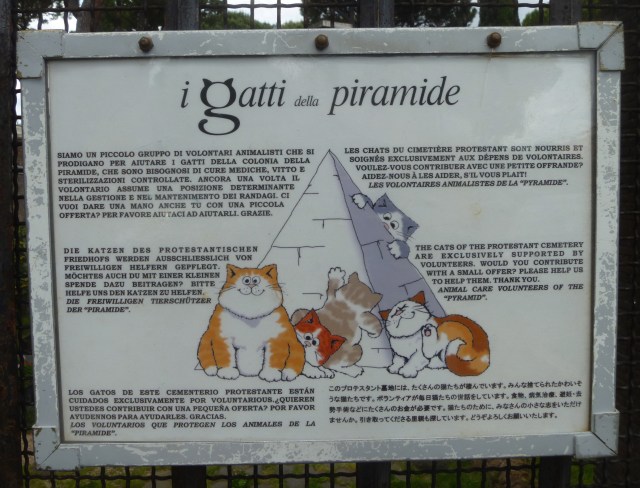
Pyramid cats

The Cats in the Area even have their own website!

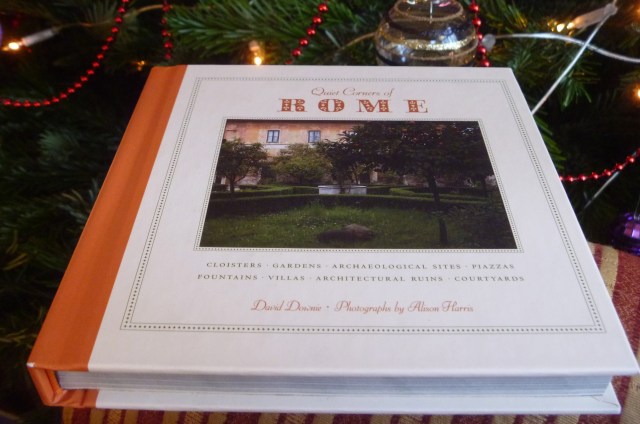
Quiet Corners Rome

Disappointed, we turned to other entries in my ‘Quiet Corners of Rome’ book by David Downie.

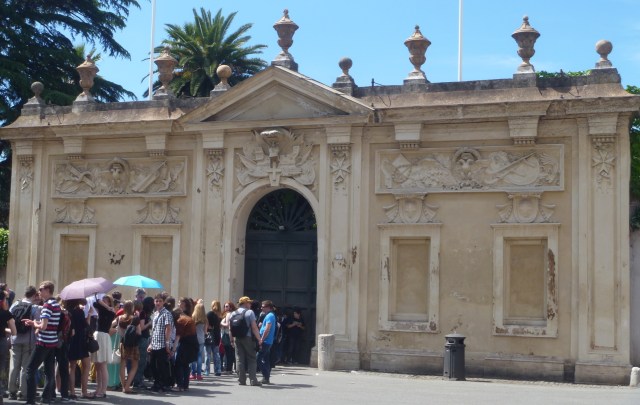
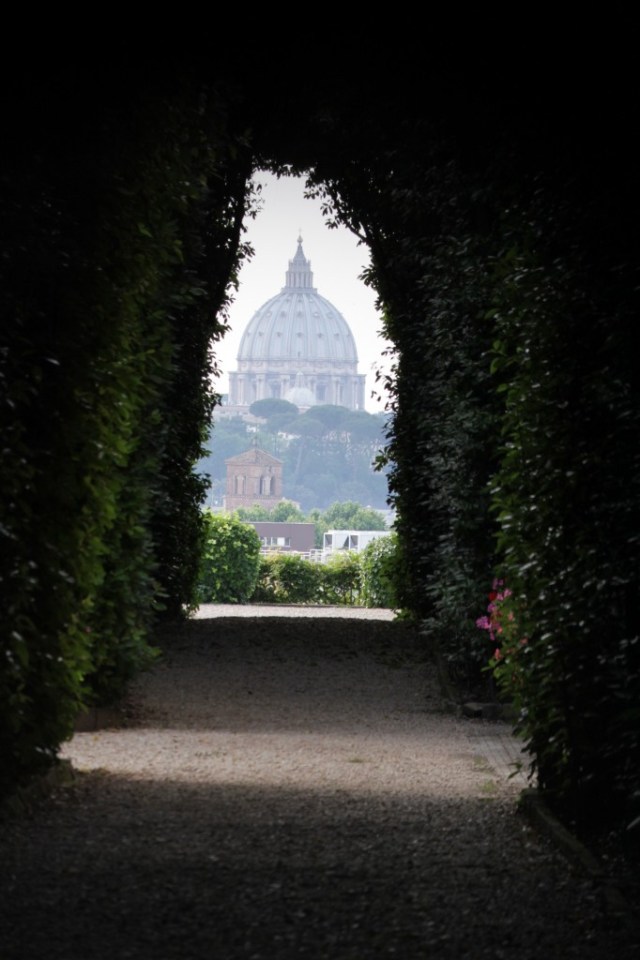
I was first told about The Magic Keyhole by a former work colleague who had lived for some time in Rome. But it is also mentioned in the Quiet Corners of Rome book so we made it our next stop : “Piazza dei Cavalieri di Malta and Piranesi Monument”. There was about a half hour queue and yes, indeed, when you reach the front there is the dome of St Peter’s framed by the keyhole in Piranesi’s door.
IMG_6617-e1337419469157-682x1024

This is the view that you get [source]

Needless to say my own photo turned out rubbish but with a long queue of people waiting behind you it is all a bit of a rush when you finally get to the front.

Piranesi Square

The Piranesi or Knights of Malta Square

Keyhole queue

The Keyhole Queue

The doors seal off the grounds of the Knights’ [of Malta] headquarters and are opened only to the pious and powerful … The piazza is egalitarian. Flame cypresses and palms rise behind the extravagantly long, L-shaped wall, erected in 1765 and conveniently lined with benches.”

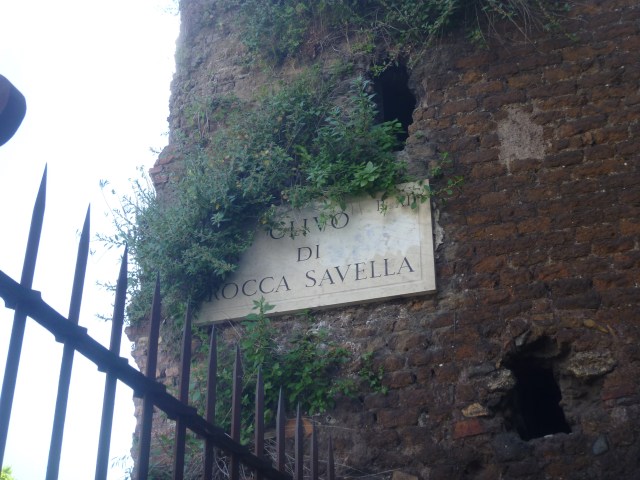
Clivo di Rocca Savella, Parco Savello, Giardino degli Aranci”

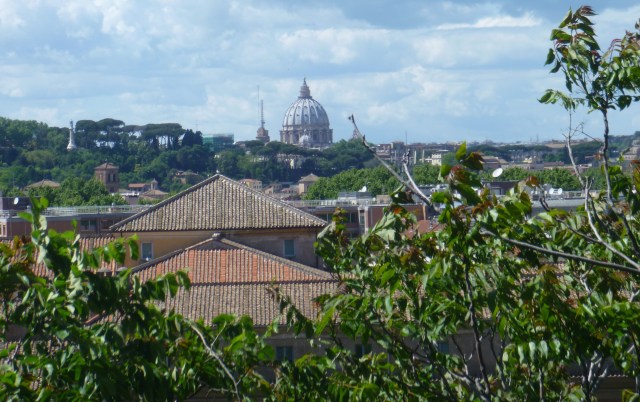
Vatican View

Vatican View

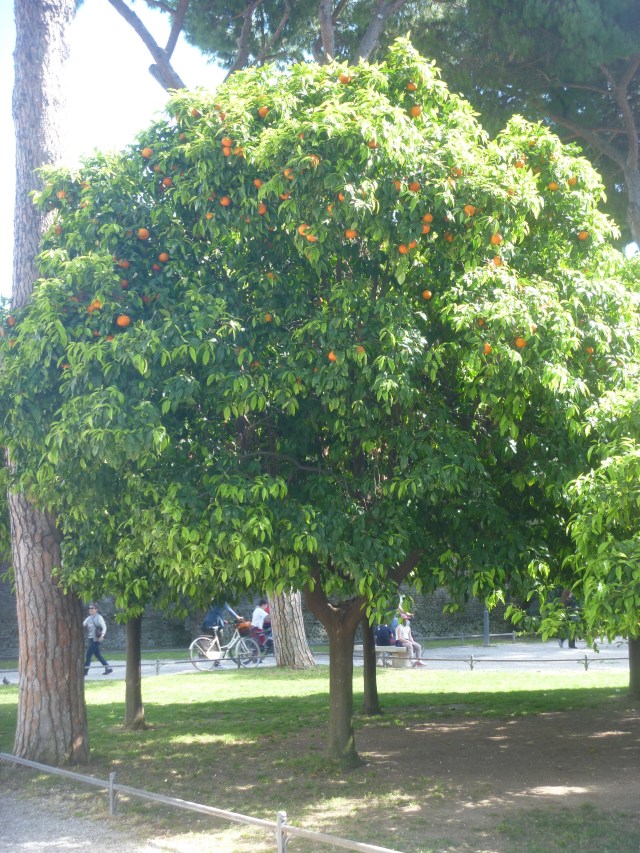
orange tree

Orange Tree

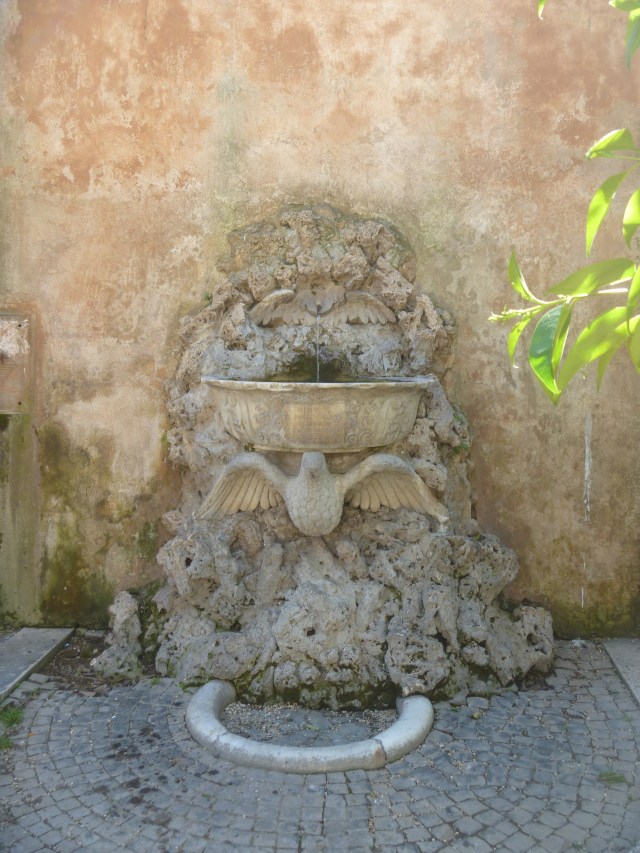
Drinking fountain 1

Drinking Fountain

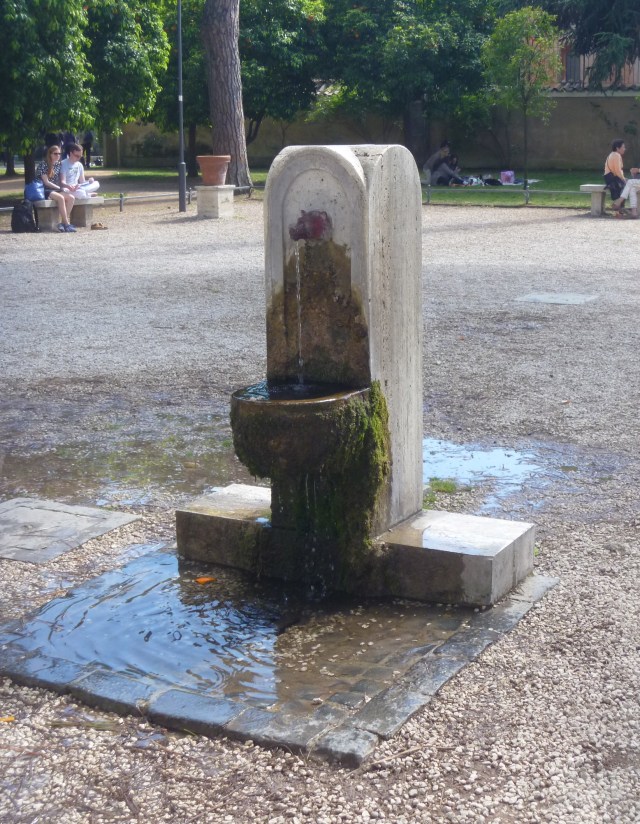
Fountain 2

Parco Savello Fountain

Next to the Knights of Malta HQ are several churches and two parks. One of the parks is the Parco Savello but both of them more or less fitted the book’s description: view of the Vatican, orange trees, drinking fountains.

Clivo sign

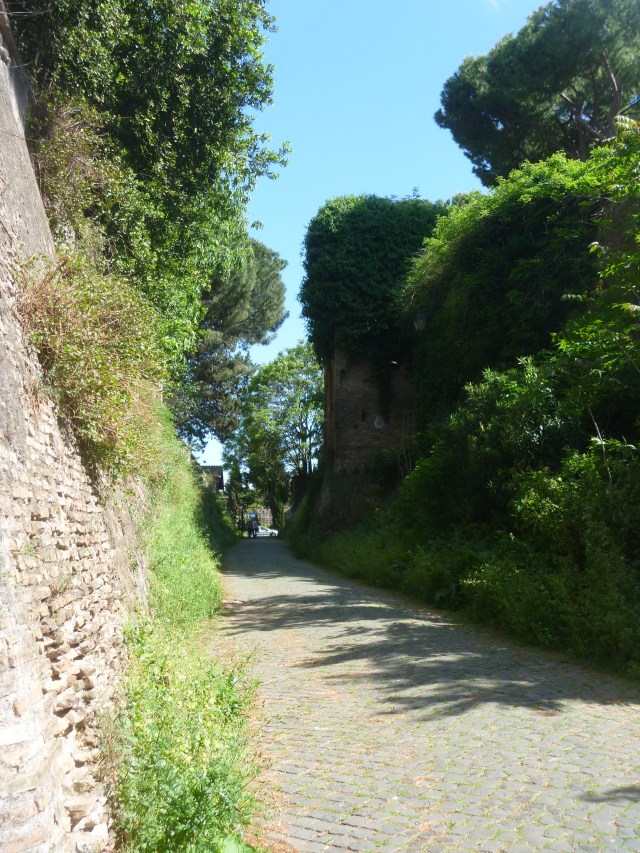
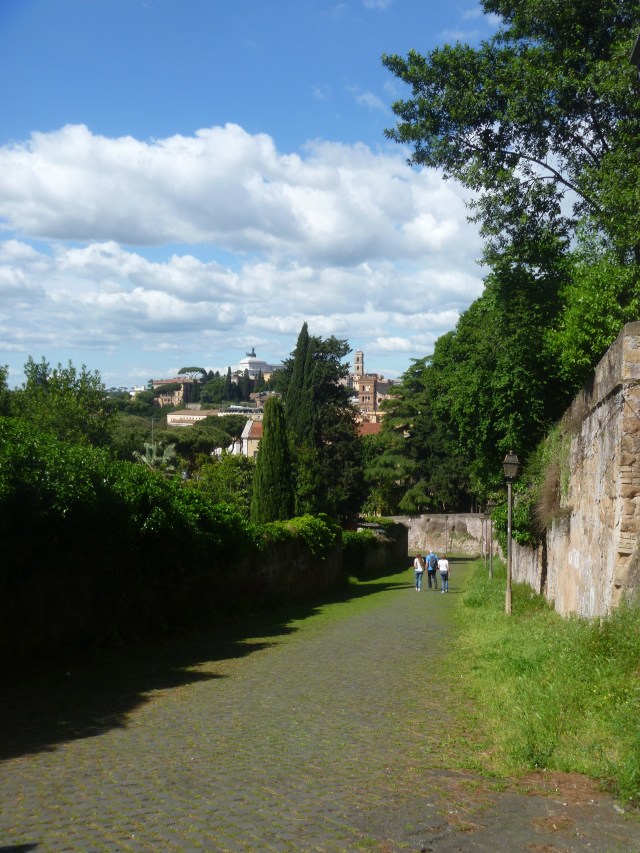
The Clivo di Rocca Savello is a narrow car-free lane that slopes down to the Tiber “mossy and picturesquely weed-grown, the clivo is as atmospheric as it is empty”. Well one or two people were walking up and down and also as the book says “stray cats own it”.

Clivo 1

Clivo 2

The Clivo di Rocca Savello

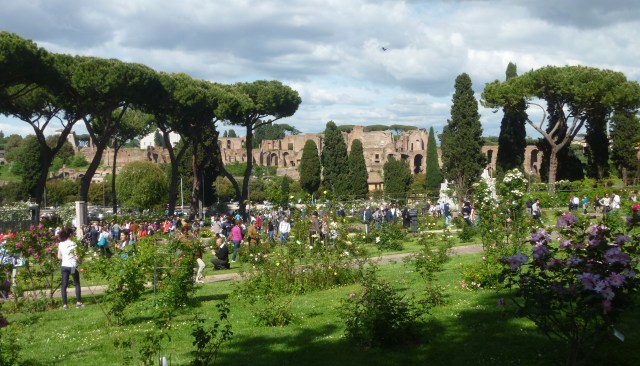
With it being a public holiday none of the places were particularly people-free and the final venue least of all. It seemed that all of Rome wished to visit the Roseto Comunale (Rose Garden) on that sunny May 1st afternoon. 1,100 varieties of rose grow on the northern slope of the Aventine Hill. All types of rose and from all corners of the earth grow here and the park is only open for about one month a year. So this time we struck it lucky !

Rose garden

The Rose Garden with the Forum behind

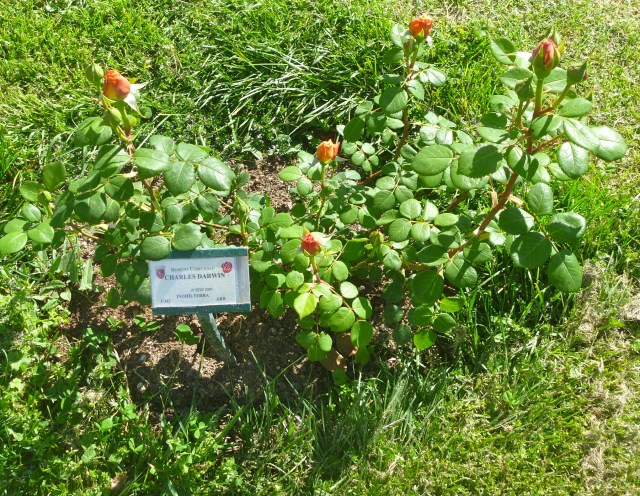
Charles Darwin rose

Charles Darwin rose still in bud (UK)

We were very happy with our choice of hotel in a Quiet Corner of Rome.

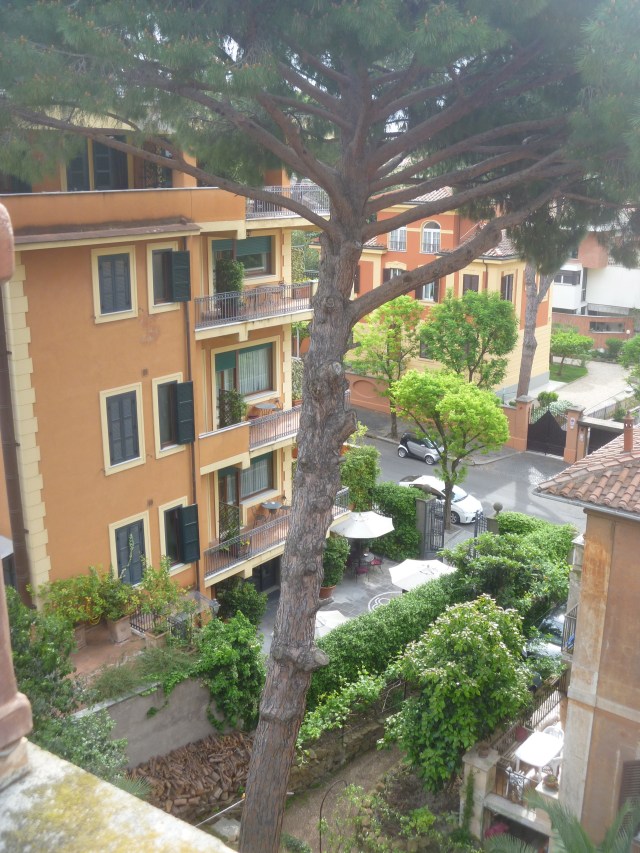
Balcony view

The Villa San Pio

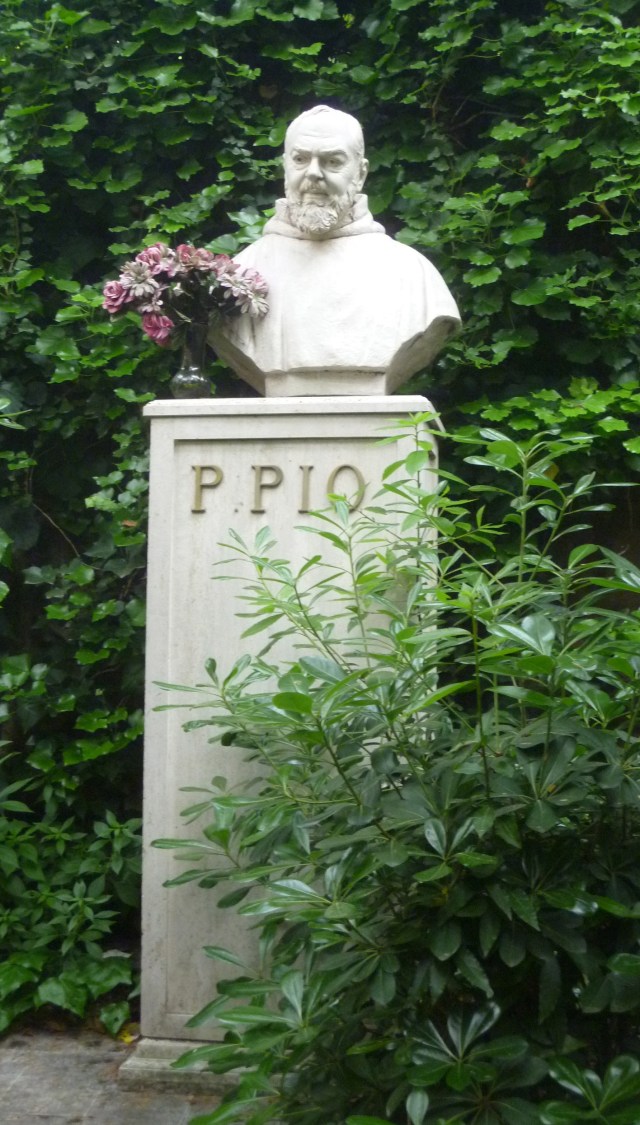
Pio

Padre Pio bids us Farewell as we make our way to the Airport


Sovana to Bolsena – Tracks and Tombs and Troglodytes … and Rain

Day 4

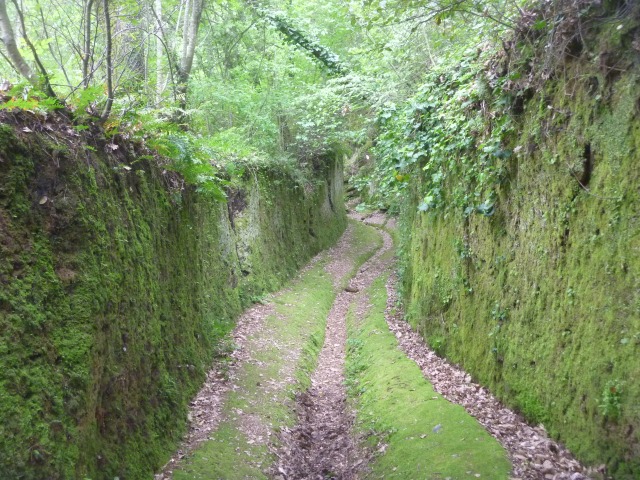
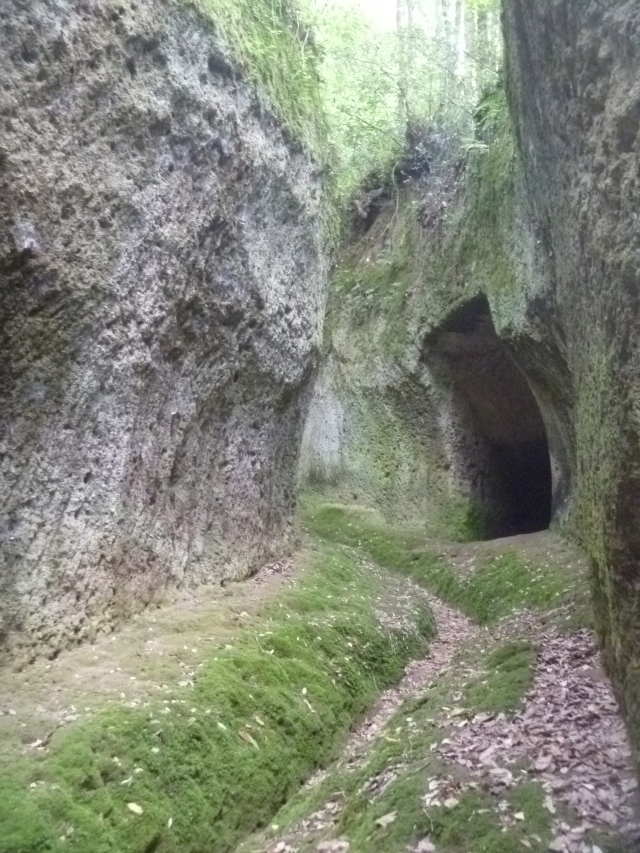
Sovana to San Quirico: Paths across farmland lead to an isolated church and fine Etruscan lane that descends into a gorge, from which rises crag-top Sorano. After exploring Sorano, paths along the gorge lead to the troglodyte habitations at Vitozza and the village of San Quirico (10.3 miles, 5 hours).

On the Sunday the walking began in earnest. Over 40 miles in 4 days – not bad going!

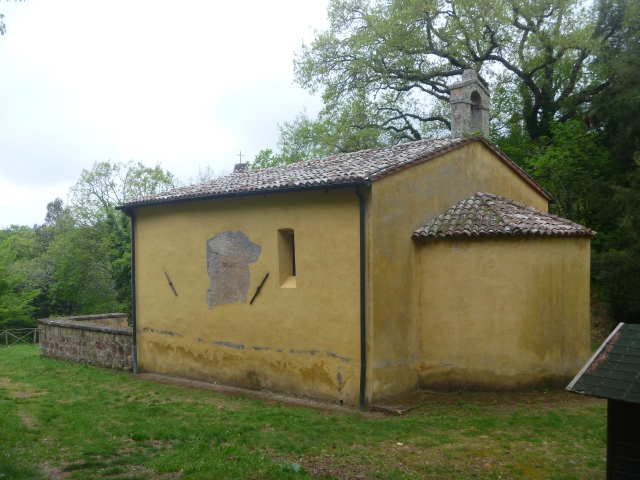
Church of San Rocco

The Abandoned Isolated Church of San Rocco
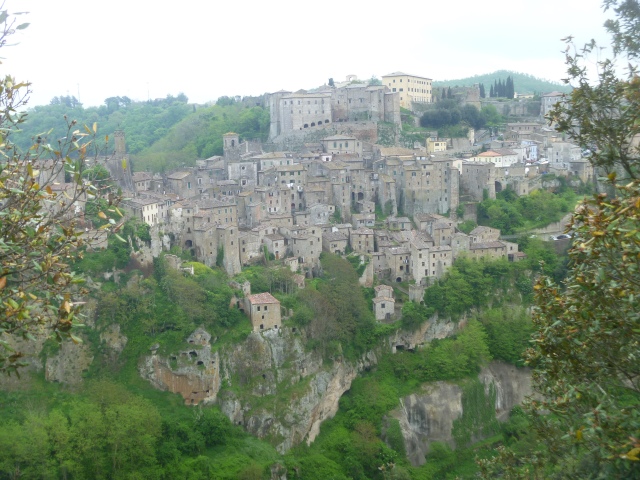
Sorana

Crag-top Sorana from San Rocco Viewpoint

Via Cava San Rocco

Etruscan Lane of San Rocco

Via Cava SR tomb

Tombs along the Via Cava di San Rocco

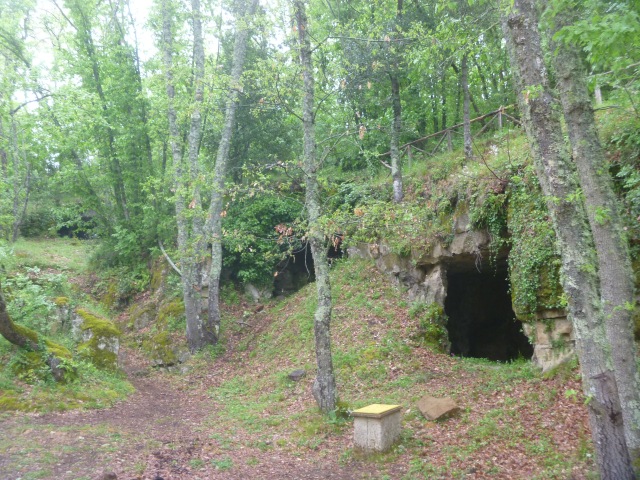
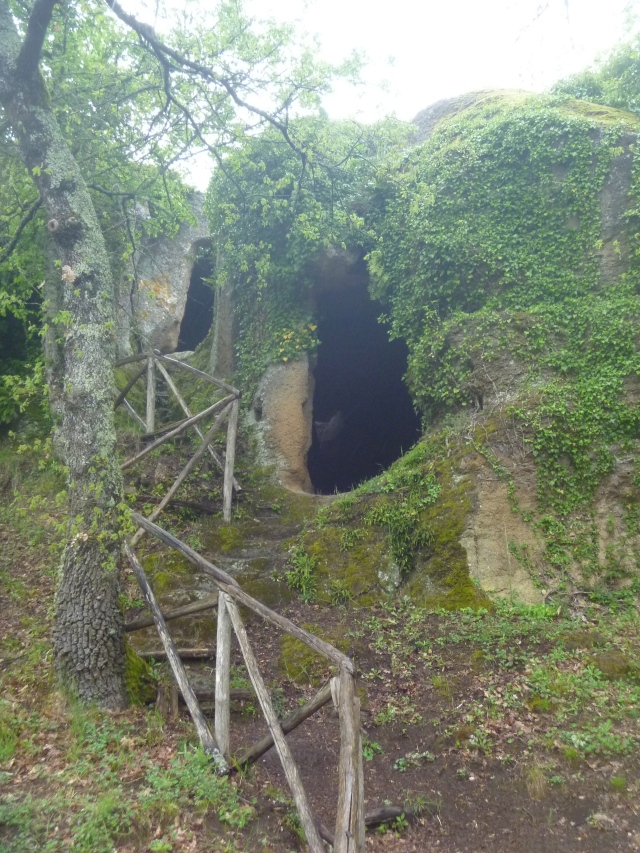
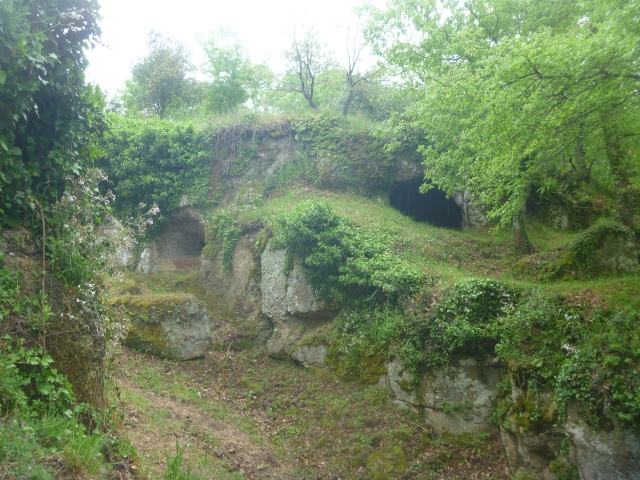
Near the village of San Quirico (our destination on Day 4) we passed through the abandoned troglodyte village of Vitozza. This fascinating, rather eerie, place had been a medieval settlement dating back to the 12th century. There are the remains of castles, churches, and many other buildings plus many caves which were used as stables, storerooms and homes.
Troglodite homes Vitozza

Vitozza groto

Vitoza caves

Cave homes at Vitozza

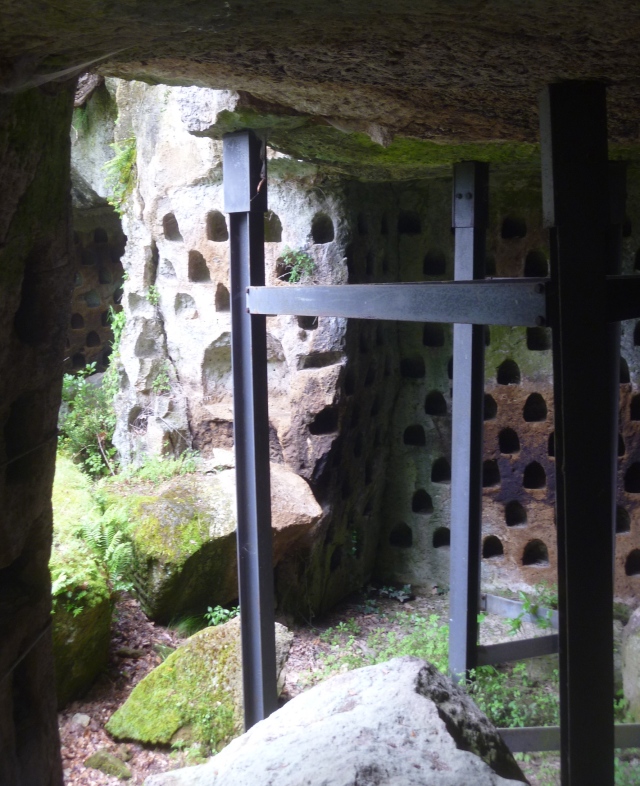
Il Colombaio Vitozza

Dovecote or Columbario – 1st Century AD

Day 5

San Quirico to Bolsena: Cart tracks across farmland lead to an escarpment, where paths descend towards the small town of Latera. A climb through chestnut woods to the rim of a volcanic crater offers superb views. Tracks lead down to Lake Bolsena (10.4 miles, 5.5 hours), from where a private boat takes you across the lake to Bolsena (town).

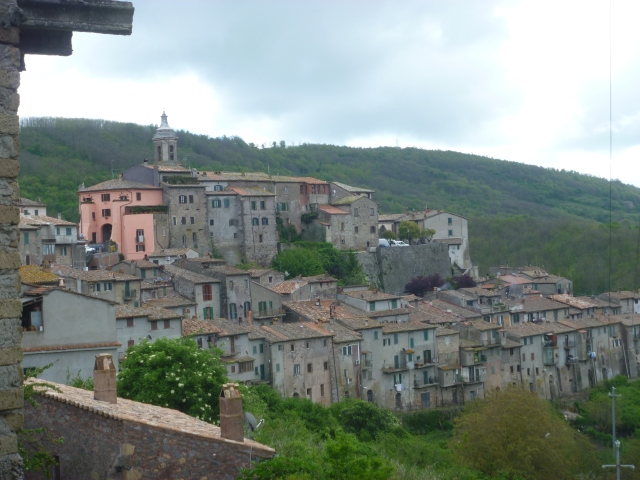
Latera

Approaching Latera

Latera Square

We ate our picnic lunch on a bench in this square in Latera: Church of San Clemente and 1790 bell-tower

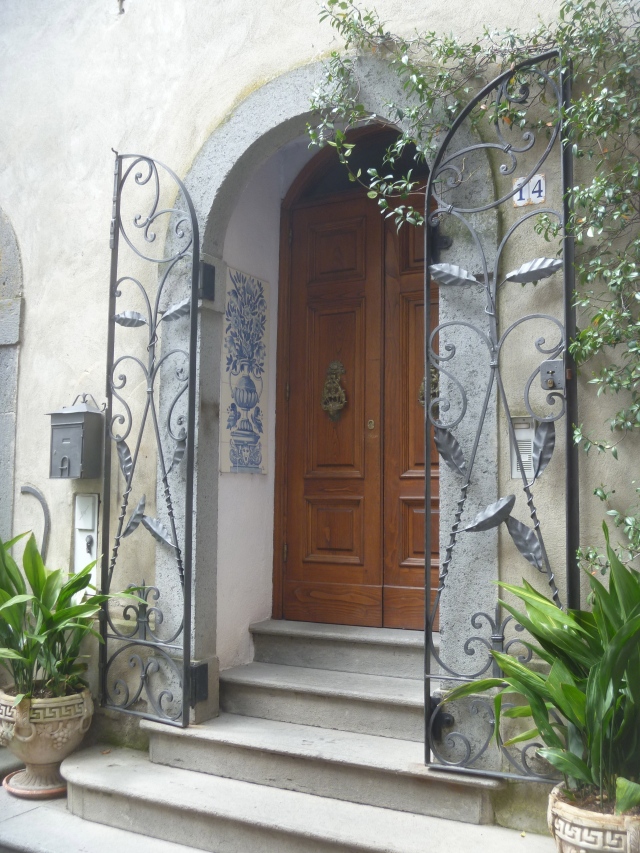
Pretty doorway in Latera

Pretty Doorway in Latera Piazza San Clemente

Leaing Latera

Leaving Latera

After leaving Latera and as we approached the crater edge with views of Lake Bolsena the rain began. Unfortunately, this meant that we were unable to take the boat trip across the lake. Annalisa had to come to our rescue and drive us round the lake to our next hotel by the lakeside at Bolsena.
A herd of sheep blocked our path

Our path is blocked by sheep – but not for too long!

Lake Bolsena in the rain

An early view of Lake Bolsena in the rain

Lake Bolsena

We arrive at the Trattoria Da Giggetto jetty