Continuing Footloose in the Gargano Peninsula

The next day we left the hotel by the way we had arrived but on leaving the section of main road headed off uphill, away from the sea.

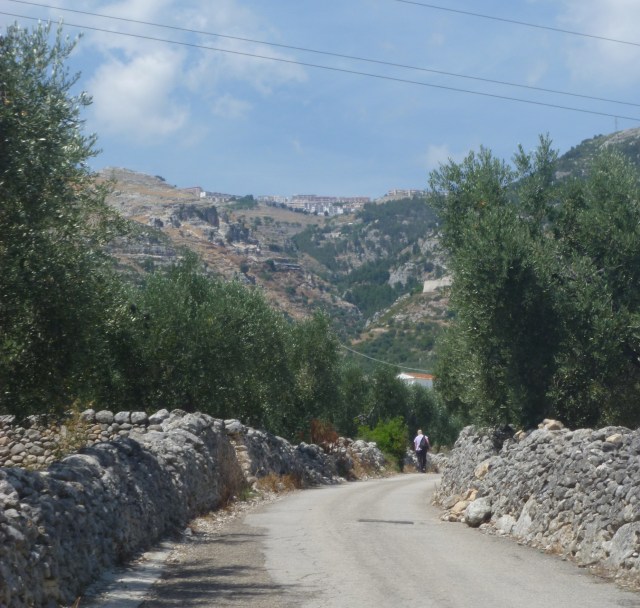
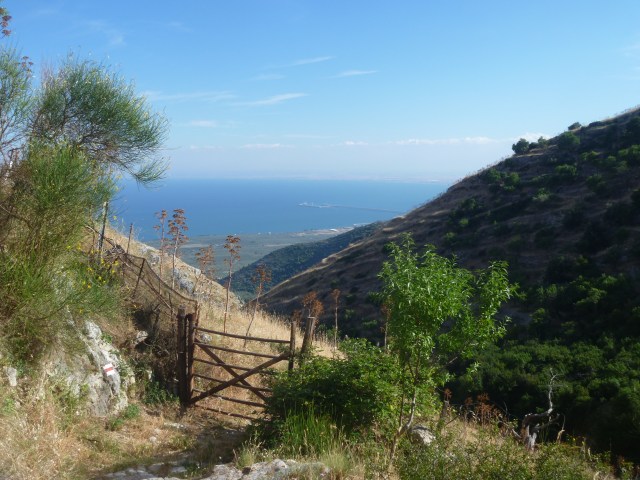
An initial climb brings you to a high point with wide views and then down along a stony, woodland track to the base of the next valley. Another climb brings you out to a high point before heading inland. You follow farm track and a short climb on road before picking up a gravel track that gently descends to your final destination with stunning panoramic views across the valley to the sea.”

At the ‘base of the next valley’ we came almost face-to-face with a family of wild boars. We knew we just could not pass through the area as they were hidden from us for the most part and making a lot of noise. In order to contact Matteo we had to retrace our steps to the ‘high point with wide views’ and wait for him to ‘rescue us’. This he did efficiently and quickly and offered to walk through the wild boars area with us. We declined his offer with the excuse that we had already lost quite a bit of time and could he put us back on the track a little further along the route.
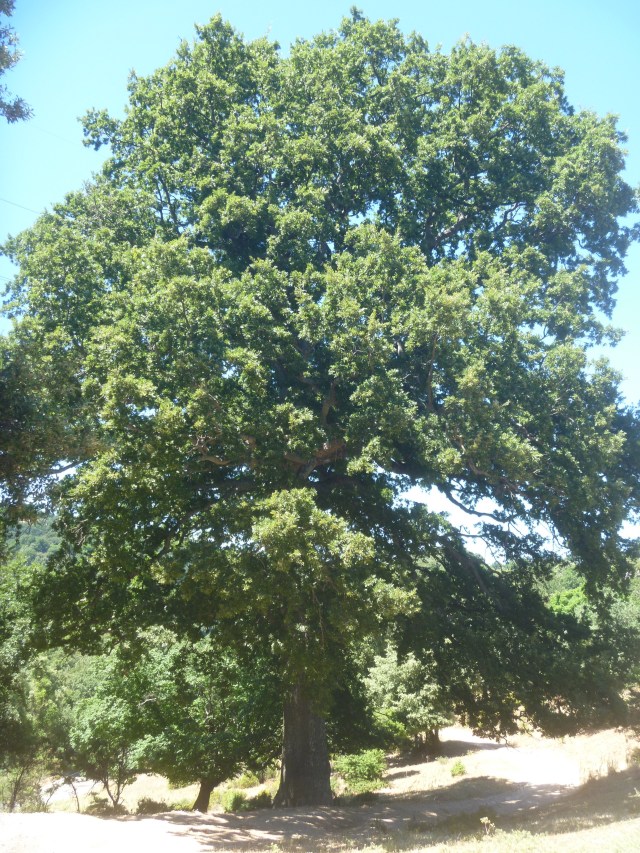
Turkish oak

The Turkish Oak

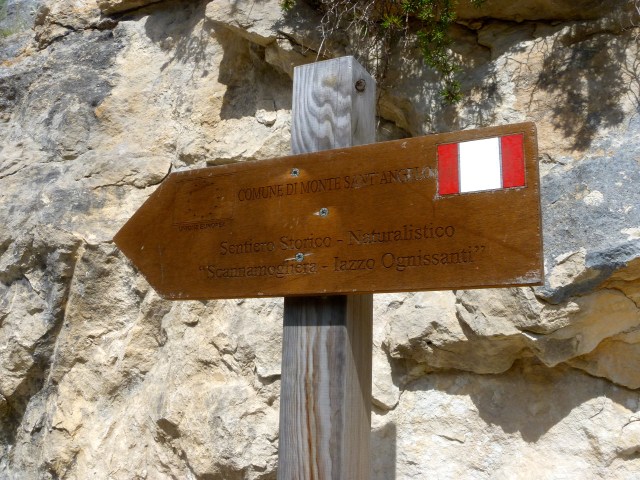
Matteo dropped us off on the track (just by a monumental Turkish Oak tree: read more about this species here) that leads over several kilometres to the very remote Agriturismo farm Masseria Sgarrazza at San Salvatore where we were to spend that night.
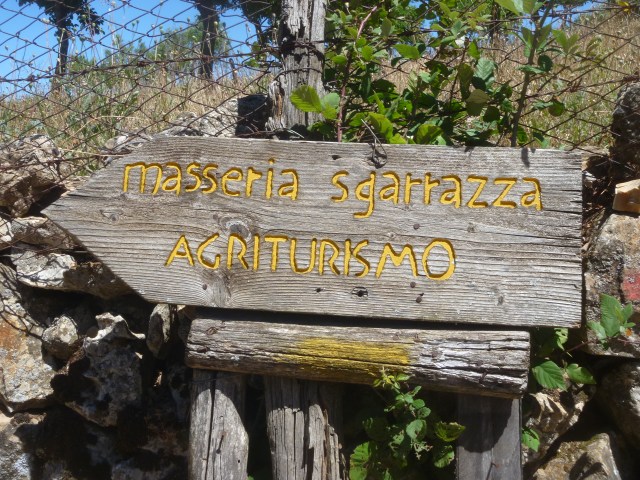
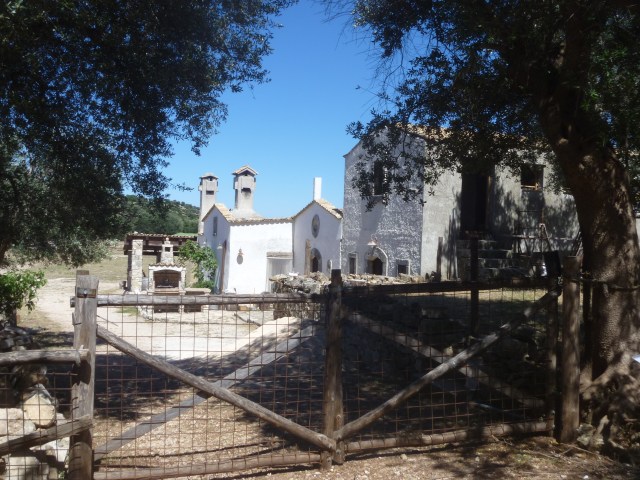
Sgarrazza sign

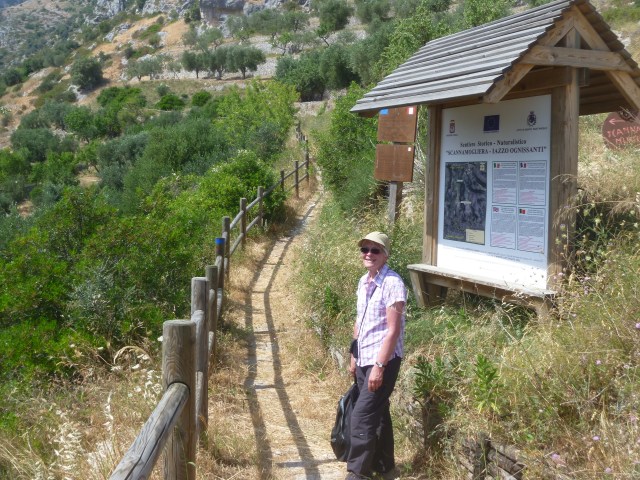
arriving at sgarrazza

Arriving at the Masseria Sgarrazza

This amazing place – it was like stepping back in time – has existed as a farm here since 1820. The name comes from the local dialect word ‘sgarra’ meaning split or crevasse, because of the way that the sea splits the horizon where it joins the land. I think the way of life has changed little here; but as we dined that evening we could hear the telly. Access to water sources is a problem throughout the Gargano due to the quick draining cretaceous limestone that makes up the area. Here at San Salvatore water is delivered by truck to a huge water store.
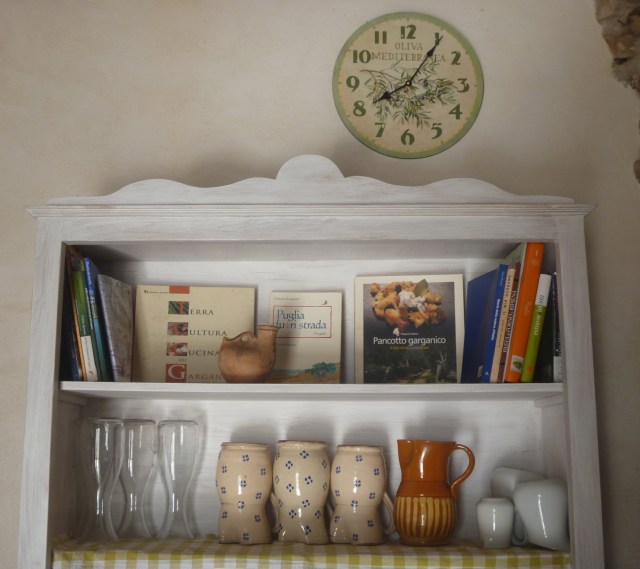
in the dining room

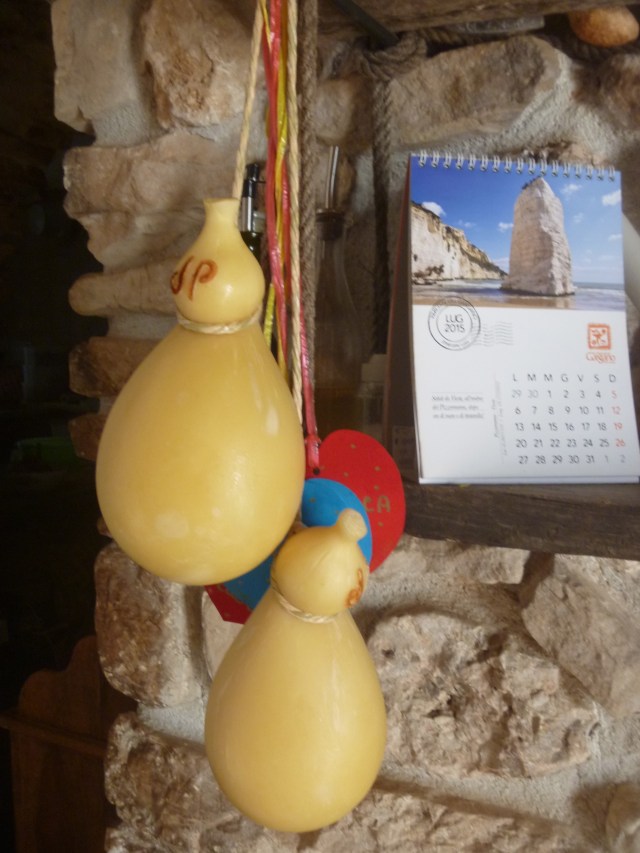
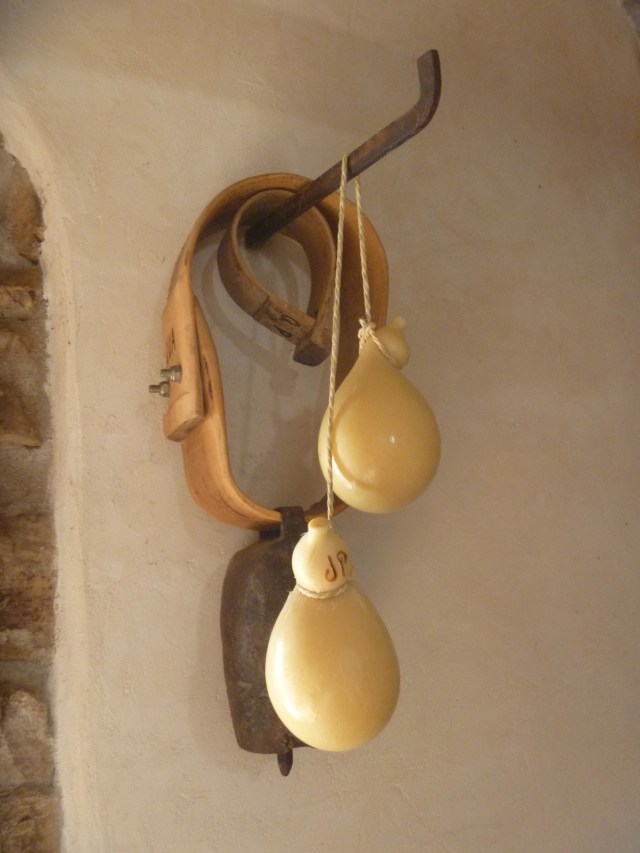
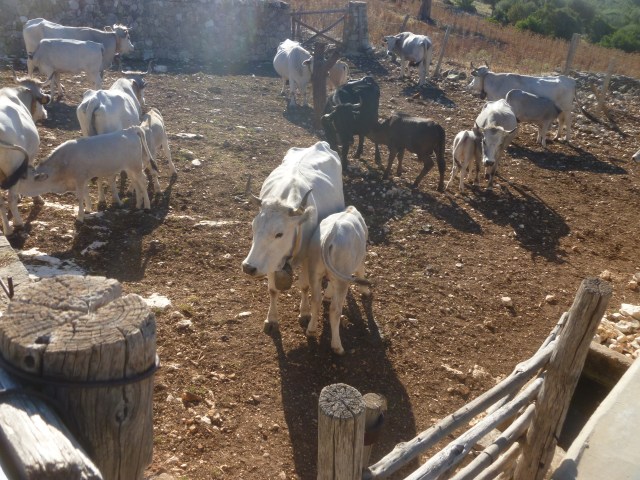
The olive oil served at dinner was all produced here and they make the wine served themselves (but they don’t own any vines). The delicious Caciocavallo cheese is a speciality of the farm and is produced from the limited supply of milk from their Podolico cows.
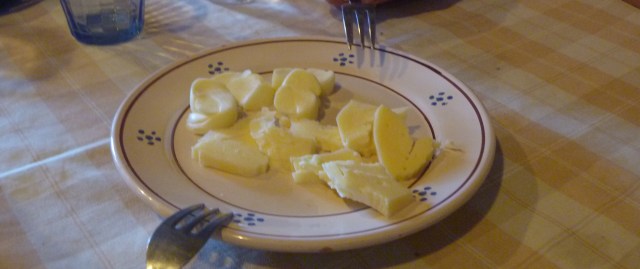
chees

Caciocavallo cheese

more cheese

cheese hanging everywhere

Cheese maturing everywhere

podolicos

Podolico cows

Guests (just us) are accommodated in converted old stables and the arrangements were primitive to say the least! The original farmhouse (where the farmer and family ate, cooked and lived) is now just the dining room of the much expanded house.
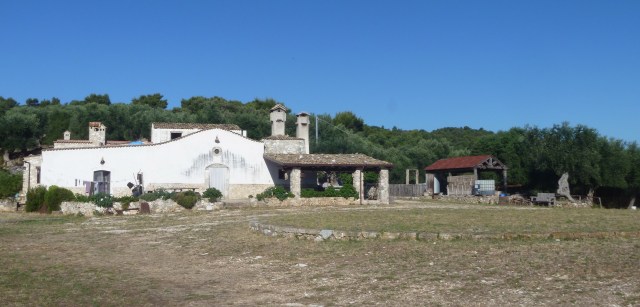
threshing floor

The Farm and Threshing Floor

The large stone circle in the middle of the farmyard is an aia (threshing floor). There was once a little grain production and when this had been cut it was brought to the threshing floor where horses were led round in circles separating the grain from the straw with their hooves. Then it was manually tossed in the air so that lighter straw would be blown away and the grain remained on the threshing floor. At 254 sq m it is one of the biggest and best preserved in the Gargano. Another aia can be seen in the Pagliaiphoto in the previous post.

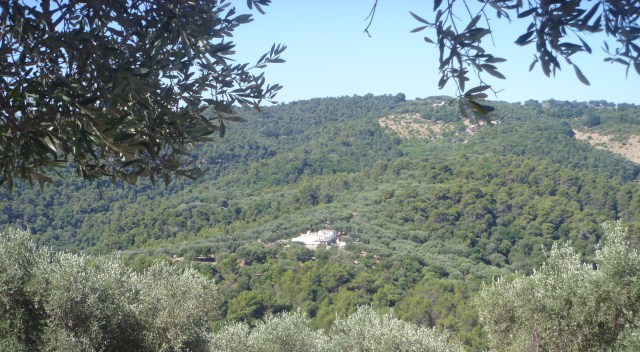
sgarrazza view

The Masseria Sgarrazza – miles from anywhere!

A short detour from the next day’s route took us to the 2,500 year old necropolis of San Salvatore. I think we thought we had seen sufficient tombs and necropolises on our ATG walk last year (Etruscan Lanes to Orvieto) but it seemed not and we added a further 2.5km to the day’s walking. Matteo worked this excursion out himself and he writes in the notes :

The necropolis was built by the Daunian Civilization between the sixth and fourth centuries BC. During the 1950s it was stripped by grave robbers; but archaeologists managed to save some finds (eg small pots, tools, funeral ornaments). These are now kept in the Archaeological Museum in the Castle at Manfredonia. It seems, though, that the Daunian inhabitants of this area were less evolved than at otehr Daunian centres (eg Siponto/Manfredonia and Ascoli Satriano). Nowadays, you can only see the square stones cut to form tombs … but to visit a 2500 year old cemetery remains a unique experience … don’t you think?”
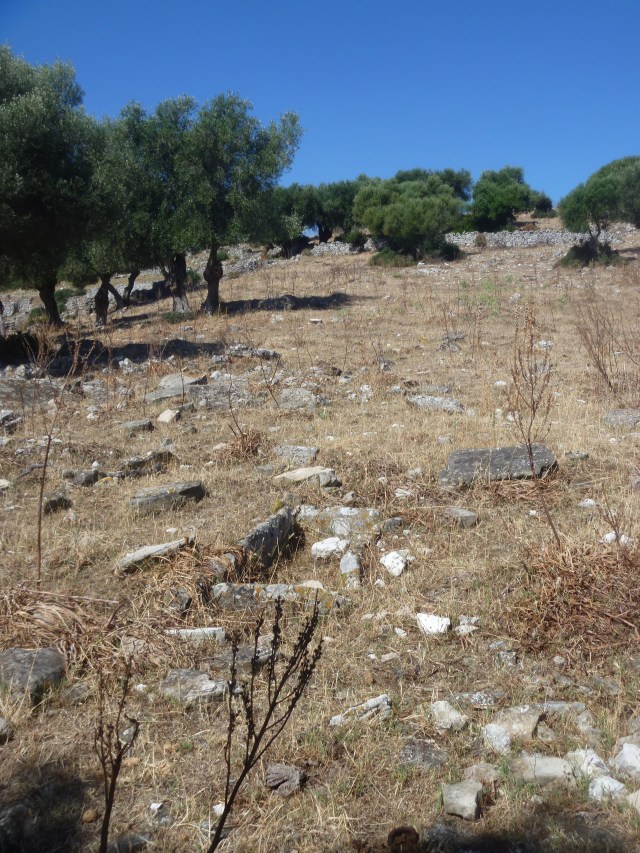
necropolis site

The Site (hard to capture the look of the place)
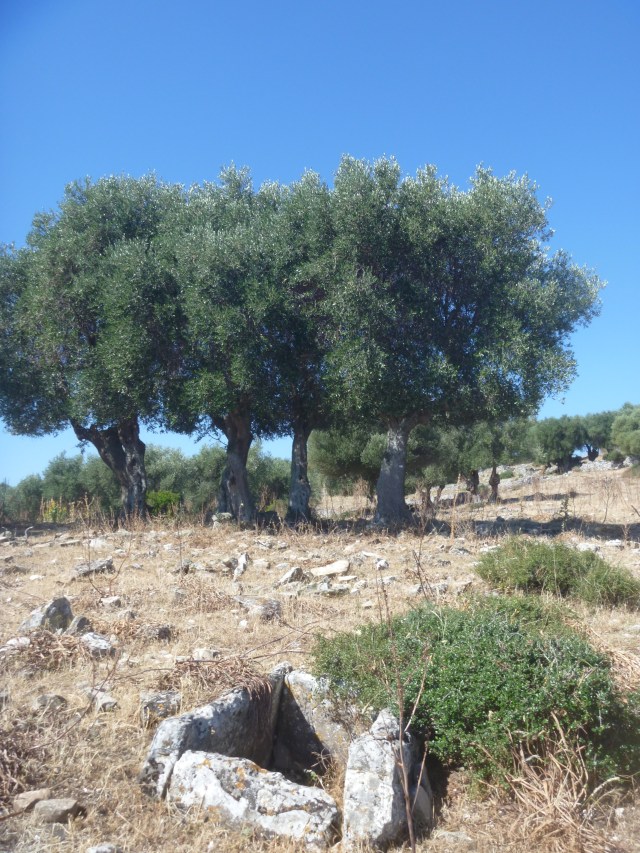
necropolis

grave

Tombs and Graves

After the detour the route is described thus :

A gravel track descends gently through the valley with wonderful panoramic views across to Vieste (our final destination) passing farms along the way. Then a rolling ridge track with splendid views carries you down to sea level, and the walk is completed along the long beach or seafront of the town.”
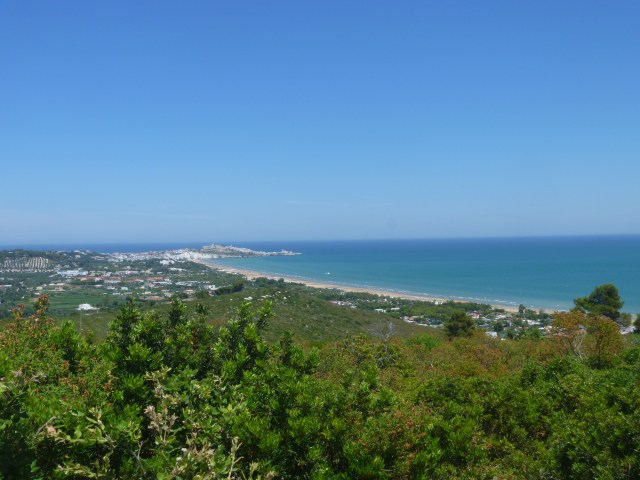
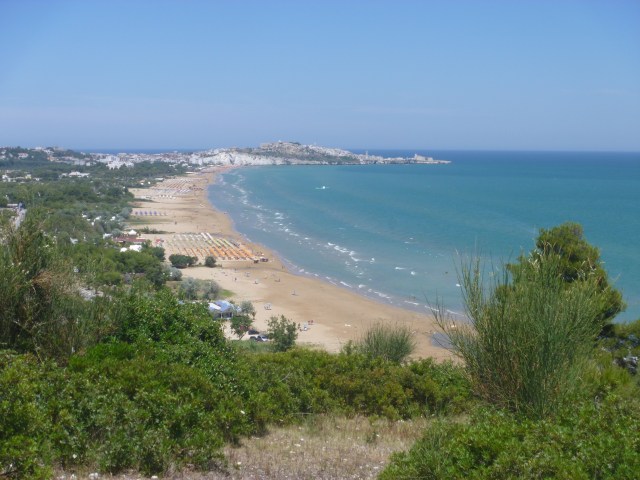
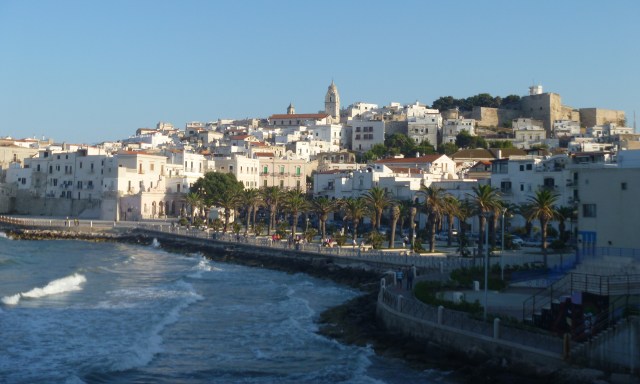
vieste and sea view

nearly there

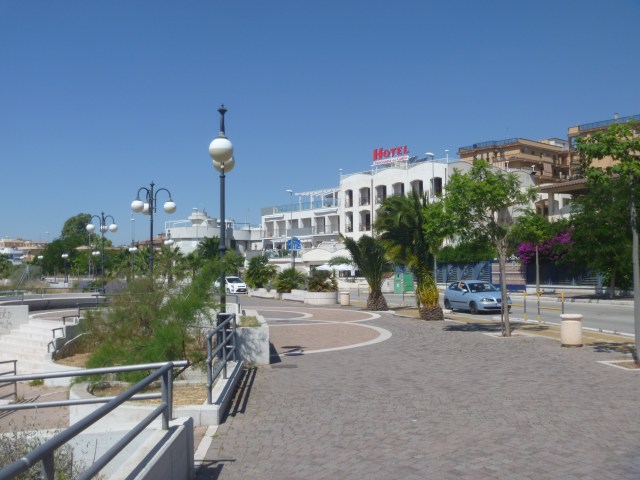
So, lots of ups and downs, super sea and town views and finally arriving at the seaside and straight into the first beach cafe for a pizza lunch. Then it was just a few more kilometres and a climb up into the town to the Palace Hotel very conveniently situated and handy for town, old town and harbour.
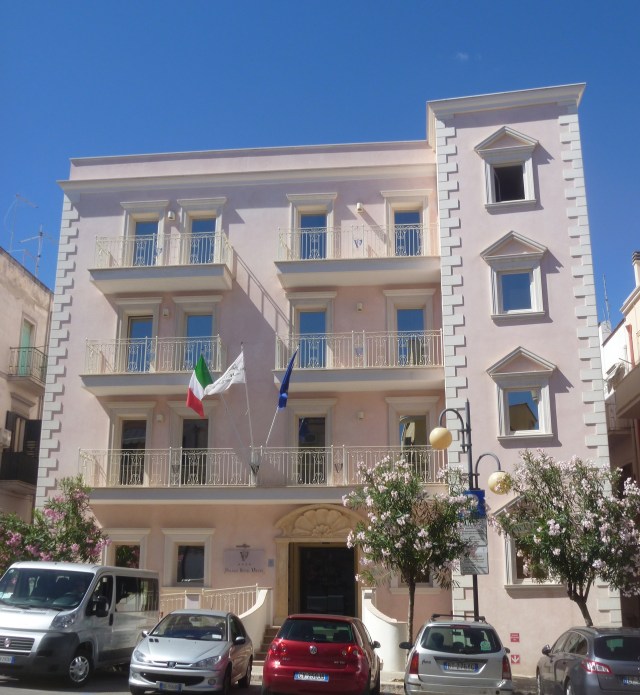
palace hotel

The Palace Hotel, Vieste

That evening we went with Matteo’s suggestion to eat at Taverna Al Cantinone in the Old Town. The Route Booklet says :

Fresh and tasty local food. Traditional dishes from the Gargano revisited with a bit of fantasy. Good value for money.”

What it doesn’t tell you about is the lovely homely atmosphere and decor and the friendly, helpful and charming owners; a chef and his Spanish partner who serves at front of house. In fact, we ate there both evenings.

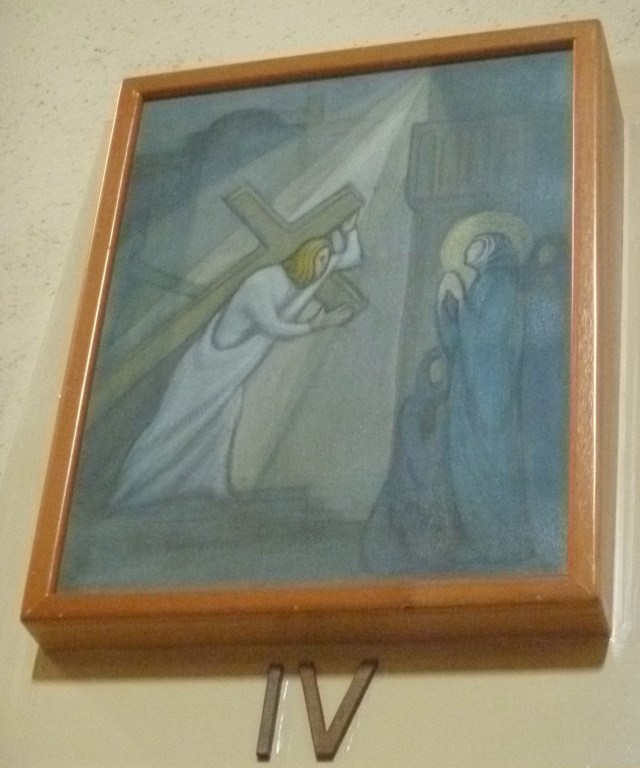
On the seven night ATG walking holidays there is always a free day so this meant we spent two nights at Vieste. On our free day we’d expected to take a boat trip to visit caves and spend a few hours with our reading at the Palace Hotel private beach. But the day dawned cloudy and windy with rain threatening so at breakfast a quick decision was made, the receptionist consulted for timetables and we took the local bus along the coast road to nearby Peschici. It’s another characterful old town with a castle (due to rain we visited the grisly Museum of Torture! – torture in itself!!), church of Sant’Ella (with Bauhaus style paintings of the Stations of the Cross), bell towers, town walls, narrow streets and plenty of craft and souvenir shops.
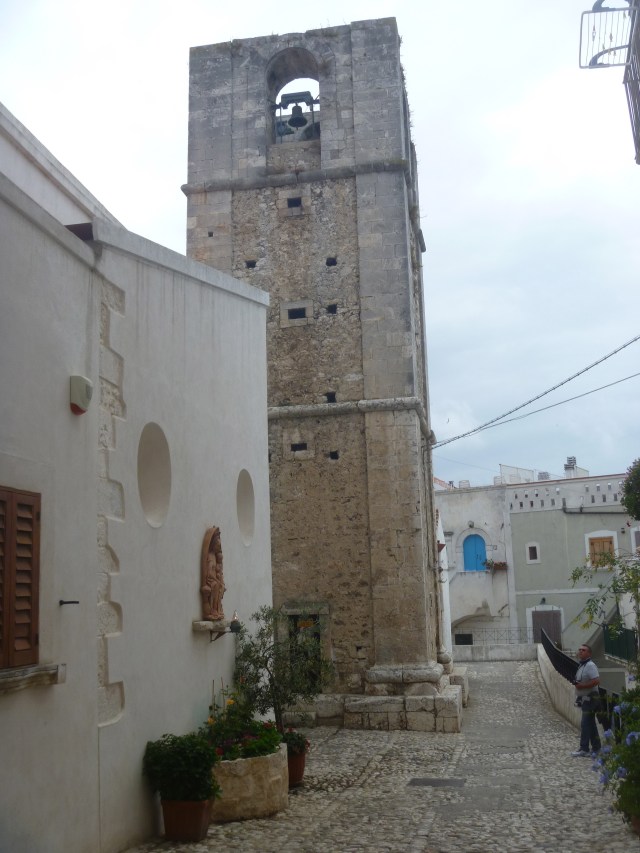
bell tower

Bell Tower at Sant’Ella

stations of cross

Stations of the Cross

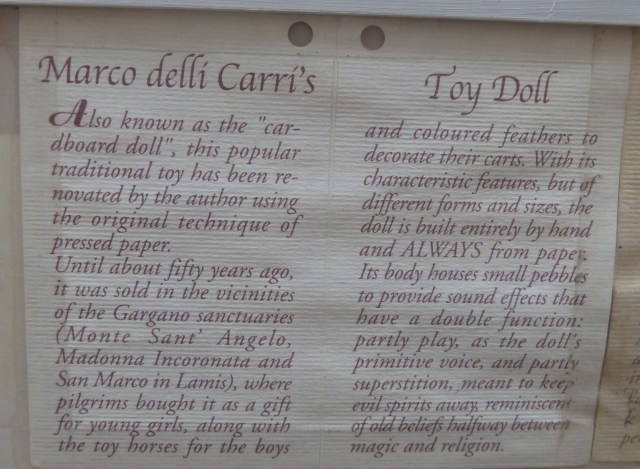
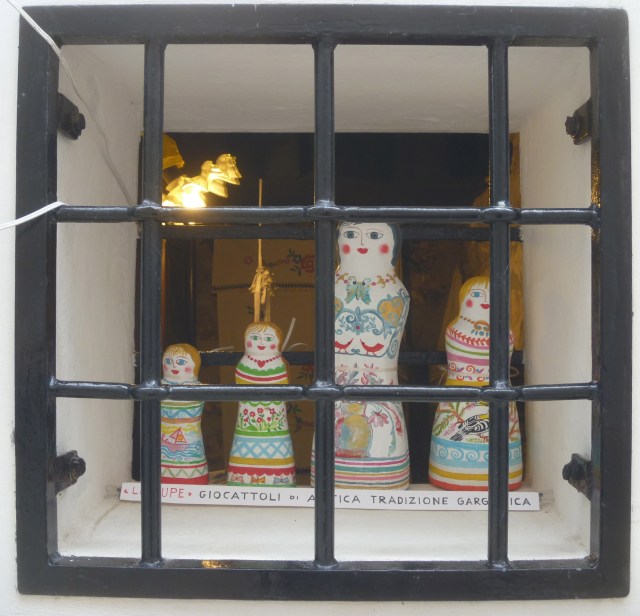
Typical souvenirs are wooden Pinocchio-style puppets and these dolls :
the dolls

about the dolls

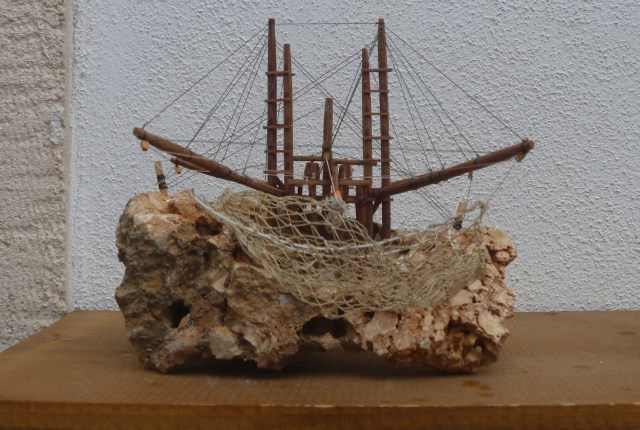
and models of trabucchi :

model trabucco

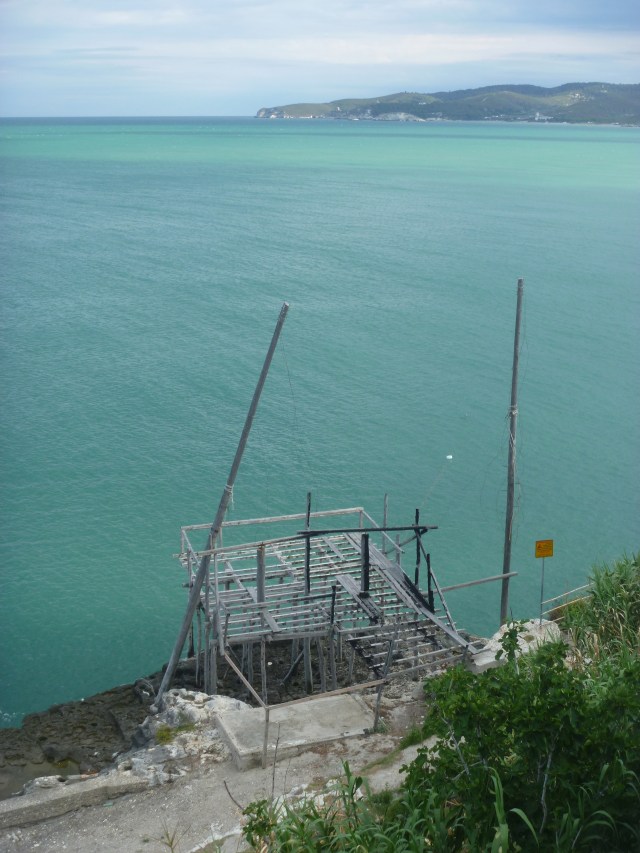
Trabucchi are wooden structures submerged in the sea. They are an ancient form of fishing technique consisting of large platforms anchored to the rocks and long wooden poles, ropes and pulleys. These days they are no longer used, except as a hobby, but they strongly symbolise the tradition and culture that was once fundamental to the economy of Vieste and the immediate region.
Vieste trabucco

A trabuccho at Vieste

By early afternoon we were back in Vieste where the sun was beginning to come out so we walked round the old town looking for the trabuccho, the Pizzomunno  stack and visiting the Cathedral.
Pizzomunno

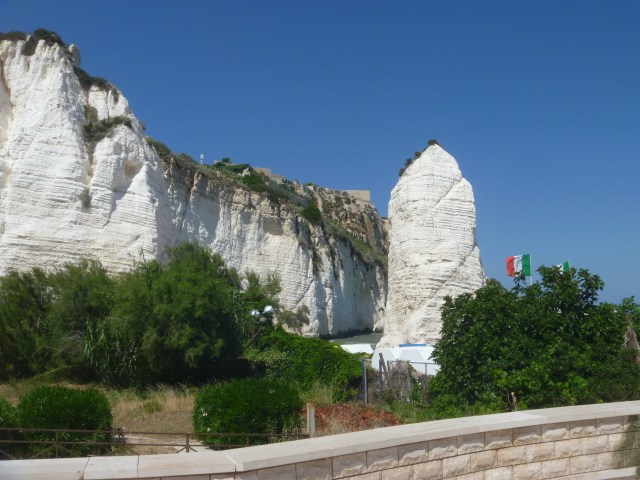
Il Faraglione ‘Pizzomunno’

This is a magnificent example of a calcareous monolith that stands 25m high next to the cliff side on the Castle Beach. It has become a symbol of Vieste. The rock’s name is taken from the legend associated with it. Read the story here.
cathedral

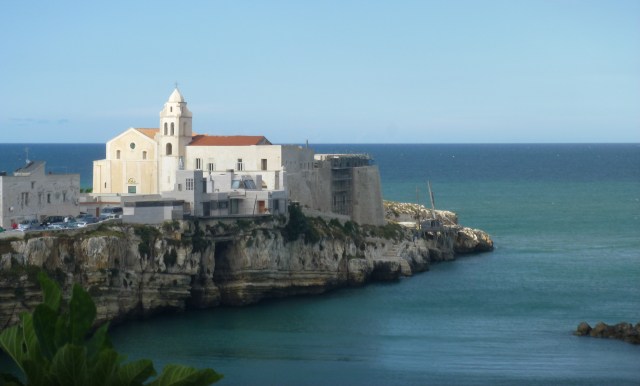
The Cathedral

old town

The Old Town of Vieste

And so, after a week of walking the paths of Gargano our trip was soon at an end. On the final evening we met again with Matteo to give our feedback and the next morning our taxi driver, Giancarlo, picked us up to whizz us along the autostrada to Bari Airport in his comfortable air conditioned Audi limousine, telling us proudly on the way how his grandfather began the family taxi business with a horse and cart.

What an adventure and what an achievement!
 

Footloose in the Gargano Peninsula

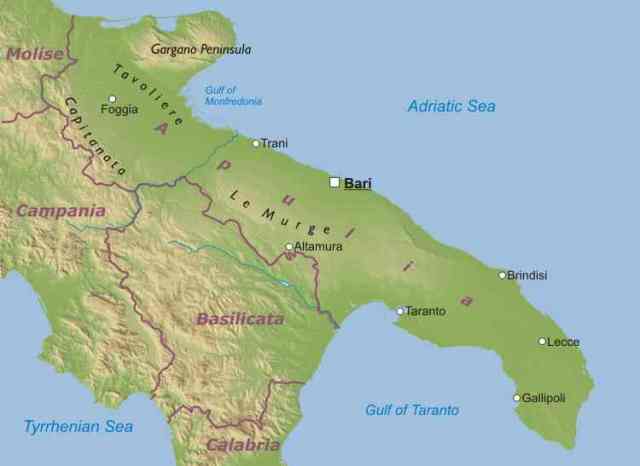
apulia

[source]

Whilst staying at Sant’Antonio in March I picked up a copy of H V Morton’s “The Traveller in Southern Italy”. It fell open at p.150 where the first sentence of part 8 of chapter 4 reads “The best way to see a country is on foot …”. By coincidence, or design, this sentence constitutes the strap line for ATG (Alternative Travel Group) of whose walking holidays I am a keen advocate. I also read Morton’s description of his visit to the “unexplored” Gargano Peninsula. My reason was, of course, that this June I was already booked on an ATG Footloose trip to explore the Gargano Peninsula. This part of Italy is still relatively unknown although some tour companies do visit and ATG have been sending walkers there for quite a number of years. We chose flights to Bari from Gatwick and ATG made our taxi arrangements for us. We had to go in June since we already had a family wedding on 13th and I had booked the month of May to be Ireland. So we had an inkling that this trip might be harder work, due to warmer weather, than previous walking holidays. In fact, I think I would say that, this one turned out to be the most strenuous of them all. However, as they say, “no pain, no gain”, we felt that we had made a great achievement as we walked along the designated route. Planning route

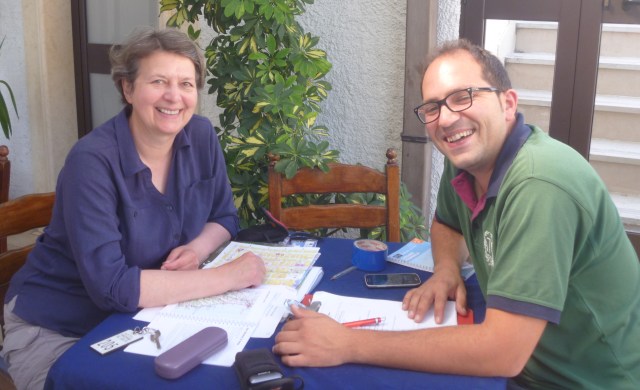
Initial Route Planning with Matteo

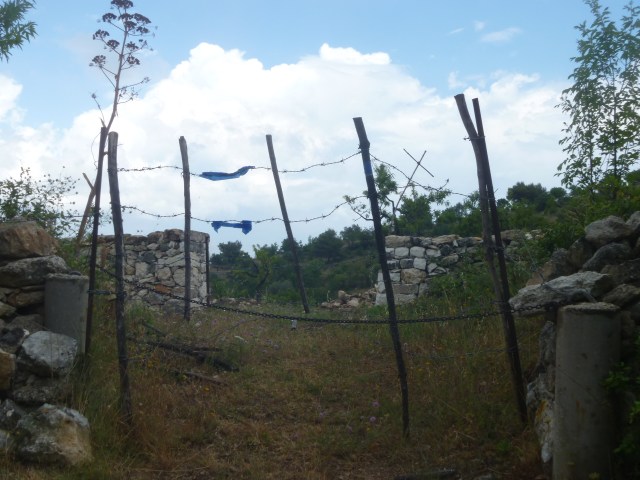
Yet again we had a great Route Manager to help us along the way, give advice, transport our bags and generally be a presence in the background in case of need. The Route Booklet explains the route step by step and we are now very familiar with the distances and what to expect. However, the ever-helpful Matteo explained that in certain places he had attached ‘environmentally-friendly’ blue tape not to show us the way but just to confirm that we were on the right track. It was always a relief to spot this tape! blue tape

Spotting Matteo’s blue tape

In brief, we walked from Manfredonia to Vieste officially a distance of 41.1 miles but we are positive that we walked a lot further than that! (… and I have the Fitbit to prove it!). ATG sum up the walk thus : “Limestone hills rising to 2,700 feet with coastal paths, quiet lanes, farm and woodland tracks and pilgrim routes leading up to Monte Sant’ Angelo. Occasionally rough under foot.” leaving first hotel
Leaving our first hotel

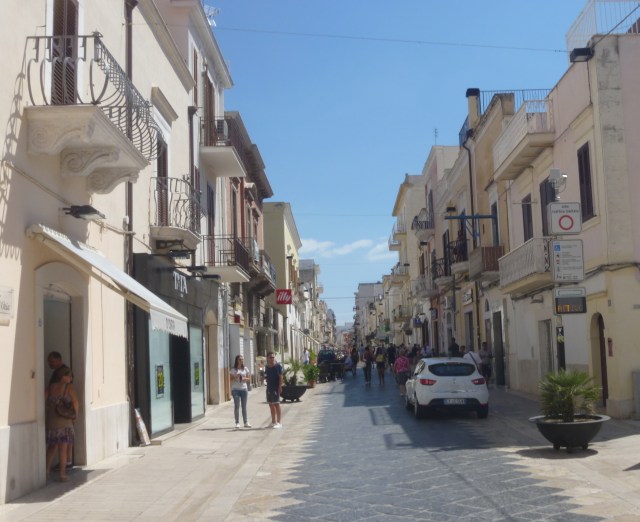
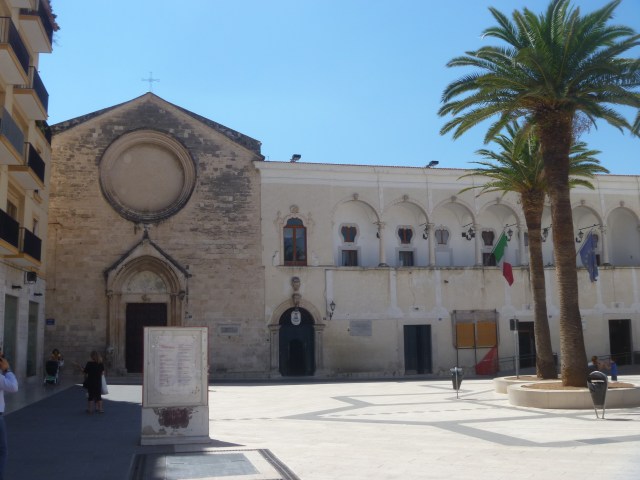
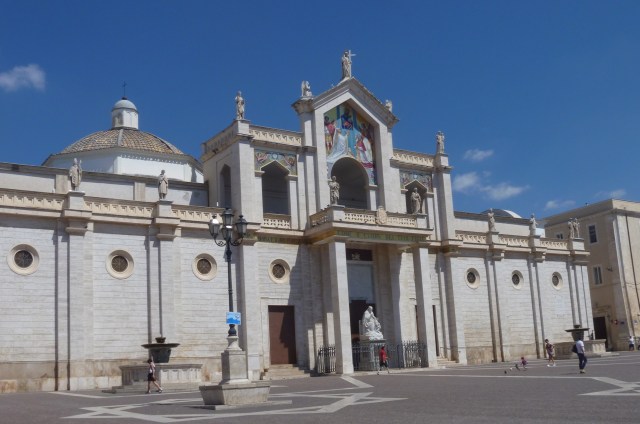
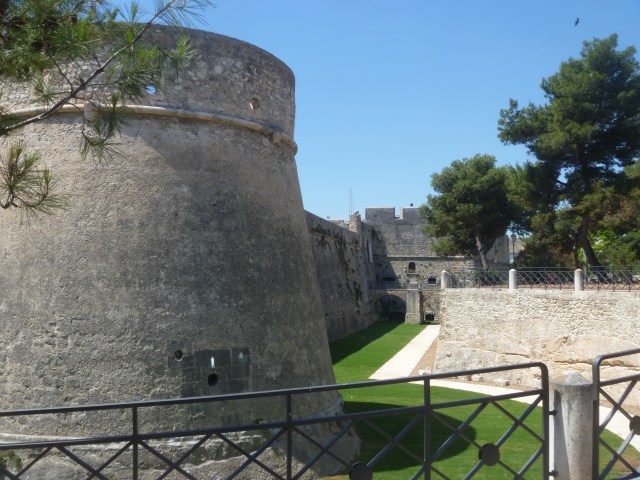
There was a long, but pleasant, walk from the first hotel along the promenade into the town centre of Manfredonia. Here we lingered a while viewing the Cathedral, the Castle and Town Hall Courtyard and Museum. Main Street Manfredonia

‘The Corso Manfredi’, Manfredonia

City Hall and Museum Manfredonia

Town Hall

Cathedral Manfredonia

Cathedral

Castle Manfredonia

Castle

There followed an even longer walk out of the town and through olive groves across the coastal plain before we even started on the “Jazzo Ognissanti” the historical and natural path.

There's Mont St Angelo

We Climbed Right Up There!
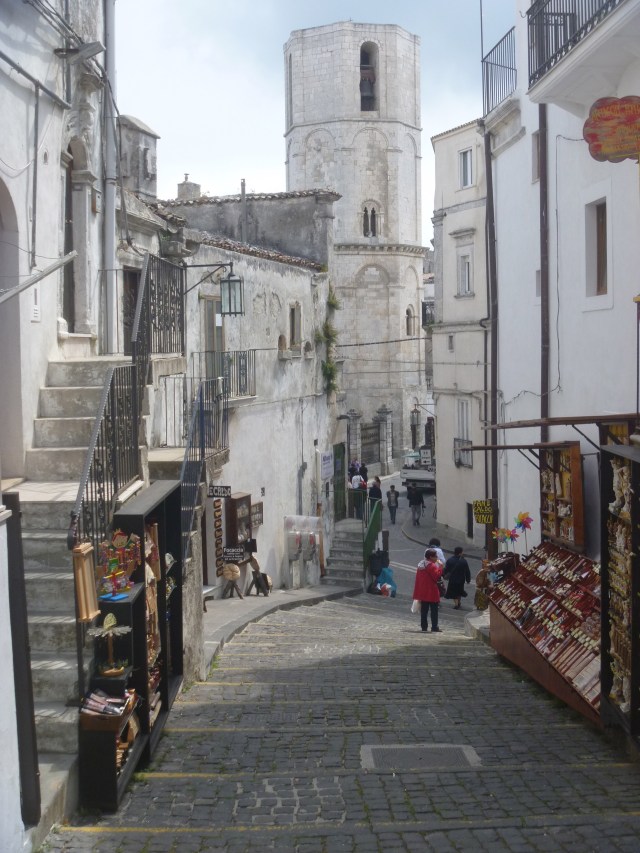
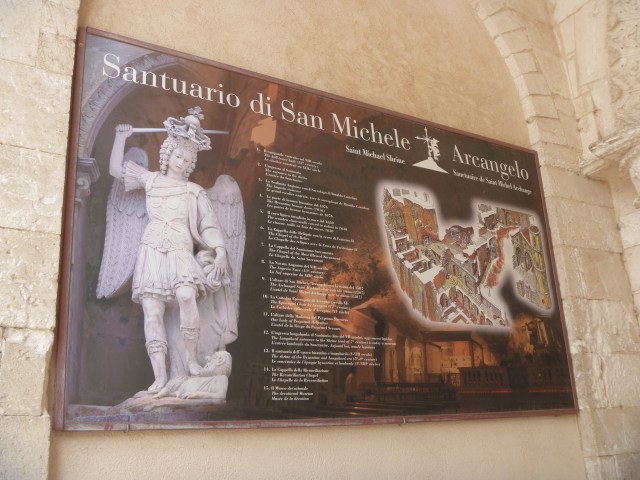
Walk along the coast then across a small plain before ascending an ancient pilgrim route, once used by crusaders before they embarked for the Holy Land. The route, now a grassy ravine with ruined monasteries on either side, leads to the ancient town of Monte Sant’Angelo (2,755ft), with its whitewashed houses, steep narrow alleys and stairways, and views across the bay of Manfredonia and coast to the south.” Pilgrim Route info boards along the way View back to Manfredonia The Pilgrim Route to Monte Sant’Angelo was memorably tough but very special and we enjoyed exploring the town the next day visiting the Sanctuary of St Michael the Archangel, churches and the Old Town (the JUNNO Medieval District) before heading off on the next stage (and getting soaking wet twice in the process) to our next stop, Mattinata. streets of Monte st  angelo

Shop

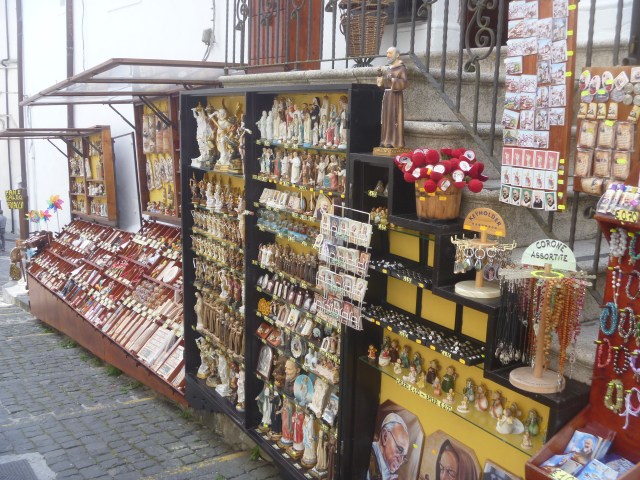
Shops selling religious mementoes abound in Monte Sant’Angelo

Santuario

Santuario door

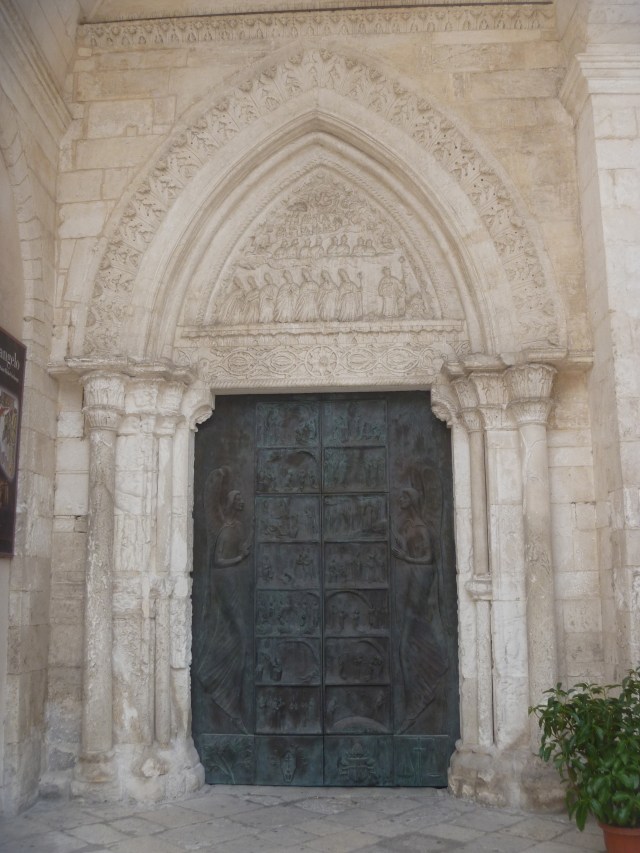
The Santuario Door

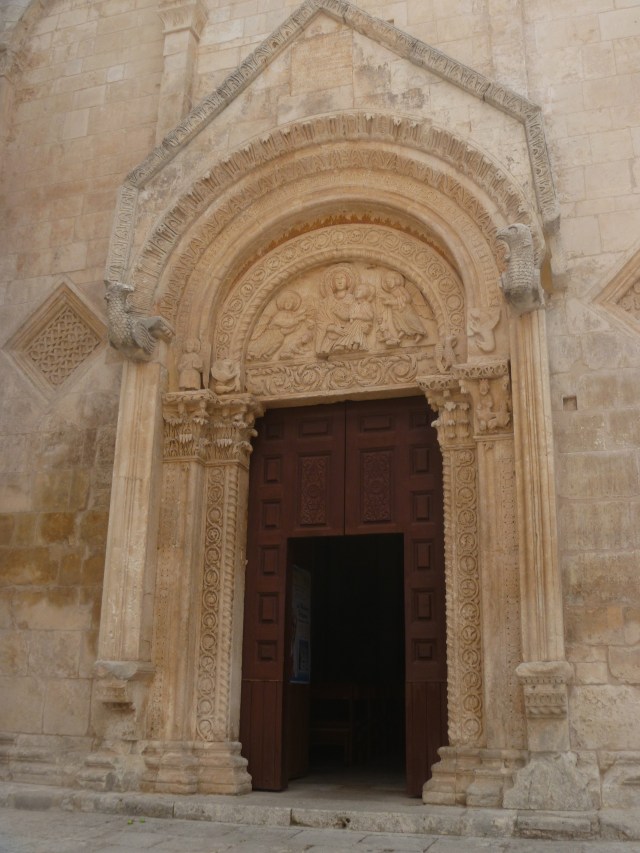
santa maria door

Door to the Church of Santa Maria Maggiore

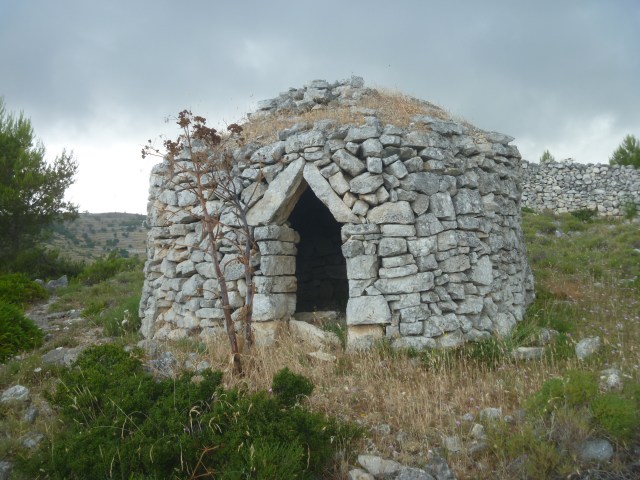
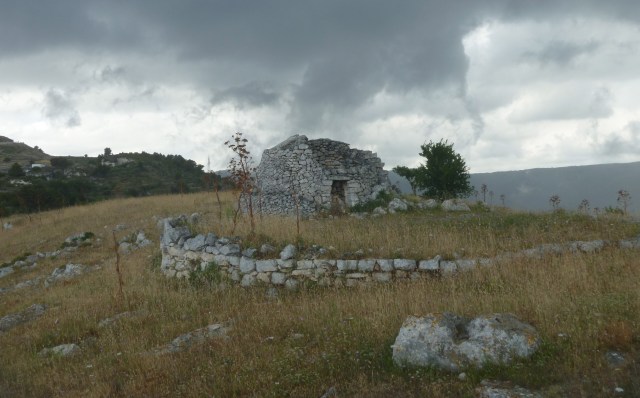
Time to explore the town and visit the famous cave church, venerated as being the last place St Michael appeared on earth in 491 AD, before setting off down a well-made pilgrim path to the small town of Mattinata (650ft) set in olive groves, close to the coast.”You descend from 800m to sea level on rocky paths, stony mountainsides and through woods, with wide views of Mattinata and the coast, following the remains of an old mule track called ‘Strada Comunale Mattinata – Monte Sant’Angelo’, which was once the only way up!” pagliaio On this section we came across pagliaio: shelters that were once used by shepherds to keep grain and straw for their herds and to sleep in if necessary. We had lunch in the shelter of one as it poured with rain. Later in another, even worse, downpour we sheltered under some trees but these made little or no difference. a pagliaio and storm clouds

A Pagliaio with storm clouds brewing

Mattinata looked like a nice town but we didn’t stop to find out as the shops were closed in the early Saturday afternoon and we needed badly to dry out our boots and clothes. The local museums had strange opening hours. The Museo Civico 5-10pm Tuesdays and Saturdays and a Museum in the local pharmacy was also open on that Saturday evening. In the end we just couldn’t face getting wet again.

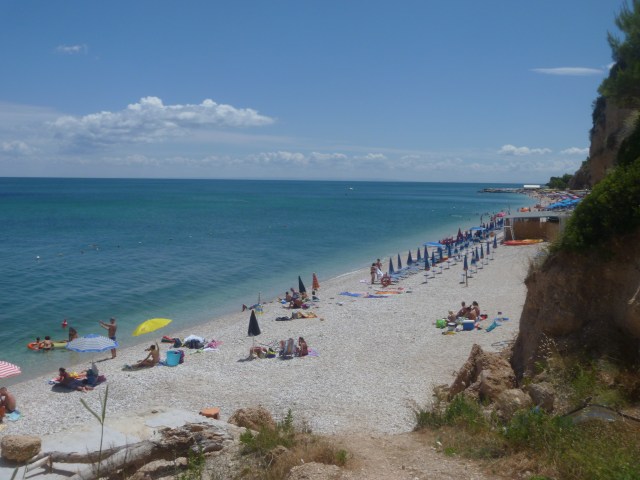
Sunday dawned bright and clear and the walk on that lovely day was virtually over by lunchtime when we arrived at the beach. We ate a leisurely lunch then hiked the final couple of kilometres to our hotel. lunch venue

We looked rather out of place in our hiking gear!

The route undulates across two valleys following surfaced road, grassy and stony paths and along a high ridgeline path with wide views east and west to the sea, before descending and across a wide plain. The route brings you close to the shore and along it before a brief section on road to the hotel.” beach

The Beach from our dinner table

Except for Monte Sant’Angelo and Vieste our hotel arrangements were on a half board basis. This is ATG policy when a hotel is not near a choice of good restaurants. The Hotel Villa Scapone is set on a cliff: walk down to the pool and up to the restaurant from our individual room with separate entrance and private terrace. It was a wonderful place to spend a relaxing Sunday evening halfway through our journey. Hotel Scapone

The Hotel Villa Scapone, Baia Fontana delle Rose

Milady goes to the Emerald Isle

For the month of May I’ll be away; mostly in Ireland but I’m driving to South Wales first and combining my trip with a visit to a dear friend in Powys.

My Itinerary :

1st – 5th May in Wales

5th May Ferry from Fishguard to Rosslare

6th to 11th May staying at Cappoquin, near Lismore, Co. Waterford

11th to 14th May staying with family in Co. Kildare

14th to 18th May volunteer helper at Ballymaloe Lit Fest, Co. Cork

18th to 26th May back in Co.Kildare

26th to 29th May at National Trust, Crom Estate, Co. Fermanagh

29th to 31st May at Glenarm on the Antrim coast

31st May Returning home from Belfast to Liverpool (actually, Birkenhead)

I had initially applied to ‘Workaway’ as I did in Switzerland two years ago but out of nine applications only four responded. Of those that did respond one has invited me to visit and another put me in touch with the Ballymaloe Festival.

I’m hoping to post daily again as I did in 2013 (although I may not have internet access each day) : so if you’re interested sign up to follow me here : My Irish Times : Round Ireland with a Book Box. The subtitle is from Tony Hawks’s book : Round Ireland with a Fridge. But I won’t be hitching – I’m taking my car – and I won’t have a fridge. I thought about saying ‘with a cool box’ but as I wrote this to a friend I thought, no, I’m more likely to have a box of books than a cool box of food.

Leeds Dublin

As Seen at Leeds City Station

More Watery Landscapes in Tivoli : The Villa D’Este and The Villa Gregoriana

Perhaps the most famous location in the town of Tivoli itself is the Garden of the Villa D’Este. The sun was shining on my last day at Sant’ Antonio and I decided that I would visit the garden and that of the nearby Villa Gregoriana.

Vd'este 1

Thursday 19 March just happened to be St Joseph’s Day (Father’s Day) and a big celebration filled the town centre of Tivoli. Was this the reason why the Gardens of the Villas D’Este and Gregoriana were practically deserted that morning? Anyway, it was very pleasant to have the gardens virtually to myself.

v d'este2

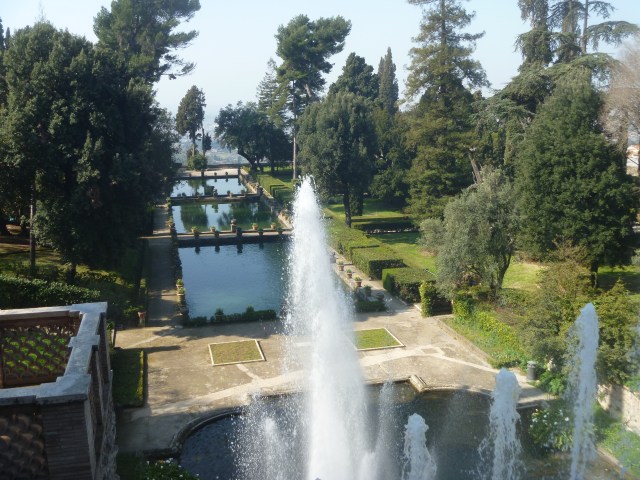
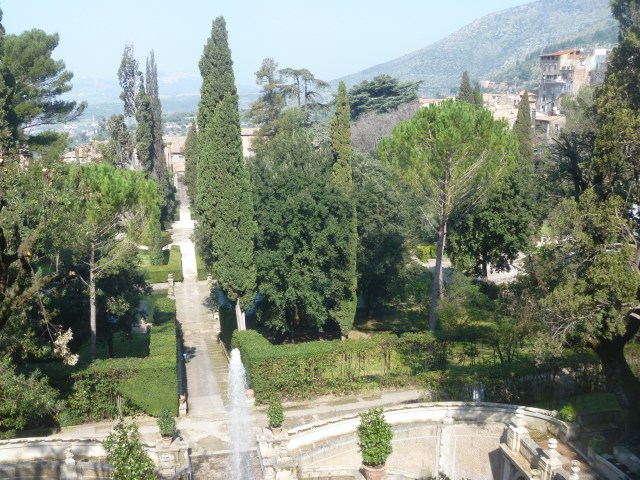
Cardinal Hippolyte D’Este (1509-1572) became governor of Tivoli and set about establishing a garden. Today it’s approached from the house but originally the entrance was at the bottom of the garden and visitors slowly climbed the hill to take in the wonders of the garden. Upon reaching the top, where the Cardinal would be waiting, you’d be in a ‘sense of breathless awe’. (According to Monty Don in the 2011 series of BBC programmes visiting Italian Gardens).

d'este gardens view

The View from the Villa

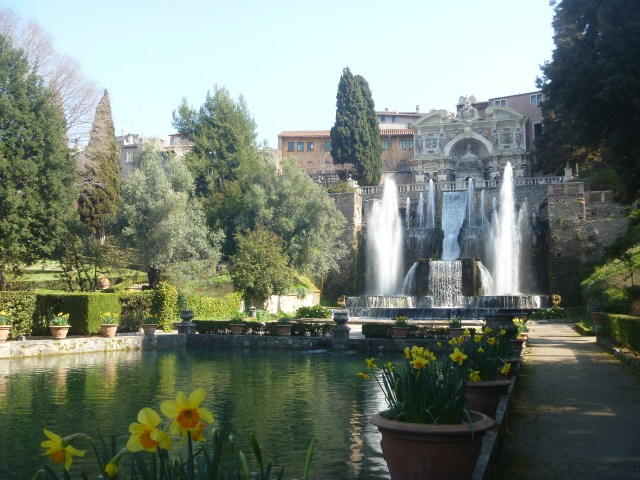
D’Este had great wealth but the one thing he wanted above all was to be Pope. He failed in 1549. So he demolished streets and had water brought to the site by a sophisticated method from a nearby aqueduct. All the water still comes from this same source and using the same methods. No pumps are used and the whole is still powered by pressure. The speed and movement of the water are still controlled by different sized pipes and spouts.

V d'este 3

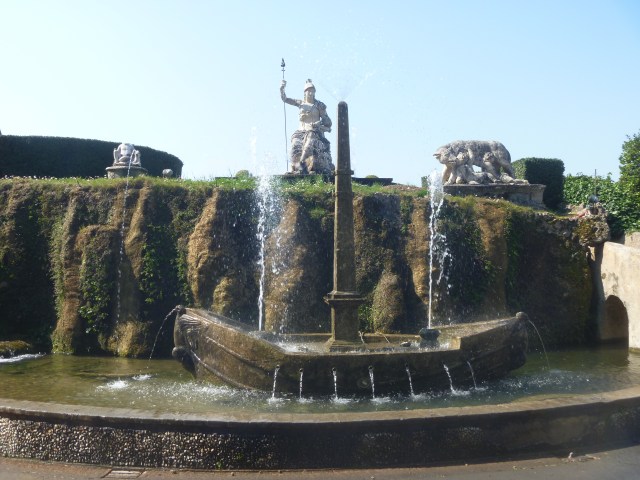
The whole estate took 20 years to construct during which time the Cardinal made 5 attempts to become Pope. Here “Rometta” is his model of Rome – he never did achieve his goal. Here is an expression of power built to impress. But he ran up huge debts: the whole project is said to have cost the equivalent of £100 million in today’s money.

fontana di rometta

Fontana di Rometta

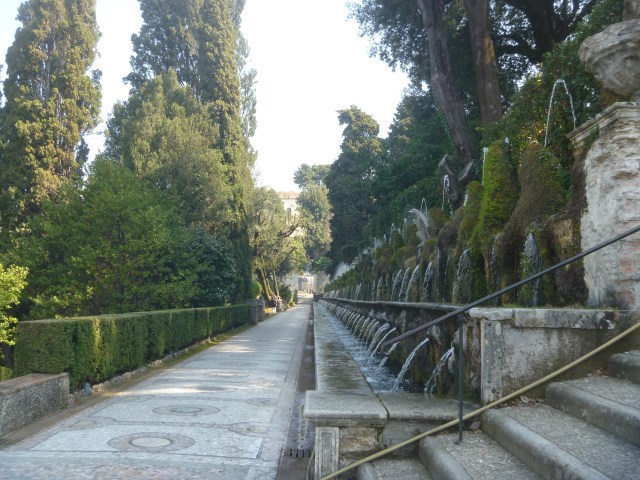
100 fountains

The 100 Fountains – they have the same rhythm and sound as you walk along beside them

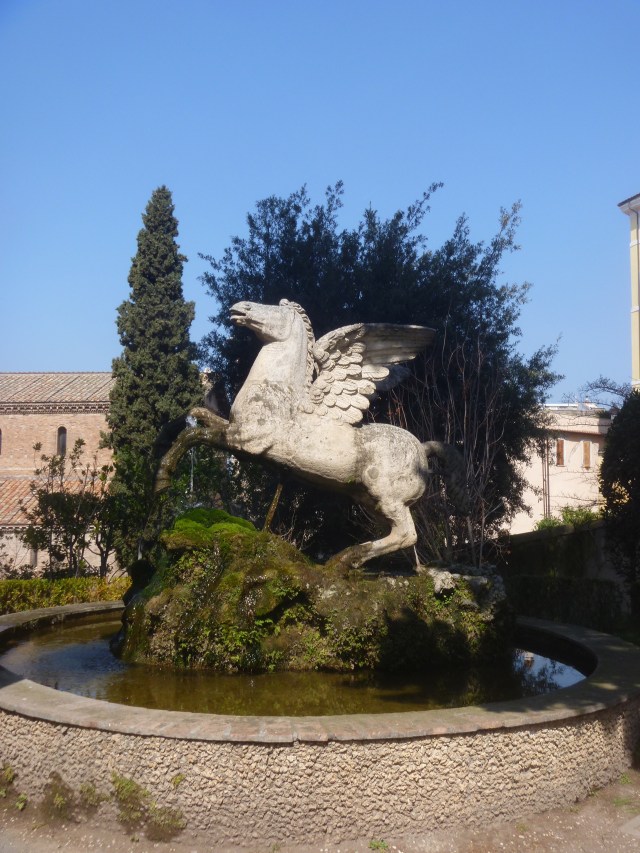
pegasus fountain

Pegasus Fountain

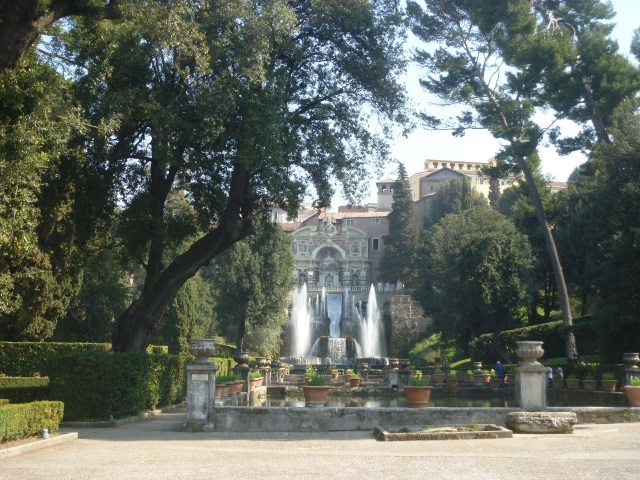
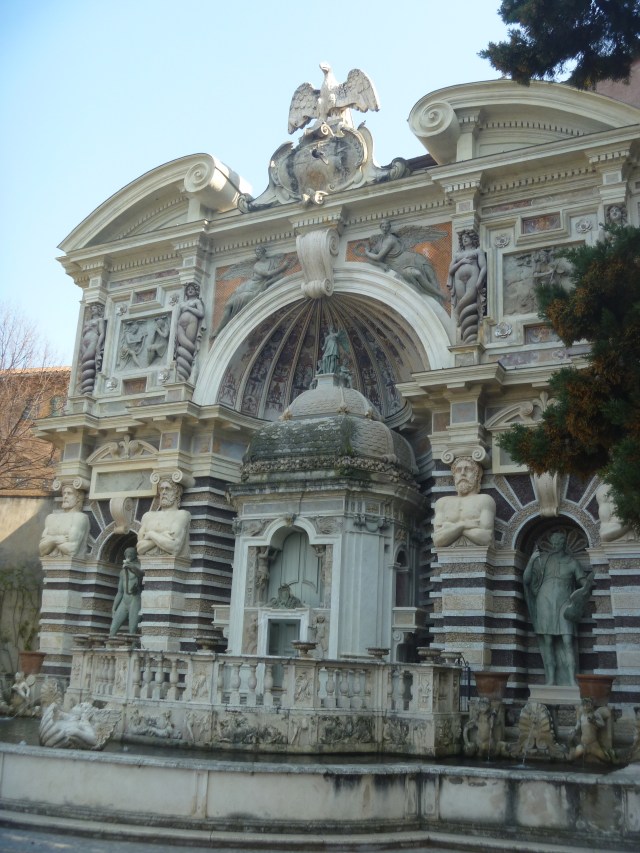
Organ fountain

The Organ Fountain Plays Every Two Hours on the Half Hour

It’s a wonderful theatrical performance full of drama and excitement; entertainment and playfulness with surprises and jokes. In addition to the gardens you can visit the mansion atop the hill the mansion is open too – room after room of breath-taking painted ceilings but little else. Like Hadrian’s Villa the Villa D’Este is a UNESCO World Heritage Site.

I spent over two hours wandering around the gardens and house but felt the call of the Villa Greogoriana and, ultimately, Sant’ Antonio.

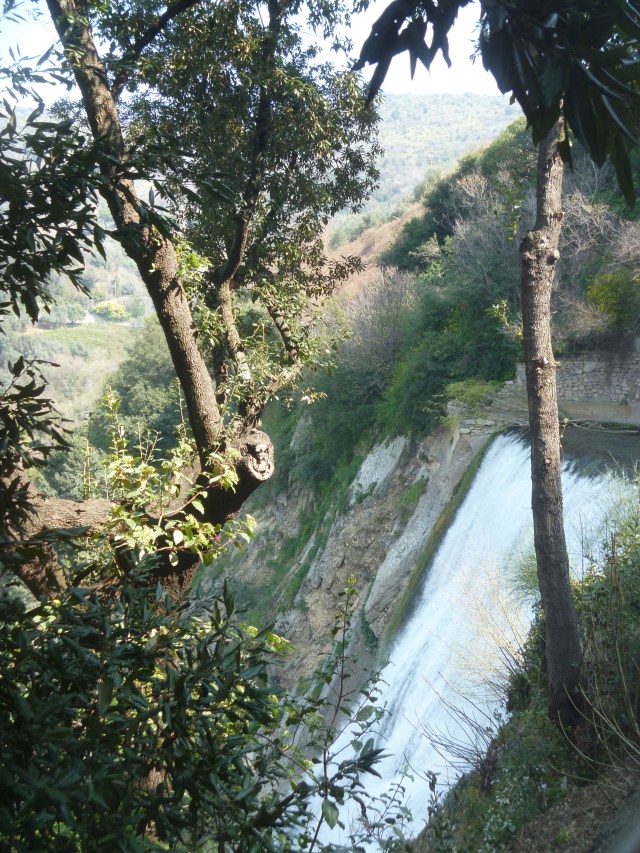
VG Grand Cascade

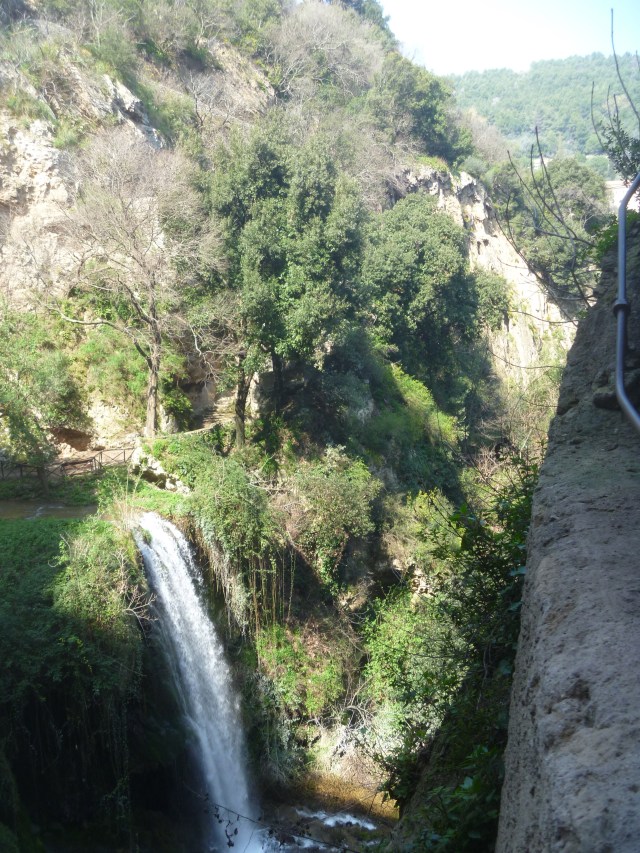
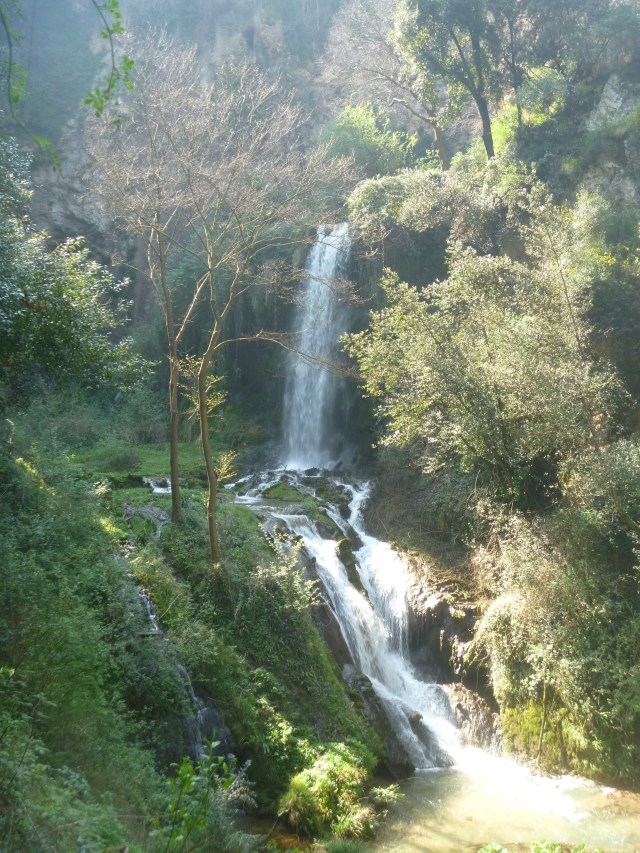
The Grand Cascade

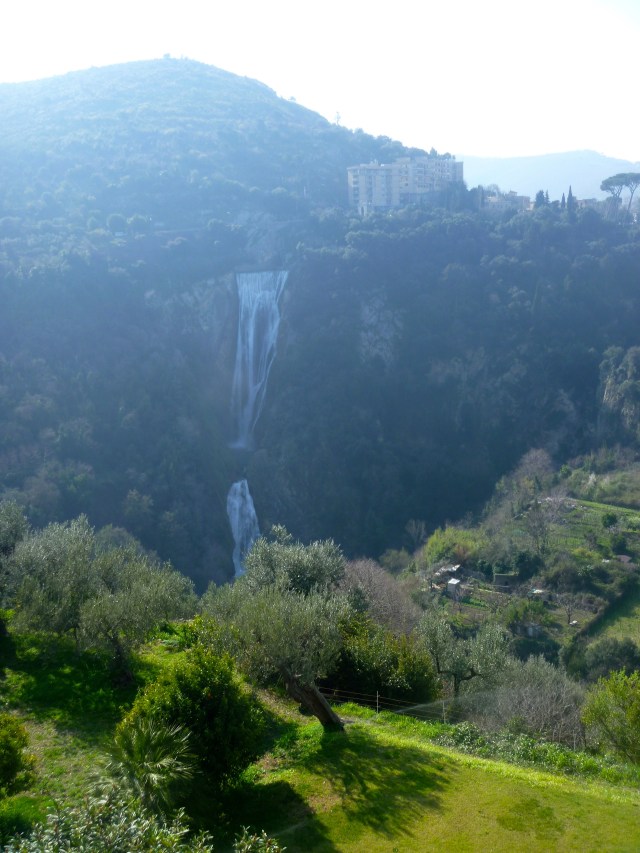
Cascade from window

The Grand Cascade from my window at Sant’ Antonio

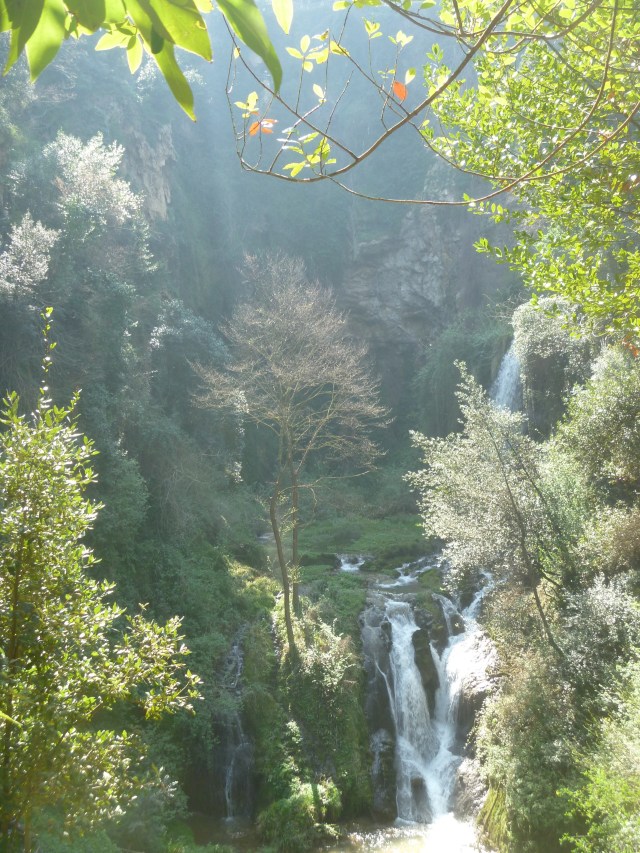
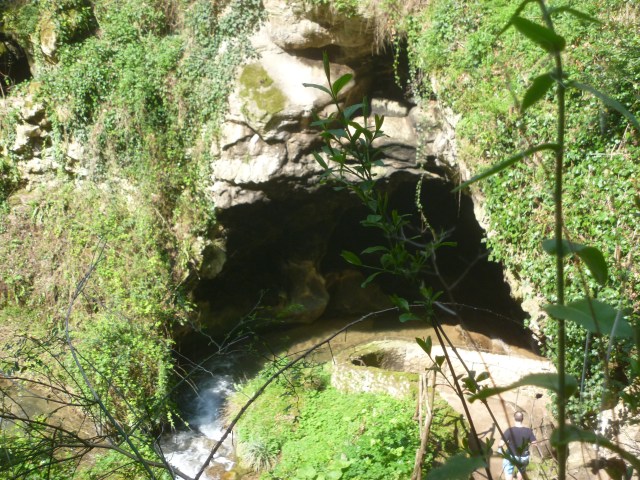
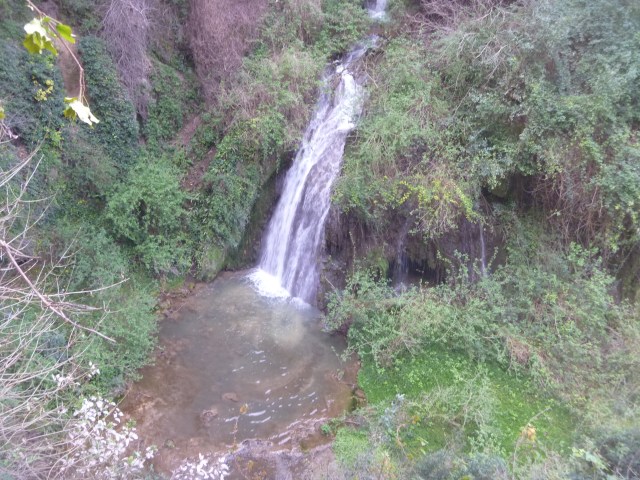
The Park of the Villa Gregoriana, for the Villa itself is no more, fills both sides of a wooded gorge where the waters of the River Aniene spill over precipices and lie still in pools in the valley bottom, is perhaps my favourite of the three gardens of Tivoli. Much of it, including the huge waterfall, can be seen from Sant’ Antonio and it appears more natural and less planned than the other two. Sant’ Antonio can be seen from the park.

SA view info

SA view

Sant’ Antonio from the Villa Gregoriana

If you ever plan to visit be sure to wear strong, rubber-soled walking shoes as the paths and steps are uneven and slippery when wet and take your National Trust card with you, if you’re a member. Entry is free to NT members. The FAI in Italy aims to preserve Italy’s art, nature and landscape and has reciprocal arrangements with our National Trust.

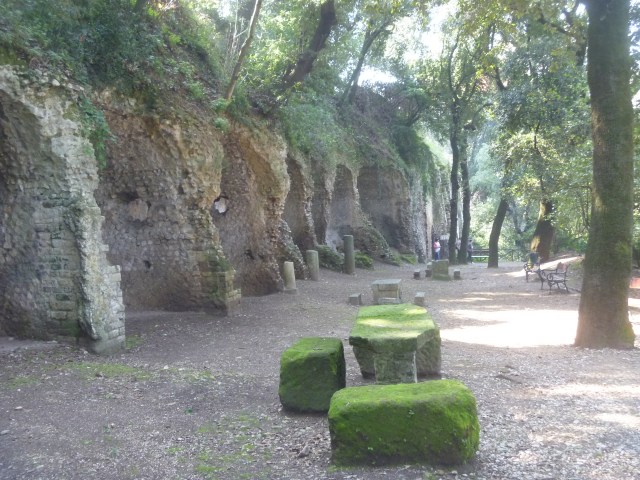
Remains of VG

Remains of the Villa of Manlius Vopiscus

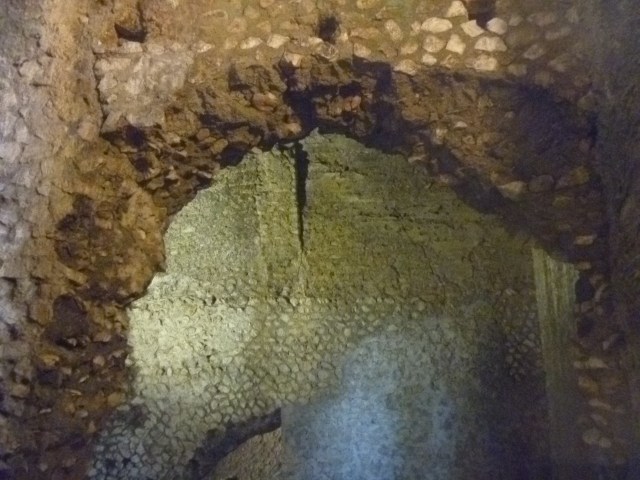
Inside the ruins

Roman Wall inside the Villa remains

The park was commissioned by Pope Gregory XVI to rebuild the bed of the Aniene River, which had been damaged by the terrible flood of 1826. It had fallen into rack and ruin by the end of the 20th century, but has been reopened to the public in 2005 thanks to a major landscape recovery project orchestrated by FAI, the Italian National Trust.

It was in 1835, after the Aniene River had burst its banks yet again, that Pope Gregory XVI decided to transform this enchanting but extremely dangerous location into a model of integration between art and nature. The project saw a tunnel being dug through Mount Catillo in order to deviate the river and thus preserve the town of Tivoli. This was then followed by the construction of an extraordinary natural garden dominated by the acropolis with Vesta and Tiburno’s Temples.

As you walk through the thick woodland of Parco Villa Gregoriana you will discover the delightful combination of the majestic landscape and the tranquillity of the paths that meander through it. En route, you will get to the caves of Neptune and of the Sirens, which form part of an incredible series of gorges and cascades, and to the Great Waterfall, with its whirling mass of water that seems to fall directly onto those who stand and gaze at it.”

cave of sirens

The Cave of the Sirens

Valley of Hell upper viewpt

valley of hell 2

valley of hell 3

valley of hell 4

Views of the Valley of Hell from Upper Viewpoints

According to the leaflet/map guide to the gardens “Goethe was among those who were amazed by the area. ‘I was recently in Tivoli, where I admired a breathtaking natural spectacle. The sight of the waterfall there, along with the ruins and the whole landscape, greatly enriches the soul’. Goethe visited during the heyday of the Grand Tour, when Italy was the destination of choice for upper-class travellers from all across Europe, affording them and unrivalled classical education.” And this was long before Pope Gregory XVI’s re-creation of the original garden.


Goethe’s Italian Journey

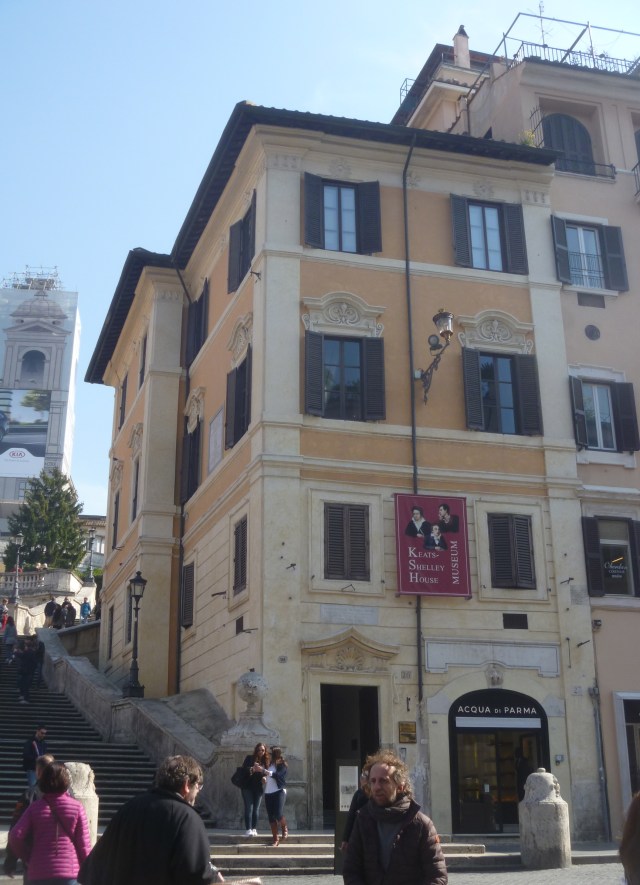
Probably my favourite of the museums and locations I’ve visited in Rome on previous trips is the Keats-Shelley Museum by the Spanish Steps. It’s a quiet oasis of 18th century England amidst the crowds of tourists milling around the Piazza di Spagna. It’s a few years since I was there and I didn’t repeat the visit on this recent trip.

K S House

Keats Shelley House, Rome, on Second Floor with Landmark Trust Apartment Above

Spanish Steps in March

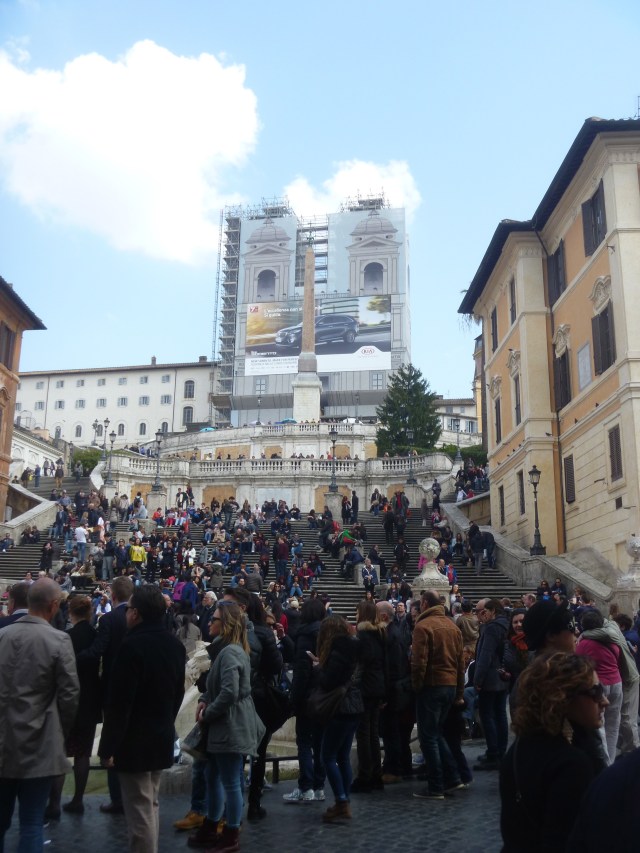
Crowds on the Spanish Steps – in early March

Babbingtons

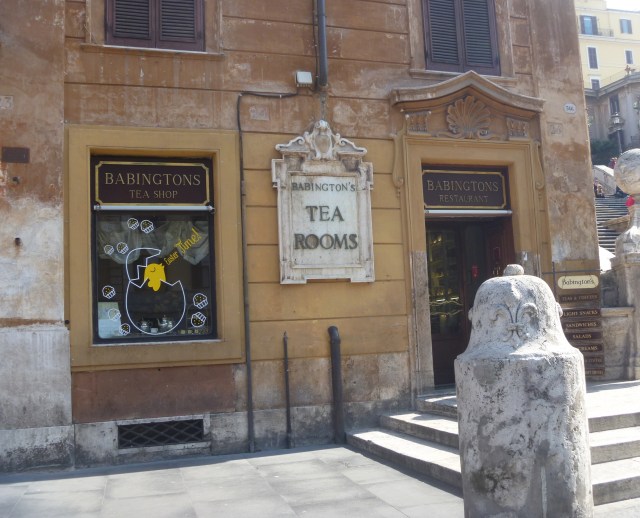
Babington’s English Tea Room by the Spanish Steps

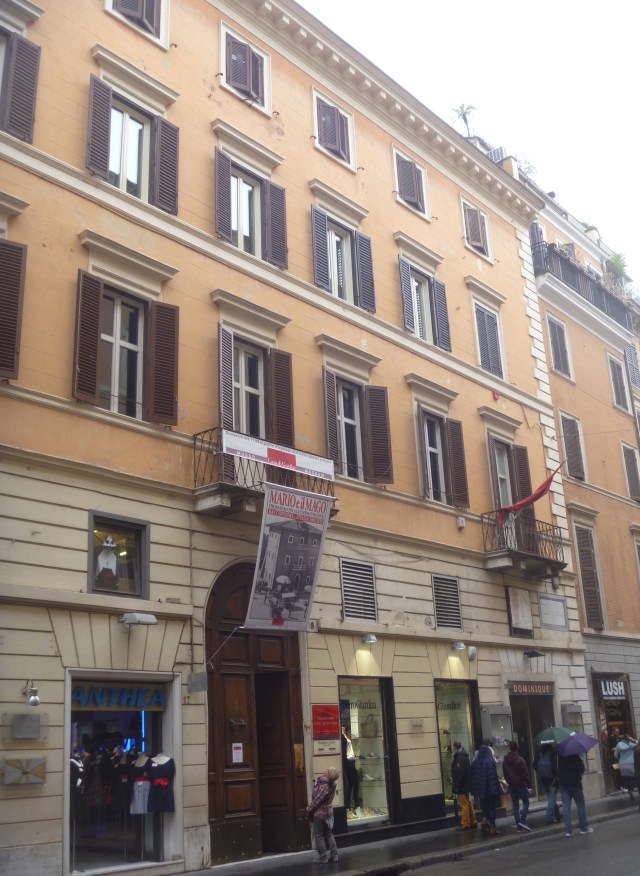
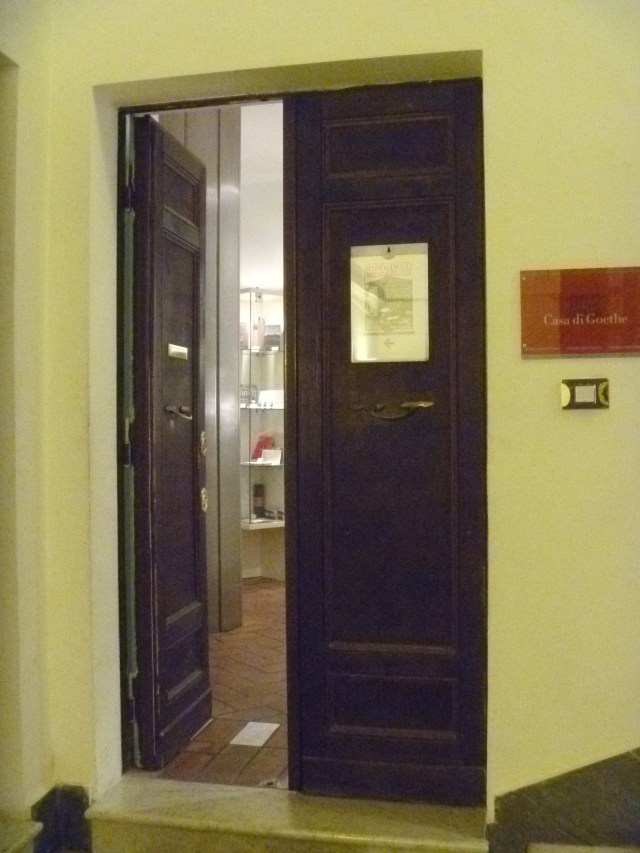
But I did discover the existence of the Casa di Goethe in my LV Guide Bari, Milan, Naples, Rome 2012. So my final port of call in the City of Rome itself (after fortification at Canova) was a visit to the Casa di Goethe on the Via del Corso nearby. I wrote a little bit about Goethe earlier this year. Here is another place of peace and calm and amazingly right on the Via Del Corso.

via del corso

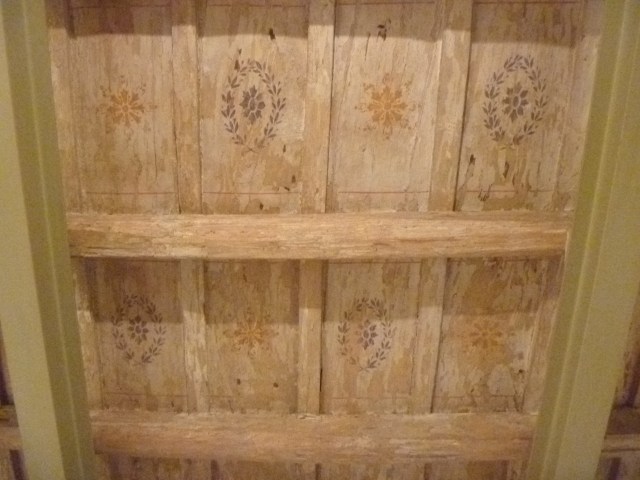
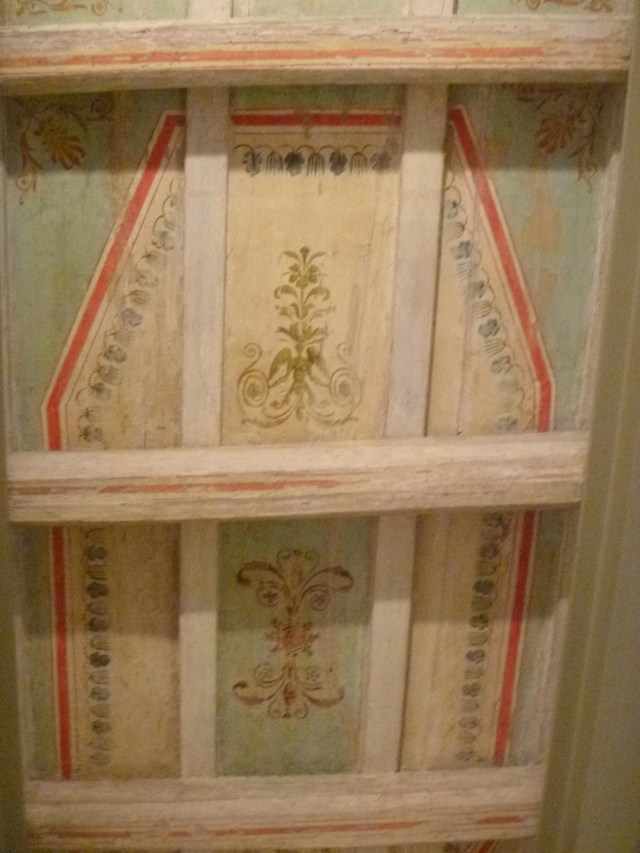
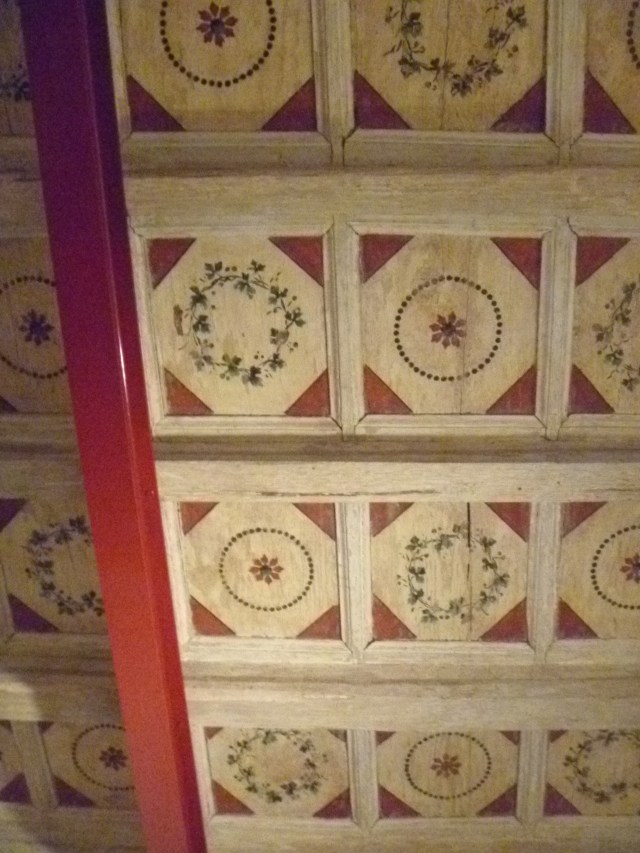
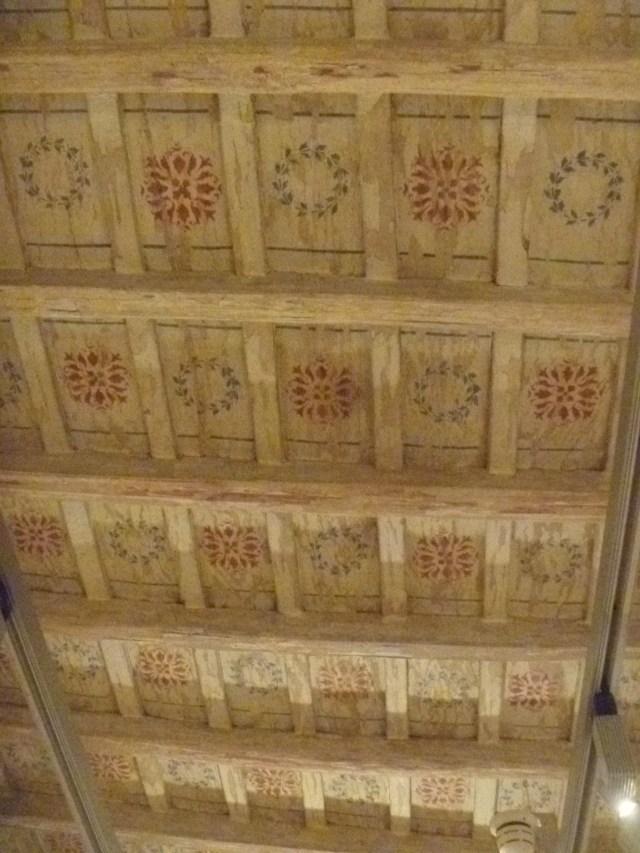
In September 1786, Goethe started out on the longest journey of his life. He was 37 when he achieved his dream of visiting Italy. He later wrote in his journal “Italienische Reise”, that he had spent the happiest period of his life there. On his arrival in Rome he stayed on the Via del Corso with his painter friend Johann Heinrich Wilhelm Tischbein, scion of a dynasty of renowned artists. This huge apartment, which gives onto the Piazza Del Popolo, is still redolent of Goethe’s time here during his Grand Tour of 18th-century Italy. It has superbly painted coffered ceilings which are set off by the white of the walls. On display are writings, letters, annotations, and drawings, as well as the paintings of his friend Tischbein.

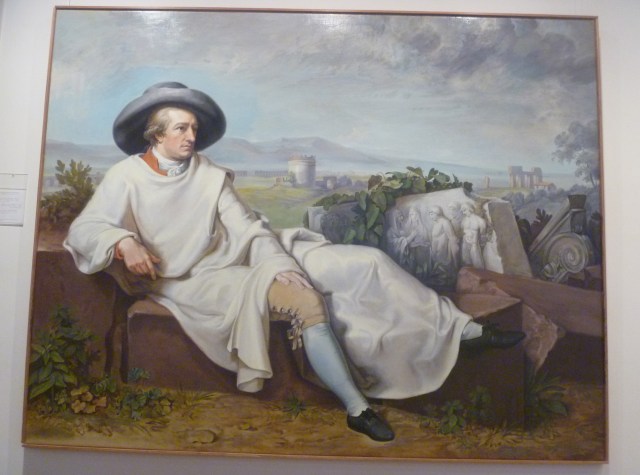
g in roman countryside

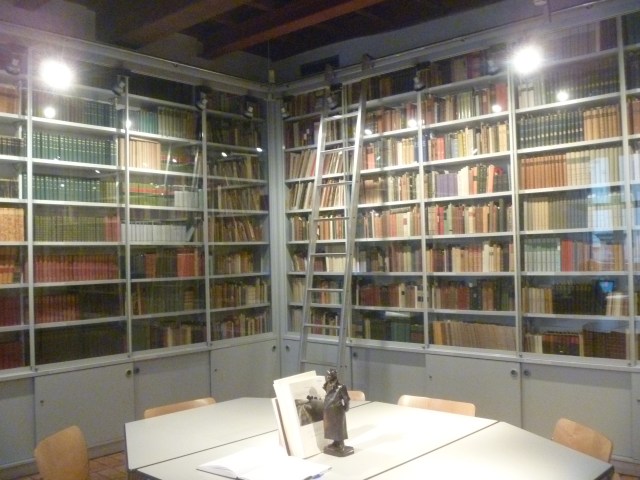
The most famous of them, Goethe in the Roman Campagna, was painted on this very spot in 1787, although the version seen here is only a copy, the original being in the Staedelsches Kunstmuseum in Frankfurt. It never fails to impress all the same. This sumptuous collection of artworks and documentary material gives us an idea of what the journey to Italy meant at the time for artists and cultivated travellers. The Casa di Goethe also offers temporary exhibitions that encourage German-Italian cultural relations. By appointment it’s possible to visit the Library which holds a number of first editions of Goethe’s work.” [LV Guide Rome 2012]

welcome

Welcome to the Casa!

This is the only German Museum on foreign soil and it was opened to the public in 1997 with support of the German Government and German cultural associations. Regular events are held here – readings, lectures, conferences, discussions and concerts – followed by gatherings and discussions in the library over a glass of wine. The Museum is also able to offer scholarships (sponsored by DaimlerChrysler) to literary figures, publishers, scientists, translators, and artists, allowing them to spend a few months in Rome collecting ideas and inspiration for their own work or finishing off projects. The work doesn’t have to be related to Goethe.

library

Goethe Library in Rome

The first few rooms are dedicated to the temporary exhibitions; currently Thomas Mann and his Italian novella Mario and the Magician. Displays relate to the historical and political background as it was written during the rise of Nazism and Fascism. The notes were all in German and as time was tight I didn’t spend much time in these rooms but moved on to the rooms occupied by Goethe at the front of the building.

ceiling 1

ceiling 2

ceiling 3

ceiling 4

Painted Coffered Ceilings

The restored painted wooden ceilings, which date back to Goethe’s time, contrast well with the pale walls which show off the displays and pictures. No furniture or furnishings dating back to Goethe’s time here. To me they are reminiscent of Swiss and German chalet decorations.

I was glad that I bought the excellent illustrated guide book. The first section, as in the rooms themselves, tells the story of Goethe’s time in Rome and Italy. There then follow pages of quotations by Goethe himself from his letters and his journal Italian Journey and by his friends and colleagues. Many of these quotations also accompany the room displays.

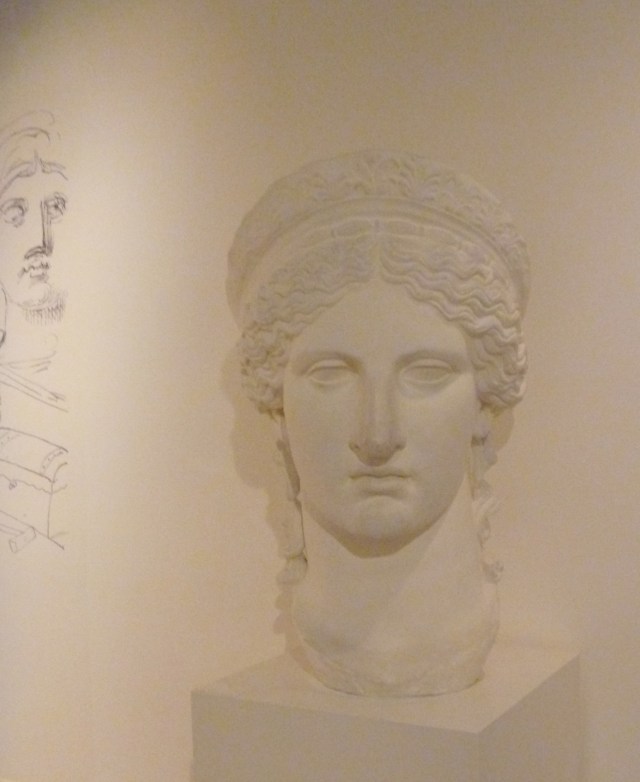
cast of jupiter

“I could not resist buying the cast of a colossal head of Jupiter . It now stands in a good light facing my bed, so that I can say prayers to him the first thing in the morning.” (Italian journey 25 December 1786

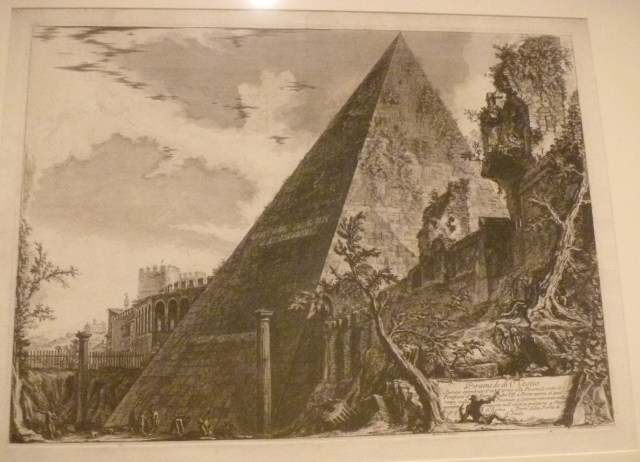
Piranesi print

Piranesi Print of the Caius Cestius Pyramid

“Water pipes, baths, theatres, amphitheatres, the stadium, temples! And then the palaces of the Ceasars , the graves of the great – with these images I have fed and strengthened my mind.” to Carl Ludwig von Knebel 17 November 1786

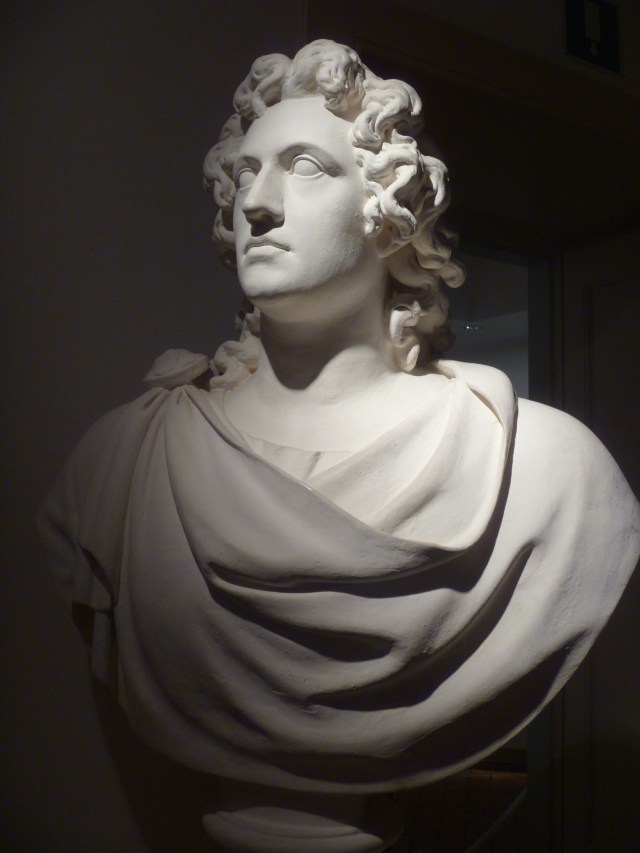
bust by trippel

1787 bust of J. W. v. Goethe by Alexander Trippel

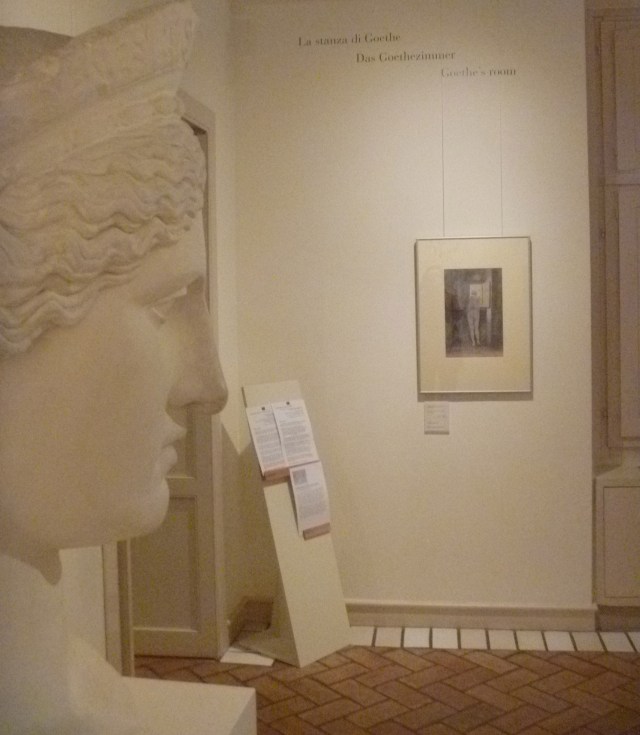
In goethe's room

Goethe’s Room

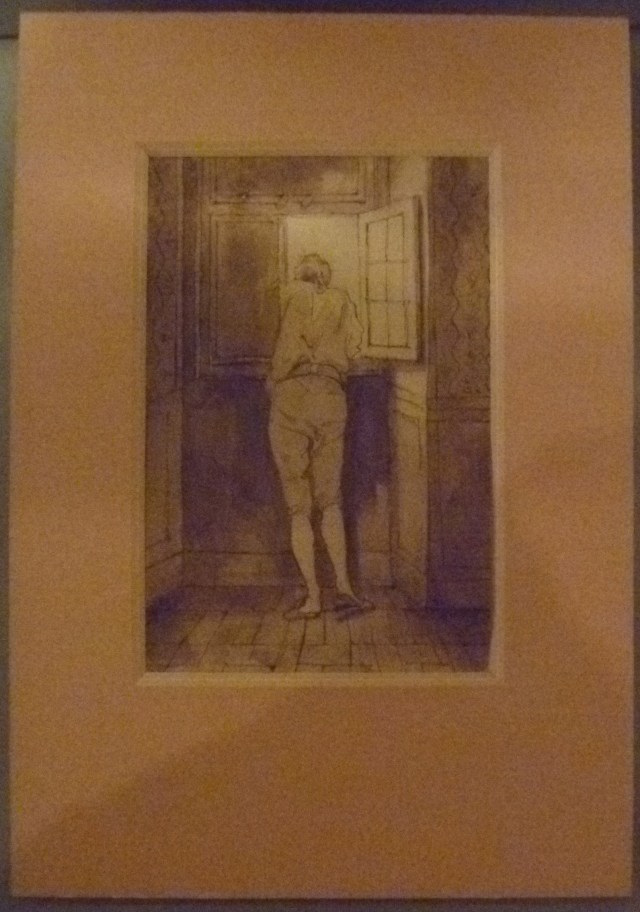
G at window

Tischbein ‘s watercolour of Goethe at the window

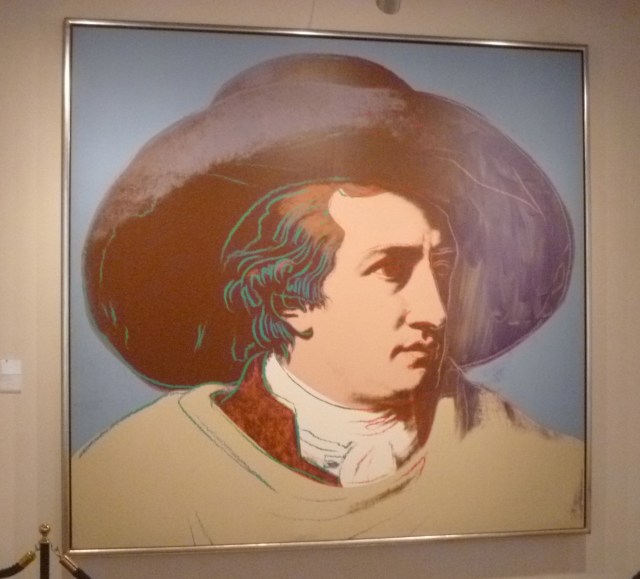
1991 and 1992 were excellent years for the acquisition of many Goethe related papers, books and artefacts by the Casa including the Andy Warhol iconic contemporary adaptation of Tischbein ‘s portrait. Also some autographs of Goethe’s including a letter card written in his own hand and giving his rome address and the Goethe library of publisher Richard Dorn.

Warhol

Screen Print and Acrylic on Linen 1982

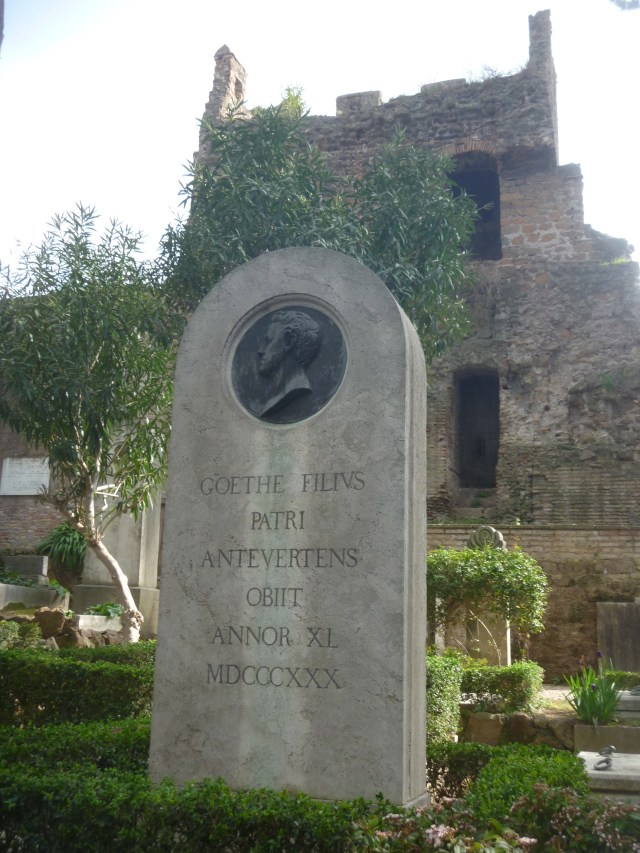
At the very end of the guide book is a list of museums and memorials to Goethe in both Italy and in Germany. Amongst those listed is the grave of his son, August, in the Protestant Cemetery. Interestingly, even though he was an adult at death his father arranged for the following to be inscribed on his gravestone.

GOETHE FILIVS / PATRI / ANTEVERTENS / Obiit / Annor [VM] XL / MDCCCXXX (Goethe’s son / father / above / died / 40 years / 1830)

August Goethe


A Roman Road : Walking The Appian Way

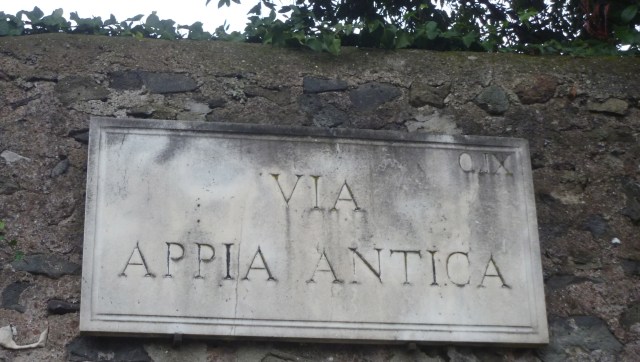
AA wall sign

A walk along the Appian Way was something I’d read about in my Quiet Rome book and in other guides so I’d added it to my ‘to-do’ list for when I was next in Rome. I studied various ways to approach the way and in the end booked the excursion ‘Catacombs and Roman Countryside Group’ with Enjoy Rome. I’ve written about the Catacombs and Aqueduct visits already. Now its the turn of The Appian Way. You’ll have noticed already that it was a rainy day but nevertheless we did manage a brief walk for a few hundred metres and now, maybe on a future visit, I feel confident to take public transport and do a further walk like the 90-Minute one described in the Dorling Kindersley Eyewitness Guide.

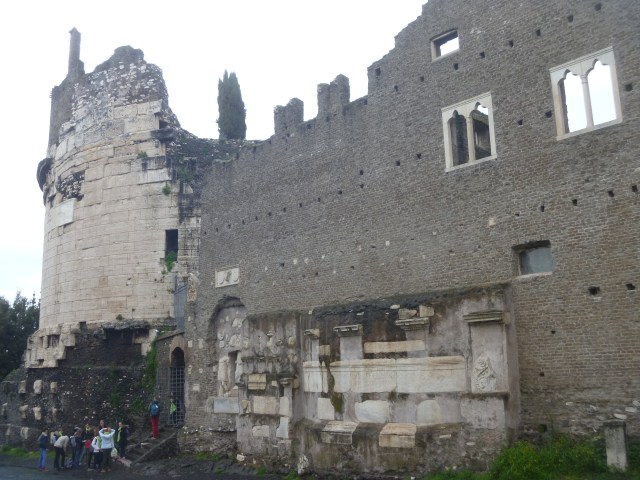
cecilia metella

Mausoleum of Cecilia Metella

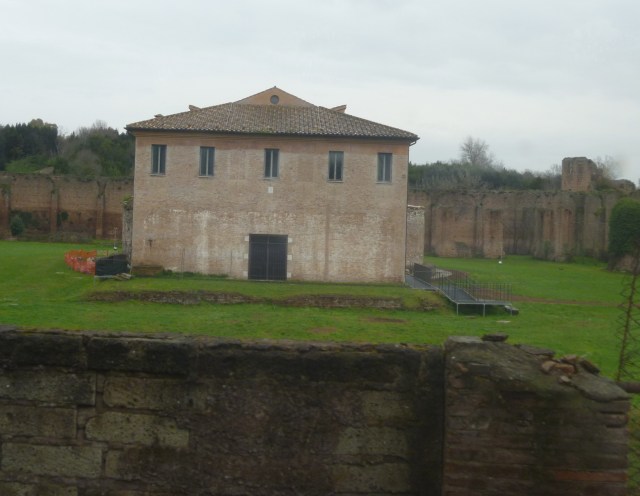
We were a small group of 15 and the half-day excursion included travel by minibus from the ER offices near Termini Station and back. From the Catacombs we bumped and jostled (I don’t recommend doing this by car!) along the Way and finally parked opposite the Mausoleum of Cecilia Metella on the Third Mile Section.

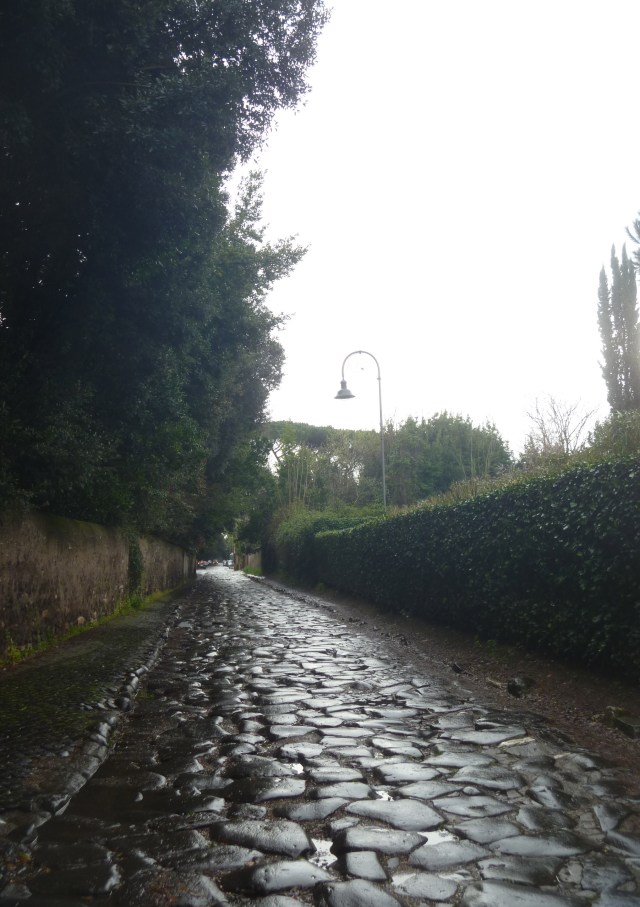
wet way

A wet Appian Way

From here we took to the wet cobbles of the road which had been built to link Rome with Brindisi in southeast Italy. The road is named after Appius Claudius Caecus, the Roman censor who began and completed the first section as a military road to the south in 312 BC. It is a Roman standard 4 metres wide surfaced with ancient basalt flagstones and flanked on either side by private villas (many built upon the original Roman foundations), cypress trees and pines. Needless to say the basalt cobbles were rather slippery when wet.

AA Villa

Villa along the Way

AA Cafe

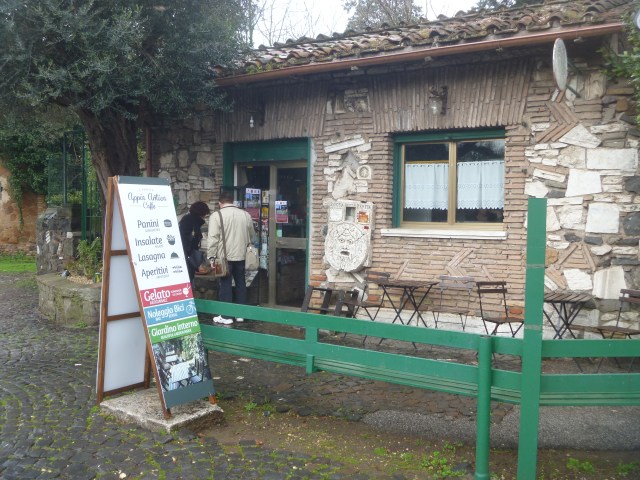
The Bar Caffe del Appia Antica

Refreshment stops along the Way are few and far between but this cafe hires out bikes in summer and is (apparently) near the bus stop for the 660 which would take you to Metro Station San Giovanni – but don’t take my word for it!!

St Nicholas church

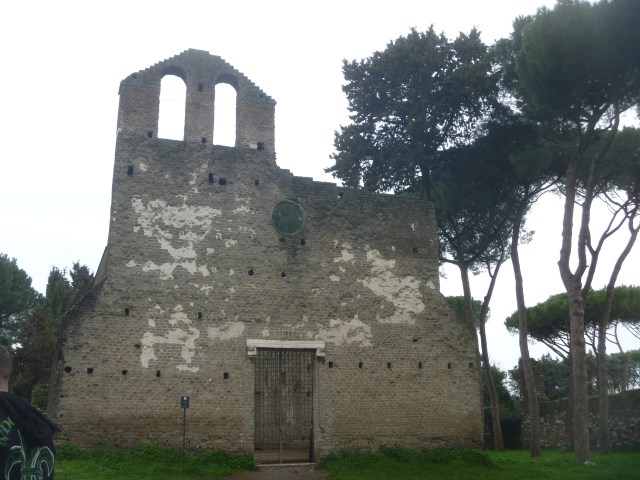
St Nicholas Church on The Appian Way

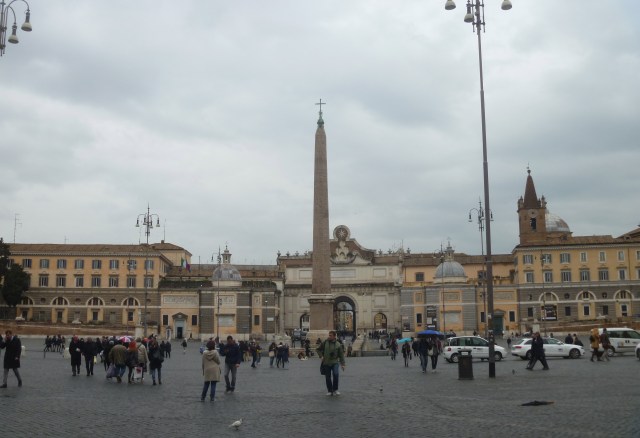
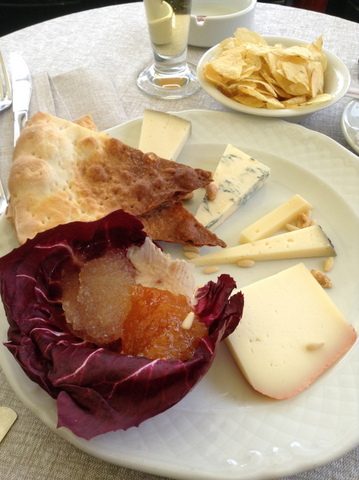
After the excursion I took the Metro to the Piazza del Popolo, crossed it in the rain and took shelter at Canova to eat a five cheese lunch and watch the dripping brollies go by!

Piazza del Popolo

Piazza Del Popolo

Canova lunch

Five Cheeses and What looks like Jelly but tastes like Hot Mustard!

Hadrian’s Villa, Tivoli : a UNESCO World Heritage Site

Wednesday last week dawned bright and sunny and I knew this was the day to visit the UNESCO listed Hadrian’s Villa another vast area of building remains. Although extensive today it’s thought to have been even more so originally.

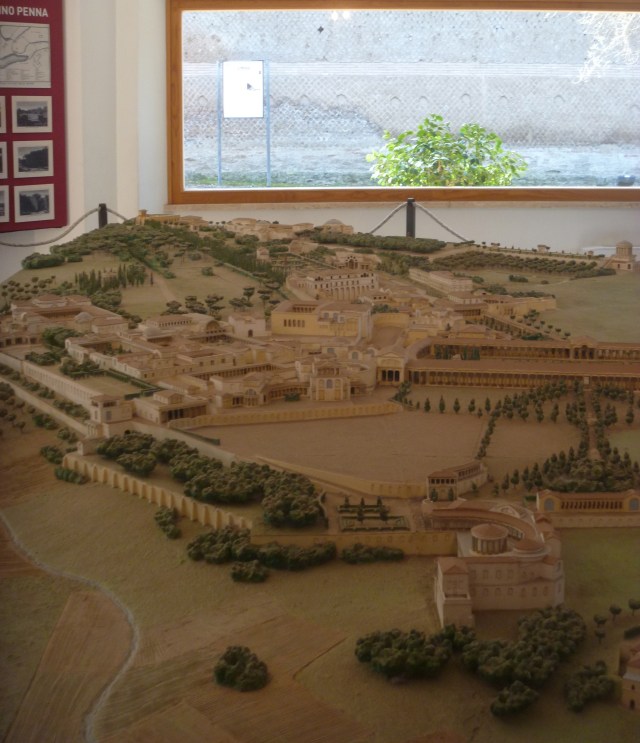
villa model

My notes here are mostly taken from the little map guide I bought. On arrival you follow a wide path up to a few modern buildings; one of which houses a model of the site as it might have looked to Hadrian. Publius Aelius Hadrianus was born in 76AD, probably in Italica (Seville). In 117AD on the death of Trajan he succeeded him at the head of the empire. He differed from previous emperors in that he tried to define the borders of the empire rather than fight to expand it. He was gifted with brilliant intelligence and a vast general knowledge but was not much liked by his contemporaries, as he was unpredictable and inconstant in character. He died in Baia in 138AD. And yes, he is the emperor in honour of whom the Wall was named.

Pecile

The Pecile Pool

the pecile

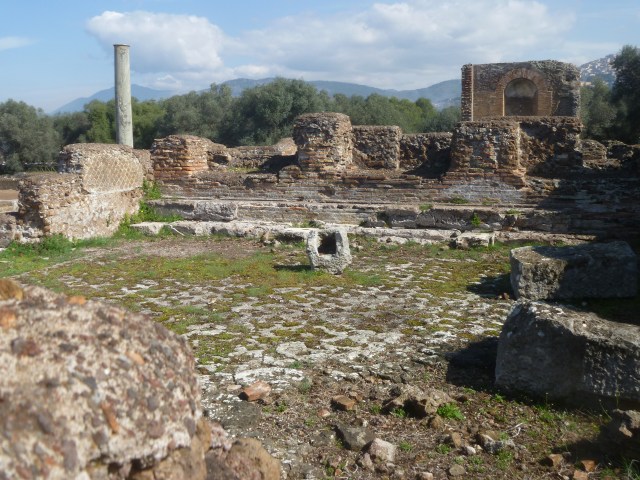
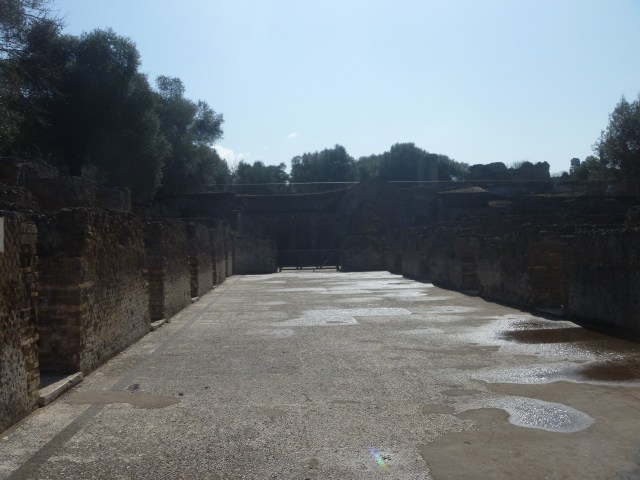
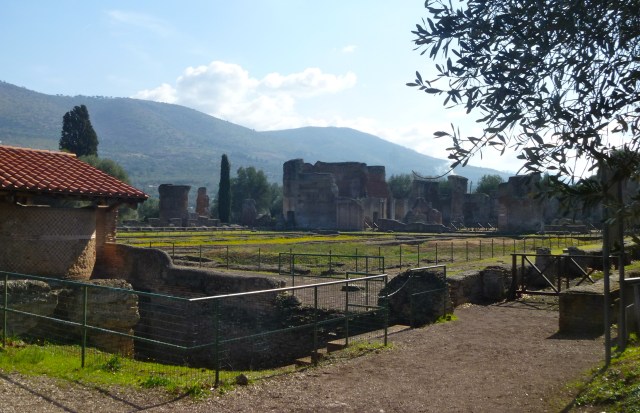
Beyond the initial modern buildings you pass through an arch in a high Roman wall into the park itself. In front is the Pecile formerly a courtyard with a pool at the centre. Then the choice of which direction to choose is yours. I headed first to the Palace and outbuildings which included the Golden Square, the Hospitalia, the Heliocaminus Baths, the Maritime Theatre (currently closed) and the Greek and Latin Libraries.

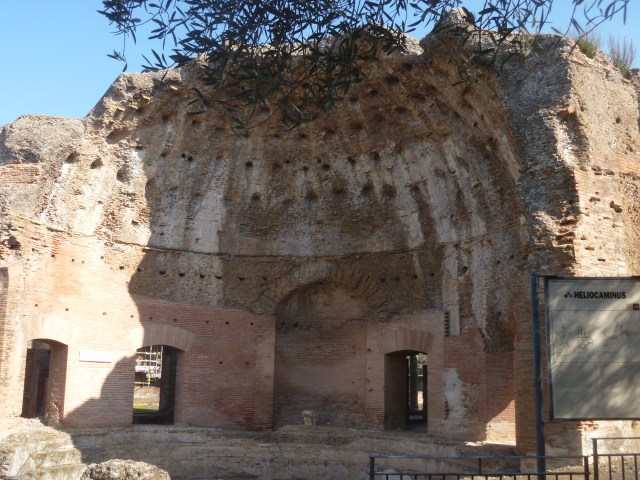
Heliocaminus

The Heliocaminus

The oldest bath complex on the site owing its name to the large circular room with a vaulted roof heated by the rays of the sun. In addition the floor was heated by the usual hot air system.

greek library

The Greek Library

hospitalia

The Hospitalia

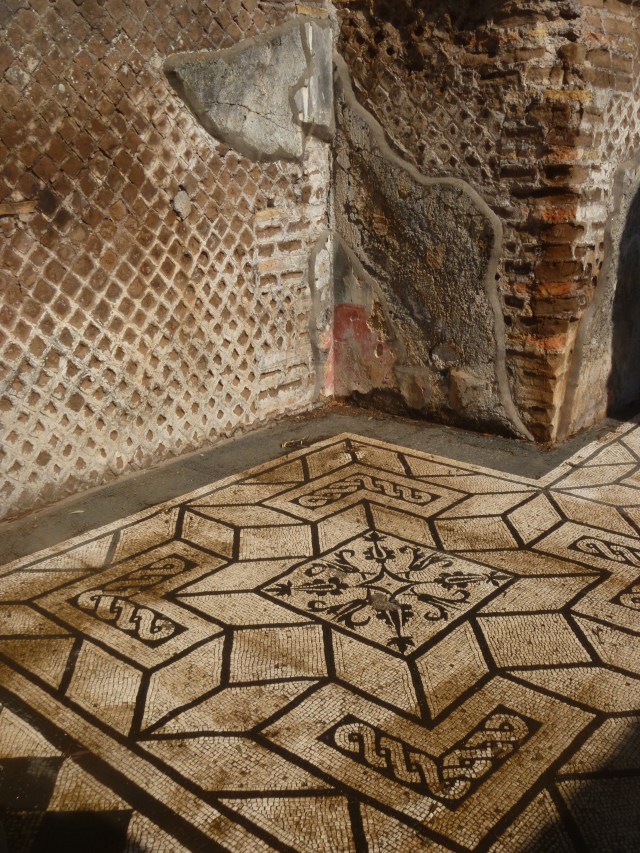
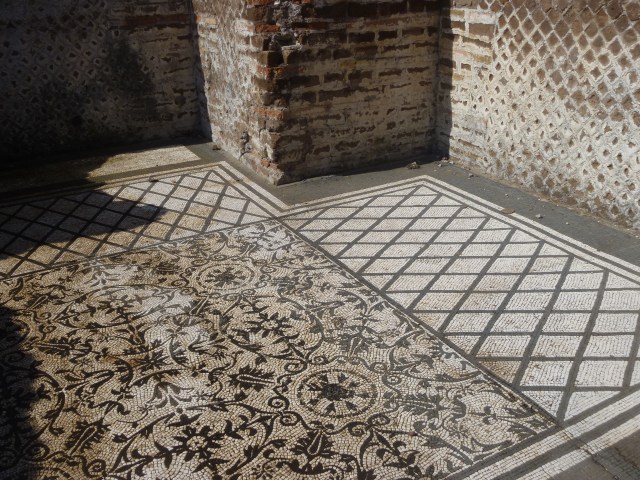
hosp mosaics

osp mosaic

Mosaic Floors in Hospitalia Cells

golden square

The Golden Square (so called because of the richness of the archaeological finds made there)

Quadriportico

The Quadriportico

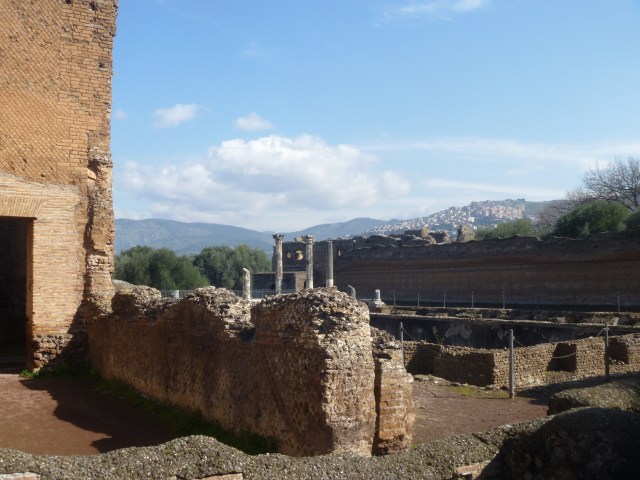
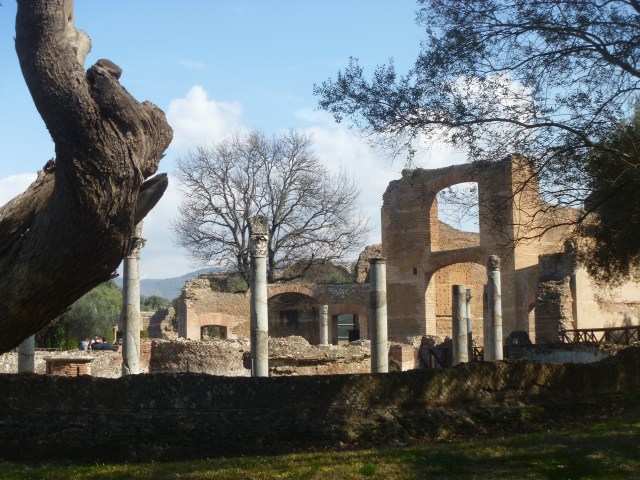
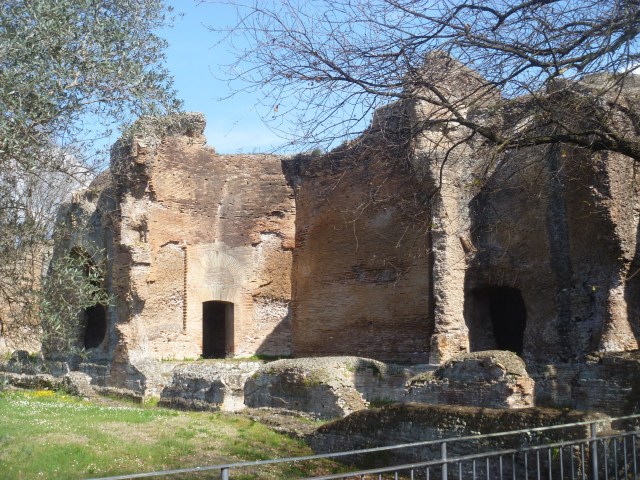
More or less in the middle of the site is the Triple Exedra Complex. According to the booklet this is nothing more than a grandiose entrance vestibule to the imperial residence.

triple exedra

The Triple Exedra

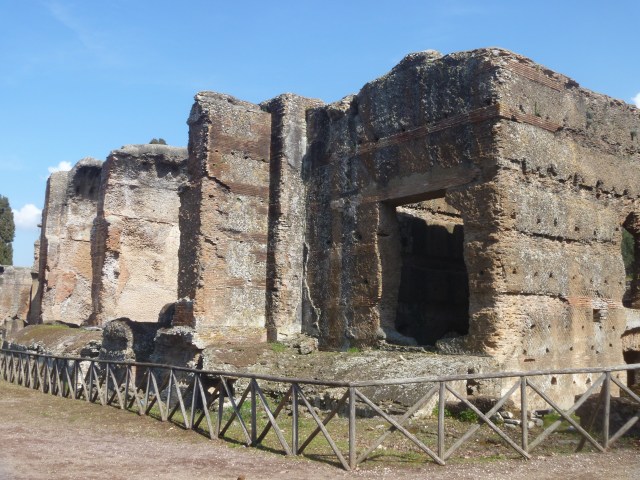
great baths

The Great Baths

small baths

The Formerly Luxurious Small Baths

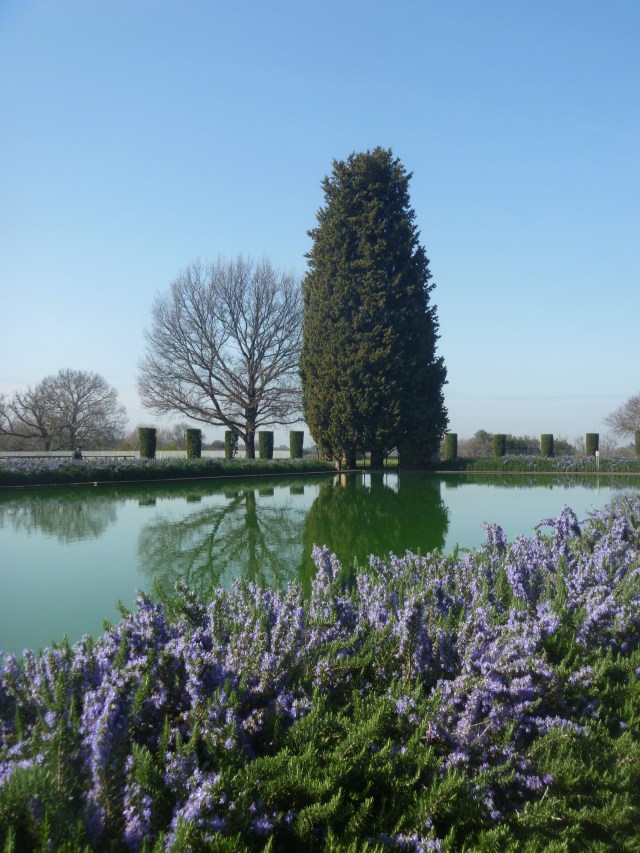
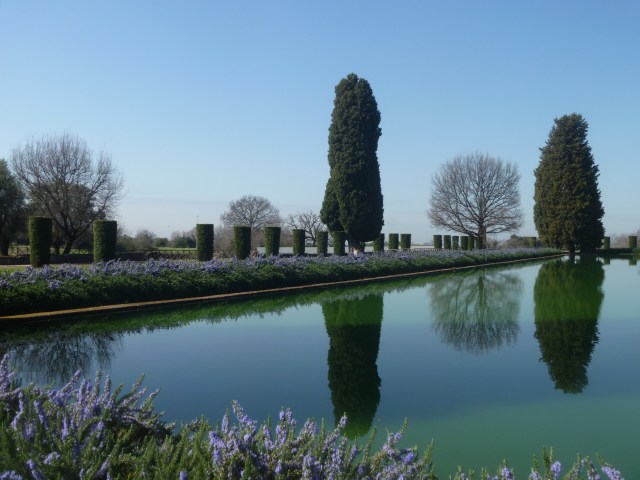
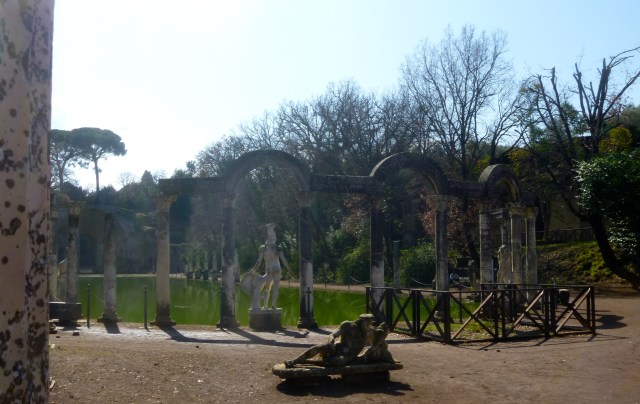
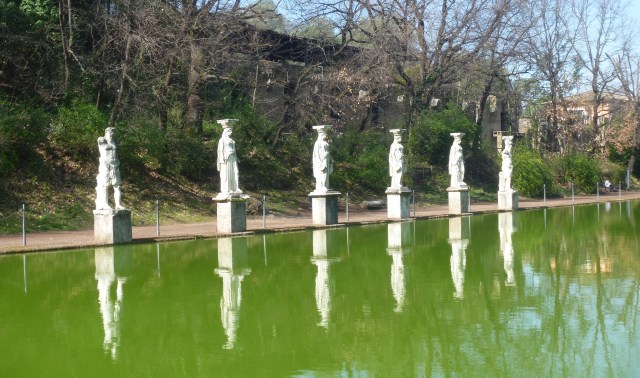
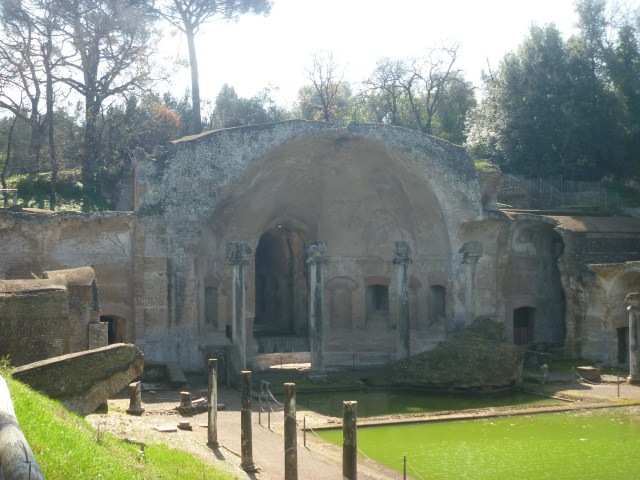
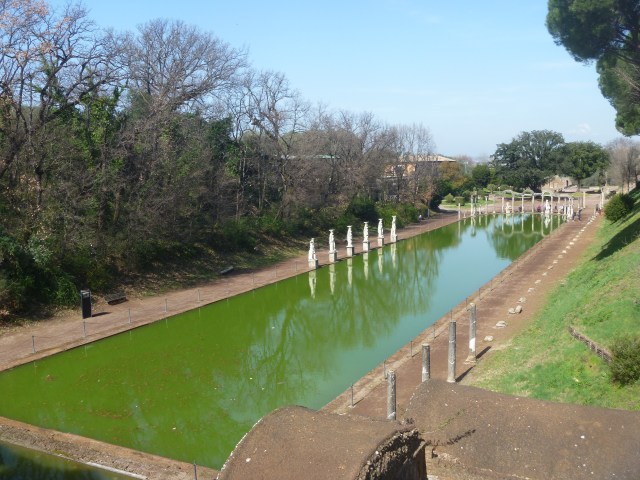
Beyond this are the Great and Small Baths and finally at the far end of the site The Canopus. This was an attempt at a copy of the channel that led from Alexandria to Canopus, a town on the Nile delta. The long basin of water is Euripus and at the far end is The Serapeum where summer banquets were held.

canopus

The Canopus

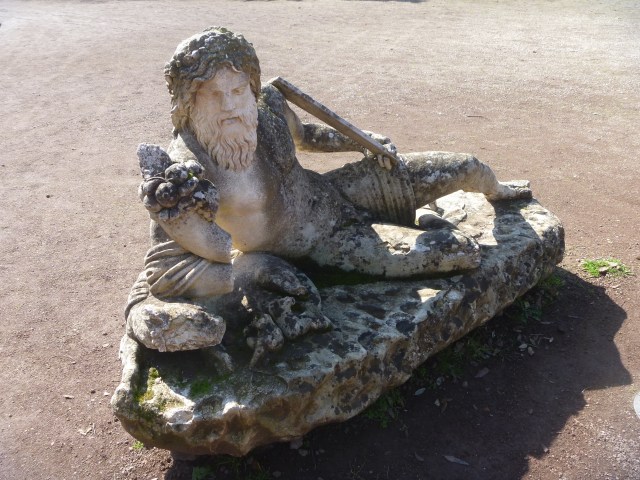
neptune

goddesses

serapeum

The Serapeum

canopus from belvedere

The Canopus from the Belvedere

Finally I made my way to Rocca Bruna a belvedere with marvellous views over the surrounding countryside. Apparently, Hadrian had a great interest in astronomy and it is also thought that the tower could have been used as an astronomic observatory.

rocca bruna

Rocca Bruna Tower

tivoli from rb

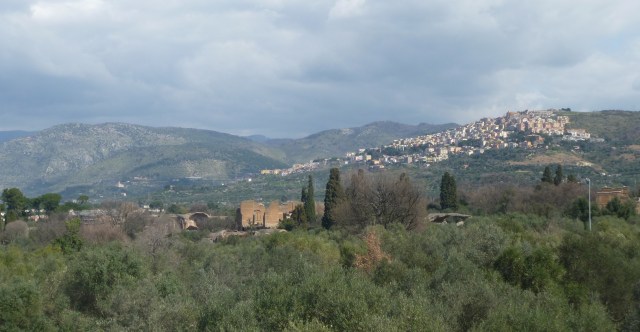
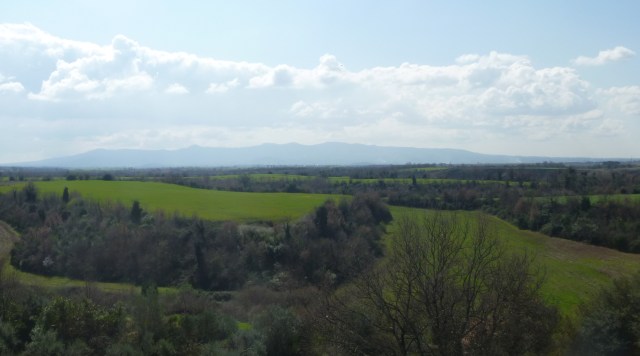
View towards Tivoli from the Tower

mtns view rb

Mountain View From the Tower

Water, water everywhere: The Caracalla Baths and The Claudio Aqueduct

The trip to The Protestant Cemetery took less time than I had envisaged and I’d booked the Appian Way walk so, as a friend had recommended seeing the Baths of Caracalla and they were just one Metro stop away, I decided to spend a couple of hours there, even though it started to drizzle with rain.

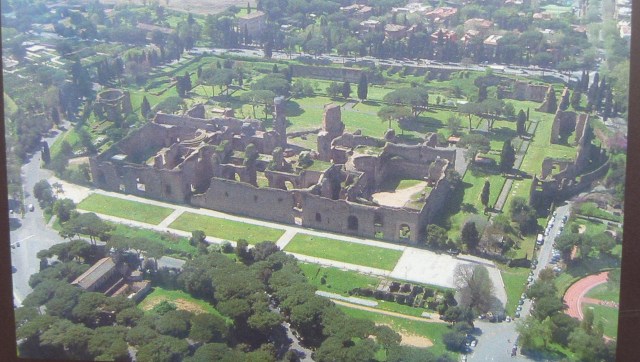
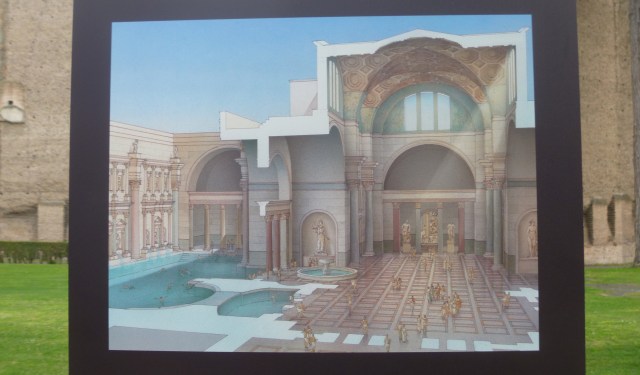
aerial view

Aerial View of the Baths

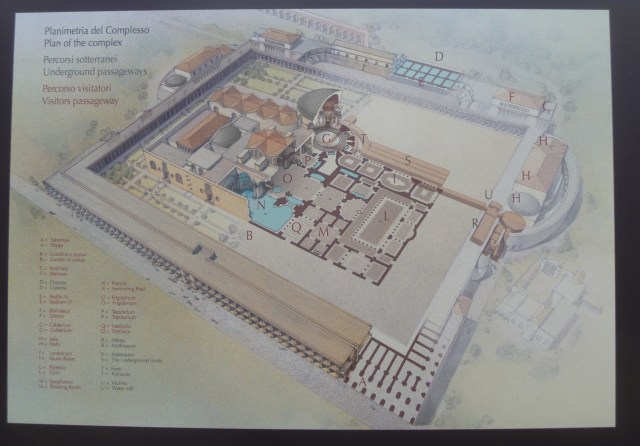
impression

Artist’s Impression of Caracalla

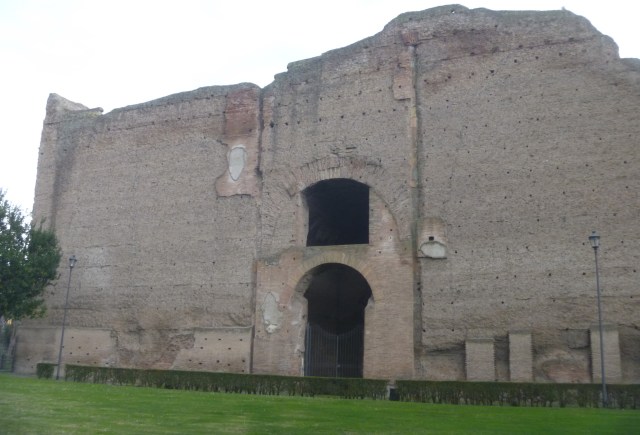
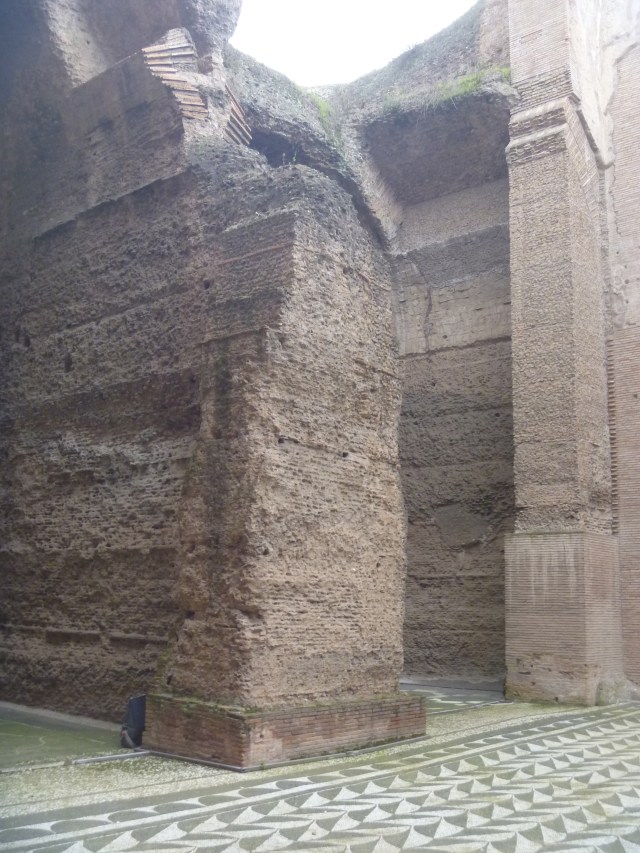
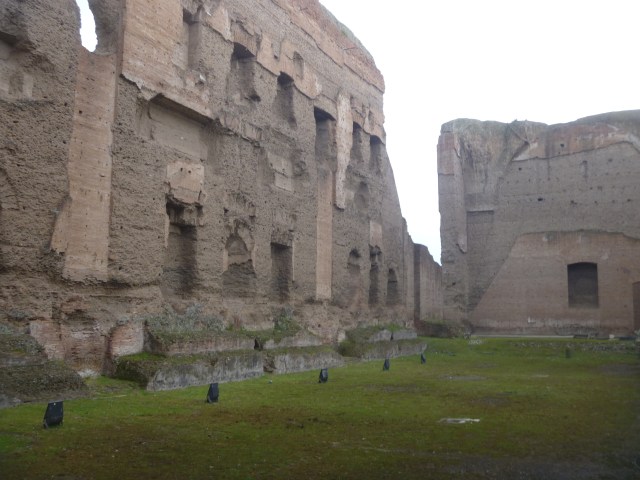
Now, Colchester may be full of Roman superlatives but, as you probably know, Rome knocks every other place that was part of the Roman Empire, into a cocked hat when it comes to remains. The Caracalla Baths are HUGE. The walls tower over you and the scale of everything was (and still is) vast.

Caracalla 1

caracalla 2

These, the largest and best preserved thermal baths, were entirely built by Emperor Caracalla since AD212. Apparently 9,000 workers were employed daily for approximately five years to create a huge platform 337m x 328m. Water was brought to the bath house by aqueduct and the whole place was abandoned after the siege of Rome when the Goths destroyed the aqueduct and cut of the supply of water to the city.

mosaic

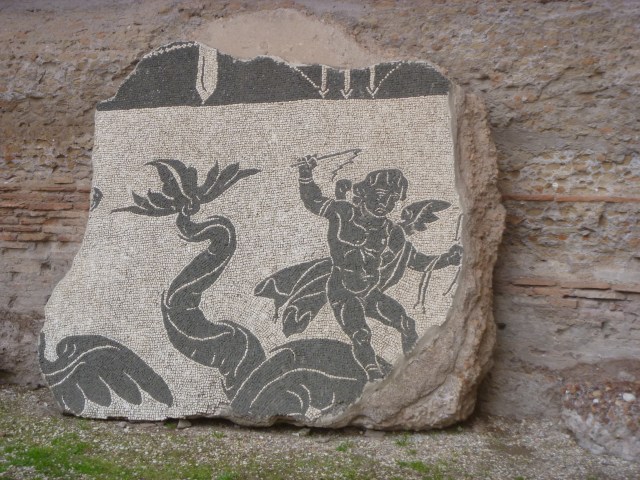
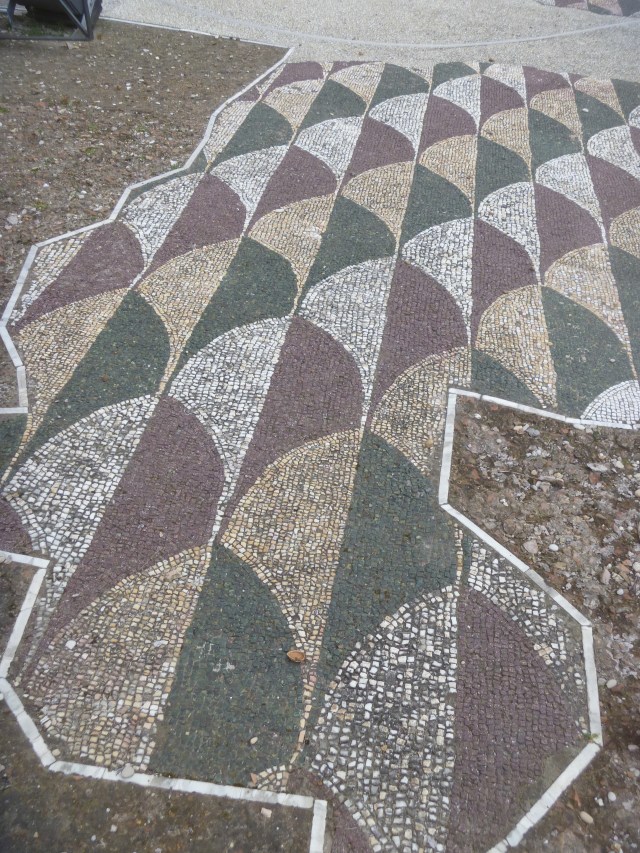
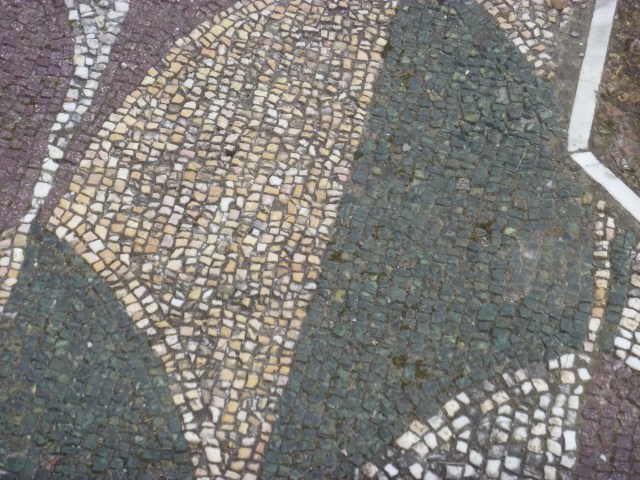
Many of the decorations and works of art were removed from the site over the centuries. There is a particularly fine collection in the Vatican Museum since several popes were involved with excavations. Some mosaics remain roughly in situ but otherwise there are few artefacts remaining. There had been bronze statues in niches, fountains, marble floors and columns and painted frescoes.

mosaic pavement

mosaic close up

Romans enjoyed board games and a tabula lusoria has been preserved here. Many such gaming boards were carved into floors and, as here, round the edges of pools. The game involved getting a walnut (or marble or knucklebone) into the holes.

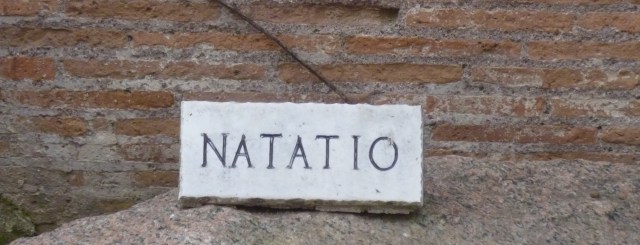
natatio

The Natatio was a huge Olympic size swimming pool – the board game is alongside – is 50m x 22m and the walls are 20m high. It was not very deep and certainly not suitable for diving.

the natatio

The Pool Today

original baths

Artist’s Impression of the Pool in its Heyday

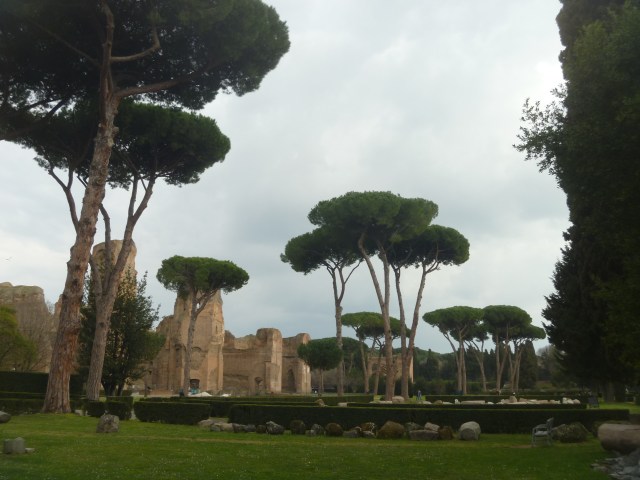
cypress trees in gardens

The Gardens – Cypress Trees – at Caracalla

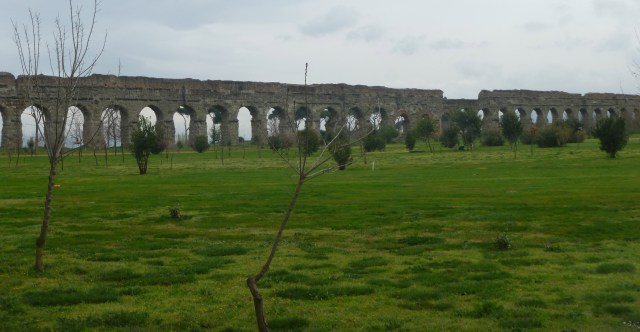
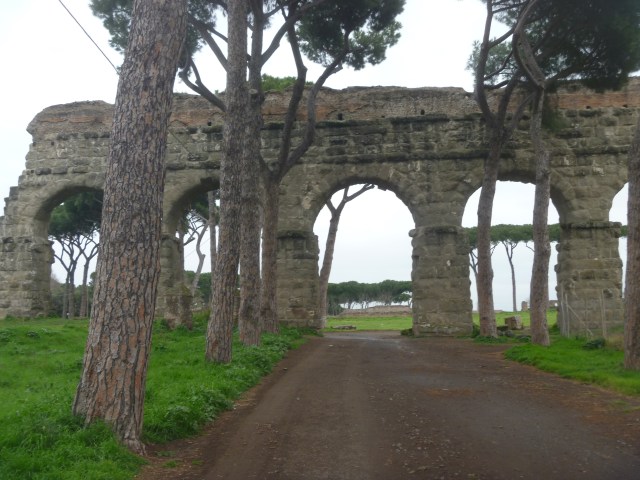
Following our visit to the Catacombs and walking along the Appian Way our Enjoy Rome Tour included a visit to the extensive remains of the Claudio Aqueduct. The aqueduct was one of several that supplied Roman Rome with its water.

Claudio Aqueduct

The Claudio Aqueduct

The Parco degli Acquedotti is a public park about 8 kilometres from the city. It is part of the Appian Way Regional Park and is of approximately 15 ha. The park is named after the aqueducts that go through it. My guess is that it’s not easy to reach by public transport but I was glad to have seen it as I had no idea of its existence before.

approaching aqueduct

Approaching the Aqueduct

Next up is a report of my visit to Hadrian’s Villa at Tivoli where there is even more Roman water!

Death in Rome : The Protestant Cemetery and The Catacombs of San Callisto

One visit I had promised myself on this trip to Rome was pay to a call at the Cimitero Acattolico or, as usually known in English, The Protestant Cemetery at Rome.

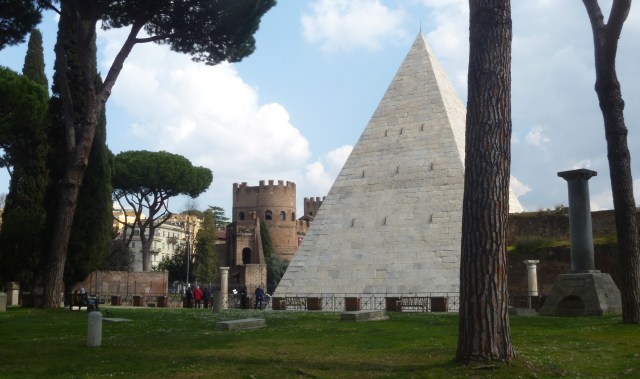
pyramid

“The cemetery is an open space among ruins, covered in winter with violets and daisies. It might make one in love with death, to think one should be buried in so sweet a place”

Percy Bysshe Shelley: Adonais: an elegy on the death of John Keats (1821)

I checked the website carefully before leaving home and made extra sure that Saturday 14 March was not a holiday and so after taking the train from Tivoli to Rome I made my way to the cemetery. When you emerge from the Pyramide Metro Station you can’t miss the huge Pyramid to Gaius Cestius and the cemetery is right next door: but you risk life and limb when crossing the roads to get to it!
Thomas Hardy wrote a poem entitled

“Rome at the Pyramid of Cestius Near the Graves of Shelley and Keats (1887)”

Who, then, was Cestius,
And what is he to me? –
Amid thick thoughts and memories multitudinous
One thought alone brings he.

I can recall no word
Of anything he did;
For me he is a man who died and was interred
To leave a pyramid

Whose purpose was exprest
Not with its first design,
Nor till, far down in Time, beside it found their rest
Two countrymen of mine.

Cestius in life, maybe,
Slew, breathed out threatening;
I know not. This I know: in death all silently
He does a kindlier thing,

In beckoning pilgrim feet
With marble finger high
To where, by shadowy wall and history-haunted street,
Those matchless singers lie . . .

–Say, then, he lived and died
That stones which bear his name
Should mark, through Time, where two immortal Shades abide;
It is an ample fame.

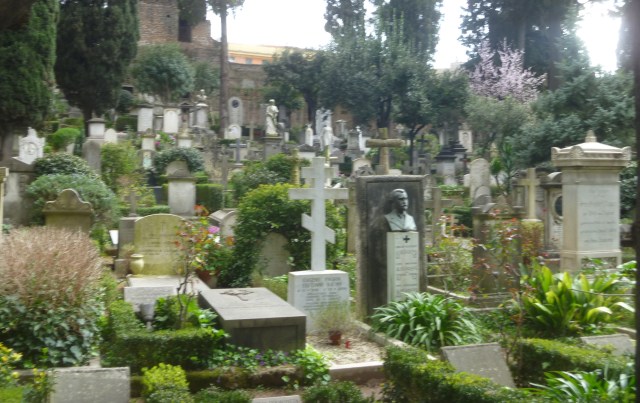
cemetery

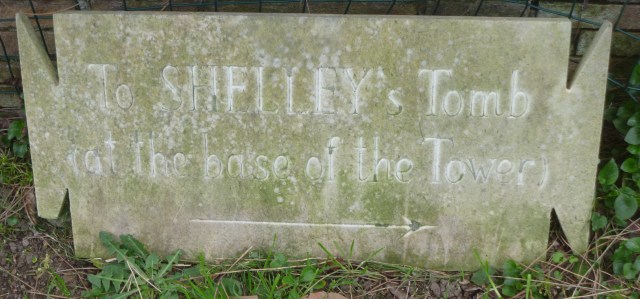
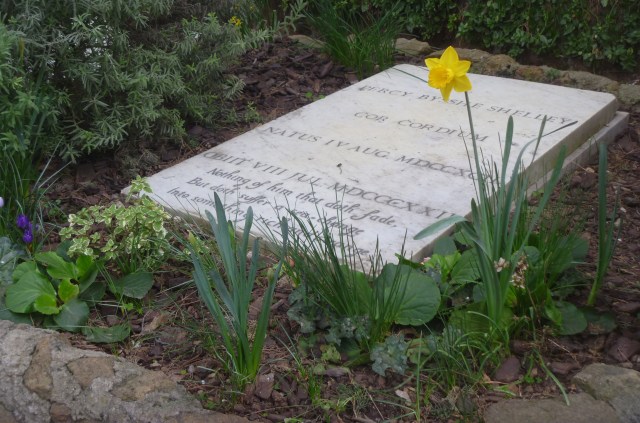
I was not disappointed. It’s truly an oasis of peace and tranquility. It’s divided into sections pre- and post- 1821; which is why Shelley’s ashes are not buried near Keats’s grave.

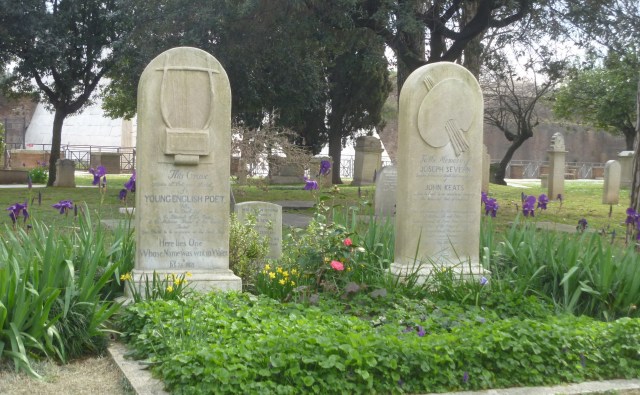
keats and severn

The Graves of Keats and Severn (and Severn’s son)

‘Here Lies One Whose Name Was Writ in Water’ [The only words Keats wished to be on his gravestone]

‘This Grave contains all that was mortal, of a YOUNG ENGLISH POET, who on his Death Bed, in the Bitterness of his heart, at the Malicious Power of his enemies, desired these words to be Engraven on his Tomb Stone’ [Words added by his friends Joseph Severn and Charles Brown]

To Shelley's

shelley's

‘Nothing of him that doth fade
But doth suffer a sea-change
Into something rich and strange’

From Shakespeare’s The Tempest [Shelley was drowned and only his ashes are buried here]

There is an especially good chapter about the cemetery in Peter Stanford’s “How to read a graveyard“.

shop and info

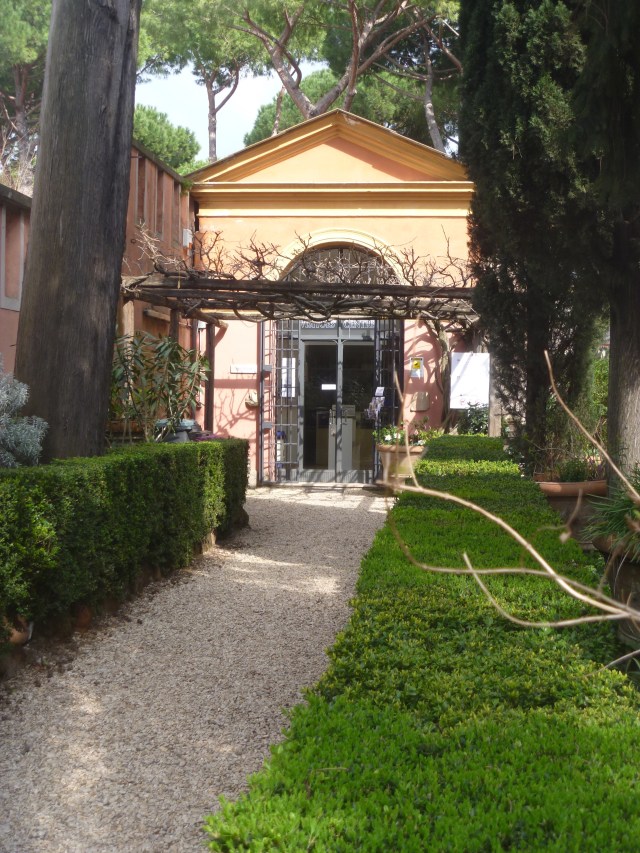
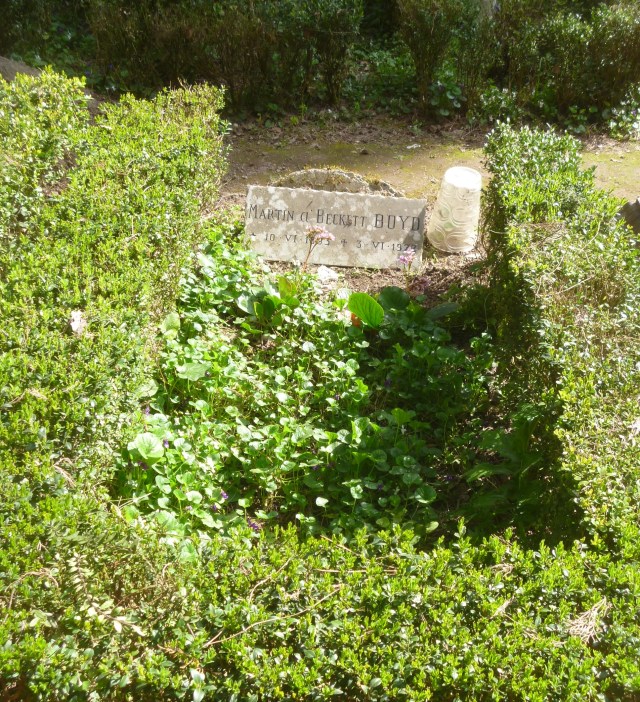
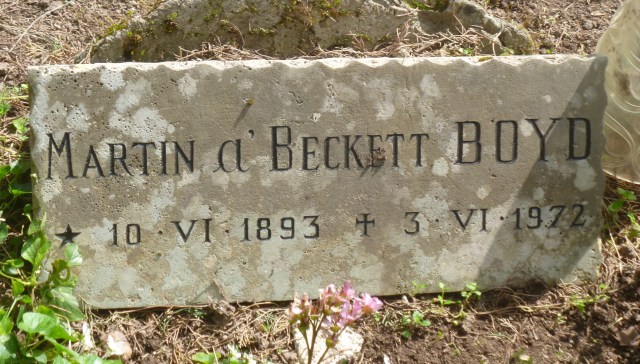
There’s a small bookshop and information office (above) near the entrance and the English guide helped me to pinpoint the grave of a little-known Australian author whose books I enjoy : Martin Boyd.

MB grave

His best-known book is “Lucinda Brayford” but I’ve enjoyed reading his Langton tetralogy lately :

The Langton tetralogy which, though not published as a series during his lifetime, is now referred to as a collective:
The Cardboard Crown (London, England: Cresset Press, 1952.)
A Difficult Young Man (London, England : Cresset Press, 1955.)
Outbreak of Love (London, England: John Murray, 1957.)
When Blackbirds Sing (London, England: Abelard-Schuman, 1962.)

MB headstone

Martin Boyd’s Headstone

Even though the Protestant Cemetery was high on my list this visit I also hoped to walk some of the famous Appian Way, the Roman road that connects Rome with Brindisi in southeast Italy. I read in my guidebooks how to get there and which were the best parts to see then noticed in small inset box this note : Enjoy Rome offers a 3-hour bus and walking tour of the Appia Antica … Call for tour times.

At Catacomb

At the Catacombs

I discovered that the Enjoy Rome office is very near to Termini Station so I bought a ticket for the Tuesday 10am departure. The first stop of the excursion is at The Catacombs of San Callisto. We were able to descend into a maze of tunnels and see various types of burial chambers with and without mural decorations.

entrance

“Ancient Roman law forbade burials, regardless of religion, inside the city walls. San Callisto is one of the most famous of over 60 catacombs in the city area. There are multiple levels of 1900 year old hand-dug corridors, past a mind-boggling number of tomb niches. Christian-themed inscriptions and frescoes, often endearingly simplistic but carrying strong messages of faith, are everywhere in the catacombs.” [Adapted from Frommer’s Rome Day-By-Day] Several Popes were entombed here.

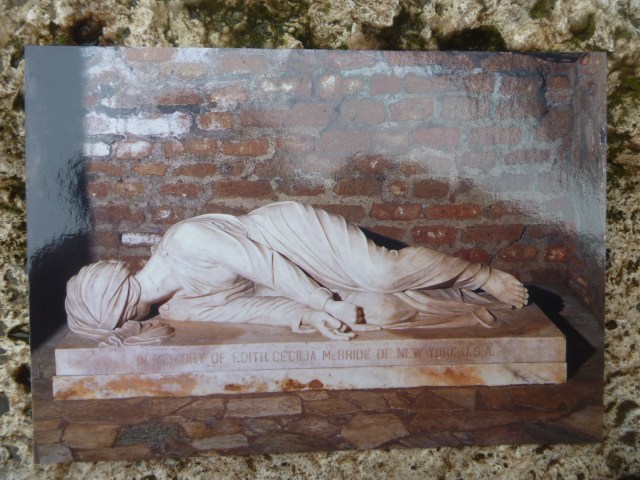
“The Crypt of St. Cecilia: the popular patron saint of music. Of a noble Roman family, she was martyred in the 3rd c. and entombed where the statue now lies. She was venerated in this crypt for at least five centuries. In 821 her relics were transferred to Trastevere, in the basilica dedicated to her.

St Cecilia pc

The statue of St. Cecilia is a copy of the celebrated work sculptured by Stefano Maderno in 1599.
The crypt was all covered with mosaics and paintings (beginning of the IX Century). On the wall, near the statue, we see an ancient painting of St. Cecilia in an attitude of prayer; lower down, in a small niche, is a fresco representing Christ holding a Gospel. On the right side is the figure of St.Urban. On the wall of the shaft is the painting of three martyrs: Polycamus, Sebastian and Quirinus.” [Source]

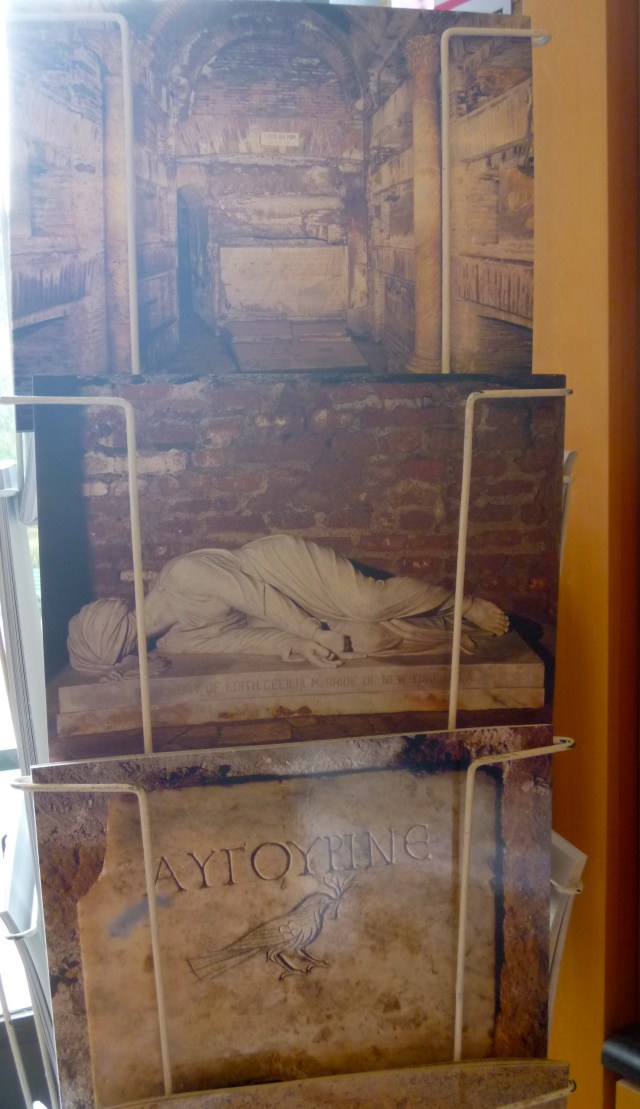
No photography is allowed in the catacombs but I snapped a couple of postcards showing what it’s like down in the depths!
what it's like inside

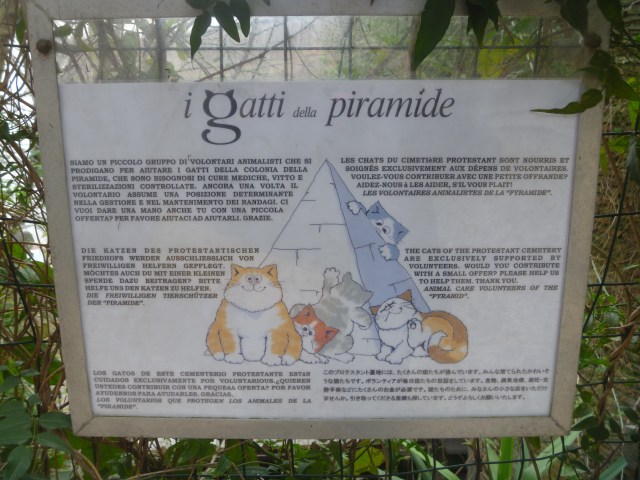
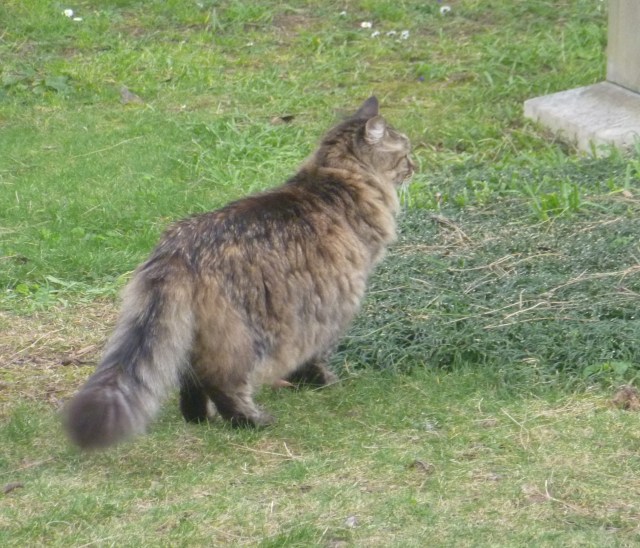
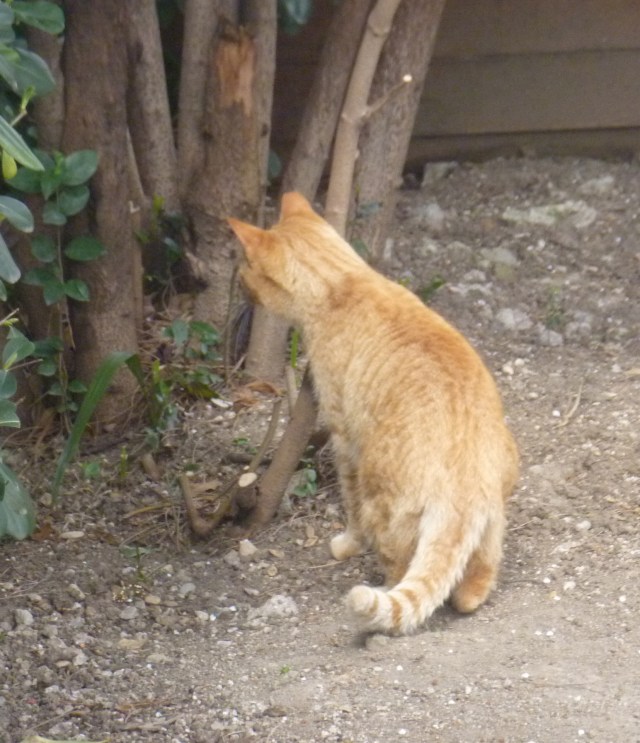
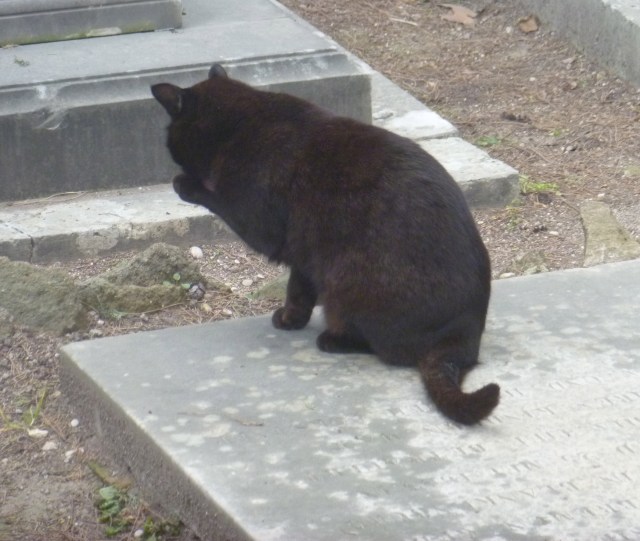
Back at the Cemetery the cats are looked after by volunteers and even have their own website.

i gatti

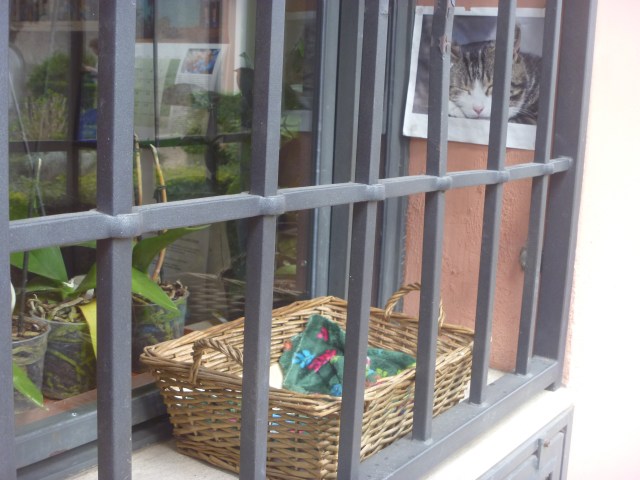
empty cat basket

Empty Basket – Where can they be?

cat 1

cat 2

cat 3

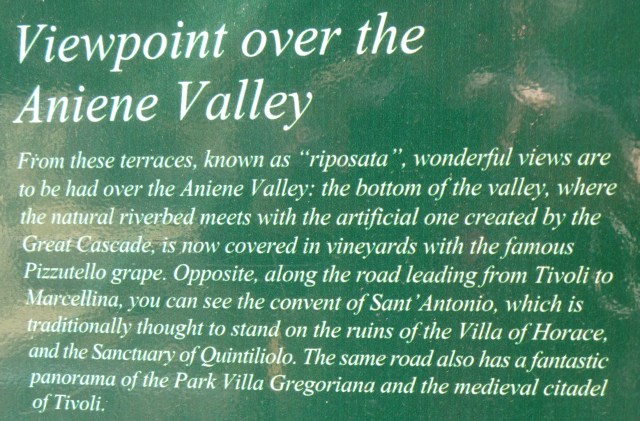
At Horace’s House : Sant’ Antonio, Tivoli

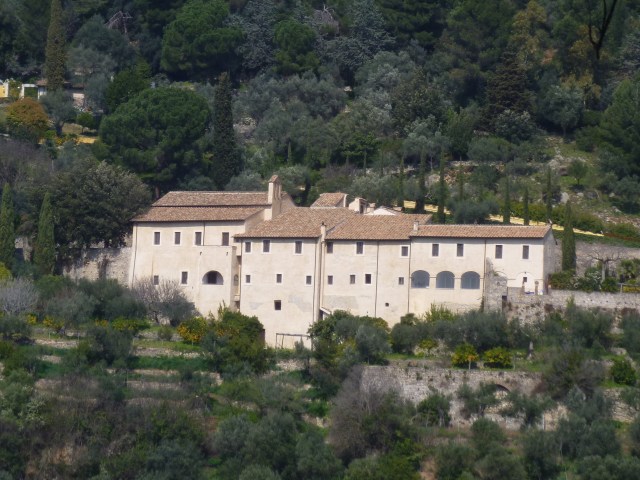
Sant' Antonio

In the summer of 2013 I had the great good luck to be offered a room and to stay with fellow Landmarkers in the Italian countryside near Tivoli, about 20 miles northeast of Rome. I leapt at the chance and finally last week the trip became a reality. I have just spent a fabulous week at Sant’ Antonio and made a few excursions too when I could manage to drag myself away from this wonderful old house.

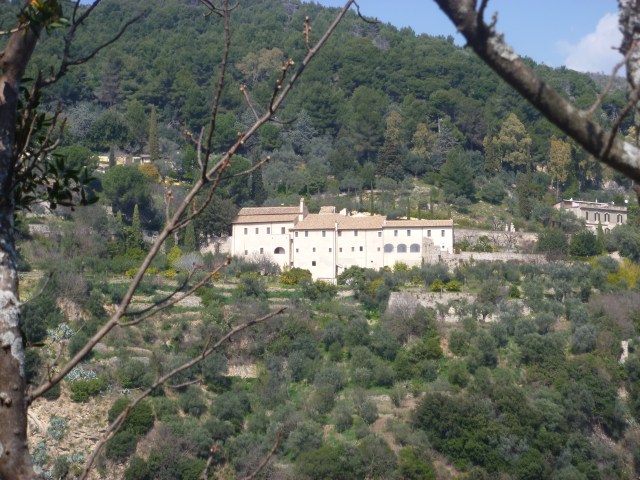
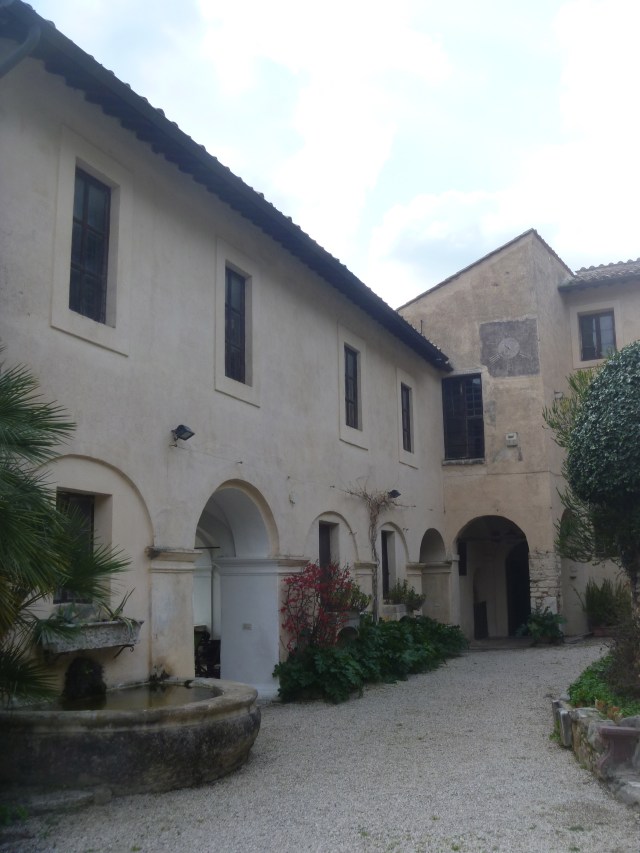
According to the History Album Sant’ Antonio was built around 100 BC.  The upper parts were rebuilt in the late 16th and early 17th centuries: the monastery between 1583 and 1590; the east wing about 1625 and the church in 1647. It was acquired for preservation by Frederick Searle in 1879. The present owner, Vicomte Roger de Brisis, is his descendant but Sant’ Antonio has been managed by The Landmark Trust since 1995. It consists of a medieval monastery grafted onto a Roman villa of the time of Caesar Augustus, or maybe even before. It was rescued from abandon in 1879 by an Englishman newly returned from West Indies.

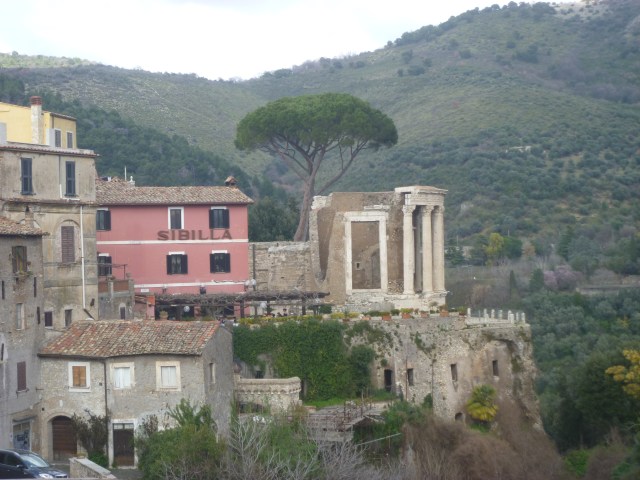
vesta temple

Temple of Vesta, Tivoli

A well-founded belief is that a frequent guest, if not an early owner, was the poet Horace. Across the ravine thunders the water of Anio, with temples of Vesta and the Sibyl poised above it. All these on the outskirts of Tivoli, the Roman Tibur, and you are approaching something very near the heart of the civilisation that has moulded Europe for two millennia.

It is fitting that the revival of this place should have fallen to an Englishman, because those two names – Horace and Tivoli have a particular resonance for his countrymen. From the Middle Ages , English boys learned their reading and writing by means of Horace’s Odes and Satires, along with the works of Virgil and other writers of the Augustan Age. Only in the late 20th century has academic education ceased to be built on these cornerstones.

In the 17th century Englishmen first began to visit Italy in large numbers and carried its influence home in the most direct manner, in their paintings, and their buildings and their gardens. The dramatic influence of Tivoli appealed strongly to painters, notably the great French creators of an ideal classical world: Claud Lorrain and Gaspard Dughet. The English imitators eg Richard Wilson, followed them here. Writers like Joseph Addison sought the places which the best paintings might be composed and the. Murmured to themselves of “Tivoli’s delightful shades and Anio rolling in cascades.”

In 1879 Frederick Searle was searching for a place to sketch the waterfall when he first saw Sant’ Antonio – “La casa di Orazio”. He made it his home; spent 20 years renovating and repairing it and encouraged scholars and archaeologists to share his discoveries. His daughter Georgina and her husband George Hallam and then her great-niece Lucy d’Aihaud de Brisis continued the tradition. In this generation Count Roger de Brisis took on the care of Sant’ Atonio and with Landmark’s help has made it possible for guests to stay here. Sant’ Antonio has long enjoyed the soubriquet ‘Horace’s Villa’ . There are several schools of thought relating to whether Horace lived here or not. It is known through the writings of Suetonius that Horace lived in Tibur (Tivoli).

The Sant’ Antonio History Album goes on to give various scholars’ opinions on the exact location of Horace’s Villa but I like to think that it was Sant’ Antonio and unless some future academic gives me proof to the contrary I will stick with this theory and the celebrity link with the house.

The Franciscan Friars took over the remains of a Roman villa – it had continued operating as a villa farm – with ample storage spaces, good water supply and fertile terraces. By becoming a monastery its survival was ensured for a further five centuries. Sant’ Antonio was a monastery complex of the lesser kind; common in the mountains of central Italy. The little church of this monastery is still an object of devotion for the many Catholics of the town. The feast day of St Anthony is 13 June.

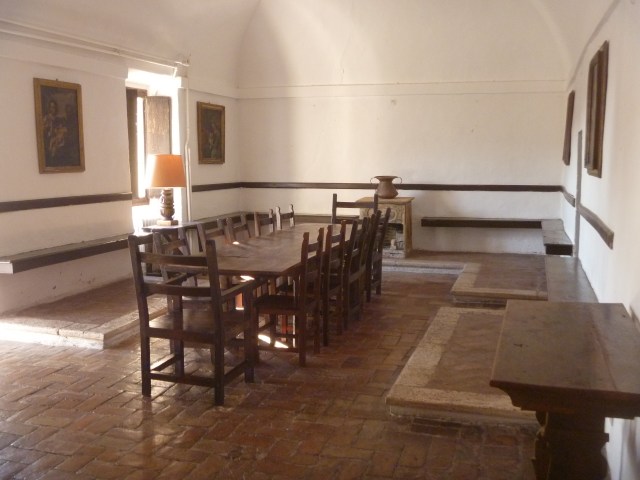
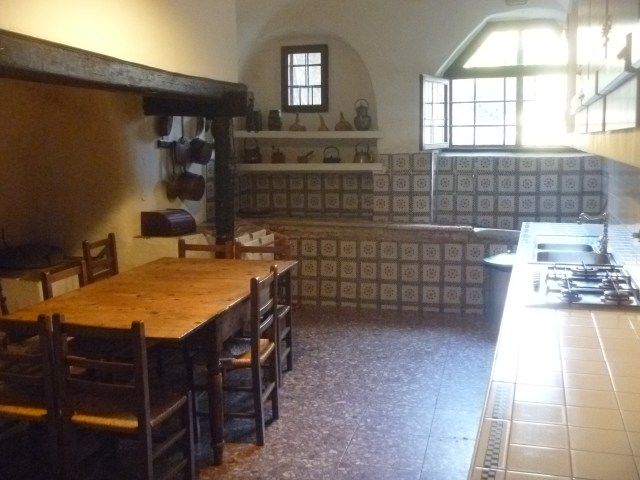
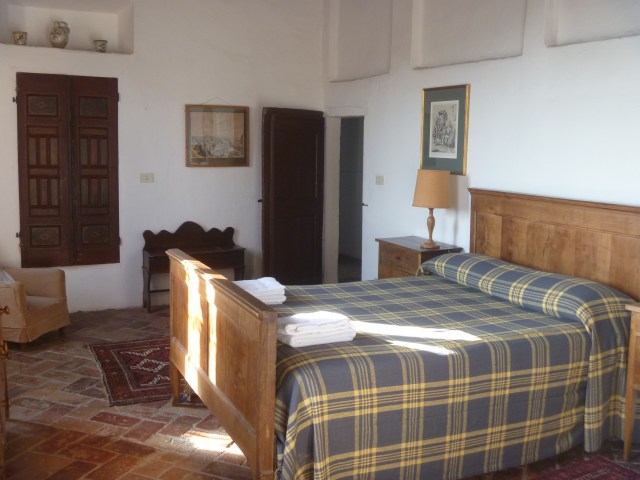
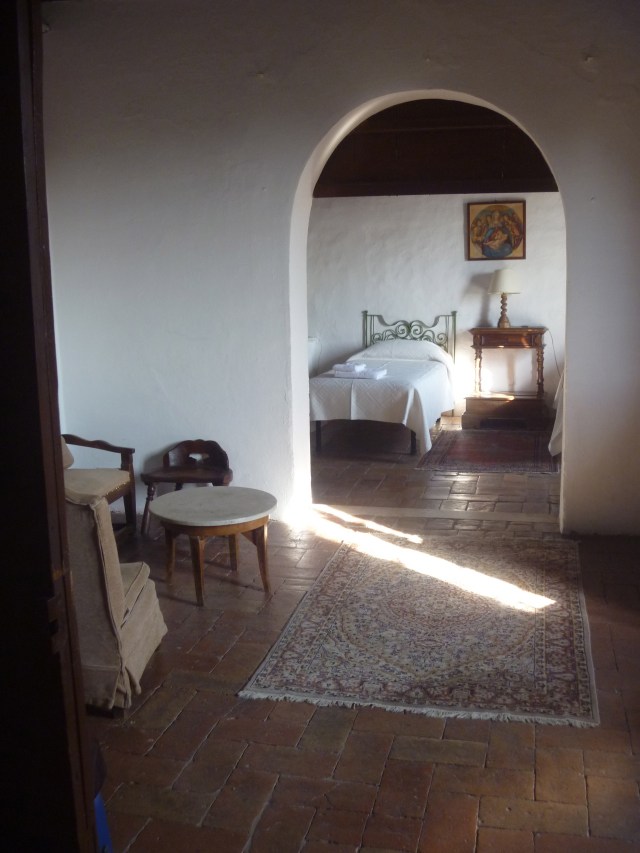
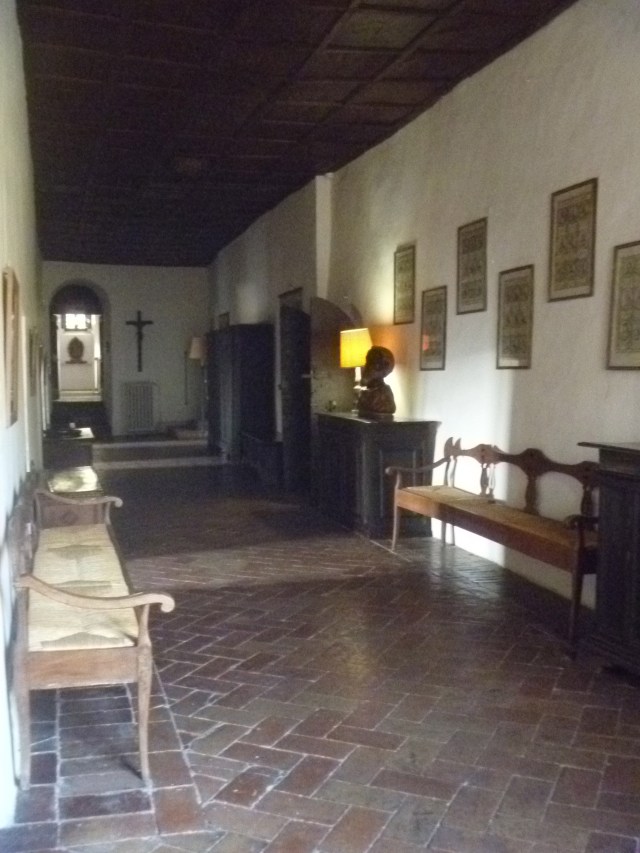
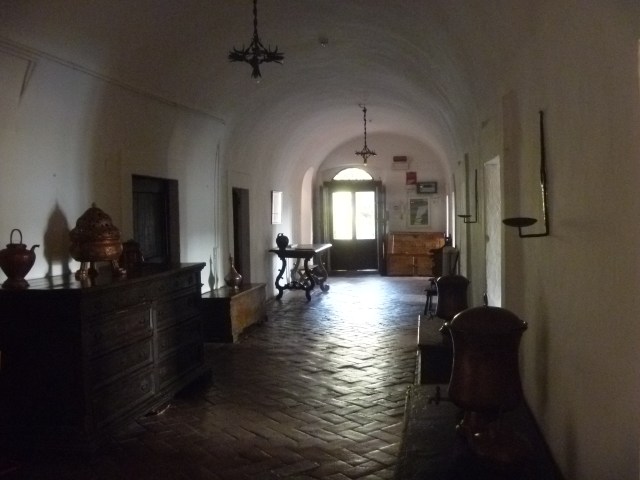
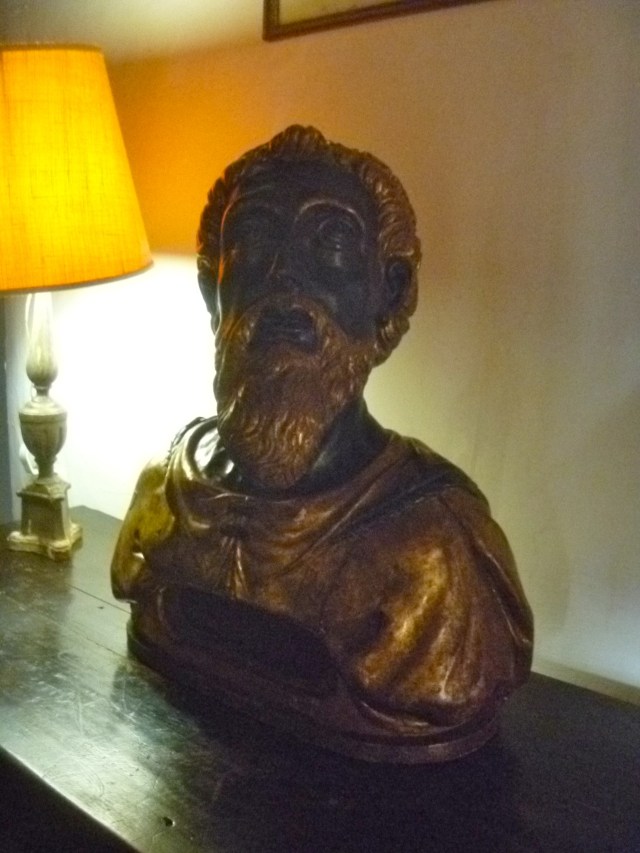
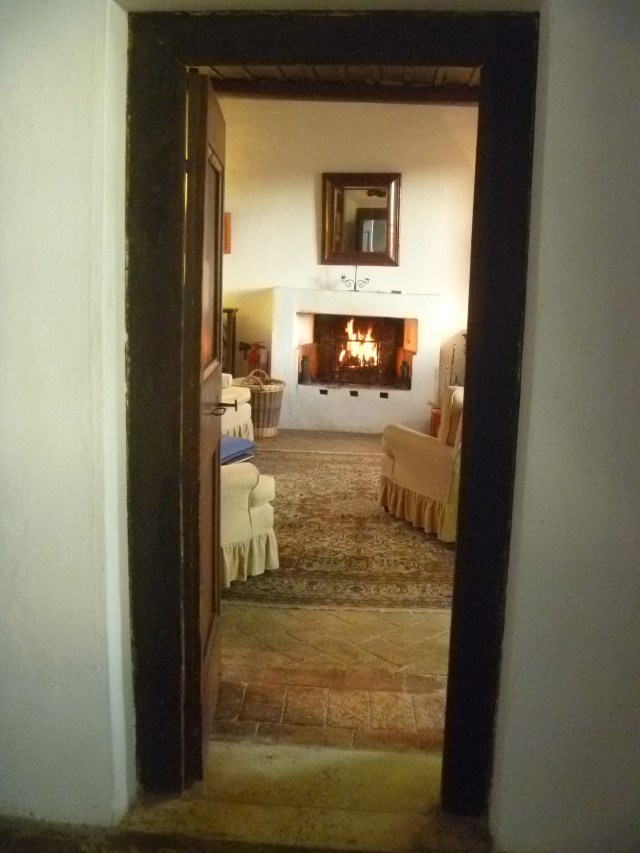
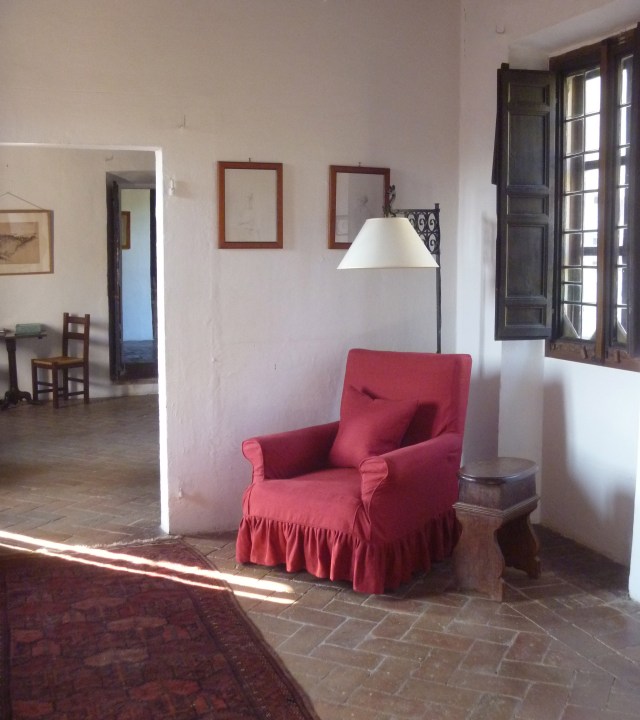
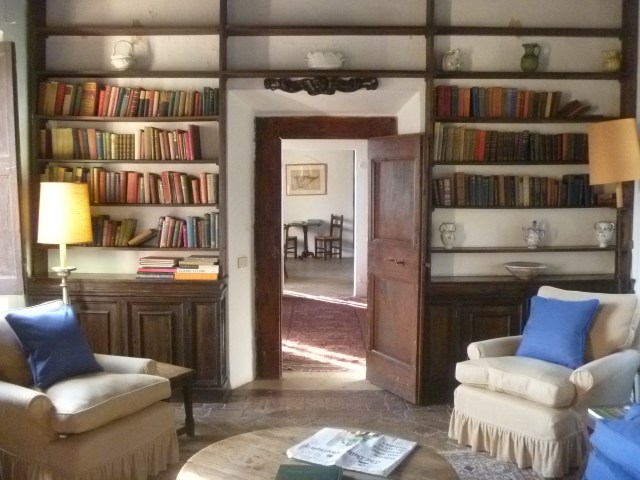
Having read details of the architectural plans of the monastery it would appear that the arrangement of the rooms and their various uses has changed little over the centuries. We dined in the Refectory, cooked in the kitchen, slept in the monks’ cells (the numbers still painted on the doors) off long wide corridors decorated with church ornaments, crucifixes and reliquaries. Our sitting rooms – a range of three – occupy a northeast projecting wing. The main floors are of rectangular terracotta bricks laid in coursed and herringbone patterns with borders, a technique common to Italy. The small casement windows are a rare feature to have lasted so long in Italy, the details of the dark unpainted wood, the panes of glass and their fixings, and the modest catches all being precious survivals.

Welcome to Sant’ Antonio – come and have a look inside.

Refectory

The Refectory

kitchen

The Kitchen

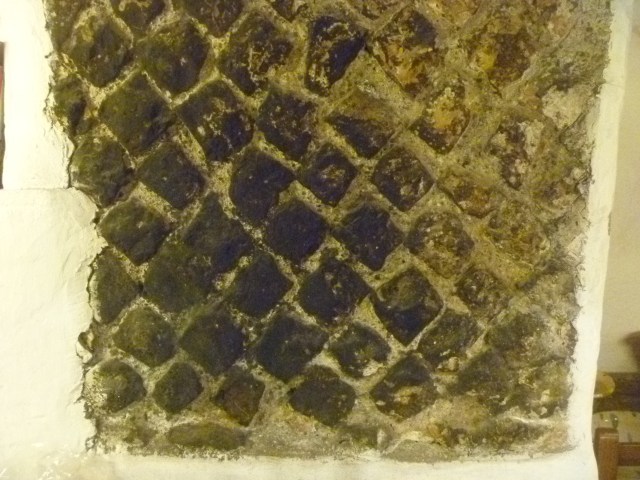
Roman wall in kitchen

Roman Wall in the Kitchen

a dble room

A Double Bedroom with Herringbone Pattern Floor

Twin bedroom

A Twin Room with Sitting Area

Upper floor

Upper Corridor

lower floor

Lower Corridor

reliquary

One of the Reliquaries

sitting room

The Sitting Room

a reading corner

A Quiet Reading Corner

sitting rm

Three Sitting Rooms

Anio falls and window

The “Anio Rolling In Cascades” seen through a Casement Window

SA Garden

Former Main Entrance now Rear Door into the Garden

Main Entrance

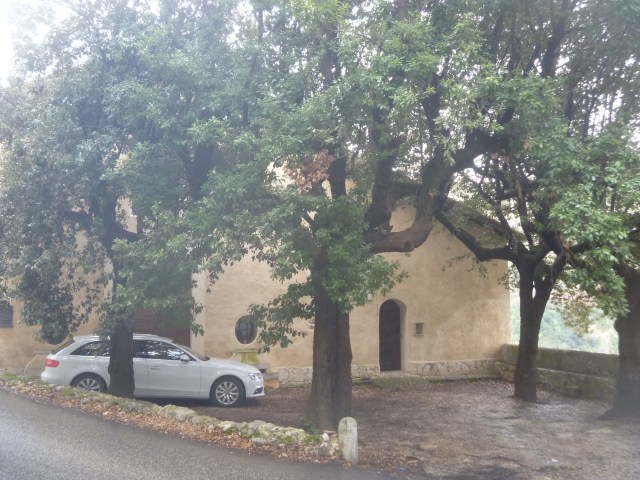
Today’s Entrance Approached from the Main Road